Disclosure: Some links in this post are affiliate links. As an Amazon Associate I earn from qualifying purchases, at no extra cost to you. Learn more
Specs are compiled from manufacturer listings and verified buyer reviews and can change over time — please confirm the key details on the product page before buying.
Plant a slope with something that goes dormant in November and you will be staring at bare dirt by January. If you want a yard that looks alive in January, you need plants that keep their leaves through winter instead of dying back to brown stubble. This guide compares seed packets and nursery listings to show which evergreen ground covers actually establish, spread, and survive on a slope, border, or rock garden.
This guide is built by comparing the manufacturers’ published specifications and the patterns across verified customer reviews, so you get each pick’s real strengths and trade-offs instead of marketing spin.
You will see what each plant needs to root well, how wide it spreads, and where it struggles, so you can pick the right one for your soil and sunlight before you order. Each pick below is a proven option among the best evergreen ground cover plants for a tough, empty patch.
Top Picks

How To Choose The Best Evergreen Ground Cover
An evergreen ground cover is a low-growing plant that keeps its leaves or needles through winter instead of dying back to the ground. That is the whole point: you get color and coverage in the cold months when most perennials disappear. The trade-off is that “evergreen” does not mean “instant” — most of these spread over one to three seasons, so how you plant and water them in the first year decides whether you get a carpet or a patch of dead twigs.
Match the plant to your hardiness zone first
Your hardiness zone is a number that tells you the coldest winter temperature a plant can survive. A juniper rated for USDA Zones 4 through 9 will shrug off a hard freeze, while a plant rated for warmer zones will not. Always check the zone range before anything else — a beautiful plant that freezes out in your first winter is money wasted.
Decide between live mats, potted plants, and seed
A live plant mat arrives as a pre-planted tile you cut and lay down, so you get instant coverage but pay for convenience. Potted shrubs give you individual plants you space out and let fill in over time. Bulk seed is the cheapest way to cover a large area, but it takes the longest to establish and performs least predictably.
Read sunlight and soil needs honestly
Most ground covers want full sun, meaning six or more hours of direct light a day. Some tolerate part shade. If you plant a full-sun juniper under a dense tree, it will thin out and die back. Look at your actual yard at noon, not what you hope it looks like, and match the plant to the light it will really get.
Side-by-Side Comparison
| Model | Best For | Form | Hardiness / Zone | Key Growth Trait | Amazon |
|---|---|---|---|---|---|
| Sedum Groundcover Mat★ Best Overall | Instant coverage and pet-safe yards | 10″ x 20″ live mat | Zones 3-9 | Drought and heat tolerant | Amazon |
| Procumbens Nana Juniper (2.5 Quart)Best for Slopes | Slopes, rock gardens, retaining wall edges | Potted shrub | USDA Zones 4-9 | Spreads 4-6 ft wide, 1 ft tall | Amazon |
| Juniper Procumbens Nana 3-Pack | Bonsai and mass slope plantings | 3 live plants | Grows 8-12″ tall, spreads to 6 ft | Blue-green spiny needles | Amazon |
| Emerald Goddess Liriope Muscari | Borders, edging, and shade-tolerant spots | 3 live plants | Dark green through winter | Purple flower spikes, black berries | Amazon |
| Ferry-Morse Sun-Shade Wildflower Seeds | Large meadow areas on a leaner budget | 1 lb bulk seed | Zones 3a to 10b | 390,000+ seeds, blooms spring to summer | Amazon |
Detailed Reviews
1. 10 in. x 20 in. Sedum Groundcover Mat
Our pick — over 4★ from 350+ verified ratings; the strongest balance of quality and price.
A 10″ x 20″ pre-planted sedum tile you cut and press onto bare soil for same-day coverage
If you have a pet that digs, grazes, or rolls on everything, this is the one to reach for first. The mat is a pre-planted 10″ by 20″ tile of live sedum succulent plants, and the listing marks it as non-toxic and pet friendly for cats and dogs. That matters when your dog treats the flowerbed like a salad bar. Sedum is a type of stonecrop, a fleshy-leafed succulent that stores water in its leaves — which is exactly why it shrugs off dry spells and hot afternoons.
The framing is what makes this a genuinely low-effort option. Because it arrives as a mat rather than loose plants, you can cut it into sections and press each piece onto loose soil, water it in, and walk away. The listing also calls out living walls, green roofs, and vertical gardens, so if you want greenery climbing a wall or covering a rooftop edge, this format handles that. It is rated for Hardiness Zones 3-9, so northern gardeners get real winter survival, and it stays green year-round.
The plants themselves are rated drought tolerant and heat tolerant, and the make is listed as a mix of sedum varieties with contrasting shapes and earthy colors. What wins people over is the raw durability of the stock. The review pages sum it up: these are plants that “handle breaking apart and replanting well,” and buyers report that even a second flat arriving after a ten-day delay — through customs, a train derailment, and a box left on end — still turned up green and recovered fast. One buyer’s tiniest sedum crumbs self-propagated on their own, which is the sort of thing that tells you the plant wants to live.
What buyers keep coming back to
- Arrives as a cut-and-place 10″ x 20″ mat, so coverage starts the day it lands
- Non-toxic and listed as pet friendly for cats and dogs
- Rated for Hardiness Zones 3-9 with drought and heat tolerance built in
- Can be separated into sections for living walls, green roofs, and vertical gardens
Where it asks more of you
- The variety is mixed — some flats carry fewer plant types than the photos suggest
- You should hold off watering for a few days after repotting to let damaged roots scab over
- The mat can shrink during shipping as it loses moisture, so keep expectations modest on arrival size
Grab this one if: you want instant green on bare dirt, have pets in the yard, and value low upkeep over a designer plant palette.
Choose another route if: you specifically want a wide color variety in every tile, since some flats ship with only a couple of sedum types.
2. Procumbens Nana Juniper (2.5 Quart)
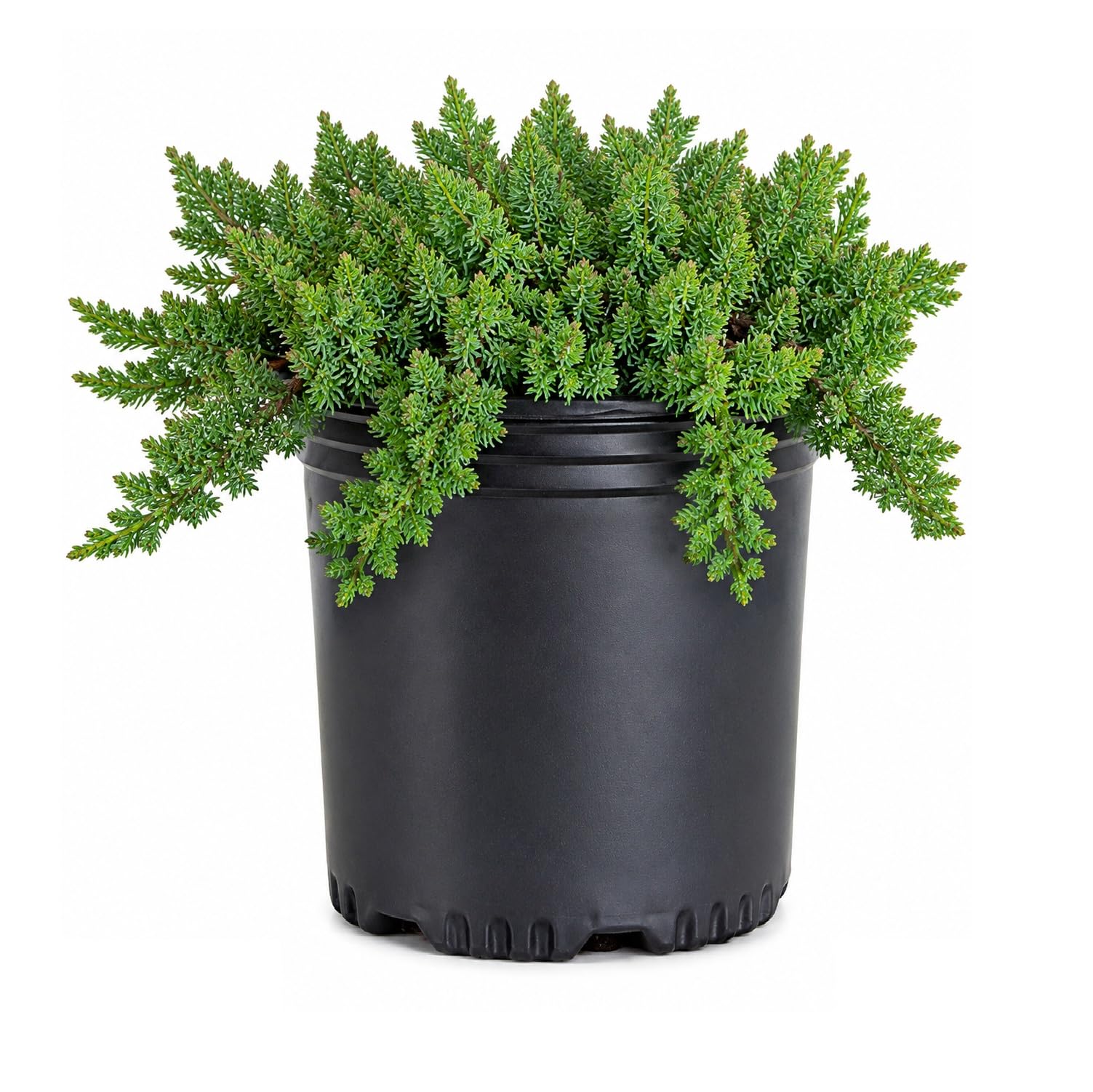
A 1-foot-tall juniper that spreads 4 to 6 feet wide into a blue-green carpet on bare hillsides
Hard slopes are the enemy of most ground covers — water runs off, soil is thin, and mowing is impossible. This juniper is built for exactly that problem. It is a Procumbens Nana juniper, which means dense, blue-green needle foliage on a low, spreading habit. At maturity it reaches about 1 foot tall and spreads 4 to 6 feet wide, so a few plants will cover real ground. It is rated hardy in USDA Zones 4 through 9 and classified as deer resistant and rabbit resistant.
The care routine is refreshingly forgiving. During the first growing season, water 2-3 times per week; in the second season, drop to 1-2 times per week depending on weather. After that, it only needs extra water during extreme heat and drought. It grows best in full sun and tolerates heat and drought once established. It wants loam soil — a balanced mix of sand, silt, and clay — so if your slope is heavy or sandy, add some organic matter before planting.
These junipers can live in containers as bonsai or desk plants and work in rock gardens, retaining wall edges, and foundation plantings. If you are weighing options, note the head-to-head: this single potted juniper ships at 6 pounds, while the three-plant juniper set below ships at 5 pounds total — so this is the heavier, more substantial single specimen. The recurring honest catch is the sizing: the plant is a 2.5-quart pot, and a minority of buyers find that smaller than expected relative to what they pictured. Given how fast this plant matures and spreads wide, though, the small start is not a dealbreaker — it is a head start.
Where it earns its keep: a spread of 4 to 6 feet wide at 1 foot tall makes it a natural fit for slopes, rock gardens, and retaining wall edges where nothing else clings. It is deer resistant and rabbit resistant, tolerates heat and drought once established, and stays blue-green instead of browning out. Oddly, its own listing suggests ordering 1-2 plants first to confirm they match your project specs before a big order — a rare bit of honesty from a nursery.
The part to plan around: the 2.5-quart pot can arrive looking smaller than the photos imply, and these plants want well-draining loam, so soggy clay soil will need amending. The warranty is worth reading closely — it guarantees live, healthy delivery but asks you to report any problem within seven days, and the customer carries responsibility for care once the box is opened.
Bring this home if: you are covering a sunny slope or rock garden and want one tough, spreading evergreen to anchor it.
Wait on it if: you expect a large, fully filled-out shrub out of the pot — treat it as a young plant that will size up with a season or two.
3. Juniper Procumbens Nana – 3 Live Plants
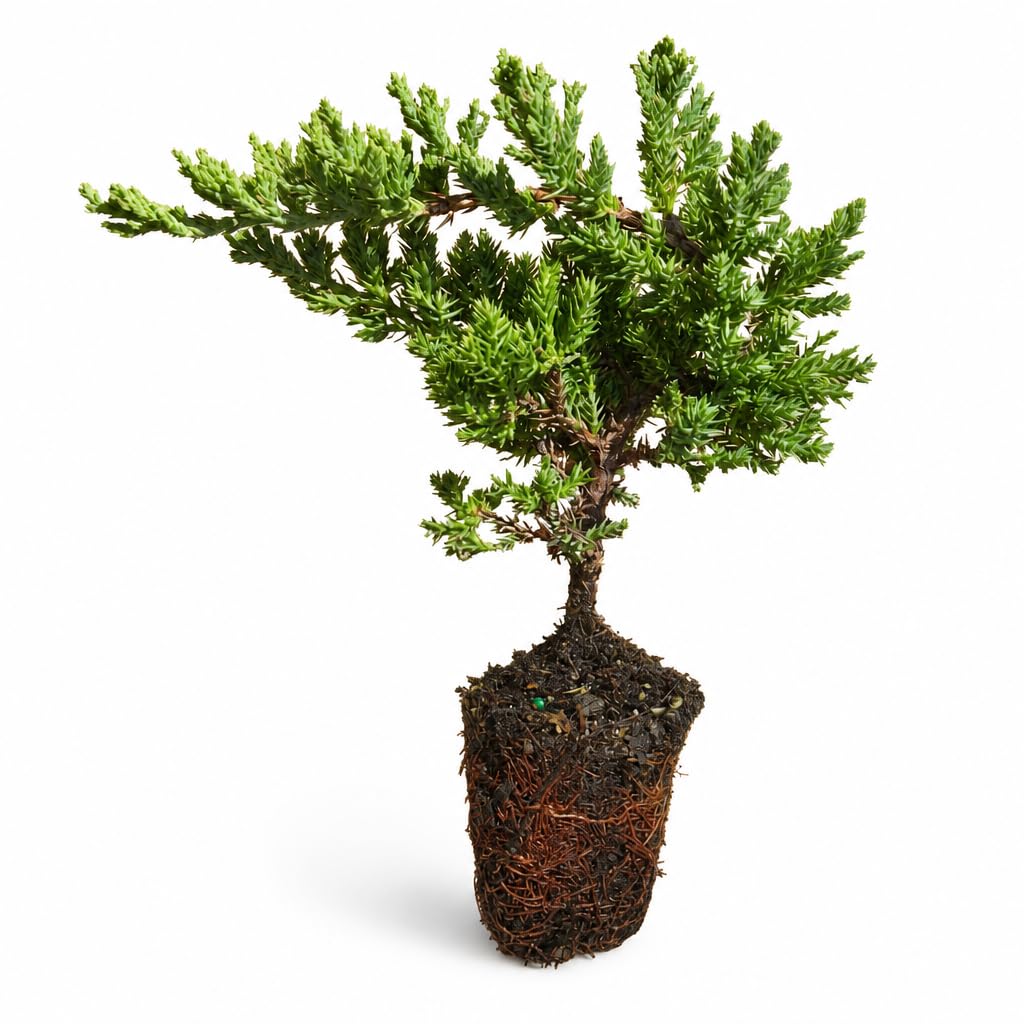
Three dwarf Procumbens Nana junipers with 1/3-inch blue-green needles, sized for bonsai pots or mass planting
If you are building a bonsai forest or mass-planting a sunny bank, buying three at once saves the hassle of sourcing singles. This listing ships three live Procumbens Nana junipers, each a dwarf form with spiny-pointed blue-green needles around 1/3 inch long. New growth comes in bright green and matures to bluish green, and the foliage takes on a purple tint in winter. It typically grows 8 to 12 inches tall and spreads to 6 feet wide over time, so three together cover serious ground.
These are genuinely adaptable plants. They grow in average, medium-moisture, well-drained soil in full sun and handle a wide range of soils, though they prefer a dryish, sandy blend. Hot, dry growing conditions, somewhat poor soils, and many city air pollutants are all tolerated. The description lists rock gardens, foundations, slopes, mass plantings, and cascades over retaining walls as natural uses. If your project spaces plants 3 to 4 feet apart, this trio is a smart way to cover a stretch without buying one at a time.
Owners mention the survival rate can be excellent — one long-term project tracked 145 of 180 junipers making it, with a slow first year followed by rapid growth, a 2-plus-foot diameter spread, tolerance of hard freezes, and resistance to wild pigs. That is a real-world data point worth flagging. The honest flip side: a few owners receive one plant that is smaller than expected or does not make it. This is not a defect in the batch so much as the reality of live shipping. Give them a sunny spot, keep the first season watered, and the odds are strongly in your favor.
The honest track record: a documented planting project saw 145 of 180 junipers pull through, surviving heat above 105°F and a hard freeze. Plant spacing of 3 to 4 feet apart gives each one room to sprawl.
The recurring gripe to size honestly: size inconsistency is the one thing that comes up — occasionally a plant ships smaller than pictured, and very rarely one arrives dead. If you need every plant uniform for a tight design, buy a spare.
Start here if: you want three junipers at once for a slope, border, or bonsai project and value the per-plant economy.
Look elsewhere if: you need one large specimen right now — these are compact starters that size up over seasons.
4. Emerald Goddess Liriope Muscari – 3 Live Plants

A strap-leaf liriope that holds dark green through winter while surrounding lawn goes brown
For bordering a walkway or softening a foundation, the standout is a strap-leaf ground cover that holds its color all winter. Emerald Goddess is a Lilyturf (Liriope muscari) selected for exactly that: the foliage stays dark green through winter, it resists crown rot, and it handles cold and drought well. The strap-leaf blades can be arranged as tight formal edging or loose, informal drifts, which makes it a versatile border plant. Ships as three live plants.
The seasonal show is worth noting. Dainty spikes of purple flowers rise above the foliage in late summer, then give way to black berries in early fall, adding interest when most ground covers are just green. In Metro Atlanta, one grower found the plants stayed green in December while surrounding grass was dead. The leaves emerge light green in spring and darken to a deep green for the rest of the year.
Care is minimal, with one clear task: divide the clumps every 2 to 3 years in early spring, and remove faded foliage before new leaves emerge for a tidier look. Water regularly in the first season to root, then it tolerates mild drought once established. It also adapts to containers, so apartment balconies and courtyards can grow it. For a raised edge along a driveway, this is one of the best choices on the list.
The winning trait: winter color. The foliage holds dark green through the coldest months, and the plant’s crown-rot resistance is its other headline strength — a common failure point for ground covers in wet soil.
Where it gets honest: patience is required. Several owners found the plants arrived looking rough or yellow and bounced back only after weeks of settling in. A minority never recovered. Plant early, water well, and expect a slow first season before it takes off.
Perfect for: edging beds, lining walkways, and any spot where you want evergreen color in a semi-formal line.
Think twice if: you need instant visual impact — this one needs a full season to establish before it looks its best.
5. Ferry-Morse Sun-Shade Bulk Wildflower Seeds

1 lb of wildflower seed — roughly 390,000 to 430,000 seeds — covering 2,178 to 4,355 square feet with spring-to-summer bloom
When you are covering a big open space and seed is the practical answer, quantity matters more than individual specimens. This Ferry-Morse bag holds 1 lb of wildflower mix seeds — the listing puts that at roughly 2,178 to 4,355 square feet of coverage depending on how densely you sow, and around 390,000 to 430,000 seeds in the bag. It is the most area per purchase by a wide margin here.
The mix is built for flexibility. It grows in partial sun to full sun, which means it will also handle spots that only get part of the day’s light — a genuine advantage in beds shadowed by a fence or tree. It is designed for hardiness zones 3a to 10b, so it covers most of the country, and it blooms from spring through summer. Plants reach heights of 6 to 36 inches, and the mix is non-GMO. A diverse all-purpose blend like this supports pollinators and fills a meadow with mixed color rather than one flat tone.
Wildflower seed is a long game — it needs regular watering and patience while it germinates and grows. It is not an evergreen in winter the way a juniper or liriope is, so if your goal is year-round green, this is not that plant. Use it where you want seasonal color and can accept a dormant winter. It is a versatile way to green up a large, sunny meadow on a leaner budget than buying live plants by the tray.
The value math: 1 lb of seed covers 2,178 to 4,355 square feet and carries roughly 390,000 to 430,000 seeds, so a single bag transforms a big meadow space without buying plants.
Set the right expectation: this blooms spring to summer, then dies back — it delivers dramatic seasonal color, not winter greenery. Water regularly while it establishes.
Choose this if: you have a large, sun-to-part-shade area and want a broad field of seasonal wildflowers for the widest possible coverage per purchase.
skip it if: you specifically need winter green — this is a flowering mix that rests in the cold months.
Know the Specs
Hardiness Zone (the cold a plant survives)
A hardiness zone is a number (often written like “Zones 3-9” or “Zones 4-9”) that maps your coldest winter temperature to a plant’s survival range. A juniper rated for USDA Zones 4 through 9 will make it through a hard freeze; a plant rated for warmer zones will not. The sedum mat is rated for Zones 3-9, and the Ferry-Morse seed mix lists 3a to 10b. If your zone falls inside the stated range, that plant should survive your coldest nights.
Mature Spread (how far it reaches)
Mature spread tells you how wide a plant will eventually grow, which is how you know how many to buy. A juniper that spreads 4 to 6 feet wide covers a real patch of slope, while a single 10″ by 20″ sedum mat is a starting tile. Spacing matters here: junipers planted 3 to 4 feet apart leave each one room to sprawl, and the liriope wants dividing every 2 to 3 years as the clumps thicken. Plan for the eventual width, not the pot you open.
Common Questions
Will a sedum groundcover mat survive winter in a cold climate?
How far apart should I plant juniper groundcover spacing?
Is sedum ground cover safe around dogs and cats?
How long does liriope take to establish?
Does the wildflower seed mix stay green in winter?
How much area does 1 lb of wildflower seed cover?
Do these ground covers need full sun?
How soon after arrival should I plant live groundcover plants?
Is liriope or juniper better for a shaded border?
The Bottom Line
For most yards, the evergreen ground cover winner is the Sedum Groundcover Mat because the living tiles drop straight onto bare soil and start covering ground the same day, plus they are pet safe and rated for Zones 3-9. If you are covering a sunny slope, grab the Procumbens Nana Juniper (2.5 Quart) — a spread of 4 to 6 feet wide at just 1 foot tall makes it a carpet that handles hills nobody wants to mow. And for a formal border that keeps its color in winter, the Emerald Goddess Liriope Muscari is the one to reach for. Whichever you pick, plant early in the season and water through that first year — rooting well is what turns a tray of plants into a permanent carpet.
How we choose
We do not accept paid placement. Every pick is matched to a real buyer and a real use-case; we do not hands-on test units.
Sources
Specifications: manufacturer listings and product documentation. Review insights: verified customer reviews, as of October 2026. Pricing: not shown on this page (it changes often); check the current price via the retailer link.
As an Amazon Associate, Aappliancez earns from qualifying purchases. This does not affect which products we feature.