Disclosure: Some links in this post are affiliate links. As an Amazon Associate I earn from qualifying purchases, at no extra cost to you. Learn more
Specs are compiled from manufacturer listings and verified buyer reviews and can change over time — please confirm the key details on the product page before buying.
If you want a still that actually produces oil and not just scented water, buy for two things: a vessel that holds enough plant material, and a condenser that stays cold. Capacity and condenser temperature are the two specs that decide your yield. The kits below split into three clear families — stainless pot stills that also handle whiskey and water, glass lab sets for learning the chemistry, and copper alembic stills built the old way. Pick the family that matches your goal, then choose the model within it.
This guide is built by comparing the manufacturers’ published specifications and the patterns across verified customer reviews, so you get each pick’s real strengths and trade-offs instead of marketing spin.
A still’s capacity, material and cooling method decide whether you get a spoonful of oil or a season’s supply. That gap separates a useful essential oil distillation kit from a decorative one you use twice.
Top Picks


How To Choose The Best Essential Oil Distillation Kit
The mistake most first-time buyers make is shopping by pot size. A big boiler full of water tells you almost nothing about oil yield. What decides that is how much plant material you can pack into the steam path and how cold you can keep the condenser.
Herb capacity beats boiler capacity
Look for a stated herb column or steamer volume and diameter, not just the pot. A still with a small herb basket gives you hydrosol (the fragrant water) all day, but barely a film of oil. High-oil plants like lavender, rosemary and oregano are the realistic targets; low-oil flowers will not give up much regardless of the equipment.
Condenser cooling is the second decision
Your options are ice in the condenser, a submersible pump recirculating from a bucket, or a fixed water jacket. Ice works fine for short runs and small batches. A pump matters when you plan multi-hour sessions, because warm condenser water lets vapour slip past uncondensed.
Glass, stainless or copper
Glass lab sets let you watch the separation happen and give you standard joints you can replace. Stainless is tough, dishwasher-friendly in some cases, and doubles as cookware. Copper conducts heat well and, as one maker puts it, improves scent — but it needs more care and usually costs more.
Heat source and safety
Many stainless pots work on gas, electric ceramic, induction and even firewood. Glass sets usually need a separate burner or heating mantle, and a weak one is a common letdown. Whatever you pick, never let a bottom pot boil dry, and keep a dry-powder extinguisher within reach.
Side-by-Side Comparison
| Model | Best For | Material | Capacity | Cooling Method | Amazon |
|---|---|---|---|---|---|
| VEVOR 3 GAL Alcohol Still★ Best Overall | First still on a budget | Stainless steel + copper | 3 gallons | Open cooling + pump | Amazon |
| CAMMOO 13.2Gal 3-Pot KitBig Batch Pick | Big batches with thumper | 304 stainless steel | 50 L (13.2 gal) | Open cooling + pump | Amazon |
| Home Distiller 15pcs Glass KitChemistry Starter | Learning the chemistry | 3.3 borosilicate glass | 500 ml | Glass condenser | Amazon |
| VEVOR 32pcs Lab Distillation Kit | Glass set with spare parts | 3.3 borosilicate glass | 1000 ml | Coil condenser | Amazon |
| Shine Still 13.2 Gallon Kit | Large stainless runs | Stainless + red copper | 13.2 gallons | Copper coil + pump | Amazon |
| Kitchen Crop Little Creek Distiller | Distilled water at home | 18/8 stainless steel | 2 gallons | Double boiler / condenser pan | Amazon |
| LETIME KD5 Hydrosol Maker | Fast hydrosol batches | 304 stainless steel | 2 L pot + 0.45 L steamer | Ice in condenser | Amazon |
| LETIME LT3000 3L Distiller | 1 L herb column | 304 stainless steel | 3 L (2 L pot + 1 L column) | Ice or circulation pump | Amazon |
| Copperholic 5 Gallon Alembic | Traditional copper distilling | Pure copper + brass | 20 litres (5 gal) | Serpentine coil condenser | Amazon |
Detailed Reviews
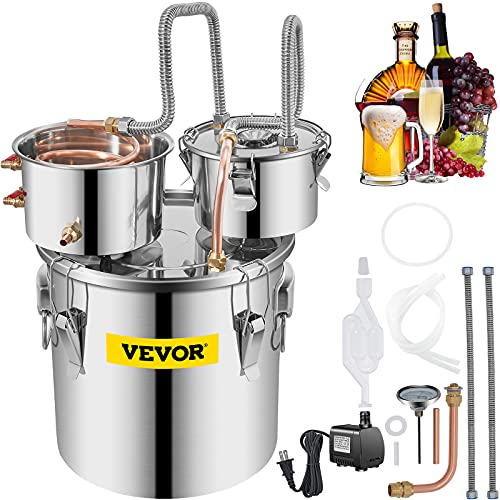
1. VEVOR Alcohol Still 3 GAL/12 L with Thumper Keg
Our pick — 4.5+★ from 750+ verified ratings; the strongest balance of quality and price.
A complete stainless starter rig that also makes hydrosol — without glass to break.
Three gallons is a genuine workhorse size for a home bench. The boiler measures 9.8″ X 9.8″ (25 x 25 cm), so it sits on a standard stovetop — the practical reason people actually use it every weekend instead of stashing it. It will ferment up to 11.4 litres of raw material. Everything that touches your distillate is food-grade: silicone, stainless steel and copper.
The cooling side is where this earns its place. A copper coil — a spiral tube with high thermal conductivity — meets a large volume of coolant, so vapour condenses at a lower temperature. A circulating water pump comes in the box to cut water waste, and a rubber pad under the condenser helps hold it steady. A one-way exhaust valve handles the fermentation stage before you ever switch the heat on.
The real-time thermometer on the lid reads in both Celsius and Fahrenheit, which is the difference between catching the good fraction and missing it. The thumper keg adds a second pass inside one run: hot vapour is drawn off, vaporising the alcohol again and carrying more flavour. That is how a home operator gets a stronger, cleaner result without a second full session.
What sells it
- Stainless body and copper coil under makes the entry gate low
- Dual C/F thermometer and thumper in one kit
- Pump, seals and one-way valve all included
What to plan around
- The instruction manual is thin — expect to watch videos
- The supplied silicone hose runs short for a sink hookup
Run two sessions back to back and you will want a longer hose and a bucket of ice water on standby — that is the honest cost of the open cooling method, not a defect. Buyers put it plainly on the manual: “The manufacturer should spend ten cents per still for good directions.” Assembly itself is not the problem; the paperwork is.
The verdict: the safest first purchase for anyone who wants oil, hydrosol and spirits from one pot.
Hold off if: you need printed, illustrated instructions to feel confident — this manual rewards a YouTube search first.
2. CAMMOO 13.2Gal/50L Moonshine Still Kit with Thumper
Fifty litres of boiler, a boosted condenser and a herb-friendly connection tube.
The headline is 13.2 gallons of cooking capacity, but the parts that matter for plant work are the two 2.5 L vessels — one condenser bucket and one thump keg. The thump keg takes the vapour through a second pass, pushing alcohol concentration up in a way that reads like a second distillation, and it is also where you drop fruit, herbs or spices to steer your flavour.
The 304 stainless thermometer — rust-resistant, dual Fahrenheit and Celsius display — reads across 0-212°F / 0-100°C in 2°F/°C gradations. That is fine enough to see a temperature climb as it happens and pull back before you lose the volatile aromatics. The maker quotes six steps and video guidance for setup, and the adjustable 50cm + 60cm connection tube lets you place the thump keg and condenser where your bench allows.
Weight is the part rarely mentioned: 13.05 pounds versus the 6.69 pounds of the glass kit further down. That is a real difference to lift onto a burner full. The 2.5 L condenser and 2.5 L thumper are also on the small side next to a 13.2-gallon boiler, so a large run will test your cold water discipline.
The silicone rings and Teflon tape included are the leak defence, and owners who have been at this a while appreciate the stainless setup over the old keg-and-copper pairing. As a weeknight essential oil and hydrosol rig with room to grow into spirit work, it is a serious piece of kit.
The bench fit: best for someone with a dedicated burner and space for a 16.5-inch footprint, since this is a large vessel you will not tuck into a cupboard.
The cold-water trade-off: a 13.2-gallon run against a 2.5 L condenser means swapping or chilling your cooling water more often than you may expect.
Choose this when: you want volume now and flexibility later, with hydrosol, oil and spirits all on the table.
Look elsewhere when: portability or a small kitchen matters more than batch size.
3. Home Distiller 15pcs Borosilicate Glass Kit, 500 ML
Watching the separation happen is the whole point of a glass set this size.
Every flask here is 3.3 borosilicate — glass with a very low coefficient of thermal expansion, meaning it can take a hard swing from flame to cool without fracturing. The maker quotes tolerance up to 500 degrees and a hand-blown, polished fit at each joint. That transparency is not decoration; it is how you learn what a proper separation looks like on a 500 ml scale.
The honest position: the quality feedback here is mixed. Some buyers get a set they rate as a great value, and others find the stoppers below standard — the recurring point is the stoppers rather than the flasks. A set that arrives perfect and is handled with a support stand and care does the job; a set treated roughly will chip. The fragility is the price of watching the separation happen.
One thing the listing does not make loud: there is no water circulator in the box. You supply the cooling. And in the practical notes, the clamps and rings can be awkward to seat, and the supplied burner may not produce enough heat to boil — factor a separate heat source into your plan.
For a first chemistry-flavoured experience with essential oil distillation, 500 ml is the right size to experiment without waste. As a demos or teaching piece it is genuinely hard to match at this tier.
Who it is built for: a learner or a demonstrator who wants to see fractions separate and does not yet need volume.
The follow-up question: the joints are non-standard per buyer feedback, so a single broken piece can mean sourcing a whole new set — plan your spare pieces before you start.
Reach for this if: hands-on learning beats finished yield for you right now.
Think twice if: you need a reliable weekly oil supply — a 500 ml flask will not carry that.
4. VEVOR 32pcs Lab Distillation Kit, 1000ml

Double the flask volume of the 15-piece set, with joints you can actually replace.
This is the glass kit that behaves like lab equipment. The 1000ml flask is twice the working volume of the 500 ML set, which matters the moment you want a usable bottle of oil rather than a demonstration. It arrives as 32 pieces, with conical flasks, beakers and brushes included so you can collect and process what comes off the condenser.
The 24/40 ground joints are the real advantage: a standardised size that lets you swap in different glassware rather than scrap the lot when one piece goes. Each joint is sandblasted for an airtight fit, so vapour goes where the design intends and your distillate stays clean. The 3.3 borosilicate body takes heat and corrosive reagents without the thermal shock that kills ordinary glass.
What wins people over is the glass itself — how it holds up under sustained, punishing heat. The foam-packed shipping protects it in transit and the construction takes prolonged boiling without complaint. On durability and fit, satisfaction is softer: the set is not what anyone would call heavy duty, and one buyer found the supplied fitting could not run the coil condenser without an extra part.
Compared to the 15-piece Home Distiller kit, the extra flask volume and standard joints are the difference between an experiment and a routine tool for essential oil work. It is a genuine step up for the same class of buyer.
Why buyers keep it
- 1000 ml flask double the size of the entry glass kit
- 24/40 joints mean replaceable, swappable glassware
- Sandblasted joints for an airtight, pure distillate
The honest gaps
- The coil condenser may need an extra fitting you supply
- Handle with care — it is precision glass, not heavy duty
Best for: the tinkerer who wants different flask sizes and replaceable parts.
Not for you if: an uninterrupted evening run with zero fuss is your priority.
5. Shine Still 13.2 Gallon Distillery Kit

A copper-coil condenser and thumper keg wrapped around a stainless pot you can lift.
The boiler is 13.2 gallons of stainless steel that doubles as a fermenter, and it is light enough to lift when full enough to matter. Everything in contact with the product is food-grade, with red copper in the vapour path. A pure copper coil collects the vapour and condenses it fast; water enters at the lower inlet and drains from the upper outlet, with a ball valve to stop an overflow.
Functionality is the strongest signal here. A submarine pump saves water on longer runs, and the thick food-grade silicone tubes are made to stay open rather than crimp under hot water. The three-piece airlock replaces the older twin-bubble type — it lets gas out but not contaminants in, pops apart for cleaning with a small brush, and it is BPA free. The thumper keg draws off hot vapour for a second-pass effect and takes fruit or flavouring.
The parts you will want to think about before buying are the thumper and condenser, which are small relative to a 13.2-gallon pot. The build quality is a mixed picture overall — good for the home bench, with some fittings feeling on the cheap side — and the line connectors are the spot where leaks have turned up. Set the whole thing up dry with a water test first and you head off most of that.
The usable strength: a big stainless pot that cleans in a kitchen sink, paired with a copper coil and a working pump.
The recurring gripe: the thumper lid gasket can be stubborn to seat even after stretching — expect some persuasion.
Pick it for: generous stainless capacity plus copper coil at a mid-range level.
Pass on it if: you plan tiny one-litre hydrosol sessions — the pot is far larger than a small batch needs.
6. Kitchen Crop Little Creek Stainless Water Distiller

Two gallons of pure water on any stovetop — and a double boiler when you need one.
Here is the member of this lineup that does not distil plant material for oil; it distils water, and it does so on every heat source you own. Induction, electric, ceramic and gas are all fine. The 18/8 stainless build pairs with a high-temperature silicone drain hose, and it produces up to 1 quart of distilled water per hour.
The familiar call on this one is the water it makes. Owners point to the filtration result as the thing they trust, and it covers the whole water-hungry list: CPAP machines, humidifiers, irons, aquariums, car batteries and radiators. It is dishwasher safe and carries a 5-year warranty — the strongest backing of any pick here.
Size is a genuine fork in the road. At an 11.75-inch diameter it is a large round pot, and some buyers find it stays put on the stove rather than sitting dead-center on every burner. On the practical side, it does not run dry quietly: add marbles or steel bearings to hear the boil, and check hourly so the bottom pot never boils away. Expect a slow gallon — one account puts it at roughly half a day per gallon.
For anyone making hydrosol and then needing mineral-free water for their routine, this is the sensible second purchase. It also doubles as a large double boiler for rendering lard and tallow.
The slow part: the process takes time and the top cooling water needs swapping regularly to stay cold.
The sensible habit: rinse and empty the bottom pot daily, and skip reusing the top water between runs.
It suits: the household that wants distilled water on hand for appliances and health gear.
It will not suit: anyone expecting a still to extract oil from lavender — this one makes water, not oil.
7. LETIME KD5 Hydrosol Maker

Twenty-five minutes from flowers to a bottle of hydrosol, with nothing breakable in the mix.
The KD5 is the beginner’s door into steam distillation for hydrosol. A 2-liter pot, a 0.45-liter steamer with a 3-inch diameter for dried or fresh flowers, and a 1.5-liter condenser. The maker quotes 25 minutes for enough hydrosol for a personal week’s use, and the pre-assembled structure means setup takes about a minute.
Build is food-grade premium 304 stainless steel with food-grade silicone rubber tubing — no glass at all. That addresses the fragility that plagues a chemist’s kit; you will not chip this one on a shelf. Cooling is handled by ice cubes in the condenser rather than a circulating pump, which saves water on small runs and keeps the whole procedure simple. Store it away in a closet between sessions.
Two practical limits before you commit. The plastic tubing can be a nuisance to attach and feels close to tearing each time you force it on. And the maker is clear that you can coax small amounts of essential oil from lavender, rosemary or oregano, but not from low-oil flowers like rose — that is a property of the plant, not a fault in the machine.
For anyone whose real goal is fresh floral water and a beginner-safe machine that will not shatter, this is the most approachable piece in this list. Pair it with a separate oil separator if a pure essential oil bottle is the destination.
Why it clicks
- Roughly 25 minutes to a week of hydrosol
- Fully stainless build with no breakable glass
- Setup in about a minute from the closet
Where it asks patience
- No dedicated oil separator, so oil collection is limited
- The condenser tubing takes a firm hand to attach
The easy call: a beginner who wants fragrant hydrosol and a forgiving first run.
A poor fit if: your goal is pure oil from the very first batch — you will need extra equipment.
8. LETIME LT3000 3L Essential Oil Distiller

A one-liter herb column is the detail that sets this apart from every small still here.
That column is the number to focus on. A 2-liter pot holds the water, but the 1-liter column is where you pack the plant material — and herb volume, not pot volume, is what decides oil output. The whole build is high-gauge food-grade 304 stainless steel, assembled by hand-twisting each component together. No tools, no glass.
Cooling is deliberately flexible. Run it manually with ice in the condenser, scooping out warm water and recharging as you go, or hook a small water pump to the circulation connector in a bucket of cold water for longer sessions. The condenser can sit left or right of the column, or level with the pot using the short straight tube. That adaptability is genuinely rare and lets the unit fit the bench you have.
The one caveat matters more than any other on this list: this machine excels at hydrosol, and essential oil output from low-yield plant material is hit and miss. A buyer ran controlled batches of lavandin with proper steam technique and cold condenser and still collected no separable oil layer — the first fraction came out milky and aromatic, but nothing floated. High-oil herbs are the realistic target, and an oil separator improves your odds.
HEPA-style patience is worth it: the built-in guidance includes hardcopy instructions, online chat and a virtual app for your first dry run, plus consistent service backing. Buy it as a premium hydrosol machine that yields oil from high-oil plants, and you will be happy.
The standout: a 1-liter column that beats every small steamer here on plant capacity.
The honest ceiling: without an oil separator, expect hydrosol first and oil second unless your herbs are high-yield.
Worth it for: a hobbyist who wants large-batch hydrosol with an oil bonus from the right plants.
skip it if: oil from rose or other low-oil flowers is the plan — no still at this level will deliver that.
9. Copperholic 5 Gallon Pure Copper Alembic Still

Handmade copper that conducts heat beautifully and comes out on the right side of scent.
Twenty litres of pure copper, hand-formed by artisans whose trade has run two generations. The alembic pot still is set up for hydro distillation, steam distillation and spirit work, and it arrives complete — no extra parts to source before your first run. Copper is a strong heat conductor, and the maker states plainly that it improves scent, which is why traditional distillers still reach for it.
Practical touches are thoughtful. The built-in temperature gauge reads Celsius and Fahrenheit so you can stay on the mark, and the condenser has an additional outlet for easier emptying or circulating water. At 1.1mm copper thickness across the pot, swan neck and serpentine-coil condenser, it is built to be handled and moved rather than left in one place.
The recurring gripe is the thermometer — a stuck gauge, or one that refuses to run under a certain temperature, shows up often enough to be worth knowing. The bright side: the support behind the sale is helpful, and a faulty gauge tends to get replaced. Do plan for a hose, clamps and electrical tape; those are not in the box, as the listing itself makes clear.
Finished output is fast for a traditional alembic, with usable distillate inside a couple of hours. This is the pick for someone who wants to learn the old method properly and is willing to keep the copper clean.
The craft trade-off: handmade copper means every unit has character, and heat transfer is excellent.
The recurring fix: the factory thermometer head may need a warranty replacement, so test the gauge on your first run.
Best for: the traditionalist who wants copper heat and copper scent in a handmade alembic.
Think twice if: you want built-in digital precision — a standalone thermometer will serve you better.
Know the Specs
Boiler Capacity vs Herb Column
Boiler volume is the size of the water and liquid pot; herb column or steamer volume is where you pack plant material. A large boiler without a matching herb space produces plenty of hydrosol but little oil. If oil is the goal, weigh column volume first.
Borosilicate Glass and Joint Sizes
3.3 borosilicate glass resists thermal shock thanks to a very low expansion coefficient, so it can take rapid temperature swings. Joint sizes like 24/40 are the standardised connection between pieces — a matched size means you can swap and replace glassware instead of scrapping a whole set.
Condenser Cooling Methods
Ice in a condenser is simple and best for short sessions. A submersible pump recirculating from a bucket keeps the water cold through long runs. A fixed jacket or coil condenser offers steady performance but usually needs a constant cold-water supply.
Copper, Stainless and Food-Grade Materials
304 stainless is tough and easy to clean; 18/8 stainless is a durable cookware-grade steel; copper conducts heat and is prized for the scent it gives a distillate. Anything food-grade means the material is intended for contact with what you will consume.
Common Questions
Can a distillation kit make both hydrosol and essential oil?
What is the difference between steam distillation and hydro distillation?
Why does my still make hydrosol but almost no essential oil?
How much plant material should I pack into the column?
Do I need a separate water pump for the condenser?
Is copper better than stainless steel for essential oil distillation?
Can I run a glass distillation kit on a standard kitchen stove?
How long does an essential oil distillation run take?
Is distilling alcohol at home safe and legal?
How do I clean the still between batches?
The Bottom Line
The strongest all-rounder in this lineup is the VEVOR 3 GAL Alcohol Still — a stainless boiler with a copper coil and dual thermometer for oil, hydrosol and spirits, and the lowest-risk first purchase if you are not sure which direction you will go. If you want a herb column that actually holds a meaningful batch, the LETIME LT3000 gives you 1 liter of packing space with dual cooling. And for flowers that need patience and no glass to break, the LETIME KD5 is the gentlest start. Check the herb capacity and the cooling method first — those two specs decide what you will actually collect.
How we choose
We do not accept paid placement. Every pick is matched to a real buyer and a real use-case; we do not hands-on test units.
Sources
Specifications: manufacturer listings and product documentation. Review insights: verified customer reviews, as of October 2026. Pricing: not shown on this page (it changes often); check the current price via the retailer link.
As an Amazon Associate, Aappliancez earns from qualifying purchases. This does not affect which products we feature.