Disclosure: Some links in this post are affiliate links. As an Amazon Associate I earn from qualifying purchases, at no extra cost to you. Learn more
Specs are compiled from manufacturer listings and verified buyer reviews and can change over time — please confirm the key details on the product page before buying.
A rotted window sill or a chewed furniture leg stays fixed only if the filler cures hard enough to hold a screw and does not shrink back out of the hole. A filler that shrinks or cures soft leaves a seam that shows through paint within months. A filler that cures to wood density holds the screw and sands level, so the patch disappears under paint.
This guide is built by comparing the manufacturers’ published specifications and the patterns across verified customer reviews, so you get each pick’s real strengths and trade-offs instead of marketing spin.
Below you will find the fastest-curing stick, the best big-job value and the strongest all-round filler, ranked by how each one behaves in the hole. The crowd favorite behind this list — 4.5+ stars across 600+ owners — is the QuikWood kneadable putty stick, which needs no mixing bowl and cures in 30 minutes.
Top Picks

How To Choose The Best Epoxy for Wood Repair
Two fillers can look identical in the tube and behave nothing alike a day later. The difference depends on how they cure, what they grip, and whether the timber underneath is still sound enough to hold them.
Start with the state of the wood, not the filler
Press a screwdriver into the wood. If it sinks into soft, crumbly fibers — the punky stage — a thick paste will just sit on top of mush. That job needs a liquid hardener applied first to firm the fibers up. A filler kit that bundles both is the safer buy when you cannot tell how deep the rot runs.
Cure time decides how fast the repair is finished
A one-part putty you knead by hand sets on its own schedule, often inside the hour. A two-part epoxy only starts its clock once you mix in the hardener, and the working window can be as short as a few minutes. If you are slow with a putty knife, a fast-set two-part mix will harden in the pot before you finish filling the hole.
Shrinkage and hardness keep the repair invisible
The best wood fillers cure to roughly the hardness and density of the surrounding wood, so a screw bites and a sander cuts level. A filler that pulls away as it dries leaves a visible seam that shows through paint within months — a seam you will end up refilling.
Side-by-Side Comparison
| Model | Best For | Form | Full Cure Time | Pieces | Amazon |
|---|---|---|---|---|---|
| QuikWood 471050-24 Putty Stick★ Best Overall | Fast, no-mix spot repairs | Putty | 30 minutes | 1 | Amazon |
| Bondo Wood Filler WF-PT-ESBest for Exterior | Exterior trim and rotted sills | Cream | 20 minutes | 1 | Amazon |
| System Three SculpWood Putty | Carving and rebuilding missing sections | Putty | 24 hours | 2 | Amazon |
| PC-Products PC-Woody and PC-Petrifier Kit | Deep rot with a hardener included | Liquid, Paste | 25 hours | 2 | Amazon |
| J-B Weld 40006 Wood Restore Putty Kit | Large-scale rebuilds | Putty | 60 minutes | — | Amazon |
Detailed Reviews
1. QuikWood 471050-24 Putty Stick
Our pick — 4.5+★ from 650+ verified ratings; the strongest balance of quality and price.
A 30-minute full cure earns this stick the top spot — knead it in your fingers, skip the hardener, skip the bowl.
You want the rotting window corner filled and the ladder put away, not a mixing session. This one-component putty (a filler that sets on its own, with no hardener to measure or stir in) reaches full cure in 30 minutes. An hour after application it can already be drilled, sawed, sanded, filed, tapped, machined and painted. No mixing bowl to wash out afterward, either.
QuikWood states the cured hardness and density match wood, so the patch sands level and holds a screw without stripping. It is putty-like in consistency, which means it does not drip or run down a vertical sill — the reason it earns a “no mess” reputation over a runny two-part mix. Kneaded by hand and pressed into deep gouges, it fills corners and carved details on high-end furniture and pianos alike. Against the Bondo Wood Filler below, the cure is slower by 10 minutes (30 against 20), but you trade that half-hour for zero mixing.
Two real trade-offs. First, it does not take stain the same way bare timber does — match the color or finish it with a diluted oil instead. Second, it throws a noticeable smell while it cures, so ventilate the room or step outdoors. Buyers report the same thing in plainer words: “Does why it’s supposed too, but does a funky smell!” Neither issue touches how strong the patch ends up. For furniture and trim work, the payoff is a repair that never shrinks or pulls away from the joint.
what separates it
- 30-minute full cure — the fastest on this list, so same-day repairs are realistic
- Single-component putty: no hardener, no measuring cup, no mixed batch going to waste
- Stated cured hardness and density are similar to wood, so screws and sandpaper react normally
- Pliable enough to replace missing carvings and fill deep gouges in one pass
Worth knowing before you buy
- Does not take stain like wood — color-match or use a diluted oil to blend
- Strong smell while curing, so plan for ventilation
- Working time runs short; one woodworker put it at under five minutes and around three at the maximum
Reach for this if: you want a tidy repair on furniture, trim or piano parts and would rather not mix anything.
skip it if: the timber under the damage is soft and punky — you will need a liquid hardener first, which this stick does not replace.
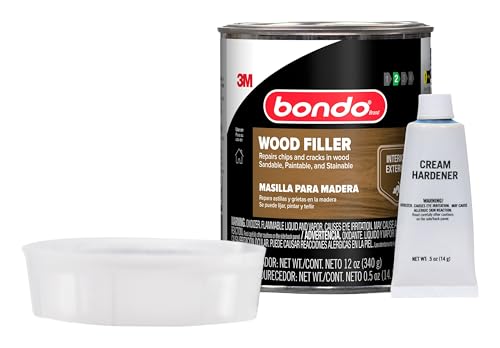
2. Bondo Wood Filler 12 oz
A 20-minute full cure and a water-resistant set — that is why a rain-soaked sill is this cream’s home turf.
Rotted window sills, siding and deck rails sit outside in the rain. This two-part cream is rated for interior or exterior use and stays water resistant once cured. The two-part formula chemically bonds with the surface rather than just sitting on it, and the non-shrinking recipe fills holes without leaving gaps or divots after drying. Sandable in as little as 15 minutes, it lets you finish a same-day repair and get paint on before the weather turns.
Speed is the whole personality here. Mix in the included 0.5 oz blue cream hardener and you have roughly three to four minutes before it hardens in the pot, so stage your tools and work small. Mix too much hardener and the cured color shifts toward green rather than the pale golden tone — a pea-size amount goes a long way in a small batch. Set that against the QuikWood stick’s longer working time and gentler learning curve.
Two honest quirks come up again and again — a strong odor and the fill you actually get. One buyer put it plainly: “This stuff works but you don’t get allot in the can it’s maybe a 1/4 full is all and kind of a pain to get out.” The smell is real, and outdoors is where it belongs anyway. For rotted exterior trim, that rock-hard cure is worth the fast hands. If instead you want a leisurely pace, an odor-free product, or something a first-timer can handle without clock pressure, the knead-by-hand putty is the easier introduction.
Where it earns the space: fast-setting exterior insurance. Sandable in 15 minutes, water resistant once cured, and compatible with most paints and stains — pair it with a rotted-wood restorer if the timber is still soft underneath.
The short window is the trade: three to four minutes of working time punishes slow hands, and the hardener can tint the patch green if you overdo it. Match the batch to the size of the hole.
Pick it for: window sills, siding, decks and doors that face the weather and need to be painted this weekend.
Think twice if: a pressure-packed race against a 20-minute clock is not how you like to work.
3. System Three SculpWood Putty Epoxy Wood Filler, 8 oz, Brown

A 24-hour cure and a clay-like feel mean you can rebuild a missing shape, not just plug a hole.
Rebuilding a curved corner is a different job from filling a flat crack, and this two-part epoxy putty (a filler that needs its companion hardener mixed in before it sets) gives you the working time to sculpt it. It arrives as two pieces and cures over 24 hours — the longest on this list, and exactly why it suits patient work. Roll it to shape, press it in with gloved fingers or a putty knife, and it holds the form you give it. Alongside the J-B Weld kit below, it is one of the two fillers here you can genuinely carve after curing.
It is moldable, carvable and sandable, and compatible with most water-based and solvent-based primers and paints. It accepts stain, and one woodworker rebuilding a rotted rub rail on a wooden boat found it matched mahogany closely. Because it is solvent-free, cleanup on uncured putty is as simple as lacquer thinner (a common paint thinner), denatured alcohol or white vinegar — no harsh solvents required.
The honest trade-off is patience. The stated full cure is 24 hours, so it sets up much slower than the Bondo cream’s 20 minutes or the J-B Weld’s 60. You will want to let it rest for 15 to 20 minutes after mixing until it loses its tack before applying. The makers also recommend packing it over a companion RotFix epoxy so it grips the surrounding wood at full strength rather than as a standalone patch.
The behavior you are paying for: it holds a shape. Carvable, sandable, stain-friendly and solvent-free, with cleanup from everyday thinners — this is the pick for rebuilding missing sections rather than filling a flat crack.
Where to plan around it: 24 hours to full cure, and it needs the RotFix base to lock onto surrounding wood. Not a same-day fix.
Best for: carvers, boat restorers and anyone rebuilding a missing detail who can give the repair a day.
Look elsewhere if: touching up a plain chip or crack and you want the job behind you by dinner.
4. PC-Woody Wood Repair Epoxy Paste
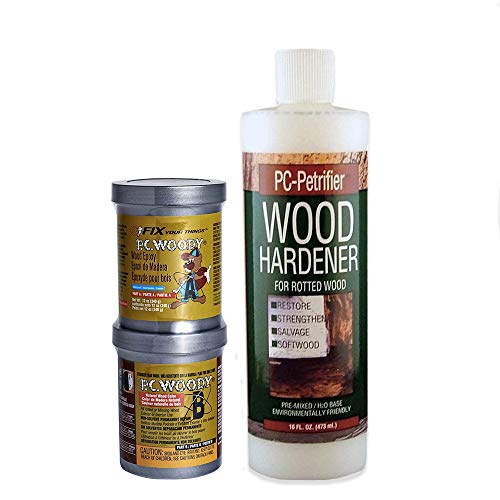
A 16 oz hardener and a 12 oz paste in one box — the kit that fixes rot a single filler cannot.
Filler pressed into soft, punky wood has nothing solid to hold, and that is the problem this bundle solves. You get a 16 oz liquid hardener and a 12 oz two-part epoxy paste together: the hardener soaks into the softened timber to firm it, and the paste then replaces the missing wood on top. It carries a 25-hour full cure, the slowest here, so plan it as a weekend rebuild rather than a same-day touch-up. For total capacity, the 12 oz paste sits comfortably alongside the largest single filler sold here.
The liquid half is where the real value hides. Called PC-Petrifier, the water-based hardener penetrates deeply into rotted wood and is aimed at window sills, frames, beams, columns and trim. Once applied to punky timber, it firms up the fibers so the paste has a solid base to grip. The paste half, PC-Woody, arrives as a two-part epoxy that can be painted, stained and machined once cured, so a repaired sill finishes like the original.
What buyers rave about is the end result: the hardener is regularly described as doing exactly what it claims, restoring dry-rotted areas so the paste has something to bite. A handful find the paste itself sticky and awkward to mix — some batches arrive gloopy and are hard to spread — but the same buyers rate the hardener highly enough to keep the kit on the shelf. The recurring gripe is simply the price, and because the components sell separately and cost more apart than together, the pair is normally the smarter buy.
Best for: window sills, door frames and beams where the rot has gone deep and soft before you caught it.
Better off with a single filler if: the hole is surface-level and the surrounding wood is still sound — you do not need the hardener for that job.
5. J-B Weld 40006 Wood Restore Premium Epoxy Putty Kit – 32 oz.

A 32 oz tub that fills a long run of rot in one go — and kneads by hand so it never drips overhead.
A repair that keeps growing once you start digging needs bulk, and this tub holds 32 oz of hand-mixable epoxy putty. That is enough to fill a long run of termite damage or a deep gouge under a window sill without stopping to re-order. It cures to the same density as wood and is solvent-free, and after 60 minutes it can be sanded, tapped, machined, filed and painted. Because the putty is kneaded in the hand rather than mixed as a liquid, it holds position on a wall or overhead without dripping down the timber — the same no-run behavior the QuikWood stick is built around, only in a much larger format.
J-B Weld states it fills, builds and bonds rotted wood with structural strength, and builders use it on doors, windows, furniture, exterior columns and posts. The stated recipe gives you roughly 30 minutes of working time — far more generous than the fast-setting Bondo cream — so you can knead, press and smooth a large void before it begins to firm. Because it is solvent-free with no runaway formula, it holds its place and avoids the sagging that catches thinner pastes on a deep fill.
Where this pick falls short is small jobs and tight budgets. For a single screw hole in a kitchen cabinet, the putty stick is the leaner pick. But when the job is large — rebuilding part of a frame or filling a deep rot hollow — the extra capacity more than earns its place, and the putty’s kneadability keeps the repair from becoming a messy fight with a dripping mixture.
The reason it earns the tub: 32 oz fills a big repair without a mid-job reorder, solvent-free formula that cures to the same density as wood, and 60-minute workability — the longest window here — before you sand and paint.
The catch is cost: a large tub is overkill for small, single-hole fixes. If your repair fits in a screw hole, go with the kneadable stick instead and keep this for the heavy lifting.
Choose it for: large rebuilds — rotted frames, deep gouges, or wood that has lost most of its cross-section and needs bulk filler.
The math doesn’t work if: the hole in front of you is the size of a screw hole.
Know the Specs
Full cure time
The clock that starts when the filler stops being a paste and becomes a solid. A 30-minute cure means you can drill and paint the repair within the hour. A 24-hour cure means the patch stays soft for a full day. Match the cure time to your patience and to the weather — a long cure outdoors can leave an unfinished patch exposed to rain.
Putty vs. paste vs. two-part cream
Putty is the thickest, holds its shape and never runs. A two-part cream is thinner and sets fastest but needs a hardener mixed in before the clock starts. A running paste needs a few minutes to firm up after mixing before you press it in. The thicker the filler, the easier it holds position on a vertical or overhead repair.
Shrinkage and hardness
A filler that shrinks as it dries leaves a visible gap around the edges, and a visible gap means a second trip up the ladder. Look for a non-shrinking formula. Hardness matters too: a filler that cures close to the density of wood holds a screw and sands level with the surrounding grain, so the patch vanishes under paint.
Wood hardener
A thin liquid that soaks into soft, punky timber and firms up the fibers before filler goes in. It is not a substitute for filler, and filler is not a substitute for it — deep rot usually needs both. Without it, a paste has nothing solid to bond to and the repair fails from the inside out.
Common Questions
Can I use epoxy wood filler on a load-bearing beam?
How short is the working time on a two-part epoxy before it hardens?
Will epoxy wood filler take paint and stain like real wood?
Do I need a wood hardener before filling rotted wood?
How long do I wait before sanding a wood repair?
Which wood epoxy holds a screw after it cures?
Is epoxy wood filler safe for exterior repairs?
How much filler do I need for a rotted window sill?
Does the type of putty matter for filling overhead or vertical repairs?
Can I sand and paint a repair the same day?
The Bottom Line
For most repairs, the best epoxy for wood repair pick is the QuikWood 471050-24 Putty Stick because it needs no hardener, reaches full cure in 30 minutes, and cures to wood-like hardness and density so the patch drills and sands like the board around it. If the wood is soft and punky, grab the PC-Products PC-Woody and PC-Petrifier Kit, which pairs a 16 oz liquid hardener with the paste so you firm up the rot first. And for a repair that needs to blend invisibly into stained oak or mahogany, the System Three SculpWood Putty is the one to reach for, since it is moldable, carvable and takes stain. Whichever you choose, let the repair reach full cure before sanding and painting — the Bondo cream in 15 minutes, the QuikWood and J-B Weld putties within the hour, the SculpWood and PC-Products kits in 24 to 25 hours.
How we choose
We do not accept paid placement. Every pick is matched to a real buyer and a real use-case; we do not hands-on test units.
Sources
Specifications: manufacturer listings and product documentation. Review insights: verified customer reviews, as of October 2026. Pricing: not shown on this page (it changes often); check the current price via the retailer link.
As an Amazon Associate, Aappliancez earns from qualifying purchases. This does not affect which products we feature.