Disclosure: Some links in this post are affiliate links. As an Amazon Associate I earn from qualifying purchases, at no extra cost to you. Learn more
Specs are compiled from manufacturer listings and verified buyer reviews and can change over time — please confirm the key details on the product page before buying.
If you are coating a table, the two things that ruin the job are bubbles trapped in the finish and a pour that never quite goes hard. Choose a kit with a low-viscosity formula (meaning it flows thin like water and lets trapped air rise out) and plenty of working time, and the table comes out glassy instead of cloudy. Choose wrong and the finish stays sticky and yellow, and you sand it off and start over.
This guide is built by comparing the manufacturers’ published specifications and the patterns across verified customer reviews, so you get each pick’s real strengths and trade-offs instead of marketing spin.
This guide maps the table-top and deep-pour epoxies worth your money by mix ratio, cure window, and pour depth, so you can match a kit to your slab instead of guessing. The picks below cover everything from a starter casting kit to a professional deep pour for river tables. Match the pour to the project and the table comes out right.
Top Picks
How To Choose The Best Epoxy for Tables
Table epoxy comes in two jobs: coating and deep pouring. A coating epoxy goes on thin, levels itself, and builds a hard clear shell over a wood top or bar surface. A deep pour epoxy is designed to fill a hole in a slab for a river table, sometimes several inches thick. Matching the type to the job is where most buyers go wrong.
Decide coating versus deep pour first
If you are sealing plywood, an 1800-style door, or a reclaimed plank, you want a coating formula. A coating kit pours around 1/8 inch at a time and cures hard and scratch resistant. If you are filling the gap between two live-edge slabs, you need a deep pour kit that stays workable for hours and cures slowly and cool. A hot, fast cure inside a thick pour traps heat and cracks the block.
Working time is the number that saves your project
Working time (sometimes called open time) is how long the mixed epoxy stays pourable before it starts to gel. A short window means you must move fast. A long window lets you reposition the slab, fish out bubbles, and fix an edge without panic. A deep pour needs hours of working time, because a thick block that gels early traps heat and cracks.
Why viscosity decides whether you get bubbles
Viscosity is how thick the liquid is. Thin, low-viscosity epoxy flows into cracks and lets trapped air float to the surface on its own. Thick epoxy traps bubbles in place, so they never reach the surface. That is why deep pour kits advertise low viscosity and air release, and why a heat gun over the surface is a common step to pop what remains.
Match the mix ratio to your confidence
Epoxy is two bottles: resin and hardener. A 1:1 ratio means equal parts, which is easier to eyeball and forgiving for beginners. A 2:1 ratio is common on woodworking and marine formulas but demands accurate measuring, so calibrated pumps help. Whatever the ratio, unmixed hardener leaves soft patches that never cure.
Side-by-Side Comparison
| Model | Best For | Mix Ratio | Full Cure Time | Reported Working Time | Amazon |
|---|---|---|---|---|---|
| KISREL Epoxy Resin Kit 82OZ★ Best Overall | Crafters and first-time table coaters who want colors included | 1:1 | 24 hours | ~30 min to 1 hour | Amazon |
| Craft Resin Table Top Epoxy Resin KitBest for Countertops | Coating countertops, bar tops, and family tables | 1:1 | 36 hours | — | Amazon |
| Bsrezn 2 Gallon Epoxy Resin Kit with Pumps | Big surface area where you want pumps and a low-odor mix | 2:1 | — | — | Amazon |
| TotalBoat High Performance Clear Marine Epoxy Resin | Wood, fiberglass, and repair work needing exact metering | 2:1 | 2 days | — | Amazon |
| EcoPoxy FlowCast Deep Pour Epoxy Resin Kit | River tables and thick slab pours that need hours of open time | 2:1 | 7-14 days | Up to 12 hours | Amazon |
Detailed Reviews
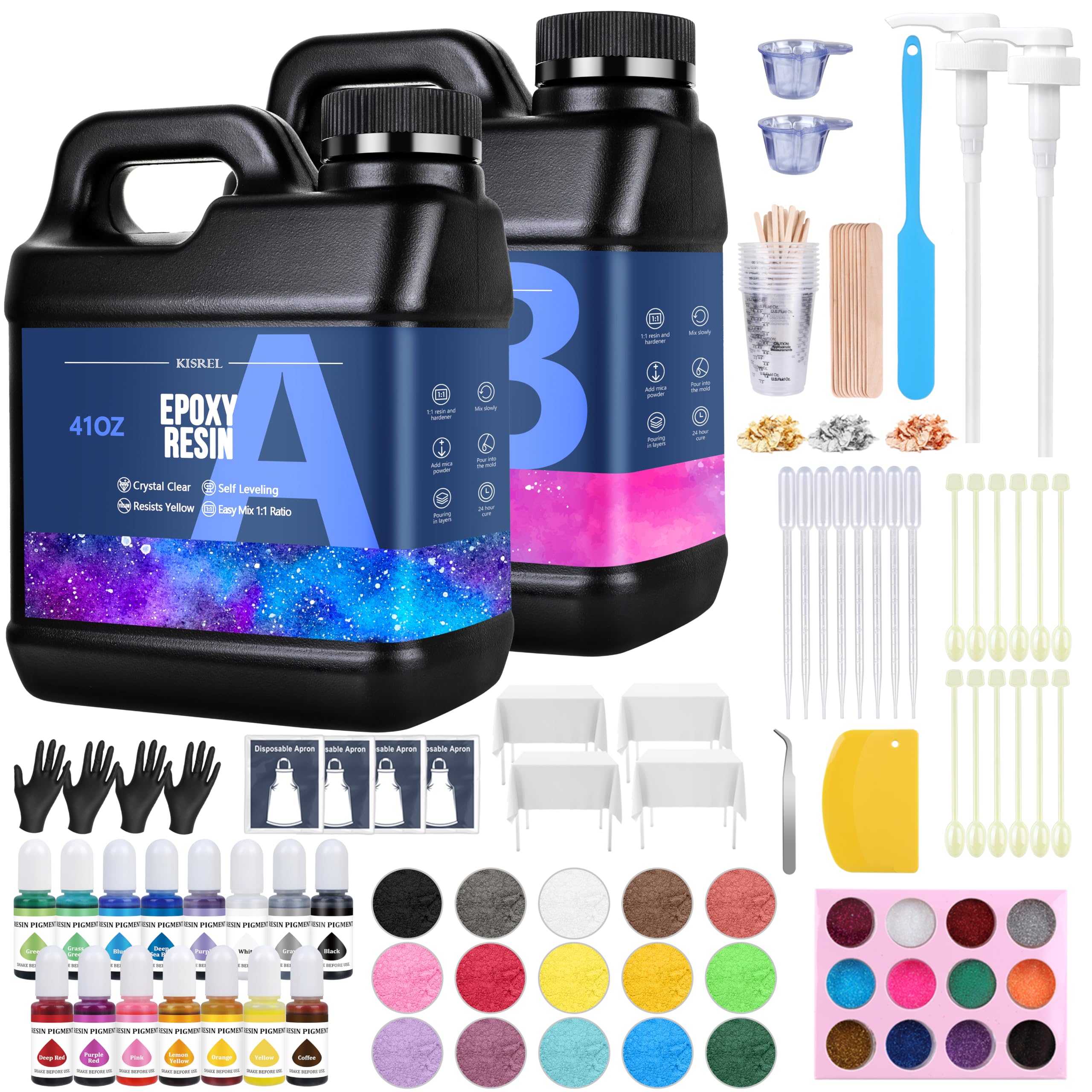
1. KISREL Epoxy Resin Kit 82OZ
Our pick — 4.5+★ from 1,000+ verified ratings; the strongest balance of quality and price.
A complete first-timer’s box, colors and pump tops included, built to start pour day without a shopping run.
This is the kit for someone who has never mixed epoxy before and wants one box that answers every question. You get 41 oz of clear resin and 41 oz of clear hardener, a 1:1 mix ratio that means equal parts of each, plus pigments, mica powder, glitter, a pump head, a measuring cup, a silicone wand, a spatula, gloves, a stirring rod, tweezers and a tablecloth. The mix is equal-parts simple, so you are not chasing a precise 2:1 measurement on your first pour. It all adds up to the crowd favorite here — 4.5+ stars across 1,000+ ratings.
The working window is the thing to plan around. As buyers report, “Watch a little bit of video how to pour it and you have 30 minutes to 1 hour to play with it depends on the weather.” In warm air you get closer to the short end; in cool air you get closer to the long end. After pouring, the surface goes tacky at 8 hours and fully cures at 24 hours, which is quick enough to coat a small table top and handle it the next day. The surface cures glossy with a fine texture and the maker lists it as no-yellowing with high temperature resistance.
What wins people over is the resin itself. Poured unrecolored, it dries see-through, and buyers who want a tinted top just add the mica or pigment before pouring. If you plan to pour clear, get the crisp version; if you always add color, that distinction stops mattering. Deeper pours and cold-room pours are where the timing complaints show up — this formula wants warmth and a thin-to-moderate layer.
What buyers keep coming back for
- Everything needed is in the box — resin, hardener, pigments, mica powder, glitter, pump head, measuring cup, silicone wand, spatula, gloves, stirring rod, tweezers and a tablecloth.
- 1:1 equal-parts mixing removes the measuring anxiety that trips up first pours.
- Dries crisp without a yellow cast, and the surface goes glossy with a fine texture.
- Colors are vibrant and blend well into the resin, so a plain clear top can be tinted however you like.
The honest catch
- The pourable window runs roughly 30 minutes to 1 hour depending on the weather, so warm-day pours need a steady hand.
- Deeper, thicker pours and cold working rooms are where the slow-cure gripes surface.
Buy it if: you are new to resin and want one box that covers the pour plus the finishing touches.
Think twice if: you are filling a deep slab gap — that job wants a slow deep-pour formula instead.
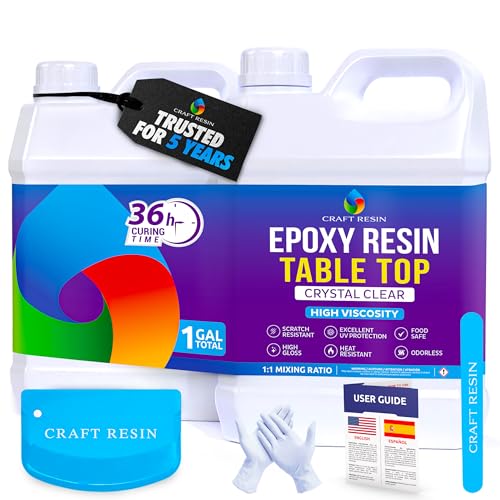
2. Craft Resin Table Top Epoxy Resin Kit 1 Gallon
The one built for horizontal surfaces: a self-leveling coat with a listed 1/8 inch pour depth.
Where the KISREL kit spreads itself across crafts and casting, this one is pointed straight at countertops, bar tops and tables. The headline number is the listed 1/8 inch recommended pour depth — that is a coating layer, not a fill, so think of it as the protective shell over your wood rather than the river running through it. Mixed viscosity sits at 3800 CPS, a measure of how thick the liquid is; low enough that it self-levels instead of sitting in a lump. It also resists UV light, which matters if the table lives near a window.
The formula pours equal parts resin and hardener from two half-gallon bottles, a 1:1 ratio, and comes with a mixing stick, spreader, gloves and a manual. Cured, it stands up to heat up to 203°F and reaches a full cure in 36 hours. Cure speed is what owners mention most favorably — the finish sets to a hard, scratch-resistant surface without leaving a tacky layer behind.
The mixed reviews land on bubbles. Some pours come out glassy with almost nothing trapped; others pull in a crowd of bubbles during mixing and pouring, which is why a slow stir and a pass with a heat gun are worth the extra five minutes. Keep the pour inside the listed 1/8 inch depth and work in a ventilated space with gloves, and the finish behaves.
The UV angle is the real sell: a table by a window takes sun all day, and a resin that resists UV light keeps its clarity instead of drifting yellow.
Read the depth line carefully: 1/8 inch is a coating, so treat this as the clear top over a table, not the fill inside one.
Reach for this if: your project is a flat surface — countertop, bar top, or table top — that needs a hard, clear, heat-tolerant shell.
Look elsewhere if: you are casting a thick block or filling a deep gap, because this kit is rated for a thin layer only.
3. Bsrezn 2 Gallon Epoxy Resin Kit

Two gallons of low-odor, low-viscosity resin with pumps on the bottles for a full-size table job.
When the project is a whole table plus matching coasters and an ashtray or two, running dry halfway through is the nightmare. This kit holds 2 gallons, which is the largest volume on this list short of the deep pour kit, and the low-viscosity formula means it flows out and self-levels rather than fighting you. The maker formulates it to cut down bubbles, and it carries a low-odor claim, so a garage or workshop pour is easier on the nose. It mixes at a 2:1 ratio — two parts resin to one part hardener — and ships with pumps to keep that ratio honest.
Beginners get along with it well; ease of mixing and clarity are what people respond to most. The pumps meter the two parts so you are not eyeballing a 2:1 split, and the mixed resin stays see-through, which is exactly what you want when a wood grain is showing underneath.
Here is the honest catch, and it is the biggest one on this pick: cure time is genuinely inconsistent. Some pours harden within hours, while others take two days and can stay a little flexible instead of going rock solid. Owners mention “Cure ~6hrs, fully set 24hrs,” and that is the good end of the range. If your table must be rock hard on a schedule, pour in a warm room and give it the full 24 hours before you touch it.
Volume without the refill: 2 gallons covers a big surface and leaves enough for small side projects in the same session.
The working pace is quick: this formula does not hand out extra time, so have your slab taped and level before you mix.
Best matched to: a large single pour where you want pumps, a low-odor mix, and enough resin to cover the whole surface in one go.
Not the fit if: you need a guaranteed hard cure on a fixed deadline — the curing behavior here varies enough that you should build in slack.
4. TotalBoat Clear Marine Epoxy Resin 1.5 Quart Kit
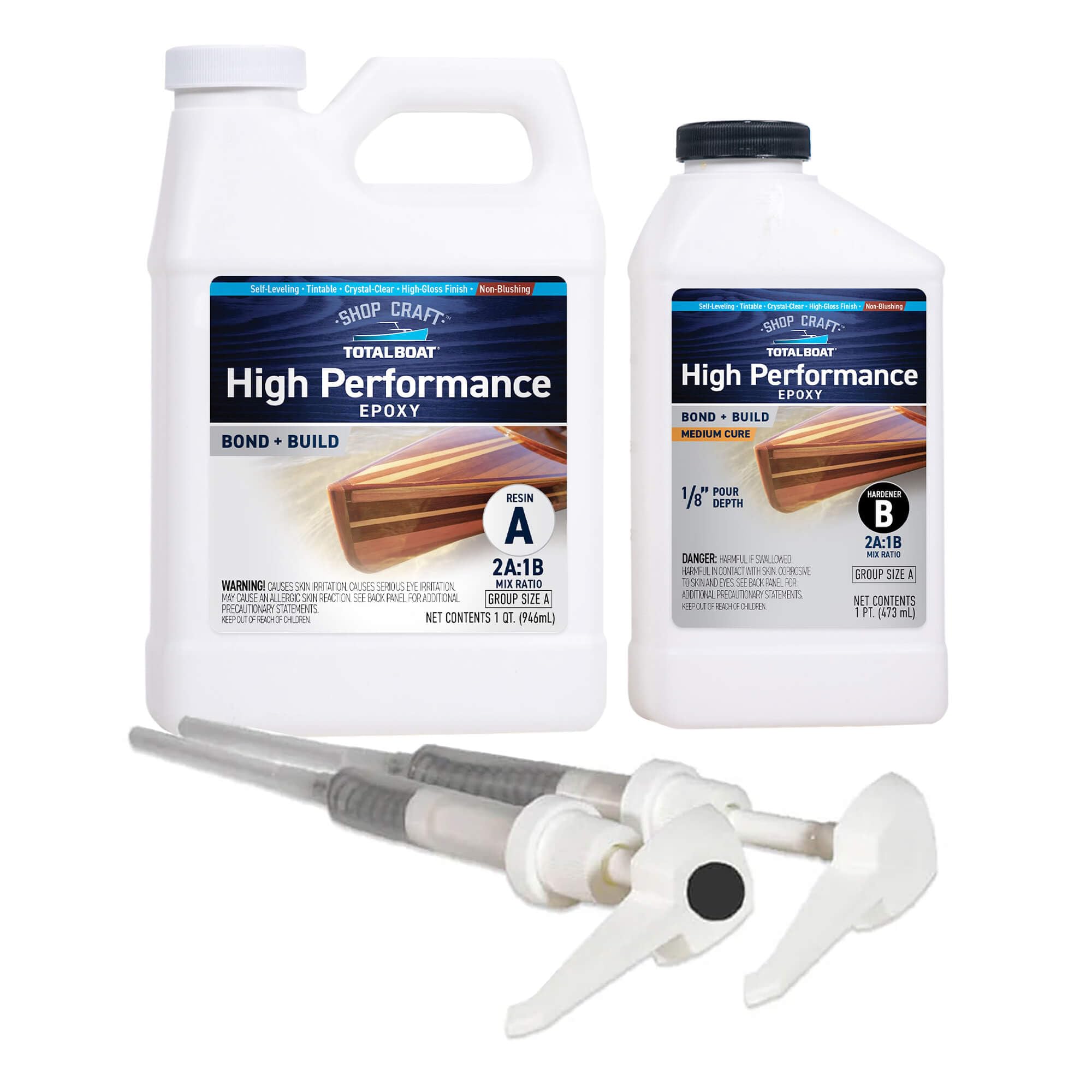
Calibrated pumps take the guessing out of the ratio, and the surface cures without a waxy blush to wash off.
This is the pick for someone who has already ruined one batch by measuring wrong. The system is a 2:1 mix, two parts resin to one part hardener, and it ships with metered pumps calibrated so you mix one full pump of hardener to every one full pump of resin. Get the pump count right and the ratio takes care of itself. It is a non-blushing formula too, meaning the cured surface does not develop the waxy film that would otherwise have to be washed off between coats.
Owners reach for it on wood and repair jobs. It seals and protects, the mixed epoxy is clear, and the specs list compatibility with wood, fiberglass and various metals. Full cure runs 2 days, so this is a slower-schedule product than the table-top kits above. The surface is BPA-free once cured per the maker, and the low-VOC, low-odor build makes it comfortable for indoor shop use. You can also choose slow, medium or fast hardener, with medium suited to most applications.
Two things to know before you buy. The pump tubes run long for the bottles, so plan to trim them — and trimming slightly too much lets the bottle close, while cutting again makes a mess. And on value, the kit costs more than comparable resin, which is the common note in owner feedback. You are paying for the pump precision and the clean cured surface.
Where it wins: metered pumps and a non-blushing cure mean fewer redos, especially across a large wood or fiberglass surface.
Where it costs you: a 1.5 quart kit at a higher outlay than similar resins, plus a 2-day full cure — and the pump tubes likely need trimming to fit the bottles.
Suits you if: you want consistent ratios on wood and fiberglass and prefer pumps over weighing your pours.
Look past it if: you are covering a big flat table in one night — the 1.5 quart volume and 2-day cure want a smaller, slower project.
5. EcoPoxy FlowCast Deep Pour Epoxy Resin Kit – 3.2 Gal / 12L

Twelve hours of working time and a water-clear cure, made for river tables and thick slab pours.
A river table is a different animal from a coated table top. You are filling a cavity between two live-edge slabs, often several inches deep, and the pour has to stay liquid long enough for trapped air to climb out. FlowCast answers with up to 12 hours of working time and a two-part 2:1 mix. The formula is low viscosity and bio-based, which lets it flow into narrow cracks and release air, and it is built to resist yellowing, warping and cracking so a thick pale block stays clear instead of drifting.
Owners push it into demanding pours. Slabs up to 2 inches thick get poured clean with thorough mixing and no soft spots, and the cured block machines well — it can be planed, though a hand planer can chip the edge. That versatility is not shared by the thin coating kits above, which are happy at 1/8 inch and have no business running inches deep.
Two cautions worth your full attention. First, cure runs long, from 7 to 14 days to full hardness, because the slow cure and low heat build-up are exactly what stop a deep block from cracking. Second, the water-thin viscosity finds every gap — customers note “Easy to use and leaves few bubbles,” but that thinness is also the reason cracks need a thin seal coat first and tape can leak. Tape choice matters here; a weaker tape on a thick pour can give way. Plan the seal coat and the tape before you start, and the finish rewards the patience.
The one number that defines it: up to 12 hours of working time, which is what turns a panic pour into a controlled one.
The trade-off you accept: a 7 to 14 day full cure and an appetite for careful taping — the same thinness that releases bubbles will seep through a sloppy edge.
Built for: river tables, ocean tables, flower encapsulation, and any deep or large casting where you need hours of open time and a water-clear block.
Wrong tool for: a quick overnight table top — the long cure and the volume are far more than a simple coating job needs.
Know the Specs
Mix Ratio
Epoxy comes as two liquids, resin and hardener, and the ratio is how much of each you combine. A 1:1 ratio means equal parts, which is forgiving if you are new to mixing and hate chasing a precise measurement. A 2:1 ratio, common on woodworking and marine formulas, wants accurate pouring — which is why kits sold at that ratio tend to include calibrated pumps. Get the ratio wrong and the resin can stay sticky and soft no matter how long you wait.
Viscosity and Bubbles
Viscosity is how thick or thin the mixed liquid is. Thinner epoxy flows into cracks and lets trapped air rise to the surface, which is why deep pour formulas advertise low viscosity and air release. Thicker epoxy holds bubbles in place, so you stir slowly and pass a heat gun over the surface to break what is left. If clarity is your goal, viscosity is worth more attention than any marketing label on the bottle.
Working Time and Cure Time
Working time is how long the mixed epoxy stays pourable before it starts to gel, so a longer window lets you position the slab and fix edges without rushing. Cure time is separate — it is how long until the surface hardens fully, and it runs from around a day on coating kits to a week or two on deep pours. Fast cures suit thin layers; slow cures suit thick ones, because slow curing keeps the heat build-up low and protects a thick block from cracking.
Pour Depth and Compatibility
Coating kits list a maximum pour depth, often around 1/8 inch, and that figure is the amount you build at once, not a suggestion. Push past it and the heat of curing can trap itself and ruin the layer. Deep pour formulas are built to run thicker. Compatibility is the other half — epoxy sticks to wood, and many formulas also list glass, metal, stone, ceramic and various fillers like shells and pigments, so check the list against what is actually in your table.
Common Questions
Can I use a craft epoxy kit on a table top instead of a dedicated table top epoxy?
How thick can I pour epoxy on a river table in one go?
How long do I have to work with the epoxy before it starts to set?
Why did my epoxy table top stay sticky and never fully harden?
How do I get rid of bubbles in a table top pour?
Will epoxy for tables yellow over time near a window?
Do I need to sand or seal my wood slab before pouring epoxy on it?
Is a 1:1 or 2:1 epoxy mix better for a beginner?
Can I use epoxy resin over a surface that had cooking oil on it?
How do I pick between a coating epoxy and a deep pour epoxy for a live-edge table?
The Bottom Line
The epoxy for tables that earns its spot at the top for most people is the KISREL Epoxy Resin Kit 82OZ, because it hands a beginner the whole pour — equal-parts 1:1 mixing, a 30-minute to 1-hour window, an 8-hour dry and full 24-hour cure, plus pigments, mica powder and pump tops in the same box. If you are coating a flat surface rather than casting, grab the Craft Resin Table Top Epoxy Resin Kit for its self-leveling 1/8 inch coat and UV-resistant, heat-tolerant finish. And for a river table or a thick slab pour, the EcoPoxy FlowCast Deep Pour Epoxy Resin Kit is the one to reach for, thanks to that up-to-12-hour working time and a water-clear cure built to resist yellowing, warping and cracking.
How we choose
We do not accept paid placement. Every pick is matched to a real buyer and a real use-case; we do not hands-on test units.
Sources
Specifications: manufacturer listings and product documentation. Review insights: verified customer reviews, as of October 2026. Pricing: not shown on this page (it changes often); check the current price via the retailer link.
As an Amazon Associate, Aappliancez earns from qualifying purchases. This does not affect which products we feature.