Disclosure: Some links in this post are affiliate links. As an Amazon Associate I earn from qualifying purchases, at no extra cost to you. Learn more
Specs are compiled from manufacturer listings and verified buyer reviews and can change over time — please confirm the key details on the product page before buying.
If your dog or cat keeps returning to the same damp patch on your wood floor, the smell is coming from uric acid crystals trapped in the grain — and an ordinary all-purpose cleaner will not touch them. Enzymes break those crystals down at the source, and that is the difference between a floor that just looks clean and one your pet stops marking. Here are five enzyme cleaners that genuinely work on hardwood, plus the one mistake that ruins most finishes.
This guide is built by comparing the manufacturers’ published specifications and the patterns across verified customer reviews, so you get each pick’s real strengths and trade-offs instead of marketing spin.
Hardwood finishes are far more sensitive than carpet, which is why the picks below are split into no-rinse mop solutions and concentrated spot sprays.
Top Picks

How To Choose The Best Enzyme Cleaner for Hardwood Floors
A hardwood floor changes the whole equation. Carpet can be soaked, scrubbed, and left to dry for hours — a finished wood plank cannot. The cleaner has to break down the mess without leaving water sitting in the seams or a soapy film that dulls the topcoat. That constraint — no standing water in the seams — is what separates the five picks below.
No-rinse mop solution or concentrated spot spray?
These are two different tools and most pet owners end up needing both. A no-rinse mop solution (one you squirt on and wipe up without a second pass of plain water) is what you reach for on a whole room, and it is the format that protects your floor because no extra moisture is pushed into the boards. A concentrated spray is for the one spot where the accident actually happened — the couch, the rug edge, the seam where urine seeped under the baseboard. If you mop an entire floor with a spot spray, you will use far more product than you need.
Watch the scent, because it tells you what the formula is doing
A cleaner that smells strongly of perfume after the floor is dry is usually covering a smell rather than removing it. Enzymatic formulas tend to smell light and slightly citrusy while wet, then fade almost completely once the floor is dry. A scent that fades as the floor dries means the formula is removing odor, not masking it. A lingering chemical smell can also mean residue is sitting on the finish, which is exactly what dulls a wood floor over a few months.
Side-by-Side Comparison
| Model | Best For | Format | Size | Weight | Amazon |
|---|---|---|---|---|---|
| ANGRY ORANGE Hardwood Floor Cleaner (2 Pack)★ Best Overall | Whole-room mopping on sealed wood | No-rinse solution | 32 oz x 2 | 4.5 pounds | Amazon |
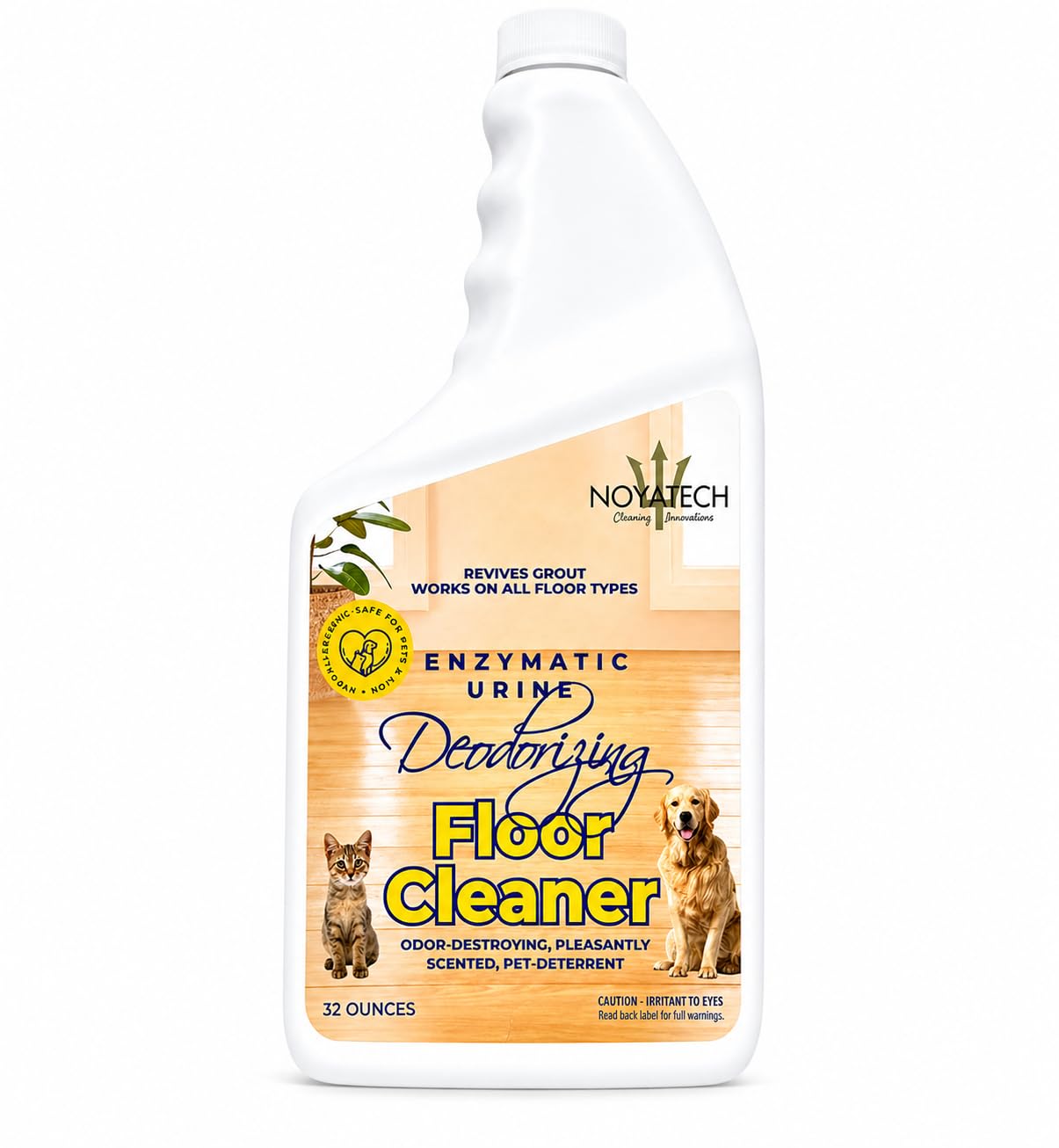
| NOYATECH Pet Floor Cleaner ConcentrateBest Value | Refill value for routine mopping | Concentrate | 32 oz | 2.27 pounds | Amazon |
| ACTIVE Pet Odor and Stain Eliminator | Set-in stains across floors and fabric | Ready-to-use spray | 32 oz | 2.31 pounds | Amazon |
| Rocco & Roxie Enzyme Stain & Odor Eliminator | Old couch and carpet accidents | Ready-to-use spray | 32 fl oz | 2 pounds | Amazon |
| Simple Solution Hard Floor Stain & Odor Remover | Large-batch mopping and potty training | Ready-to-use liquid | 128 fl oz | — | Amazon |
Detailed Reviews
1. ANGRY ORANGE Hardwood Floor Cleaner 2 Pack
Our pick — 4.5+★ from 550+ verified ratings; the strongest balance of quality and price.
The no-rinse two-pack that lets you mop a whole room without a second water pass.
This is the pick for the household with a dog that tracks mud in daily and a floor you would rather not risk soaking. The bottle holds 32 oz and there are two of them in the pack, so you get through a long stretch of mopping before a reorder. The instructions are almost aggressively simple: squirt the solution onto the floor, mop it up, and stop. No rinse bucket, no drying towel, no second step where water sits in the plank seams.
The finish it leaves is the part owners describe best. It is designed to restore shine and leave sealed surfaces spotless, and the reason it does not smear is that it dries without the soapy film that ordinary all-purpose cleaners leave behind. Residue matters most on hardwood, where a soapy film turns a glossy finish dull and hazy within weeks of casual mopping.
It is the heaviest bottle in this group at 4.5 pounds — against the 2.27 pounds of the NOYATECH concentrate below, that is a substantial object to carry up a staircase. But a two-pack at that weight is built to sit next to the mop bucket rather than travel, so unless you are hauling it between floors, the bulk buys you fewer restock runs. The scent is the other thing that wins people over: a bright citrus mint that reads clean rather than perfumed, without the heavy sweetness that makes some pet cleaners obvious in a living room.
Where It Wins
- No-rinse formula means one pass with the mop and no standing water left in the seams of a wood floor.
- Two 32 oz bottles, so a full room clean does not eat the whole supply in one go.
- Citrus mint scent that fades instead of lingering — buyers report it works well on LVP flooring with “no residue and nice smell, not over powering.”
- Restores shine on sealed hardwoods, vinyl, and laminate without a rinse step.
What To Weigh
- At 4.5 pounds for the pair, it is a heavier bottle to lug around than a concentrate you mix yourself.
- Shine results are a real split — some floors come up glossy, others stay matte. Your finish decides which camp you land in.
- The scent is mint-forward, not the orange the name promises. If you expected citrus-orange, adjust.
Made for: the pet owner who mops a whole sealed-wood floor regularly and wants zero rinse work.
Think twice: if you need a floor that gleams, because the shine payoff varies with your existing topcoat.
2. NOYATECH Pet Floor Cleaner Concentrate 32 oz
One bottle, sixteen gallons of mop water — the value play for weekly hardwood care.
Two ounces per gallon of warm water stretches a single 32 oz bottle into up to 16 gallons of cleaning solution. That 16-gallon yield is why this is the refill-style buy for anyone who mops on a schedule rather than chasing one emergency spill. Squirt-and-go it is not — you measure, you mix, you mop — but you are paying for a bottle of concentrate instead of a bottle of water.
The formula is built without bleach, ammonia, or added dyes, and it is made with plant-derived ingredients by a mom-led brand. It is rated for hardwood, tile, laminate, vinyl, LVP, sealed concrete, and grout, with a rinse-free finish for routine mopping. The scent is deliberately light and fades as the floor dries, which is the honest trade-off you should know about before buying: a couple of buyers wanted a fresh smell left behind and could not detect one. If you want an obvious fragrance while you clean, this is not the bottle. If you want a floor that smells like nothing at all, it is exactly right.
The enzyme side is aimed squarely at uric acid residue from pet accidents and is suited to floors, grout lines, and tile joints. One concrete habit from the review pages is worth repeating: repeated use is what keeps a pet from re-marking the same tile, and owners mention the smell is gone once it dries. Against the 4.5-pound ANGRY ORANGE pair above, this bottle is far easier to handle at 2.27 pounds, and its smaller footprint slides onto a shelf.
The mixing math: 2 oz per gallon, up to 16 gallons per bottle, and the concentrate breaks down uric acid in grout lines and tile joints as well as on the plank itself. Sealed concrete, LVP, vinyl, and grout are all listed surfaces.
One catch to accept: odor removal lands as a split outcome — some floors come up genuinely fresh, and some stubborn spots need a second soak. This is a routine-maintenance bottle, not a guaranteed one-shot fix for a decade-old stain.
Reach for this if: you mop weekly and want the cheapest cost-per-gallon of the group.
Look elsewhere if: you need a fragrance left behind after the floor dries.
3. Pet Odor and Stain Eliminator 32 oz

The spot spray that follows the accident everywhere — wood, rug, couch, and mattress.
Where the mop solutions own the floor, this one owns the mess. It is a ready-to-use spray built from enzymes and natural probiotics that target the source of animal messes rather than coating the smell, and the coverage list runs from puppy accidents and cat urine through vomit and litter trays. On hardwood it is a spot treatment: spray the mark, let the solution soak for up to an hour so it reaches odor-causing residue, blot with a clean cloth, and dry the area. That soak time is the whole method — skip it and the enzymes never reach the residue below the surface.
The citrus oil scent is the thing most people notice first, and the reason it works is that nothing is being hidden. It lifts stains and removes the smell instead of perfuming over it. In practical terms, buyers with multiple pets describe working through puke, urine, and poop stains on floors and fabric, then finding the marks barely visible once the area dries and is vacuumed. It dries quickly too, which matters when the sprayed surface is a spot you need back underfoot.
If you want one bottle for the whole house, this is the broadest single container here — spray the hardwood, then walk to the rug and the couch with the same trigger. The trade-off is economic: it is the only cleaner on this list that works out pricier per clean than the concentrates, so it makes sense as a dedicated spot tool rather than your everyday mop water.
The five-minute rule: the label asks for up to one hour of soak time before blotting, and that soak is what lets the enzymes reach the residue instead of just the surface. For tough marks, reapply, agitate with a soft cloth, and repeat.
The cost reality: as owners put it, it is “pricier than others, but worth the cost” — this is a spot spray, and if you are treating a whole room every week you will burn through it fast.
Best for: the multi-pet home that needs one bottle to handle hardwood, carpet, and upholstery spot work.
Skip if: you want a single product to mix into a mop bucket for weekly whole-floor cleaning.
4. Rocco & Roxie Enzyme Stain & Odor Eliminator, 32 Fl Oz
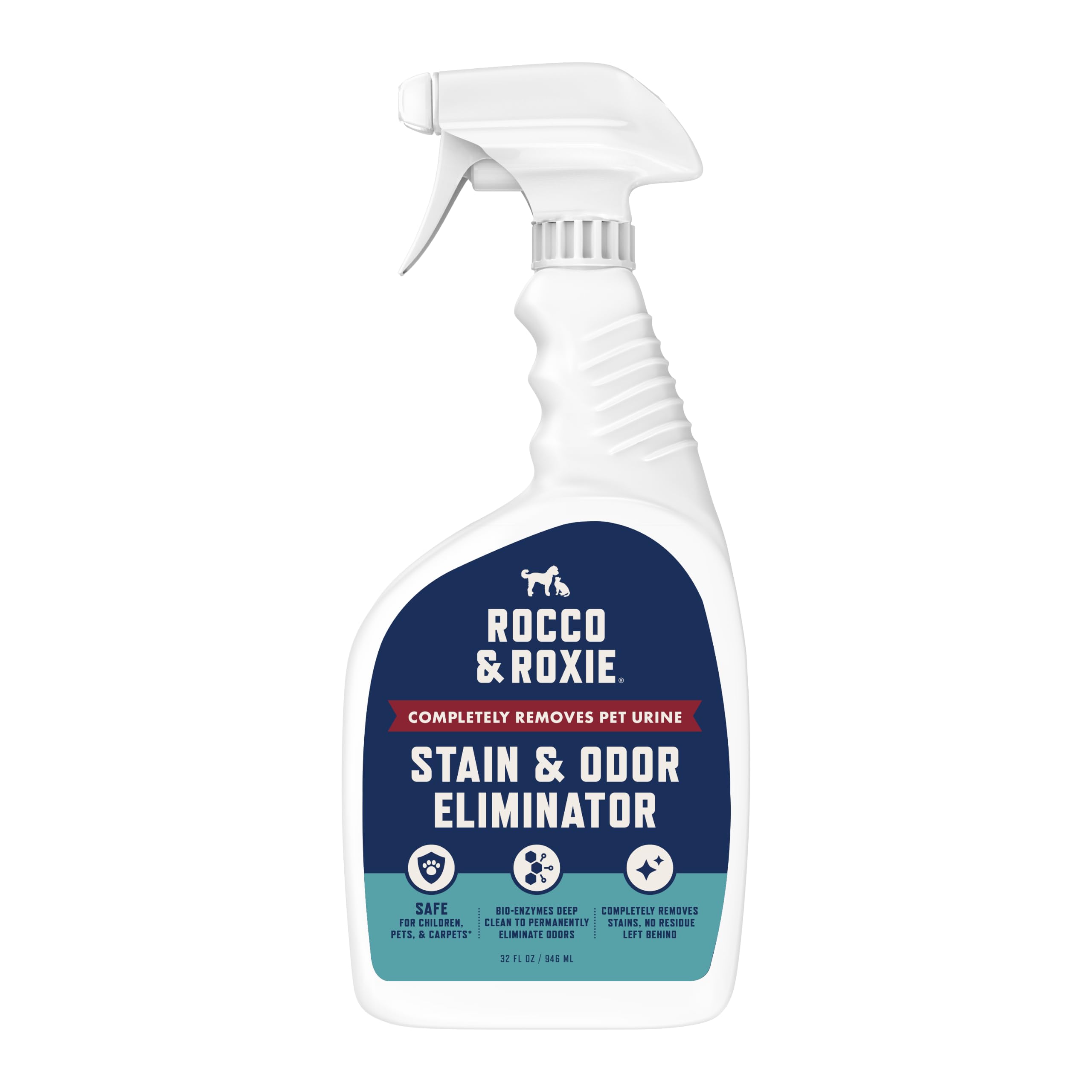
The bottle people reach for when the couch has smelled for a year and nothing else touched it.
This is the veteran of the group and the one with the deepest track record on the hardest jobs. It carries a Seal of Approval from the Carpet and Rug Institute and is certified safe for all carpets, chlorine-free, color-safe, and free of hazardous propellants or residue — a meaningful detail if you are spraying it near children or pets. The formula is bio-enzymatic, aimed at breaking down uric acid crystals so the odor is gone rather than hidden, and it is cleared for carpets, floors, furniture, clothing, litter boxes, kennels, carriers, and cars.
The place it earns its reputation is fabric that has been soaked for months. Buyers describe saturating the seams of a couch that had been marked a year and a half, letting the formula sit for three hours, pressing towels over it overnight, airing the room, then vacuuming — and the urine smell was simply gone with no stain left on a gray sofa. Others report the same on a leather chair’s comforter and on carpet that had already failed a professional cleaning. On hardwood it is safe to use, though it is still a spray — the same spot-treatment rules apply, and you should dry the area rather than leave it wet.
Two honest notes. The spray smell does mix with the urine odor for the first few minutes, so ventilate the room and expect that passing phase. And the price tag is the one point of friction: a genuine split among buyers, with some calling it absolutely worth the money and others feeling it is not. For a one-time rescue on a piece of furniture you were ready to replace, the math is easy — it costs far less than either the replacement or a professional cleaning.
The deep-soak method: saturate the seams, give it three hours, cover with towels overnight, air the room, then vacuum. That sequence is what turned a eighteen-month-old couch mark into a clean, odor-free cushion.
Ventilate first: the initial spray smell blends strongly with the urine odor before both clear, so open a window and give it a few hours.
Made for: rescuing one piece of furniture or a section of carpet that years of vinegar and shampooing failed to fix.
Worth knowing: the up-front cost is the recurring gripe, and the first few minutes of spray smell are strong before the room clears.
5. Simple Solution Hard Floor Stain & Odor Remover Gallon
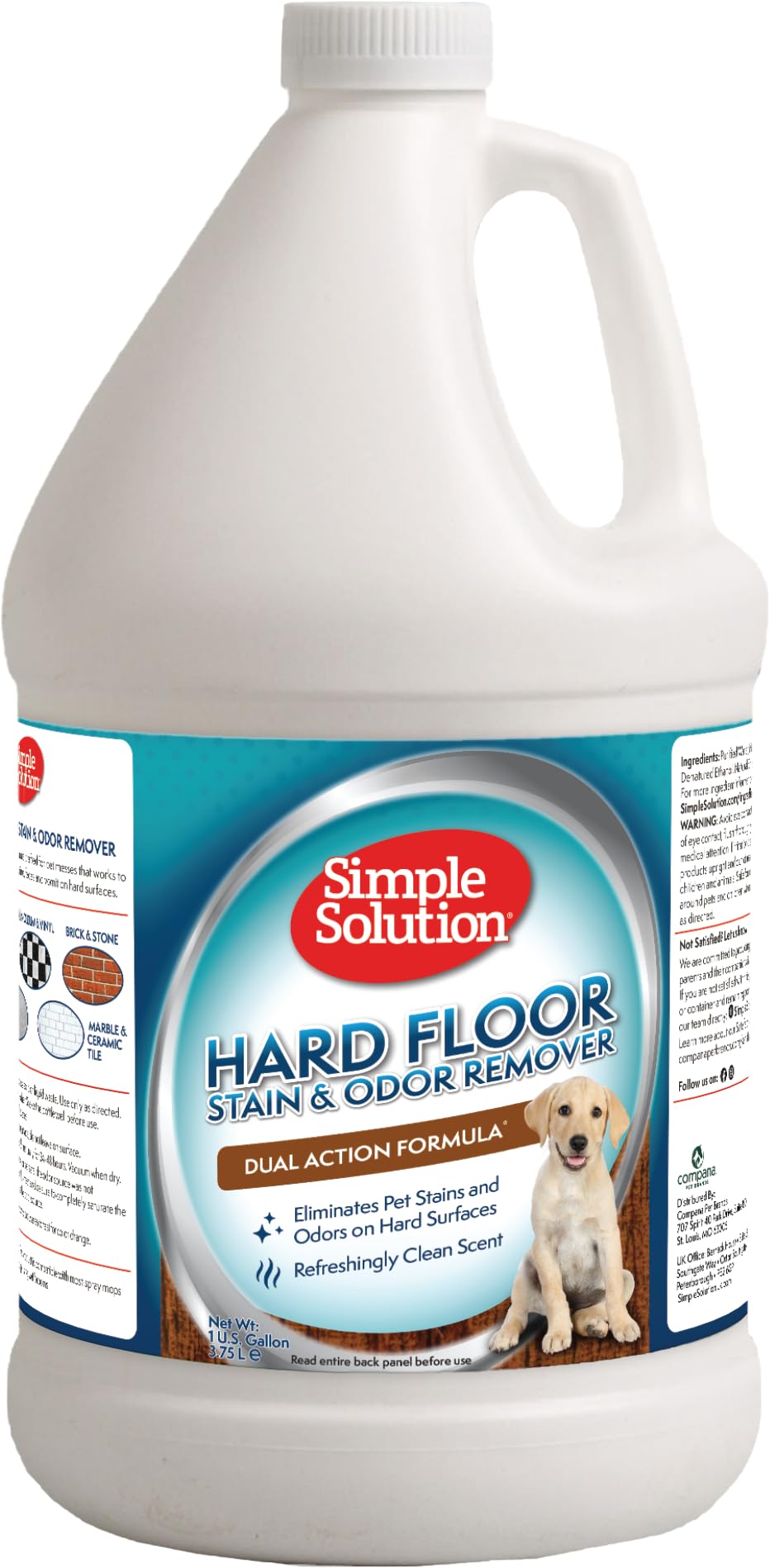
A gallon of hard-floor enzyme cleaner for the puppy-training months when the mess never stops.
One hundred twenty-eight fluid ounces in a single jug is what separates this from everything above. It is built specifically for sealed hardwood, stone, linoleum, vinyl, and other hard floors, with a dual-action enzyme formula that neutralizes pet odors and stains while also helping to prevent repeat markings. That second function is what suits potty training: the goal is not just to erase the spot, it is to stop your puppy from choosing that exact corner again.
It is a no-drama product in use. Buyers describe using it on little dog messes and finding no residue or buildup left on the floor, with no strong smell in the air either while spraying or after. It is also cruelty-free and scented lightly with citrus. For a hardwood floor, the residue-free detail is the one that protects your finish — a film left behind is what dulls the topcoat over time, and this one dries clean.
The honest limitation is worth knowing before you buy. It removes new and old pet stains easily, but it is better at stain removal than at completely erasing a deep odor — a faint trace can linger on an old porous spot, so treat this as your routine and potty-training jug, and keep a spot-specific enzyme bottle for the stubborn set-in jobs. Note as well: the sprayer is the weak point on the container, so keep a spare trigger on hand if you buy this size.
Why the gallon earns its shelf space: 128 fl oz of hard-floor cleaner means potty-training season does not run you dry in a fortnight, and the dual-action enzyme also helps discourage repeat marking in the same spot.
The trade-off to plan for: stains come out easily, but a stubborn old odor can leave a faint trace behind — this is the everyday routine jug, not the one-shot rescue bottle.
Reach for this if: you are in the middle of potty training and want a hard-floor cleaner you will not run out of.
Look elsewhere if: you need a deep-set old odor fully erased — pair it with a spot-specific enzyme spray for that job.
Know the Specs
Enzymatic vs. Masking Formulas
An enzyme cleaner contains enzymes — proteins that chemically break down uric acid crystals, the sticky residue left behind by pet urine. Ordinary all-purpose cleaners cannot touch those crystals, which is why a floor can smell clean right after mopping and start to smell again once it dries. Formulas described as enzymatic, bio-enzymatic, or dual-action enzyme are the ones doing this work rather than hiding the smell under perfume. The mixed feedback you will see on odor removal across these products tends to come from set-in stains and porous surfaces, where one soak is not always enough.
No-Rinse vs. Soak-and-Blott
Two different methods for two different jobs. A no-rinse mop solution is squirted onto a sealed floor and wiped up in a single pass — no rinse bucket, no standing water pushed into the seams. A spray and blot method is for spot treatment: spray the mark, allow the solution to soak up to one hour so it reaches the residue deep in the fibers or grain, then blot with a clean cloth and dry the surface. On hardwood, the rule to remember is that wet is fine, soaking is not — always dry the area afterward so moisture does not sit against the finish.
Common Questions
Can I use an enzyme cleaner on hardwood floors every day?
Will an enzyme cleaner damage my hardwood finish?
Does an enzyme cleaner really stop my pet from peeing in the same spot?
Should I use a mop solution or a spot spray for pet urine?
How long should I leave an enzyme spray on a stain before wiping?
Can I use these cleaners on other floors besides hardwood?
What scent do these enzyme cleaners leave behind?
Are enzyme cleaners safe around pets and children?
Why does a wood floor still smell after I mop with a regular cleaner?
How many uses will one bottle of concentrate give me?
The Bottom Line
For most pet households with hardwood, the enzyme cleaner for hardwood floors winner is the ANGRY ORANGE Hardwood Floor Cleaner because it takes the no-rinse route and never leaves water sitting in the plank seams. If you mop weekly and want the lowest cost per gallon, the NOYATECH concentrate gives you up to 16 gallons from one bottle. And if you are fighting a stain that has been on the couch for a year, the Rocco & Roxie is the one you soak into it. Across the review pages, the Rocco & Roxie rescue bottle carries the deepest verified-owner track record of the five.
How we choose
We do not accept paid placement. Every pick is matched to a real buyer and a real use-case; we do not hands-on test units.
Sources
Specifications: manufacturer listings and product documentation. Review insights: verified customer reviews, as of October 2026. Pricing: not shown on this page (it changes often); check the current price via the retailer link.
As an Amazon Associate, Aappliancez earns from qualifying purchases. This does not affect which products we feature.