Disclosure: Some links in this post are affiliate links. As an Amazon Associate I earn from qualifying purchases, at no extra cost to you. Learn more
Specs are compiled from manufacturer listings and verified buyer reviews and can change over time — please confirm the key details on the product page before buying.
You want the oil and caked grease off your engine bay without breaking a sweat, ruining your paint, or having a strong chemical smell hang around for a day. The five engine degreasers below all do that job in different ways, and the one I’d buy first is the 3D Grand Blast Engine Degreaser — the crowd favorite at 4.5+ stars across 1,100+ ratings, and the one that lets you spray, soak for a minute or two, and rinse off with a pressure washer.
This guide is built by comparing the manufacturers’ published specifications and the patterns across verified customer reviews, so you get each pick’s real strengths and trade-offs instead of marketing spin.
I’ve focused this list on what actually cuts engine grease, what’s safe on paint, plastic, and rubber, and how each formula is meant to be applied. By the end you’ll know which of these best engine degreasers fits your garage and how you plan to clean.
Top Picks


How To Choose The Best Engine Degreasers
Buying an engine degreaser is really a question of how you plan to apply it. If you have a pressure washer and a few minutes to wait, a liquid concentrate that you dilute into a sprayer gives you the most reach for the least effort. If you’re cleaning parts by hand in a bucket, a ready-to-use spray can that you can refill makes more sense. Check the label for the surfaces and dilution it’s built for before you buy.
Concentrate or ready-to-use
A concentrate lets you mix a weaker batch for delicate surfaces and a stronger batch for thick grime. That’s why one detailer dilutes to 33% and still gets good results on an engine bay and truck exterior. A ready-to-use spray saves mixing time but costs more per cleaning since you can’t stretch it with water.
Non-staining matters for your driveway
Many degreasers leave a dark residue on concrete after you rinse them off. Some formulas are specifically built to avoid that, and those are the ones worth looking for if you don’t want a permanent oil shadow on your driveway. Check whether the product description says “non-staining” before you buy.
Safe on paint, rubber, and plastic
An engine bay isn’t just metal. It has plastic covers, rubber hoses, and painted panels. A degreaser that says it’s safe on metal, plastic, paint, and rubber is a better bet for a complete engine bay than one that only mentions steel or concrete.
Side-by-Side Comparison
| Model | Best For | Form | Volume | Weight | Amazon |
|---|---|---|---|---|---|
| 3D Grand Blast★ Best Overall | All-around engine bay cleaning | Liquid concentrate | 1 gallon | 9.02 pounds | Amazon |
| Spray Nine Grez-OffBest Value | Parts washing and shop floors | Spray | 32 oz. | 16 ounces | Amazon |
| Adam’s All Purpose Cleaner | Dilutable all-surface detailer | Liquid concentrate | 16 oz. | 1.1 pounds | Amazon |
| Oil Eater Original | Floors, grills, and oil spots | Liquid concentrate | 32 oz. (2-pack) | 2 pounds | Amazon |
| 3D Yellow Degreaser | Wheels, tires, and whitewalls | Liquid spray | 16 oz. | 16 ounces | Amazon |
Detailed Reviews
1. 3D Grand Blast Engine Degreaser
Our pick — 4.5+★ from 1,000+ verified ratings; the strongest balance of quality and price.
The gallon jug that turns a filthy engine bay into a spotless one without a scrub brush.
You get a full gallon of liquid concentrate — that’s the whole reason this one tops the list. 3D designed it for engine bays, wheel wells, and undercarriages, and it’s safe on metal, plastic, paint, and rubber all at once. Because it’s a concentrate, you pour what you need into a sprayer, and a single jug lasts through several cleanings rather than one afternoon.
What wins people over is how little work you have to do once it’s on the engine — the effectiveness side of the formula is what owners rave about most, and it’s the thing to check first if you’re comparing. As buyers report: “Undiluted in pressure sprayer, 1-2 min soak, pressure wash rinse leaves engines spotless; oil/grime melts away, no brush needed, sometimes 2 applications for very dirty engines; no residue or after-smell.” That’s the ideal workflow: spray, wait a minute or two, hose it off.
The catch is concentration and smell. This is a powerful formula, so a few people find it needs a second pass on very dirty engines, and the odor is strong enough that you’ll want the garage door open. Expect it to weigh about 9.02 pounds in the shipping box — that’s a sturdy jug you’ll be lifting, not a light spray bottle. A budget 16-ounce bottle like Adam’s comes in at just 1.1 pounds by comparison, so this one is the heavy, long-lasting option.
Why It Earns Top Spot
- Gallon concentrate goes far across several engine bays
- Safe on metal, plastic, paint, and rubber
- Non-staining rinse with no residue left behind
What To Plan For
- Powerful odor means you need ventilation
- Very dirty engines can need a second application
Reach for this if: you own a pressure washer and want one jug that cleans engines, wheels, and exhaust tips.
Look elsewhere if: you’d rather have a small, light bottle for a one-off job.
2. Spray Nine 22732 Grez-Off Heavy Duty Degreaser
One 32-ounce spray bottle that dissolves years of stubborn grease for the price of a lunch.
This is the pick for parts washing and garage floors, not just engine bays. It’s a 32-ounce spray bottle of a nonflammable, non-acidic, biodegradable formula with no harsh petroleum solvents — that’s a mouthful, but it means no overpowering chemical fumes and no risk of burning a surface. It’s also USDA approved and VOC compliant in all 50 states.
The grease removal is the part that earns it a spot on this list. A little goes a long way — as owners mention, “After soaking or keeping wet for about 10 minutes, all the carbon and oil residue washed right off with water. No parts flash rusted afterwards.” It works on engines, machinery, tools, work benches, garage floors, and much more, so it’s the one to grab when the job isn’t just your car’s engine.
Here’s the honest trade-off: it’s not magic on every surface. On thick, dried-up old grease, you should plan to soak longer than 10 minutes or help it with a wire brush, and it may take two treatments on a never-cleaned engine before it looks right. It’s also a spray, not a concentrate, so if you want to dilute a batch for a bigger job, you’re better off with the 3D Grand Blast above.
Where the value lives: a 32-ounce bottle at a budget-friendly price that stretches across multiple jobs, with no noxious fumes and no staining on your driveway.
The honest limit: heavy old grease needs more soak time and a brush, so a thorough clean is a two-step process, not a one-spray job.
The pick for: home mechanics who clean parts, tools, and floors with the same bottle.
The wrong match: anyone expecting to blast dried-on grease off a farm engine with one quick spray.
3. Adam’s All Purpose Cleaner (16oz)

The friendly-scented all-rounder that cuts through engine grease in a compact bottle.
What sets this one apart is how far it dilutes. Adam’s says the formula can be diluted up to 90% for gentle applications, so one 16-ounce bottle stretches a long way. At full strength it cuts heavy grease; mixed down it’s meant for sensitive surfaces like body panels, carpet, and upholstery. So it handles engine bays and interior detailing from the same bottle.
The cleaning performance is clearly what keeps people coming back — the thing buyers rave about most is how much grime it lifts, and it’s the reason a white-rimmed Honda Civic came back to clean this time. It’s also got a mildly sweet smell rather than a harsh chemical sting, which is a real plus for detailers working in a small garage. It’s small and light at 1.1 pounds, so it stores easily on a shelf.
One thing to watch: at full strength it can leave stains if you don’t wipe it off promptly, so follow the direction label. It’s also a bit more aggressive than the mild-mannered name suggests — treat it with the same care you’d give any heavy degreaser. Budget-friendly compared to the gallon option, but you get a much smaller bottle for it.
What Customers Praise
- Scent is noticeably mild, not chemical-heavy
- Dilutes up to 90% for gentle surfaces
- Full strength cuts heavy engine-bay grease and dirt
Where It Requires Care
- Must be wiped promptly at full strength to avoid stains
- Small 16-ounce bottle runs out faster than a gallon
Go with this: if you detail both interior and engine bay and want one mild-smelling bottle for both.
Pass on it: if your priority is a single large jug for repeated full-strength engine work.
4. Oil Eater Original 32 oz (2-Pack)

A two-bottle concentrate built for driveways, grills, and greasy floors as much as engine bays.
You get two 32-ounce bottles of a biodegradable, noncorrosive formula with no harsh solvents — the standout being that it’s USDA approved for use in food service facilities. It cleans kitchens, patios, floors, vehicles, grills, and engine parts, so it’s the most crossover-capable pick here. The directions tell you to use it full strength on engine parts and dilute it for lighter jobs.
The thing everyone raves about is how easily it dissolves greasiness — a little goes a long way. As one professional engine builder’s routine shows, full strength gets used on engine parts with a brush, hot-water rinse, and a quick spray of WD40 afterward, and it also works on installed engines with a rag and a hot-water jet. Just keep it off the air inlet, vents, ignition, and electrical parts.
The honest fit note: quality opinions are genuinely divided on this one. Some find it the best degreaser they’ve tried and others find it only partially effective on old oil stains, especially on driveways. If you want a sure thing on a deep oil stain, this may not finish the job on the first try — but on food-service floors and greasy grills it earns its keep. It’s a strong option for a household that also does a lot of garage-floor and patio cleaning.
The real-world edge: USDA-approved for food-service use and safe enough for grills, kitchens, and floors alongside your engine work.
Honest fit note: on old established oil stains, results are inconsistent — some jobs need a second pass or a different product.
Suits: the household that wants one concentrate for engine parts, grills, and concrete floors.
Not the one for: a guaranteed single-pass result on a stubborn old oil stain.
5. 3D Yellow Degreaser – Non-Acid Wheel & Tire Cleaner Spray
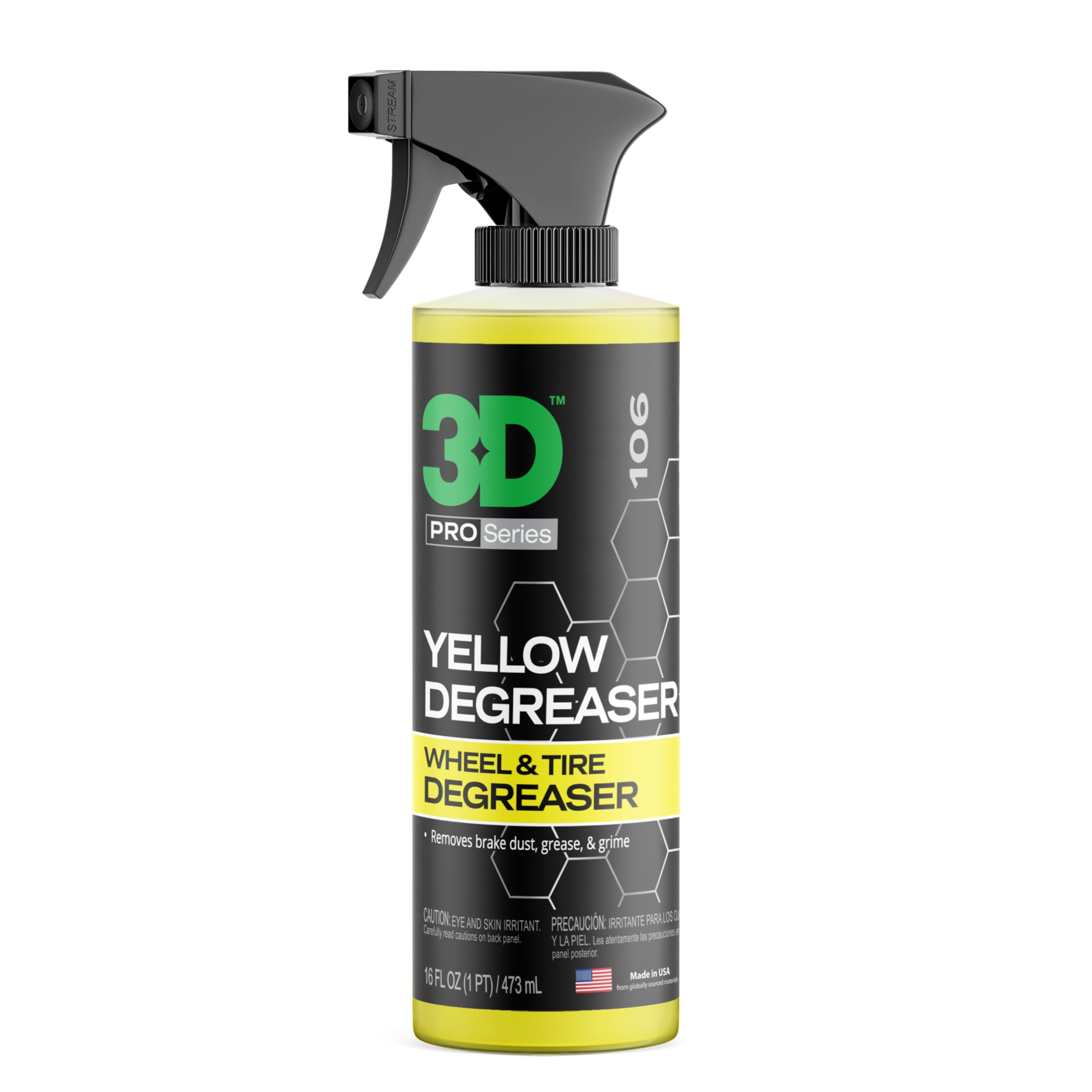
The wheel-and-tire specialist that melts brake dust and revives whitewalls without an acid burn.
This one is aimed squarely at wheels and tires, not the engine bay itself. Its acid-free formula breaks down brake dust, silicone residue, road grime, and old tire dressings, and it’s safe for chrome, painted, polished, and other wheel finishes. It’s also unscented and biodegradable, so it won’t leave a chemical smell behind like the heavier engine degreasers do. It can even do double duty on an engine bay — the wheel-and-tire formula is versatile enough to handle both.
What makes it stand out is that it tackles the oily bond between metallic brake dust and the wheel, so you can spray, agitate lightly, rinse, and see a clean finish. A detailer used it on both scrubbed and unscrubbed wheels and got the same result either way, though a pump sprayer beats a basic spray bottle for even coverage. It’s also the pick for reviving neglected white letters and walls, since it lifts old tire shine and leaves the rubber looking fresh.
The honest caveat: it’s not a universal cleaner. Some users find it does no better than simple car soap on regular dirt, and on truly caked-on dust you’ll still need a brush. If your engine bay is the main mess and you want one product for everything, a concentrate like the 3D Grand Blast is the better buy. But for wheels, whitewalls, and tires, this is the one to reach for.
The Case For It
- Acid-free and safe on chrome, painted, and polished wheels
- Lifts old tire dressings so whitewalls look fresh again
- Unscented, so no lingering chemical smell
Limits To Know
- On caked dust it still needs a brush
- Some find it no better than plain car soap on light dirt
Best pick for: anyone fighting BMW-grade brake dust and dull whitewalls.
Think again if: your main goal is engine-bay cleaning rather than wheels and tires.
Know the Specs
Concentrate vs. Ready-to-Use
A concentrate is a formula you mix with water before use, so you control how strong it is. It’s cheaper per cleaning because one bottle makes several batches. A ready-to-use spray is already mixed, which saves time but costs more per job. If you clean your engine more than once a year, a concentrate’s per-batch cost beats a ready-to-use spray.
What “Non-Staining” Means
Some degreasers leave a dark residue on concrete or paint after you rinse them off. A non-staining formula is one designed to avoid that, so your driveway or wheel finish doesn’t turn permanently dirty. That one word on the label is what keeps a dark oil shadow off your concrete.
Dilution Ratios
A dilution ratio tells you how much water to add. A formula you can dilute up to 90% is mostly water at that point, making it gentle enough for sensitive surfaces like carpet or interior panels. Full strength is what you use on engine grease. A formula that works at both full strength and 90% dilution covers engine grease and interior panels from one bottle.
Acid-Free vs. Acidic
Acidic cleaners cut heavy buildup fast, but they can dull chrome or painted wheels if left too long. An acid-free wheel cleaner does the same job more gently, which is why it’s the safer choice for alloy rims and whitewalls you care about.
Common Questions
Do I have to cover electrical parts before spraying a degreaser on my engine?
Can I dilute an engine degreaser to make it last longer?
Will a degreaser damage my car’s paint or clear coat?
How long should I let a degreaser sit on a greasy engine?
Is a wheel and tire cleaner the same as an engine degreaser?
Do these degreasers stain concrete driveways?
Can I use these degreasers on a hot engine?
Are these degreasers safe for aluminum engine parts?
How do I dispose of dirty degreaser runoff after cleaning my engine?
The Bottom Line
For most people buying an engine degreaser, the winner is the 3D Grand Blast Engine Degreaser — a gallon of concentrate that’s safe on metal, plastic, paint, and rubber, and rinses clean after a short soak. If you want a single spray bottle for parts and floors, the Spray Nine Grez-Off is the value pick. And if your mess is mostly brake dust and whitewalls, the acid-free 3D Yellow Degreaser is built for exactly that. Pick the one that matches how you actually clean — pressure washer and concentrate, or a spray bottle for parts and floors.
How we choose
We do not accept paid placement. Every pick is matched to a real buyer and a real use-case; we do not hands-on test units.
Sources
Specifications: manufacturer listings and product documentation. Review insights: verified customer reviews, as of October 2026. Pricing: not shown on this page (it changes often); check the current price via the retailer link.
As an Amazon Associate, Aappliancez earns from qualifying purchases. This does not affect which products we feature.