Disclosure: Some links in this post are affiliate links. As an Amazon Associate I earn from qualifying purchases, at no extra cost to you. Learn more
Specs are compiled from manufacturer listings and verified buyer reviews and can change over time — please confirm the key details on the product page before buying.
If your electric bill spikes every summer, the culprit is often the fan you leave running all night. An energy efficient fan fixes that by moving serious air while drawing a fraction of the power a standard AC fan gulps down. The trick is knowing which motors, speeds, and airflow ratings actually deliver that savings in a real bedroom or living room, not just on a spec sheet.
This guide is built by comparing the manufacturers’ published specifications and the patterns across verified customer reviews, so you get each pick’s real strengths and trade-offs instead of marketing spin.
You will see which motors slash running costs, why airflow ratings matter more than blade count, and how quiet a fan can stay while still cooling a whole room. Here is a clear, no-nonsense walkthrough of the strongest energy efficient fans worth your money right now.
Top Picks

How To Choose The Best Energy Efficient Fans
The biggest money decision is the motor, and the second is how much air it actually pushes. Everything else — blade count, remote control, oscillation — is comfort frosting on top. Get these two right and you will cut your summer running costs without sacrificing a decent breeze.
DC vs AC motor: where the savings hide
A DC motor (a motor that runs on direct current and wastes less energy as heat) is the single clearest efficiency upgrade you can buy. These fans typically run on a fraction of the watts a traditional AC fan needs, and because they waste less power as heat, they also run cooler and quieter. You will notice the difference most on low settings, where a DC fan can sip just a couple of watts for hours while you sleep.
Read the airflow number, not the blade count
Airflow is the real proof of cooling power. It shows up as CFM (cubic feet per minute — how much air moves past a point) or ft/s (feet per second — how fast the breeze travels). A higher airflow number means the fan can cool a bigger space. A high blade count with weak airflow just means more parts spinning for less reward.
Quiet matters more than you think
If you want to sleep or watch TV with the fan running, the noise level decides whether that works. Noise is measured in decibels (dB) — a unit that tells you how loud a sound is. A fan rated around 20 to 28 dB at its lowest setting is quieter than a whisper, so it will not keep you awake at the bedside. High settings on almost any fan get louder, so look for variable speed control (a dial that lets you set any speed, not just a few fixed ones) so you can find the balance between airflow and noise.
Match the fan to the room it will cool
A compact desk fan is the right call for a dorm or office, while a standing or ceiling model handles a living room or master bedroom. Ceiling fans move the most air overall and can run in reverse for winter, pulling warm air down from the ceiling. Desk and tower fans trade total room coverage for portability and a smaller footprint.
Side-by-Side Comparison
| Model | Best For | Motor / Power | Airflow | Noise / Speeds | Amazon |
|---|---|---|---|---|---|
| Vornado 610DC★ Best Overall | Whole-room circulation | DC motor | Up to 80 ft throw | Near-silent low | Amazon |
| DREO Smart Ceiling FanMost Powerful | Whole-room ceiling mount | DC motor | Up to 6000 CFM | 22 dB min, 12 speeds | Amazon |
| COMFORT ZONE 32″ Tower | Budget small spaces | Standard motor | Not listed | 3 speeds | Amazon |
| Levoit Tower Fan | Bedside & small rooms | DC motor, max 7.5W | 23 ft/s | 20–43 dB, 5+Turbo | Amazon |
| IRIS USA WOOZOO Desk | Desks & dorms | Standard AC motor | 36 cfm | 28.2 dB low, 3 speeds | Amazon |
| Amazon Basics 16″ Standing | Medium to large rooms | DC motor, 28W | 16″ fan head | 12 speeds, 3 modes | Amazon |
| IRIS USA WOOZOO Circulator | Tabletop & floor | Standard AC motor | 348 cfm | Quiet, 3 speeds | Amazon |
Detailed Reviews
1. Vornado 610DC Energy Smart Air Circulator Fan
Our pick — over 4.5★ from 950+ verified ratings; the strongest balance of quality and price.
The circulator that keeps a whole room moving on pocket-change power
This is the fan to buy if you want one unit that quietly cools an entire room and barely touches the meter. At its core sits a brushless DC motor (a motor that uses direct current and wastes far less energy as heat), paired with Vornado’s signature Vortex air circulation design. That combination is why it moves air up to 80 feet, so a single placement can reach across a living room instead of just blasting one spot. The adjustable tilt head lets you aim that column exactly where you want it.
The variable speed control sits on the base, and it is a true dial rather than a handful of fixed clicks. That matters because you can fine-tune down to a near-silent whir for sleeping, then crank it up when the afternoon heat rolls in. Buyers report the payoff in real numbers — one owner cut their electric bill by letting the thermostat stay higher. It also cleared 780 square feet of smoke in 10 minutes on max, proof of how much air it moves. What wins people over most is the silence at low speeds, and the sturdy airflow backs it up.
The trade-off is real but small. This fan leans toward the premium end of the category, and some shoppers feel the asking amount is steep for a single circulator. One unit also developed a knocking motor after three months, though the company replaced it promptly under the five-year warranty. Compare the footprint to the Levoit tower: the Vornado measures 8.7″D x 12.1″W x 13.7″H against the Levoit’s 5″D x 5″W x 13″H, so the Vornado takes noticeably more surface space in exchange for that wider air column. The dial and DC efficiency are what you are paying for.
What earns it the top spot
- Variable DC motor runs near-silent on low and cuts running cost hard
- Vortex design throws air up to 80 feet for whole-room coverage
- Real owner savings: lower monthly electric bills by raising the thermostat
- Five-year replacement warranty and adjustable tilt head
Where it asks you to compromise
- Priced at the premium end for a single circulator
- No mounting holes; one buyer used conduit straps to wall-mount it
- Bigger footprint than a slim tower fan
Buy it if: you want one premium circulator that can quiet down for sleep and still empty a room of heat on max.
Look elsewhere if: you need a slim tower to tuck into a tight corner, or you want the lowest possible entry amount.
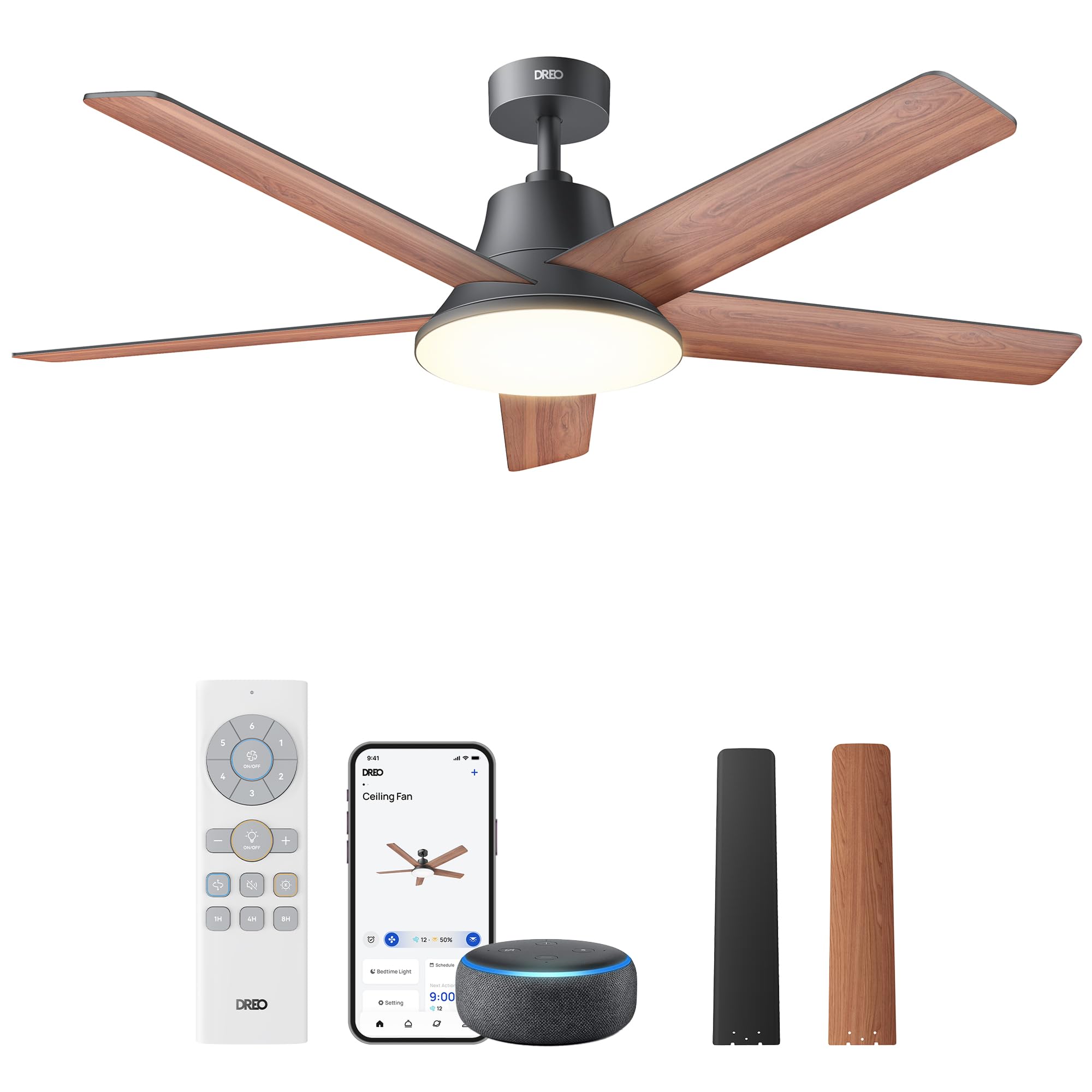
2. DREO Smart Ceiling Fan with Lights, 52 Inch
A ceiling fan that cools the whole room and runs quieter than a whisper
If you want the most raw air movement on this list, this is it. The DREO pushes up to 6000 CFM (cubic feet per minute, the volume of air it moves), which is whole-room scale rather than a personal breeze. A 52-inch fan with 14-degree angled blades does the heavy lifting, and the brushless DC motor keeps it smooth. It runs as low as 22 dB, which is below the noise of a quiet library, so it disappears into the background even on a bedroom ceiling.
What sets this pick apart is the control freedom. You get 12 speed levels and three wind modes through the DREO app, plus Alexa and Google Home voice control and a physical remote. The integrated LED light is as bright as a 24W bulb, and you can dial brightness from 1% to 100% and shift color temperature from 2700K warm yellow to 6500K cool white. For winter, one touch flips the airflow direction upward so it circulates warm air back down. One user raised their AC setting entirely because of it.
Here is the catch worth knowing before you buy. This is a ceiling-mount fan, so it needs a working electrical junction box and a bit of install confidence, though buyers describe the included video as accurate and the pairing as quick. A couple of minor gripes surface: the light can feel bright on its lowest app-free setting and dims in six steps from the remote, and the color reads taupe rather than the silver some expected. For a small bedroom that only needs a personal breeze, a compact desk fan is the smarter spend.
Airflow leader: at 6000 CFM with 12 speeds, nothing else here covers a room this thoroughly, and the 22 dB floor keeps it bedroom-friendly.
Smart bonus: app, remote, and voice control plus a dimmable LED make it the most flexible pick for a living room or loft.
The right fit: a bedroom, loft, or living room where you want ceiling-mount reach and hands-free control.
Think twice if: you rent, or your ceiling has no junction box, since this one installs permanently overhead.
3. Levoit Tower Fan for Bedroom, 20dB Quiet Desk Fan
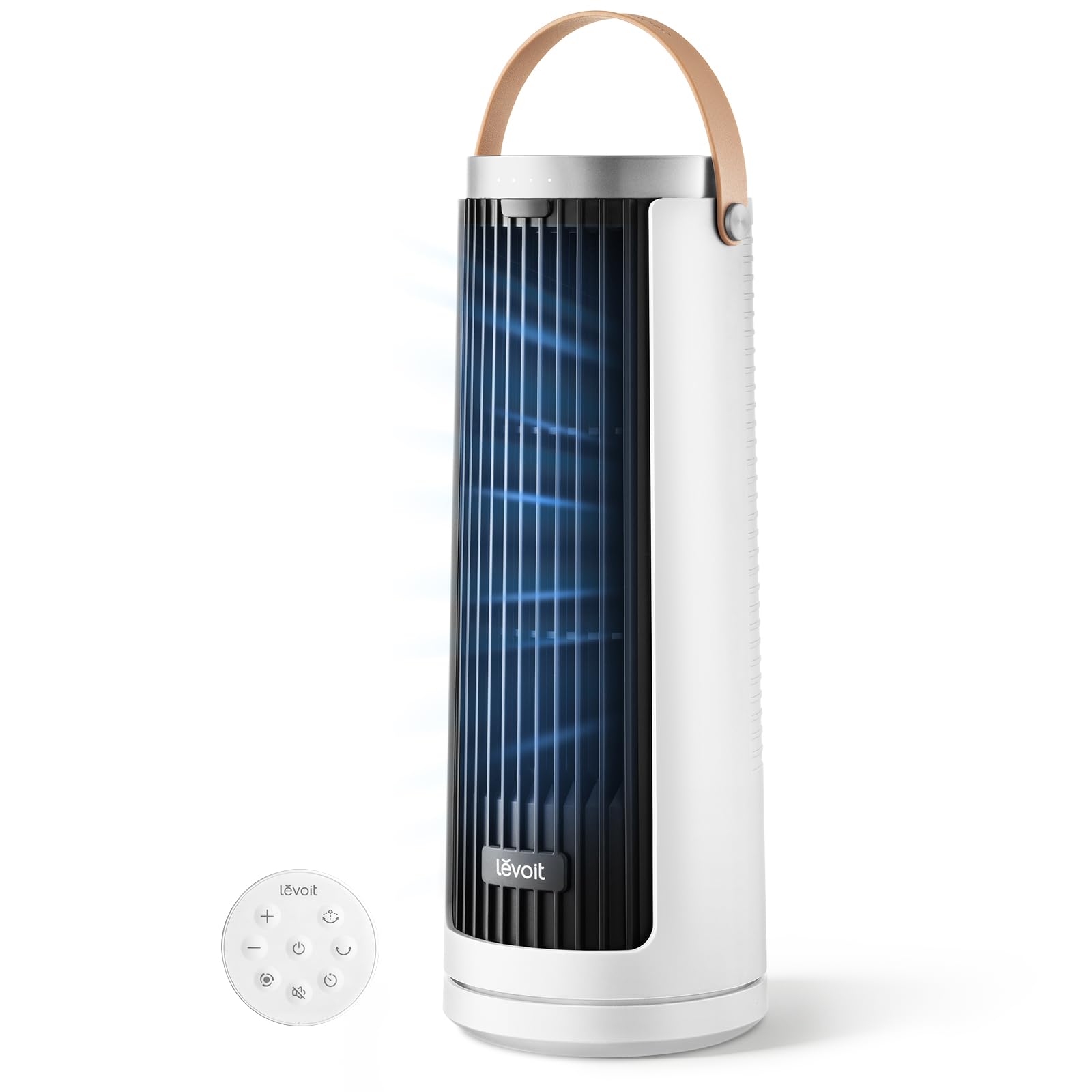
The whisper-quiet bedside companion that sips just 7.5 watts
For a nightstand or a cramped dorm desk, the number that matters most is electricity draw, and this Levoit tops out at just 7.5 watts. A DC motor with VortexAir technology delivers a strong focused breeze at up to 23 ft/s while staying quiet, ranging from 20 to 43 dB across its speeds. It stands only 5″D x 5″W x 13″H, so it slides onto a windowsill or a small shelf where a full-size fan never could.
You get five fan speeds plus an extra Turbo setting, and the oscillation is unusually flexible — set it to 30, 60, or 90 degrees depending on how wide you want the air to sweep. There is a sleep mode, a temperature sensor, and a remote so you can adjust everything from bed. Just know it needs a wall outlet at all times, since it is not cordless despite the portable size. Buyers find it lands perfectly as a bedside cooler that fits where bigger fans cannot.
The honest limit is coverage. This is a small-space fan, and one buyer found it was not enough to chill a large west-facing bedroom alone. If your room is big, budget for a circulator instead. On low settings, though, the noise nearly vanishes, so it never interrupts sleep. Compare the compact footprint to the Vornado’s wider 8.7″D x 12.1″W x 13.7″H body — this Levoit is the clear pick when shelf space is scarce.
Low-power champ: 7.5 watts max and a 20 dB floor make this the easiest fan to leave running all night without guilt or noise.
Setup note: it must stay plugged in, so plan its spot near an outlet rather than treating it as a carry-anywhere fan.
Pick this: for a bedside table, dorm desk, or small office where quiet and low wattage beat maximum airflow.
Pass if: you need to cool a large bedroom on its own, or you want a fan you can move without a cord.
4. Amazon Basics 16-inch Quiet DC Motor Standing Floor Fan

The budget standing fan that runs for days on a solar generator
Here is the value play for a medium to large room. The DC motor pulls just 28W while pushing a 16-inch head across the space, and owners mention it runs for days on a solar generator, a real-world sign of its low power draw. A dual-tier blade system with 10 total blades creates a softer, more natural breeze than a standard fan’s mechanical blast. The height adjusts from 44.4 to 53.1 inches, and the tilting head lets you aim the airflow where you need it.
Control is generous for the category: 12 speed settings, three modes (Nature, Sleep, and Normal), a timer, and a remote paired with a digital touchscreen. The easy assembly and the heavy, stable stand come up again and again as reasons owners buy a second unit. On low speeds it stays quiet enough for TV or music, and even a mid setting is described as fine for both.
The catch is durability, and it is worth weighing honestly. Some units stop working after a stretch of months, and the speed wheel loops back to low past its top setting instead of stopping at max. The remote is infrared, so you have to aim it at the display, and its beep can be turned off via the instructions if it bothers you. For the amount you pay for a 16-inch DC standing fan, though, it is a lot of airflow and control for the money.
Why the price makes sense
- 28W DC motor runs for days on a solar generator
- 12 speeds, 3 modes, timer, and remote included
- Adjustable height from 44.4 to 53.1 inches
- Soft dual-tier blade breeze instead of a harsh stream
What to keep in mind
- Some units stop working within months
- Speed wheel loops back to low past the top setting
- Infrared remote needs a direct aim at the display
Worth grabbing if: you want full-size airflow and 12 speeds for a low entry amount, and you value a stable, tall stand.
Consider skipping if: you need a fan built to run for many years without a hiccup, since a few units fail early.
5. IRIS USA WOOZOO Air Circulator Fan with Remote
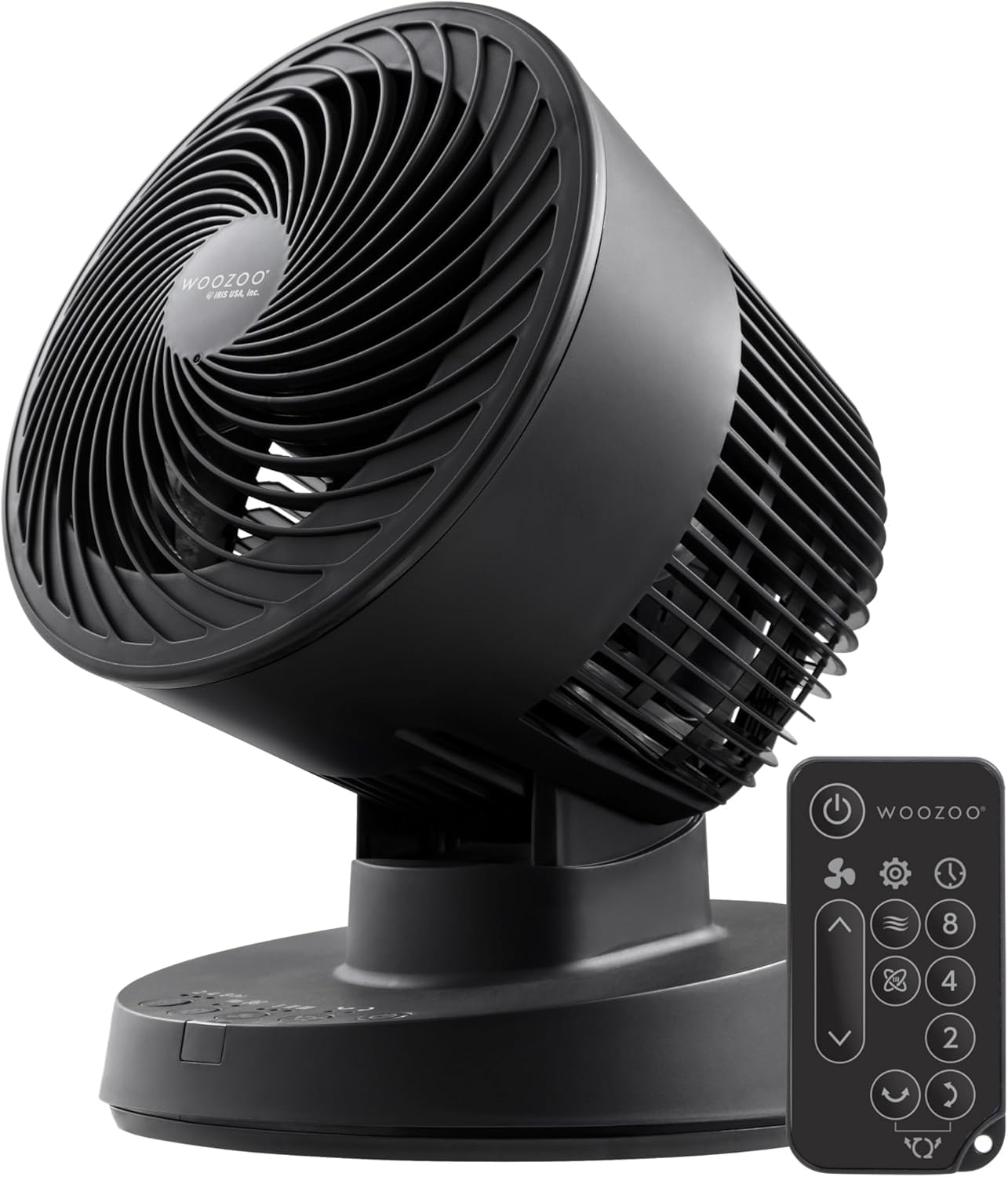
A small-footprint circulator that covers up to 348 square feet
Do not let the size fool you — this WOOZOO moves serious air for a tabletop unit. Its airflow rating reaches 348 cfm with coverage up to 348 square feet, and the deep-pitch blades push a breeze up to 56 feet. Oscillation is the standout: 90 degrees horizontally and 72 degrees vertically, plus a manual tilt, so the air fans out and reaches the corners of a room rather than just one spot. It stands only 8.74″L x 8.26″W x 11.65″H, making it easy to tuck onto a desk or the floor.
Three speed settings cover a gentle breeze up to strong circulation, and the included remote adds an auto-off timer plus control over the oscillation directions. Owners love it for dorm rooms and bedrooms, and the durability stories are reassuring — some units keep working for up to three years, surviving a couple of college semesters before needing a replacement. It is light, portable, and easy to move between rooms.
The main consideration is that it runs on a standard AC plug with a standard motor, so it will not match the rock-bottom wattage of the DC fans on this list. It is also a tabletop circulator, not a whole-home ceiling solution, so keep your space size in mind. For a dorm or small room where compact size and wide oscillation matter most, it is a strong fit.
Coverage standout: 348 cfm and up to 348 sq ft of reach from a body under a foot tall, backed by dual-axis oscillation.
Longevity story: customers note units running for up to three years, some outlasting multiple college semesters.
Reach for this if: you want wide two-directional airflow in a dorm, office, or small bedroom without giving up desk space.
Keep looking if: you are chasing the lowest possible wattage, since this uses a standard AC motor rather than a DC one.
6. IRIS USA WOOZOO Medium Desk Fan, Oscillating, 112° Tilt

A desk-size WOOZOO that stays quieter than a whisper and follows you room to room
For a desk, a dorm, or a small room without AC, this compact WOOZOO is built to sit close and stay quiet. It runs at just 28.2 dB at its lowest setting — genuinely quieter than a whisper — and pushes 36 cfm through deep-pitch blades and a spiral grid that shapes the airflow. The head tilts across six angles and oscillates 65 degrees, so you can point the breeze exactly at your face or sweep it across the room. At 3.5 pounds with a built-in handle, it moves from desk to floor without effort.
Three speed levels take it from a light breeze to a strong gust, all on the push of a button. Owners put it to work in plenty of creative spots — it handles office desks, kitchen counters, and even defogging a bathroom mirror. The quality is the thing people trust most, and it is described as sturdy and reliable, with units still going strong after a year of daily use. It is a favorite for college dorms because it fits small spaces and travels easily.
The honest caveat is that 36 cfm (cubic feet per minute — a measure of how much air the fan moves) is a personal breeze, not whole-room cooling. If you need to drop the temperature in a larger space, a circulator or ceiling fan does that better. But for a focused, near-silent airflow right where you sit, this desk fan is tough to top for its size, and its portability means it earns its place on any desk.
Quiet-and-close: at 28.2 dB it beats a whisper, and the 65-degree oscillation covers a desk or counter neatly.
Built to travel: 3.5 lbs with a handle means it follows you from office to bedroom to dorm.
Ideal for: anyone who wants near-silent, focused airflow on a desk, counter, or dorm shelf.
Not the pick if: you need to cool a larger living space, since 36 cfm stays a personal breeze.
7. COMFORT ZONE 32″ Oscillating Tower Fan with Bladeless Design
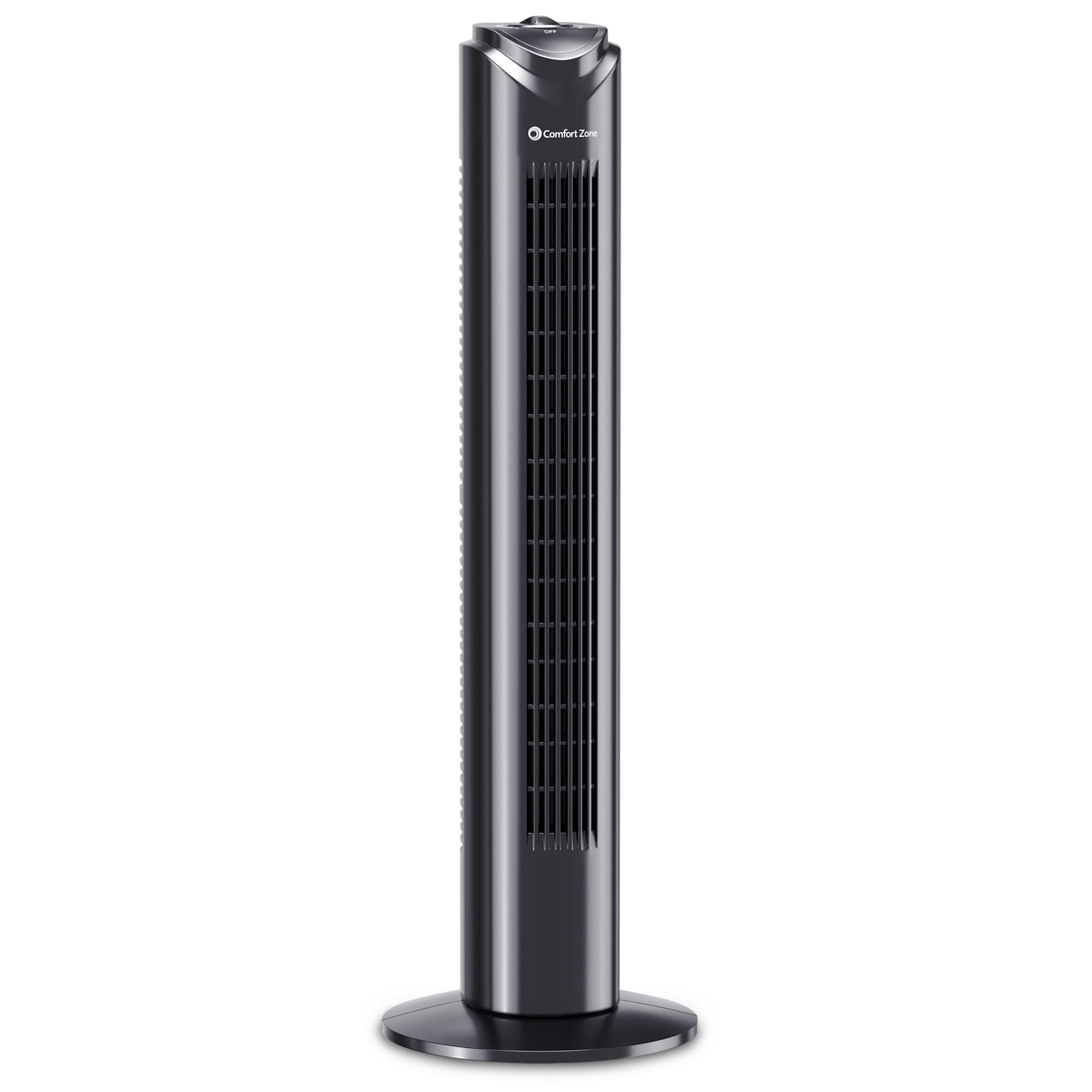
The slim, bladeless tower that squeezes into tight corners for very little money
If floor space is tight and you want the lowest entry amount on this list, this slim tower earns a look. The 32-inch bladeless design (no exposed spinning blades) keeps fingers and paws safely away, which matters in homes with kids or pets. It stands 8″D x 8″W x 32″H, so it tucks into a corner and saves floor space, and a 90-degree oscillation sweeps air across the room on all three speeds. A top-mounted knob handles both speed and oscillation, and there is a built-in carry handle for moving it between rooms.
It is also ETL certified and ships with a safety plug that guards against voltage overloads. Assembling it is quick and simple, and for small spaces — an apartment or a dorm corner — it delivers a surprising amount of air. Owners who use it in compact rooms find it cools well and circulates nicely.
The trade-off is real and it is the loudest note in the reviews. On the top speed, buyers compare it to a much louder fan, with TV volume needing to climb to compensate. A few units arrived with weak assembly parts or a loose knob. It is best thought of as a small-room companion rather than a whole-house cooler — if your space is bigger than a bedroom, a higher-airflow fan serves you better.
The budget appeal
- Slim 32-inch bladeless tower saves floor space
- 90-degree oscillation on all three speeds
- ETL certified with a fused safety plug
- Built-in carry handle and simple knob control
The honest trade-offs
- Top speed runs loud — much louder than the quiet fans here
- Occasional units arrive with a loose knob or weak base clamp
- Best suited to small rooms, not large spaces
Good match for: a tight apartment corner or dorm where space and budget are the priorities.
Not for you if: quiet operation matters most, since its top speed gets noisy.
Know the Specs
DC vs AC motor
A DC motor runs on direct current and wastes less energy as heat, so it typically draws far fewer watts than an AC fan and stays cooler and quieter while running. On this list, the Levoit’s DC motor tops out at 7.5W and the Amazon Basics draws 28W. If low running cost is your goal, a DC motor is the spec to hunt for.
Airflow in CFM and ft/s
CFM (cubic feet per minute) tells you how much air volume a fan moves, and it is the clearest sign of how large a space it can cool. The DREO ceiling fan reaches up to 6000 CFM, while the WOOZOO circulator hits 348 cfm. A higher number means broader room coverage; ft/s instead measures how fast the breeze travels.
Decibels and sleep
Noise is measured in decibels (dB), and the lower the number, the less you notice the fan. The Levoit spans 20–43 dB, the DREO runs as low as 22 dB, and the WOOZOO desk fan sits at 28.2 dB. Anything hovering around 20 to 28 dB at the lowest setting tends to disappear at night, so you can sleep or watch TV without distraction.
Oscillation and speed control
Oscillation spreads air across a wider area instead of one fixed point. The Levoit lets you choose 30, 60, or 90 degrees; the WOOZOO circulator does 90 degrees horizontally and 72 vertically. Variable speed control matters just as much, because it lets you dial in the exact balance of airflow and quiet you want rather than picking from a couple of fixed clicks.
Common Questions
Do DC motor fans really use less electricity than AC fans?
How quiet is a fan that is rated around 20 to 28 dB?
Will a compact desk fan cool a whole bedroom?
What does CFM mean and why does it matter when choosing a fan?
Can I run an energy efficient fan all night without worrying about the bill?
Is a ceiling fan better than a standing or desk fan for saving energy?
Do these fans need to stay plugged in or are any battery powered?
How do I stop a fan from waking me up at night?
What fan size fits a dorm room or small apartment?
Should I look for a warranty when buying an energy efficient fan?
The Bottom Line
For most rooms, the energy efficient fans pick is the Vornado 610DC, because its DC motor slashes running cost while the Vortex design throws air up to 80 feet for whole-room comfort. If you want the most airflow and hands-free control, grab the DREO Smart Ceiling Fan and its 6000 CFM ceiling reach. And for a bedside that needs near-silent, low-wattage cooling, the Levoit Tower Fan at 7.5W is the one to reach for. With so many buyers choosing the Vornado and the DREO, either is a confident place to start — just match the airflow number and the decibel floor to the room you actually have.
How we choose
We do not accept paid placement. Every pick is matched to a real buyer and a real use-case; we do not hands-on test units.
Sources
Specifications: manufacturer listings and product documentation. Review insights: verified customer reviews, as of October 2026. Pricing: not shown on this page (it changes often); check the current price via the retailer link.
As an Amazon Associate, Aappliancez earns from qualifying purchases. This does not affect which products we feature.