Disclosure: Some links in this post are affiliate links. As an Amazon Associate I earn from qualifying purchases, at no extra cost to you. Learn more
Specs are compiled from manufacturer listings and verified buyer reviews and can change over time — please confirm the key details on the product page before buying.
The hardest part of end-of-life planning is not dying — it is the paper trail your family has to sort out afterward. A good planner turns a cabinet of unlabeled envelopes into one book your family can open and follow. Below you will find the five picks worth your money, ranked by how much they actually help the person left holding the folder.
This guide is built by comparing the manufacturers’ published specifications and the patterns across verified customer reviews, so you get each pick’s real strengths and trade-offs instead of marketing spin.
Each pick below is a workbook, not a legal document, so it works best as a companion to a will or trust. Read on for the end of life planners that keep your wishes, accounts, and final instructions in one place.
Top Picks
How To Choose The Best End of Life Planners
You are not shopping for stationery. You are buying a working document your spouse, your adult children, or your executor will use while stressed and grieving. That changes what matters: a clean layout beats a pretty cover, and enough writing space beats a clever name.
Start with the sections, not the cover
A complete planner walks through four clusters: legal and financial details, medical information, digital accounts and passwords, and personal messages or funeral preferences. Count the sections before you buy. A book with 16 tabbed sections covers the essentials; one with 23 sections leaves room for the odd detail, like what to do with the heirloom silverware.
Paper weight and binding decide whether you will actually finish it
Paper weight is listed in gsm, or grams per square meter. A 120gsm sheet is thick enough that a gel pen will not bleed through to the next page — so you can write on both sides and lighten the book. Binding is the second half of the same question: spiral and lay-flat bindings stay open on a table while you write, and a 3-ring binder lets you add printed or legal documents later.
Honest note on what a planner can and cannot do
These books are organizers, not legal instruments. A will, a power of attorney, and beneficiary designations still need to be executed the way your state requires. The planner is the map that tells your family where those documents live and what you wanted.
Side-by-Side Comparison
| Model | Best For | Format | Sections / Pages | Paper & Paper Size | Amazon |
|---|---|---|---|---|---|
| Planners with Purpose confidence★ Best Overall | Most families, from first page to finish | Spiral-bound, lay-flat | 16 tabbed sections | 120gsm, B5 (7.5″ x 10″) | Amazon |
| Legend In Case of Death OrganizerMost Thorough | Packing every account and password into one place | Lay-flat binding, large format | 16 sections + 29 empty pages | 120gsm, 7 x 10 in | Amazon |
| JC Classics confidence for Parents | A keepsake gift with a secure closure | Hardcover journal, zip closure | 144 pages | 120gsm, 8.2″ x 10.2″ | Amazon |
| Legacero End of Life Planner for Seniors | Readers who need large, crisp print | Hardcover notebook | 23 sections, 192 pages | 15-point text, A4+ | Amazon |
| Lanpn End of Life Binder Organizer | Adding legal documents as you collect them | 3-ring binder with pockets | 20 sections, 8 dividers | 120gsm, Letter 8.5″ x 11″ | Amazon |
Detailed Reviews
1. Planners with Purpose End of Life Planner
Our pick — 4.5+★ from 1,000+ verified ratings; the strongest balance of quality and price.
A 16-section workbook that stays flat while you write, so you actually finish it.
Sixteen tabbed sections walk you from medical details and power of attorney (the legal right to act for someone) through life insurance, asset distribution, funeral preferences, and passwords. That structure is the whole point: nothing essential gets skipped because the book already asked you the question. It is the crowd favorite here — 4.5+ stars across 1,000+ owners — and buyers single out the spiral binding and the 120gsm paper (a thicker paper weight) that keeps a gel pen from bleeding onto the next page.
At 10″L x 7.5″W it is a B5-size book (a common notebook size), so it is small enough to hold in one hand and big enough that the lines do not feel cramped. Compare it with the Legend below at 7 x 10 inches and the two are close in size, but the confidence book is the one with the 16 pre-printed tabs you can find in seconds. It also fits flat under a lap desk, which is the sort of unglamorous detail that decides whether you fill it out in one weekend or leave it on a shelf.
What earns it first place
- 16 tabbed sections cover legal, medical, financial, and personal wishes in one book.
- Spiral binding opens flat, so you can write with two hands free.
- 120gsm paper blocks ink bleed-through — write on both sides.
- Expandable pockets hold certificates and loose documents.
Where it asks a little patience
- Some owners want more document pockets than the built-in set.
- The spiral means you cannot clip in a full letter-size page the way a ring binder allows.
The best fit for: the family that wants one complete book they will actually fill out, with clear tabs and no guesswork.
Think twice if: you plan to file original legal documents inside the same book — a binder format serves that better.
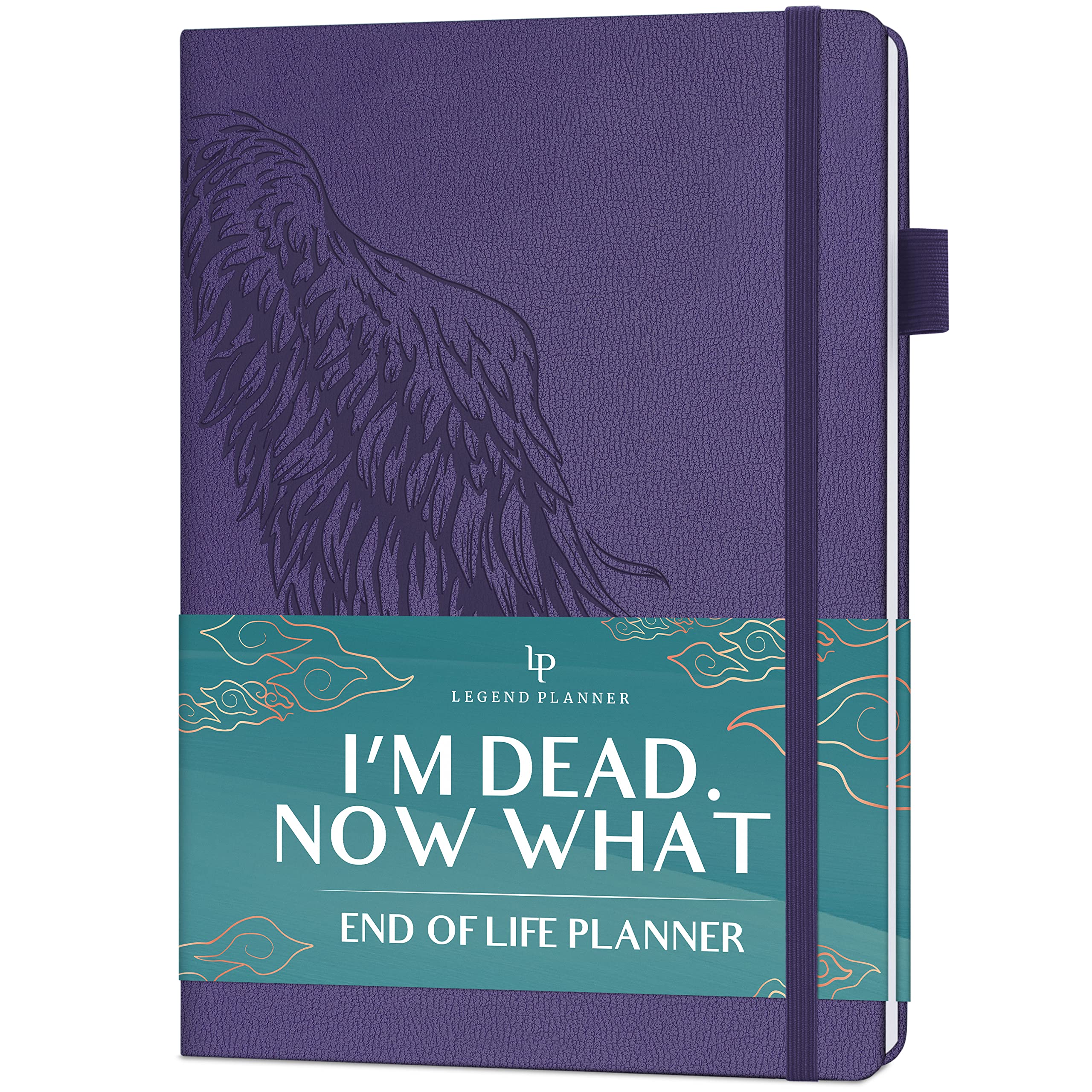
2. Legend End of Life Planner
Sixteen sections plus 29 blank pages, because your life has detail a template never predicted.
Start with the extra pages. Most planners hand you a fixed set of prompts and stop; this one gives you 16 sections for dependents, beneficiaries, pets, insurance, active accounts, memberships, passwords, and where your documents live, then adds 29 empty pages for everything else. Owners single out the prompts as the book’s strongest quality, because the detail is what makes it informative rather than decorative. The 7 x 10 inch page format is large enough to write comfortably and still compact enough to store on a shelf beside your files.
Most buyers come to this book after a death in the family. One buyer wrote: “I bought this book not long after my father died.” That is the honest reason most people pick one up — clearing a parent’s house and hunting for account numbers is what makes you want something better for your own family. The same 120gsm paper (a thicker paper weight) and faux leather hardcover as the best overall mean no bleed-through and a cover that survives being handled.
The one thing to know before you start: the prompts ask about nearly everything, so it can feel heavy to fill out. That is a pacing problem, not a defect — leave it and come back. If you would rather have a smaller section count and more document storage, the Lanpn binder below is the better tool for that job.
Where the value sits: 16 sections, 29 blank pages, and 120gsm paper in one organizer, with a range of cover colors so each family member can keep their own.
The honest catch: the depth is the point and the burden — expect several sittings rather than one evening.
Choose this one: if you want the most room to record accounts, pets, and everything else that does not fit a standard section.
Pick something shorter: if a 16-section book already feels like more than you will finish.
3. JC Classics End of Life Planner
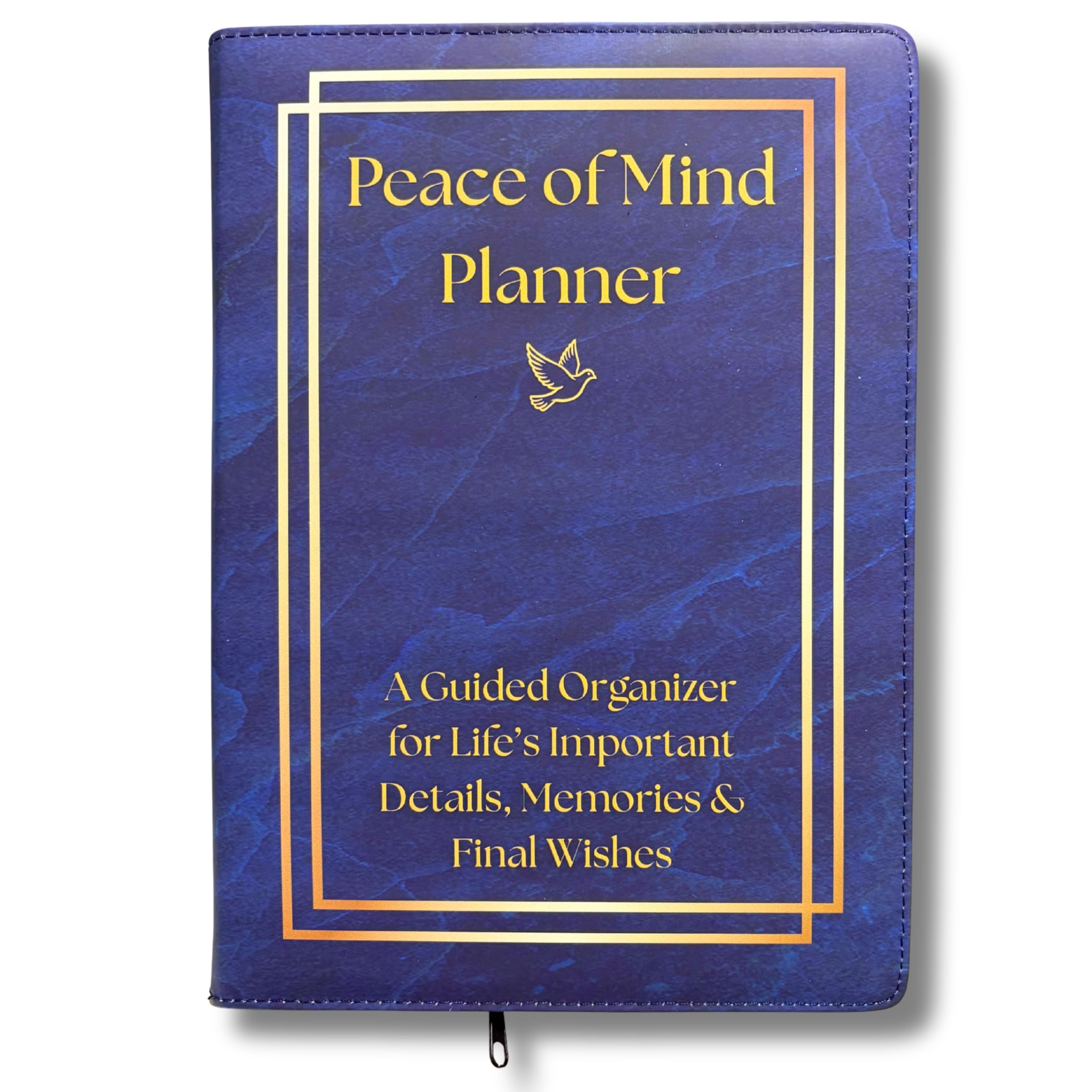
A zippered, gold-accented journal that looks like a gift and keeps loose papers from drifting out.
This is the planner you hand to a parent who would bristle at a spiral notebook. The blue marble faux leather hardcover with gold accents and a zipper closure turns a difficult conversation into something that looks like a keepsake, and the zip keeps the whole book sealed once it is filled. At 10.2″L x 8.2″W it is the largest footprint on this list, and the 144 pages of 120gsm paper give you room to write without the book fighting you.
Compare it directly with the confidence Planners with Purpose at the top: that one measures 10″L x 7.5″W, so this JC Classics book runs noticeably wider in the hand — about two percent more front-to-back space by the published dimensions. The section prompts are guided rather than numbered into tabs, so the flow reads like a journal you complete at your own pace instead of a workbook you tick off.
The fair caveat is presentation versus price. The cover, box, and zipper are what you are paying for, and this is the pick where you should decide upfront whether the packaging matters to the person receiving it. If the answer is no, the Planners with Purpose book delivers more utility per dollar.
The reason to pay the extra: a faux leather hardcover, gold accents, and a zip closure make this the most giftable of the five.
What you give up: it carries fewer tabbed sections than the 16-section books, and the larger 10.2″ x 8.2″ footprint takes more shelf space.
Reach for this if: you are giving a planner to a parent and want it to feel considered rather than clinical.
Look elsewhere if: you want a max-section workbook on a tighter shelf.
4. Legacero End of Life Planner
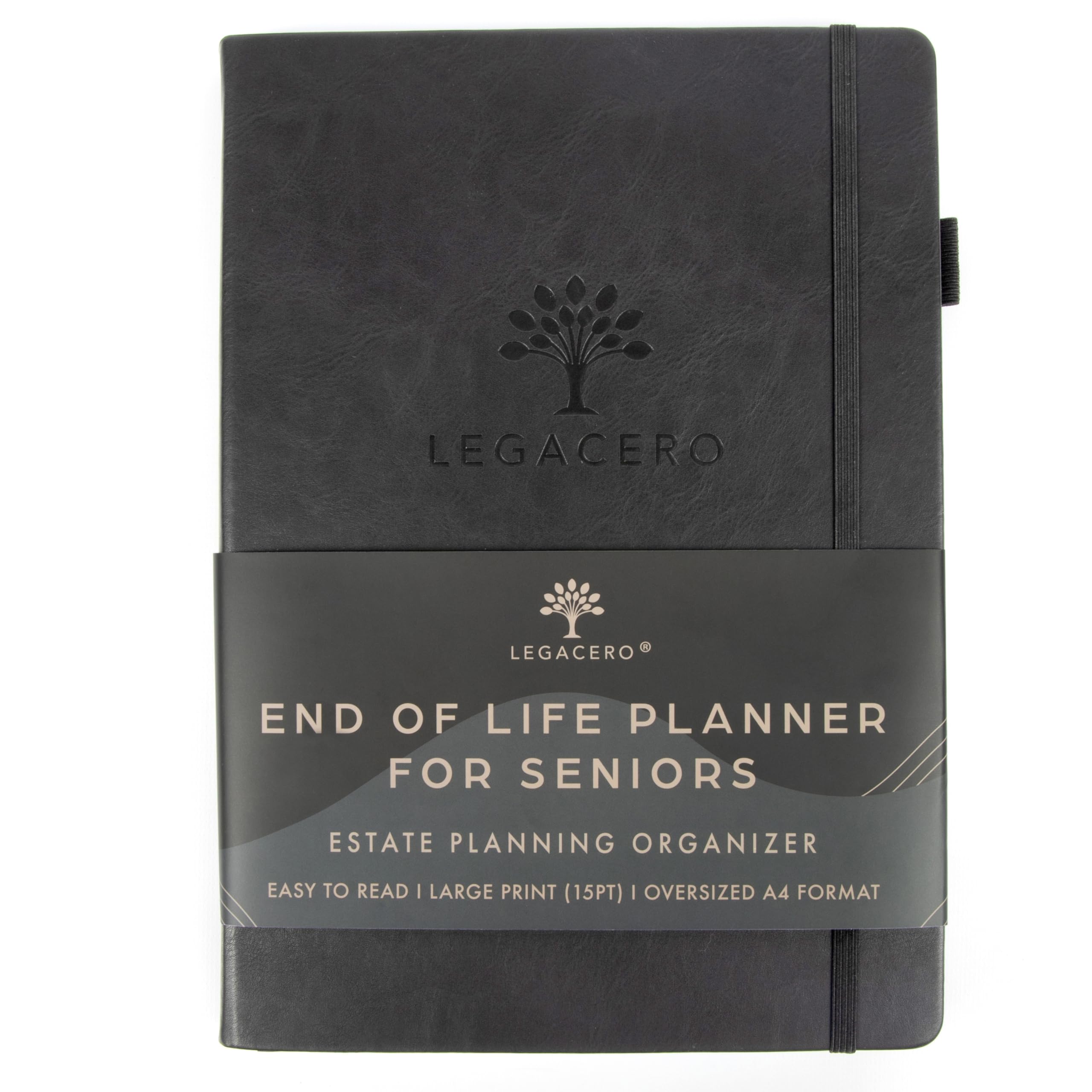
Fifteen-point text and 23 sections — the planner built for eyes that are tired of squinting.
Print size is the spec that wins this one. The oversized 15-point text and crisp black ink make every prompt readable without reading glasses propped on your nose, and that single decision changes whether an older parent can fill the book out independently. Behind it sit 23 comprehensive sections across 192 pages on A4+ paper, with lines wide enough that you are not crushing an account number into a half-inch space.
What makes that page count worth it is the question selection, not the paper. The book asks about bills, passwords, where physical items are kept, funeral arrangements, business contacts, and obituary preferences — the things a will typically does not cover. It also runs a section for memory-keeping, so the book is not purely a logistical folder. Buyers come to it after seeing what happens without one; one buyer described a relative’s death that left property, accounts, and a will tangled for the family.
Here is the version of the caveat you should weigh before ordering: the page size is A4+, larger than a standard 8.5″ x 11″ letter sheet. That means a standard-size printed document will not slip neatly into the back pocket, and the pocket is sized for smaller items. If your main goal is to carry originals and printouts alongside your notes, the Lanpn binder is the better answer.
What stands out: 15-point text, 192 pages, and 23 sections — the most page-level room here for readers who need larger type.
Fit note: A4+ pages mean letter-size documents ride at the edge of the back pocket rather than sliding in flat.
It suits: a senior filling out their own planner, or an adult child who knows large print is the difference between done and never started.
Another route: if document storage is the priority, take the binder format instead.
5. Lanpn End of Life Binder Organizer, 8.5″x11″ with 8 Dividers
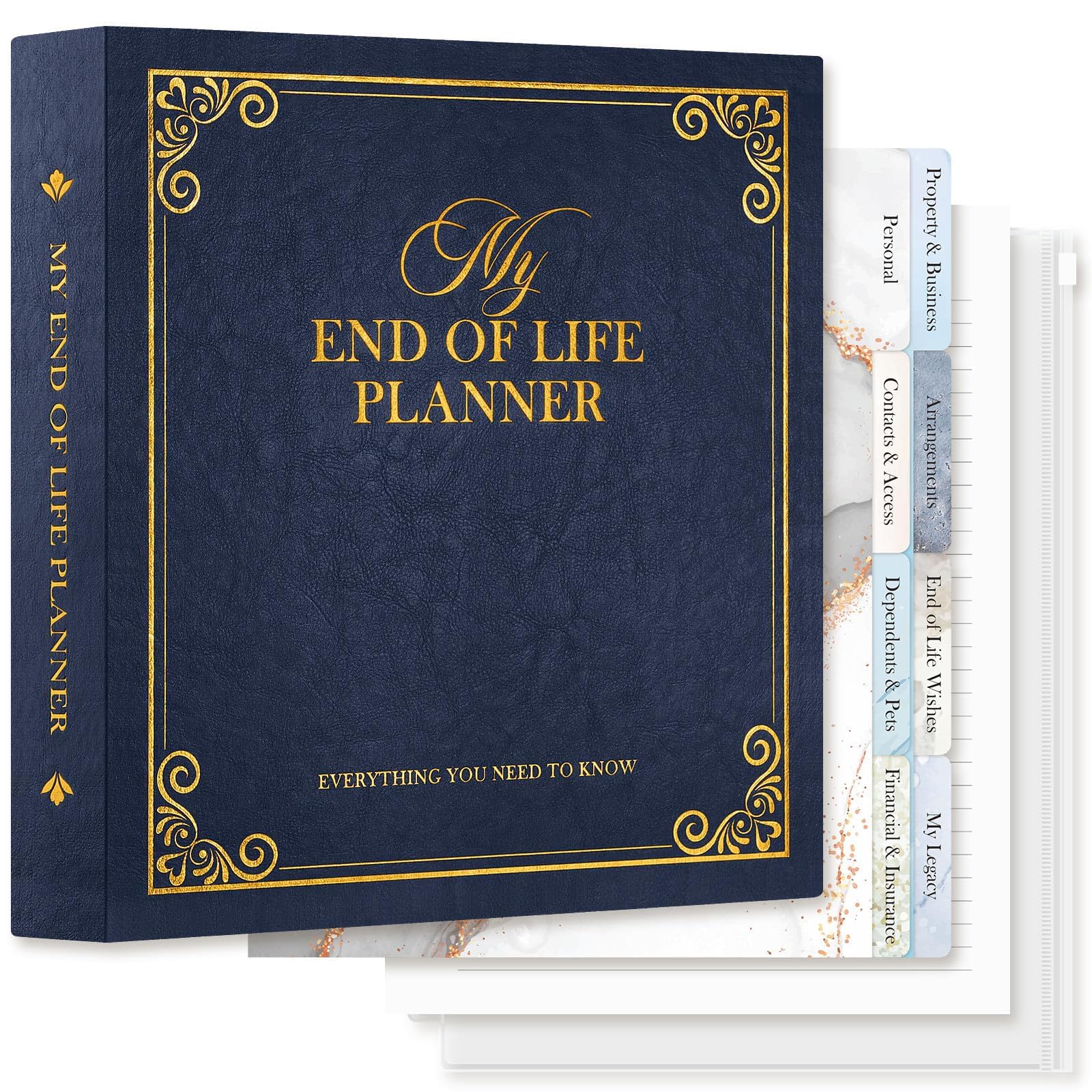
Twenty sections in a 3-ring binder, so the will and the water bill can finally live together.
This is the only binder on the list, and the difference is practical: the 3-ring design accepts standard letter-size paper, so you can punch and file the actual legal documents instead of just writing down where they are. Ten acid-free binder pockets (made to resist yellowing over time) keep those items protected from moisture and wear, and 8 durable dividers split the 20 sections — personal info, medical, finances, will, beneficiaries, final wishes — into tabs you can flip to in a hurry.
Storage capacity is real here: it takes 8.5″ x 11″ pages and the paper is 120gsm non-bleed stock, so printed inserts and handwritten notes can live in the same binder without the ink showing through. It measures 12.13″L x 10.94″W, which means it wants a shelf rather than a bedside table, and the closure is a binder mechanism rather than a zip.
The everyday complaint about a binder is that it feels like homework. This one answers that with the tab structure — you fill a section, close the rings, done — and the detail on digital passwords and heirlooms is what gives it a genuine edge over a plain folder. If you have already collected documents and want them filed with the instructions, this is the pick; if you want a book you can write in on the sofa, choose the spiral-bound options above.
The practical upside: letter-size pages, 8 dividers, 10 pockets, and 20 sections make this the closest thing to a full home filing system for your estate.
The trade-off: at 12.13″ x 10.94″ it occupies real shelf space, and a ring binder is less comfortable to write in than a spiral book.
Worth it when: you are the executor or the organized one, and you want original documents and written wishes in the same place.
Not for you if: you want to fill the planner in by hand on the couch — the binder wants a desk.
Know the Specs
Paper Weight (gsm)
Gsm means grams per square meter — the higher the number, the thicker the sheet. A 120gsm page is thick enough that a normal pen will not bleed through to the back, so you can write on both sides and keep the book from ballooning. Thin planner paper ghosts through and makes an account number hard to read later.
Page Size and Format
Letter-size pages (8.5″ x 11″) accept standard printed documents, which is what makes a 3-ring binder useful for filing an actual will. Smaller books — B5, 7 x 10 inches, A4+ — are easier to hold and write in but may not take a letter sheet in the back pocket. Match the page size to whether you are filing documents or just writing information down.
Tabbed Sections vs. Guided Prompts
Tabs let you jump straight to the medical page or the password page; guided prompts walk you through in order so you do not skip a category. A planner with 16 tabbed sections tends to suit someone who wants to fill it fast and find things later, while a journal-style book with open prompts works better for someone who wants to think as they write.
Font Size and Readability
Print size is not a small detail. A planner set in oversized 15-point text is easier to read with tired eyes, and crisp high-contrast ink on the page makes the prompts clear even in dim light. If the person filling it out wears reading glasses, check the font size before anything else.
Common Questions
Do I still need a will if I fill out an end-of-life planner?
How long does an end-of-life planner take to fill out?
Should I buy a spiral-bound planner or a 3-ring binder?
Where do I record passwords in a planner safely?
Is 120gsm paper thick enough to stop ink bleed?
Can a parent with poor eyesight use these planners?
What is the difference between an end-of-life planner and an estate planning binder?
Will a standard letter-size document fit in a 7 x 10 inch planner?
Can I use one planner for two people?
How many sections does a complete end-of-life planner need?
The Bottom Line
For most families, the end of life planners winner is the Planners with Purpose confidence, because its 16 tabbed sections and lay-flat spiral mean the book actually gets finished instead of gathering dust. If you need to record every account, pet, and extra detail, the Legend In Case of Death Organizer gives you 29 blank pages on top of its 16 sections. And for anyone filing real legal documents, the Lanpn binder is the one to reach for, with its 8 dividers and letter-size pages.
How we choose
We do not accept paid placement. Every pick is matched to a real buyer and a real use-case; we do not hands-on test units.
Sources
Specifications: manufacturer listings and product documentation. Review insights: verified customer reviews, as of October 2026. Pricing: not shown on this page (it changes often); check the current price via the retailer link.
As an Amazon Associate, Aappliancez earns from qualifying purchases. This does not affect which products we feature.