Disclosure: Some links in this post are affiliate links. As an Amazon Associate I earn from qualifying purchases, at no extra cost to you. Learn more
Specs are compiled from manufacturer listings and verified buyer reviews and can change over time — please confirm the key details on the product page before buying.
You want one pocket-sized device that plays your old favorites without dragging a bag of cartridges around. The short answer: pick by the games you actually play. If you want GameCube and PS2 titles, go straight for the Retroid Pocket 5 and its 128 GB of storage. If you want something small, cheap and ready to go, the Anbernic RG35XX H at 64 GB is the simpler call.
This guide is built by comparing the manufacturers’ published specifications and the patterns across verified customer reviews, so you get each pick’s real strengths and trade-offs instead of marketing spin.
Every pick below is sorted by what it can actually emulate and how easy it is to set up. Here is the honest breakdown of the emulator handhelds worth your money.
Top Picks

How To Choose The Best Emulator Handhelds
The list of handhelds looks endless, but most decisions come down to three things: the processor, the screen, and how much work you want to put in before your first game.
Match the chip to the console you love
Every handheld in this list runs an emulator — a piece of software that pretends to be an older console. The processor does that pretending. A quad-core chip handles 8-bit and 16-bit systems easily. If you want smooth GameCube or PS2 games, look for a device with a dedicated graphics processor and a modern Android build like the Retroid Pocket 5.
Decide on preloaded versus empty
Some consoles arrive with thousands of games on the included memory card. Others arrive completely empty. That is not a flaw — the Retroid Pocket 5 has no games preloaded on purpose, and you add your own. Preloaded cards are great for a gift, but the game list varies and you may still want to add your favorites.
Check the screen before the buttons
A 640 x 480 screen gives you sharp pixels for classic systems. A 1080p screen with a 5.5-inch panel handles modern indie games and PS2 titles with far more detail. If you plan to play older 8-bit and 16-bit games, a smaller screen keeps them looking crisp.
Plan for setup time
Android handhelds and Linux handhelds both ask for some setup work. Installing a custom front end or adding ROMs (your game files) usually means following a video tutorial. Expect an evening of tinkering before everything feels right.
Side-by-Side Comparison
| Model | Best For | Screen | Battery | Storage | Amazon |
|---|---|---|---|---|---|
| Retroid Pocket 5★ Best Overall | GameCube and PS2 fans | 5.5-inch, 1080p | 5000 mAh | 128 GB | Amazon |
| RG35XX HBest Value | Pocket carry and quick play | 3.5-inch HD | 3300 mAh | 64 GB | Amazon |
| Miyoo Mini Plus | Pocketable retro play | 3.5-inch, 640 x 480 IPS | 3000 mAh | 64 GB | Amazon |
| Anbernic RG40XX H | Big screen, easy carry | 4.0-inch, 640 x 480 IPS | 3200 mAh | 64 GB | Amazon |
| RG353V | Dual boot Android and Linux | 3.5-inch, 640 x 480 IPS | 3200 mAh | 16 GB | Amazon |
| Atari Gamestation Go | Atari and arcade classics | 7-inch full color | Built-in rechargeable | 5 GB | Amazon |
Detailed Reviews
1. Retroid Pocket 5 Retro Handheld Game Console
Our pick — 4.5+★ from 250+ verified ratings; the strongest balance of quality and price.
A pocket computer dressed as a game console, built to push PS2 and GameCube.
If you want a handheld that plays the games you grew up with and the games you bought on Steam, this one closes that gap. Inside is a Snapdragon 865 quad-core processor working alongside an Adreno 650 GPU (the graphics chip that draws every frame). That pairing is what lets it handle the heavier 3D consoles instead of stopping at the 16-bit era.
Its 128 GB of built-in storage doubles the Miyoo Mini Plus’s 64 GB, and that headroom matters once your ROM library fills out. Its 5000 mAh battery holds 67% more capacity than the Miyoo Mini Plus’s 3000 mAh. The 5.5-inch 1080p screen is also noticeably larger and sharper than the RG35XX H’s 3.5-inch panel, so PS2-era text and UI elements stay readable without squinting. Owners keep coming back to how solid the whole thing feels, and the setup gripes are mostly about the software side, not the hardware.
What wins people over most is device quality, and the gameplay that follows from it — buyers report smooth PS2 performance and 2D indie titles that just work. As one owner put it, the screen holds up “even on sunny days.” The honest catch is setup. Nothing is preloaded, and getting your emulators and front end configured is a project for an evening, not a five-minute job. Buyers describe needing guides and some patience, especially with Switch-style games where settings tinkering is often required.
What earns its spot
- 128 GB storage and 5000 mAh battery give you more room and more play time than the budget picks
- Snapdragon 865 and Adreno 650 handle PS2 and GameCube without the stutter you get on weaker chips
- 5.5-inch 1080p touchscreen keeps modern indie and higher-end titles legible
- Android 13 opens up app stores, cloud gaming and Steam streaming
Where it demands effort
- No games preloaded — you supply and configure everything yourself
- Setup expects comfort with guides and emulator settings
- Large hands may want the separate case add-on for longer sessions
Go here for: a do-everything handheld that covers PS2, GameCube, Android games and Steam streaming.
Think twice if: you want to unbox and play immediately — this one needs configuring first.
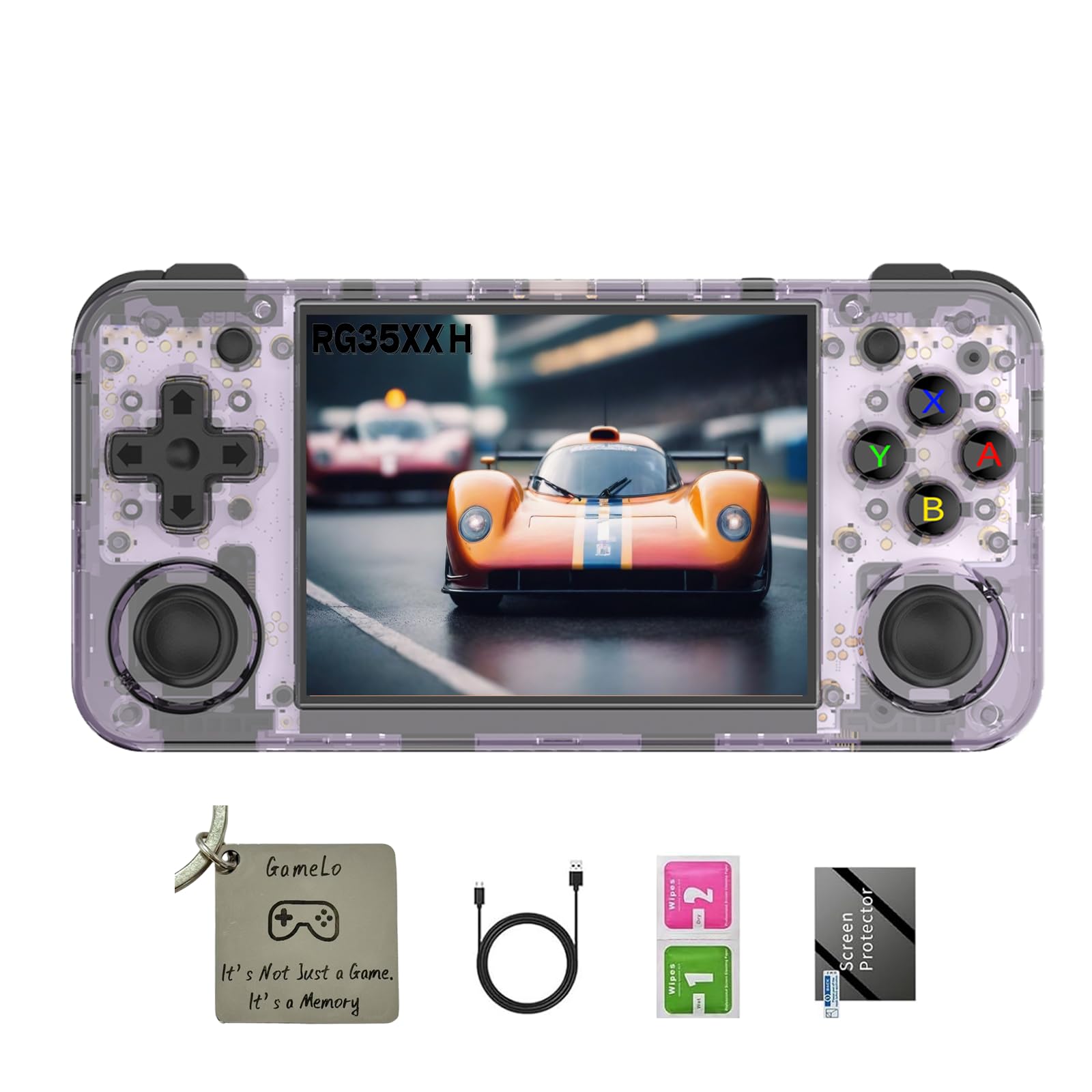
2. RG35XX H Anbernic Retro Handheld Gaming Console
The grab-and-go handheld that arrives ready with a library already on the card.
For someone who wants a retro console to toss in a bag, the RG35XX H answers the question before you finish asking it. The 64G TF card (a removable memory card) arrives with 10+ emulators built in and support for up to 30+ once you download more. That includes PSP titles and the classic adventure, shooter, racing and action genres. Gameplay is the thing buyers praise most, and the sheer volume of games waiting on the card is right behind it.
The 3.5-inch HD screen with dual joysticks, vibration motors and dual speakers gives fighting and racing games the controls they need. A 3300 mAh battery runs up to 8 hours per charge over USB Type-C. The H700 quad-core chip clocked at 1.5GHz keeps retro titles stable. The horizontal grip design and OCA full lamination — a screen bonding technique that keeps the display flat and glare-free — make it comfortable to hold for longer sessions.
Here is where honesty matters: reliability and battery life both draw mixed feedback. Some units arrive with a dead battery or a corrupted card, and the fix is usually swapping in a fresh memory card. The finish and buttons still earn plenty of praise, and most buyers treat this as a wallet-friendly entry point rather than a daily driver. If you want the simplest ownership experience, know that a small amount of troubleshooting may come with the low price.
The pocket factor: at 5.76 ounces and small enough to slide into a jacket pocket, this is the one you actually carry.
The setup reality: the included card covers a lot, but a backup card is a smart early purchase given the mixed reports on the stock one.
Reach for this if: you want a preloaded retro console for gifting or casual play without spending much.
Look elsewhere if: you need rock-solid reliability from the start or plan to push demanding 3D systems.
3. Miyoo Mini Plus Retro Emulator Handheld Game Console

Small enough to vanish in a pocket, sharp enough to make old pixel art sing.
The Miyoo Mini Plus is the pick for someone who wants a true pocket handheld and does not care about PS2. Its 3.5-inch IPS screen at 640 x 480 keeps classic games crisp without stretching them. Its ARM Cortex-A7 CPU and 3000 mAh battery deliver up to 6 hours of play per charge. The Linux system runs stable without frame drops, and the save, load, favorite and recent folder features mean you can pick up exactly where you stopped.
WiFi and RTC (a real-time clock, so in-game clocks and timelines behave correctly) round out a feature set that punches above its size. Device quality is what the review pages keep returning to, with value for money close behind. The downloadable OnionOS front end is the reason many people buy this — it installs with a simple drag-and-drop and transforms the menu experience.
The catch is setup and performance. Some units need a fresh brand-name card and a proper OS install before they feel right, and performance reports split between working great and needing a tune. The game library on the stock card leans toward Chinese titles, beat-em-ups and shmups, so Nintendo and other console catalogs may need adding yourself. Buy it expecting a small project and it rewards you generously.
Who it suits: you want the most pocketable device here and don’t mind following one tutorial to get OnionOS (a custom operating system you install yourself) running.
Not for you if: you want a big screen or heavy 3D consoles — this one stays in its retro lane.
4. Anbernic RG40XX H Retro Handheld Game Console
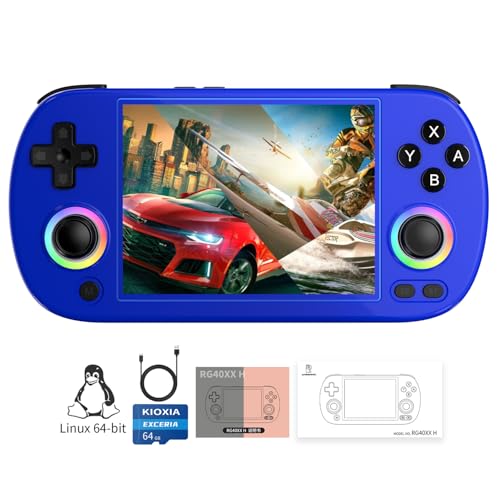
A four-inch screen that finally makes retro text readable without a magnifier.
For anyone who has squinted at a tiny handheld screen, the RG40XX H is the answer. Its 4.0-inch IPS full-viewing-angle display with OCA full fit renders at 640 x 480 and looks better than expected, with 16 million colors of RGB joystick lighting you can set to constant, breath, rainbow or chasing effects. A 3200 mAh polymer battery runs up to 8 hours of continuous play, and the 200-gram body is light enough to forget in a pocket.
The quad-core ARM Cortex-A53 chip pairs with a quad-core PowerVR SGX544MP GPU and 1GB of RAM, which keeps the Linux system responsive. GBA, N64, SNES and PSP titles run fine, and 2D games handle flawlessly. WiFi online pairing, Bluetooth controller support, vibration and HD output to a TV extend it well beyond solo play. Device quality is the clear standout in owner feedback, with the screen close behind and build quality rounding out the positives.
Two things to know before you buy. Owners mention mixed feedback on reliability and game selection, and some units have arrived non-functional — so keep the return window open. The bundled card has no Nintendo titles, so plan to add your own. The D-pad (the cross-shaped direction pad) can also feel overly sensitive on diagonals. Even so, this is the balance for screen size versus pocketability.
Why it stands out
- 4.0-inch 640 x 480 IPS screen beats the 3.5-inch panels on most rivals for readability
- Up to 8 hours on a 3200 mAh battery for long trips
- Roughly 200 grams keeps it genuinely pocketable
- WiFi, Bluetooth, vibration and TV output cover solo and group play
What to watch
- No Nintendo titles on the bundled card — you supply those
- D-pad runs sensitive on diagonal inputs
- A few units have shipped dead, so test yours early
Best fit: players who prize a larger screen while still wanting something pocket-sized.
Less ideal if: you want zero risk on your first unit — test it the day it arrives.
5. RG353V Retro Handheld Game Console

One handheld that boots into Linux for retro play or Android for everything else.
The RG353V is for the tinkerer who wants two devices in one shell. It ships with both an open-source Linux system and Android 11, a 64G SD card, and 4452 preloaded games across 20 supported formats. On the Android side it also works as a general entertainment device — music, TV, shopping and social apps all run on the same screen. The RK3566 quad-core chip clocked at 1.8GHz, with LPDDR4 2GB RAM and 32GB eMMC 5.1 storage, keeps the interface quick.
The 3.5-inch IPS screen at 640 x 480 with zero-distance OCA full fit delivers a clear picture behind tempered glass that resists scratches. A 3200 mAh battery supports up to 6 hours of play and USB Type-C fast charging. 2.4/5G WiFi and Bluetooth 4.2 handle online pairing, controllers and headsets, and Moonlight streaming lets you pull PC games onto the small screen. Quality is the leading positive in owner feedback, backed by a healthy dose of gameplay praise.
The honest trade-off is reliability and the missing-game list. Some units stop working or glitch mid-game, and certain titles (the Pokémon catalog especially) are not on the card and need adding. Value, game availability, battery and user-friendliness all split down the middle in feedback. Know that the Linux boot option only triggers if you hold F at power-on, or you will land in Android and wonder what happened.
Two systems, one shell: dual OS is the whole pitch here — a retro machine and a small Android tablet in the same body.
The honest caveat: reliability is the weak point, so test yours thoroughly in the return window and keep a card backup.
Right for you if: you want Moonlight streaming and Android apps alongside your retro library.
Skip if: you want a trouble-free device — this one may need a return-and-replace cycle.
6. My Arcade Atari Gamestation Go
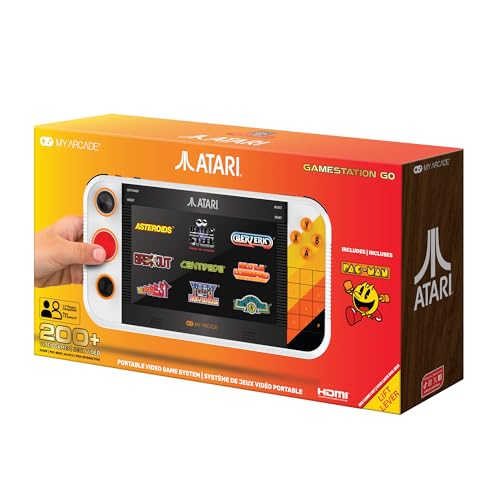
The only handheld here with a trackball, a spinner and a paddle already attached.
Most emulator handhelds ask you to accept one control layout for every game. The Gamestation Go refuses that compromise. Its 7-inch full-color display sits above an integrated paddle, D-pad, trackball, numeric keypad, bumpers and classic A/B/X/Y buttons — so Asteroids plays with the buttons it was designed for, Breakout gets its paddle, and Centipede gets a trackball. It arrives with 200+ games built in, including PAC-MAN, Asteroids, Breakout, Centipede, Missile Command, Tempest, Warlords and Yars Revenge, plus licensed titles from Jaleco and PIKO Interactive.
It officially licenses Atari titles across the 2600, 5200 and 7800, Atari Arcade, Atari Recharged and Balls of Steel pinball tables. Gameplay is the leading positive in owner feedback, with nostalgia right behind — the “brings me back to the 80s” reaction comes up constantly. Built-in WiFi handles firmware updates, and HDMI output lets you push the 7-inch picture onto a big TV. A built-in rechargeable battery keeps it portable, and a microSD slot expands the library.
The controls are where opinions split. The spinner can feel stiff, the trackball sometimes overshoots, and there is no vertical mode for Centipede. The bigger catch is that this is not a general-purpose emulator — you cannot load a modern ROM library the way you would on the Retroid Pocket 5. It is the pick for someone who wants the arcade cabinet feel, not the widest game range.
The deciding question: do you love Atari-era arcade games? If yes, the dedicated control panel (a built-in trackball and dial setup) is class-leading here.
Walk away if: you want to emulate modern consoles — this one stays in the arcade era.
Know the Specs
Processor and GPU
The processor decides which consoles you can emulate without slowdown. A quad-core ARM chip handles 8-bit through 16-bit systems comfortably. When you add a dedicated graphics chip like the Adreno 650, the handheld can push GameCube and PS2 titles. The RG353V’s RK3566 runs at up to 1.8GHz, while the RG35XX H’s H700 runs at 1.5GHz — both fine for retro, both short of PS2-grade.
Battery capacity
Battery life is measured in mAh (milliamp-hours, the size of the tank) and hours (how long it lasts). A 5000 mAh battery in the Retroid Pocket 5 gives you more headroom for heavy 3D games than the 3000 mAh in the Miyoo Mini Plus. A 3300 mAh battery in the RG35XX H is rated for up to 8 hours of lighter retro play. Higher mAh generally means more play time per charge.
Screen resolution
Resolution is the number of pixels across and down the screen. A 640 x 480 panel keeps 8-bit and 16-bit games crisp. A 1080p screen like the Retroid Pocket 5’s 5.5-inch display handles modern indie games and PS2 titles with more detail. Bigger is not always better — a 7-inch display on the Gamestation Go makes arcade games easier to see but the console harder to pocket.
Storage and expandability
Storage is measured in GB (gigabytes) and holds your games, emulators and saves. Preloaded cards range from 5 GB to 128 GB here. A microSD slot lets you expand beyond the built-in capacity on most of these handhelds, and a backup card is worth keeping because stock cards can fail. Buy a brand-name card and keep your ROM library on a separate one.
Common Questions
Can an emulator handheld play PS2 games?
Do these handhelds come with games preloaded?
How long does the battery last on a retro handheld?
Is the Miyoo Mini Plus better than the RG35XX H?
Can I add my own ROMs to these devices?
Which handheld is easiest to set up?
Do I need WiFi on a retro handheld?
Are the preloaded game cards reliable?
Which handheld has the biggest screen?
Can I connect these handhelds to a TV?
The Bottom Line
For most buyers, the emulator handhelds winner is the Retroid Pocket 5. It is the only pick here with the chip and screen to run PS2, GameCube and Steam streaming (playing PC games streamed from your computer) on one device. Want a preloaded console you can gift without touching a settings menu? Grab the RG35XX H. And for replaying Centipede on the couch with a real trackball (a rolling ball you spin with your hand), reach for the Atari Gamestation Go. One honest nudge: the Retroid Pocket 5 is the crowd favorite at 4.5+ stars, while the RG353V draws the most owner feedback here — 400+ ratings — yet scores lower on satisfaction. So for most people, the safer bet is the top pick.
How we choose
We do not accept paid placement. Every pick is matched to a real buyer and a real use-case; we do not hands-on test units.
Sources
Specifications: manufacturer listings and product documentation. Review insights: verified customer reviews, as of October 2026. Pricing: not shown on this page (it changes often); check the current price via the retailer link.
As an Amazon Associate, Aappliancez earns from qualifying purchases. This does not affect which products we feature.