Disclosure: Some links in this post are affiliate links. As an Amazon Associate I earn from qualifying purchases, at no extra cost to you. Learn more
Specs are compiled from manufacturer listings and verified buyer reviews and can change over time — please confirm the key details on the product page before buying.
You want a stim machine to help build muscle, and the TENS 7000 Rechargeable unit delivers: it combines TENS (electrical pulses that interrupt pain signals) with EMS (pulses that make a muscle contract) in a palm-sized box, and it is the pick most people should start with. The bigger question is if you want a pain-first device, a true gym stimulator, or a cordless patch system. That’s what this breakdown answers, pick by pick.
This guide is built by comparing the manufacturers’ published specifications and the patterns across verified customer reviews, so you get each pick’s real strengths and trade-offs instead of marketing spin.
The differences that matter are waveform, channel count, program control, and how well the pads hold on — not how many buzzwords the box carries. Below you get seven honest options and a plain-English read on which one fits your body, your routine, and your goals, all laid out for anyone shopping for the Best ems for muscle growth.
Top Picks


How To Choose The Best Ems For Muscle Growth
Start with the job you want done. A muscle stimulator that claims “muscle growth” is really doing one thing: sending an electrical pulse strong enough to make a muscle contract without you lifting anything. If the pulse never reaches that threshold on your body, you get a pleasant tingle and nothing more. So the specs that matter are the ones that control pulse strength and duration — not the number of modes on the box.
EMS versus TENS — pick the right tool first
TENS (transcutaneous electrical nerve stimulation) is aimed at nerve endings, and it’s the mode people use for back, neck, and joint discomfort. EMS (electrical muscle stimulation) targets the muscle itself and causes it to contract. Most combo units sold today carry both, and that’s what you want — you can run a recovery session one day and a contraction session the next from the same device. A TENS-only unit will not give you a real muscle contraction no matter how high you turn it.
Intensity headroom decides whether you feel it
Check how high the intensity scale goes, not just how many levels it has. A unit capped low on output can feel weak on a large muscle group like quads or glutes, while a device with real output headroom lets you dial into a genuine contraction on big muscles and back off on smaller ones. If you have thick muscle or a lot of body fat over the target area, headroom matters more than mode count.
Channels and pads — how much you can treat at once
Each channel drives one pair of pads. A two-channel unit runs four pads at the same time, which is enough for both quads or both shoulders. A four-channel unit runs eight pads, which is what you want if you’re covering a whole back or working several muscle groups in one session.
The pad problem nobody warns you about
Pads are the consumable here. They lose stickiness over time, they’re fiddly to place on your own back, and on some devices you’re locked into the manufacturer’s own pads. Before you pick, check whether the unit takes standard snap or pin connectors so third-party pads fit — that single detail decides your long-term running cost far more than the device itself.
Side-by-Side Comparison
| Model | Best For | Channels | Programs | Power | Amazon |
|---|---|---|---|---|---|
| TENS 7000 Rechargeable★ Best Overall | All-round TENS + EMS starter | — | — | Rechargeable | Amazon |
| TAMTEC-HANA SportPunchiest Output | Raw power on a budget | 2 | 8 | Rechargeable battery | Amazon |
| Beurer EM59 | Fine-tuning pulse settings | 2 | 64 presets + 6 custom | Rechargeable | Amazon |
| iStim EV-906 | Covering several muscle groups | 4 | 30 | Rechargeable | Amazon |
| Chattanooga Primera | HAN waveform sessions | 2 outputs | 8 TENS + 6 NMES | 9V battery | Amazon |
| Chirp Halo | Cordless wear-anywhere | 2 pods | Multiple modes | Rechargeable | Amazon |
| Compex Performance 3.0 | Structured gym sessions | — | 6 | USB rechargeable, up to 8 hours | Amazon |
Detailed Reviews
1. TENS 7000 Rechargeable Tens Unit Muscle Stimulator
Our pick — 4.5+★ from 650+ verified ratings; the strongest balance of quality and price.
A palm-sized stim box that covers pain relief and muscle recovery without asking you to buy batteries.
This is the sensible first stim machine for most people — it runs both TENS for aches and EMS for muscle contraction, and it recharges over USB instead of eating disposable batteries. At 13.7 ounces it sits in your hand like a small case rather than a brick, and the 4 x 2.5 x 1 inch body slips into a gym bag or a drawer between sessions. The crowd favorite of the group at 4.5+ stars across 600+ ratings, it earns that spot by being simple rather than clever.
What wins people over is build quality — the unit feels solid, the hardshell case holds the pads and leads together, and the 2mm pin pads grip well and pass current cleanly. Buyers report the tissue response feels like a traditional TENS contraction rather than the buzzing “massage” pattern some rivals produce, which is exactly what you want when the goal is a muscle that actually flexes. One tennis player reported that soreness in an ankle and shoulder faded for the rest of the day after sessions. Muscle recovery and growth are the stated second job here, and it handles both from the same four pads.
The catch is that this is a basic unit, and the controls assume you already know what you’re doing. Placing pads on your own back solo is awkward, since they bend and stick to themselves before you get them down. Nerve pain is a different story from muscle pain too — this device is designed around the muscular side. Keep a spare set of pads on hand, because the ones in the box are the first thing to wear out.
What earns it the top slot
- Runs TENS for pain and EMS for muscle contraction from one device
- USB rechargeable, so no disposable battery runs to manage mid-session
- 2mm pin pads connect cleanly and hold well through a full session
- 13.7 ounces with a hardshell case that keeps pads and leads together
Where it asks a little patience
- Reaching and placing pads on your own back takes practice
- Controls are plain — some functions aren’t obvious without the manual
- Built around muscular discomfort rather than nerve pain
Start here if: you want one rechargeable unit that handles both everyday aches and post-workout muscle recovery without a learning curve.
Look further if: you need four channels of coverage or fine control over pulse timing.
2. TAMTEC-HANA TENS/EMS Sport Muscle Stimulator
Two independent channels, eight programs, and enough output that most people never leave the middle of the dial.
If intensity headroom is your worry — and on thick muscle groups it should be — this unit answers it. There are 12 intensity bars, and as owners mention, most people only ever need 4 of them. That’s a machine with room in reserve, which is what you want on quads and glutes where a low-output unit disappears into a tingle.
The two channels are independently controlled, so you can run four pads at once and set a different level on each side. Eight programs cover both TENS and EMS duties, and the large digital screen with soft push buttons makes it straightforward to select a program, set a session time, and start. It ships as a full kit: the unit, 12 self-adhesive electrode pads, 2 lead wires with polarity indicators, a rechargeable battery, a wall charger, a USB charger, a manual with pad-placement charts, and a carrying case. The unit itself measures 7.09 inches long and 4.72 inches wide, so it’s a bench or tabletop device rather than a pocket one.
Here’s the honest trade-off. The device is bulky and comes in white, and the programs are numbered rather than labelled on the unit, so you’ll keep the manual nearby. The manual’s pad-placement diagrams are basic, which means a little searching for the right spots. Russian stimulation — the burst pattern gym-goers use for strength work — is onboard, which is uncommon at this level. On the flip side, you can adjust intensity but not the duration, frequency, or stim timing of a program, so the machine decides those for you.
Where it earns its keep: raw output at a modest outlay, with dual channels so both sides of a muscle group run at once. Battery lasts several days at three sessions a day, and the kit arrives complete enough to start on day one.
Worth it for: anyone who wants a strong, uncomplicated stim with Russian mode and does not mind a bigger box on the table.
Keep looking if: you want to hand-tune frequency and pulse timing rather than pick a numbered program.
3. Beurer EM59 Digital 3-in-1 TENS, EMS & Heat Therapy Unit
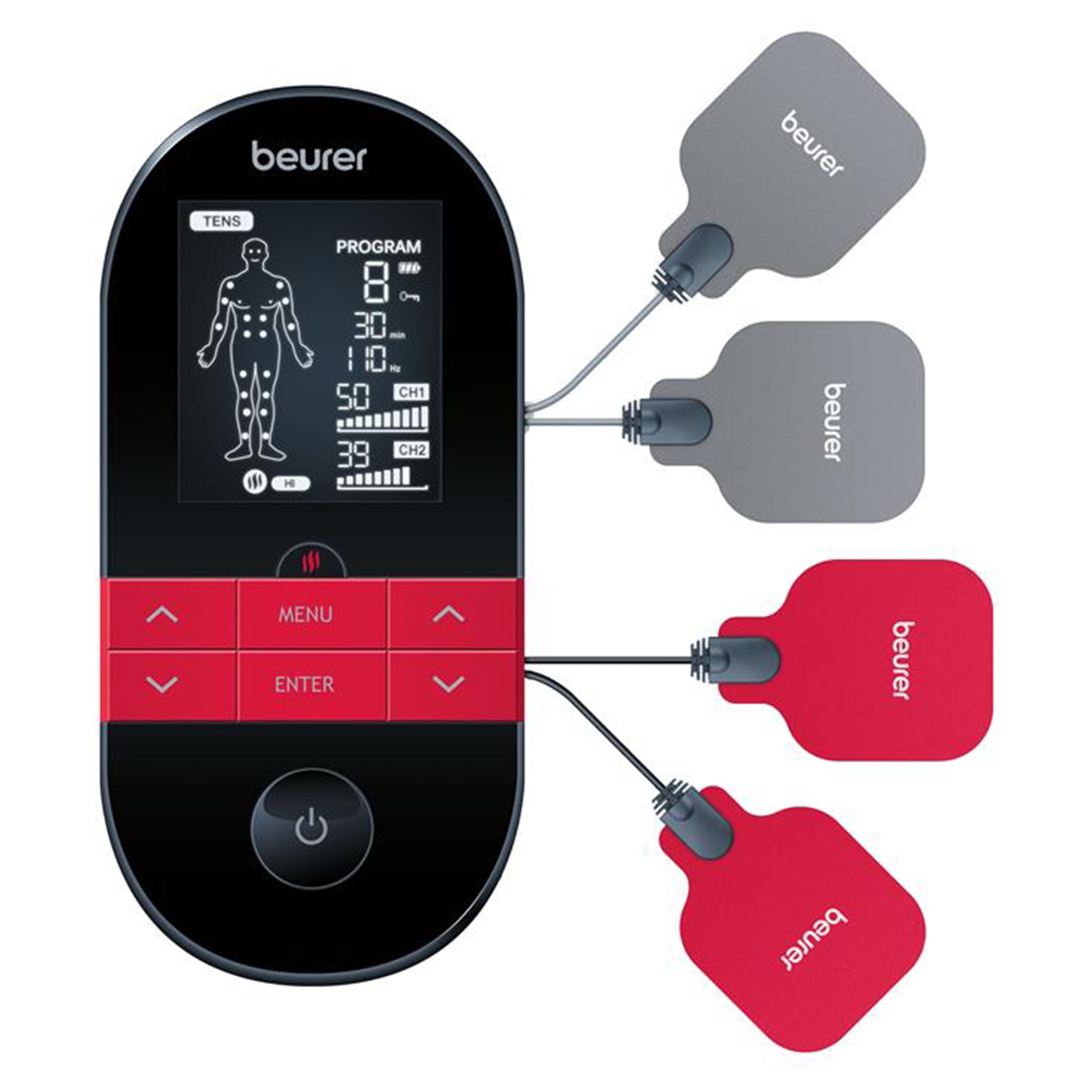
Three therapies in one shell, and the only unit here that lets you dial pulse width yourself.
For someone who wants to understand what the stim is doing rather than just press a preset, this is the pick. It combines TENS, EMS, and heat therapy in one device, with 2 independently adjustable channels driving 4 self-adhesive pads across back, neck, knees, shoulders, legs, and abs. There are 64 preset programs plus 6 customizable settings, and the adjustable 5–100 minute timer means a session is measured rather than open-ended.
The custom controls are the real story. Customers note being able to set pulse width (up to 450us), frequency, and on/off time, with burst and continuous modes available — that’s the level of control that separates a serious stim from a toy. Build quality is a recurring theme in the right direction, with 3.5mm snap electrodes on sturdy cables. Strength is real too: 50 intensity levels, with the unit rated up to 200mA at 100V, so you are not running out of headroom. One second-time owner’s original unit lasted many years before a cable failed, and the replacement shipped straight from the factory.
Two things to plan for. The pads are the weak link — adhesion is the most common complaint, and the unit is built around Beurer-branded pads at roughly 20 uses each, which adds up over time. It also runs on 3 AAA batteries rather than an internal cell, so rechargeable NiMH cells are the smart pairing. At 8 x 6 x 2 inches and 6.7 ounces it is bigger than the TENS 7000 above and a good deal lighter than the 2.2-pound iStim.
Control worth paying for: pulse width, frequency, and burst/continuous modes on a 64-program device with heat therapy included — this is the unit for someone who wants to tune, not just tap.
Reach for this if: you want genuine manual control over the waveform and value the added heat mode for relaxation sessions.
Think twice if: you want a long-term low running cost — plan for branded pads and rechargeable AAA cells.
4. iStim EV-906 TENS EMS Muscle Stimulator

Eight pads, thirty programs, and an intensity scale that most competing units cannot touch.
Four channels is the headline, and it changes what a session can look like. Eight pads means you can cover a full back, or work quads and hamstrings in one sitting, instead of running the machine twice. Thirty preset programs split across TENS and EMS duties, and the kit arrives with 24 electrode pads in two sizes (2″x2″ and 2″x4″), four lead wires, a manual, and a USB charger.
Where this one separates itself is the intensity ceiling. Reviewers point out their previous units topped out at 20 while this one climbs to 100 — that is a machine you can grow into rather than one you outgrow. After weeks of use, buyers rate it on par with the units used in physical therapy sessions, and the Japanese gelled pads conduct current evenly enough to suit sensitive skin. Battery life is a genuine strength: it runs many sessions between charges, which matters if you use it daily.
The flaws are practical rather than mechanical. The lead wires are not colour-coded, which slows pad placement until you learn the routine, and there is no carrying case in the box. It also relies on 2 AA batteries per the spec rather than a sealed internal cell, so keep spares on hand. None of that changes how the pulses feel — it just means a five-minute setup rather than a two-minute one.
The case for four channels
- 4 channels and 24 included pads cover large areas in one session
- Intensity reaches 100, well beyond basic units
- Japanese gel pads conduct evenly on sensitive skin
- Runs many sessions per charge
Small frictions to expect
- Lead wires are not colour-coded
- No carrying case included
- Runs on 2 AA batteries, so keep spares ready
Made for: anyone treating several muscle groups at once who wants real intensity headroom and does not mind a short setup ritual.
Easier alternatives: if a single channel pair covers your needs, the TENS 7000 above is simpler to run.
5. Chattanooga Primera TENS/NMES Unit with HAN Waveform

The rehab-room waveform in a home unit, with a belt clip and a bag to carry it in.
HAN is the reason to pick this one. That waveform layers low- and high-frequency stimulation together, and it’s the pattern many therapists reach for on stubborn muscle groups. You get 8 TENS and 6 NMES preset programs, with Continuous, Burst, Modulated, and HANS modes for TENS alongside NMES for muscle re-education, plus an electrode positioning back belt and a diagram booklet in the box.
This is a rehab-setting device rather than a gym stim: pelvic floor therapists use it on the pelvic area, back, and hips, and occupational therapists use it for arm and hand work during post-stroke recovery. It comes with a travel bag and a full set of electrodes, and one buyer was running it within 15 minutes of opening the box. It is also genuinely light for its size, sits on a belt clip, and carries an open-circuit safety feature that cuts output if a pad loses contact.
Three things to weigh. It runs on a single 9V battery, which works fine but is not a sealed rechargeable cell. The included pads are not built to last — they can lose their stickiness within a couple of weeks, so buy a spare set with the unit. And it has two outputs, which is enough for most areas but short of the iStim’s four channels if you want full back coverage in one go.
Why it stands out: the HAN waveform, paired with NMES modes and a positioning belt, gives you a rehab-grade session at home. The design is professional and the package is complete enough to start immediately.
Best fit: you or a family member are working through a specific rehab goal and want a clinician-familiar waveform rather than a general-purpose stim.
Not the pick if: you need four outputs to cover a whole back in one session.
6. Chirp Halo Wireless Muscle Stimulator
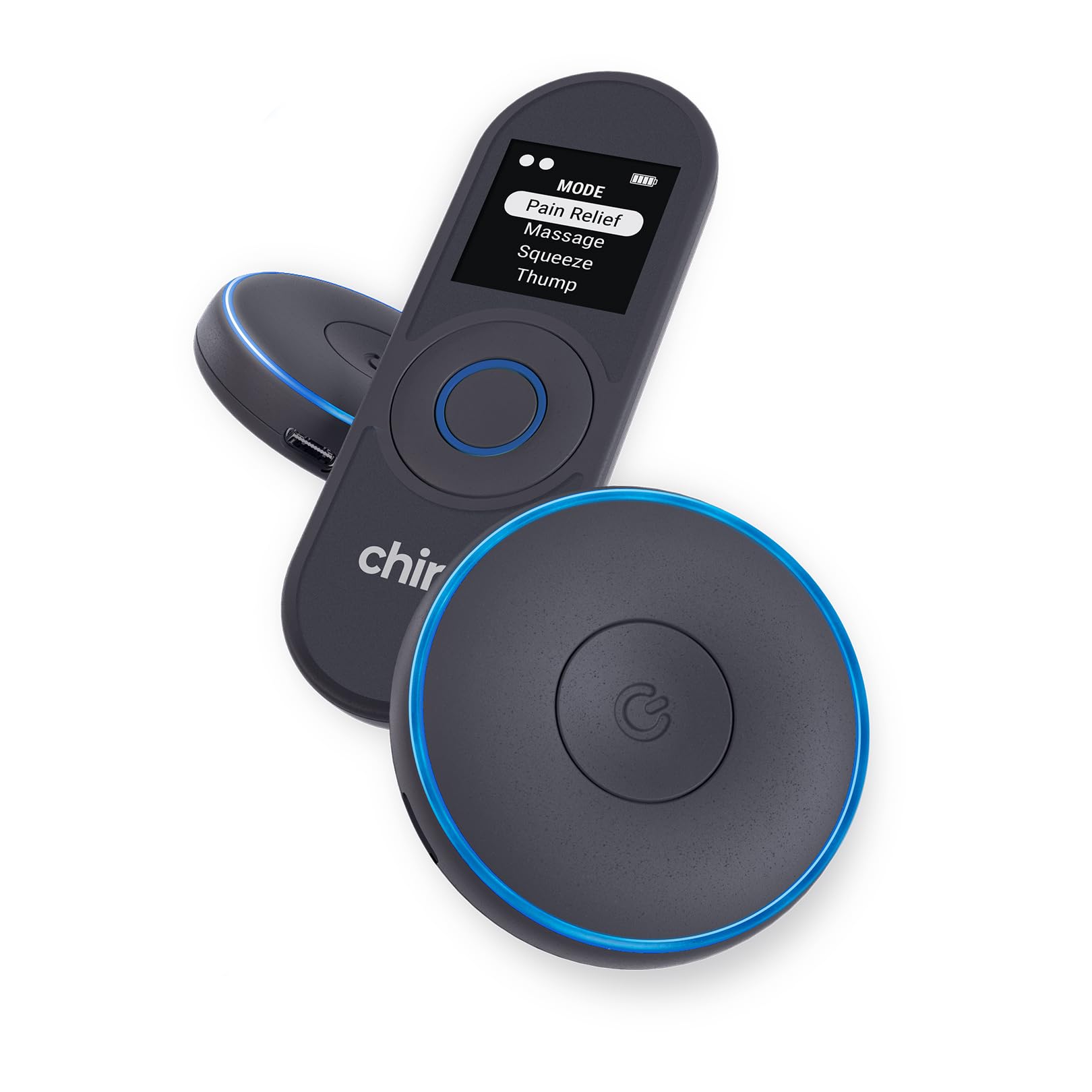
No leads, no dangling wires — just pods that stick on and a remote you keep in your pocket.
Every other pick here is a box with wires trailing to your pads. This one isn’t. The Halo uses wireless pods that stick directly to the muscle and talk to a handheld remote, so you can move, stretch, or walk around during a session. The wireless range holds up at distance too, with sessions staying connected several minutes away in a yard. It ships in a case that charges the pods and the remote together, which makes it the easiest of the group to travel with.
Battery life holds up in real use. Shoppers say getting 5-6 sessions of 15-20 minutes at intensity 10-12 out of a charge, plus roughly three more after that, and the adjustable timer stretches to 60 minutes rather than stopping at 20. Settings are the top praise point, with multiple modes and adjustable intensity to target specific muscle groups, and the pads are affordable to replace. If you treat back or shoulder tension daily, the cordless pods are what keep it in use instead of in a drawer.
The remote is the part that splits opinion. Pairing can be finicky — pods that are fully charged still occasionally refuse to connect — and the remote’s connection is the weak half of the system, not the pods. Pads need proper care to reach their full lifespan, and the manual does not explain much, though support is responsive when something goes wrong. This is also the priciest format here per pad, so go in expecting to replace pads regularly.
The real advantage: using the device while you move. Cordless pods plus a charging case mean a session during dinner, at a desk, or in the yard — a practical upgrade over a wired box tethered to a table.
Pick this: if you want to stim while doing something else and the cable-tangle of a wired unit is what has put you off so far.
Skip the format if: you want fuss-free pairing every single time — the remote needs a little patience.
7. Compex Performance 3.0 Muscle Stimulator with TENS Kit

Built around a workout, not a backache — warm-up, three strength modes, recovery, and TENS in one.
The program list is the whole pitch. Six programs break down as 1 Warm Up, 3 Strength, 1 Recovery, and 1 TENS, which maps neatly onto a training week: prime the muscle before you train, run strength sessions on rest days, and use recovery after. It is designed to be used before, during, or after a workout, and the redesigned body adds a water-resistant silicone sleeve, an improved LCD display, a center navigation button, and a textured grip. The USB-rechargeable lithium-ion battery is rated for up to 8 hours of stimulation per charge.
Buyers report it sped up recovery from a torn calf, and the guided interface with high-quality connectors and pads makes level-by-level dialing easy — most people only need around level 60 of 100. The build quality on the connectors and pads is a clear step up from budget TENS kits. This is the pick for someone who wants to follow a structured routine rather than improvise.
Weigh the weak points honestly. The silicone casing is bulky, the charging port sits behind a small flap that has been known to break, and it uses a proprietary micro-USB tip that needs careful alignment. Pads wear out faster than you’d like, and the pulse at lower levels is subtle, so expect to climb the scale. The charging system is the most fragile part of the design — treat the port and cable gently and you’ll get the most out of it, and the warranty process is worth knowing about before you buy.
What a training routine gets
- Warm Up, three Strength modes, Recovery, and TENS in one program set
- Up to 8 hours of stimulation per charge
- Guided interface with quality connectors and pads
- Water-resistant silicone sleeve and improved LCD
What to handle with care
- Charging port flap and proprietary micro-USB tip are the fragile points
- Pads wear out relatively quickly
- Lower intensity levels feel subtle before the muscle responds
Built for: the person following a real training plan who wants warm-up, strength, and recovery modes mapped to their week.
Elsewhere: if you want fine control over every pulse parameter or a device that never needs careful cable handling, the Beurer EM59 is the safer long-term bet.
Know the Specs
Channels and pad count
A channel is one output that drives a pair of pads, so a two-channel unit runs four pads at once and a four-channel unit runs eight. More channels means you can cover a larger area — a whole back, or two muscle groups — without running the machine twice. Buy for the body area you’ll actually treat; extra channels you never use just add setup time.
Intensity range and headroom
Intensity is how strong the pulse is. A unit that caps low can feel weak on big muscles like quads and glutes, while one with headroom lets you dial into a real contraction and back off for smaller areas. Check the ceiling, not just the number of levels — 100 levels that top out weak are less useful than a shorter scale with real output.
Pulse width and frequency
Pulse width is how long each electrical pulse lasts, and frequency is how many arrive per second. Together they decide whether a stim feels like a light tingle or a deep muscle contraction. Most preset-only units lock these for you; a customizable unit lets you change them, which is what you want if you’re chasing a specific contraction quality.
Pad connectors and running cost
Pads are the consumable. Snap connectors (like 3.5mm) and pin connectors (like 2mm) are the two common types, and whether third-party pads fit decides your long-term spend. A unit locked into branded pads at roughly 20 uses each gets expensive fast — check the connector before you buy.
Common Questions
Can an EMS unit actually build muscle on its own?
What is the difference between TENS and EMS modes?
How many channels do I need to cover my whole back?
Why do the electrode pads stop sticking so quickly?
Can I use a stim machine while walking around or exercising?
How long does the battery last on these devices?
What is Russian stimulation and why does it matter for strength work?
Can I use third-party electrode pads on these units?
Where should I place the pads for muscle stimulation?
Is a heat therapy mode worth having on a stim machine?
The Bottom Line
For most people, the ems for muscle growth winner is the TENS 7000 Rechargeable because it covers both pain relief and muscle contraction in one rechargeable unit that fits in your hand. If manual control over pulse width and frequency is what you’re after, the Beurer EM59 gives you the deepest tuning of the group. And for a whole-back session in one go, the four-channel iStim EV-906 is the one to reach for.
One last thing worth knowing: the device is only half the purchase, because pads are the part that wears out and the part that decides whether you keep using it. Buy a spare set with whichever unit you choose, and you’ll get the most out of every session.
How we choose
We do not accept paid placement. Every pick is matched to a real buyer and a real use-case; we do not hands-on test units.
Sources
Specifications: manufacturer listings and product documentation. Review insights: verified customer reviews, as of October 2026. Pricing: not shown on this page (it changes often); check the current price via the retailer link.
As an Amazon Associate, Aappliancez earns from qualifying purchases. This does not affect which products we feature.