Disclosure: Some links in this post are affiliate links. As an Amazon Associate I earn from qualifying purchases, at no extra cost to you. Learn more
Specs are compiled from manufacturer listings and verified buyer reviews and can change over time — please confirm the key details on the product page before buying.
If you want your music to stop beaming a radio signal into your skull, the fix is simpler than the marketing suggests: buy wired. Every pick here is a corded pair of headphones, or a shielding garment, that keeps the wireless transmitter out of the equation — and the Sony MDR7506 is the one most people should buy first. It is a 40 millimeter closed-back studio headphone with a 9.8 foot cord, no battery, no Bluetooth radio, and nothing to pair. That single design choice — no radio at all — is the whole point of this shelf.
This guide is built by comparing the manufacturers’ published specifications and the patterns across verified customer reviews, so you get each pick’s real strengths and trade-offs instead of marketing spin.
Some options here cut radio frequency exposure by going passive, while others block it with shielding fabric; this breakdown of the emf protection headphones market shows which approach fits your day.
Top Picks


How To Choose The Best EMF Protection Headphones
Start with one question: do you want to remove the radio, or block it? A wired headphone with no Bluetooth chip has no transmitter at all, so there is nothing to shield. A shielding garment works the other way — it leaves the radio in the world and puts a barrier between it and you. Both approaches show up on this list, and they solve different problems.
Wired versus shielded — pick your approach first
A corded headphone like the Sony MDR7506 or the beyerdynamic DT 770 Pro X runs audio down a copper cable and has no battery, no antenna, and no pairing step. That is the most direct way to keep a wireless transmitter off your head: no chip, no antenna, no pairing. Shielding fabric, by contrast, is measured in decibels of attenuation — the Radia Smart beanie is rated up to 99% shielding effectiveness (roughly 50dB). Those are two entirely different mechanisms, so do not compare their numbers against each other.
Understand what “air tube” actually changes
Air-tube earbuds put the speaker driver at the far end of a hollow tube instead of inside your ear. The sound travels up the tube; the electronics stay away from your head. The DefenderShield earbuds run an 8-inch air tube to a speaker chamber at the base, and their 42.5-inch cable carries the signal from your device. This design has a real acoustic cost — expect a slightly hollow edge on some tracks, which owners of air-tube sets do notice.
Check the plug before you buy
The single most common return reason in this category is a plug mismatch. A 3.5 millimeter jack (the standard round headphone plug) is the safest bet. USB-C audio is trickier: the DefenderShield over-ear model needs a USB-C port that carries analog audio and microphone support, and charging-only or digital-only ports may not work at all. If your phone dropped the headphone jack, budget for a dongle that specifically passes audio and mic channels.
Side-by-Side Comparison
| Model | Best For | Connection | Driver Size | EMF Approach | Amazon |
|---|---|---|---|---|---|
| Sony MDR7506★ Best Overall | Everyday studio listening | Wired, 3.5mm | 40 mm | No wireless radio | Amazon |
| 3M WorkTunes ConnectJob Site Standard | Loud job sites and yard work | Bluetooth wireless | — | 26 dB NRR hearing protection | Amazon |
| Radia Smart Slouch Beanie | Sleeping and head coverage | None (wearable) | — | Shielding fabric, ~50dB | Amazon |
| DefenderShield Air Tube Earbuds | All-day wired listening | Wired, 3.5mm | — | Air tube, no wireless signals | Amazon |
| Klein Tools AESEM1S | Talking while protected | Bluetooth 5.1 | — | 23 dB NRR hearing protection | Amazon |
| DefenderShield Air Tube Over-Ear | Long desk sessions, wired | Wired, USB-C | — | Air tube, no battery or RF | Amazon |
| beyerdynamic DT 770 Pro X | Recording and mixing | Wired, mini-XLR | 45 mm | No wireless radio | Amazon |
Detailed Reviews
1. Sony MDR7506 Professional Large Diaphragm Headphone
Our pick — 4.5+★ from 28,000+ verified ratings; the strongest balance of quality and price.
No battery, no pairing, no radio — just a 40mm driver and a cord.
The cleanest way to kill a wireless signal is to never build one in, and this Sony never does. This Sony has no Bluetooth chip, no battery, and no antenna, so there is nothing transmitting and nothing to charge. What you do get is 40 millimeter neodymium drivers — the motor that actually makes the sound — covering 10 Hz to 20 kHz, which is the full range of human hearing. The closed-back cups seal out room noise, so a shared office or a bus seat gets quieter around you.
What wins people over is the sheer consistency of the sound. Owners describe clean bass, crisp highs, and instrument separation clear enough that a techno producer called them great for long sessions with better bass than pricier sets. The flat, uncolored tuning that makes them a studio reference also means they are not bass-heavy — one comparison puts the sibling V6 at 5–30kHz versus the 7506’s 10–20kHz, a difference you feel more in the low end than the numbers suggest. If you want thumping bass, this is the wrong headphone; if you want to hear the recording as it was mixed, it is the right one.
Two practical things to plan around. The cord is 9.8 feet and not detachable, so it is heavy and long enough to catch on a chair arm — a fold-flat design and a soft case help for storage but not for the cable. The earcups also grip firmly, which is comfortable for long stretches for most people but reads as too tight for some head shapes. It ships with a 1/4-inch adapter for audio interfaces and a fabric case, and at around 9.6 ounces the case keeps the whole kit tidy in a bag.
Why People Keep These
- No radio, no battery — nothing to pair or charge, ever
- 40mm neodymium drivers over 10 Hz–20 kHz for full-range detail
- Closed-back cups cut external noise without a single chip
- Folds flat into the included fabric case
- 1/4-inch adapter included for interfaces and mixers
Plan Around These
- The 9.8-foot cord is fixed and heavy in hand
- Clamp force reads as too tight for some head shapes
- Flat tuning means light bass, not party bass
Buy this one if: you want the most direct path away from a wireless transmitter — a plain corded headphone with reference-grade tuning and no charging routine.
Think twice if: you want detachable cables or a punchy low end, since neither is on the menu here.
2. 3M WorkTunes Connect
Built to muffle a table saw, then stream a podcast through the wreckage.
Here is the honest split in this category: this is not a low-EMF product, it is a hearing protector that happens to stream Bluetooth. If your priority is protecting your ears from a 26 dB Noise Reduction Rating (NRR — a lab-tested number for how much noise the muff removes) while you listen to music, it delivers. On a tractor, a mower, or a table saw, you get the beat and the barrier in one piece of gear, and it is water and sweat resistant with vented earcups for long wear.
The battery story is the standout. Owners routinely report more than 50 hours per charge, and the USB-C port is the upgrade people keep mentioning — stretching time between charges from a week to well over two. The USB-C charging port means one cable for your phone and your earmuffs. Comfort holds up for shorter stints, and the headband cutouts stop it mashing against a cap button on a hard hat.
The recurring gripe is weight and the headband over long stretches. This pair is 14.72 ounces, which some owners read as a sign of build quality but which gets tiring by the end of a full shift, and the headband shape presses after a while. Sound is adequate rather than audiophile — fine at normal volume, thin if you push it. Treat this as safety gear that plays music, not a listening headphone that happens to protect.
Where it earns its keep: the 26 dB NRR muff and the 50-hour-plus battery make it a one-piece solution for mowing, sawing, and drilling, and the USB-C port kills the spare-cable hunt.
The real trade-off: at 14.72 ounces with a shaped headband, it is a shift-length tool rather than an all-evening comfort pick.
Right call for: anyone whose loudest daily noise comes from a motor and who wants music without adding a second device.
Wrong call for: anyone hunting a genuinely reduced-signal headphone — this one transmits Bluetooth by design.
3. Radia Smart EMF Protection Slouch Beanie

A hat that wraps your head in silver instead of strapping a speaker to your ears.
Sometimes the answer is not a headphone at all. This beanie layers a silver radiation-shielding fabric inside a cotton outer, covering your head and neck edge to edge, and it is rated for up to 99% shielding effectiveness (roughly 50dB) against radio-frequency sources like Wi-Fi routers, cell towers, and cordless phones. The demo owners run is dependable: put a phone inside the rolled fabric, call it, and it does not ring. One buyer summed up the proof simply: “Works. Phone inside doesn’t ring or register a call.”
Two things make it genuinely wearable rather than a gimmick. It is thin enough to sit under a CPAP mask strap, which is how some owners actually use it, and it does not overheat the head the way a thick knit would. The outer is 95% natural spinning fiber with 5% spandex, so it stretches to fit most men and women on a one-size-fits-all cut. If your reason for this category is a phone sitting by your pillow all night, a shielding beanie covers the head while you sleep without a cord in your ear.
The catch is fit and care. The adult size runs large — it slides when you turn over and a smaller head will find it loose, which is the most common fit complaint. And the silver lining is picky: hand-wash in cold water with a gentle phosphate-free soap or mild non-detergent soap, never bleach or tumble dry, and the fabric is specified to keep its shielding effectiveness indefinitely if you follow those rules. Note too that it does not block high-frequency radiation like X-rays, nor low-frequency magnetic fields measured in milligauss.
What it shields: edge-to-edge silver fabric rated to about 50dB against Wi-Fi, cell, and Bluetooth radio frequencies — the kind of signal that reaches across a whole house.
The fit reality: one size is generous, so it works dressed down as a slouch but slips on smaller heads.
Fits your nightstand if: you want head coverage while you sleep, not earbuds, and you can follow a cold hand-wash routine.
Look elsewhere if: you need a snug, stay-put hat or you want to block magnetic fields — this only handles radio frequency.
4. DefenderShield EMF Radiation-Free Earbuds

The earbud that puts its speaker in your pocket instead of your ear canal.
Air-tube earbuds are the clever middle ground. The speaker driver sits at the base of an 8-inch air tube and the sound travels up a hollow path to your ear — so the electronics live away from your head, and the whole thing runs on a wire with no battery. The 42.5-inch cable plugs into a standard 3.5 millimeter jack (the round headphone plug nearly every laptop and older phone still has), and there is a coiled copper-infused braided cord for added ELF mitigation. There is no active noise cancellation by design — that would mean circuitry near your head.
Sound is the surprise. Buyers report bass and treble crisp enough to rival a Sennheiser, with the only tell being a slightly hollow edge on some songs — the air-tube signature. Because there is no battery, an all-day listener never hits a wall; one buyer swapped out AirPods for these specifically and found they never needed recharging. Over loud farm noise, podcasts stay clear without cranking volume. Three ear tip sizes and three interchangeable sports tips come in the box, plus two clips to anchor the cable to a shirt during a workout.
Now the part you should hear before buying. The build is the weak point, and it is not a rare fluke — a pattern of failures runs through the low reviews. Sound can drop from one speaker inside a year, the control bar can go unresponsive, and the cable can snag on a chair or door handle and yank the buds out. The earbuds also fall out when you lean over or chew, though re-seating is easy if you have found the right tip size. If you baby your gear and clip the wire down, these last; if you toss them in a bag, they do not.
The Appeal
- Speaker driver sits 8 inches from your ear, not inside it
- No battery and no wireless signal — all-day listening
- Six tip options plus two clips in the box
- Sound quality surprises people who expect air tubes to be thin
Where It Falls Short
- Speaker and control failures show up inside the first year
- Buds slip out when you lean or chew
- The cable snags and has been known to yank out
Best suited to: bedside and desk listeners who want zero wireless signal and clip the cord down so it stays safe.
Not for you if: you move around a lot or you expect a headphone to survive a backpack — the wire and driver connections are the fragile part.
5. KLEIN TOOLS AESEM1S Smart Sense Electronic Safety Earmuff

Lets a customer’s voice in, shoves the mower’s roar out.
What sets this Klein apart is the Smart Sense feature. It uses microphones to lift faint sounds — a coworker calling your name, a warning shout — back up to a safe listening level, while pushing high impulse and continuous noise down. Paired with a 23 dB Noise Reduction Rating (NRR — the tested amount of noise the muff blocks), it lets you keep the earmuffs on instead of pulling them off to talk. Bluetooth 5.1 handles music and calls, and a dual-knob design means you can dial Smart Sense and Bluetooth volume independently rather than fighting one master wheel.
Battery is where owners get smug. The rechargeable USB-C cell is rated for up to 25 hours, and owners mention it lasting for days on a charge without dying mid-shift, so you can skip the disposable battery run to the truck. The large volume knobs are repeatedly singled out as easy to work with gloves on. The cups form an excellent noise-blocking seal, one reason the earmuffs last through years of rain, paint, and job-site abuse.
Two caveats to weigh fairly. The seal that blocks sound also traps heat — ears get hot by mid-afternoon. And the noise blocking is good, not bottomless; people who want the deepest possible reduction will find this falls short of an active noise-cancelling setup, and calls to someone else can be one-sided (they hear you fine; you may not hear them well). The raised Klein logo on the inner headband can press under a work hat. That is a small, fixable annoyance, not a reason to walk away.
The draw: Smart Sense plus 23 dB NRR lets you talk to people without removing hearing protection, and the dual knobs split music volume from ambient volume.
Worth knowing: hot earcups after a few hours and blocking that stops short of full active cancellation.
Choose it when: your day involves talking to people on a noisy site and you want one piece of gear to cover protection, music, and conversation.
Pass if: your top priority is the quietest possible silence — this favors awareness over total isolation.
6. DefenderShield Air Tube Over-Ear Headphones USB-C
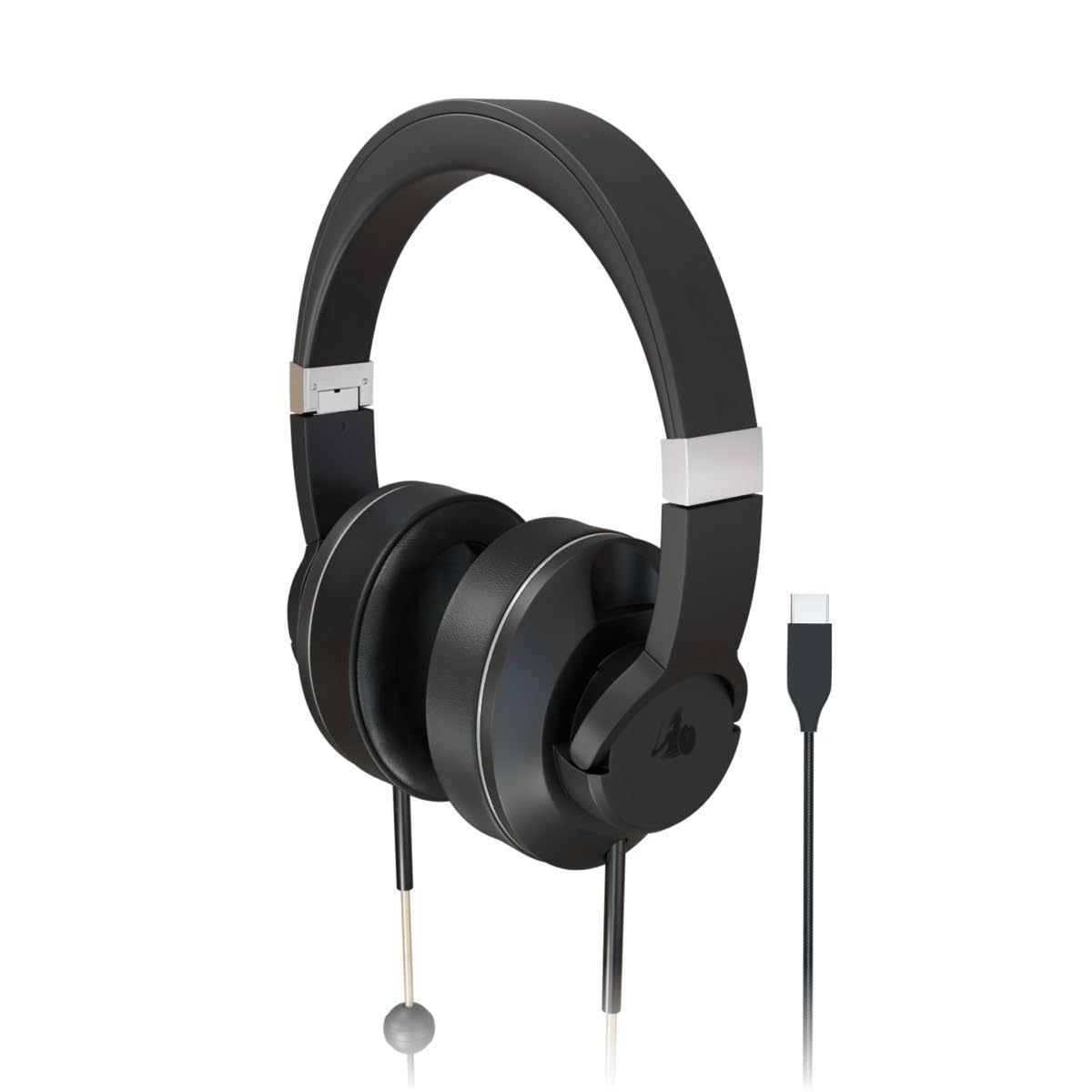
Full over-ear comfort, an air tube between you and the signal, and no Bluetooth on board.
This is the over-ear version of the air-tube idea: cushioned cups that sit around your ears for long desk sessions, wired over USB-C with no Bluetooth, no battery, and no radio-frequency transmitter. The frequency response tops out at 20 kHz, and the sound is described as full-bodied for calls, music, and podcasts. If you spend hours at a laptop and want the away-from-your-head electronics of an air tube without pushing buds into your ear canal, this is the shape that avoids ear fatigue.
Because the list of reviews is short, the sound verdict is a brief one: early feedback puts it in favorable territory, with the first buyer noting “Great sound for a tube headset!” and promising to flag any breakdown. The build is fold-flat with a zipper case for travel, and the maker’s tuning of the air tubes is the selling point they lean on hardest.
USB-C is the compatibility risk you must check before ordering. This headphone needs a USB-C port that carries analog audio and microphone support, and charging-only or digital-only ports may not run it fully — so plug directly into the device rather than a hub, and confirm your settings. Second, if the headband feels firm, stretch it gently over a stack of books for 24 hours and store it folded to keep the air tube from kinking. A failed right-side channel at 1.5 years of use is the durability note to have in mind; with a modest track record here, treat these as a considered purchase rather than an impulse one.
Suits you if: you want over-ear comfort, a corded signal path, and you can confirm your USB-C port passes audio and mic.
Reconsider if: your phone has a charging-only USB-C port or you want a long-proven reliability record — the sample size here is thin.
7. beyerdynamic DT 770 Pro X
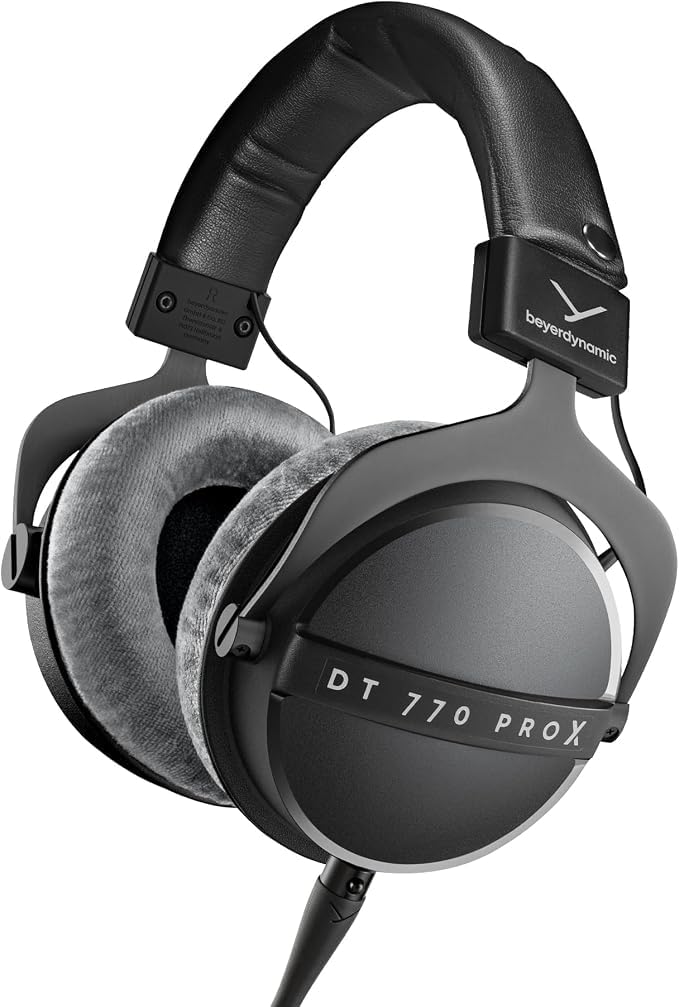
A 48-ohm studio tank that plugs into a laptop and needs no amp.
Most studio headphones force you to buy a headphone amplifier first. These do not. The 48-ohm impedance (the electrical resistance that normally decides whether a source can drive a headphone) is low enough to plug straight into a laptop, phone, console, or interface with no extra box. Inside, the STELLAR.45 driver — a 45 millimeter flagship transducer — pushes precise, high-resolution detail at any listening level, and the closed-back shell keeps your mix from leaking into an open microphone while you record.
What the crowd praises most is the sound, and the numbers agree it dominates the feedback. Detail and clarity run far ahead of a gaming headset, and even picky listeners who found them hollow from the start say an equalizer transforms them into something exceptional. The detachable mini-XLR cable lets you swap or replace it in seconds, and the replaceable velour ear pads mean years of daily use rather than a disposable pair. It drives fine straight off a controller and is genuinely comfortable for long sessions.
The honest note is treble. These lean bright and forward, which is why they reveal subtle detail — but on a poorly mixed track the highs can wear you down, and listeners sensitive to brightness will want to equalize. A few owners also find the velour pads warm and the fit snug. Those are tuning and fit preferences, not defects; almost everyone who buys gets the build they expect, hand-made in Germany with a 3 meter detachable cable in the box.
The signature: a 45 millimeter STELLAR.45 driver with strong sub-bass and exceptional detail that beats even pricier references once equalized.
The honest limit: bright highs punish badly mixed tracks, and the velour cups run warm.
Made for: recordists and gamers who want one closed-back pair that runs without an amp and can have its cable and pads replaced.
Look past it if: you want a warm, relaxed, laid-back sound — this is a monitor, and it tells you the truth.
Know the Specs
Noise Reduction Rating (NRR) in Decibels
NRR is a lab-tested number for how much noise a muff removes, so a higher figure means more protection. The 3M WorkTunes carries a 26 dB NRR and the Klein Tools a 23 dB NRR. Treat these as hearing-protection scores, not music quality scores — they tell you how much a loud motor shrinks, not how good the bass sounds.
Shielding Effectiveness in Decibels and Percent
Shielding fabric is graded differently. The Radia Smart beanie is rated for up to 99% shielding effectiveness, roughly 50dB, against radio-frequency sources like Wi-Fi and cell signals. That figure describes how much a signal is attenuated — do not compare it to an NRR, which measures sound-blocking for your ears.
Why a Wired Pair Has No EMF to Shield
A corded headphone with no Bluetooth chip and no battery has no radio to transmit. The Sony MDR7506, the beyerdynamic DT 770 Pro X, and the DefenderShield over-ear all run on a cable, so the signal that carries music is not a wireless transmission at all. That is the simplest way to reduce exposure: remove the transmitter entirely.
USB-C Audio Compatibility
Not every USB-C port carries audio. The DefenderShield over-ear needs a port with analog audio and microphone support, and charging-only or digital-only ports may not work. A 3.5 millimeter jack is more broadly compatible — that is the plug on the Sony, the DefenderShield earbuds, and most older laptops.
Common Questions
Do EMF protection headphones actually block radiation?
Is an air tube headphone better than a regular wired one?
Will the DefenderShield USB-C over-ear work with my phone?
Can I wash an EMF shielding beanie in the machine?
Does the Radia Smart beanie block X-rays or magnetic fields?
How long does the 3M WorkTunes battery last on a charge?
What does a 48-ohm headphone mean and do I need an amp?
Are Bluetooth earmuffs an EMF protection product?
What plugs into a computer with a normal headphone jack?
The Bottom Line
For most people chasing the emf protection headphones idea, the Sony MDR7506 wins because it simply has no wireless radio to worry about — a 40 millimeter closed-back driver, a 9.8 foot cord, and zero pairing or charging. It also has the largest review base here, holding 4.5+ stars across tens of thousands of owners. Add the beyerdynamic DT 770 Pro X to the shortlist if you want a detachable mini-XLR cable and a replaceable-pad build that plugs straight into a laptop. Sleeping beside a router? The Radia Smart beanie covers the head with silver shielding fabric rated to about 50dB. And if the loud noise is a mower rather than a signal, grab the 3M WorkTunes — a 26 dB NRR muff that streams music for over 50 hours a charge.
How we choose
We do not accept paid placement. Every pick is matched to a real buyer and a real use-case; we do not hands-on test units.
Sources
Specifications: manufacturer listings and product documentation. Review insights: verified customer reviews, as of October 2026. Pricing: not shown on this page (it changes often); check the current price via the retailer link.
As an Amazon Associate, Aappliancez earns from qualifying purchases. This does not affect which products we feature.