Disclosure: Some links in this post are affiliate links. As an Amazon Associate I earn from qualifying purchases, at no extra cost to you. Learn more
Specs are compiled from manufacturer listings and verified buyer reviews and can change over time — please confirm the key details on the product page before buying.
If you are watching your blood pressure, the electrolyte question gets tricky fast. Most sports drinks load you with sugar and a mountain of sodium, which is exactly what you are trying to avoid. But cutting salt entirely is not the answer either — your body still needs sodium, potassium and magnesium to keep muscles working and fluid balanced. The real trick is picking a formula that delivers those minerals cleanly, without added sugar or a salt load you cannot control. That is what separates the picks below.
This guide is built by comparing the manufacturers’ published specifications and the patterns across verified customer reviews, so you get each pick’s real strengths and trade-offs instead of marketing spin.
The five options below split into two camps: swallow-and-go tablets and capsules for people who hate the taste of salt water, and dissolvable or drop-in formulas for anyone who wants to sip their minerals. Every pick lists its actual sodium, potassium and magnesium content so you can weigh it against your own daily limits before you buy. Each one earns its spot as a serious electrolyte drink for high blood pressure.
Top Picks


How To Choose The Best Electrolyte Drink for High Blood Pressure
Blood pressure management is about totals, not single foods or drinks. The American Heart Association generally advises keeping sodium intake low, and that means every electrolyte product you add is a sodium deposit into your daily bank. Before you buy anything, do two things: read the sodium content per serving in milligrams, and check whether the product contains added sugar. Those two numbers drive most of the decision.
Sodium per serving is the first number to check
Sodium is listed in milligrams (mg) on the nutrition label. A product with 200 mg per serving adds about 200 mg to your total day. A product with 1,000 mg adds five times more. If a doctor has told you to stay under a specific daily milligrams target, a lower-sodium product gives you more room to eat real food. Liquid-drop formulas are helpful here — you decide how many drops go in your glass, so you can start small.
Potassium and magnesium support muscle function
Potassium and magnesium work alongside sodium to keep muscles from cramping and to support normal fluid balance. Potassium is listed in milligrams per serving. Magnesium is usually listed in milligrams too, and some products supply it as “ionic magnesium” — a form suspended in liquid that may absorb more easily. If your main complaint is leg cramps at night or after workouts, a magnesium-forward formula often fits better than a straight sodium salt tablet.
Sugar-free matters more than flavor
Added sugar in a sports drink is empty calories that spike blood sugar without helping blood pressure at all. Look for the words “zero sugar” or “no added sugar” on the front of the label, then confirm on the nutrition panel that total sugars read 0 g. Watch out for sugar alcohols and maltodextrin, which can still register on the glycemic index.
Format: tablets, capsules, or drops
Capsules and tablets are easy to carry and swallow with water — no salty taste. Drops and powders let you control strength: you can put a few drops in a bottle or dissolve a tablet in 16 fl oz. People who drink a lot of plain water and want a gentle mineral top-up usually prefer drops. People who want a fixed, consistent dose prefer tablets.
Side-by-Side Comparison
| Model | Best For | Sodium | Potassium | Format | Amazon |
|---|---|---|---|---|---|
| Trace Minerals Electrolyte Stamina Tablets, 90 Tablets★ Best Overall | Cramp prevention, daily use | — | — | Tablet, 90 count | Amazon |
| Trace Minerals No Muscle Cramps Liquid ElectrolytesBest for Cramp Relief | Adjustable daily drops | — | — | Liquid drops, 4 oz | Amazon |
| Flyby Electrolyte Capsules | Sugar-free capsule routine | — | 1,000 mg per scoop | Capsule, 60 count | Amazon |
| Electrolyte Pills Supplement Salt Tablets | Keto, fasting, cramp support | — | — | Capsule, 100 count | Amazon |
| Nuun Zero Sugar Hydration Electrolyte Tablets | Flavored everyday hydration | 200 mg | 125 mg | Effervescent tablet, 40 servings | Amazon |
Detailed Reviews
1. Trace Minerals Electrolyte Stamina Tablets, 90 Tablets
Our pick — 4.5+★ from 1,500+ verified ratings; the strongest balance of quality and price.
The one that turns nightly leg-cramp relief into a two-second habit.
The single tablet you take with a glass of water. No salt shaker, no measuring, no flavor to argue with. Each bottle holds 90 tablets, which works out to a routine you restock roughly every three months at one a day. The formula centers on a full spectrum of trace minerals with ionic magnesium and potassium — ionic here just means the minerals are already dissolved in a liquid-friendly form the body can use, rather than a dry powder you have to break down first.
What wins people over is cramp relief, and it is not close. Reviewers describe taking one tablet the night before a match, one in the morning, and one pre-match, then playing three-plus hours of tennis without a cramp. The energy side draws steady praise too: the lift people describe feels steady rather than a jolt, which matches a mineral-based approach rather than a caffeine one.
The honest catch is taste. These are uncoated, and some people find the mineral flavor noticeable — if you are someone who gags on plain mineral tablets, the capsule options below may suit you better. There is also a sodium-restriction note worth flagging: the label directions call for up to six tablets a day, which is a real amount of sodium for anyone managing blood pressure. Start at one, watch how you feel, and check with your doctor about your total daily sodium if you are on a restricted plan.
The Case for a Daily Tablet
- 90-tablet bottle — one a day keeps a simple, low-effort routine going
- Ionic magnesium and potassium in a full-spectrum trace mineral blend
- Vein of loyal users who came over from discontinued formulas and stayed
- Tablet format travels easily — no water bottle required beyond a swallow
Points Worth Knowing
- Uncoated tablets — the mineral taste does not suit everyone
- Label calls for up to 6 tablets a day; sodium adds up if you follow that fully
- Value and taste both sit in mixed territory in the feedback — neither is a slam dunk
Best fit: anyone who wants a fixed, no-thought daily mineral tablet and cares most about cramp prevention.
Consider otherwise: if you are on a strict sodium-restricted diet and want fewer milligrams per dose, or you cannot stomach an unflavored tablet, look at the capsules or drops below.
2. Trace Minerals No Muscle Cramps Liquid Electrolytes
You control the dose — a dropper in your water bottle, adjusted to what your body needs that day.
If a fixed tablet feels like tying your hands, the liquid version flips that. This is a 4 oz bottle of flavorless concentrate with 60 servings, and the working dose is described in reviews as roughly 32 drops per liter or one dropper full in a water bottle. That flexibility is the whole point: on a heavy workout day you take a full dropper; on a light day you take less. Unlike the tablets above, there is no mineral-taste pill to swallow — the drops are unflavored, so they disappear into whatever is in your glass.
The thing everyone raves about is effectiveness, with cramp relief the close second. Reviewers describe nightly foot and leg cramps that stopped within a week or two, and one wrote: “I’m amazed — this stuff really works.” The sodium, potassium and magnesium blend carries no sugar, no artificial sweeteners, no dyes and no stimulants, and each batch is third-party tested for purity and potency, including heavy metals screening — that last part matters if you are being careful about what goes into your body every day.
The trade-off is real but narrow: the taste reads salty to some, and if you want a flavored drink, this is not it. Value also splits — the bottle lasts if you use it sparingly, less so if you dose fully. The one spec caution: this is a magnesium-forward mineral drop, not a low-sodium salt replacement, so if your doctor has you counting sodium milligrams, check with them before making it a daily habit.
Where the flexibility pays: 32 drops per liter gives you a dial most electrolyte products do not offer. Dial up on a hard day, down on a rest day, and you are not locked into a fixed tablet count.
The honest read: salty is the recurring note in the feedback, and if you want a flavored sip, this is the wrong bottle for you. It is a mineral concentrate first, a drink second.
Reach for this if: you want to control your own dose and mix it into whatever you already drink.
Pass if: you need a flavored drink, or you are specifically trying to limit sodium and want a formula with a lower mineral load.
3. Nuun Zero Sugar Hydration Electrolyte Tablets
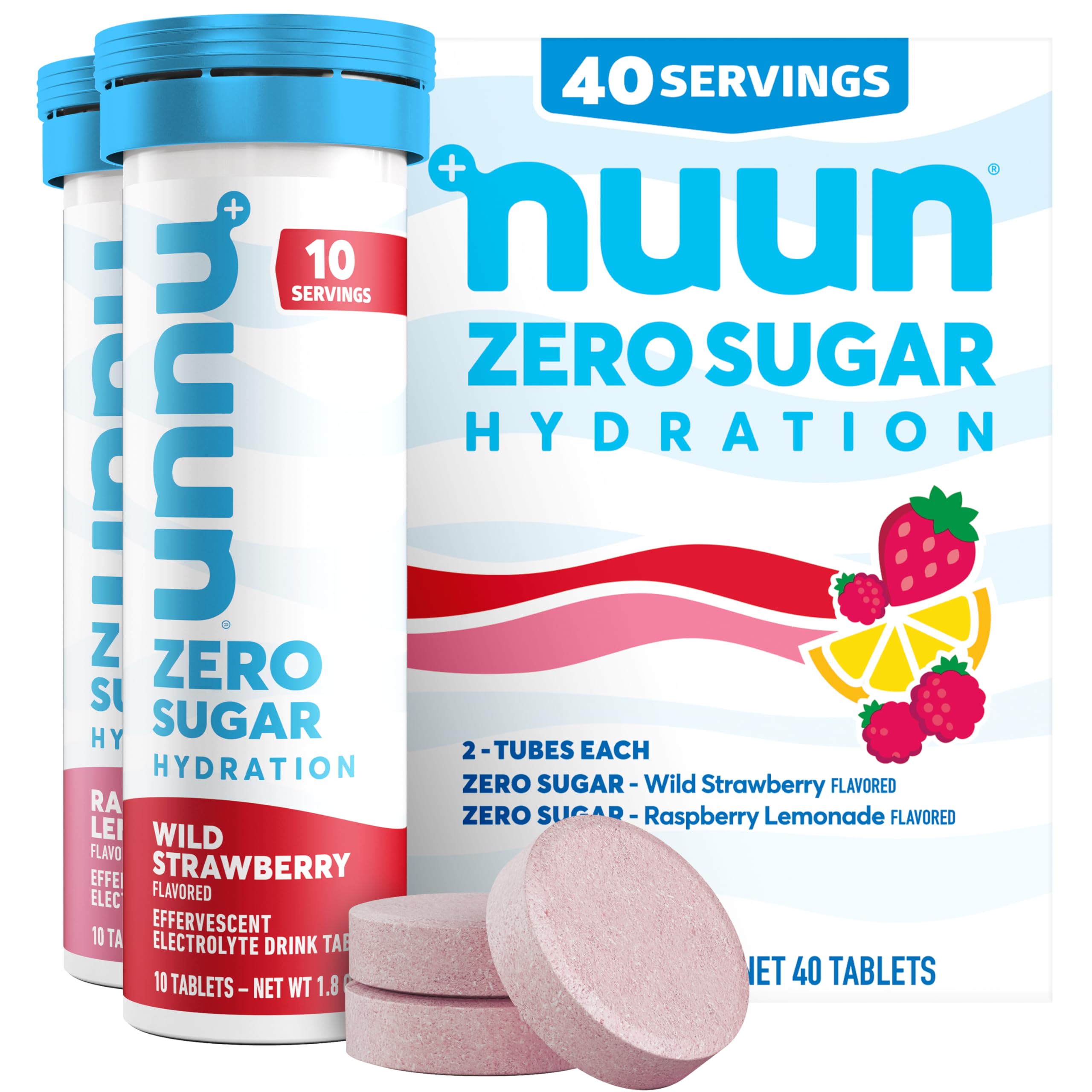
The one that tastes like fruit and prints the exact sodium and potassium per tablet.
Most electrolyte products either taste good or tell you what is in them. Nuun Zero does both, and it publishes the mineral quantities clearly on the label — five everyday electrolytes in fixed amounts: sodium at 200 mg, potassium at 125 mg, chloride at 75 mg, calcium at 30 mg and magnesium at 20 mg. Those numbers matter here because 200 mg of sodium per tablet is a modest, countable amount. If your daily sodium target is tight, you can see exactly what one tablet adds.
The format is a drop-in effervescent tablet, and this 4-pack holds two tubes of Raspberry Lemonade and two tubes of Wild Strawberry for 40 servings total. Drop one in 16 fl oz of water, let it dissolve, drink. Reviews call the flavors genuinely good — one buyer wrote that these are the best-tasting no-sugar electrolytes they have tried, with “absolutely no undesirable after-taste.” Compared with the unflavored Trace Minerals drops above, this is the pick for anyone who wants to actually enjoy drinking their electrolytes.
The catch is intensity. A few people find the flavor too strong, especially the lemon-raspberry, and prefer to dilute it in more water than the label suggests. The GF and vegan labeling, non-GMO ingredients and zero sugar keep the label clean, which is exactly what people watching what they drink tend to want. Just know that if bold flavor bothers you, half a tablet in a full bottle is a reasonable workaround.
What Shines
- Full mineral panel printed in milligrams — sodium 200 mg, potassium 125 mg, chloride 75 mg, calcium 30 mg, magnesium 20 mg
- Zero sugar, non-GMO, gluten-free, vegan
- 40 servings across two flavors in one mixed-berry pack
- Dissolves clean in 16 fl oz — no gritty residue
Where It Falls Short
- Flavor runs strong — some buyers dilute it further than the package suggests
- Tablets must sit in water; not a carry-in-your-pocket-and-swallow format
- Effervescent tubes need to stay sealed to keep the tablets from clumping
Go with Nuun if: you want a flavored, sugar-free drink you look forward to and you want the mineral milligram counts in plain sight.
Look elsewhere if: you prefer swallowing a tablet with no taste at all, or you need something that works without a bottle of water.
4. Flyby Electrolyte Capsules

A swallow-and-go capsule that skips the glass entirely — unless you want to mix it.
Capsules win on one thing: you do not have to taste anything. That is the entire pitch here, and it is a strong one if you have ever gagged on a salty electrolyte drink. The formula blends sodium, potassium, B vitamins and antioxidants with copper and manganese, all with no added sugar and no fillers. It pairs potassium with the B vitamins and antioxidants, which is a slightly broader nutrient mix than the mineral-only formulas above. A 60-count bottle is one month of supply at the standard two-per-day dose.
Buyers single out the 1,000 mg of potassium per scoop, a mineral your body needs for muscle function alongside sodium. Buyers flag the no-added-sugar label as the deciding factor — no stevia bitterness, no artificial sweeteners, no pink dye from beetroot powder lingering at the bottom of a glass. The capsule format also travels clean: no shaker, no powder clumping in a gym bag.
The honest catch: the formula is designed to also be mixable, and when people empty the capsule into 12 ounces of water, the taste comes in sweet — one reviewer noted the sweet taste is strong enough that they use half the dose per glass. That is a real reason to prefer the capsule-and-swallow route over a powder style. Capsules are also slightly bulkier to carry than a flat tablet tube, and the physical container takes up a bit more room — the Flyby bottle measures 2.68 x 2.64 x 2.32 inches compared with the Dr. Bo capsule bottle at 2.3 x 2.3 x 4.29 inches. The Flyby bottle weighs 3 ounces, lighter than the Dr. Bo bottle at 4.7 ounces.
Why people pick it: no swallow-the-salt problem, no dye residue, no stevia aftertaste — the capsule format sidesteps every flavor issue at once. That is why it lands as the pick for anyone who wants a sugar-free routine with zero taste compromise.
Before you commit: if you plan to empty the capsule into water instead of taking it whole, expect a sweet taste that needs to be cut in half. The whole capsule swallowed with water bypasses that entirely.
Pick it if: you want a no-taste, no-sugar capsule you swallow with any glass of water and skip the flavor debate.
Choose another if: you would rather dissolve a flavored tablet in a bottle — Nuun above is the better call for that habit.
5. Electrolyte Pills Supplement Salt Tablets

The tasteless capsule with the widest mineral list — built for keto, fasting, and cramp-prone days.
For anyone running keto or intermittent fasting, that first week can hit hard — the “keto flu” is essentially your body dumping sodium and water and not replacing them. That is the exact gap these Dr. Bo capsules aim at. They pack a broad mineral list in one tasteless capsule: potassium, magnesium, sodium, chloride, calcium, phosphorous, vitamin D3, boron and Bioperine. That is more minerals per dose than the Flyby capsules above, which stick to sodium, potassium, B vitamins and antioxidants. Two capsule formats, two different mineral philosophies.
The 100-count bottle is the value angle here — more capsules in the bottle than the Flyby 60-count, though the Dr. Bo bottle is physically bigger too. At 4.7 ounces, the Dr. Bo bottle is heavier than the 3-ounce Flyby bottle, so Flyby wins on carry weight for a travel bag. Dr. Bo wins on capsule count and mineral breadth.
Feedback centers on effectiveness and then quality, and the stories are specific: one family reports that a college-age daughter who slept excessively and woke with headaches found the electrolytes eased her headaches. Another buyer, working outside in the heat and drinking 16 glasses of water a day, wrote: “I used it because I was working outside in the heat and even though I would drink 16 waters a day I was still getting dehydrated.” The recurring honest note is that a minority of users feel a little jittery after taking one — if you are sensitive to stimulant-like reactions, start with one capsule rather than the full daily dose and see how you feel.
What Earns Its Spot
- 100-count bottle — the largest capsule count on this list
- Widest mineral panel: potassium, magnesium, sodium, chloride, calcium, phosphorous, vitamin D3, boron and Bioperine
- Tasteless capsule — no salt flavor, no sugar
- Keto-friendly, fasting-friendly format
What to Weigh
- Physically heavier than the Flyby bottle — a real difference if you pack it daily
- A minority of users report feeling jittery after a dose — start with one capsule
- Does not publish sodium content per serving on the front of the label, so check the back panel if you are tracking milligrams
Best for: keto and fasting routines that need a broad mineral sweep in a tasteless capsule, and buyers who want the most capsules per bottle.
Skip if: you need every sodium milligram visible on the front of the label, since the Dr. Bo panel list does not publish a per-serving sodium number prominently.
Know the Specs
Sodium in Milligrams (mg)
Sodium is the mineral most directly tied to blood pressure, so it is the first number to read on any electrolyte label. Sodium is what your body uses to hold water in your cells, and it is the reason salt tablets exist for athletes and outdoor workers. For anyone watching blood pressure, the trick is to know your sodium number and account for it against everything else you eat. Nuun publishes 200 mg per tablet — a countable, modest amount. Liquid drops let you dial your own dose down. Capsules hide the number unless you turn the bottle over.
Potassium in Milligrams (mg)
Potassium works opposite sodium in the body — it helps balance fluid and supports normal muscle function. For cramp-prone buyers, potassium and magnesium together often matter more than sodium alone. Flyby lists 1,000 mg per scoop, which is a big potassium number relative to the other products here. The Dr. Bo capsules include potassium plus magnesium and calcium. Nuun lists 125 mg per tablet. If your daily diet is already potassium-rich, you may not need a high milligram capsule, but if you are on a low-carb or fasting routine you likely will.
Format: Tablet, Capsule, or Liquid Drops
The format decides how much control you have over your dose and how much taste you deal with. Tablets and capsules are fixed doses — swallow and done. Liquid drops let you start small and adjust up. Effervescent tablets dissolve in water and deliver a flavored drink, but the dose is locked per tablet. For someone managing blood pressure, drops give the tightest control over sodium, tablets give the most consistent daily routine, and capsules give the cleanest taste-free experience.
Added Sugar Versus Zero Sugar
Traditional sports drinks use sugar to drive fluid absorption, but that is not what you want for daily blood-pressure support. Sugar-free formulas skip the sugar spike entirely — no added sugar, no cane sugar, no high-fructose syrup. Read the nutrition panel for “Total Sugars” and look for 0 g. Watch out for maltodextrin and sugar alcohols too — they can still register on the glycemic index even when the label says sugar-free. Every product on this list reads zero or no-added-sugar on the front of the label.
Common Questions
Are electrolyte drinks safe with high blood pressure medication?
How much sodium is in a typical electrolyte tablet?
What is the difference between electrolyte tablets and electrolyte capsules?
Can I take electrolyte capsules if I am on a low-sodium diet?
Do sugar-free electrolyte tablets actually work as well as sugary sports drinks?
What is the difference between electrolyte pills and salt tablets?
How long does one bottle of electrolyte tablets last?
Can electrolytes raise blood pressure?
Are these electrolyte products sugar-free and keto-friendly?
What should I look for on an electrolyte label if I have high blood pressure?
The Bottom Line
For most people managing blood pressure, the right electrolyte drink for high blood pressure is whichever one lets you actually count the sodium and skip the sugar — and for that, Trace Minerals Electrolyte Stamina Tablets is the pick that starts with the cleanest, most consistent format. If your priority is flexibility and a formula you can dial up or down on any given day, the Trace Minerals No Muscle Cramps Liquid Electrolytes is the one to reach for. And if you want a flavored drink with every milligram printed on the label — sodium, potassium, chloride, calcium and magnesium — the Nuun Zero Sugar Hydration Electrolyte Tablets is the best tasting of the bunch. For a tasteless capsule routine with the widest mineral panel and the biggest bottle, grab the Dr. Bo Electrolyte Pills. Whichever you choose, start with a lower dose, watch how your body responds, and talk to your doctor about how it fits the sodium you already eat.
How we choose
We do not accept paid placement. Every pick is matched to a real buyer and a real use-case; we do not hands-on test units.
Sources
Specifications: manufacturer listings and product documentation. Review insights: verified customer reviews, as of October 2026. Pricing: not shown on this page (it changes often); check the current price via the retailer link.
As an Amazon Associate, Aappliancez earns from qualifying purchases. This does not affect which products we feature.