Disclosure: Some links in this post are affiliate links. As an Amazon Associate I earn from qualifying purchases, at no extra cost to you. Learn more
Specs are compiled from manufacturer listings and verified buyer reviews and can change over time — please confirm the key details on the product page before buying.
If your gums bleed when you brush, the fix is usually not a harder brush — it is a softer, smarter one that tells you when you are pressing too hard. That single feature separates the picks below more than any other. Every brush here pairs gentle gumline cleaning with a pressure cue or a sensitive mode, because with periodontal disease the goal is removing plaque without grinding already-irritated tissue.
This guide is built by comparing the manufacturers’ published specifications and the patterns across verified customer reviews, so you get each pick’s real strengths and trade-offs instead of marketing spin.
Below you will find seven brushes sorted by what they actually do for tender gums, from the two-mode Sonicare that anchors the list to the oscillating Oral-B models with a visible pressure ring. Each entry names the one spec that matters for gum care, the honest trade-off, and who it fits — so you can pick the right Electric Toothbrush for Periodontal Disease without guessing.
Top Picks

How To Choose The Best Electric Toothbrush For Periodontal Disease
Your hygienist has probably already told you the headline: electric beats manual for plaque removal along the gumline. The harder decision is which electric brush stops you from scrubbing sore gums raw. Three things decide that — the pressure feedback, the gentleness of the head, and how many intensity steps you can drop down to on a bad day.
Pressure feedback is the feature that protects gums
A pressure sensor is a small detector that notices when you push the brush too hard against your teeth. On most models here it answers with a light ring or a vibration pulse, so you ease off before you abrade the gumline. Brushes without any feedback rely on your hand to stay light, and most people press harder than they think. If your gums bleed easily, treat a pressure cue as near-essential.
Sonic vibration versus oscillating-rotating heads
Sonic brushes vibrate the bristles side to side at high speed and drive fluid between teeth; oscillating-rotating brushes spin a small round head back and forth. Both clean well. Sonic tends to feel softer and buzzier against tender tissue, while the round oscillating head reaches around individual teeth. Buyers with sensitive gums often call the sonic feel gentler, and several picks below are sonic for that reason.
Intensity levels and a sensitive mode
A dedicated sensitive or gum-care mode lowers the motor’s intensity so the brush still cleans but stops jolting inflamed gums. The more intensity steps a brush offers, the more you can dial down during a flare-up and dial back up once things settle. Two modes with three intensity levels, as on the Sonicare 5900, gives you a gentle lane without stripping out cleaning power.
Brush head size, softness, and running cost
A smaller head slips into the tight pockets at the back of the mouth where periodontal problems often start. Soft bristles matter just as much as the motor. Remember that every brush locks you into its own replacement heads — some use generic cheap heads, others use brand-specific ones that cost more over the years. Factor that running cost in alongside the brush itself.
Side-by-Side Comparison
| Model | Best For | Brushing Modes | Pressure Feedback | Stated Battery | Amazon |
|---|---|---|---|---|---|
| Philips Sonicare 5900★ Best Overall | Best overall for tender gums | 2 modes + 3 intensity levels | Haptic vibration sensor | Up to 21 days | Amazon |
| Oral-B iO5Most Modes | Most modes and app tracking | 5 cleaning modes | Visual pressure sensor | — | Amazon |
| Waterpik Sensonic STW-03W020 | Gentle sonic at a mid price | 3 modes | — | Up to 4 weeks | Amazon |
| Oral-B iO3 | Entry oscillating with pressure ring | 3 modes | Visible pressure sensor | — | Amazon |
| Made by Dentists PRO-X | Longest battery on the list | 3 modes | — | Up to 70 days | Amazon |
| usmile Y10 PRO | Smart display and zone tracking | Multiple modes | Screen + auto-reduction | Up to 180 days | Amazon |
| Philips Sonicare 6500 | Most intensity control | 3 modes + 3 intensity levels | Visual light ring | Up to 21 days | Amazon |
Detailed Reviews
1. Philips Sonicare 5900 Electric Toothbrush
Our pick — 4.5+★ from 950+ verified ratings; the strongest balance of quality and price.
The two-mode Sonicare that buzzes when you press too hard and stays gentle enough for sore gums.
The thing that puts the 5900 at the top of this list is a very specific kind of feedback. It carries a haptic pressure sensor — a small detector that feels your push against the teeth and answers with a soft vibration in the handle when you overdo it. You do not have to watch a light ring in the mirror; you feel the cue in your hand and ease off. For someone brushing inflamed gums, that is the single most useful feature on the brush.
Under the hood there is more gum-specific tuning than the model number suggests. It runs 2 brushing modes — Clean and Gum Health — plus 3 intensity levels, so you can drop the motor down during a flare-up and lift it back once things calm. The Gum Health mode is the one to lean on when your gums feel tender after a hygienist visit. Philips also drives its Sonicare Fluid Action, which pushes fluid between teeth and along the gumline to help reach the plaque that sits where bristles struggle. The C3 two-in-one head combines dense center bristles with softer gumline bristles for the same reason.
Battery life is stated at up to 21 days per charge over USB-A, and the charger is a stand only — you supply the wall adapter. A guided routine runs on a 20-second BrushPacer to move you around the mouth and a 2-minute SmartTimer to end the session. Buyers consistently describe the clean as something close to a hygienist finish, and the recurring praise lands on build quality most of all. The honest catch is the adapter gap and a head habit that adds up; you also get just 2 heads in the box, so plan the next order early. One owner who uses it daily still had it running like new months in.
What earns it the top slot
- Haptic pressure sensor vibrates in your hand so you feel when to ease off tender gums
- Gum Health mode plus 3 intensity levels gives a gentle lane for flare-ups
- Stated up to 21 days per charge — plenty for a week’s trip
- C3 two-in-one head pairs dense center bristles with softer gumline bristles
Where it asks you to compromise
- USB-A stand only; the wall adapter is not included
- Just 2 brush heads in the box, and replacements are brand-specific
- Only 2 modes, so less fine-tuning than the 6500
Best for: anyone with tender or bleeding gums who wants one button, a felt pressure cue, and a hygienist-style clean without learning an app.
Think twice if: you want a travel case or a wall adapter in the box — this one ships with the stand only.
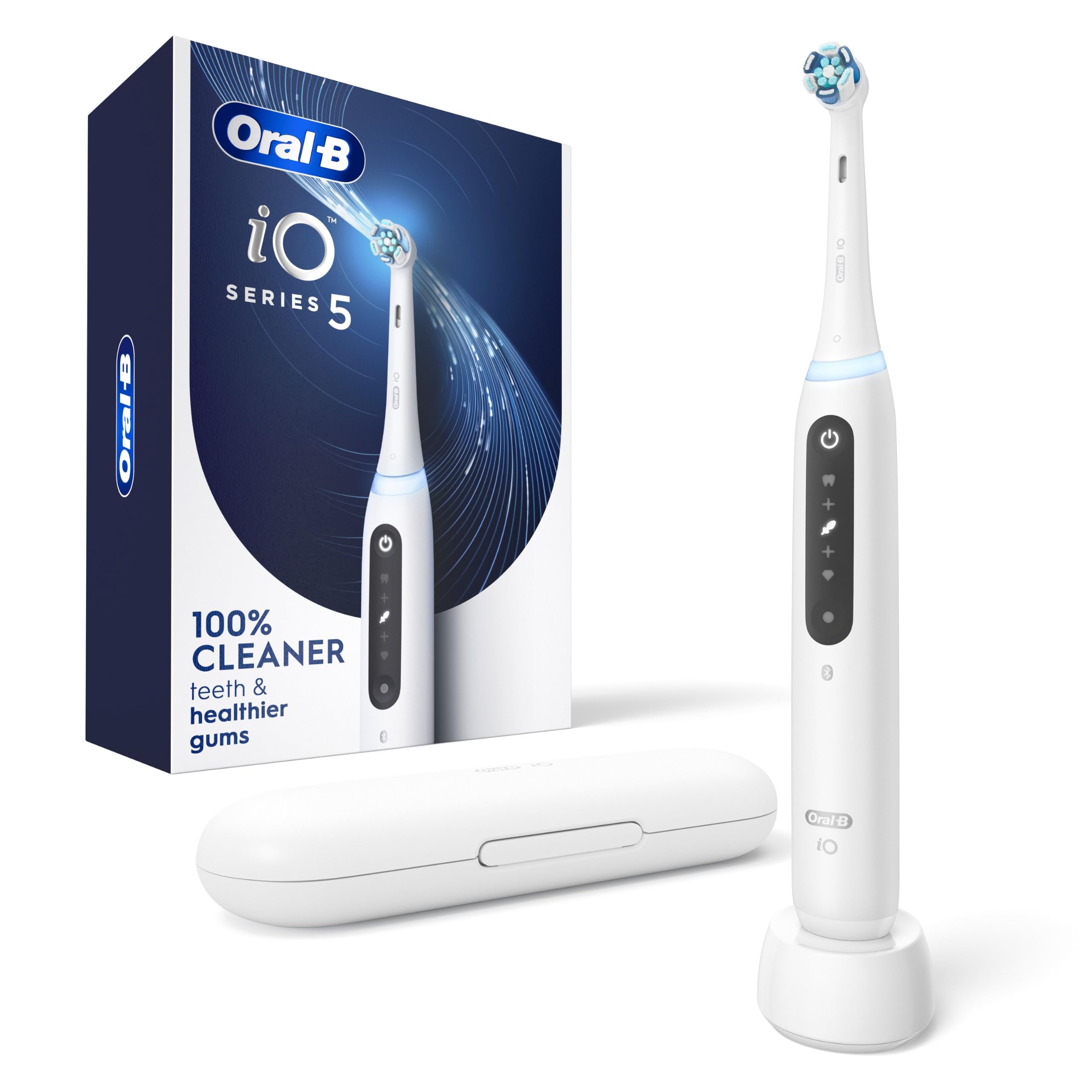
2. Oral-B iO5 Electric Toothbrush
The oscillating Oral-B that gives you five modes, a full-color pressure ring, and a travel case.
If you prefer the small round oscillating head over sonic vibration, the iO5 is the most tunable brush in this article — it carries 5 cleaning modes, where the Sonicare 5900 offers 2. That spread lets you step into a sensitive setting on a sore day and switch to a deeper clean once your gums settle. The iO pressure sensor does the gum-protecting work with a light ring that shifts color to tell you if you are brushing too hard, too soft, or just right.
The iO cleanup system also runs an iO light ring timer built around the 2-minute dentist-recommended brush, plus a head-change alert so you swap the brush head on schedule. Pair it with the Oral-B app and it tracks where you have been in real time, which helps if you tend to rush the back molars. Oral-B rates it at 100% more plaque removal than a manual brush, and up to 2.5X between the teeth. That between-teeth number is the one that matters for gum pockets.
The trade-offs are real but manageable. This is the heaviest-handled unit here thanks to the battery and app hardware, and a few buyers needed the extra-soft heads because the stock brush felt rough on sore gums — plan to buy a pack. Battery life draws mixed notes; some enjoy long stretches between charges while others find it drains quicker than older brushes, so bring the charger on long trips. As owners put it: “Excellent plaque removal, still like new after 3 months daily use.”
Gum-protection read: the color pressure ring is the clearest feedback here — it tells you at a glance whether your pressure is safe, which takes the guesswork out of brushing over sore gumline.
Set your expectations: the app is optional, but the pressure ring and five modes are the reason to pick this over a simpler brush; if you want a lighter handle, the 5900 sits better in hand.
Reach for this if: you want maximum control — five modes, a color-coded pressure ring, and app tracking to fix your technique.
Look elsewhere if: a bulky handle or the need for extra-soft heads turns you off; the slim sonic picks fit easier.
3. Waterpik Sensonic Electric Toothbrush

A quieter, softer sonic brush with a dedicated Gum Care mode and a stated four weeks between charges.
Waterpik’s Sensonic answers the tender-gums brief with three modes you can switch at the press of a button: Clean for everyday, Stain Removal for surface stains, and Gum Care for gentle gum stimulation. The Gum Care mode is the relevant one here — it is built to be softer against the gumline than a full-power clean. The American Dental Association also accepts the brush — a third-party sign-off beyond the spec sheet.
Where it beats the bigger Oral-B picks is weight and battery. It states up to 4 weeks of cleaning per charge from a lithium-ion battery, and it lists a 2-minute timer with a 30-second pacer to move you around the mouth. The handle uses an ergonomic, non-slip finish, and the whole thing is lighter and more compact than the Oral-B iO5 — the iO5 is a notably heavier unit by comparison, so this one packs easier for travel. A premium travel case is included, and the head uses a Contour bristle pattern to hug tooth surfaces. What wins people over is the gentle feel combined with a clean that still removes plaque.
The catch here is charging and heads. It ships with a USB-C to USB-A cable only — no wall adapter — so the charging option is the recurring gripe, and you need your own plug. Replacement heads are genuine Waterpik Sensonic Contour heads, which some buyers find pricey. It is also the heavier of the two sonic brushes by stated weight compared with the Sonicare 5900, though the difference is modest in hand. A 2-year limited warranty backs it up.
Answering the gum question: the Gum Care mode plus ADA acceptance makes this a reasonable gentle-sonic pick if you want a softer feel and a month of battery without charging.
Worth knowing: no wall adapter in the box and brand-specific heads mean a small ongoing cost to budget for.
Good match for: travelers and anyone who wants a soft, quiet sonic clean and a full month between charges.
Pass if: you want a wall adapter included or prefer the round oscillating-head feel of a Oral-B.
4. Oral-B iO3 Electric Toothbrush

The simple oscillating Oral-B that keeps the pressure ring and drops the extras to stay accessible.
The iO3 is the sensible entry point if you want Oral-B’s gum-protecting pressure sensor without paying for five modes and an app. It keeps 3 cleaning modes — Daily Clean, Sensitive, and Whitening — and the Sensitive mode is the one to camp in if your gums are touchy. The iO pressure sensor lights red when you push too hard, which owners describe as a genuine guide rather than a gimmick; you watch the light, ease off, and the gumline stops taking the beating.
Oral-B claims 100% more plaque removal than a manual brush, and the round oscillating head reaches around individual teeth where a rectangular manual head struggles. A light-ring timer marks the dentist-recommended 2-minute brush and a refill alert reminds you to swap the head. The lithium-ion battery is described as long-lasting, and buyers often call out the quiet motor and the smaller head that slips into the back of the mouth. One long-term user who had avoided electric brushes for years now rates the clean as the best their teeth have felt.
The fair caveat is size and durability. The handle is bulky — heavier in the hand than the slim Sonicare brushes here — and the speed settings sit close together, so the difference between modes is subtle. A few units stop working within a couple of years, so treat it as a good-value brush rather than a buy-it-for-life one. Note too that its brush heads are not compatible with older Oral-B models, so you start fresh on the head lineup.
The gum-safety case: you get the red-on-overpressure light and a dedicated Sensitive mode for a modest outlay, which is the core of what a periodontal-focused buyer needs.
The blunt trade-off: a chunky handle and closer-spaced settings mean it feels less refined than the iO5, and longevity is the open question.
Pick it when: you want real pressure feedback and a Sensitive mode at the accessible end of the range, and you do not need an app.
Skip it when: a slim handle matters to you, or you want the brush to last many years.
5. PRO-X Sonic Electric Toothbrush
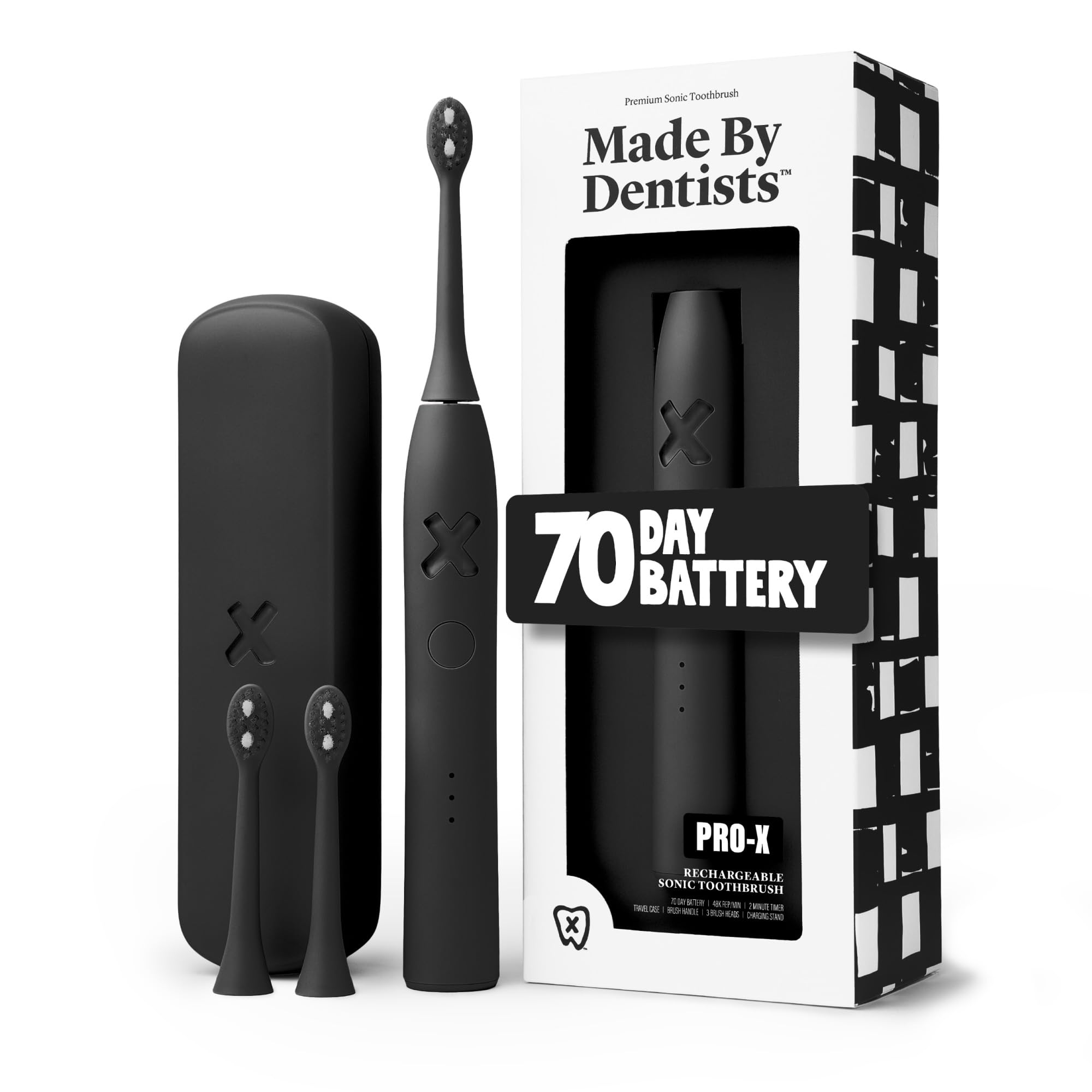
A dentist-designed sonic brush that runs up to 70 days on one charge and ships with three heads.
The headline number here is stated battery life — up to 70 days on a single charge, which is far longer than the 21 days the Sonicare 5900 claims and the four weeks the Waterpik Sensonic lists. If you travel or simply hate babysitting a charger, that gap is meaningful. It still gives you the gum-relevant basics: a Sensitive mode for sore days, a Clean mode, and a Whitening mode, each using sonic vibration rather than a spinning head. A 2-minute timer with 30-second Quadpacer pulses walks you around all four quadrants so no gum pocket gets skipped.
What makes it appealing for periodontal use is the gentleness. Sonic vibration tends to feel softer against tender gums than a fast oscillating head, and the Sensitive setting lets you ease off further. The maker claims up to 9× more plaque removal than a manual brush. The kit is unusually complete — 3 brush heads, a protective travel case, and a charging stand are all included, so you are not buying a case separately as you would with the Sonicare 5900. Buyers describe a clean that feels close to a professional one, and the extra heads plus case are frequent reasons people are glad they chose it.
Where it gives ground is feedback and cost. There is no pressure sensor here to tell you when you are brushing too hard, so you protect your gums through the Sensitive mode and your own light hand rather than a warning light. It is also mid-range priced with a 2-year warranty, and the smart-tracking features of the usmile or Oral-B app brushes are not part of the package.
Why the 70-day figure matters
- Up to 70 days on one charge — the longest stated battery in this list
- Sensitive mode for flare-ups, plus Clean and Whitening
- 3 brush heads, travel case, and charging stand all in the box
- 2-year warranty and sonic vibration that suits tender gums
What you give up
- No pressure sensor to flag over-brushing
- No app or zone tracking like the smart brushes here
Suits you if: you want a gentle sonic clean, a huge battery, and a complete travel kit without hunting for accessories.
Consider another pick if: a hard-stop pressure warning is the feature you came for.
6. usmile Y10 PRO Electric Toothbrush

The smart brush that shows your coverage on a screen and guards gums with auto-reduction.
For a periodontal buyer who wants to see exactly where they are missing, the Y10 PRO puts the feedback on a small screen instead of a light ring. The display and pressure sensor combine to warn you when you are brushing too hard, and the vibration auto-reduces so your gums get a softer clean the moment you over-press. That automatic step-back is the gum-protecting logic in one line, and it is what distinguishes this brush from the light-ring models here.
Battery is the marquee spec — up to 180 days on one charge, which dwarfs the 21-day Sonicare claims and the 70-day figure from Made by Dentists. It also tracks where you have brushed and flags missed spots, and a 30-second quadrant vibration timer cues you around the mouth. Owners describe exceptional stretches between charges and easy setting changes, and the clean itself earns strong praise from people who say it beats the big-name brushes they have used.
One honest caveat: the sensors can be unreliable. This brush is compact and light, at a stated weight well below the Oral-B iO5, but some of the smart tracking can act up over time — a sensor (a small part that detects where you brush) can falsely flag a zone as unbrushed even with a fresh head. The reassuring part is that support has replaced faulty units, so buyers generally end up with a working brush. Cleaning performance draws mixed notes rather than universal cheers, so judge it on the coverage feedback and battery, not on promises it cleans deeper than everything else.
Where it shines: the on-screen coverage map and auto-reduction make it easy to see your gaps and stop pressing on sore gums, and the stated 180-day battery is the longest here.
The caveat to weigh: smart-sensor reliability is the soft spot — treatment support has replaced units, but you are buying into electronics that can misread, not just a motor.
A natural fit for: gadget-minded brushers who want a screen showing exactly where they missed and a battery measured in months.
Not your brush if: you would rather have zero electronics to fail and want the simplest possible pressure cue.
7. Philips Sonicare 6500 Electric Toothbrush
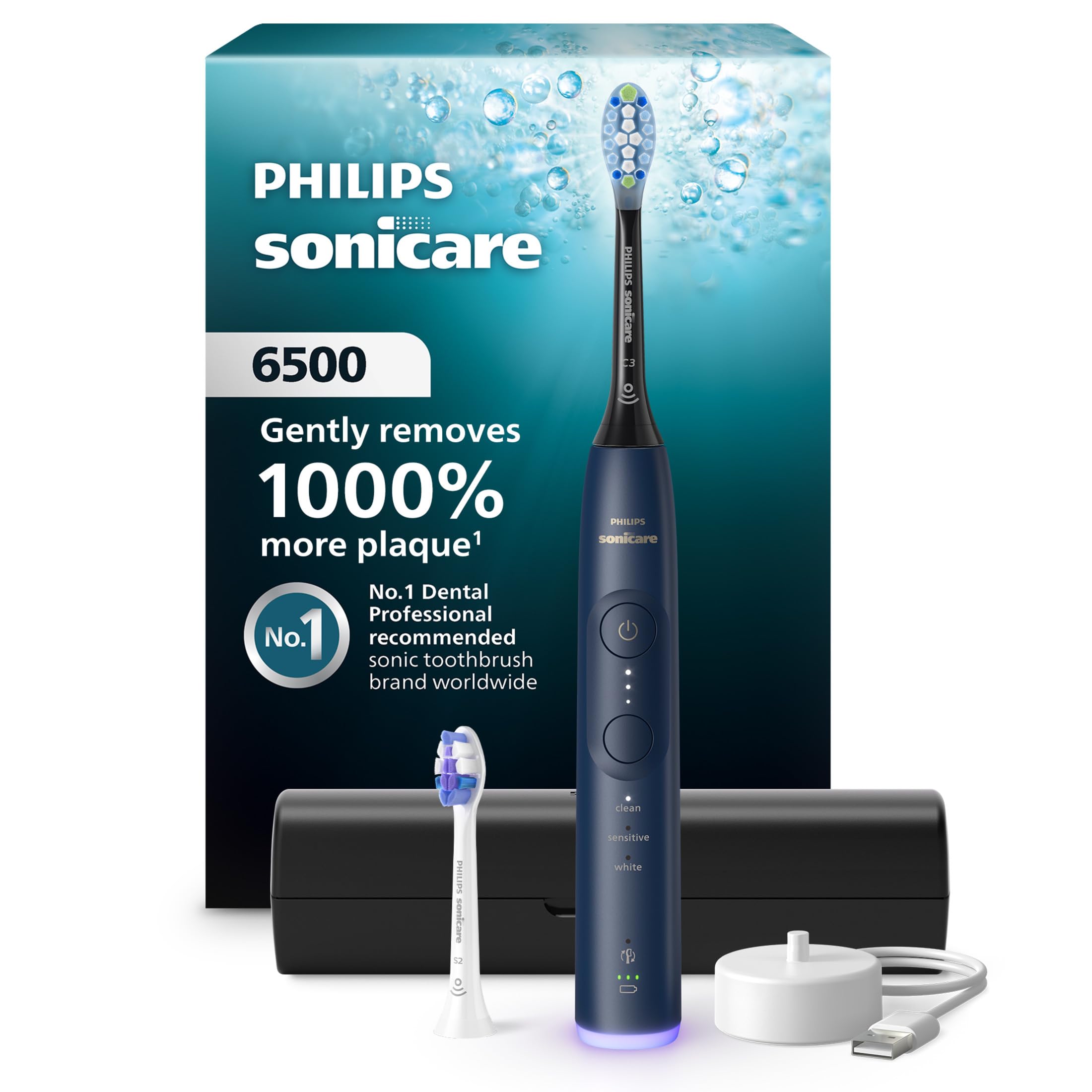
The premium Sonicare that pairs a visible pressure ring with three modes and three intensity steps.
You get more gum-care control here than on the 5900. The 6500 offers 3 brushing modes — Clean, Sensitive, and White — and 3 intensity levels, so you can run a full-power clean on a good day and drop to Sensitive on low intensity when your gums flare. That is one more mode than the 5900, plus a visible light ring instead of a felt vibration to signal over-pressure (pressing too hard): the ring at the base of the handle glows when you press too hard, and you ease off until it dims.
Its C3 two-in-one head lines up softer bristles along the gumline to reach plaque where pockets form, and the same Sonicare Fluid Action drives fluid between teeth. It also pairs with the app for guided brushing and personalized tips, and a brush-head replacement reminder tracks how hard you brush so you swap on time — useful when soft bristles wear down and stop protecting gums. The in-box kit is the richest of the two Philips brushes: one C3 head, one S2 Sensitive head, a travel case, and a charging stand. Owners gravitate to the S2 Sensitive head and describe strong vibration that still feels comfortable and gentle on small, sensitive teeth.
Two trade-offs hit you at the sink: the charger and the price of entry. The charging stand does not include a power adapter (the wall plug), and the stand itself is small but can clutter a counter; it also uses a fixed cord rather than a detachable one, which bothers anyone who keeps a tidy sink area. Battery is stated at up to 21 days per charge, matching the 5900 rather than the 70-day or 180-day brushes here, and a few units have stopped charging early — support aside, expect the usual electronics risk.
Best gum-tuning in the Philips lineup
- 3 modes + 3 intensity levels for fine control over how hard you clean
- Visible light-ring pressure sensor so you can see when to ease off
- Includes C3 and S2 Sensitive heads, travel case, and stand
- App-guided brushing and a head-replacement countdown
The honest downsides
- No power adapter in the box; stand cord is not detachable
- 21-day battery trails the long-life picks here
- Premium-tier cost and brand-specific heads to keep buying
Worth it if: you want the most adjustable gentleness — three intensity steps and a visible light ring — and a full travel kit in the box.
Overkill if: you would rather trade modes for a 70-day battery or on-screen tracking.
Know the Specs
Pressure Sensor Explained
A pressure sensor is a small detector in the brush handle that notices when you press the head too hard against your teeth. On the brushes here it answers with either a vibration in the handle or a light ring that changes color. The point is to stop you scrubbing inflamed gums before you cause more bleeding. Models like the Sonicare 6500 use a visible light ring, the 5900 uses a felt vibration, and the Oral-B iO brushes use a color-coded ring. A brush with no sensor relies on your own hand staying light.
Sonic vs Oscillating Heads
Sonic brushes vibrate the bristles side to side at high speed and drive fluid between teeth along the gumline. Oscillating-rotating brushes spin a small round head back and forth to reach around each tooth. Both remove plaque; the feel differs. Sonic tends to read as softer and buzzier against tender tissue, while the round head reaches into tight spots. If your gums are sensitive, the sonic feel is often more comfortable, and several picks here are sonic.
Brushing Modes and Intensity Levels
A brushing mode changes how the motor behaves — a Sensitive or Gum Care mode lowers the intensity so the brush cleans gently. Intensity levels let you step the motor down further within a mode. The more of both you have, the more precisely you can go gentle during a flare-up. Two modes with three intensity levels, as on the Sonicare 5900, is plenty for most people; five modes, as on the Oral-B iO5, suits someone who likes fine control.
Stated Battery Life and Charging
Battery claims here range widely, from 21 days up to 180 days on one charge. Longer stated life means fewer charging sessions and easier travel. Watch what is in the box too — several brushes ship with a charging stand but no wall adapter, so you supply the plug. Brush heads are brand-specific, so the running cost continues after the brush itself.
Common Questions
Is a sonic electric toothbrush better than an oscillating one for periodontal disease?
Does a pressure sensor really protect gums that bleed easily?
How long does the battery last on these brushes?
Do I need a special brush head for sensitive gums?
Will an electric toothbrush fit my existing brush heads?
Can I use a gum-health mode every day?
What is the difference between the Sonicare 5900 and the 6500?
Do these brushes come with a travel case and charger?
How often should I replace the brush head on a gum-care brush?
Is an app worth it on a toothbrush for periodontal care?
The Bottom Line
For most people managing tender gums, the electric toothbrush for periodontal disease winner is the Philips Sonicare 5900. It pairs a felt pressure sensor (it buzzes when you press too hard) with a Gum Health mode and three intensity levels — the core gum-protection tools — without the bulk or app overhead. If you want more control and a color pressure ring, the Oral-B iO5 gives you five modes. And for a gentle sonic clean with a long battery and a full travel kit, the Made by Dentists PRO-X runs up to 70 days on a charge. Any of these cleans gently; the pressure cue is what separates them.
How we choose
We do not accept paid placement. Every pick is matched to a real buyer and a real use-case; we do not hands-on test units.
Sources
Specifications: manufacturer listings and product documentation. Review insights: verified customer reviews, as of October 2026. Pricing: not shown on this page (it changes often); check the current price via the retailer link.
As an Amazon Associate, Aappliancez earns from qualifying purchases. This does not affect which products we feature.