Disclosure: Some links in this post are affiliate links. As an Amazon Associate I earn from qualifying purchases, at no extra cost to you. Learn more
Specs are compiled from manufacturer listings and verified buyer reviews and can change over time — please confirm the key details on the product page before buying.
Weeds sprouting through paver joints are the worst kind of yard work: too tight for a mower, too stubborn for a rake, and just low enough to wreck your knees. A string trimmer or stand-up puller turns a half-hour of kneeling and yanking into a few minutes on your feet. This guide covers six machines that pull, twist, or cut paver-joint weeds, sorted by joint width, reach, and power source.
This guide is built by comparing the manufacturers’ published specifications and the patterns across verified customer reviews, so you get each pick’s real strengths and trade-offs instead of marketing spin.
Below you’ll find the honest split between string trimmers, stand-up pullers, and the one corded workhorse that never needs a charge — everything you need to pick the right electric tool to remove weeds between pavers.
Top Picks

How To Choose The Best Electric Tool to Remove Weeds Between Pavers
Your first decision isn’t brand or budget — it’s if you want to cut the weed or pull it. Cutting clears the joint fast, but the root stays put and regrows. Pulling takes the whole plant out of the crack, which keeps a patio clean for longer. Pick your method first, then shop within it.
Cutting tools: string trimmers for the long joints
A string trimmer spins a nylon line fast enough to slice grass and small weeds at the surface. The spec that matters is cutting width — the diameter of the circle the line sweeps. A wider cut covers more ground per pass, but a narrower one squeezes into tighter spaces between raised pavers and edging. Line feed style matters too. Automatic feed (sometimes called auto-feed) pushes fresh line out as you work, so you are not stopping to bump the head or hand-pull the spool.
Pulling tools: stand-up weed pullers for deep roots
A stand-up puller saves your back: steel claws grab the weed at the base and a motor twists or levers it out while you stay upright. Check three numbers. Handle length lets you stand without stooping. Claw material matters — stainless steel resists bending and rust. Battery capacity in amp-hours (Ah, a measure of charge) sets how many weeds you get per charge; the higher the number, the more weeds. These tools shine on dandelions and crabgrass in soil or sand joints. They struggle in the razor-thin gap between tightly butted pavers, where the claws simply cannot open wide enough.
Corded versus cordless
Corded tools pull power straight from an outlet, so they never fade mid-job and tend to run stronger through dense growth. Cordless tools free you from dragging an extension cord across a driveway, which is genuinely safer around wet stone. If your paver area is large and far from an outlet, cordless wins on convenience. If it is a small strip beside the house, corded gives you steady power without a charging routine.
Side-by-Side Comparison
| Model | Best For | Type | Cutting Width / Claw Head | Power Source | Amazon |
|---|---|---|---|---|---|
| BLACK+DECKER Weed Wacker (BESTA510)★ Best Overall | Trimming and edging long paver borders | 2-in-1 string trimmer / edger | 14 inches | 6.5-amp corded electric | Amazon |
| 21V Weed Wacker Cordless & Lawn EdgerBest Cordless Trimmer | Cord-free edging along sidewalks and borders | 2-in-1 cordless trimmer / edger | 12 inches | 2 x 2.0Ah lithium-ion batteries | Amazon |
| TaskStar Electric Weed Puller (EWP001) | Root-pulling dandelions without bending | Stand-up 3-claw puller | 3 steel claws | 2 x 2000mAh batteries | Amazon |
| SEESII Stand-Up Weed Puller | Extra-long reach for taller users | Stand-up 3-claw spiral puller | 3 spiral steel claws | 2 x 2.0Ah lithium batteries | Amazon |
| Seesii Electric Stand Up Weed Puller | Compact storage and light carry | Stand-up 3-claw puller | 3 stainless steel claws | 2 x 2000mAh lithium-ion batteries | Amazon |
| DIAINSKY Weed Puller Tool (DS618G) | Lightweight pulling in rocky, sandy soil | Stand-up 3-claw puller | 3 steel claws | 1 x 21V lithium-ion battery | Amazon |
Detailed Reviews
1. BLACK+DECKER BESTA510 Weed Wacker
Our pick — 4.0+★ from 16,000+ verified ratings; the strongest balance of quality and price.
The corded workhorse that clears a full paver border without ever asking for a charge.
If your weeds grow in the long joints along a driveway, sidewalk, or flower-bed border, this is the tool that ends the job fastest. The 14-inch cut path is the widest here — it beats the 12-inch cordless trimmer by a clean 2 inches of sweep. It is a corded 6.5-amp machine, so it never loses power halfway through a dense patch. You plug in, you work, you are done.
Its second trick solves a different paver problem. Rotate the head and it becomes a wheeled edger, rolling along the edge of the stone to cut a clean line between pavers and lawn. The automatic feed spool pushes fresh line out as you go, so there is no bumping the head or stopping to hand-feed. Owners describe the cutting power as more than enough for tall weeds and even tree suckers. As buyers report: “My husband has used this throughout this year’s growing season.” The 14-inch reach means fewer passes than a narrower trimmer on big stretches.
The catch is line consumption and cord duty. The tool eats string quickly, so you will be reloading spools more often than you would like, and you are tied to an extension cord the whole time. Assembly takes some force to snap the sections together, though it feels solid once seated. One long-term note: these units have a track record of a year or two of hard service before motor trouble shows up, which is why the 2-year limited warranty is worth registering the day it arrives.
Where It Wins On Pavers
- 14-inch cut path clears long paver borders in fewer passes
- 6.5-amp corded motor holds full power through tough overgrowth
- Rotates into a wheeled edger for clean sidewalk lines
- Automatic feed spool ends the bump-and-reload routine
What To Expect Going In
- String spools run out fast, so keep spares on hand
- Cord retention system helps, but you still manage an extension cord
- Assembly needs a firm press to seat the sections
Reach for this if: you have a long paver edge near an outlet and want maximum cut coverage per pass.
Think twice if: your weeds sit in tight raised-paver gaps where a trimmer line cannot reach the root.
2. 21V Weed Wacker Cordless
Cut the cord, not corners — 9000 RPM of edging power with a spare battery in the box.
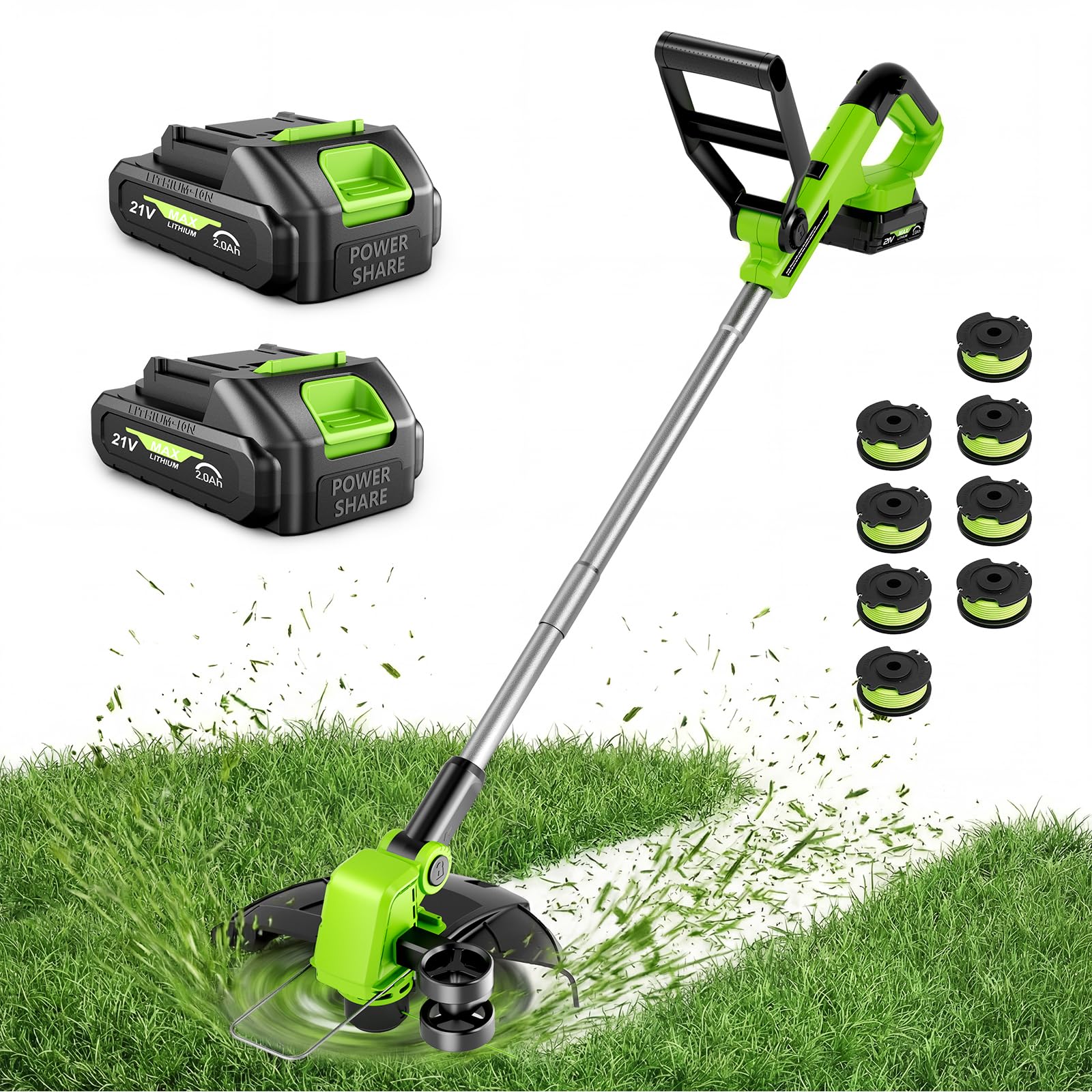
Dragging an extension cord across wet pavers is the part of trimming nobody enjoys. This one runs on two 2.0Ah lithium-ion batteries instead, and the kit gives you both at once so you can keep working when one runs down. The motor spins up to 9000 RPM, which is serious speed for slicing grass and small weeds out of joints. It is a 12-inch cut path — 2 inches narrower than the BLACK+DECKER above, so it fits around raised stone and tight edging better but takes more passes on wide open borders. The head rotates 90 degrees with a hold of the button to switch from trimming to edging.
Owners praise the 5-pound build and the two included batteries plus 8 spare spools. Owners talk about how light it feels at 5 pounds and how quickly it goes together. Battery life draws steady praise — one buyer reports a single charge held through “over an hour of use.” It also comes with 8 spare spools, so you won’t hunt for line the way you do with trimmers that ship without extras. The handle rotates 180 degrees and the cutting angle adjusts up to 80 degrees, so you can match the head to your height and the slope of your patio.
Here is the honest split. It handles light duty well — stems under about a quarter inch and softer growth. Push it into thick, woody weeds and cutting performance disappoints, and the durability record is the weaker part of its story. The auto line feed also advances roughly half an inch with every trigger pull, so on a big patch you want to limit the start-and-stop and let it run.
Runtime reality: 30 minutes per battery is the rated figure, but two batteries plus 8 spare spools mean a whole yard job without a trip to the garage.
Height and reach: the 46.5-inch length pairs with the 180-degree rotating handle to keep taller users from stooping along paver edges.
Your match if: your paver borders are far from an outlet and you want cord-free edging with spares included.
Pass if: you need to chew through thick, woody overgrowth — this one is built for light-to-medium growth.
3. TaskStar Electric Weed Puller Tool
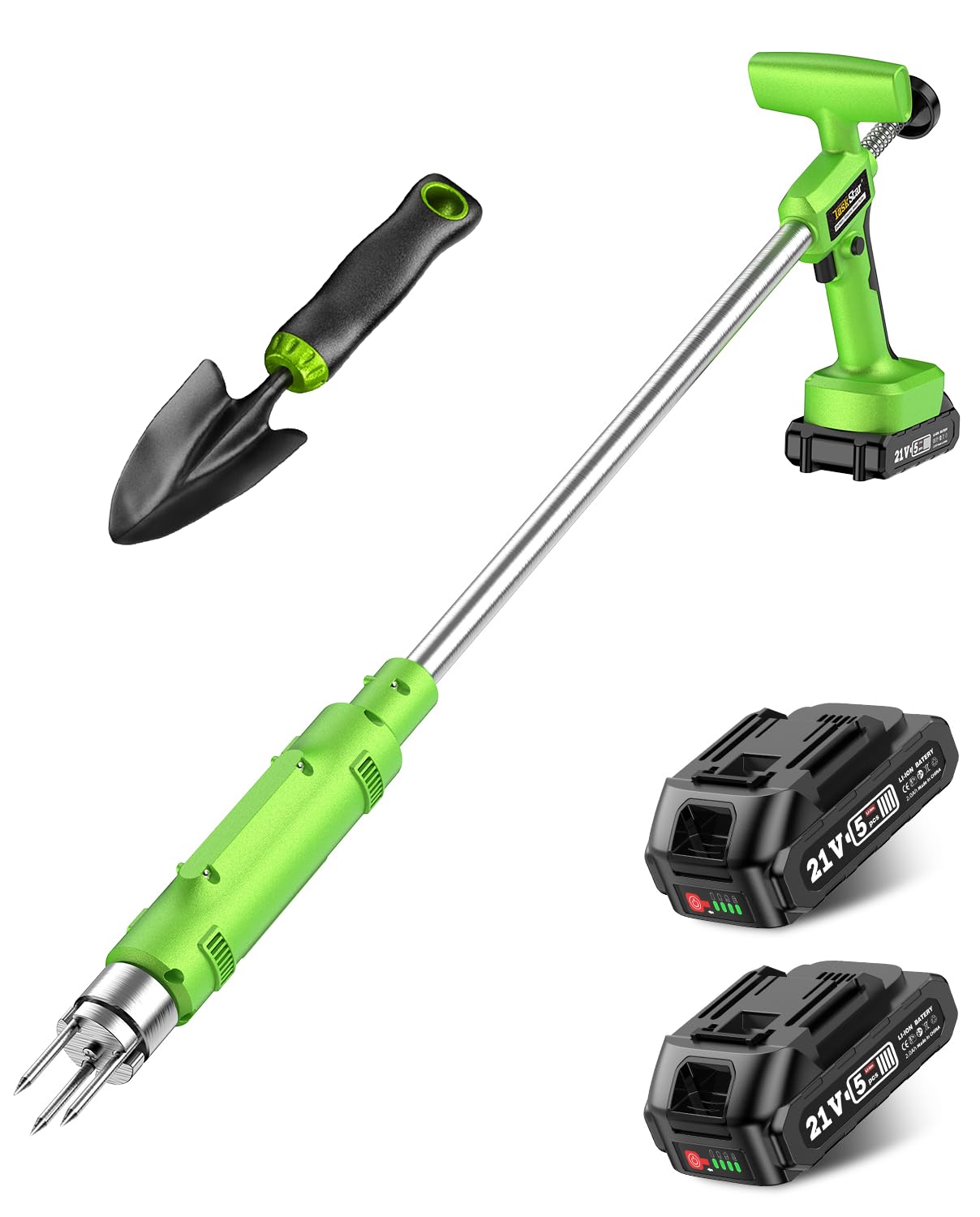
A 4-second root grab that saves your knees on dandelion-packed joints.
This is a different animal from the trimmers. It does not cut — it grabs. Three stainless steel claws close on the weed at the base and the motor twists it out of the ground in about 4 seconds per weed. That root-in-hand result is what keeps a patio from sprouting back in two weeks. It stands 33.9 inches tall so you work upright, which is the whole point for anyone whose back objects to kneeling on stone.
Owners mention the 3-claw head grips dandelions and other soft-stemmed weeds cleanly at the base. Two 2000mAh batteries ride along, each rated at up to 2 hours of continuous use or roughly 500 weeds per charge. A small shovel is in the box for loosening stubborn soil, and the ejector pushes the pulled weed out without you touching it.
The honest caveat is the motor’s durability record. There is at least one account of the wiring giving out on a second use, which points to a tool that rewards light, steady pressure over muscling it through hard ground. It also has only one speed setting, so you cannot dial back the torque for delicate work. At 4.0+ stars, most customers note it pulls dandelions and crabgrass as advertised.
Built for the back: the tall standing design and second handgrip make it a genuine option for anyone with limited mobility who cannot kneel between pavers.
Where it stops: tight, narrow joints between butted pavers leave the claws no room to open — this tool wants soil gaps, not hairline cracks.
Pick it for: sandy or soil-filled paver joints thick with dandelions and crabgrass that you want pulled by the root.
Look elsewhere if: your weeds are in razor-thin cracks or you need variable power for rocky, compacted ground.
4. SEESII Stand-Up Weed Puller

The tall one — a handle that stretches to 47 inches so nobody has to fold over the patio.
Height is the whole pitch here. The handle telescopes from 40 to 47 inches, the longest reach in this lineup, and that matters when you are chasing weeds across a wide paver driveway. Taller users get a genuinely upright work position instead of a half-stooped one. Inside the head, three stainless steel spiral claws grip the root and a high-torque motor twists it free, with the inward-claw shape leaving smaller holes behind than a straight pull.
On paper it is quick — about 4 seconds per weed — and the two 2.0Ah batteries together deliver up to 80 minutes per charge for up to 500 weeds. The one-button ejector pushes each weed out without your hands touching dirt, and a dual-action safety switch keeps it from firing by accident. It weighs 7.87 pounds. Assembly and height adjustment are straightforward, though the included manual is light on usage guidance.
Here’s what you need to hear before buying. This is the lowest-rated pick in the group at 3.5+ stars, and the complaints cluster in one spot: the plastic collar and the motor have a habit of failing, with snapping or quitting reported within the first few uses. It pulls dandelions fine while the collar holds, but established weeds by the root are where the claws lose grip. If you buy it, register the warranty immediately and treat it as a light-duty tool, not a workhorse.
Best for the tall and the stiff: 47 inches of reach keeps your back out of the equation on raised or wide paver layouts.
The fragility trade-off: a plastic collar is the weak link — gentle, steady pressure is the difference between a season of use and a snapped part.
Worth considering if: you are tall and want the longest stand-up reach for light weeding in soil joints.
skip it if: you need something that survives heavy, established weeds season after season.
5. Seesii Electric Stand Up Weed Puller
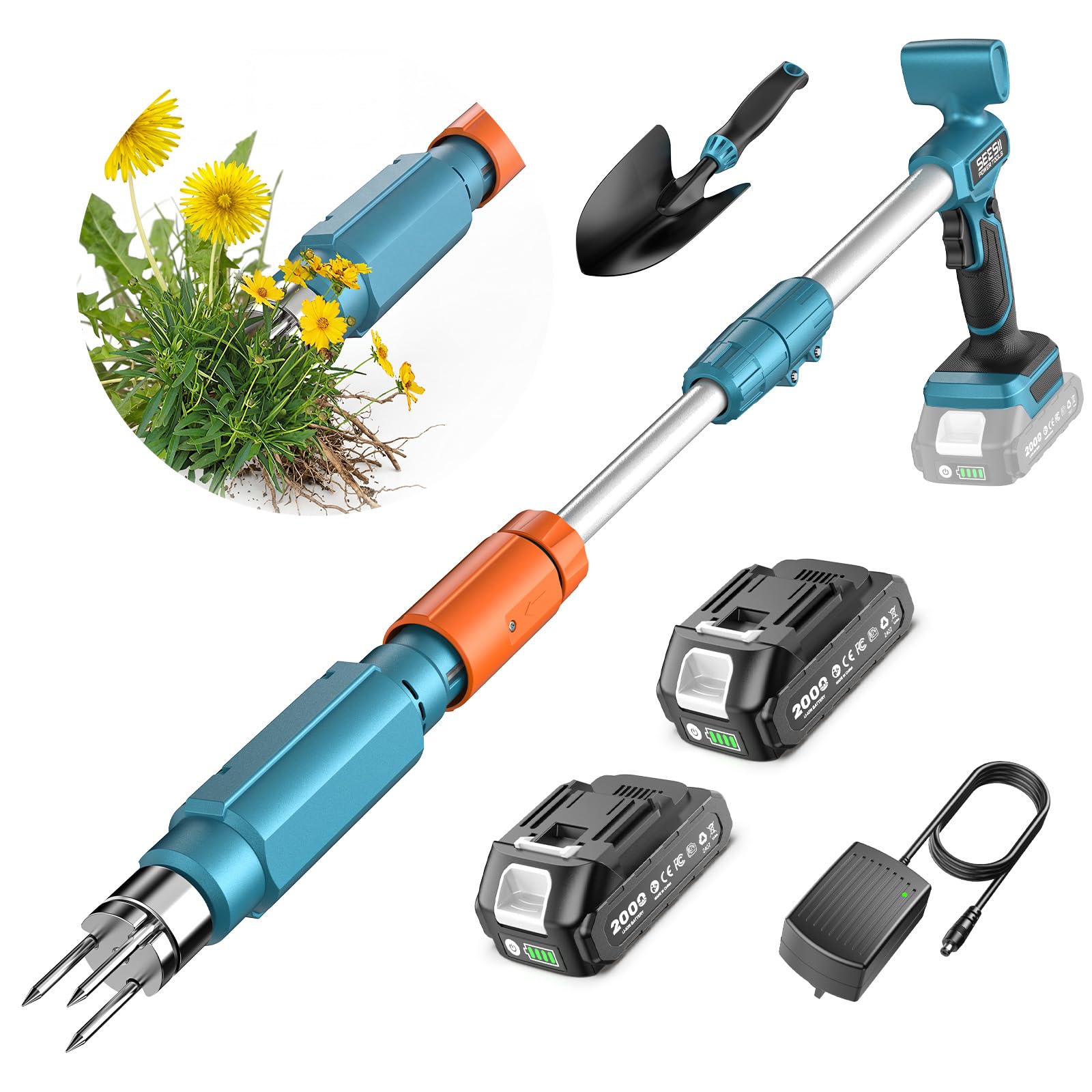
A tool that breaks down into sections and stores in a trunk — with real torque behind it.
If your paver patio shares a shed with bikes and bins, this is the puller that gets out of the way. It twists apart into compact sections with no tools and tucks into a small space. It is also the lightest stand-up puller here at 6 pounds, so carrying it to a back patio is not a chore. A 350W motor delivers 350 RPM and is rated to reach roots up to 2.4 inches deep, which covers dandelions, crabgrass, and thistles.
The 20V motor and stainless steel three-claw head are the working pieces, and the telescoping handle extends from 30 to 40 inches for different heights. Two 2000mAh batteries ride in the box so you can swap when one drops. One buyer learned quickly that light pressure is the whole game: pushing too hard twists the wrist with the rotational torque, while letting the tool do the work keeps it smooth. Assembly takes a few minutes. The dual-switch safety takes a little getting used to since both hands must engage it.
The reliability question hangs over this one. It is rated 3.5+ stars, and the mixed reports are worth knowing: some units run fine for a long stretch, while others stop working after a few days of use. A separate note for anyone with a shared battery platform — this Seesii is not compatible with Makita LXT batteries, so do not assume your existing packs will fit. It comes with a 3-year warranty, which is the longest here and the reason it stays on this list.
Deep-root spec: the 2.4-inch root reach is the figure that matters — it means dandelions come out whole, not snapped at the crown.
Battery honesty: confirmed by owners that these are Seesii’s own packs, not a cross-brand platform — budget for buying replacements from Seesii.
Choose it if: storage and portability rank high, and you want a 3-year warranty standing behind the tool.
Bypass if: you already own a Makita battery system and expect to share packs.
6. DIAINSKY DS618G Weed Puller Tool
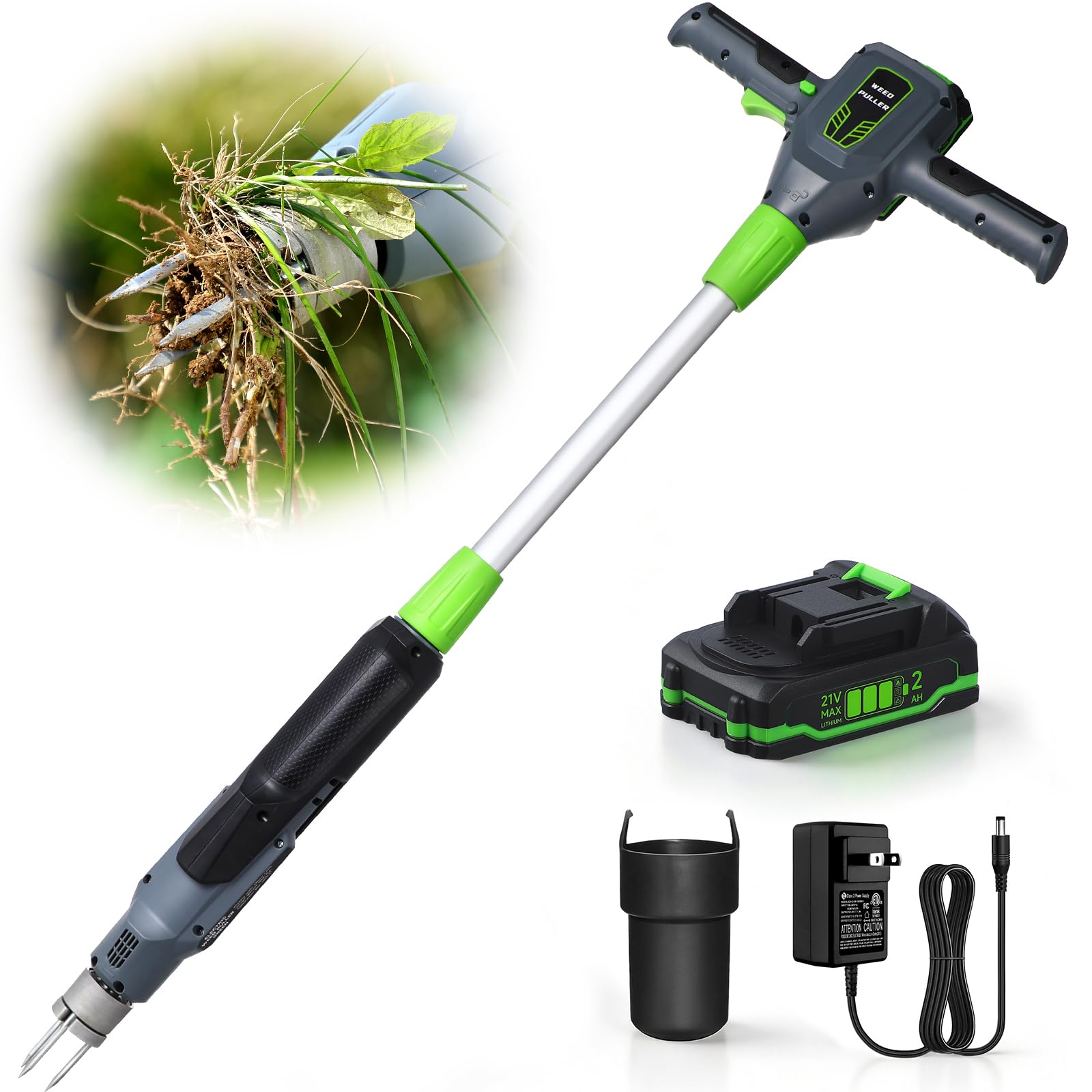
The lightest puller of the bunch — and the one that still works when the joints are full of rock.
Weight is the headline. The bare tool is 3.8 pounds and only 4.7 pounds with the battery in, so swinging it around a paver garden does not leave your arms aching. It is 40 inches long overall, which lets you work standing, and it splits into three sections with the longest piece just 20 inches for easy storage. One 21V lithium-ion battery and charger are included.
Reviewers point out the spinning 3-claw head still pulls weeds in stone and rock joints. A buyer with a meniscus tear found it easy and even fun to use, and the spinning head pulled weeds in stone and rock areas where a puller is not supposed to work. The T-shaped handle is built with an ambidextrous open up button so either hand can fire it, and the three steel claws dig for the full root. A claw cover keeps the business end safe in storage.
A tool with this much torque demands respect. The rotating power travels up into the top of the handle, so you need to hold firm — one owner ended up with a sore elbow from letting it spin. It is rated 4.0+ stars, which is a strong showing for a budget-tier puller, and it carries a limited lifetime warranty. The one-battery setup means a charge break between sessions, unlike the two-battery pullers above.
Runs in rough ground: stone and rock joints do not stop the spinning 3-claw head, which is unusual for a puller this light.
Torque caution: the motor twists hard enough to jar your wrist and elbow — hold firm and let light pressure do the pulling.
Grab it if: you want a light, easy-to-store puller that still bites in rocky or sandy paver ground.
Look at a two-battery pick if: you want to clear a whole yard without pausing to recharge.
Know the Specs
Cutting Width
The diameter of the circle a trimmer’s line sweeps. A wider cut — like the 14-inch BLACK+DECKER — clears long paver borders in fewer passes. A narrower cut, such as the 12-inch cordless trimmer, fits closer to raised stone and edging. Pick wide for long straight runs, narrow for tight or raised layouts.
RPM and Amp Draw
RPM is how fast the motor spins, and on a trimmer like the 9000 RPM cordless unit that means the line slices weeds quickly. Amp draw, like the 6.5-amp corded motor, refers to how much current a corded tool pulls — higher amps generally mean more cutting muscle through dense growth, with no battery to run down.
Battery Capacity (Ah) and Runtime
Ah, or amp-hours, measures how much charge a battery holds. A 2000mAh pack is 2.0Ah, and the tools here pair two of them so you can swap mid-job. Rated runtimes vary by tool — 30 minutes per battery on the cordless trimmer, up to 2 hours on the TaskStar puller — so check the figure against your yard size.
Handle Length and Stand-Up Design
The handle length decides whether you stand or stoop. The stand-up pullers here range from 30-40 inches on the Seesii to 40-47 inches on the SEESII. Taller users want the longer reach; anyone storing the tool in a tight shed wants a model that breaks down into compact sections.
Common Questions
Will an electric weed puller work in the narrow cracks between tight pavers?
Does a stand-up weed puller really remove the root or just snap the top off?
How long does a battery last on a cordless weed tool?
Is a corded trimmer better than a cordless one for paver weeds?
Can I use these weed tools on wet pavers?
What is automatic line feed on a string trimmer?
Do these tools work for seniors or anyone who cannot kneel?
Will a Seesii weed puller run on my Makita batteries?
How do I keep the line from breaking in thick weeds?
Does the electric weed puller leave holes in my paver joints?
The Bottom Line
For most paver-weeding jobs, the corded BLACK+DECKER Weed Wacker is the strongest pick. Its 14-inch cut path clears a wide strip in one pass, and its 6.5-amp motor never fades, so you keep steady power along a long patio edge. An edging mode lines up any sidewalk border without ever needing a charge. If you want to work cord-free along a big driveway, the 21V cordless trimmer brings 9000 RPM (revolutions per minute, a measure of cutting speed) and two batteries to the job. And for pulling dandelions straight out of the soil joints, the TaskStar puller saves your back while the root comes up whole. Buy once for the cracks you actually have: a trimmer for long borders, a puller for soil joints.
How we choose
We do not accept paid placement. Every pick is matched to a real buyer and a real use-case; we do not hands-on test units.
Sources
Specifications: manufacturer listings and product documentation. Review insights: verified customer reviews, as of October 2026. Pricing: not shown on this page (it changes often); check the current price via the retailer link.
As an Amazon Associate, Aappliancez earns from qualifying purchases. This does not affect which products we feature.