Disclosure: Some links in this post are affiliate links. As an Amazon Associate I earn from qualifying purchases, at no extra cost to you. Learn more
Specs are compiled from manufacturer listings and verified buyer reviews and can change over time — please confirm the key details on the product page before buying.
Most conversion kits that disappoint their owners were never matched to the bike they went on. A hub motor kit needs the right dropout spacing, a controller that can actually feed the motor, and a battery with enough amps to back it up. Get one of those wrong and you get a weak, overheating build that never reaches its rated speed. This guide walks you through eight kits that real builders actually use, so you can match a motor to your frame, your battery, and your riding style before you spend anything.
This guide is built by comparing the manufacturers’ published specifications and the patterns across verified customer reviews, so you get each pick’s real strengths and trade-offs instead of marketing spin.
Some kits here replace a skateboard deck’s electronics, while others bolt a hub or mid-drive onto a bicycle frame. Your pick hinges on three numbers: dropout width, battery voltage, and how many hours you’ll spend installing. Choosing the right electric longboard conversion kit starts with knowing your frame’s spacing and your controller’s real amp rating.
Top Picks


How To Choose The Best Electric Longboard Conversion Kit
The first thing to sort out is what you are actually converting. An electric skateboard conversion swaps a deck’s motors and battery, while a bike or go-kart conversion bolts on a hub or mid-drive motor. Those two paths need completely different numbers checked before you buy, so decide your platform first and then match the specs below.
Match the dropout spacing before anything else
A hub motor only fits if the gap between your frame or fork legs matches the kit’s spec. Bicycle rear hubs commonly ask for a 135mm dropout, while the Ktaxon kit is built around a 3.93-inch front dropout spacing on a 26-inch wheel. Measure your own frame with a ruler before ordering — a mismatch means filing metal or a kit that will not mount at all.
Check the controller amps against your battery
The controller is the gatekeeper that decides how much current reaches the motor. A 33A controller on a motor rated for 2000W will cap your real output well below the sticker number, which is exactly the mismatch some Kunray buyers report. Look for a controller rated for the motor’s continuous draw, and confirm your battery’s BMS (the circuit board that limits current) can feed it.
Decide between hub drive and mid-drive
A hub motor lives inside the wheel and pushes you directly — simple, quiet, and maintenance-light. A mid-drive like the BAFANG BBS-HD runs through your bike’s gears, so it climbs using the cassette and can pull heavy loads up steep grades. Mid-drive costs more complexity and can wear your chain faster, but it uses your gearing in a way a hub cannot.
Side-by-Side Comparison
| Model | Best For | Motor Power | Rated Speed | Weight | Amazon |
|---|---|---|---|---|---|
| DNASKATE M8★ Best Overall | First-time board riders | 400W hub | 15 mph | 11.5 lb | Amazon |
| UDITER S3/Pixel/MiniSpeed Demon | Long-range cruising | 1200W dual hub | 26+ mph | 10.1 kg | Amazon |
| Ktaxon 48V 1000WBest Budget Bike Kit | Budget bike conversions | 1000W hub | — | 21.4 lb | Amazon |
| Kunray MY1020 | Go-karts and mini bikes | 2000W peak | 4300 rpm | 6 kg | Amazon |
| doinal 72V 5000W | Serious go-kart builds | 5000W | 6800 rpm | 8 kg | Amazon |
| BAFANG BBS-HD | Hill-climbing bicycle builds | 1000W mid-drive | 45 km/h | — | Amazon |
| NBPOWER 3000W | High-speed commuters | 3000W | 100 km/h | — | Amazon |
| NBPOWER Fat Bike 3000W | Fat-tire trail riding | 3000W | — | — | Amazon |
Detailed Reviews
1. DNASKATE M8 Electric Skateboard with Remote
Our pick — 4.0+★ from 100+ verified ratings; the strongest balance of quality and price.
The complete electric board that skips the conversion entirely — and does it for a starter-friendly total.
You get a fully assembled 400W brushless hub motor (the motor sits inside the rear wheel, driving it directly with no belt to snap), a 28-inch short deck, and an LCD remote that shows your battery and speed. The 11.5-pound build with a maple wood deck and kicktail is easy to carry up stairs and turn around on a sidewalk. It reaches a rated 15 mph and covers a rated 9 miles per charge, and the 2-hour charge time means a lunch break roughly refills it.
The M8 is not a conversion kit in the strict sense — it is the finished electric skateboard you can compare against a build-your-own path. Against the UDITER S3, it is the smaller, lighter, more compact board: 28 inches of deck versus 37.6 inches, and 8 inches wide versus 9.7 inches. That makes the M8 easier to store and tuck in a trunk, while the UDITER board rides with a wider, more stable stance for longer cruises.
Lighter riders routinely beat the rated 9 miles and 15 mph on flat ground. Owners mention: “Got 11mi range and 17mph top speed (155lb rider, flat terrain).” Charging is gentle on the remote, roughly once every two weeks according to owners. Owners single out the maple deck and hub assembly as sturdier than the price suggests. The recurring caveat is hills — this single 400W motor does not have the torque to start on an incline, so it belongs on flat neighborhoods, boardwalks, and campus paths.
What makes it a smart first board
- 400W hub motor drives the wheel directly, so no belts to replace and it still rolls like a normal board with power off
- Rated 15 mph top speed and 9 miles of range that many riders report exceeding on flat ground
- 2-hour charge time on the board and a remote that needs charging about once every two weeks
- 28-inch deck with a kicktail and an 11.5-pound weight make it easy to carry and turn
Where it stops short
- Single 400W motor limits climbing — it cannot start on a grade with any momentum
- Rough pavement sends vibration up through the board
- Riders over 180 pounds will find real-world range and speed fall toward the low end
Reach for this if: you want a genuine electric skateboard that arrives ready to ride, works on flat pavement, and stores easily.
Look elsewhere if: your daily route includes real hills or you weight more than about 180 pounds and need the rated range to hold.
2. UDITER S3/Pixel/Mini Electric Skateboard
Twin 600W hub motors and a swappable battery turn a long deck into a 26+ mph commuter.
Two 600W hub motors deliver 1200W combined through a 37.6-inch bamboo and maple deck, so it carves with a wide stance and climbs up to 30 degrees. The removable 187.2Wh/5.2Ah battery is the standout feature — carry a spare and swap it in seconds to roughly double your range. A full charge takes about 2.5 hours on one charger, or 1.25 hours if you use the dual-port system with two chargers. It carries a 330-pound load capacity and IP55 water resistance (protected against dust jets and rain from any direction) and UL 2272 certification.
Against the M8, this is the bigger and faster board — 37.6 inches of deck versus 28, and 1200W versus 400W. Despite 1200W, owners say level 1 is gentle enough for a first ride. One rider sums it up plainly: “Love it, more than enough power and torque. Start with level 1 to get used to it.” The tightener advice comes up repeatedly — tighten the trucks from the start, because speeds near 30 mph get sketchy on loose trucks.
The battery is the honest trade-off to know about. It is the part that draws the most criticism, with reports of cells failing to accept a charge after short use and, in a few cases, overheating. The removable design is the mitigation — swapping and storing batteries separately is easy, and the seller has sent replacement boards to buyers who reported problems. This remains a fast, capable board for confident riders who treat the battery with care.
The power-to-price read: 1200W across two motors, a 37.6-inch deck, and 330-pound capacity put serious electric-skateboard performance in reach of a committed beginner. The swappable battery is the feature no board here matches at this tier.
The honest caveat: battery longevity is the weak spot in the ownership picture, so buy the removable battery as a consumable rather than an heirloom and store it cool when the board sits idle.
Pick this board if: you want 26+ mph speed with a wide, stable deck and the option to carry a spare battery for a long weekend ride.
3. Ktaxon 48V 1000W Electric Bike Conversion Kit
A no-frills 48V hub kit that turns your 26-inch bike electric without replacing the whole bike.
You get a 1000W gearless hub motor that bolts onto a 26-inch wheel, so you can add power to a bike you already own. It connects to a controller, a Pedal Assist Sensor (a switch that senses your pedal cadence and adds power as you turn the cranks), and an LCD that shows speed, battery, mileage, and error codes. The aluminum alloy rim and 36 high-carbon steel spokes carry up to 220 pounds, enough for most adult riders plus gear. Front dropout spacing is 3.93 inches, so check your fork before ordering to avoid a return. Battery is not included — you supply a 48V pack.
You keep the bike you already own and add power, which is why the price-to-ride math tends to favor this kit. A power cut-off brake handle (which kills the motor the moment you squeeze the brake) is a genuine safety feature at this tier, so you stop reliably even if the throttle sticks. The four modes — throttle, presets, pedal assist, and fully manual — let you ride any way you like. If the motor ever quits, you can still pedal home.
Build quality consistency is the honest limit. A couple of riders have had hubs fail early with a clinking rattle, so factor in possible downtime. The printed instructions contain translation errors — one owner needed to test the motor’s spin direction before installing the tire because the manual had it backwards. This kit suits a hobbyist who can troubleshoot and has a backup bike; if you want plug-and-play, look elsewhere. It remains a low-cost entry into powered riding for the DIY crowd.
Why budget builders like it
- 1000W hub motor with throttle, pedal assist, and manual modes gives you full control
- LCD shows speed, battery, mileage, and error codes for easy troubleshooting
- Aluminum rim and 36 steel spokes handle up to 220 pounds of rider
What to plan for
- Battery is not included, so factor that purchase into the total
- Instructions have translation errors and the motor’s spin direction can be reversed — test before fitting the tire
- A few hubs have failed early with a rattling noise
Best for the tinkerer: someone with basic wrench skills who wants to electrify an existing 26-inch bike on a tight budget.
Not for the plug-and-play buyer: if you want to bolt on a kit and ride without troubleshooting, budget for more support and a second bike as backup.
4. Kunray Electric Brushless DC Motor Kit 48V 2000W
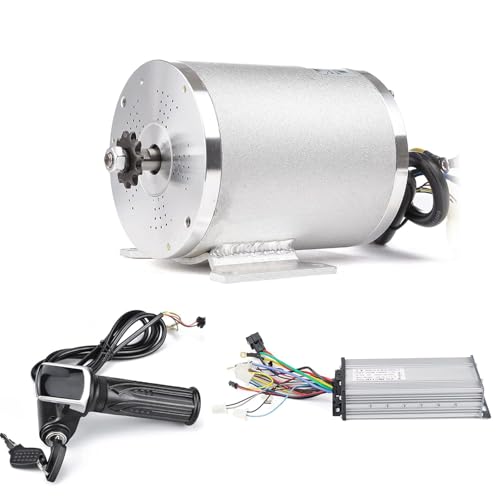
A mid-size 48V motor with a sprocket built for go-karts, mini bikes, and mower conversions.
The MY1020 brushless motor spins to 4300 rpm with a T8F 11-tooth sprocket (a chain sprocket sized for #35 pitch chains), an aluminum body, and full copper coils. The kit includes a 33A controller with Hall sensor (a sensor that reports the motor’s position so the controller can time its pulses), an LCD twist throttle with ignition lock, and an E-brake input. At 6 kg this kit fits mini bikes and go-karts without adding a huge lump of rotating mass.
The controller and motor together deliver real, tested performance in the field. A rider who dropped this into a Coleman B200RSV reached 26.5 mph on 48V 20Ah eBike batteries with 11.1:1 gearing. Another builder reports 23-25 mph top speed in a mini bike with 10T front/75T rear gearing and 30-60 minutes of runtime from a 48V 13.5Ah pack. Owners rate the MY1020 motor and included throttle as the best value in the kit. Beyond that, the honest catch is setup: you need to sort out the matching connectors and may need a different sprocket for your chain pitch.
The controller draws the most complaints from owners — it runs hot on hard use. One builder pushing a 200-pound drift trike with an upgraded motor had the controller overheat and wires melt after about 20 minutes, so heavy riders should watch heat. Also worth knowing: the manual’s stated 40A controller rating implies the kit is not fully delivering 2000W as shipped, so expect less than the headline power.
Where it shines: the 4300 rpm motor, twist throttle with ignition lock, and included controller make a fast, upgradable package for go-karts and mini bikes — tested at 26.5 mph in a converted Coleman.
Where to mind the limits: the 33A controller struggles under sustained heavy loads, and the kit lacks matched connectors and the right pitch sprocket for every build, so plan on parts shopping.
Suits the kart and mini-bike builder: someone upgrading a small vehicle who wants a compact 48V motor with a ready sprocket and matching throttle.
5. doinal 72V 5000W Brushless Motor Kit

A programmable 72V kit for go-kart and dirt-bike builders who want real torque and app tuning.
The headline here is 5000W of 72V power with 8.5 N.m of rated torque and 35 N.m peak, spinning to a rated 6800 rpm. A heat-sink housing and IP54 body (protected against limited dust and splashing water) keep it cool on long runs, and an external Hall sensor placement makes maintenance easier. What separates it from the Kunray and Ktaxon kits is the 100A Fardriver sine-wave controller — you can tune acceleration, current limiting, and braking from your phone or PC via Bluetooth.
The app control is a genuine differentiator, and owners use it. A mini-bike converter had no issues with power or speed and found app pairing straightforward — just note that Bluetooth connection requires phone location and nearby-device sensors enabled. The kit is pre-fitted with a #35 sprocket and four mounting holes, and it is designed for Razor MX500, MX650, and SX500 upgrades. After 100 hours of use, a buggy builder took his rig from 9 mph to 33 mph and it was still running strong.
The honest caveat is durability at stock tune. One rider melted the motor after 2.5 months in a Razor SX 500 on the factory settings, and found the motor cover bolts strip easily. The Fardriver app is the workaround — tune current limiting down, use the KTY84-130 temperature sensor (an internal sensor that reports motor heat) to watch for overheating, and monitor motor temperature in real time. Riders who dial in the settings rather than run stock report good results.
Why builders choose it
- 5000W motor with 8.5 N.m rated torque and 35 N.m peak for hills and mud
- 100A Fardriver controller tunes from your phone via Bluetooth, including acceleration and braking
- KTY84-130 temperature sensor and heat-sink housing watch internal heat
- #35 sprocket pre-installed and four mounting holes for Razor upgrades
What to weigh first
- Stock tune runs hot — one motor melted after 2.5 months of use
- Motor cover bolts strip easily, so torque carefully
- App requires phone location and nearby-device sensors enabled to pair
The right kit for: an experienced builder converting a go-kart or dirt bike who will use the programmable controller to dial in the settings.
Think twice if: you want a bolt-on-and-ride kit — this one rewards tuning, and running it stock risks heat damage.
6. BAFANG Mid Drive Kit BBS-HD 1000W

A torque monster that runs through your gears, so it climbs like nothing else on this list.
The BBS-HD G320 mid-drive motor produces 160 N.m of torque and reaches up to 45 km/h. Unlike a hub motor that pushes the wheel directly, a mid-drive sits at the bottom bracket and drives your chain, so it uses your bike’s cassette gearing to climb. Fitment covers bottom brackets 68-73mm, 100mm, or 120mm long and 33.5-36mm inner diameter, on disc or V-brake chain-driven bikes only. Throttle, pedal assist, and standard cycling modes are all included, plus a headlight, tools, and optional display choices.
Installation is the part owners describe as surprisingly manageable. One rider finished the job in a day, with the hard part being removal of the old crank. Another converted a stretch cruiser and reports the motor pulling a 250-pound rider, a 50-pound kid, and a trailer uphill at about 15 mph with ease — still running strong after six months. One Sun EZ-Sport owner found the 160 N.m motor delivered about four times the power he needed.
The recurring gripes are in the details around the motor rather than the motor itself. The included chainring has bent within a week for some, and the chain can pop off without a chain guide. Display compatibility caused trouble for one builder whose CAN bus display did not work. You may also need a separate battery-to-motor adapter. The G320 motor itself draws no complaints; the chainring, display, and adapter are where owners spend extra.
The case for mid-drive: 160 N.m of torque, 45 km/h, and gearing through your cassette make this the hill climber of the list — the motor pulls heavy loads up grades that stall a hub kit.
The count-the-costs caveat: the chainring and display compatibility are the weak links, and some builds need an adapter and a chain guide to run cleanly.
Choose this for: a bike you already love and want to keep, especially if your rides include hills or cargo loads.
7. NBPOWER 135mm Dropout e-Bike Conversion Kit 48V-72V 3000W

A 3000W rear hub with a color display and alarm lock for riders who want genuine speed.
This is a 48V-72V 3000W rear hub kit built around a 135mm dropout, with a sine-wave controller and a TFT UKC1 color display. Power is the thing owners talk about most, and for good reason — the setup has plenty of torque for hills and the display shows speed, battery, and settings clearly. The single-speed freewheel and throttle-plus-pedal-assist operation keep the install simpler than a geared build, and the alarm lock adds a basic theft deterrent.
For a high-speed commuter, the field numbers are real. With a 72V 25Ah battery, one rider logged 45-53 mph for about 29 miles, and 40 mph for 30 miles on a backup 52V 30Ah pack — over 2000 miles total. The controller pulls about 5000-6000W continuous on an 80A setup and the kit hit 55 mph. Multiple owners name NBPOWER rep Anne for prompt replies and quick corrections on missing or faulty parts.
The kit is not for the mechanically timid. Builders report roughly 6 hours of install time even for experienced mechanics, and the controller’s power terminals can spark or shock even after the battery is disconnected — disconnect and treat them with care. The other real safety note is torque: use the included torque arm and consider a second on the other side, because a loose axle can spin out of the dropout under full power. The payoff is a silent, powerful, stealthy hub build for confident riders.
Why speed chasers pick it
- 3000W rear hub hits 45-53 mph with a 72V 25Ah battery and 5000-6000W continuous draw
- Sine-wave controller and TFT color display for clear speed and battery readout
- Responsive customer service that owners name by person
- Alarm lock built in for basic theft deterrence
The trade-offs to respect
- Controller terminals can spark even after battery disconnect — handle with care
- Needs a torque arm (ideally two) to avoid axle spin-out at full power
- Install takes hours and no assembly instructions are included
Built for: a confident builder who wants highway-level speed from a stealthy rear hub and will fit torque arms and a proper battery.
Not for: a first-time converter — the high voltage, spark risk on the terminals, and multi-hour install demand experience.
8. NBPOWER 3000W Fat Bike Conversion Kit 72V

A 3000W fat-tire kit with a 7-speed flywheel, so the bike still rides like a bike.
The 3000W rear hub fits a 26-inch fat bike wheel and pairs with a 72V 80A Sabvoton programmable controller (which lets you dial in current and speed settings) and a 7-speed flywheel. The torque arm adds dropout support, and the rear-wheel mount keeps the build clean. It carries a one-year warranty. Where the other NBPOWER kit runs a single-speed freewheel, this one keeps seven gears, so you can still pedal it up a hill or coast a trail like a normal bike.
The 7-speed cassette is the feature that separates it, and owners lean on it for real gearing. The freewheel and gearing let the bike hit 55-60 mph while still pedaling normally, and one rider notes it can cruise past law enforcement without drawing attention. Build quality earns strong marks, with a 6’3″ 240-pound rider reporting it cruises with no problem and reached 40 mph on power level 2 of 3. The Sabvoton controller is pre-programmed at 72V, so a 48V battery will show 0% until the display is in range — check your pack voltage before you buy.
The honest trade-off is parts quality at the edges. One rim arrived dented and needed straightening, and a spare motor axle broke after about 200 miles of street riding at the cable entry point. The vendor declined compensation on that axle because the kit was four years old. Torque arms are recommended — doubling up protects the phase and hall wires. For a fat-tire trail rig, it is a strong, fast, and capable kit that benefits from careful assembly and a quality battery.
The standout spec: 3000W through a 72V 80A Sabvoton controller with a 7-speed flywheel — riders report 55-60 mph while still pedaling through the gears, which no single-speed kit here allows.
The real caveat: rim and axle quality can vary, so inspect the wheel on arrival and fit two torque arms to protect the wiring and dropout.
The pick for fat-tire riders: someone converting a 26-inch fat bike who wants high speed and the option to pedal through seven gears.
Know the Specs
Motor Power (Watts) and Torque (N.m)
Watts tell you how much power the motor can deliver per second; torque in N.m tells you how hard it twists at the wheel to climb. A 5000W motor with 35 N.m peak torque pulls hills a 400W hub cannot. For flat-board fun, 400W is enough. For hills and loads, look for mid-drive torque like the BAFANG’s 160 N.m, which runs through your gears.
Controller Amp Rating
The controller limits current reaching the motor, so its amp rating caps real output. A 33A controller on a 2000W-rated motor will not deliver the full sticker number, and a 100A controller on a 5000W motor lets you tune the behavior. Match the controller to the motor’s continuous draw and to your battery’s BMS limit, or you risk a hot controller and melted wiring.
Voltage (V) and Battery Matching
Voltage sets the ceiling on speed. A 72V kit will outrun a 48V kit on the same motor, and a controller pre-programmed for 72V will read a 48V pack as empty. Confirm your battery’s voltage and amp-hour capacity (Ah) match the kit before you build, so the display and controller work correctly.
Dropout Spacing and Fit
Dropout spacing is the gap between your fork or frame legs where the axle sits. Hub kits are built for a specific spacing — 135mm rear, 3.93-inch front, and so on — and a mismatch means filing metal or no fit at all. Measure your frame with a ruler before ordering, and confirm the wheel size and brake type match your bike.
Common Questions
Do I need a battery to run the Ktaxon 48V 1000W kit?
What is the difference between a hub motor and a mid-drive kit?
Why does my kit show low speed from the rated spec?
Do I need a torque arm on a high-power hub kit?
How long does a BAFANG BBS-HD installation take?
Will the UDITER S3 swappable battery work with a second battery?
What does a programmable controller let me change?
Is the DNASKATE M8 good for hills?
How fast will a 3000W rear hub kit actually go?
Can I use the BAFANG kit on a bike with rim brakes only?
The Bottom Line
Your best starting point with an electric longboard conversion kit depends on if you want a finished board or a build project. For most first-time riders, the DNASKATE M8 is the easiest entry — a complete 400W board that arrives ready to ride on flat ground, at a starter-friendly price. If you want real speed and a wide deck, the UDITER S3 delivers 1200W and 26+ mph with a swappable battery. And if you are converting a bike you already love, the BAFANG BBS-HD is the one to reach for — its 160 N.m of mid-drive torque climbs like nothing else here. A smart nudge: the M8 earns 4.0+ stars across 100+ ratings, which tells you its flat-ground formula works for the riders who buy it.
How we choose
We do not accept paid placement. Every pick is matched to a real buyer and a real use-case; we do not hands-on test units.
Sources
Specifications: manufacturer listings and product documentation. Review insights: verified customer reviews, as of October 2026. Pricing: not shown on this page (it changes often); check the current price via the retailer link.
As an Amazon Associate, Aappliancez earns from qualifying purchases. This does not affect which products we feature.