Disclosure: Some links in this post are affiliate links. As an Amazon Associate I earn from qualifying purchases, at no extra cost to you. Learn more
Specs are compiled from manufacturer listings and verified buyer reviews and can change over time — please confirm the key details on the product page before buying.
If your spare room, basement or bathroom stays cold while the rest of the house is fine, a baseboard or wall heater lets you warm that one zone instead of paying to heat everything. The catch most people hit first is the wiring, not the heater: some models here run on 240 volts and need a dedicated circuit, while others plug into a standard 120-volt outlet. Get the circuit right and the rest of the install is straightforward. This guide sorts the eight strongest picks by how they actually heat a room, how loud they run, and what you need on the wall before one goes in.
This guide is built by comparing the manufacturers’ published specifications and the patterns across verified customer reviews, so you get each pick’s real strengths and trade-offs instead of marketing spin.
Some units here silently convect heat upward, others push it with a fan, and a few are built to be recessed right into the drywall. Below you will find the room sizes, voltages and wattages side by side, so you can match a unit to your space. That is the whole job with electric baseboard heating systems — matching a heater to the room and the circuit you already have.
Top Picks


How To Choose The Best Electric Baseboard Heating Systems
Check your circuit before you shop for a heater. Every unit here is electric, but they split into two jobs. Hardwired models need 240 volts (a heavy line) from a dedicated breaker. The plug-in model runs on ordinary 120-volt household current (a standard wall outlet). Not sure what is behind your wall? An electrician can tell you in minutes. Knowing your voltage and amperage narrows the list faster than any spec sheet.
Match the wattage to the room, not the other way round
A heater’s wattage is the number that decides how much space it can actually warm. Too small and it runs nonstop and never quite catches up; too large and you have paid for capacity you cannot safely wire. Check the published square-foot coverage on each unit and compare it honestly against your room. A 150-square-foot bathroom and a 400-square-foot basement need very different machines.
Convection versus fan-forced: silent or fast
A convection heater warms air and lets it rise on its own. There is no fan, so there is nothing to hum, click or blow dust around — good for bedrooms and anyone who records audio at home. A fan-forced heater pushes warm air out into the room and typically warms it faster, at the cost of some noise. Neither wins outright: choose convection for a bedroom and fan-forced for a living room or utility space.
Wall-mounted versus baseboard, and the thermostat question
Baseboard heaters sit low along a wall and take up floor-length real estate. Wall heaters recess into the drywall and free that space back up, which matters in tight bathrooms and hallways. Either way, check whether a thermostat is included. Plenty of hardwired units need one added, and some include an adjustable front-mounted thermostat so you can set the heat without extra parts.
Side-by-Side Comparison
| Model | Best For | Wattage | Voltage | Coverage | Amazon |
|---|---|---|---|---|---|
| KING PAW2422-W Pic-A-Watt★ Best Overall | Zone heating a basement or bedroom | 2250 W (adjustable) | 240 V | 400 sq ft | Amazon |
| KING W2415-BW W SeriesTop Performer | Replacing an existing wall heater | 1500 W | 240 V | — | Amazon |
| Cadet Com-Pak CSC202TWBest for Small Rooms | Small rooms and converted attics | 2000/1500 W | 240/208 V | 200 sq ft | Amazon |
| Broan-NuTone 198 | Large rooms and mobile homes | 4000/2000 W | 240 V | 265–400 sq ft | Amazon |
| Fahrenheat FBE15002 | Rentals and rooms without 240 V | 1500 W | 120 V | 250 sq ft | Amazon |
| Cadet 09956 Baseboard | Along-the-wall permanent heat | 1500 W | 240 V | 250 sq ft | Amazon |
| Envi LE5022D Panel Heater | Bathrooms with almost no wall space | 500 W | 220 V | 150 sq ft | Amazon |
| Dimplex Linear Convector 20″ | Tight bathroom nooks | 500/375 W | 240/208 V | 300 sq ft | Amazon |
Detailed Reviews
1. KING PAW2422-W PAW Pic-A-Watt Electric Wall Heater
Our pick — 4.5+★ from 300+ verified ratings; the strongest balance of quality and price.
The heater you can dial down to the exact room it lives in.
What makes the Pic-A-Watt worth leading with is its name made real: you set how many watts it draws to suit the room, and it covers up to 400 square feet at 240 volts. That flexibility is what owners keep coming back to — a spare bedroom and a finished basement do not need the same output, and this unit lets one product serve both. The 2250W ceiling and 9.38 amps of draw put it comfortably in dedicated-circuit territory.
It is a fan-forced heater, not a silent convector, so expect the sound of moving air rather than dead quiet. What owners describe is closer to a forced-air vent than a jet engine — the kind of white noise you stop noticing once the room warms. One buyer put it simply: it is “quiet, unobtrusive, strong heat for basement bedrooms/theater.” Just know the 220V wiring means you will also need a thermostat; that is not included.
The build feels substantial, and swapping the fan-and-element assembly out is a one-screw job if it ever needs replacing. Thermal cutoff protection is built in, and at least one owner had a cutoff fail early and got a free replacement shipped without returning the old part. The honest catch: installation is straightforward if you are handy, but the sides will bow if you overtighten, and the grille screws can strip if forced. Go gently and it goes in clean.
What earns it the top spot
- Adjustable wattage lets you match output to the exact room instead of guessing
- 400 square feet of coverage is the widest single-unit reach on this list
- Fan-forced heat runs closer to a forced-air vent than a loud appliance
- One-screw element swap makes future service genuinely easy
Where it asks more of you
- 240-volt hardwiring means an electrician and a separate thermostat
- Overtightening the sides during install bows the frame and misaligns grille screws
- The higher 9.38-amp draw needs a circuit rated for it
The call: This is the pick for anyone heating one stubborn room — a basement theater, a cold spare bedroom — who wants output they can tune rather than a fixed one-trick unit.
Know first: You are committing to 240-volt wiring and a wall thermostat, so budget for the electrician, not just the heater.
2. KING W2415-BW W Series Wall Heater
A drop-in wall unit that turns a big living room warm fast.
Where the Pic-A-Watt flexes across rooms, the W Series is a straightforward 1500-watt, 240-volt wall heater that trades flexibility for a clean, simple fit. Its NiChrome open-coil element transfers heat quickly, and the 4-blade aluminum fan spreads it out with far more push than a silent convector. Two units in a large living room warmed it quickly and held the temperature well, which is exactly the job this was built for.
Installation is the quiet win here — a contractor had one wired and running in under 15 minutes, and it slips into the space an older wall heater used to occupy. The dual wattage design gives you some room to match the draw, and it sips 6.25 amps, well below the Broan-NuTone 198’s 16.67. A buyer put it plainly: “Awesome heater easy to install. The heater is well made with easy to use temperature control.”
Here is the trade-off you should hear before buying: noise is the recurring gripe. Plenty of owners have no issue and find it quiet, but a steady drumbeat of feedback calls it a little loud, and that fan is always going to be audible in a bedroom. The value question splits too — some find it reasonable, others think it is priced above what a single wall heater should cost. For a living room or a hallway it disappears into the background; for a light sleeper’s bedside, think twice.
Why it lands so well: Quick heat from a 1500-watt element, a 15-minute install, and a footprint that replaces an old wall unit without cutting new drywall — for a replacement job it is close to painless.
The noise question: The fan is the one thing that splits opinion, so match this to a room where a little air movement will not bother you.
Reach for this if: You are swapping out a tired wall heater and want fast heat in a big room without a redesign.
Look elsewhere if: The unit is going within a few feet of where someone sleeps — the fan hum will be part of the deal.
3. Cadet Com-Pak Electric Wall Heater CSC202TW
The one that arrives complete — wall can, grille, heater and thermostat in the box.
Most wall heaters nickel-and-dime you on parts. This one does not: the wall can, heater, grille and a built-in adjustable thermostat all come together, which is a real convenience when you are finishing an attic or a spare room. It warms up to 200 square feet quickly and runs at 2000 watts on 240 volts or 1500 watts on 208, drawing 8.33 amps. For a converted attic or a small bedroom, that is a tidy match.
Owners consistently describe the same experience: immediate, even heat that the thermostat actually holds steady, in a compact package that recesses discreetly out of the way. It is not silent, but the fan is described as not noisy, and the heat comes on fast enough that long run times are not the norm. Models rated 1500 watts or less can even be ceiling-mounted, which opens up options in tight rooms. Compare its 200 square feet to the Broan-NuTone 198’s 265–400 and you can see where each belongs.
The honest part: durability is the recurring worry. A meaningful slice of feedback says units stop working after a few months, and that is worth weighing if you expect a decade of service from a wall unit. Installation is best done by a licensed electrician the first time, since it needs its own breaker and a 220 circuit. It also has no off switch — you rely on the thermostat set to its lowest setting to stop it heating.
Why the package wins
- Everything included — no separate thermostat or wall can to source
- Fast, even heat that holds a steady room temperature
- Compact recessed design frees up floor and wall space
- Ceiling-mount option on the 1500-watt setting
The catch worth knowing
- Durability is the split point — some units quit within months
- No dedicated off switch; the thermostat does the stopping
- Needs a dedicated 240-volt circuit and a first-time electrician
Best-suited to: A small room, attic conversion or bedroom where you want one box to contain the whole job.
Weigh this: If long-term reliability tops your list, the mixed durability track record here is the one thing to think hard about.
4. Broan-NuTone 198 High Capacity Wall Heater
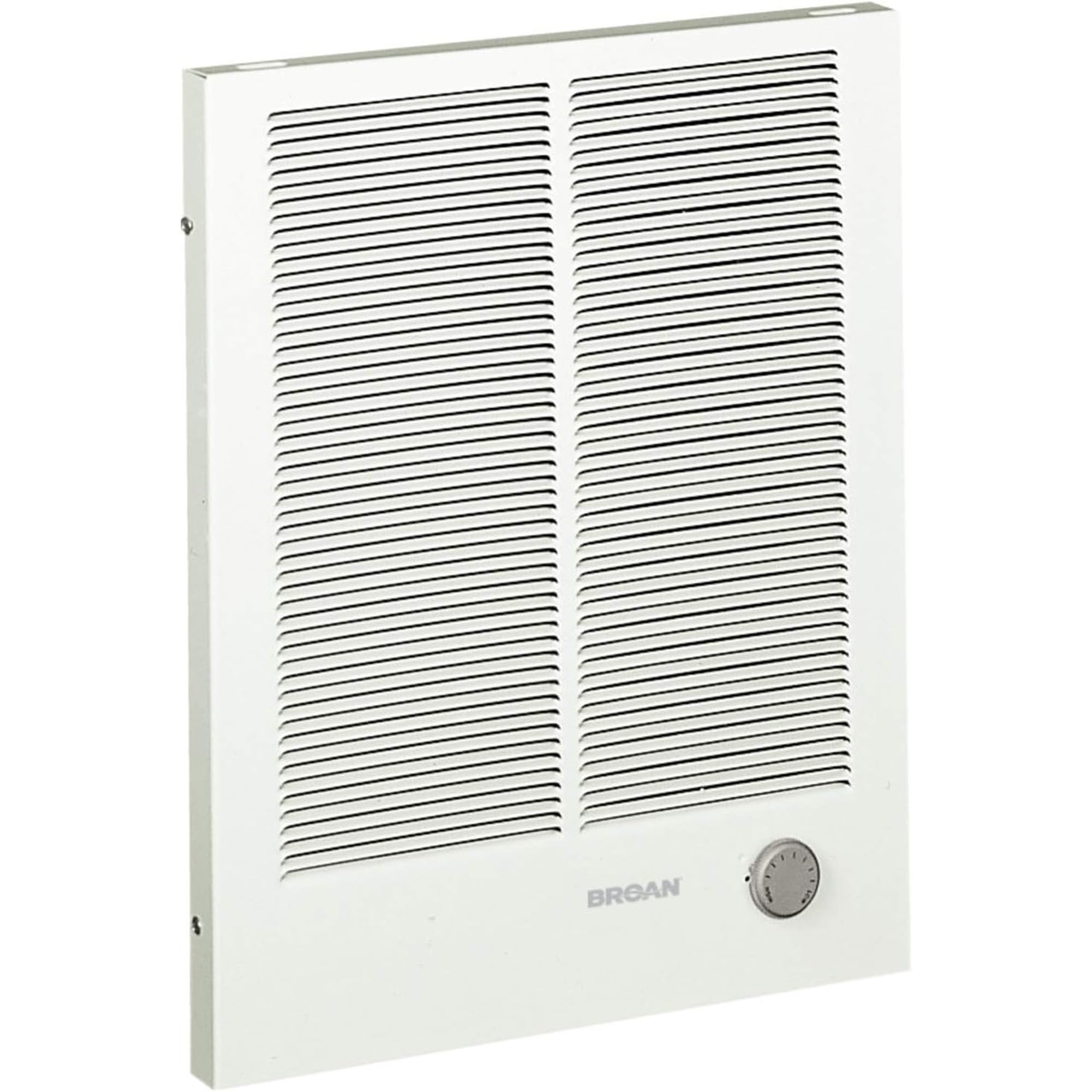
Four thousand watts of brute heat — bring the wiring that deserves it.
This is the biggest hitter on the list: 4000 watts at 240 volts, covering 265 to 400 square feet, drawing 16.67 amps. If you are heating a large basement, a mobile home, or two small rooms off one unit, this is the one with the output to do it. One reviewer noted that, once installed in the wall, it heated their mobile home better than their old furnace.
It is fan-forced with downflow louvers that push warm air gently toward the floor, and the heavy-duty 18-gauge steel grille with a baked enamel finish feels like something that belongs in a workshop. You can recess it or surface-mount it, and the front-mounted adjustable thermostat means no separate control to wire in. The included motor is permanently lubricated and there is a manual reset thermal overload protector for safety.
Two things to plan around. The 16.67-amp draw at full 4000 watts needs the wiring to match — some owners run it derated to 2000 watts by removing a bridge wire because their circuit only supports that, and it still puts out plenty. Second, the fan is the split opinion: plenty find it quiet, a fair number find it loud enough to notice from a few feet away. It is a utility heater, and it sounds like one.
The capacity story: 4000 watts and 400 square feet of coverage make it the only unit here that can carry a genuinely large space on its own.
Set your expectations: This is a workhorse, not a whisper-quiet bedroom piece — plan for the fan and the heavier circuit it demands.
Its balance: Big rooms and mobile homes, where raw heat output matters more than a hushed hum.
Look elsewhere if: Your circuit cannot carry 16.67 amps at full tilt, or the unit is going somewhere silence is non-negotiable.
5. Fahrenheat FBE15002 Portable Electric Baseboard Heater

The only unit here you can carry room to room and plug into a normal outlet.
Every other pick on this list wants a hardwired 240-volt line. This one runs on standard 120-volt household current at 12.5 amps, so it goes anywhere there is an outlet — a rental, a sunroom, a basement that never got wired for heat. It is 45 inches long and convection-driven, meaning no fan and no moving parts. The heat rises and circulates on its own, and the cabinet stays cool to the touch, which is why it appeals to households with kids or pets around floor level.
Silence is the whole point. It makes no fan noise at all, just the faint tick of the heating element expanding and contracting, and the thermostat holds a remarkably steady temperature without wide swings. In a 12×12 room it takes hours to fully warm, so this is a room that stays warm, not a blast of instant heat.
The catch is a real one for the first evening. Several owners describe a strong odor on first startup that takes about two hours of continuous use to fade, so ventilate the room and give it that first burn-in before you judge it. The rear support feet are also fiddly to attach and can slip off when you move the unit. On a 15-amp circuit, run it alone — 12 amps at 120 volts is a heavy continuous load, and an electrician’s advice is not to exceed 80 percent of the circuit’s rating.
Where it stands out
- Standard 120-volt plug — no electrician, no dedicated line
- Completely silent, fanless convection heat with no moving parts
- Cool-to-touch cabinet and overheat protection for household safety
- Most accurate thermostat on the list, holding steady without swings
Before it settles in
- Strong startup odor that needs a ventilated burn-in to clear
- Slow to warm a room — hours, not minutes
- Rear support pieces are awkward and can fall off when moved
The fit: Renters, sunrooms and any room where you cannot hardwire 240 volts but do want silent, even heat.
The honest limit: Plan for a slow warm-up and a smelly first evening before this becomes the quiet companion it is meant to be.
6. Cadet Manufacturing 09956 Baseboard Hardwire Electric Zone Heater

A long, low, silent stretch of warmth for the room that needs even heat.
The 72-inch length is the point here — it spreads 1500 watts across a long run of 25-gauge steel, covering 250 square feet with gentle, silent convection heat. If you are replacing old baseboard in a living room or a small barn, the six-foot span is a direct fit for the footprint you already have. Owners find it installs easily against a wall thermostat and warms an 11×10 room quickly, and one experienced installer chose baseboard over fan heaters for reliability in a dusty environment, where fans tend to choke and burn out.
The quality of the build is what buyers praise most, followed by how straightforward it is to install. It is quiet and unobtrusive once running, and it warms a laundry room to a comfortable temperature without drama. One owner noted a single-pole thermostat was hard to find locally, so source one before you start the job — this heater needs a thermostat and does not ship with one.
Be honest with yourself here. The metal is thinner than older baseboard, so it weighs less and spreads heat faster. But that same thin metal arrives prone to shipping damage — dents and bent corners show up in enough buyer feedback to flag. Budget for 10-gauge wire (thick wire rated for 240-volt lines) and an electrician, because installation, not the unit, is the real expense. Running a 1500-watt heater around the clock also moves the meter: one buyer saw their bill climb noticeably after running it continuously. That is how electric zone heat works, not a flaw in this unit.
The quiet operator: Silent convection over a six-foot length, easy to install, and a solid choice for anyone replacing old baseboard in a space that already has the footprint.
The going-in costs: No thermostat in the box, likely 10-gauge wire, an electrician’s visit, and a visible bump in your electric bill if it runs constantly.
Who it suits: Anyone replacing an old baseboard run who wants silent, even heat along a wall.
Who it does not: Anyone hoping to avoid a thermostat purchase, heavy-gauge wiring, or a bump in their power bill.
7. Envi 220 Volt Hardwired Electric Panel Wall Heater
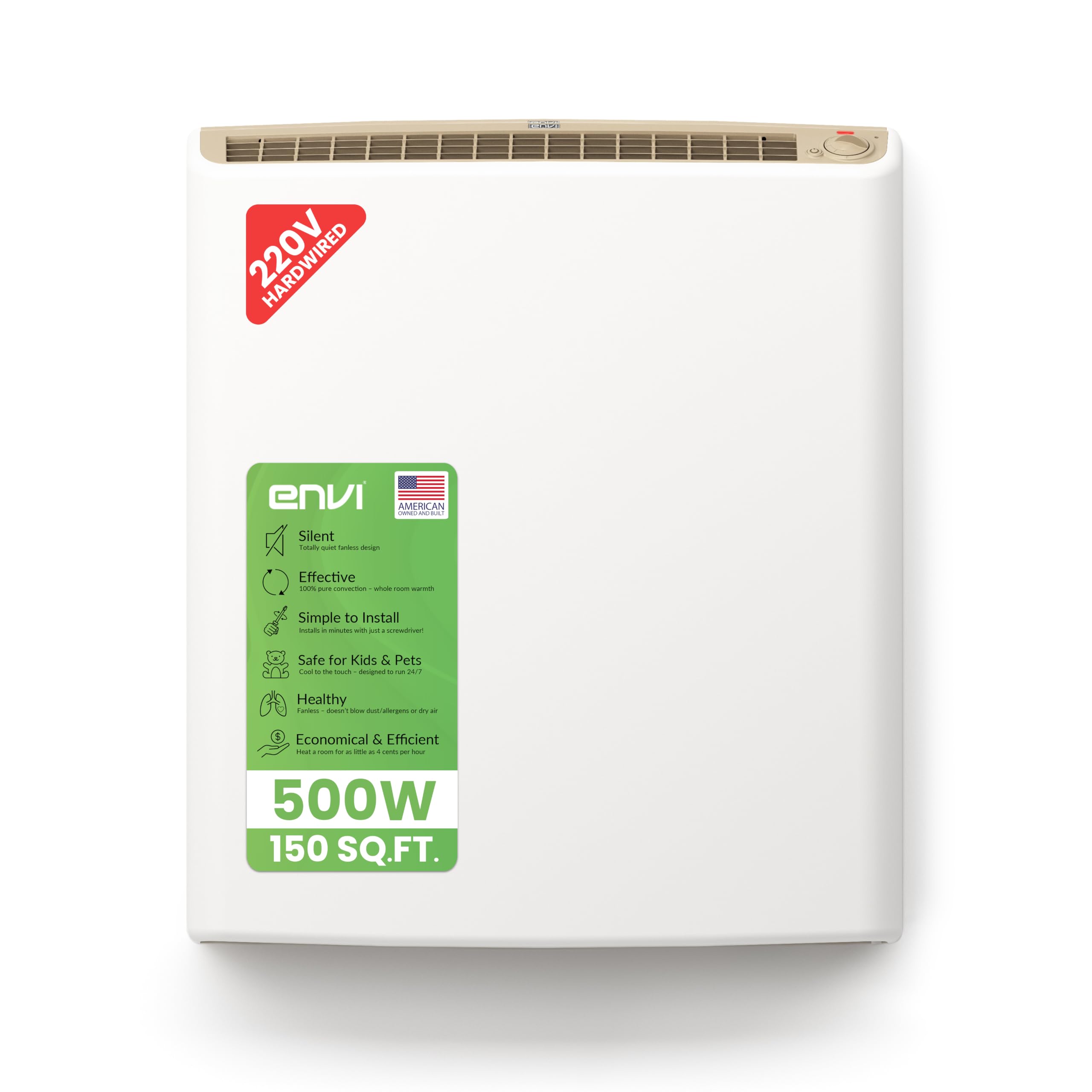
A two-inch-thick panel that hangs flat on the wall and runs on a whisper of power.
This is the low-power pick on the list, and that is deliberate: it draws just 500 watts and 2.27 amps on 220 volts. That low draw lets several panels share one circuit without tripping a breaker (the switch that cuts power on overload). So it suits bathrooms, hallways and bedrooms where you want extra warmth without a dedicated heavy line. It is fan-less and totally silent, moving heat with a slow updraft of air. The cabinet is rated cool to the touch at 90 degrees Fahrenheit, and a wall-sense safety sensor cuts power if the unit comes off the wall.
Its 150 square feet of coverage is modest, and that is where you have to be careful. Feedback on heating performance is genuinely mixed — some owners find it keeps a small, well-insulated room comfortable, while others find the warmth barely reaches into the room. One owner running five units reports lower electricity costs and no paint peeling after six years. Another, in a 122-square-foot room, felt the heat only close to the panel and never got the room warm. The difference seems to track with insulation and expectation: treat it as a quiet, direct supplemental source, not a whole-room furnace.
Installation is simple — mounting kit, template and manual included, no drill or contractor required in most cases — and because there are no moving parts it is essentially maintenance-free. The built-in thermostat is a soft spot: it does not regulate the room as tightly as a wall-mounted thermostat placed a proper distance away. Buy this for the bathroom, the cold hallway, the spot that needs gentle background warmth, and set your expectations to match its 500 watts.
Why the panel earns its place
- Only 500 watts and 2.27 amps, so multiple units can share a circuit
- Fan-less and totally silent, with an auto-dimming light for night use
- Two-inch profile and flat wall mount save floor clutter
- Cool to the touch at 90°F with a wall-sense safety cutout
Where it asks you to adjust
- 150 square feet of coverage is modest, and heating feedback is genuinely split
- Built-in thermostat does not hold the room as tightly as a wall unit
- Hardwired 220-volt install, not a plug-in
Made for: A small, well-insulated bathroom or hallway where you want silent background heat and light power draw.
Not for: A large or drafty room you expect one 500-watt panel to heat on its own.
8. Dimplex Linear Convector Baseboard Heater 20″

Twenty inches of baseboard for the bathroom corner no full-length heater fits.
The number that matters here is 20 inches — short enough to tuck between a toilet and a wall, which is exactly where owners end up putting it. Per Dimplex it is up to 42% shorter than conventional baseboards, yet still rated for 300 square feet at 500 watts on 240 volts (375 on 208). The steel tubular element with a shark-fin blade design is built to move heat upward quickly and quietly. If you have a tight bathroom, a master bath remodel, or a hallway nook with no wall space, this is the unit that actually drops in.
Owners notice the look — they describe it as slim and good-looking, not a utilitarian box stuck on the wall. With no fan, it runs quiet, as a convection unit (one that circulates heat by rising air) should. It also puts out a surprising amount of heat for its size. One buyer put it well: “Great little heater, it fit perfectly in a small area in my bathroom and gives off a lot of heat.” Compact size is what buyers praise most, and it is why this one makes the list.
Be clear-eyed about the wattage. At 500 watts, this is a small-room specialist; left on continuously, it keeps a compact room comfortable, but it is not built to bring a large space up to temperature quickly. It also needs 240-volt wiring, and a buyer with no such circuit will wish there were a 110-volt version. That is the honest limit — brilliant in a tight space, out of its depth in a large one.
The tight-fit answer: Twenty inches, silent convection and a slim profile make this the heater to reach for when a standard baseboard simply will not fit the gap.
Set the scale: 500 watts suits a small room left on; a big space needs more than this panel can give.
Best for: Bathrooms and nooks where floor length is at a premium and 240 volts is already available.
Think twice if: The room is large, or your wiring is only standard 110-volt household current.
Know the Specs
Wattage and Square-Foot Coverage
Wattage is the one number that tells you how much room a heater can handle. A 500-watt panel is built for a small bathroom, while a 4000-watt wall unit can carry several hundred square feet. Match the published coverage figure to your room and you avoid both underpowered heaters that never catch up and oversized ones you cannot safely wire. When two units cover the same area, the higher wattage simply means faster recovery.
Voltage, Amps and the Circuit You Have
Voltage decides how a heater connects. Hardwired units here run on 240 volts (some list 208 as well) from a dedicated breaker, while the 120-volt plug-in runs on ordinary current. Amps are the actual draw on that circuit — a 4000-watt heater pulls 16.67 amps, so the wiring must be rated for it. Before buying, confirm the circuit you have matches the voltage and amperage the heater lists.
Convection versus Fan-Forced Heat
Convection heaters warm air and let it rise silently, with no fan and no moving parts — best for bedrooms and quiet spaces, but slower to heat. Fan-forced heaters push warm air out with a blower, warming a room faster at the cost of some audible hum. Neither is superior; pick silence for sleeping rooms and speed for a living room or utility space.
Thermostats and Safety Features
Some units ship with a built-in adjustable thermostat, while others need a wall thermostat wired separately. A built-in one is convenient but often less precise than a wall-mounted thermostat placed a proper distance from the heater. Look for a manual reset thermal overload protector and overheat cutouts for safety, and keep furnishings and curtains clear of the discharge path.
Common Questions
Can I plug a baseboard heater into a normal wall outlet?
How much square footage will a 1500-watt heater heat?
Do I need a separate thermostat for a baseboard heater?
Is a convection or fan-forced heater better for a bedroom?
Can a 240-volt wall heater be installed by a handy homeowner?
Will a baseboard heater make my electricity bill jump?
What is the difference between a wall heater and a baseboard heater?
Why does a new heater smell on first use?
Can I use a wall heater in a bathroom or near water?
How long will an electric baseboard heater last?
The Bottom Line
For most buyers, the electric baseboard heating systems winner is the KING PAW2422-W Pic-A-Watt because its adjustable wattage and 400 square feet of coverage let one unit serve whatever room you point it at. If you want a plug-in solution with zero wiring, the Fahrenheat FBE15002 runs on standard 120 volts and is completely silent. And if raw capacity for a big space is the job, the Broan-NuTone 198 brings 4000 watts to the table — just make sure your circuit can carry it.
Whichever way you go, confirm your voltage and amperage first and the rest of the decision gets a lot simpler.
How we choose
We do not accept paid placement. Every pick is matched to a real buyer and a real use-case; we do not hands-on test units.
Sources
Specifications: manufacturer listings and product documentation. Review insights: verified customer reviews, as of October 2026. Pricing: not shown on this page (it changes often); check the current price via the retailer link.
As an Amazon Associate, Aappliancez earns from qualifying purchases. This does not affect which products we feature.