Disclosure: Some links in this post are affiliate links. As an Amazon Associate I earn from qualifying purchases, at no extra cost to you. Learn more
Specs are compiled from manufacturer listings and verified buyer reviews and can change over time — please confirm the key details on the product page before buying.
If your elbow aches every time you lift a coffee cup, swing a racquet, or click a mouse, the fix is usually a firm pad pressing on the right spot, not a tight sleeve squeezing everything. A counterforce brace works by putting pressure on the forearm muscle just below the elbow, which takes the strain off the tendon that is complaining — and the wrong strap, worn too tight or placed too low, can make the whole thing worse. This guide lines up the 11 straps and sleeves worth a look, what actually holds up over months of wear, and how to size one so it stays put instead of sliding down your forearm mid-swing.
This guide is built by comparing the manufacturers’ published specifications and the patterns across verified customer reviews, so you get each pick’s real strengths and trade-offs instead of marketing spin.
The quick table below makes those differences obvious, then the reviews break down each of the best Elbow Counterforce Brace options for real daily use.
Top Picks

How To Choose The Best Elbow Counterforce Brace
Nearly every strap in this roundup does the same basic job: press a pad into the forearm muscle below the elbow and take load off the tendon. The differences that actually change your day are the fastening type, the forearm range it covers, and where the pad sits when you tighten it.
Fastening: hook-and-loop, D-ring, or a twist knob
Hook-and-loop is the classic — you pull the strap and press the hook side onto the loop side, and you can fine-tune the pressure in seconds. A D-ring closure instead threads the strap back through a ring, which is easier with one hand but can be fiddly if grip strength is the exact problem you are treating. A twist-knob system takes the guesswork out: you turn a dial until the band feels right, which is handy if pressing a stiff hook-and-loop strip hurts your fingers.
Measure your forearm, not your elbow
Counterforce bands sit roughly an inch below the elbow joint, so that is the measurement to take, at the widest point. Sizing ranges in this roundup stretch from a 7.5-inch forearm at the smallest end to 16.5 inches at the largest, so measuring first saves you a return. If you land between two sizes on a sleeve-style brace, sizing up is usually the safer call.
Pad, gel, or nothing at all
The pad is the working part. A firm gel or EVA pad concentrates pressure on the extensor muscle; a silicone pad dampens vibration in addition to pressing; a plain strap just squeezes. Wider pads spread the load and tend to feel less sharp on the skin. Narrow bead-style pads bite harder but demand careful placement, so they reward a minute of adjusting before you start playing.
Side-by-Side Comparison
| Model | Best For | Fastening | Forearm Fit | Style | Amazon |
|---|---|---|---|---|---|
| Fit Geno Elbow Brace★ Best Overall | Tennis and golfer’s elbow relief | Adjustable band with Velcro | 10″–15.5″ | Single strap | Amazon |
| ACE Tennis Elbow SupportBest Value | Everyday tendon support during projects | Hook & loop | One size, adjustable | Air-cushion strap | Amazon |
| Neo-G Tennis/Golf Elbow StrapRehab Favorite | Rehabilitation and racket sports | Hook & loop | One size fits most | Neoprene strap with dampening pad | Amazon |
| THX4COPPER Adjustable Brace | Copper-infused compression | Adjustable strap | Adjustable, both elbows | Copper fabric strap with pad | Amazon |
| Mueller Tennis Elbow Support | All-day wear and work use | Hook & loop | 10″–14″ | Strap with gel pad | Amazon |
| CAMBIVO 2 Elbow Sleeves + Strap Set | Gym goers wanting both styles | Hook & loop and pull-on | Size-chart based | 2 sleeves + 1 strap | Amazon |
| Oberlet Tennis & Golfer’s Elbow Brace Strap | Targeted pressure with two pads | Hook & loop | Adjustable back strap | Strap with 2 removable pads | Amazon |
| BraceAbility Epicondylitis Brace | One-handed adjustment | Double D-ring | Up to 15″ | Strap with compression tube | Amazon |
| Bracemundo Tennis Elbow Brace | Quick tension changes | Pull on, knob dial | 9″–11.5″ (M/L) | Dial-adjust strap | Amazon |
| FREETOO Tennis Elbow Brace | Large arms, multi-sport use | Hook & loop with buckle | 11″–16.5″ (L/XL) | Strap with gel pad | Amazon |
| SOLOEVER Copper Elbow Compression Sleeve | Sleeve wearers wanting anti-slip grip | Pull on with 5CM strap | 8.66″–14.9″ | Copper sleeve | Amazon |
Detailed Reviews
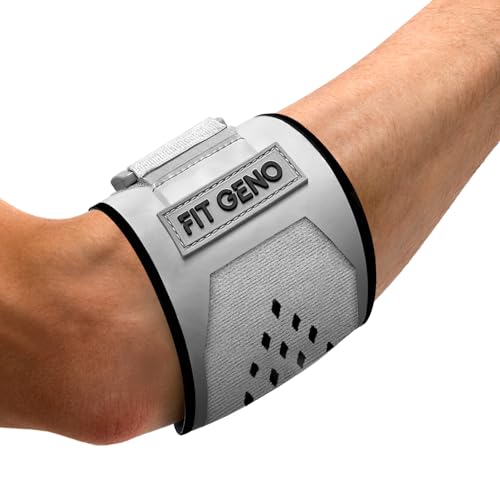
1. Fit Geno Elbow Brace 1 Pack
Our pick — 4.5★ from 450+ verified ratings; the strongest balance of quality and price.
One band that covers forearms from 10 to 15.5 inches — and stays there.
Most counterforce straps cover a narrow slice of arm sizes, so the Fit Geno’s 10”–15.5” range is the reason it lands first: it is the widest sizing span here, and it means a heavyweight lifter and a slim golfer can both tighten the same band without running out of strap. The closure is a standard adjustable band with Velcro (a hook-and-loop fastener that grips when pressed), the pad presses on the forearm tendon, and there’s a printed measurement reference on the inside so you can line the band up the same way every time.
What keeps people reaching for it is the pressure itself — owners praise the pad’s relief more than any other feature, followed closely by how well the materials hold up. It does not pinch or scratch, it sits under a shirt sleeve without bulging, and the strap fits around an ice pack if you want cold therapy alongside the compression. Breathable fabric means full range of motion during a match or a set of curls, and the whole thing is light enough that you forget it is on.
The catch is snugness. A handful of wearers find they need to cinch it tighter than other brands to feel real support, and after several hours that firmer fit starts to ache a little higher up the arm. Buyers also report a mixed picture on relief speed — one put it plainly: “Relieved my pain somewhat, but my elbow only healed after a long stretch of inactivity.” Fine if you want support while you play; not a miracle cure.
What earns it first place
- Widest fit range here — 10” to 15.5” forearm circumference
- Measurement reference printed inside the band for repeat placement
- Breathable, non-pinching fabric that works under clothing
- Velcro holds through ice-pack use and full-motion activity
Where it asks for patience
- Needs a tighter pull than some rivals to feel supportive
- After hours of wear, that tighter fit can bother the upper arm
- Hand wash only, so no tossing it in the machine
Reach for this if: you want one band that fits nearly any forearm and lets you keep playing through golfer’s or tennis elbow.
Look elsewhere if: you prefer a feather-light touch rather than a firm, higher-pressure wrap.
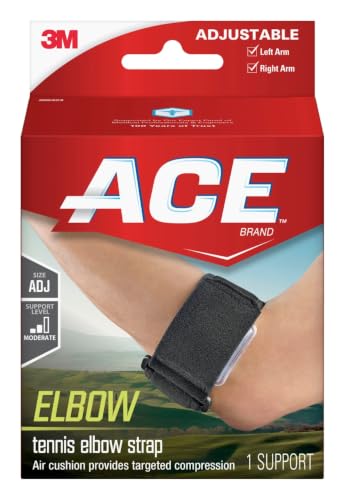
2. ACE Tennis Elbow Support, One Size, Adjustable, 1 Count
An air cushion that presses just the tendon — and weighs next to nothing.
At 27.22 g, this ACE strap is one of the lightest in the roundup, and it is built around a single idea: an air cushion that presses directly on the forearm tendon while the rest of the band stays thin and breathable. The polyester body lets air circulate so skin stays dry, the hook-and-loop closure (a Velcro-style strap that grips when pressed) adjusts in seconds, and because it is so light, you can keep playing tennis, golf, netball, cross training, or pickleball without the strap becoming the story. It is compact, too — 5.13 x 3.75 x 2.25 inches against the Neo-G strap’s 1.57 x 3.94 x 7.48 inches, so it tucks into a racket bag or glovebox far more easily.
The relief on tennis elbow is what sells it: the air cushion presses the tendon and quiets the ache mid-match, and it is the kind of support that lets you finish what you started. It handles tendonitis, tennis elbow, and golfer’s elbow, and because it holds its shape, it works as well on weekend projects as it does on court.
Two honest notes. The fit is genuinely one-size, and while most wearers get a snug hold, some with smaller or larger forearms find it either too loose to stay put or too tight to keep on. And the hook-and-loop is the wear point — it works well at first, but a few owners say the grip softens over time. For the money, though, it does one job cleanly.
Editor’s take: the ACE air-cushion strap is the value pick because it puts real tendon pressure on for very little weight and material, and the polyester band stays breathable through a full session.
One to watch: the one-size fit is a coin flip on extreme forearm sizes.
Best for: casual players and weekend project-doers who want light, breathable support and quick on-off.
Think twice if: your forearm falls well outside average, or you want a closure you know will stay crisp for years.
3. Neo-G Tennis/Golf Elbow Strap One Size
A neoprene strap built around a pad designed to soak up vibration, not just press.
The Neo-G strap is the only one here that lists a silicone vibration-dampening pad alongside its premium-grade neoprene body, and that combination is why it holds a spot for people coming back from injury rather than just managing a twinge. The pad presses the medial and lateral elbow (the inner and outer sides of the joint) while the neoprene gives the joint a warm, flexible hug; because it is registered as a Class 1 Medical Device (a low-risk medical product cleared for sale) and made to fit either the left or right arm, it is built for rehabilitation as much as for play. It also runs 2.4 ounces, so it stays put without feeling like a load on your arm.
Weight lifters get the most out of it — the padded pressure helps under load, and it works for tennis and golfer’s elbow just as well. The blue neoprene is soft enough for long wear and the hook-and-loop adjusts to sidestep circulation problems. Because it’s a one-size strap, the forearm circumference you’re working with matters if you have slim arms.
Its care routine is the one thing that takes getting used to: hand wash cold, dry flat, no fabric softener, no tumble dryer, no bleach, no iron. Treat it that way and it holds up. If you’re hard on gear and want something you can throw in the laundry, look at simpler materials.
Pick it when: you’re rehabbing a real epicondylitis flare and want a medical-device-built strap with a dampening pad — and you don’t mind hand-washing it.
Choose differently if: you want a low-maintenance strap you can machine-wash and dry.
4. THX4COPPER Tennis and Golfers Elbow Support Brace

Copper-infused fabric over a firm pad — supportive, and easy on the skin for most.
If you want the compression concentrated on a pad rather than spread through a full sleeve, this THX4COPPER strap is the copper-fabric option. The material is woven with copper ions and 5000PPM of copper filler, which is what makes it breathable and quick-drying, and the fabric is light enough that it doesn’t sit heavy on the arm. There’s a firm protective compression pad under the whole elbow that gives you cushioned support, and the adjustable strap lets you tighten or loosen it on either the left or right arm.
It’s built for the overuse crowd — golfers, bowlers, cleaners, tennis players, mouse-clickers, and assembly-line workers — and the moderate pressure is designed to offload the tendon through a full day of movement. The pad shape and the strap system are what make it feel like a targeted brace instead of a wrap. It’s hand-washable and the strap tends to hold its shape through repeated use.
Two honest caveats. The hook-and-loop also draws occasional gripes about longevity. Try it if you want the copper-fabric feel; skip it if your skin is easily fussy.
What it nails: copper-infused fabric that stays breathable and light, paired with a firm pad and a left-or-right adjustable strap.
What to weigh: copper is a fabric feature, not a treatment — and a small minority of wearers find the material itchy.
Suits you if: you want a firm-padded, copper-fabric band you can adjust on either arm.
Not for you if: your skin reacts to fabric blends, or you want a hook-and-loop closure you can trust to stay grippy for years.
5. Mueller Tennis Elbow Support, One Size Fits Most (Pack of 1)

The gel pad that keeps arms working — mail, tools, or racquet in hand.
Mueller’s strap carries an integrated gel pad that both cushions and compresses, which is what makes it a steady pick for people who use their arms all day. The double-knit moisture-wicking fabric pulls sweat away while it holds body heat for flexibility, and it fits forearms from 10” to 14”. It slides on, tightens to your comfort level, and stays put through activity — with a design that works on either the right or left elbow.
Owners who work with their hands get the most from it. Whether you’re delivering mail, working a factory line, painting, or playing pickleball, this strap is built to come off after a long shift without having dug in. It also holds up to sweat and repeated tightening far better than a bare air-cushion strap.
The trade-off is a two-part fit problem: as with all one-size pieces, the strap won’t play nice with every forearm, and it can feel either right or too loose depending on your arm. And the gel pad itself needs occasional repositioning to stay on the painful spot. Neither ruins the brace — it just asks you to spend a minute getting it right.
Where it shines
- Integrated gel pad cushions and compresses at once
- Moisture-wicking double-knit fabric for sweaty days
- Fits forearms 10”–14” and either elbow
- Built for use during work — mail, painting, factory lines — not just sport
Worth knowing
- One-size fit won’t suit every arm; some need a tighter pull
- The gel pad drifts and needs a quick reposition now and then
Pick this one if: you want a gel-pad strap you can wear through a full working day and still feel support after hours of motion.
Better elsewhere if: you have a forearm smaller than 10” or larger than 14” and want the sizing locked in from the start.
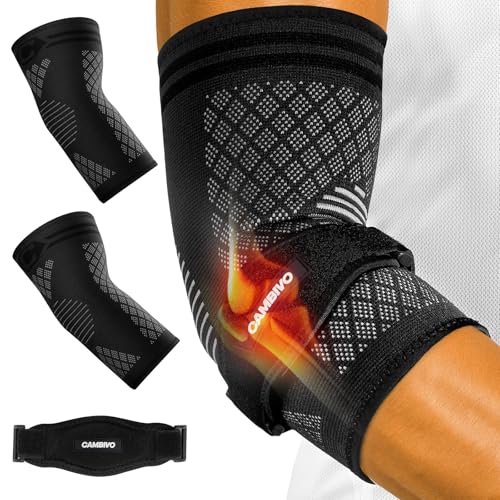
6. CAMBIVO 2 Elbow Sleeves and 1 Tennis Elbow Strap Set
Two sleeves and a strap in one kit — pick your level of support by the day.
The CAMBIVO set is the only option here that hands you three pieces: two compression sleeves plus an adjustable counterforce strap. That’s an unusual amount of flexibility for the price, and it lets you pick your weapon — sleeves alone for light activity, the strap for targeted pressure, or both stacked together for maximum stability during high-impact work like tennis, golf, baseball, or lifting. The straps use a hook-and-loop closure (a Velcro-style fastener that grips when pressed), and the strap itself carries an EVA pressure pad (a foam cushion) that sits right on the forearm extensor muscle.
The sleeves are a 3D knit with 4-way stretch, so they breathe and wick sweat during a hot session, and the whole set is built for gym and crossfit lifestyles. Wear them solo or as a base layer under the strap for a skin-friendly layer between the pad and your arm.
The setup has one clear quirk: the sizing chart is off for a meaningful share of buyers, and the sleeve measurements run small, so it’s worth measuring at the top of your recommended range and going up rather than down if you’re between sizes. Strap-fastening instructions are also thin, and a few buyers figured out pad placement from other users’ photos rather than the paperwork. Both are fixable with a minute of trial and error.
Standout feature: the 2+1 format — two sleeves and a strap — gives you three levels of support from a single purchase, and the strap’s EVA pad presses the exact forearm muscle that drives tennis elbow pain.
The catch: sizing runs small and the instructions are thin, so plan to experiment with placement once before you use it in a match.
Fits best with: gym-goers and multi-sport athletes who want both a sleeve and a targeted strap and don’t mind a sizing adjustment.
pass on it if: you want a single piece of gear sorted from the start without any measurement fuss.
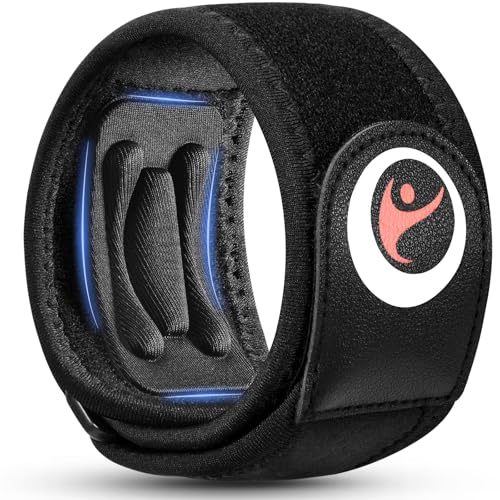
7. Tennis & Golfer’s Elbow Brace Strap 1 Pack
Two removable pads let you dial in exactly where the pressure lands.
At 1.76 ounces with a blend of EVA (a foam cushion), nylon, SBR (a synthetic rubber), and spandex, this Oberlet strap is the kind of brace you forget you’re wearing. what separates it is the two removable compression pads — you can spread the force across the elbow or concentrate it on the painful spot, and it’s a meaningful step up from the single-pad designs. The hook-and-loop closure (a Velcro-style fastener that grips when pressed) works with a back strap, so a single pull adjusts the sizing, and it’s built to fit either the left or right arm.
Buyers report it applies just the right amount of pressure on the tendon, and the strap stays where you put it through daily tasks — no slipping or readjusting mid-movement. The stretchy blend conforms to the elbow without restricting the arm, so it stays comfortable through a full workday or a long session. The breathable fabric also keeps it from getting clammy.
The main trade-off is wear on the closure. Pull the strap tight daily and the Velcro grip loosens over the months, which is why some buyers end up replacing it after about six months of continuous use. If you rotate it in and out rather than wearing it nonstop, it holds much longer.
Choose it if: you want a nearly weightless strap with two pads you can position around your own pain point.
Pick another if: you plan to wear one brace daily for a year or more and want the closure to last with zero maintenance.
8. BraceAbility Epicondylitis Brace One Size Fits Most

An embedded compression tube and a D-ring that adjusts with one hand.
BraceAbility’s strap is built around an embedded compression tube rather than a flat pad, and it uses a double D-ring closure (two metal rings the strap threads through) with a strong fastener strap clearly aimed at one-handed adjustment — useful if your elbow pain makes two-handed fiddling painful. It fits arm circumferences up to 15 inches, measured around the widest point of the forearm, and it’s worn on either the right or left arm. The construction is thin and stretchy, and the material holds its shape without feeling stiff.
What owners mention most clearly is that it stays put on smaller forearms where other braces slid around, thanks to the stretchy, substantial material and the way the D-ring locks the strap once threaded. The compression tube does the work of the pad — press it against the forearm and the pressure travels into the tendon. It’s thin enough to wear under a shirt sleeve and easy to adjust the pressure after the initial threading is done.
Two honest notes. The tightening itself can be fiddly if your hand strength or dexterity is limited, which is a real irony given the one-handed design goal — plan to thread it slowly. And the material surface is rough where the fastener sits, which some wearers find scratchy against the skin over long sessions. It does the job, but it’s not the gentlest on sensitive skin.
Why it earns a slot
- Double D-ring closure adjusts with one hand
- Fits forearm circumferences up to 15″
- Embedded compression tube presses the tendon directly
- Thin profile sits under a shirt sleeve
What to know going in
- Threading the strap can be fiddly if hand dexterity is limited
- Fastener surface is rough and can irritate sensitive skin
- Compression tube area is small, so placement matters
Made for: anyone who wants to tighten a brace one-handed after the initial threading, or needs the up-to-15″ stretchy fit.
Look past it if: your hand dexterity is the exact thing causing you trouble, or your skin is easily bothered by rough fabric.
9. Tennis Elbow Brace REGULAR Size 1 Pack
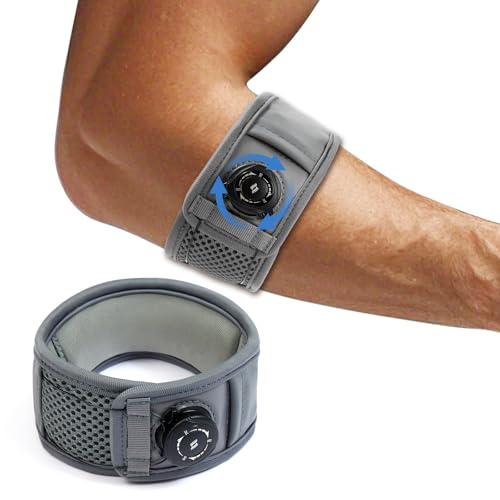
Forget velcro strips — one twist on the knob sets your pressure.
Most straps make you fight with velcro every time you change your tension. This bracemundo model swaps all that for a twist knob, so you dial the compression up or down with a single turn and it holds. That’s a real advantage if ten seconds of strap-fiddling between points is exactly what you don’t want, and it’s why owners call the quick tension changes the best part of this brace. The line comes in three sizes — REGULAR (M/L) covers 9–11.5 inches, PLUS (L/XL) covers 11–14 inches, and Small covers 7.5–9.5 inches, all measured around the widest part of the forearm.
At 1.8 ounces, the strap is barely noticeable on the arm, and the polyester body is breathable enough for gym use, work use, and court time. It’s built for tendonitis, bursitis, arthritis, and epicondylitis, and the pull-on closure means there’s no velcro to fray over time — the knob does the fastening.
The trade-offs come down to the rigid cuff and how you use it. The band is bulkier than flimsier velcro alternatives, so it can feel more present under a coat or a thick sleeve, and it’s hand wash only. Also, dial pressure is precise but the brace won’t isolate the tendon quite as sharply as a targeted pad design — customers note it’s effective overall, but one noted it “doesn’t isolate the tendon as sharply as a pad-based strap.” If you’d rather feel the pressure right on the tendon, a pad-based strap like the Fit Geno serves you better.
What it changes: twist-knob tension replaces velcro entirely, so adjusting takes one hand and about a second.
Fit note: the firm cuff runs bulkier than velcro straps and doesn’t isolate a single tendon point as sharply.
Good for you when: you want to change strap pressure fast and prefer a closure that never wears out.
Look further when: you need pinpoint tendon isolation or want a strap that disappears under layered clothing.
10. FREETOO Tennis Elbow Brace
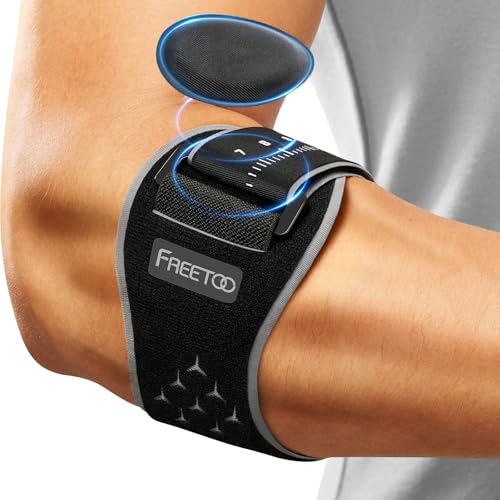
Built for the bigger forearm — the L/XL tops out at 16.5 inches.
Most straps tap out somewhere around 15 inches, so the FREETOO’s L/XL sizing up to 16.5 inches makes it the pick for larger arms. There’s also an S/M that covers 7.1 to 11 inches. The closure is a hook-and-loop strap with a buckle overlap that pairs with a detachable silicone gel pad, and the two together are designed to press the extensor tendon with enough force to quiet the ache. The 70g construction is built so you barely notice it while you’re mid-swing.
Where it earns its keep is stability under movement. Reviewers point out the gel pad lands squarely on the extensor tendon, the strap stays put through a full session, and it’s comfortable enough for hours of wear. It’s built for tennis, golf, weightlifting, pickleball, baseball, and general exercise, and the nylon fabric holds up to repeated use. It’s the kind of brace you can actually forget you’re wearing.
The one thing to think about is the size chart. Because the pad and buckle work together for the double-pressure effect, fit matters more than on a simpler strap — measure your forearm first and stick to the range rather than guessing. If you’re between sizes, the L/XL is the more forgiving call.
Best for: larger forearms, or anyone focused on tendon pain who wants a gel pad with real bite behind it, up to 16.5 inches.
Not the one if: your forearm is below 7 inches or you want a minimal strap with nothing to position.
11. Copper Elbow Compression Sleeve

A copper sleeve with a 5CM strap — support where a strap alone won’t reach.
This SOLOEVER brace is a copper-fabric sleeve rather than a plain counterforce strap, and the difference matters: instead of one pad pressing a spot, it wraps the whole elbow in 360-degree compression that targets the joint broadly. The copper-infused nylon is designed to stay breathable and cool through long wear, and there’s an upgraded anti-slip design to keep the sleeve from rolling down mid-session. A wider 5CM strap sits on top so you can tighten compression to taste. Sizing spans Small at 8.66” through XL at 14.9”, measured about 4 inches above the elbow.
Functionality is the standout here — the brace is built to hold in place through weightlifting, tennis, and cycling, and the gradient compression is designed to lend stability across the joint rather than concentrate on one point. Shoppers say steady support and real relief during play, with the sleeve especially appreciated for swelling and inner-elbow discomfort.
The honest downsides: the fit is a gamble across the size range, with owners all over the map — some finding it perfect and others struggling with a tight or loose band. A slick inner grip material can also bother skin during long wear, and a small number of owners reported irritation. Measure carefully, wear it in short sessions first, and adjust from there.
What stands out
- 360-degree copper-sleeve compression that covers the whole joint
- Anti-slip construction to keep it from rolling during activity
- Wide 5CM strap for on-the-fly pressure changes
- Nylon fabric designed to stay breathable through long wear
The honest caveats
- Sizing across the range is inconsistent, so measure first
- Inner grip surface can bother sensitive skin in a small number of cases
- Sleeve style spreads pressure rather than isolating one tendon point
Consider it if: you want full-joint coverage and a sleeve that stays up through movement — and you’re fine taking a minute to dial in your size.
Try another if: you need pinpoint tendon isolation or have skin that reacts to slick grip material.
Know the Specs
Counterforce Pad vs Compression Sleeve
A counterforce pad is a small, firm bump that presses on the forearm muscle just below the elbow — that pressure narrows the muscle mechanics and unloads the tendon, which is the effect the Fit Geno, Oberlet, and FREETOO straps all aim for. A compression sleeve instead wraps the whole elbow in gradient pressure (squeezing more at the bottom than the top), like the SOLOEVER and CAMBIVO sleeves do, which suits swelling and general joint support better than a single hot spot. Straps work best for pinpoint tendon pain; sleeves help more when the whole joint feels warm and puffy.
Closure Types You’ll Actually Live With
Hook-and-loop is the most common and the easiest to fine-tune — pull it tight, press the hook into the loop, done, and the whole thing comes off in a second. D-ring closures like BraceAbility’s thread the strap through a metal ring for a mechanical lock that doesn’t rely on velcro grip. A twist-knob like the bracemundo uses a dial so you can set tension precisely with one hand. Plan for what you’ll actually do: if you’re adjusting pressure mid-match, hook-and-loop or a dial beats threading a ring.
Common Questions
Where exactly should an elbow counterforce brace sit on my arm?
How tight should I tighten a tennis elbow strap?
Should I choose a strap or a compression sleeve for tennis elbow?
Will a copper-infused elbow sleeve actually help my tendonitis?
How do I measure my forearm for an elbow brace?
Can I wear an elbow brace all day at work?
What’s the difference between a counterforce strap and a tennis elbow sleeve?
Which elbow brace is best for pickleball players?
How long does the velcro on an elbow strap usually last?
Can I wear an elbow brace while I sleep?
Are these elbow braces safe if I have sensitive skin?
Do I need a different brace for golfer’s elbow versus tennis elbow?
How long should I keep wearing a tennis elbow strap each day?
The Bottom Line
For most people buying an elbow counterforce brace, the Fit Geno Elbow Brace is the pick because its 10”–15.5” fit range covers nearly any forearm, it holds its position under clothing, and owners mention the pad presses the tendon squarely below the elbow. If pinpoint tendon pressure with two positionable pads and a nearly weightless 1.76-ounce build appeals more, the Oberlet strap is the natural next step. And if you want to skip velcro entirely and dial in tension with one twist, the bracemundo dial-adjust brace is the one to reach for. Whichever you choose, measure your forearm first — fit is what determines whether the brace helps or just sits there.
How we choose
We do not accept paid placement. Every pick is matched to a real buyer and a real use-case; we do not hands-on test units.
Sources
Specifications: manufacturer listings and product documentation. Review insights: verified customer reviews, as of October 2026. Pricing: not shown on this page (it changes often); check the current price via the retailer link.
As an Amazon Associate, Aappliancez earns from qualifying purchases. This does not affect which products we feature.