Disclosure: Some links in this post are affiliate links. As an Amazon Associate I earn from qualifying purchases, at no extra cost to you. Learn more
Specs are compiled from manufacturer listings and verified buyer reviews and can change over time — please confirm the key details on the product page before buying.
Waking up with a numb ring finger, a tingling pinky, or an elbow that aches before you even sit up usually means your arm bent during the night. The fix is a night splint that holds your elbow straight until morning. The hard part is finding one that does not slide off your arm by 2 a.m. Almost every night splint works while you are awake and testing it. The real question is whether it stays put through eight hours of sleep. This guide separates the splints that hold their position overnight from the ones that slide down your arm by 2 a.m.
This guide is built by comparing the manufacturers’ published specifications and the patterns across verified customer reviews, so you get each pick’s real strengths and trade-offs instead of marketing spin.
Nighttime ulnar nerve support depends on two things: how firmly the splint holds your elbow straight, and whether it stays anchored for eight hours. That is exactly what this breakdown of the elbow brace for sleeping covers, pick by pick, with the sliding problem front and center.
Top Picks
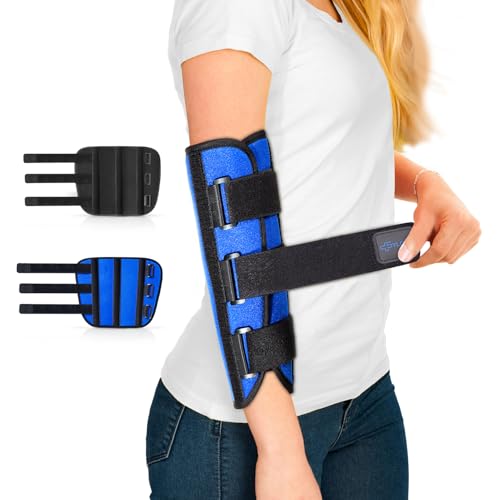

How To Choose The Best Elbow Brace for Sleeping
A night splint has one job: keep your elbow from folding past the point where it presses on the ulnar nerve (the nerve that runs along the inside of your elbow and feeds your ring and pinky fingers). During the day you can feel when your arm drifts. Asleep, you cannot — so the brace has to do the noticing for you. Here is what separates a splint that stays on until dawn from one that ends up on the floor.
Why sliding is the number one complaint
Your upper arm tapers as it narrows toward the elbow, so any tube-shaped brace naturally wants to creep downward. A splint that fits snugly when you are standing still can work loose the moment you roll onto your side. This is the single most repeated frustration in night-brace reviews, and it is why the strap layout matters as much as the padding. Look for a design that anchors above the elbow, not one that relies on friction alone.
Fixed vs range-limiting angle control
Some night braces lock your elbow at one set position, while others let you choose a fixed angle and also set a range your arm can move within. A fully locked elbow can feel rigid and make it hard to get comfortable. A range-limiting splint lets your arm settle into a natural slight bend while still blocking the deep fold that causes the tingling. If you toss and turn, the adjustable kind is usually the gentler way to sleep.
Support plates and how many you need
The rigid strips inside the sleeve are what actually stop your elbow from bending. Braces here run from a single bendable metal strip to three plastic support plates spaced around the joint. More plates spread the stopping force around your arm instead of digging into one spot. Fewer, broader plates can be more comfortable but may let the elbow give a little. Neither is universally better — it depends on how strictly you need your arm held straight.
Getting the size right the first time
Every brace on this list is sized by the circumference of your upper arm, not by height or shirt size. Measure around the middle of your upper arm and match it to the maker’s range. Ordering a size up “to be safe” is the most common mistake — an oversized night splint spins and slides, which defeats the entire purpose of wearing it.
Side-by-Side Comparison
| Model | Best For | Support | Adjustability | Size Range | Amazon |
|---|---|---|---|---|---|
| Sylong Elbow Brace S (Ulnar Nerve Splint)★ Best Overall | Daytime and rehab support | 3 support plates | 3 hook-and-loop straps | S: 8.5-11 in biceps | Amazon |
| IMAK Brownmed RSI Elbow PMMost Trusted Brand | Nighttime cubital tunnel support | Removable plastic splint | Hook-and-loop closure | Fits larger arms | Amazon |
| Sylong Cubital Tunnel Elbow Splint S/M | Straight-arm night immobilizing | 3 support plates | 3 velcro straps | S/M: 9-13 in mid-upper arm | Amazon |
| Sylong Adjustable Angle Stabilizer L | Choosing your own sleep angle | Bendable aluminum strip | 90 to 180 degrees | L: 13.5-16 in upper arm | Amazon |
| Sylong Multi-Angle Elbow Immobilizer L/XL | Day-to-night angle switching | Metal bracket plus strap | 3 fixed angles or 120–180 range | L/XL: 14.1-16 in | Amazon |
Detailed Reviews
1. Elbow Brace Sylong S
Three stiff plates ring the joint so this splint simply will not let your elbow fold.
This is the pick that comes closest to the ideal night brace, and it earns the top spot on the strength of its three plastic support plates (rigid strips spaced around your arm). Three strips spread the stopping force around the joint instead of pressing on one spot, which is the whole point of an immobilizing splint. It weighs just 120 g, so it will not feel like a weight dragging your arm down as you drift off.
Pulling this brace on is easy because the inside is soft foam with a smooth lycra lining (a slick, stretchy fabric). That slick surface slides over your arm instead of grabbing and twisting as you roll in your sleep. It fits either arm, so you can buy a matching brace for the other side later if you need one. This is the one to start with if you are shopping strictly for sleep and want maximum straightening force.
Where it can let you down is real, and it is the same failing that runs through this whole category: a firmly locked splint can slide down your arm in the night. Owners trying it for a fracture reported that keeping the arm straight overnight worked, but the brace would work its way loose, and tightening enough to stop that could cut off circulation. If your arms are on the slender side, size carefully — the smallest size fits an 8.5-11 inch biceps circumference, and an oversized splint will move around far more.
What earns it the top slot
- Three support plates wrap and stabilize the joint from more than one side
- Light at 120 g, so it will not drag your arm down overnight
- Three separately adjustable straps let you anchor the top cuff tighter
- Smooth lycra-lined interior slides on easily and resists twisting
What to plan around
- Immobilizing forces a fully straight, rigid position all night
- Can creep down the arm like most night splints
- Oversized on a thin arm will slide and spin
- Hand wash only
The bottom line: Buy this if you want the firmest straightening force and your own sleep position to end the numbness, sized to your exact arm measurement.
Think twice if: You sleep on your side and cannot tolerate a locked-straight arm, or your upper arm measures outside the S range.
2. IMAK Brownmed RSI Elbow PM Nighttime Brace
The one built with one thing in mind: an elbow held still between sheets, not at a desk.
Where most splints look like a daytime accessory, the Brownmed RSI Elbow PM reads as a dedicated night device — a single, removable plastic splint riding inside a soft cotton-lined sleeve. The splint is removable, so you can pull it out to wash the sleeve or to soften the brace. The cotton lining and stretchable webbing are the reason it earns its reputation for endurance: the interior stays smooth against your skin, and the hook-and-loop closure never sits where it can scratch. It is also one of the easier braces to put on and take off with one hand, which matters when you are half-asleep.
What people keep coming back to is the fundamental correction it makes: keeping the elbow from folding enough to pinch the ulnar nerve. That is what has made this design a reference point in cubital tunnel support, and it is why so many buyers land here first. The plastic splint can be positioned down the front of the joint to block bending, and once it is set right, a straight-arm sleep is achievable without a bulky cage around your elbow.
The honest catch is fit on smaller arms. The sleeve is sized for generous upper arms, and a slimmer arm lets the interior tube slide against itself and creep down in the night. Owners who wear it over a long-sleeved shirt get the most stability, because the fabric-to-fabric contact in a t-shirt can let it work loose. It also costs more than the direct rivals here. If your arm is on the fuller side and you want a soft, cotton-lined night splint with a removable splint bar, this is a strong, well-proven pick.
Why it holds its spot: A cotton-lined, removable-splint night brace that has quietly anchored this category for years, and remains one of the easiest to position and adjust one-handed in the dark.
Where it bites back: The sleeve is cut for larger arms — a slimmer upper arm will let it slip, and the profile is built around sleeping, not daytime typing.
Reach for this if: Your arm is average-to-large and you want a soft, cotton-lined night splint with a flexible removable bar and simple one-hand adjustment.
Look elsewhere if: You have a notably slim upper arm, or you need the same brace to double as a daytime typing splint.
3. Cubital Tunnel Elbow Splint Sylong S/M

The one that ships with a shoulder strap, so the splint has nowhere to fall.
The clever bit here is a detail almost no night brace bothers with: a velcro shoulder strap. Since sliding down the arm is the documented weak point of every splint in this category, an anchor that clips over your shoulder is a direct answer to the single most common complaint. On top of that you get three support plates for wraparound stability and three velcro straps — upper arm, elbow, forearm — to dial in compression. It comes in two sizes, and the S/M fits a 9-13 inch mid-upper-arm circumference, measured around the middle of your upper arm.
The inner sleeve is a polyamide bubble fabric (a soft, textured knit) with soft foam behind it, so the surface against your skin is breathable rather than clammy. Sitting second against the day-and-night supports here, it splits the difference neatly: more anchoring than a plain strap-on splint, less rigid than a fully locked arm. Weighing 0.18 kg, it is light enough to forget about once it is on. For a buyer who has already had one splint creep off in the night, that shoulder strap is the feature worth paying attention to.
The recurring complaint is the neck strap itself. It goes around your neck to hold the brace up, and the listing did not make that obvious. Several buyers find the pressure against the back of the neck annoying enough to stop wearing the brace to bed at all. The fix is to loosen the shoulder strap so it rests on your shoulder rather than pulls at your neck, and let the three arm straps hold the splint in place. If you want the extra anchoring, this is your pick. If a strap around the neck would bother you, one of the plainer splints will sit better.
The standout detail: A velcro shoulder strap that finally answers the sliding problem head-on, paired with three support plates and three independently adjustable straps — a genuine two-arm-capable night splint in a 9-13 inch S/M fit.
The trade-off: That shoulder strap runs across the neck, and if you did not expect it, the pressure can make a full night uncomfortable until you slacken it off.
Go with this if: You have already fought a splint that slid off, and you want the added anchoring of a shoulder strap plus firm wraparound plate support.
Pick something else if: Anything resting across the back of your neck keeps you awake, or your mid-upper arm falls outside 9-13 inches.
4. Elbow Brace Support Splint Sylong L

A bendable aluminum bar lets you set your own sleep angle instead of locking straight.
For anyone who cannot sleep with a rigid, dead-straight arm, this is the design that gives you a choice. A lightweight aluminum strip inside the sleeve bends to set your elbow anywhere from 90 to 180 degrees, so you can choose the exact angle your arm rests at — many splints do not offer that at all. Four velcro straps (up from three on the straighter splints) tighten around your arm, and the padding is foam lined with breathable cotton over a flannel-like fabric (a soft, brushed surface). Weighing just 0.11 kg, it is the lightest brace here. For buyers who need a slight, controlled bend rather than a hard lock, this is the one to reach for.
The open-elbow design is the other reason it stands out: rather than caging the joint, it leaves the front of the elbow free, which buyers find takes pressure off the ulnar nerve instead of adding to it. The bendable rod is removable, so you can pull it out to adjust the shape or to soften the brace for resting without the bar. It is discreet enough to wear out in public as well as overnight, which is a perk the dedicated night-only braces cannot match.
The catch is what the adjustable strip does not do. The aluminum bar flexes to your chosen angle, so it does not rigidly resist your arm straightening. The correction it gives is a gentle hold rather than a hard stop, so for serious ulnar nerve therapy it may not be firm enough. This brace also runs large. Buyers of the L size have found it oversized for the stated range, so measure carefully before ordering. The four straps hold well once set, but users report it can still shift toward the wrist overnight and may need a touch more tightening than you would expect.
Reasons to choose the bendable bar
- Slide the aluminum strip to any angle between 90 and 180 degrees for your own comfortable position
- Weighs only 0.11 kg — the lightest brace reviewed
- Open elbow design eases pressure rather than caging the whole joint
- Removable rod lets you soft-adjust and reuse the sleeve
Reasons it may not suit you
- Adjustable bar gives a gentle hold, not a hard lock against straightening
- L size runs large for the stated range
- Can still drift toward the wrist overnight
- Hand wash and air dry only
Best for: Sleepers who need a slight, chosen bend rather than a locked-straight arm, and want the lightest brace here.
Skip if: Your priority is the firmest possible immobilization, since the flexible strip gives less of a hard stop than a fixed splint.
5. Cubital Tunnel Elbow Immobilizer Sylong L/XL
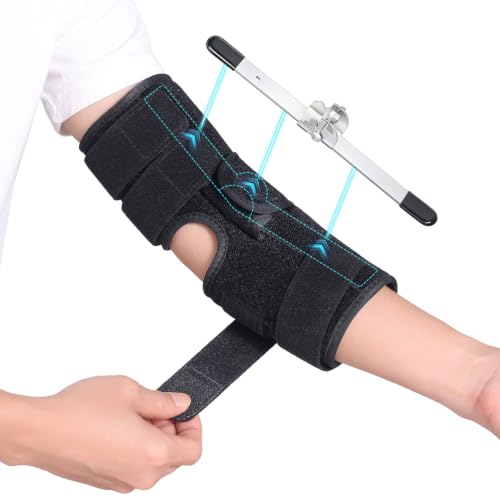
Flip a lever to switch your elbow from day mode to a straighter night position.
This splint solves a problem the others just live with: one brace for both your waking hours and your sleep. A lever sets three fixed angles — 120, 150, and 180 degrees — or a range-limiting mode that lets your elbow move within a 120 to 180-degree span. For daylight typing you set it near the working end of that range; when you go to bed you flick it to the 150 or 180 position that holds the arm straight. It is the only pick here that both locks an angle and allows a controlled range, and the L/XL fits a 14.1-16 inch arm. The interior is soft foam under a comfortable outer fabric, with velcro straps you can tighten freely.
This brace holds a chosen angle instead of merely discouraging a bend, so it is the strongest corrective device in the list for the daytime half of your routine. The leverage of the metal bracket does the straightening for you. Comfort is a genuine split, though. Some wearers find it supportive and easy to adjust, while others find the same brace uncomfortable enough to keep them awake.
Two things to know before you commit. The cuffs are not labeled top and bottom, and the right way up matters: the smaller cuff belongs on your upper arm and the larger on your forearm, so if it feels wrong you have probably got it upside down. And like every other splint here, it can slip toward your wrist in the night; a snugger set of the straps is the answer. One buyer’s take, echoed across the category, was blunt: “Horribly uncomfortable and prevented me from sleeping.” If you like the idea of one adjustable brace for work and sleep, this is a strong mid-range choice. Set the cuffs right and expect to tune the fit.
What makes it different: It is the only brace here that combines three fixed angles with a 120–180 degree range-limiting mode (a setting that stops your arm bending past a chosen point). That means it can support a working bend by day and a straighter arm by night, in an L/XL fit that suits larger upper arms.
The catch: Fit and comfort split sharply between wearers, and the unmarked cuffs mean an upside-down wear can feel wrong until you sort the smaller cuff to the upper arm.
This suits you if: You want one adjustable brace to support you through the day and hold your elbow straighter at night, and your arm falls in the L/XL range.
Look elsewhere if: You want something simple to slip on in the dark — the lever, the cuffs, and the strapping all take some getting used to.
Know the Specs
Support plates and the bending angle
The rigid strips inside a night splint — plastic plates or a bendable aluminum or metal bar — are what actually stop your elbow folding far enough to press the ulnar nerve. More plates spread that stopping force around the joint; a single bendable bar lets you set your own resting angle, from a locked-straight 180 degrees down to a 90-degree bend. The firmer the support, the more strictly your arm is held straight, but the harder it may be to get comfortable enough to sleep. A middle path — a splint that holds a chosen angle while allowing a little controlled movement — often suits restless sleepers better than a fully rigid one.
Straps and the sliding problem
Night braces here run from one closure up to four velcro straps, with three being the common layout: one each for the upper arm, elbow joint, and forearm. The upper-arm strap is the one that fights sliding, so being able to tighten it independently matters more than the total count. A few designs add a shoulder or neck strap for extra anchoring, though that strap itself can be a comfort issue. The lining matters too — a smooth lycra or foam-lined interior slides on easily and resists twisting, while a cotton or flannel-like surface feels softer but can let the sleeve creep against your shirt overnight.
Common Questions
Will a night elbow brace actually stay on while I sleep?
How do I measure my arm to pick the right size?
Is a fixed-angle splint better than one I can adjust?
Can I wear a night elbow brace during the day too?
Why does the brace keep sliding toward my wrist?
Do I need one brace or two for both arms?
How tightly should I strap a cubital tunnel splint at night?
Can I wash a night elbow brace?
Will an elbow brace help the numb ring and pinky fingers at night?
How is a night splint different from a daytime elbow support?
The Bottom Line
For most people shopping for the best elbow brace for sleeping, the winner is the Sylong Elbow Brace (S). Its three support plates ring the joint and hold your arm straight with the firmest stopping force on this list. If sliding is what drove you here in the first place, grab the Sylong S/M night splint, whose velcro shoulder strap keeps the brace from creeping down your arm. And if you want one adjustable brace that works through your day and holds your elbow straighter at night, the Sylong multi-angle immobilizer is the one to reach for. Whichever you choose, measure your upper arm first. A night splint sized to your upper arm is the only kind that stays anchored until morning.
How we choose
We do not accept paid placement. Every pick is matched to a real buyer and a real use-case; we do not hands-on test units.
Sources
Specifications: manufacturer listings and product documentation. Review insights: verified customer reviews, as of October 2026. Pricing: not shown on this page (it changes often); check the current price via the retailer link.
As an Amazon Associate, Aappliancez earns from qualifying purchases. This does not affect which products we feature.