Disclosure: Some links in this post are affiliate links. As an Amazon Associate I earn from qualifying purchases, at no extra cost to you. Learn more
Specs are compiled from manufacturer listings and verified buyer reviews and can change over time — please confirm the key details on the product page before buying.
Numbness in your ring finger and little finger, plus an ache on the inner elbow, usually depends on one fix: stop your elbow from folding up while you sleep. Every pick below locks or limits the elbow angle through the night. The first one is the strongest all-rounder for most people.
This guide is built by comparing the manufacturers’ published specifications and the patterns across verified customer reviews, so you get each pick’s real strengths and trade-offs instead of marketing spin.
You will see how each splint locks your arm, how the straps behave on a real arm, and which size to order before you commit. Every pick below is a wearable elbow brace for cubital tunnel syndrome, with its honest catch spelled out.
Top Picks
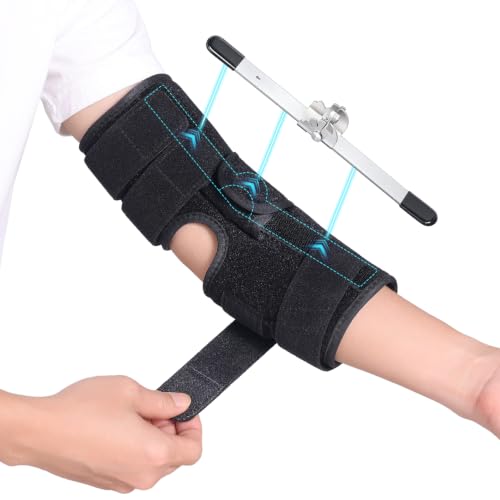

How To Choose The Best Elbow Brace For Cubital Tunnel Syndrome
The whole job of a cubital tunnel brace is to stop your elbow from bending past a safe angle, especially at night when you cannot control it. Padding, strap count and color all matter less than that one mechanical job.
Fixed angles versus range-limited movement
A fixed-angle setting holds your elbow at one locked position, like 150° or 180°. Range-limited mode lets the elbow move inside a set window instead, which is what you want for daytime desk work. The adjustable Sylong brace at the top of this list offers both, which is why it covers more situations than a single-angle splint.
Measure the bicep, not the forearm
Most returns start with sizing. Measure the circumference around the middle of your upper arm and match it to the maker’s chart. A brace that is one size too big slides toward your wrist overnight, and you wake up with the elbow folded anyway.
The inner lining decides whether you sleep
Soft foam and breathable fabric keep you from tearing the brace off at 3 a.m. A metal stay sits inside most of these splints and must come out before washing — that is normal, not a defect.
Side-by-Side Comparison
| Model | Best For | Angle Settings | Straps | Sizes | Amazon |
|---|---|---|---|---|---|
| Sylong Cubital Tunnel Elbow Brace (M)★ Best Overall | Best all-round night and day use | 120°, 150°, 180° plus 120°–180° range | Hook & loop | S, M, L/XL | Amazon |
| IMAK Brownmed RSI Elbow PMSoftest Lining | Soft overnight immobilizer | Fixed splint, single position | Hook & loop | One size | Amazon |
| Sylong 4-Angle Elbow Splint (M) | Precise fixed-angle control | 120°, 135°, 150°, 180° | 4 hook & loop | S, M, L/XL | Amazon |
| Sylong Adjustable Angle Stabilizer (L) | Bendable custom angle | 90° to 180° bendable | 4 hook & loop | M, L | Amazon |
| Sylong 3-Support Elbow Brace (M) | Swappable metal supports | 120°, 150°, 180° | 4 hook & loop | S, M, L/XL, 2XL/3XL | Amazon |
| BraceAbility Padded Cubital Tunnel Splint | Elbow padding for desk work | Thick and thin stays | Hook & loop | Universal | Amazon |
| BraceAbility Elbow Immobilizer (S/M) | Locked 90° immobilization | Fixed 90° | Hook & loop | S/M | Amazon |
Detailed Reviews
1. Sylong Cubital Tunnel Syndrome Elbow Brace (M)
Our pick — 4.0+★ from 400+ verified ratings; the strongest balance of quality and price.
One lever, three locked angles, and a range mode that lets you work without fighting the splint.
The part that sells this brace is the lever. Instead of swapping metal bars, you slide it to pick 120°, 150°, or 180° — or park it in a 120°–180° range-limiting mode so your elbow can move a little without ever folding shut. That single lever is what owners talk about most, and it is the reason this takes the top spot.
It wears lighter than you would guess at 0.23 kg, with a soft foam inner layer and fabric outer that breathe through a workday. The hook-and-loop straps tighten freely, so you can set compression on your upper and lower arm separately. The metal bracket comes out for hand washing, and the whole thing fits either arm.
Measure your arm before you order, because the size chart decides the fit: S covers 8.5–11 inches, M covers 11.1–14 inches, and L/XL covers 14.1–16 inches around the arm. The honest catch is the loose end of the range. The same strap that lets you fine-tune compression can let the brace slide if you cinch it too lightly. A snug fit is what keeps the lever sitting where you set it.
Why this one leads the list
- Lever picks 120°, 150°, or 180° in seconds, no bars to swap
- 120°–180° range mode covers daytime movement, not just sleep
- 0.23 kg with a soft foam inner layer that breathes
- Three sizes spanning 8.5 to 16 inches around the arm
Where it asks more of you
- Straps need a genuinely snug set or the brace creeps
- Hand wash only, and the metal bracket must come out first
- A very tight strap can leave the hand feeling puffy by morning
Reach for this if: you want one brace that locks your elbow flat for sleep and lightens to a 120°–180° range for daytime desk work.
Think twice if: you have a very slender upper arm at the low end of S — measure before ordering, because a loose shell will not hold the lever in place.
2. IMAK Brownmed RSI Elbow PM
A cotton-lined night splint built to block the bend, not to lock a dial.
This is the simplest design on the list and the one that wins on pure overnight comfort. A soft cotton lining and stretchable webbing sit against your skin, with a hard plastic stay down the front that blocks the full elbow bend. Buyers report overnight relief from weeks of cubital tunnel pain once the front stay is positioned correctly.
Its reputation rests on how well it does that one job, and how gentle the fabric feels. The smooth interior means the hook-and-loop never touches skin, and the stay is removable. It is designed for sleeping, not for a workday of typing at an angle.
The recurring gripe is slip. The tube-on-tube fit tends to creep during the night, and long sleeves hold it in place far better than a t-shirt. It comes in one size and suits larger arms better than small ones, so a slight build may find it rotates. If you need a daytime angle range, a lever-based splint is the better buy.
What your sleep gets: a soft cotton shell and a front stay that stops the arm folding shut, in a shape that works on the left or right elbow.
The practical caveat: one size only, and the shell tends to drift on slimmer arms unless you sleep in long sleeves.
Fits best: side sleepers with a fuller arm who want a soft overnight splint and nothing more complicated.
Not the one for: daytime desk wear, or a small arm that needs a tight, dialled-in shell.
3. Sylong 4-Angle Elbow Splint (M)
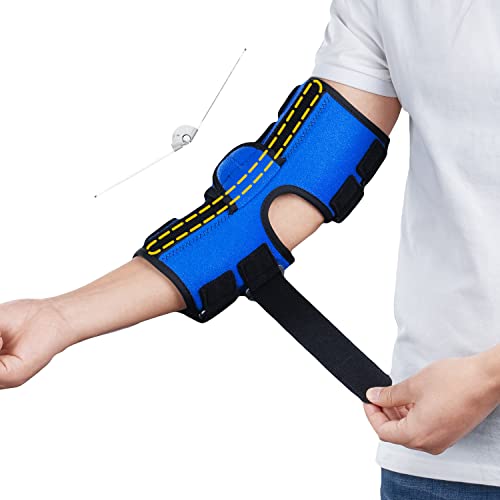
Set the angle with a screw, then forget it until you want a new position.
Four positions — 120°, 135°, 150° and 180° — give you finer steps than the three-angle braces. You pick one by seating a screw into the matching hole, which is a patented layout unique to this brace. Four hook-and-loop straps split across the upper and lower arm let you dial compression where you feel it.
Night mode leans on 150° and 180° to stop the elbow folding in your sleep; day mode uses 120°, 135° or 150° so you can still work. The inner foam and soft outer fabric make it wearable through a full day.
The trade-off sits in the mechanism. The screw can be awkward to line up one-handed, and if you over-tighten it, loosening the screw again may call for pliers. The metal bracket has to come out before washing, and reassembling the parts for a clean takes patience. A few owners also found the shell loosened at the straps over a couple of months of nightly use.
The appeal: four discrete, non-slip angle settings with no bar swapping — 120°, 135°, 150°, 180° — plus four straps for a fit you can tune per arm.
Set-up cost: the screw is fiddly to seat one-handed, and over-tightening it can mean pliers to undo.
Worth it when: you have been told to hold a specific angle and want more than three choices to hit it.
Better elsewhere if: you apply the brace yourself one-handed every night and want something that clicks on without fuss.
4. Sylong Adjustable Angle Stabilizer (L)

One bendable aluminum strip that sweeps from 90° to 180°, with your elbow left open.
Rather than fixed click stops, an aluminum strip inside this splint lets you bend it to any angle between 90° and 180°. You shape it once, then the strap holds it. The open cutout at the back of the elbow keeps direct pressure off the ulnar nerve — the reason people with cubital tunnel often reach for it over a fully closed sleeve.
Four hook-and-loop straps adjust one-handed, and the lining is soft foam under breathable cotton with a flannel-like face. At 0.11 kg it is the lightest brace here, so it disappears under a loose sleeve. Large arms are covered by the L size at 13.5–16 inches.
Here is the honest limit: a bendable bar resists bending one way, not straightening the other. Several owners found it stopped them folding the arm but did not stop it over-extending, and the same loose cutout that relieves nerve pressure lets the shell drift at night. Straps pulled very tight to compensate can leave fingertips numb.
The real benefit: an open elbow cutout plus any angle from 90° to 180°, in the lightest frame on this list at 0.11 kg.
Where it falls short: one direction of control only — it blocks bending but not straightening — and loose at night on smaller arms.
Suits you if: you want a light, discreet brace you can shape to one exact angle and slip under clothing.
Look past it if: you need the elbow held flat against over-straightening — a locked-angle splint does that job better.
5. Sylong 3-Support Elbow Brace (M)
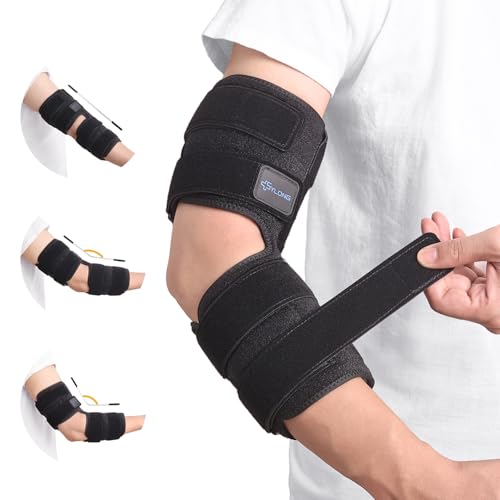
Three solid bars you swap by hand, sized all the way out to 18.5 inches.
Instead of a lever or a bendable strip, this brace ships with three independent metal supports — one each for 120°, 150° and 180°. You pull one out and seat another as your recovery stage changes. It is the widest size run here, with four options running from S at 8.5–11 inches up to 2XL/3XL at 16.1–18.5 inches.
Each bar locks the elbow at a set position, so there is no give once it is seated. Buyers credit the three fixed stability angles for why it works. One described it as putting the arm into “work mode, chill mode, or sleep mode.” A 5 mm thickness and four hook-and-loop straps (the reusable hook-and-loop fastening used on most braces) give it a substantial feel against the skin.
The mechanism has a cost. Inserting and removing the bars is a little tricky, and the brace can migrate down the arm overnight even with the straps cinched hard — when that happens you wake with the elbow bent anyway. Sizing also runs generous on the upper arm, so a slim arm may want the smaller option.
Sound construction: three non-bending steel supports at 120°, 150° and 180°, with the biggest size range on this list.
The catch: bar swapping is fiddly, and the shell can slide down the arm by morning on a loose fit.
Go for it if: you have a larger arm the standard sizes miss, or you want solid bars rather than a flexing strip.
Hold off if: you need to change angles quickly each day — swapping bars is not a one-handed, ten-second job.
6. BraceAbility Padded Cubital Tunnel Splint (Universal)

A foam elbow pad aimed at anyone who rests their arm on a desk all day.
Most cubital tunnel splints only stop the bend. This one adds an open-cell foam pad over the ulnar nerve, the spot that takes the pressure when you lean on a desk or armrest. You choose a thick stay for maximum support or a thin one for mild help, and you can pull both out for a light sleeve. It fits bicep circumferences up to 16 inches.
Unlike the fixed-angle braces above, this one is built to allow some movement, so the joint keeps some motion while you wear it. That makes it a reasonable daytime companion to a firmer night splint. It wipes down by hand once you remove the stays and air-dries flat.
The honest sticking point is security. Several owners found the hook-and-loop loosened or the stays slid free of their retaining flap over time, and the universal shape sits snug on a large arm. If you are a 6’1″ frame near the top of the range, plan on a careful fit check. As a light day-support sleeve, it does its job well.
What it adds over a plain splint
- Foam pad shields the ulnar nerve from desk and armrest pressure
- Thick and thin stays let you swap between more and less support
- Stays come out for a lightweight sleeve option
- Designed to keep some joint movement while you wear it
Where it can let you down
- Hook-and-loop can loosen and the stays can slide from the flap
- One universal size can run snug on a large bicep
- Not a locked-angle night splint — the elbow can still bend
Pick this for: daytime desk and computer work where your elbow rests on a hard surface.
Not for: overnight immobilization — you need a fixed-angle splint to stop the arm folding while you sleep.
7. BraceAbility Elbow Immobilizer (S/M)
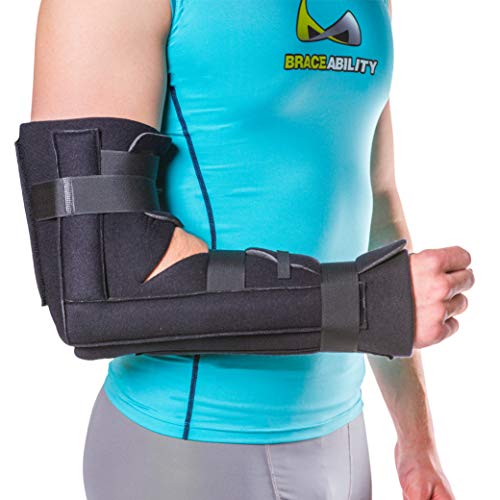
A soft long-arm cast that holds the joint at 90° and takes the load off completely.
This is the heavy-support end of the group. A soft long-arm cast with aluminum stays and a soft foam laminate locks the elbow at a 90° angle, the neutral position used for recovery after fractures and surgery. The removable elbow pad and stays let you soften it for sleep, and it covers hyperextension, nerve entrapment and cubital tunnel syndrome.
Quality is what carries it: the construction and support do the most talking across its reviews, and it holds its shape over months of use. It weighs 8.96 ounces, and the S/M size is the one to check carefully if you have a slim arm.
Expect bulk and warmth, because a wrapping cast covers most of the forearm. The S/M still fits loosely on a smaller frame, and a one-size shell can feel short on a longer arm. It is not a slim splint for light daytime desk work — it is what you wear when the joint needs to be held still.
Built to hold still: a fixed 90° lock with a removable pad and stays, in a soft long-arm cast that survives months of wear.
Bulk you accept: it runs warm in summer and loose on a slim arm, so check the size chart before ordering.
Right choice when: you are recovering from a fracture or surgery and need the elbow locked at 90° day and night.
Overkill for: light daytime support or a discreet splint you want to wear under a normal shirt sleeve.
Know the Specs
Angle Settings (Degrees)
The degree number tells you how bent the elbow is held. A larger number means a straighter arm: 180° is fully straight, 150° is slightly bent, and 120° is a firmer bend. Night braces usually favor 150° or 180° to stop the elbow folding during sleep, while daytime wear often uses 120° to 150° so you can still use your hand. Range-limited modes let the elbow move between two points instead of locking flat.
Bicep Circumference and Sizing
Sizing runs on the circumference around the widest part of your bicep, not your forearm. Measure with the arm bent at 90° and match it to the maker’s range. Too loose and the brace slides toward the wrist overnight; too tight and the straps dig in and can leave the hand puffy. When you sit between two sizes on a brace that runs generous, drop down a size.
Stays, Splints and Supports
The stay is the rigid piece — metal or plastic — that does the actual blocking. A fixed stay holds one angle; a bendable aluminum strip lets you shape the angle yourself; interchangeable stays let you swap the position by hand. Most stays pull out before washing, so remember which way it went in.
Lining and Breathability
Foam padding under a breathable fabric is what makes all-night wear possible. A smooth inner liner keeps the hook-and-loop off your skin and cuts down on itching. Breathability matters more than thickness for a brace you sleep in, since trapped heat is a common reason people pull a splint off mid-night.
Common Questions
Which angle should I set for sleeping with cubital tunnel syndrome?
Will an elbow brace for cubital tunnel fit my left arm and my right arm?
How do I measure my arm so the splint does not slide at night?
Can I wear a cubital tunnel splint during the day at work?
Does a bendable-stay brace stop my elbow from straightening too far?
How do I wash a foam-lined elbow splint?
Is a padded split better than a locked-angle splint for desk work?
Will a tighter strap give me more support?
How long should I wear the brace each day?
Can I sleep in a 90° elbow immobilizer brace?
The Bottom Line
The winner for a elbow brace for cubital tunnel syndrome is the Sylong Cubital Tunnel Syndrome Elbow Brace. One piece covers both jobs: a locked 150° or 180° for sleep, and a 120°–180° range for daytime work. If soft overnight fabric is your priority, the IMAK Brownmed RSI Elbow PM has the cotton lining and front stay that make a night splint easy to keep on. And if you are recovering from a fracture and need the elbow held at 90°, the BraceAbility Elbow Immobilizer is the one built for it.
How we choose
We do not accept paid placement. Every pick is matched to a real buyer and a real use-case; we do not hands-on test units.
Sources
Specifications: manufacturer listings and product documentation. Review insights: verified customer reviews, as of October 2026. Pricing: not shown on this page (it changes often); check the current price via the retailer link.
As an Amazon Associate, Aappliancez earns from qualifying purchases. This does not affect which products we feature.