Disclosure: Some links in this post are affiliate links. As an Amazon Associate I earn from qualifying purchases, at no extra cost to you. Learn more
Specs are compiled from manufacturer listings and verified buyer reviews and can change over time — please confirm the key details on the product page before buying.
You want a watch that records a heart rhythm strip on demand, and the Apple Watch Series 8 is the safest place to start. The Apple Watch Series 8 is the safest place to start: it has an ECG app (a feature that records your heart’s electrical signal) and a 4.5+ star rating from thousands of buyers. But the right EKG watch depends on your phone, your battery needs and your training load. Do you live inside the Apple ecosystem? Do you need multi-day battery? Are you training for a triathlon and want the ECG as a bonus rather than the main feature?
This guide is built by comparing the manufacturers’ published specifications and the patterns across verified customer reviews, so you get each pick’s real strengths and trade-offs instead of marketing spin.
Some watches here record an ECG and last two weeks; others record one and need a nightly charge. Below is the honest split between rhythm-strip contenders and fitness-first devices with a heart sensor bolted on. This breakdown of the ekg watch market separates the rhythm-strip contenders from the fitness-first devices with a heart sensor bolted on.
Top Picks


How To Choose The Best EKG Watch
Settle your phone first, because an ECG app lives inside an ecosystem. An ECG app lives inside an ecosystem, and a watch built for one platform will hold back features on another. Decide that first, then narrow by battery and case size.
Confirm the ECG actually runs on your phone
Apple’s ECG app needs an iPhone 8 or later running the latest iOS — that is stated plainly in the Series 8 spec sheet. Samsung’s Galaxy AI health features lean on a Samsung phone for analysis. Fitbit’s ECG app is listed for atrial fibrillation assessment, but buyers report the finger placement is fussy and results can come back inconclusive. Check the pairing requirement before you commit to a case design.
Read the battery number as a range, not a promise
Battery figures move a lot once the always-on display and GPS are live. Garmin quotes up to 16 days in smartwatch mode on the fēnix 8 and up to 15 days on the Forerunner 970. Samsung quotes 22 hours average on the Galaxy Watch 7. Neither number is a lie — they just describe different use. If you want overnight sleep and rhythm data, a multi-day battery is the feature that matters most.
Match the case to your wrist, not the spec sheet
A 41mm case suits a smaller wrist; a 47mm titanium chassis at 80g is a different animal entirely. The fēnix 8 weighs 80g, which you will feel by evening. The Apple Watch Series 8 in 41mm comes in at 1.48 ounces, and the Fitbit Sense 2 at 1.28 ounces — a real difference on a slim wrist over a full day.
Side-by-Side Comparison
| Model | Best For | ECG App | Battery Rating | Case / Weight | Amazon |
|---|---|---|---|---|---|
| Apple Watch Series 8 [GPS 41mm]★ Best Overall | Everyday health on iPhone | Yes | All-day, nightly charge | 41mm / 1.48 oz | Amazon |
| Fitbit Sense 2Best for Stress Tracking | Stress and sleep focus | Yes | 6+ day battery (maker claim) | — / 1.28 oz | Amazon |
| Samsung Galaxy Watch 7 40mmBest for Galaxy Phones | Galaxy phone owners | Yes | 22 hours average | 40mm / — | Amazon |
| Withings ScanWatch Light | Analog looks, weeks of power | — | 30-day battery life | — / — | Amazon |
| Withings ScanWatch Nova | Dress-watch ECG | Yes | 30 days | — / — | Amazon |
| Polar Sport Watch | Multisport training | — | Up to 8 days | — / — | Amazon |
| Garmin Forerunner 970 | Runners and triathletes | Yes | Up to 15 days | 47mm / — | Amazon |
| Apple Watch Series 10 46mm | iPhone users wanting the newest | Yes | Daily charge | 46mm / — | Amazon |
| Garmin fēnix 8 Sapphire 47mm | Adventure and expedition use | Yes | Up to 16 days | 47mm / 80g | Amazon |
Detailed Reviews
1. Apple Watch Series 8 41mm
Our pick — 4.5+★ from 9,500+ verified ratings; the strongest balance of quality and price.
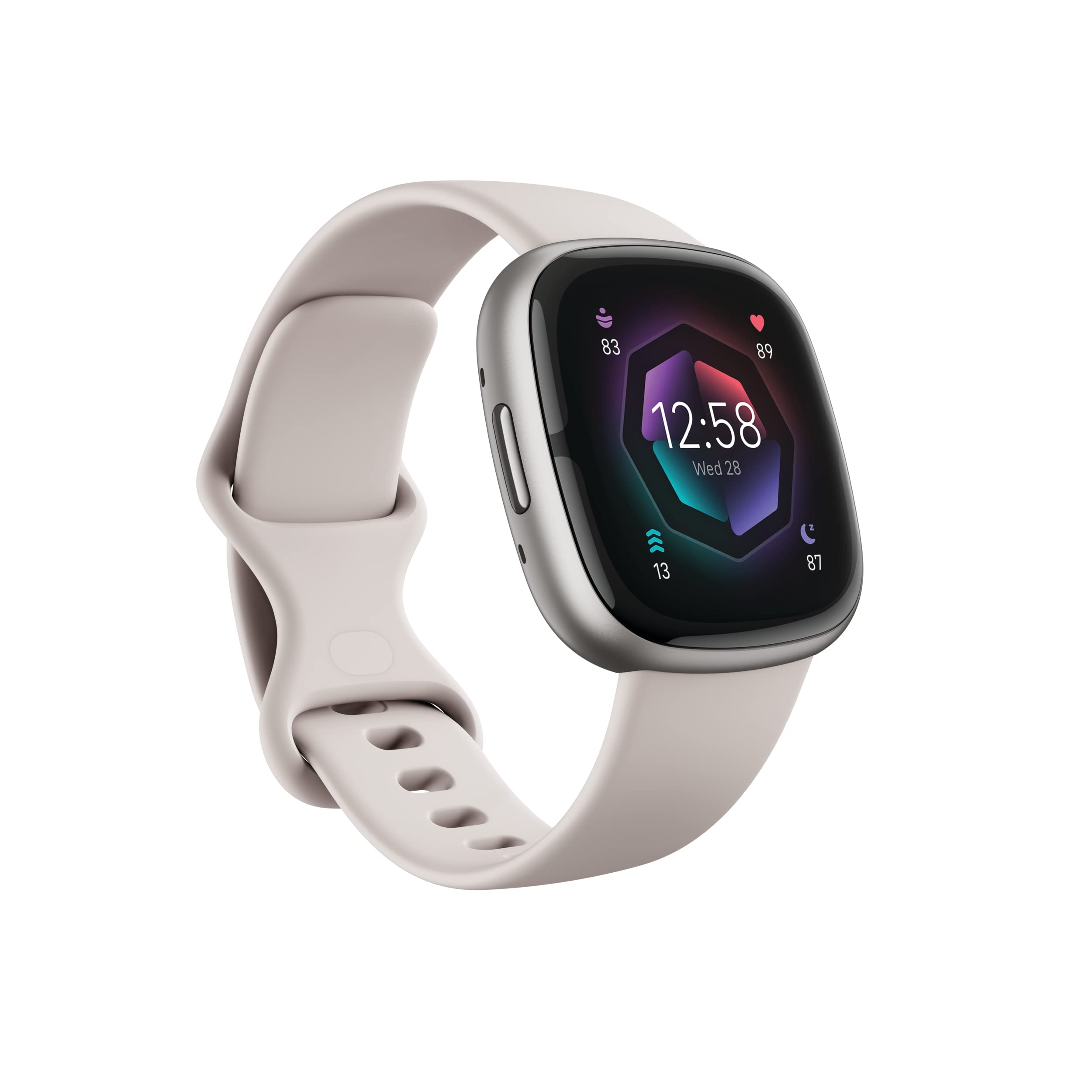
The 41mm case that keeps a full ECG app on a wrist small enough to forget about.
Start with the size. A 41mm case is the version to look at if you have a slim wrist, and the aluminium body comes in at 1.48 ounces — light enough that you stop noticing it by mid-morning. The always-on Retina display stays readable with your wrist down, so a glance at your heart rate during a meeting does not require a wrist-raise.
The health side is where this earns its place. You can take an ECG anytime, get a notification if your rhythm looks irregular, and the blood oxygen sensor runs in the background. Temperature sensing feeds into women’s health insights, and Sleep Stages breaks your night into REM, Core and Deep. For a home where someone lives alone, the safety layer is the quiet selling point: Fall Detection and Crash Detection can reach emergency services, and Emergency SOS works from a button press. Owners mention the watch “increases the safety of someone living alone” — the same reason it keeps showing up as a gift for parents.
Here is the catch, and it is the one that shows up in the review pages again and again. Customers note the battery “had to charge it every other day now almost every day.” Heavy GPS and workout use drains it faster, and a full day of training will not leave much in the tank. If you want to wear it overnight for sleep data, you will be charging it at your desk instead.
What holds up in daily wear
- ECG app records a rhythm strip on demand, with irregular-rhythm notifications built in
- IP6X dust rating plus WR50 water resistance means showers and light swimming are fine
- Fall Detection, Crash Detection and Emergency SOS all run without a subscription
- The 41mm case suits smaller wrists without looking like a gadget strapped on
Where it asks for patience
- Battery needs a nightly or every-other-night charge, and GPS sessions shorten it further
- Requires an iPhone 8 or later on the latest iOS — no Android pairing
- The charging cable uses a smaller USB-C end that will not fit a standard USB-A wall cube without an adapter
Go with this if: you carry an iPhone and want the ECG, the safety alerts and the sleep breakdown in one familiar package.
Think twice if: you want to sleep in it every night without a charger nearby — the daily top-up is the honest tax here.
2. Fitbit Sense 2
At 1.28 ounces, the lightest watch here — and the one built around stress, not just steps.
The Sense 2 goes after a different problem than the Apple Watch. All-day stress detection uses a cEDA sensor (a skin-conductance sensor that reads sweat response) to build a daily Stress Management Score, and the ECG app is listed for atrial fibrillation assessment alongside irregular heart rhythm notifications and SpO2. There is a Daily Readiness Score in the mix too, plus a health metrics dashboard. If your reason for wanting an EKG watch is a stressful month rather than a marathon, this is the one built for that.
Physical comparison puts it in perspective: 1.28 ounces against the Apple Watch Series 8 at 1.48 ounces, and 1.57 x 0.47 x 1.57 inches against 1.61 x 1.61 x 1.61 inches. It is the slimmer, lighter piece of hardware, and it wears accordingly. The maker lists a 6+ day battery, and the built-in GPS covers workout mapping without your phone.
The ECG is the sore point. Reviewers point out the finger placement is tricky and results often come back inconclusive, and viewing the ECG graph is harder than it should be. Battery is the other split: some owners see multi-day stretches, while others report it dropping to 20% in around twelve hours with sensors running full-tilt. That is a wide spread, so treat the 6+ day figure as a ceiling, not a floor.
What wins people over: the stress and sleep picture. Daily Sleep Stages (a breakdown of your night’s sleep), a Sleep Score (a number rating your sleep quality), a smart wake alarm (wakes you at the best point in your sleep cycle) and a do-not-disturb mode all work together. The readiness rating gives you a reason to take a rest day that is based on something other than feeling tired.
The honest trade-off: an ECG that takes practice to get a clean reading. If rhythm review is your main goal, a watch with a simpler capture step will frustrate you less.
Reach for this if: stress and sleep are what you want to understand, and you like the idea of a watch that weighs 1.28 ounces.
Look elsewhere if: you need a dependable, easy-to-read ECG strip on the first try.
3. Samsung Galaxy Watch 7 40mm Bluetooth AI Smartwatch
The 40mm Galaxy that turns yesterday’s effort into today’s Energy Score.
Samsung’s angle is less about the strip and more about the interpretation. An Energy Score with Galaxy AI reads what you did yesterday and tells you how ready you are today, while Wellness Tips turns that into suggestions analyzed on your phone. Heart Rate Tracking is filtered to screen out body movement, and sleep tracking goes as far as detecting moderate to severe sleep apnea. The 40mm case in green keeps it a normal-sized watch rather than a wrist computer.
The list of features buyers mention most is telling — the look of the thing comes up far more than any single sensor. That tracks with what you see: the green band and clean case are the reasons people pick it over a plainer fitness band. Accuracy lands next, with step, heart rate, workout and sleep tracking all called out as dependable.
The battery is where the Galaxy Watch 7 makes you choose. Samsung lists 22 hours average life from a 300 battery cell, and shoppers say needing a charge roughly every two days. Fast charging softens it — about two hours to full — but this is not a watch you take on a weekend trip and forget about. With a Galaxy phone, pairing is the smoothest path to a working ECG; without one, look at the Apple or Garmin options first.
The right call for: Galaxy phone owners who want their watch to explain their recovery, not just log it.
The catch to accept: a 22-hour average battery rating means a charger is part of your daily routine.
4. Withings ScanWatch Light – Hybrid Smartwatch

A real watch face with hands, and a battery measured in weeks rather than hours.
Most people who buy the ScanWatch Light are not shopping for a screen. They want a watch that looks like a watch and quietly tracks heart rate, activity, sleep and cycle data in the background. The case is stainless steel, the band is fluoroelastomer, and the battery is listed at a 30-day life — the single figure that sells this watch to anyone tired of a nightly charging ritual.
Note one caveat up front: this is the hybrid of the group, so the ECG app is not part of its feature list. What it does offer is 24/7 heart monitoring, connected GPS through your phone, and sleep and cycle tracking. Buyers looking for rhythm strips should step up to the Nova below; buyers who want the analog look and a charging cable that stays in a drawer for a month are exactly who this is for.
The step counter is the honest weakness. Several owners describe it undercounting badly compared to a phone or a Fitbit, and the workout app has a quirk — you have to launch the workout from the watch, or it will not register. The appearance, by contrast, gets consistent praise; this is a watch people compliment before they realize it tracks anything.
The case for the classic face
- 30-day battery life means you can travel without packing a charger
- Stainless steel case and a real analog dial sit comfortably in a business setting
- 24/7 heart monitoring, sleep tracking and cycle tracking run in the background
- FSA and HSA eligible, which matters if you are paying with a health account
What to know before you wear it
- No ECG app — this is a heart-rate tracker, not a rhythm recorder
- Step counting runs low against dedicated fitness trackers, by several owners’ accounts
- Workouts must be started on the watch itself, not from the app
Suits you when: you want heart and sleep data without a glowing rectangle on your wrist or a charger on your nightstand.
Not for you when: a printable rhythm strip is the whole point of the purchase.
5. Withings ScanWatch Nova Brilliant Health Smart Watch

ECG, SpO2 and body temperature in a stainless case nobody will mistake for a smartwatch.
The Nova is the hybrid formula with the health hardware turned all the way up. You get an ECG, on-demand SpO2 with overnight breathing tracking, and the TempTech24/7 module that logs a baseline body temperature and the fluctuations around it. Overnight heart rate variability is tracked too, alongside a Sleep Quality Score and a VO2 max fitness estimate across 40+ auto-recognized activities. The battery is listed at 30 days, with a 2-hour charge time on a 0.19 amp-hour cell.
The design is the point. Stainless steel case, stainless band, a deployant clasp, and a face that reads as a dress watch. The one review quoted verbatim on the listing puts it well: “Watch looks classy! Does not look like a plastic toy like most smartwatches.” That matters if you want your health tracking to stay private in a meeting room.
Because the Nova is newer to the market, its review base is thin — treat that as caution, not a red flag. The feature set is the most complete of the hybrid pair, including the temperature tracking that the Light model leaves out. If body temperature trends are something you want to watch over the long term, this is the watch that logs them.
The standout sensor: TempTech24/7 body temperature tracking, which puts a temperature trend line on your wrist alongside the ECG and SpO2 readings.
Worth knowing: this is a premium-priced hybrid with a small review base behind it. The hardware is complete; the track record is young.
Pick this one if: a stainless watch that records an ECG and a temperature trend, while lasting a month between charges, is exactly what you have been trying to find.
Hold off if: you want a large body of long-term owner experience before committing to a premium price.
6. POLAR Sport Watch

A training watch that maps the trail, then survives the week without a charger.
Polar’s pitch here is about the long run, literally. Dual-frequency GPS paired with downloadable offline maps means you can follow a contour line without a phone signal, and the AMOLED touchscreen is sized to show multiple metrics at once. The 488 milliamp-hour battery is rated at up to 140 hours of training time and up to 8 days of regular use, so a multi-day event does not end with a dead wrist. Over 150 sports modes cover everything from a gym session to a triathlon block.
Buyers who train regularly tend to hit the same high notes: the display is bright, the GPS accuracy holds up, and the analytics in the app are more useful than expected. One runner in the review pages does 90-minute sessions four to five times a week and still calls the battery life “wonderful.”
The recurring complaint is the charger. The connection needs careful cleaning and monitoring, and if the battery dies completely, settings can reset and require a full setup again. Quality feedback is mixed overall. That is the honest picture: Polar’s training tools are respected; the charging hardware is the part that needs care.
Best matched to: trail runners and triathletes who want offline maps and a battery measured in days.
Set expectations if: you expect to set it on a charger and forget it — the charging contact needs attention.
7. Garmin Forerunner® 970, 47mm, Carbon Gray DLC Titanium

Up to 15 days in smartwatch mode, a titanium bezel and an ECG app — the runner’s answer.
Garmin’s Forerunner 970 puts a 47mm titanium-bezel case with a sapphire lens on your wrist and pairs it with an ECG app that records your heart rhythm and checks for signs of atrial fibrillation. Battery is the number that matters: up to 15 days in smartwatch mode and up to 26 hours in GPS mode from a 560 milliamp-hour cell. That is the opposite of the Apple Watch trade-off — you can wear this overnight for sleep and HRV data without planning your evening around a charger.
The training side is deep. Running economy, step speed loss and running tolerance all feed into a Training Readiness score built on sleep quality, recovery, training load and HRV status. Full-color built-in maps and multi-band GPS handle the routing, and multisport auto-transition detects the change between swim, bike and run so you do not have to touch a button mid-race. There is even a built-in LED flashlight for early runs.
What wins people over is the build and the display — the design draws far more praise than any feature. The trade-off is a learning curve that triathletes accept and casual buyers may not. If you have used a Garmin before, you will be at home in a day. If you have only used an Apple Watch, budget a weekend to find your way around.
Why triathletes keep this on
- Up to 15 days smartwatch battery and 26 hours in GPS mode
- ECG app plus full-color maps and multi-band GPS accuracy
- Sapphire lens and titanium bezel hold up to daily abuse
- Multisport auto-transition records each leg without manual splits
Where it will test your patience
- The button-and-touch menu system takes real time to learn
- The most advanced running metrics need a separate HRM 600 monitor
This one is for: runners and triathletes who want the ECG without losing two-week battery life.
Skip the weekend-read of the manual at your peril: the depth is the product, and the menus reward the time you put in.
8. Apple Watch Series 10 46mm

A 46mm titanium case that adds cellular, a bigger display and the newest Apple sensor set.
The Series 10 spends its upgrade budget where you notice it. The display is up to 30 percent larger in screen area, in a thinner and lighter body, in a gold titanium case with a Milanese loop band. Advanced health features cover ECG, high and low heart rate notifications, irregular rhythm notifications, cycle tracking with retrospective ovulation estimates, and a Vitals app that pulls overnight metrics. There is also sleep apnea detection on board, and cellular lets you call, text and stream without your iPhone in the room.
Charging is the practical improvement. The spec sheet lists 80 percent battery in about 30 minutes, so a morning shower is enough to keep it alive for the day. That and the bigger display are the two reasons to pick this over the Series 8 at a higher outlay.
The honest limit is the maturity of the listing itself. The review volume for this specific cellular-configuration watch is thin, so there is less long-term owner experience to draw on. The experience the platform offers is well established; the config is new. That is a reason to read the spec sheet carefully rather than a reason to avoid it.
The screen and the charging: up to 30 percent more screen area than before, and 80 percent battery in about 30 minutes — the two upgrades you will feel every day.
The honest note: daily charging is still part of the routine, and this cellular configuration is a newer addition with a smaller track record.
The choice for: iPhone users who want the newest display, the newest sensors and cellular freedom in one watch.
Weigh the trade-off: nightly charging stays in the routine, and this specific titanium cellular configuration is still building long-term owner history.
9. Garmin fēnix 8 47mm

A 40-meter dive-rated titanium watch that will still be running when you get home.
This is the expedition tool. A 1.4-inch AMOLED display behind a scratch-resistant sapphire lens, a titanium bezel, a built-in LED flashlight, and a 40-meter dive rating with leakproof metal buttons. Battery is rated at up to 16 days in smartwatch mode and up to 47 hours in GPS mode. It weighs 80g, which is the price you pay for the build.
The sensor suite is complete for the category: wrist-based heart rate, advanced sleep monitoring, respiration tracking, Pulse Ox and an ECG app that records your rhythm and checks for signs of atrial fibrillation. Multi-band GPS with SatIQ, a 3-axis compass, gyroscope and barometric altimeter cover navigation, and dynamic round-trip routing adjusts your route to get you back on schedule.
What wins people over is the watch itself — the build and the battery are the reasons it stays on the wrist. The sticking point is the cost, and that is fair. If you need the dive rating, the sapphire and the off-grid voice commands, it earns its keep. If you mostly run in a city park, the Forerunner 970 above gives you the same brand of battery life without the expedition premium.
The right buy for: divers, hikers and multi-day athletes who need a watch they can drop, soak and rely on for two weeks.
Question the purchase if: your training stays on pavement and the 40-meter dive rating will never once be used.
Know the Specs
What an ECG app actually records
The ECG app records an electrical signal of your heart rhythm and flags signs of an irregular rhythm — typically when you rest a finger on the crown or side button. It is not a continuous monitor and it is not a replacement for a clinical test; it is a snapshot. Wearables carry disclaimers for a reason, and the best use of one is a record to bring to your doctor, not a diagnosis in your head. The capture step matters: a clean, still reading needs dry skin and a steady hand.
Why the battery number varies so much
Listed battery life assumes the display is dimming when possible and GPS is off. Add the always-on display and a GPS workout and the number drops sharply. That is why a watch rated at 22 hours average and one rated at up to 16 days can both be accurate. If you plan to wear it overnight for sleep and rhythm data, pick the device whose realistic number survives a full training day.
Case size and weight in the real world
A 41mm case at 1.48 ounces is nearly forgotten by dinner. A 47mm case at 80g is a conscious presence on the arm. Neither is wrong — it is fit. Small wrists and slim builds do better with 40mm or 41mm, and anyone who sleeps in a watch should weigh that decision carefully because the strap will press against your wrist for hours.
The phone your watch lives with
Every pick here has a preferred platform. Apple’s watches pair with an iPhone 8 or later on the latest iOS. Samsung’s Galaxy AI health features are richest with a Galaxy phone nearby. Garmin, Polar and Withings run with both iOS and Android. Choose the watch that matches the phone in your pocket before you compare sensor lists.
Common Questions
Does an EKG watch replace a doctor’s ECG test?
Will an Apple Watch ECG app work with an Android phone?
How long does the battery actually last if I wear the watch overnight?
Can the ECG app read through a case or screen protector?
What is the difference between heart rate tracking and an ECG reading?
Is a hybrid watch like the ScanWatch Light good enough for health tracking?
How much water resistance do I need for swimming?
Do I need a separate chest strap to get accurate heart rate data?
Does an ECG watch work if I live alone?
Can I use an EKG watch with an HSA or FSA account?
The Bottom Line
For most buyers, the ekg watch that wins is the Apple Watch Series 8 [GPS 41mm]. It puts the ECG app, irregular rhythm alerts, Fall Detection and Emergency SOS on a 41mm case that suits smaller wrists, and it earns its keep as the everyday pick for anyone with an iPhone. If you want the newest screen, the newest sensors and cellular freedom, reach for the Apple Watch Series 10. And for a triathlon on the calendar, the Garmin Forerunner 970 is the watch to wear — it gives you an ECG app and up to 15 days of battery life in one package. The Apple pick had the deepest owner base in this set, and that experience is part of the product’s case.
How we choose
We do not accept paid placement. Every pick is matched to a real buyer and a real use-case; we do not hands-on test units.
Sources
Specifications: manufacturer listings and product documentation. Review insights: verified customer reviews, as of October 2026. Pricing: not shown on this page (it changes often); check the current price via the retailer link.
As an Amazon Associate, Aappliancez earns from qualifying purchases. This does not affect which products we feature.