Disclosure: Some links in this post are affiliate links. As an Amazon Associate I earn from qualifying purchases, at no extra cost to you. Learn more
Specs are compiled from manufacturer listings and verified buyer reviews and can change over time — please confirm the key details on the product page before buying.
Winter is where most electric bikes quietly give up. Standard tires skate on packed snow, cold air drains a battery faster than the display admits, and a rear-hub motor spins uselessly on ice. The bikes that actually work in the cold share three things: fat tires with real tread, a battery you can carry indoors to charge, and enough torque to pull through slush instead of stalling in it. That is exactly what this list filters for.
This guide is built by comparing the manufacturers’ published specifications and the patterns across verified customer reviews, so you get each pick’s real strengths and trade-offs instead of marketing spin.
You will see the cold-weather essentials explained in plain words, a side-by-side table, and honest notes on what each bike does well and where it asks for patience. Every winter rider’s shortlist should start with the specs that survive a frozen morning, and this breakdown of the best ebike for winter covers them one by one.
Top Picks

How To Choose The Best Ebike for Winter
The cold changes the rules. A bike that feels brilliant on a dry July commute can feel sketchy the moment the pavement turns to slush, so the buying checklist shifts toward traction, torque delivery and how you handle the battery.
Tire width and tread decide whether you stay upright
Fat tires are the whole game in winter. A 20-inch by 4-inch tire and a 26-inch by 4-inch tire both put a wide, flat contact patch on the ground, which is what lets you roll over packed snow instead of cutting into it. Wider rubber also floats on sand and slush rather than sinking. Look for a tire described as all-terrain or puncture-proof if you plan to ride through debris-strewn winter streets.
Torque and motor layout beat top speed
You will rarely touch a bike’s top speed in February. What you will use is low-end pull — the force that gets you moving from a stop on a slick surface. A torque figure in newton-metres (N·m, a measure of twisting force at the wheel) tells you more about winter capability than a speed number. Dual-motor bikes split that force between front and rear wheels, which helps when one wheel loses grip, and single-motor mode lets you save battery on flat, cleared roads.
Treat the battery as a cold-weather item
Lithium batteries lose usable capacity when they sit in freezing air, so a removable pack you can carry inside is a genuine winter feature, not a convenience. Charging indoors at room temperature keeps the cells healthier and means you start each ride with a full, warm battery. Check the charging time too — a pack that takes 10 to 12 hours to fill needs to go on the charger the night before.
Brakes and lighting are not optional in the dark
Winter commutes happen in low light. Hydraulic disc brakes use fluid pressure for a firmer, more consistent squeeze than mechanical cable brakes, and they hold up better when the rotors are wet. A headlight, a brake-activated taillight and turn signals all matter when visibility drops. Certification marks like UL2849 and UL2271 are worth checking as well — those are independent electrical and battery safety standards.
Side-by-Side Comparison
| Model | Best For | Claimed Range | Top Speed | Motor / Battery | Amazon |
|---|---|---|---|---|---|
| FREESKY Dual Motor 26″ Fat Tire★ Best Overall | All-round winter riding | 105 miles | 34 MPH | 4000W peak / 48V 25Ah | Amazon |
| TST 20″ Fat Tire All-TerrainBest For Snow | Snow and sand grip | 60 miles | 28 mph | 1500W peak / 48V 15Ah | Amazon |
| Gotrax R7 20″Best Value | Budget commuting | 50 miles | 25Mph | 750W peak / 48V 10.4Ah | Amazon |
| Aipas M1 Pro 26 x 4 | Step-thru accessibility | 85 miles | — | 1800W peak / 48V 17.5Ah | Amazon |
| EVBYCKEV 60V 30Ah Dual Motor | Wet and snowy weather | 105 miles | 48MPH | 9000W peak / 60V 30Ah | Amazon |
| HiKNiGHT 24″ Fat Tire Dual Motor | Adjustable fit | 90 miles | 40MPH | 4000W peak / 52V 20Ah | Amazon |
| Aipas M2 Pro 1800W | Long-range touring | 85 miles | — | 1800W peak / 48V 17.5Ah | Amazon |
| PUJH 9000W 50MPH Dual Motor | Deep snow and trails | 35–110 miles | 50 MPH | 9000W peak / 60V 20Ah | Amazon |
| CTVVXXC 9000W 52V 34Ah | Cold-temperature riding | 105 miles | 45MPH | 9000W peak / 52V 34Ah | Amazon |
| LPQVIATAS 58V 34Ah Dual Motor | Uphill traction | 90–105 miles | 48MPH | 9000W peak / 58V 34Ah | Amazon |
| PHILODO Falcon 60V | Hunting and off-grid | 100 miles | Class 3 | Dual motor / 60V 32Ah | Amazon |
| eAhora Romeo Pro 3 | Maximum range | 300 miles | 52MPH | 6000W / 60V 80Ah | Amazon |
Detailed Reviews
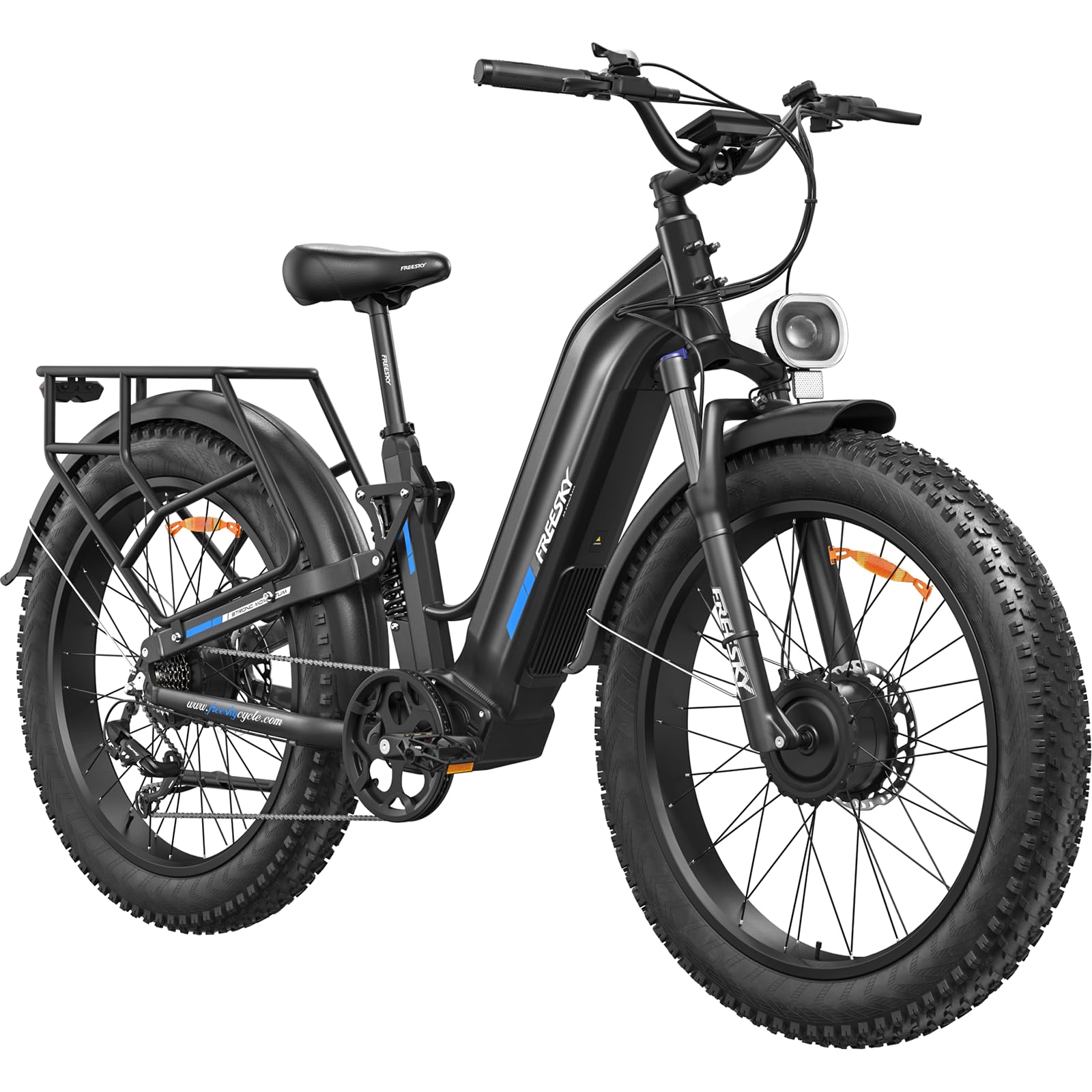
1. FREESKY Dual Motor Electric Bike
Our pick — 4.5+★ from 150+ verified ratings; the strongest balance of quality and price.
Two motors, a pack you can carry inside, and rubber wide enough to float over slush.
This is the winter bike for the rider who wants one machine to cover a snowy commute and a trail ride on the same weekend. The headline is range: the 48V 25Ah battery is rated for up to 105 miles on a charge, which is enough for a week of commuting without touching an outlet. For comparison, the Gotrax R7 further down the list is rated at 50 miles from a 48V 10.4Ah pack — less than half the capacity story.
Where it earns its winter stripes is the drivetrain. Two motors deliver 4000W of peak power (2000W at the front wheel, 2000W at the rear) and 210N·m of combined torque, a measure of twisting pull at the wheel. That torque is what hauls you out of a slushy rut instead of spinning in it. You can also drop to single-motor mode on cleared pavement to stretch the battery, then switch back to dual drive the moment the road turns white. Top speed is a claimed 34 MPH, well above the Gotrax R7’s 25Mph.
The step-thru frame fits riders from 5’4″ to 6’8″, so sharing the bike with a taller partner is realistic. Hydraulic suspension and the fat tires soak up the chatter of frozen pavement on your wrists and back. The battery detaches and charges on a 3A charger indoors — exactly the winter habit that keeps a cold pack from sagging. It is also certified to UL2849 and UL2271 by TÜV, independent electrical and battery safety standards, and rated for a 400 lbs payload. The trade-off is heft: one verified owner describes a “HEAVY bike — but great power and speed,” which is the honest bargain here. Another notes a button concern while still logging about 20 miles at 28 mph on both motors with roughly 45 percent battery left at a 310 lbs rider weight.
What wins people over
- 105-mile claimed range on a 48V 25Ah removable pack that charges indoors
- 4000W dual-motor peak with 210N·m torque for pulling through snow and up 40° grades
- UL2849 and UL2271 certification by TÜV for electrical and battery safety
- Step-thru frame sized 5’4″ to 6’8″ with full suspension and 26″ fat tires
What to plan around
- It is a genuinely heavy bike to lift onto a rack or up stairs
- The manual and display labels do not always match, so plan a learning session on the PAS modes
Top of the list: the winter rider who wants dual-motor traction, indoor battery charging and a frame that fits the whole household.
Look elsewhere if: you need to carry the bike up a flight of stairs every day.
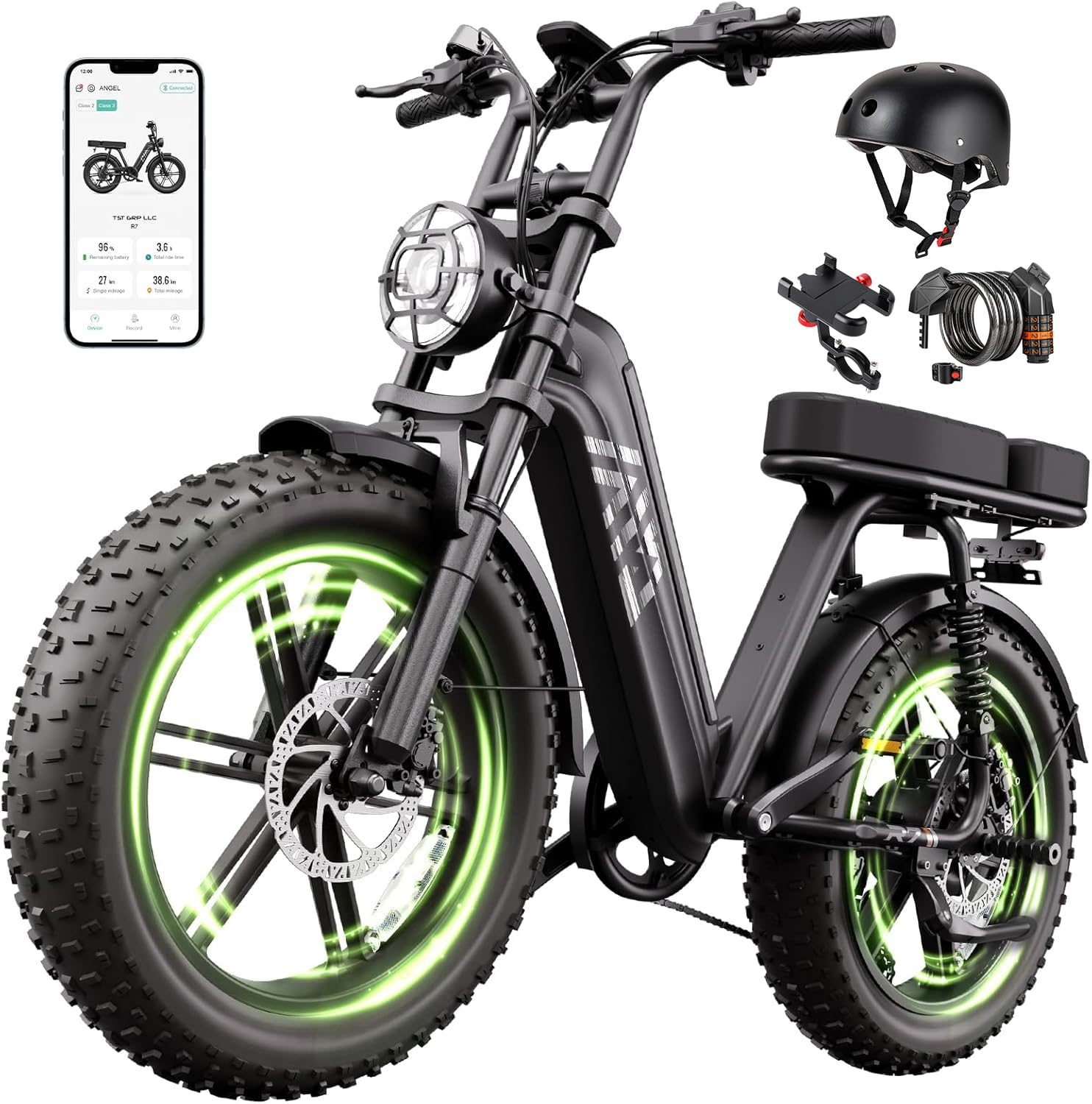
2. TST Electric Bike
Smaller wheels, wider contact patch, and a motor tuned for loose ground rather than highway speed.
The TST is built around a simple idea: put as much rubber on the ground as possible and let torque do the rest. Its 20 x 4.0-inch tires are described as puncture-proof and wide, designed to grip on sand, mountains or snow. Power comes from a 1500W peak motor with 90N.M of torque, which climbs a 35-degree slope. For scale, the FREESKY above delivers 4000W of peak power — a big gap — but the TST’s lighter frame and shorter wheelbase make it feel more planted on tight, slick paths.
The cold-weather detail that matters most is the battery routine. The 48V 15Ah pack is removable and waterproof, charges two different ways, and takes about 5 hours to fill. That is a far quicker turnaround than the PHILODO Falcon’s 10 to 12 hour recharge, which means you can run a morning ride, charge over lunch, and go again before the light dies. Claimed range is more than 60 miles per charge, and the app lets you set the top speed up to 28 mph.
You stay visible on a dark, wet commute thanks to a 360° LED setup (lights all the way around the bike) with headlight, brake light and turn signals. Dual mechanical disc brakes (cable-pulled brakes that clamp the wheel) bring you to a stop. An extended seat with an integrated rear rack makes it easy to strap down winter gear. The honest catch is build consistency from the start: a small number of units have arrived with a leaking rear brake. Check the brakes before the first ride, and use the 6-month warranty if a lever feels soft. It is still a capable snow bike — just treat the unboxing as a proper inspection.
The snow-first read: a 35-degree climb rating and 20 x 4.0 puncture-proof tires make this a natural pick for riders whose winter route is more trail than tarmac.
Do this on arrival: squeeze both brake levers and spin the rear wheel before your first ride — the 6-month warranty exists for exactly these early catches.
Reach for this if: your winter riding is short, snowy and off the main road.
Think twice if: you want a bike that arrives perfectly dialed in with zero brake-checking.
3. Gotrax R7 20″ Electric Bike for Adult, 750W Peak Motor
The entry ticket to fat-tire winter riding, with a battery you can lock and carry.
Not every winter rider needs 4000W. If your route is a cleared city street with the occasional icy patch, the Gotrax R7 covers it with a 48V 750W brushless motor that tops out at 25Mph. The UL-certified 48V 10.4Ah battery is removable, has a key-activated lock for security, and is rated for up to 50 miles per charge. Compare that with the FREESKY’s 105-mile claim and you see the trade-off plainly: half the pack, half the range, but a much lighter, simpler machine.
The winter hardware is genuinely thoughtful for a value pick. The 20″ x 4″ inflatable fat tires are rated for sand, snow, trails and city streets, and a front suspension fork takes the sting out of frozen ruts. There are 5 levels of pedal assist plus a 7-speed gear system, so you can drop to a low gear and a high assist level when the road gets slick and keep your cadence steady. Stopping comes from 180mm disc brakes, and there are front and rear lights plus pedal reflectors for the dark ride home. The frame carries 264 lbs.
Assembly is 90% done from the start, and it is UL2849 certified for electrical and battery safety. The recurring gripe is small and easy to live with: there is no ignition, just a button, and the warranty process has drawn frustration from at least one buyer whose bike arrived damaged. Treat the delivery as a moment to photograph the box before you sign, and the rest of ownership stays simple. At 4.0+ stars across 20+ ratings it has the thinnest review base here, which is why it sits mid-list rather than at the top.
The value case: you get fat tires (wide, low-pressure tires that grip loose ground), disc brakes, lights and a lockable removable battery in among the most affordable packages on this list.
The honest limit: 750W peak and a 10.4Ah pack mean you will feel hills more than on the dual-motor bikes.
Best for: a first winter ebike where the route stays mostly on cleared streets.
Not for: riders who want dual-motor grunt or a keyed ignition.
4. Aipas M1 Pro Electric Bike for Adults, 26 x 4 Fat Tires
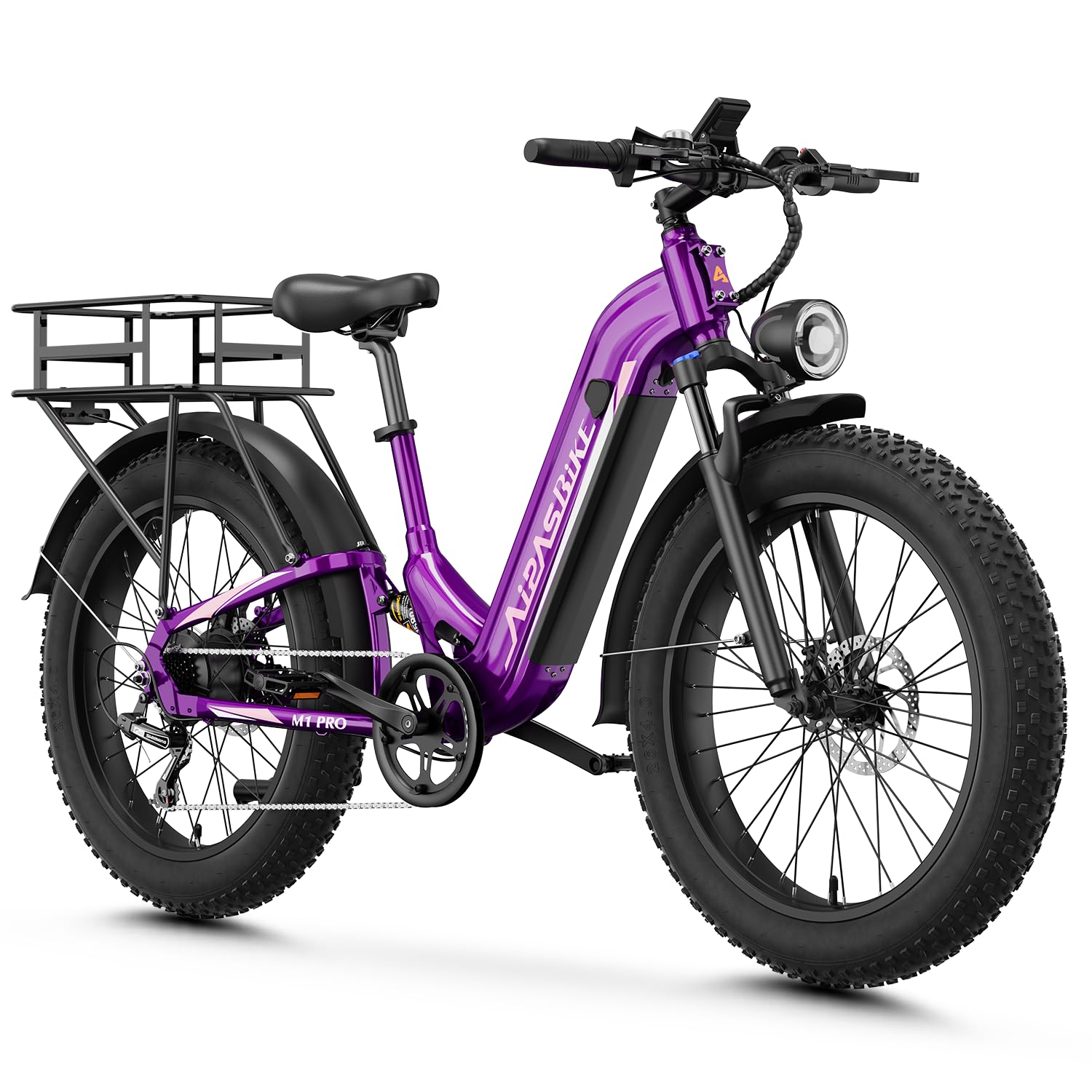
A step-through frame for anyone who does not want to swing a leg over a snow-caked saddle.
Winter layers make mounting a tall top tube genuinely awkward. The M1 Pro solves that with a step-through frame and a height-adjustable seat, sized for riders from 5’5″ to 7’2″. Behind the easy access sits an 1800W peak rear-hub motor with 110Nm of torque that climbs grades up to 23°. The 26 x 4-inch fat tires are the same winter-friendly width class as the FREESKY, and full suspension — a 100mm front fork plus a rear shock — softens frozen pavement on your back and shoulders.
The battery is the part that sells itself for cold riding. The 48V 17.5Ah pack is removable, charges on or off the bike in about 4-6 hours, and is rated for up to 85 miles of pedal-assist range. It is SGS certified to ANSI/CAN/UL 2271, an independent safety standard for battery systems. Riders report genuine satisfaction with the build: one logged 135 miles in five days, and another got 35 miles on PAS 1-2 with the battery still showing full bars. Braking is handled by dual 180mm mechanical disc brakes with metal pads, and there is a front headlight, brake-activated rear light and horn for low-light visibility.
Two things to weigh honestly. First, this is an 88 lb bike with a 500 lb max load — heavy enough that you should plan where it lives. Second, tire punctures come up: the 26 x 4 tires have flatted for at least one rider on desert terrain, which is a reminder to carry a spare tube and sealant through thorn season. Neither undoes the core appeal of a step-thru, full-suspension fat bike with a certified removable battery.
Why the step-thru matters
- Step-through frame plus height-adjustable seat, sized 5’5″ to 7’2″
- 48V 17.5Ah removable battery, 4-6 hour charge, up to 85 miles of assist
- Full suspension: 100mm front fork and rear shock
- SGS certified to ANSI/CAN/UL 2271 for battery safety
Where it asks for patience
- 88 lb net weight is a lot to move around a garage
- Fat tires can flat on thorns and rough ground — carry a spare tube
Made for: riders with limited mobility, shorter inseams, or anyone hauling winter layers who wants a frame they can step through.
Consider the alternative if: you want the lightest possible bike to lift.
5. EVBYCKEV 60V 30Ah Ebike, 9000W Peak Dual Motor, 48MPH
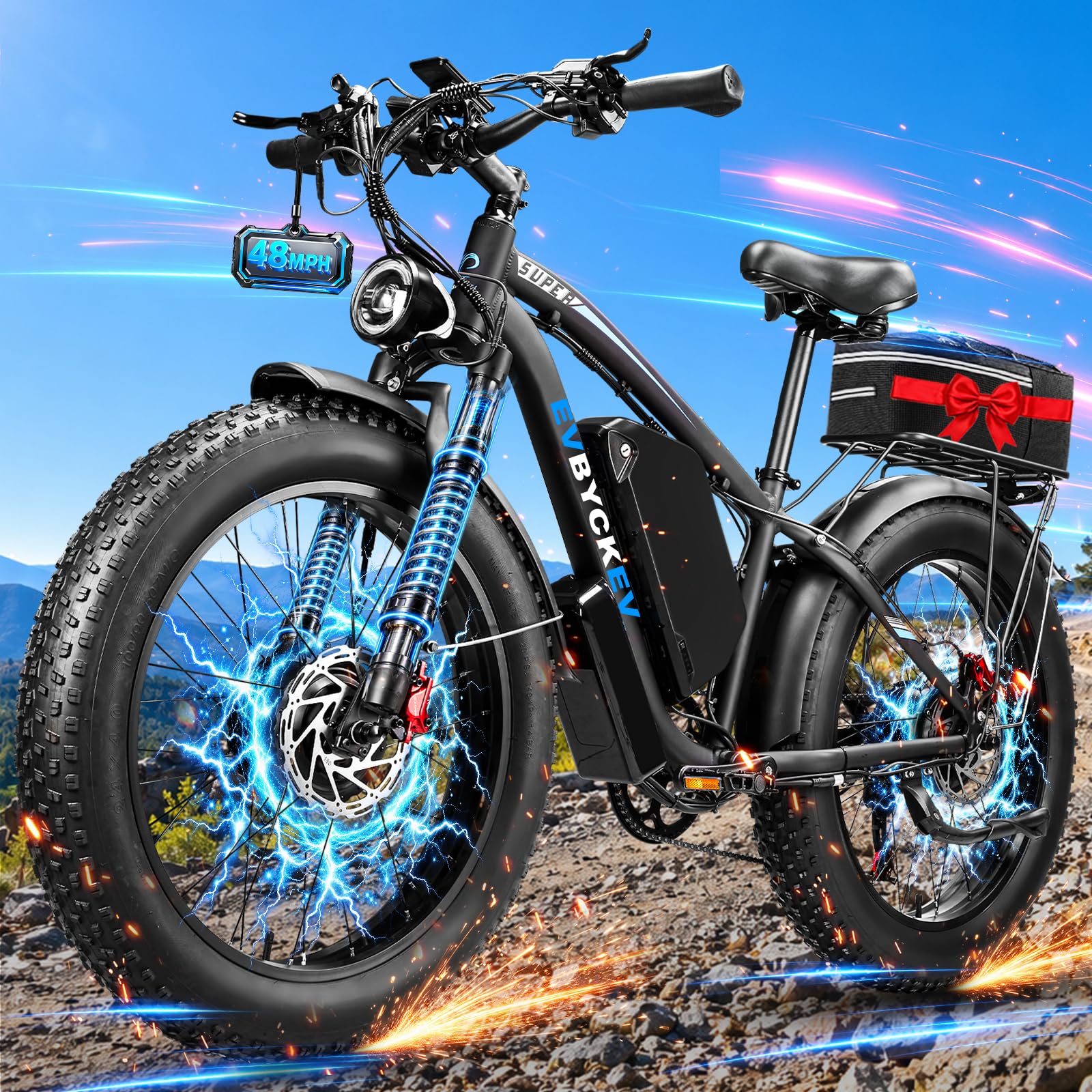
An IP67 rating is the rare winter spec that actually names snow and rain in the same breath.
Most bikes on this list tell you they handle snow. This one is built to survive the wet part of winter too. The 60V 30Ah battery carries an IP67 waterproof rating, meaning it is sealed against dust and against water immersion for short periods. The spec sheet explicitly names rainy, snowy and humid riding environments, and adds intelligent temperature protection modules to guard against overheating and overcurrent in extreme temperatures. For a rider who commutes through sleet, that is the most directly relevant line on the page.
It is not short on grunt either. Two brushless motors combine for 9000W of peak power and 240N·M of torque, good for 45-degree slopes and a 48MPH top speed at PAS Level 5. The 60V 30Ah lithium pack delivers a maximum cruising range of 105 miles in pedal assist mode, and the cells support a 6-10 hour full charge. Its 24 x 4-inch skid-resistant fat tires and lockable front suspension are claimed to absorb up to 85% of road shocks, so a frozen pothole does not rattle straight into your spine.
Stopping power is well-matched to the speed: dual hydraulic disc brakes with four-piston calipers and 180mm front and rear rotors, with adjustable brake tension. There are six ride modes, from single motor for flat cleared roads to dual motor for slopes and rough ground, plus a walk mode that makes pushing the bike across an icy patch labor-free. One practical wrinkle to know about is assembly: a buyer found the Allen screws varied and awkward to reach, and the front light arrived broken on one unit before the seller shipped a replacement. It is a big, heavy machine, so plan for a helper on setup day.
The winter seal: an IP67 battery rating plus a temperature protection module is the most cold-and-wet-specific spec on this entire list.
Setup day tip: recruit a second pair of hands — the hardware is fiddly and the bike is heavy.
Built for: year-round commuters who ride through rain and slush and want a sealed battery plus 105-mile assist range.
Skip if: you want a light bike you can assemble solo in twenty minutes.
6. HiKNiGHT Dual Motor Electric Bike
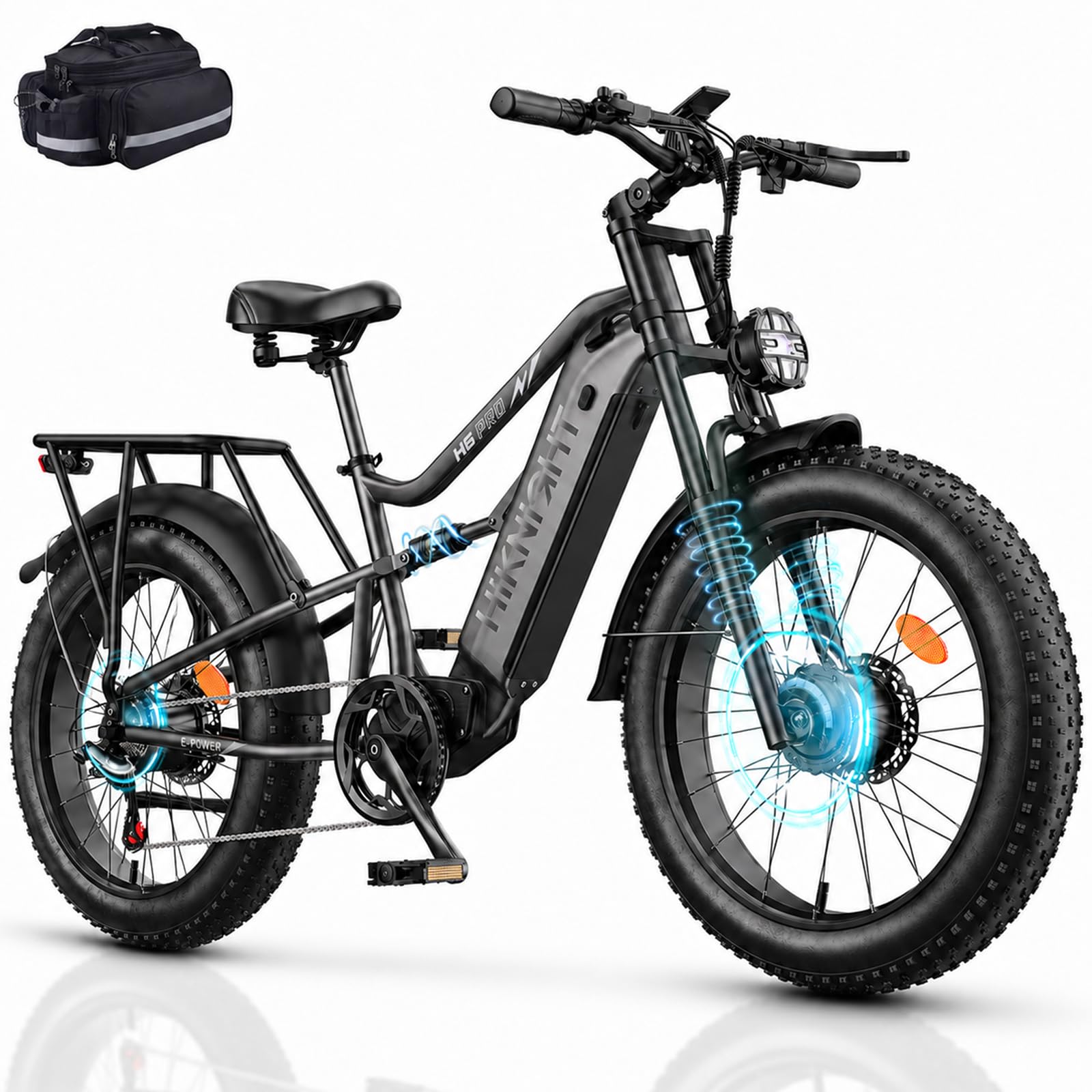
A 50-degree adjustable handlebar stem means winter gloves do not force a bad riding position.
Cold hands change how you sit on a bike. Thick gloves make a low, stretched-out reach uncomfortable, and a cramped cockpit gets painful fast. The HiKNiGHT addresses that with a 50° adjustable handlebar stem and an adjustable seat, sized for riders roughly 5’1″ to 6’3″ with a 400 lbs maximum load. The wider saddle adds support for longer cold-weather rides, and front and rear suspension absorb the bumps that frozen pavement throws at you.
Power comes from dual brushless motors totaling 4000W of peak output, reaching speeds of up to 38 MPH under suitable conditions. You can switch between single and dual motor modes and pick from 5 pedal-assist levels, which is the winter strategy: single motor on cleared streets to save juice, dual motor when you hit a snow-covered climb. The 52V 20Ah battery carries 1040Wh of capacity, is removable for indoor charging, and is rated up to 40 miles in throttle-only mode or up to 90 miles with pedal assist.
You get grip on snow, beach and rugged roads from 24 x 4.0-inch fat tires, which the listing describes as non-slip and load-bearing. Dual hydraulic disc brakes (fluid-pushed brakes) give you a firmer, more consistent squeeze than cable brakes when the rotors are wet. The styling draws the most praise of anything about this bike — buyers notice the look first. Assembly is a mixed point: some find it simple, others less so. The twist throttle has also drawn a comfort complaint on long rides. Allow an evening for setup, and consider a throttle rest if you plan long distances.
Fit and finish: a 50° adjustable stem, adjustable seat and 5’1″ to 6’3″ fit range make this the most tunable cockpit here.
Set realistic expectations: the twist throttle gets uncomfortable on long rides, and assembly varies by rider patience.
Reach for this if: you are between sizes or share the bike with a partner of different height.
Look elsewhere if: you want a thumb throttle and a guaranteed quick build.
7. Aipas M2 Pro Electric Bike
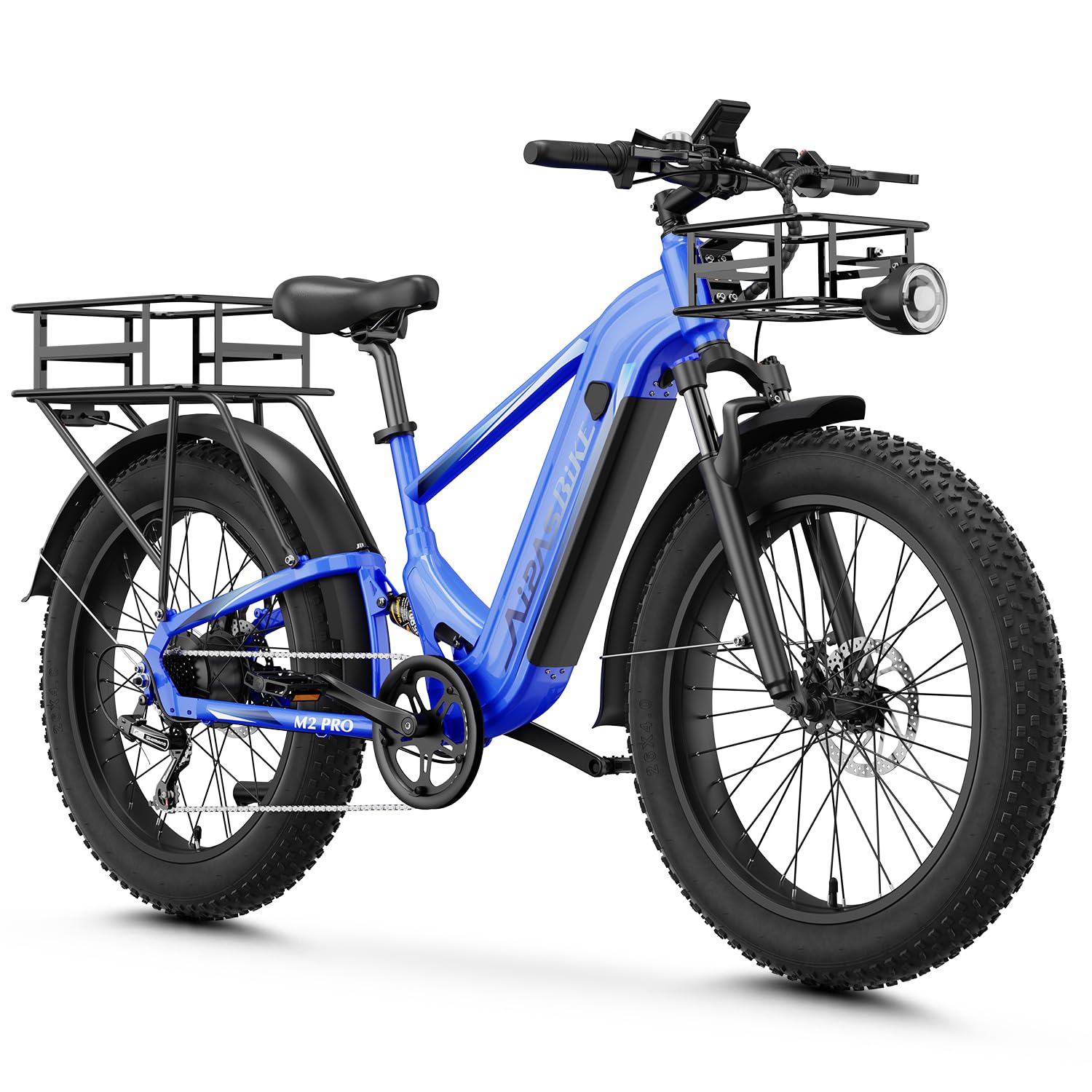
Five riding modes and a 17.5Ah pack make this the versatile all-season commuter of the Aipas pair.
Where the M1 Pro above leans on a step-thru frame, the M2 Pro leans on flexibility. It pairs an 1800W peak rear-hub motor with 110Nm of torque and a 30° climbing rating, then adds five riding modes: Electric, Pedal Assist, Cruise Control, Normal Riding and Walk Mode. That last one matters in winter — walking a heavy bike across a patch of black ice is far safer than riding it, and Walk Mode makes the push light work.
The 48V 17.5Ah battery is removable and rated for up to 85 miles of pedal-assisted range, and a handlebar-mounted USB port lets you top up a phone on the go. Full suspension and an adjustable, lockable front fork help with the rough stuff, while 180mm dual disc brakes are specified for rain, off-road terrain and long downhill slopes. The 26 x 4.0 fat tires are the same size class the FREESKY runs, and the LCD shows speed, battery level and mileage at a glance.
Honesty time: this bike weighs 90 lb and carries a 500 lbs max load, and owners comment on the weight steadily. Range is the most debated number on the page. The 85-mile figure is a pedal-assist claim (range with you helping by pedaling), and owners at heavier rider weights report real-world figures well below it. Some find the battery mixed rather than stellar. That does not make it a bad buy — it means you should plan your route around reality, not the brochure. Build quality, by contrast, draws the loudest praise on the page. One owner managed an estimated 30-35 miles of pedal-assist riding in hilly terrain at 210 lbs.
Strengths worth trusting
- Five riding modes including Walk Mode for ice patches
- 48V 17.5Ah removable battery rated to 85 miles of assist
- Full suspension with a lockable, adjustable front fork
- 180mm dual disc brakes specified for rain and descents
The fine print
- 90 lb weight makes it a two-person job to load or carry
- Real-world range runs shorter than the assist claim at heavier rider weights
Best for: the rider who wants one bike for commuting, trail days and cruise-controlled long rides.
Think twice if: you need to carry it up stairs or you are buying for the headline range alone.
8. PUJH 9000W 50MPH Dual Motor Ebike, 60V 26×4 Fat Tire
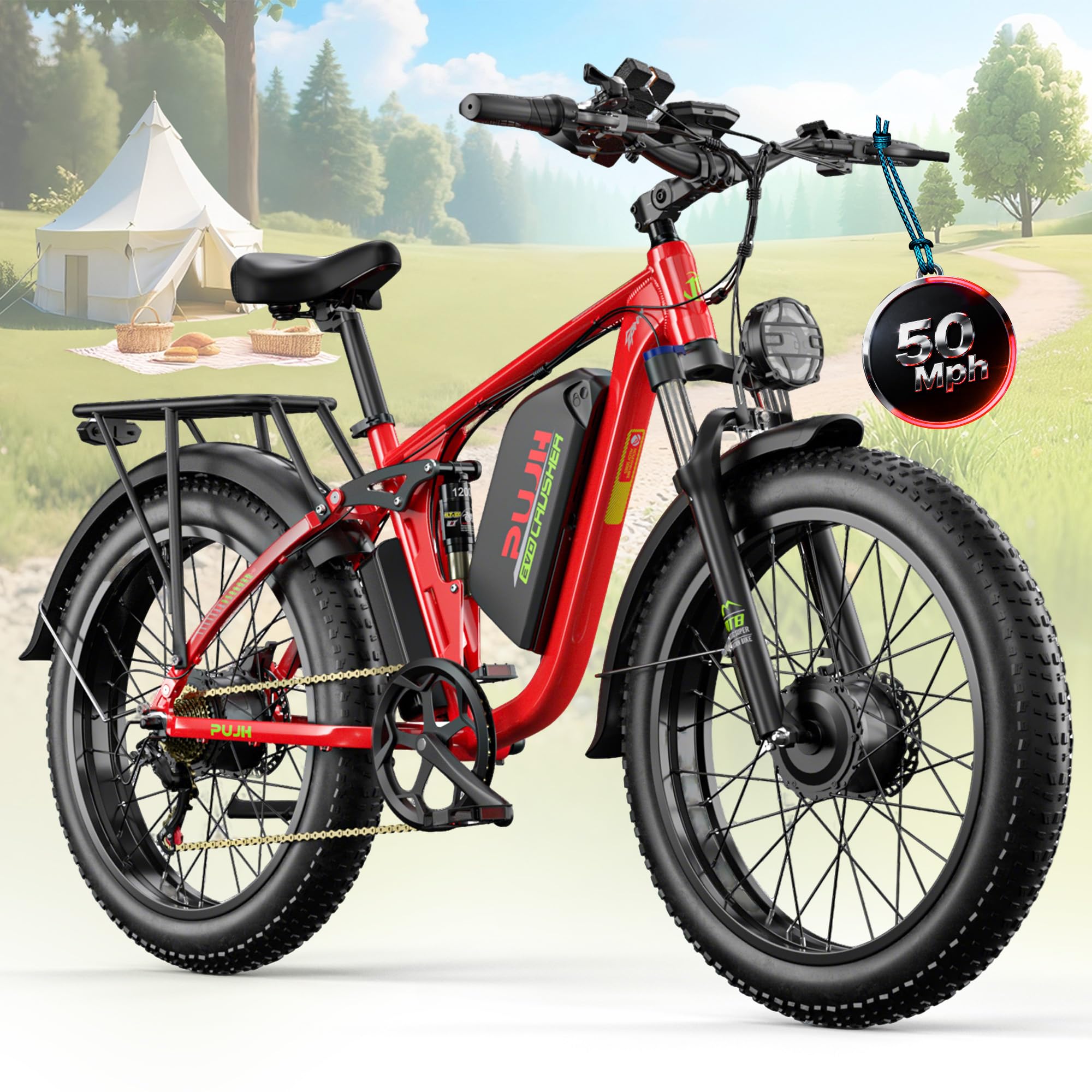
Seven levels of suspension and 240Nm of torque for riders who take the long way through snow.
This is the bike for the rider whose winter route means gravel, sand and snow rather than a plowed commute. Dual brushless motors deliver a peak 9000W and 240 Nm of torque, with speeds up to 50 MPH available. That torque is the winter number: it is what lets you carry cargo or a heavier rider up a hill instead of bogging down. A 7-level suspension system — front fork, rear shock and seat springs — plus 26″ x 4.0″ fat tires keeps traction on sand, snow, gravel and rocky trails.
The battery is a lockable, removable 60V 20Ah lithium-ion pack rated for 35 to 110 miles per charge, depending on terrain and assist level. Being able to pull the pack out and charge it indoors is the winter habit that makes the biggest difference to usable range. Dual hydraulic disc brakes deliver fade-resistant stopping power in wet or dry conditions, which matters a lot more at these speeds than at commuter pace. The frame comes 90% assembled.
Two recurring frustrations are worth knowing about before you buy. The handlebars have a tendency to loosen and wobble — the fix owners converge on is a hidden front screw plus a thread-locker compound. And range claims are optimistic: riders report roughly 55 to 65 miles with moderate pedaling rather than the 110-mile ceiling. There is also a serious safety note in the review pages: a rear fender has broken loose on one bike and jammed the rear wheel. That is a single report and not a pattern, but it is the kind of thing you inspect before every winter ride. Check the fender mounts, add thread-locker to the handlebar bolts, and this bike rewards you with huge amounts of capability.
The standout spec: 240 Nm of torque and 7-level suspension put it in a different class for rough, snow-covered ground.
Before your first ride: tighten the handlebar hardware with thread-locker and check the rear fender mounts.
Made for: heavier riders and cargo haulers who need torque more than they need range claims.
Skip if: you want a bike that arrives needing zero bolt-checking.
9. CTVVXXC 9000W Peak Dual Motor Ebike, 52V 34Ah, 105 Mi
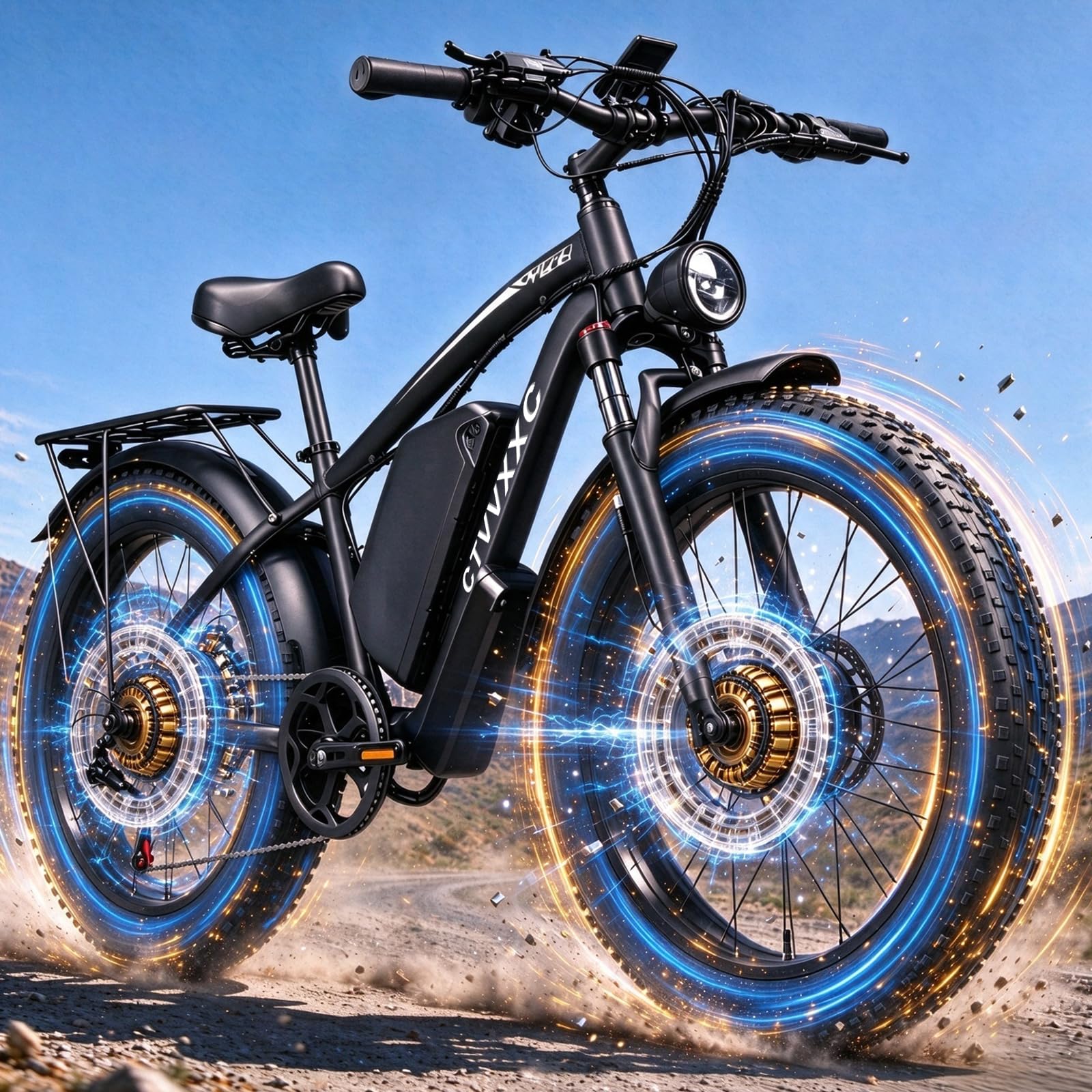
The only bike here that names a cold-weather operating range in actual degrees.
If you want a number that speaks directly to winter, this is it. The 52V 34Ah battery, built with authentic LG cells, is IP67 rated and paired with an intelligent thermal management system specified to hold performance from -4°F to 140°F. That is a real cold-weather claim rather than a vague “all terrain” line. The pack is lockable, removable, rated for 1000+ cycles and delivers up to 105 miles of riding range in PAS mode.
Power comes from dual 4500W peak brushless motors for 9000W combined, with 200N·m of torque climbing 40° inclines and a max speed of 45MPH in PAS Level 5. The spec sheet adds an instant PAS1-5 acceleration curve and a smart torque algorithm meant to keep power delivery smooth on dirt, hills or city streets. Up front, an upgraded hydraulic fork with saddle absorption is claimed to cut bumps by 85%, paired with 24×4.0 fat tires the listing describes as gripping on snow, sand and mud.
The reality check is range. Owners at PAS5 without throttle have reported around 40 miles rather than the 105-mile claim, and a replacement battery is described as costly with a six-week wait. That is the most important thing to understand before buying: this is a bike that asks you to manage your battery rather than trust the brochure. The build quality itself draws the strongest praise, and one owner reports climbing hills in PAS1 that a 750W class 3 bike needs PAS4 for. A tall rider may find the frame small — one 6-foot owner suggests an offset seat post and riser stem to dial in the fit.
The genuinely winter-specific bits
- Battery specified to operate from -4°F to 140°F with thermal management
- 52V 34Ah LG-cell pack, lockable and removable, rated 1000+ cycles
- IP67 sealing against rain, snow and humid conditions
- Dual hydraulic disc brakes and a 3.5″ smart LCD display
Manage your expectations
- Real-world range at high assist runs well under the 105-mile claim
- The frame feels small under a taller rider
Best for: riders in genuinely cold climates who want a battery engineered to tolerate sub-zero mornings.
Not for: anyone who plans to ride full-throttle all day and expects the claimed range.
10. LPQVIATAS 9000W Peak Dual Motor Ebike, 58V 34Ah, 48MPH
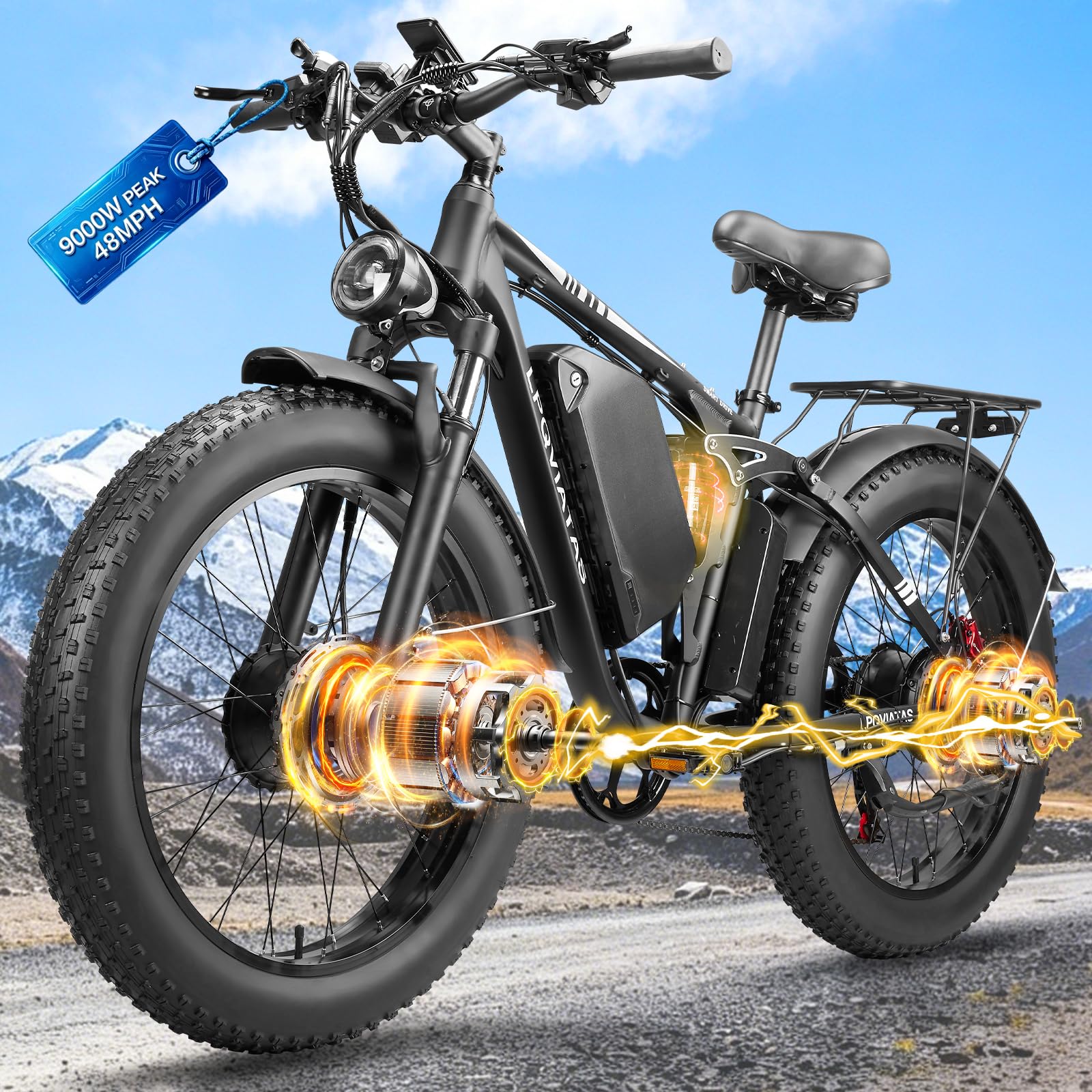
Two 4500W motors and 220 N.m of twist for the steepest, slipperiest winter grades.
A snow-covered hill is the hardest test a winter bike faces. This one has the strongest climbing numbers on the list: two 4500W peak motors for 9000W combined, 220 N.m of torque, and a 42° uphill rating. Top speed is 48 mph. The 58V Max-output 34Ah BMS lithium battery is removable and rated for 90 to 105 miles with pedal assist, with range adjusting to terrain and load. A BMS, or battery management system, is the circuitry that keeps individual cells balanced and protected — useful in the cold, where cell behavior gets uneven.
The comfort package is thorough. A lockable and adjustable front fork shock absorber pairs with a racing-grade mid-mounted shock absorber, reducing bumps and improving stability. The professional 7-speed transmission helps on rugged ground, and the 24 x 4.0-inch fat tires are described as stable across snow road, sand road and gravel road. Dual hydraulic disc brakes deliver responsive stopping on steep slopes and extreme terrain. The bike arrives 95% assembled with a full accessory set: headlight, horn, phone holder, 3.5-inch LCD display, adjustable saddle, mudguards, kickstand and rear cargo rack.
Where it gets real is the gap between the claim and the ride. The 48 MPH figure draws mixed reactions — owners find the bike fast, but some report the speedometer reading below the advertised ceiling. Another recurring note: in dual-motor mode, a hard takeoff can spin the front wheel and trigger a brief motor cutout, which is unsettling at an intersection. Roll on the throttle smoothly in winter and that is manageable, and one owner calls the ride out as somewhat stiff. Performance and stability are what the bike is loved for, so if traction and pull matter more to you than a top-speed number, this is a strong fit.
What stands out: 220 N.m of torque and a 42° climbing rating make this the hill specialist of the group.
Ride it gently off the line: hard dual-motor starts can spin the front wheel, so ease into the throttle on slick ground.
Match for: riders whose winter route includes real grades and who want the strongest pull on this list.
Mismatch if: you want the advertised top speed to match what the display shows.
11. PHILODO Falcon 60V Off-Road Electric Bike
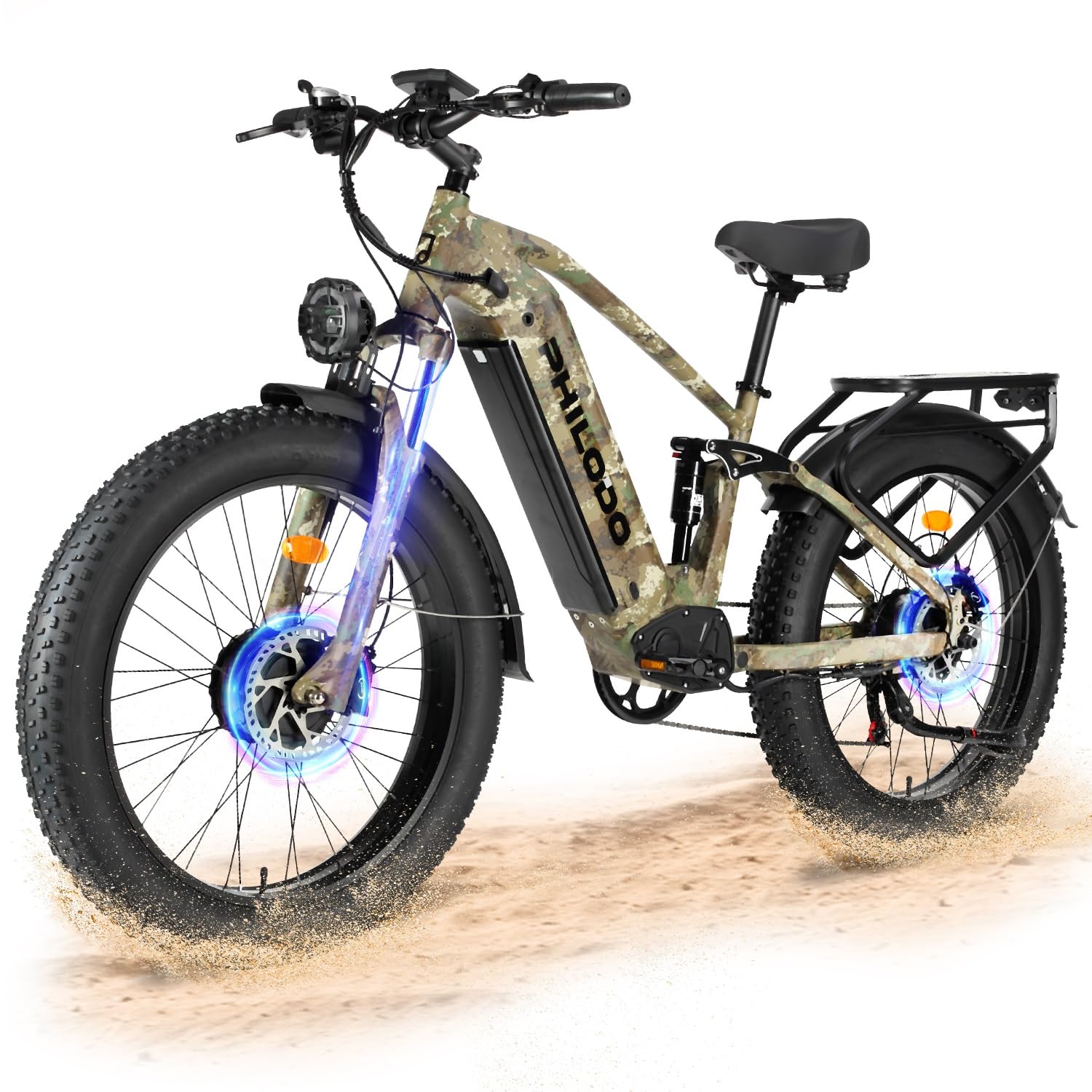
Camo paint, dual motors, and a battery built for the kind of cold that keeps everyone else indoors.
The Falcon is aimed squarely at the hunter and the off-grid rider. Its 60V 32Ah battery delivers up to 100 miles in PAS mode or 50 miles in full electric mode, with a real-time battery level display so you are never guessing. A 10-12 hour recharge time is the longest on this list, which means this is a bike you plug in overnight rather than between errands. The 26-inch all-terrain fat tires pair with a lockable, adjustable front fork plus a rear air shock — an air shock uses compressed air instead of a coil spring, which lets you tune the firmness for your load.
Six riding modes cover dual motor, single motor, pedal assist, walk, cruise and plain bike, and the display settings let you dial the bike between Class 3 speed and Class 1/2 for local law compliance. That adjustability is genuinely useful when you cross between a private trail and a public path. The metallic paint finish draws compliments, and the frame is aluminum. Buyers report hitting 45 MPH on pavement and pulling through sand and loose dirt on Arizona trails without running out of charge.
The honest catch is that this bike arrives configured oddly and expects you to fix it. One owner had to correct the display from kilometers to miles, the voltage reading, and the tire-size setting before the bike behaved properly. The rear suspension has also arrived over-torqued at the factory, with no movement until the pivot bolts were loosened — after which the off-road ride improved noticeably. If you are comfortable in an advanced settings menu, this is a rewarding machine. If you are not, budget an afternoon with the manual. The step-over frame is also tall, so shorter riders should look at the step-through version.
Built for the backcountry
- 60V 32Ah battery for up to 100 miles in PAS mode
- 26″ fat tires with lockable front fork and rear air shock
- Six modes with adjustable speed class settings
- Dual-motor pull through sand and loose dirt
Setup realities
- Display settings often need correcting from the start
- 10-12 hour recharge is the slowest here
Pick this for: hunters and trail riders who want a rugged dual-motor rig with real off-grid range.
Pass if: you want a bike that works perfectly without touching a settings menu.
12. eAhora Romeo Pro 3 6000W Dual Motor Ebike, 60V 80Ah
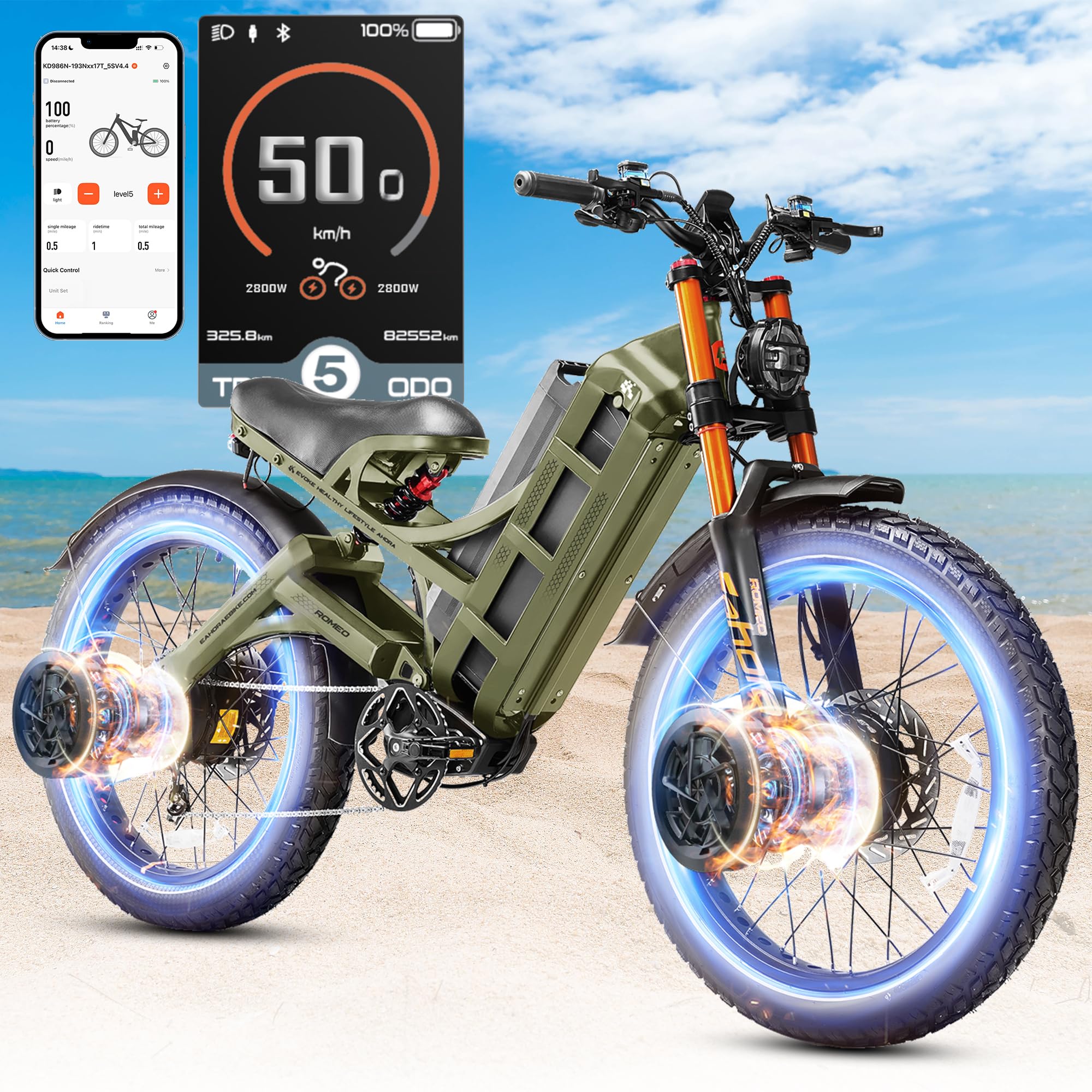
The 80Ah pack and 240mm brakes make this the heavyweight answer for riders who refuse to plan around a charger.
Range anxiety is the quiet killer of winter riding — the cold shrinks usable capacity, so the bike with the biggest reserve wins by default. The Romeo Pro 3 carries a 60V 80Ah removable battery rated for up to 300 miles under ideal laboratory conditions, with a 67.2V 7A fast charger that fills it in about 8 hours. Dual 3000W motors combine for 6000W of peak output, 300N.M of torque, a 52MPH top speed and 50° of climbing capability. For reference, that is far beyond the 1800W peak of the Aipas M1 Pro above.
The chassis is built to match. A reinforced frame supports up to 500 lbs, riding on 26″x4.0″ all-terrain fat tires that handle pavement, gravel, dirt trails, sand and snow. Suspension is a split design: a left air fork and a right oil-coil shock-absorbing fork, both adjustable for rebound and compression. Stopping comes from oversized 240MM hydraulic disc brakes with dual oil reservoirs, plus an intelligent motor cut-off system and regenerative reverse charging that feeds energy back during braking.
The details that matter after dark are covered properly: a 360° lighting system with a 2000-lumen LED headlight, brake taillight and reflective tire strips, plus a P-mode safety start that prevents accidental launches. The color LCD includes a USB port, and the companion app adds Bluetooth positioning, navigation and ride records. What owners flag is a rear disc brake pad that rubs while riding, risking wear, and rear motor noise at 5-10 mph on startup. The throttle and pedal assist are also described as overly sensitive, though both can be softened through the advanced settings. It is heavy and large — one owner calls it a motorcycle — so plan storage accordingly.
The range argument
- 60V 80Ah battery, up to 300 miles under ideal laboratory conditions
- 6000W dual motor with 300N.M torque and 50° climbing
- 240MM hydraulic disc brakes with dual oil reservoirs
- 2000-lumen headlight plus brake taillight and reflective strips
Where it costs you
- Rear brake pad can rub and motor can whine at low speed
- Throttle and pedal assist feel sensitive until you tune them
Worth it for: long-distance and delivery riders who want the biggest battery and brake package available.
Overkill if: your winter rides are short loops and you have nowhere to store a motorcycle-sized bike.
13. eAhora Romeo Pro 3 6000W Dual Motor Ebike, 60V 80Ah
The 80Ah pack and 240mm brakes make this the heavyweight answer for riders who refuse to plan around a charger.
Range anxiety is the quiet killer of winter riding — the cold shrinks usable capacity, so the bike with the biggest reserve wins by default. The Romeo Pro 3 carries a 60V 80Ah removable battery rated for up to 300 miles under ideal laboratory conditions, with a 67.2V 7A fast charger that fills it in about 8 hours. Dual 3000W motors combine for 6000W of peak output, 300N.M of torque, a 52MPH top speed and 50° of climbing capability. For reference, that is far beyond the 1800W peak of the Aipas M1 Pro above.
The chassis is built to match. A reinforced frame supports up to 500 lbs, riding on 26″x4.0″ all-terrain fat tires that handle pavement, gravel, dirt trails, sand and snow. Suspension is a split design: a left air fork and a right oil-coil shock-absorbing fork, both adjustable for rebound and compression. Stopping comes from oversized 240MM hydraulic disc brakes with dual oil reservoirs, plus an intelligent motor cut-off system and regenerative reverse charging that feeds energy back during braking.
The details that matter after dark are covered properly: a 360° lighting system with a 2000-lumen LED headlight, brake taillight and reflective tire strips, plus a P-mode safety start that prevents accidental launches. The color LCD includes a USB port, and the companion app adds Bluetooth positioning, navigation and ride records. What owners flag is a rear disc brake pad that rubs while riding, risking wear, and rear motor noise at 5-10 mph on startup. The throttle and pedal assist are also described as overly sensitive, though both can be softened through the advanced settings. It is heavy and large — one owner calls it a motorcycle — so plan storage accordingly.
The range argument
- 60V 80Ah battery, up to 300 miles under ideal laboratory conditions
- 6000W dual motor with 300N.M torque and 50° climbing
- 240MM hydraulic disc brakes with dual oil reservoirs
- 2000-lumen headlight plus brake taillight and reflective strips
Where it costs you
- Rear brake pad can rub and motor can whine at low speed
- Throttle and pedal assist feel sensitive until you tune them
Worth it for: long-distance and delivery riders who want the biggest battery and brake package available.
Overkill if: your winter rides are short loops and you have nowhere to store a motorcycle-sized bike.
Know the Specs
Battery Capacity and Cold Weather
Battery capacity is measured in amp-hours (Ah) — think of it as the size of the fuel tank. A 48V 10.4Ah pack (the Gotrax R7) holds far less energy than a 60V 80Ah pack (the eAhora Romeo Pro 3), and that difference shows up directly as range. In winter, cold air temporarily reduces how much of that capacity you can actually use, which is why a removable pack you can carry inside and charge at room temperature is such a practical feature. Watt-hours, often listed alongside, combine voltage and amp-hours into one total-energy number.
Torque, Motors and Grip
Torque, measured in newton-metres (N·m), is the twisting force the motor sends to the wheel — the number that decides whether you pull out of a snow rut or spin in place. Dual-motor bikes split that force across the front and rear wheels, so when one loses grip the other can keep pulling. A 210N·m dual-motor setup (the FREESKY) will feel very different from a 90N.M single motor (the TST) on a steep, slick grade. Single-motor mode on a dual-motor bike lets you save battery on cleared, flat pavement.
Fat Tires and Traction
Fat tires are measured as width by diameter, like 26″ x 4.0″ — a 4-inch-wide tire puts a broad, flat patch on the ground for flotation and grip. That width is what lets you roll across packed snow rather than cutting into it. Puncture-resistant construction helps on debris-strewn winter streets, and lower tire pressure increases the contact patch further. Check that the tread is described for the surfaces you actually ride, whether that is snow, sand, gravel or city pavement.
Brakes, Certification and Visibility
Hydraulic disc brakes use fluid pressure for a firmer, more consistent squeeze than mechanical cable brakes, particularly when the rotors are wet. Rotor size matters too — 240MM rotors (the eAhora) provide more leverage than 180mm rotors. Certification marks like UL2849 and UL2271 indicate the electrical system and battery have been tested to independent safety standards. A headlight, brake-activated taillight and turn signals are not decoration in winter; they are how you stay seen on a dark, wet commute.
Common Questions
Can I ride a fat tire ebike in snow?
Does cold weather drain an ebike battery faster?
Is a dual motor better than a single motor for winter riding?
Do I need hydraulic brakes for winter riding?
What does the UL2849 or UL2271 certification mean on an ebike?
How heavy are these winter ebikes to move around?
Are these ebikes legal to ride on public roads?
How long does it take to charge one of these batteries?
What tire pressure should I run in snow?
Can I charge the battery indoors during winter?
The Bottom Line
Winter riding rewards the bike that combines grip, torque and a battery you can bring inside. The FREESKY Dual Motor 26″ Fat Tire delivers all three, with a 105-mile claimed range, 4000W of dual-motor peak power and UL2849/UL2271 certification (safety standards for e-bike batteries and electronics). At 4.5+ stars from 150+ owners, it carries the highest rating on this list. If sealed, weather-proof hardware matters most to you, the EVBYCKEV 60V 30Ah brings an IP67 battery rating (sealed against dust and brief water immersion) and 240N·M of torque (twisting force that pushes you through snow). For riders facing genuine sub-zero mornings, the CTVVXXC 52V 34Ah names a -4°F to 140°F operating window. And for a step-through frame you can mount in thick winter layers, the Aipas M1 Pro is the one to reach for.
How we choose
We do not accept paid placement. Every pick is matched to a real buyer and a real use-case; we do not hands-on test units.
Sources
Specifications: manufacturer listings and product documentation. Review insights: verified customer reviews, as of October 2026. Pricing: not shown on this page (it changes often); check the current price via the retailer link.
As an Amazon Associate, Aappliancez earns from qualifying purchases. This does not affect which products we feature.