Disclosure: Some links in this post are affiliate links. As an Amazon Associate I earn from qualifying purchases, at no extra cost to you. Learn more
Specs are compiled from manufacturer listings and verified buyer reviews and can change over time — please confirm the key details on the product page before buying.
Highway wind roar is what quietly damages riders’ hearing, and a filtered plug cuts it without muffling traffic, sirens, or your intercom. You want wind and engine drone pushed down, but you still need to hear traffic, sirens, and your helmet intercom. That balance of real protection and usable awareness is what separates a motorcycle plug from a foam wad.
This guide is built by comparing the manufacturers’ published specifications and the patterns across verified customer reviews, so you get each pick’s real strengths and trade-offs instead of marketing spin.
Below you’ll find eleven options sorted by what they actually do on a bike — filtered plugs that keep speech clear, high-attenuation foam for pure wind blocking, and moldable sets for odd ear canals. The short answer: the right pair of earplugs for motorcycles is the one whose filter matches your helmet and your intercom.
Top Picks


How To Choose The Best Earplugs for Motorcycles
Most riders buy on the decibel number and get burned. A plug that drops the most sound can also cut your intercom and traffic cues to useless mush, which is exactly the wrong trade on a moving bike. The better question is how much of the road you still need to hear.
Filtered versus foam — the core decision
A filtered plug (sometimes called high-fidelity) lowers volume across the board while keeping speech and music intelligible, so your helmet speakers still work. A foam plug blocks nearly everything, which is ideal for short blasts or a noisy helmet but buries your intercom. Pick filtered if you ride with comms; pick foam if you just want silence.
Why NRR can mislead on a motorcycle
NRR is a lab number measured in a controlled setting, not at 70 mph with buffeting. A plug rated lower can still feel quieter on the road if it seals properly, especially when the wind is the dominant noise. Fit and depth decide more of your real experience than the box rating suggests.
Insertion and helmet pressure
Your helmet presses against your ears, so a plug that sits proud or has a stiff stem will rub or work loose. Low-profile stems and soft materials survive the on-and-off of a full-face lid far better. If your ears are small, look for a set that includes multiple tip sizes.
Side-by-Side Comparison
| Model | Best For | Noise Rating | Style | Reusable | Amazon |
|---|---|---|---|---|---|
| Howard Leight Laser Lite★ Best Overall | Bulk wind blocking | NRR 32 | Disposable foam | Limited | Amazon |
| Etymotic ER20Sound-First Pick | Clear sound, low volume | — | High-fidelity filter | Yes | Amazon |
| Alpine MotoSafe TourRider Favorite | Wind cut plus intercom | 17 dB SNR | Filtered, soft | Yes | Amazon |
| Mack’s Ultra Soft Foam | Maximum foam attenuation | NRR 33 | Disposable foam | Limited | Amazon |
| SureFire EP4 Sonic Defenders | Filtered with closable caps | NRR 24 | Triple-flange, reusable | Yes | Amazon |
| Decibullz Custom Molded | Molded personal fit | NRR 31 | Thermoplastic custom | Yes | Amazon |
| EarPeace Moto | Rider-focused filters | Up to 26 dB | Filtered, swappable | Yes | Amazon |
| Loop Experience 2 | Concert-grade filtered | 17 dB SNR | Filtered, silicone | Yes | Amazon |
| VIBES High Fidelity | Conversation-friendly | — | Filtered, low-profile | Yes | Amazon |
| Plugfones Basic Pro | Earplugs plus audio | 27 dB NRR | Bluetooth earplug | Yes (foam swaps) | Amazon |
| Eargasm High Fidelity | Festival and road sound | Up to 21 dB | Filtered, silicone | Yes | Amazon |
Detailed Reviews
1. Howard Leight Laser Lite Earplugs
Our pick — 4.5+★ from 13,500+ verified ratings; the strongest balance of quality and price.
The pink-and-yellow box that turns a roaring highway into background hum without touching your intercom budget
If you want the simplest possible answer to wind noise, this is it. The Laser Lite carries an NRR of 32, a lab-tested rating for how many decibels it can block, and that is about as high as foam earplugs go. You get 200 pairs in the box, so a full season of riding costs you almost nothing per pair. The contoured T-shape is meant for easy insertion and removal, and the foam is a closed-cell skin that resists dirt, so they hold up across several rides instead of one.
The smaller-than-average profile is deliberate. It slides in deep without pinching, which matters when your helmet is pushing against your ears for hours. The bright yellow and magenta shell makes a dropped plug easy to find on the garage floor, and it stops you from accidentally leaving a pair in your jacket pocket for a month. What wins people over, though, is the sheer quiet. The foam expands to fill the canal, and riders use these for everything from motorway commuting to mowing the lawn, which tells you how thoroughly they kill noise.
The honest catch: this is a full-block plug. It will bury your Cardo or Sena speakers, so if you ride with comms you want a filtered set instead. A few riders also note the box packaging changed to a tougher-to-open style that needs a real tug. Neither is a reason to walk past them — they remain the best value in raw wind protection. 13,000+ owners have rated them 4.5+ stars.
What riders actually get
- NRR 32 is among the highest foam ratings you can buy, so wind roar drops to a murmur
- 200 pairs per box means you never ration them on a long tour
- High-vis yellow and magenta make lost plugs easy to spot in a helmet bag
- Closed-cell foam skin resists dirt, so each pair lasts several rides
Where it falls short
- Blocks so much that helmet intercom audio becomes hard to hear
- Recent packaging needs a firm tug to open
- Not reusable long-term — this is a disposable format
Best if you ride solo or hate wind roar: this is the plug that makes a noisy helmet feel calm, and the bulk box keeps you stocked.
Look elsewhere if: your rides depend on hearing your intercom — a filtered plug will serve you better.
2. Etymotic Research ER20 High-Fidelity Earplugs
Built to lower the world’s volume, not to erase it — music and speech stay clear at a safer level
The ER20 is the classic “volume knob” plug. Instead of smothering sound, it replicates the natural response of your ear so the world is simply quieter, with voices and engine tone still recognizable. That is the whole reason it suits riders who want protection without the muffled-helmet feeling. It ships as one standard pair with blue tips, a neck cord, and a carrying case, and it measures just 0.75 x 4 x 6 inches at 0.3 ounces, so it disappears into a jacket pocket.
For pure attenuation it does not go as deep as a foam plug, and that is a feature if you like hearing traffic around you. The reusable eartips can weaken with heavy use, and Etymotic itself advises replacing them every three to six months, so treat them as a consumable. Worth knowing: the maker does not recommend them for impulse noise like shooting, which is a reminder that this is a road-noise tool, not a range tool.
Two practical notes from the road. The neck cord is a real safety add when you are pulling your helmet on and off, and the standard size tips fit most ears. Some riders find a consistent seal takes a little fiddling, so give yourself a trial run before a long trip. Compared with the bulk foam box above, this is the pick for riders who want to keep their ears in the conversation.
The real strength: a filter tuned so that speech and detail survive the volume drop, which is exactly what you want when you still need situational awareness.
Small caveat: the eartips are a wear item, so plan on replacing them periodically.
Choose this if: you want to hear the world, just softly, and you like the security of a neck cord.
Not the one for: riders who want maximum silence at any cost.
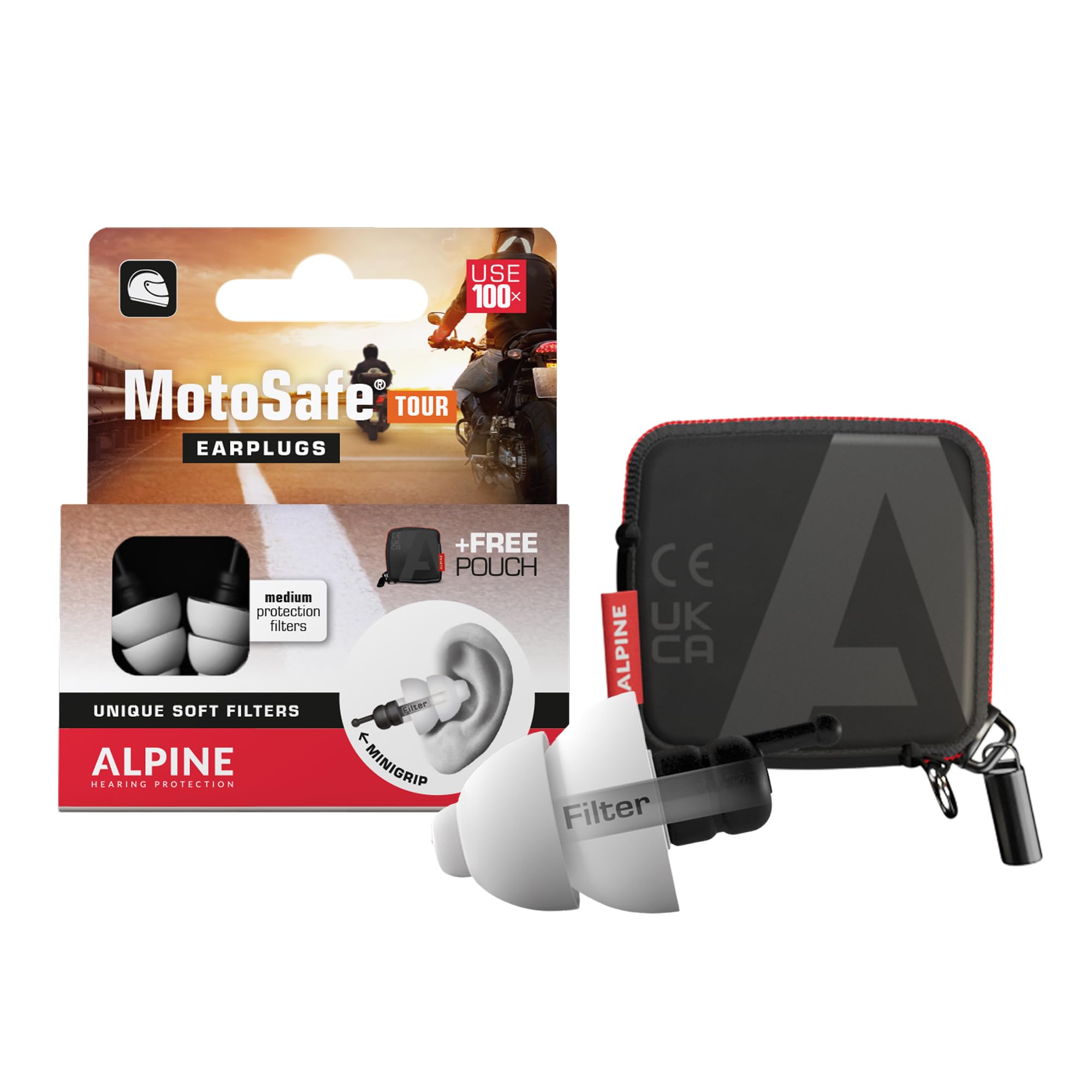
3. Alpine MotoSafe Tour Motorcycle Ear Plugs
The plug designed around a helmet — soft, low-stemmed, and tuned to cut wind while letting your speakers sing
This is the one that solves the core motorcycle problem directly. The MotoSafe Tour is certified to reach a noise reduction of 17 dB SNR, a European-standard measurement of average attenuation, and its filter is aimed squarely at wind rather than at everything. The material is Alpine’s patented AlpineThermoShape, which the maker describes as hypoallergenic, sustainable, and silicone-free, so it adapts to your ear canal instead of forcing a shape on it. At 0.88 ounces, it is a featherweight in the ear.
The real-world win is what happens under the lid. Riders with Cardo and Sena units report the filter lets music and navigation through clearly while it drops the wind and engine drone to tolerable. Foam plugs, by contrast, flatten a good intercom to tinny mush. The soft body also means no pressure points on longer rides, and a mini-grip tab helps you pull them out at a fuel stop without digging.
Here is the recurring gripe, and it is a small one: the removal tab can break off under rough handling, so grip gently and consider the plug your long-term partner rather than something to yank. Fit is also a matter of ear — a few small-canal riders find them hard to pull. For the majority who want wind protection and working comms at the same time, this is the pick that gets it right.
Why it earns its spot: 17 dB SNR certified reduction aimed at wind noise, with a filter that keeps intercom audio intelligible — the exact balance riders hunt for.
The one thing to watch: the removal tab is delicate, so ease them out rather than tug.
Reach for this if: you ride with a communicator and want wind gone without losing your music or directions.
skip it if: your ear canals run very small and you struggle to grip and remove plugs.
4. Mack’s Ultra Soft Foam Earplugs, 50 Pair
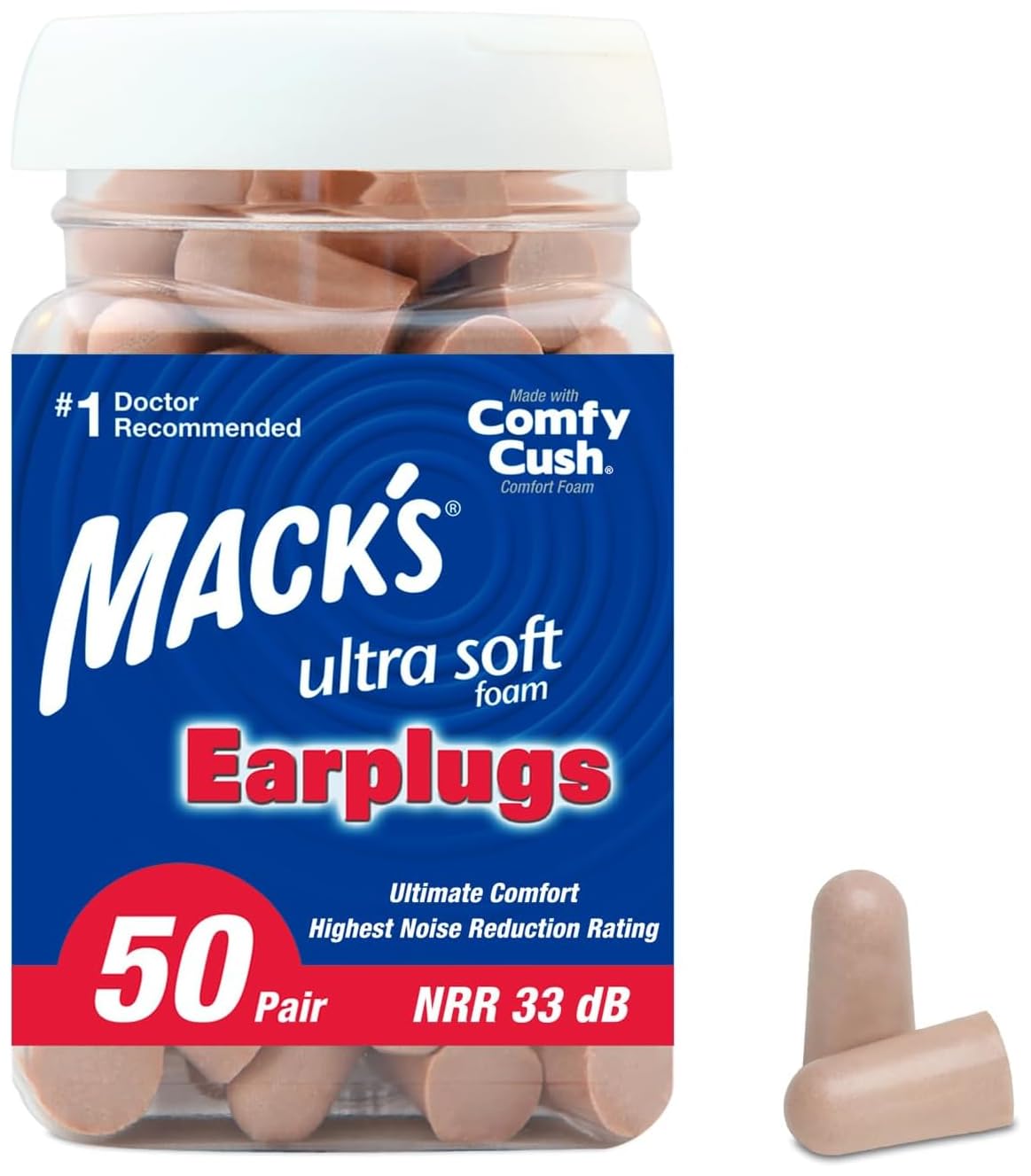
The highest attenuation on this list, wrapped in foam soft enough to forget it is in your ear
Mack’s pushes the number as high as it goes. The NRR of 33 is the top of the foam scale, and the slow-release Comfy Cush foam is built to expand gradually so it seats without the sharp pop that stiffer plugs deliver. You get 50 pairs in a safety-sealed flip-top jar, which is the practical format for a garage or tank bag. The short length is intentional — it keeps the plug off your pillow and out of contact with your eardrum, which matters when you wear them under a helmet for long stretches.
The softness is what most riders notice. Slow-rebound foam creates less outward pressure, so a full day with a helmet pressing on your ears stays comfortable. It seals deeply enough to cut traffic rumble, barking dogs, and mower noise-alike, and an alarm clock or phone still gets through, so you are not fully deaf to the world. Made in the USA, the jar’s flip top makes dispensing one pair at a time easy.
The trade, same as any foam plug: it is a full block, so buried intercom volume. A few people find they need a week or two to learn the right seating depth, and the tub format means you handle them with clean hands to keep things hygienic. As a low-cost, high-protection backup, it is the box to keep in the garage.
Reasons to keep a jar handy
- NRR 33 is the maximum foam rating available, so wind gets flattened
- Slow-release foam seats with less ear pressure under a helmet
- 50-pair flip-top jar is easy to dispense from the tank bag
- Loud alarms and phone still get through the block
Trade-offs to know
- Full block means intercom audio is a struggle
- Seating depth takes a little practice to dial in
- Tub format needs clean handling
Buy this if: you want the strongest cheap silencer in the drawer for wind and noise.
Think twice if: you rely on helmet audio — this plug shuts it down.
5. SureFire EP4 Sonic Defenders Plus Filtered Earplugs
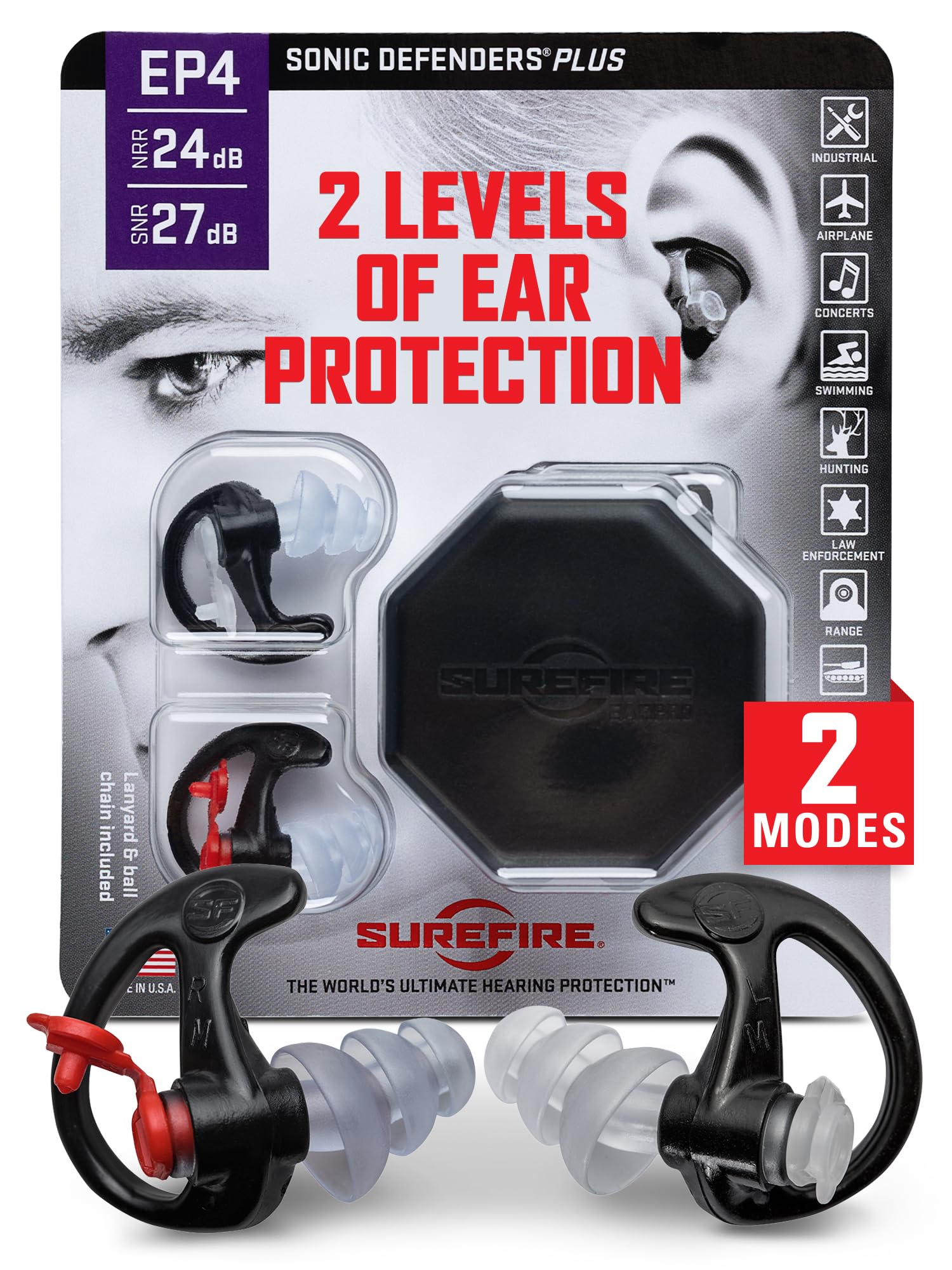
A triple-flange plug with locking rings and caps you can close — switchable between wind-block and hear-through
SureFire’s EP4 is the switchblade of this group. With the filter caps inserted it delivers an NRR of 24, and with the caps out you hear safe sound levels almost as if you had nothing in. The soft, adjustable triple-flanged stems are designed to seal in the canal, and the patented EarLock retention rings use seven contact points to hold them in the same position every time. That consistency is what stops a plug working loose mid-ride.
The low-profile shape is built to coexist with a helmet, hat, or mask, so it does not fight the padding. Riders report the filter chops wind noise while letting voices and comms through, and the caps give you a second, quieter mode when you want full block at a stop or on a noisy stretch. The body is a medical-grade polymer made in the USA, and 27.22 grams on the scale tells you it is a sturdy, not disposable, piece.
Two quirks. You have to pull the plug to switch the caps, and a few riders find that fiddly under a helmet, so set your mode before you ride. The curved shape also takes a few attempts to seat the first time. Neither is a dealbreaker — think of it as a set you learn once and then trust for years.
Standout detail: seven contact points of EarLock retention plus closable caps give you two modes from one pair.
Expect to learn: insertion and cap-switching are a skill, so dial your setting before you pull the helmet on.
Go for it if: you want one reusable pair that can flip between wind-through and full-block.
Not ideal if: you want a no-fuss plug you never have to configure.
6. Decibullz Custom Molded Ear Plugs

Boil, shape, and set — a plug that becomes the exact map of your ear canal
The idea here is personal fit taken as far as it can go in a home kit. You heat the thermoplastic molds in boiling water, let them cool briefly, then press them into your ears so they harden to your canal’s shape. If you miss, they are the rare custom plug that can be redone — so a bad first attempt is not a dead end. The rated protection is an NRR of 31, and the kit includes three sets of triple-flange tips plus a set of foam tips and a carrying pouch.
A note on process before anything else: the molds harden fast, and the fit is entirely in your hands, so work one plug at a time and be patient. Done right, the result is a plug that sits tight against helmet pressure and stays where you put it. That is a real advantage on touring days when a loose foam plug slides and needs re-seating at every stop.
Because the outcome depends on your molding, you will see a spread of experience — some riders love how secure they feel, others find a firm shape can ache over a long day. The honest read: this is the pick for riders whose ear canals never quite fit anything off the shelf, as long as you are willing to spend a few minutes getting the mold right. When it clicks, it clicks.
Why molding wins
- NRR 31 with a fit that copies your own canal
- Re-moldable, so a botched first attempt is fixable
- Stays put under helmet pressure once set
- Full kit of flange and foam tips plus a pouch
What to expect
- Fit quality depends on your molding technique
- A firm set can feel tight over very long days
- Takes a few minutes of careful work to get right
Made for you if: standard plugs never quite seal and you want a molded fit you can redo.
Have second thoughts if: you want protection with zero setup effort.
7. EarPeace Moto Motorcycle Ear Plugs

Three filters in one tin, so you can dial protection up or down without changing plugs
EarPeace sells a kit, not just a plug. Each set arrives with three interchangeable filters — Medium, High, and Max — rated up to 26 dB of noise reduction, so you can match the plug to the ride. Add in one set each of small and medium plugs, plus an aluminum case, and you have the most configurable option here. The universal double-cone design is shaped to sit inside most ears and clear a helmet without pressure points.
The high-fidelity filter is the point. It lowers overall sound while keeping traffic and communication more natural, which means you still register the world around you. Riders report the wind and engine get pushed down far enough to stop the ringing and fatigue after a long ride, while helmet music and Bluetooth calls stay usable. The metal case clips to a jacket zipper or key ring so you do not lose them, and there is a spare compartment for a backup plug.
The honest catches are real but small. The plugs run slightly large for some ears, and a few riders find they can work deep if over-inserted — follow the tab-up insertion and pull the ear to seat them. The case can scratch a key receptacle, so a soft wrap helps. For the rider who wants to tune their own protection, this is the toolkit.
What makes it different: three swappable filters and two plug sizes in one kit let you dial the exact level you want.
Keep in mind: seat them tab-up and pull your ear to insert, or they can creep too deep.
This suits you if: you want adjustable protection and a case you can clip to your jacket.
Pass on it if: your ear canals are very small or you dislike any setup.
8. Loop Experience 2 Ear Plugs

Jewelry-styled and certified, a filtered plug that stays put all day and all night
Loop built its name on looks and livability, and the Experience 2 carries 17 dB SNR of certified filtered reduction. The fit is the headline: four silicone tip sizes, from XS to L, come in the box with medium pre-installed, so small-canal riders get a real option. The set is reusable, easy to clean, and ships with a keychain carry case that tucks into a jacket.
Comfort earns the most praise, and on a bike that matters — a plug that digs in after an hour is a plug you stop wearing. The silicone tips sit without that suction feeling and the low profile clears a helmet shell. The filter lowers volume while keeping music clear, so helmet speakers and speech stay intelligible rather than flattened. That is why so many riders also use a set off the bike at concerts.
One honest limit: this is not a max-block plug. Riders who want the deepest silence may find it too light, and a few report the top loop cord feels flimsy. Treated as a comfort-first filtered plug rather than a wall of protection, it delivers exactly what it promises.
The appealing parts
- Four tip sizes, from XS to L, for a genuinely snug fit
- 17 dB SNR certified filtered reduction
- Comfortable silicone that stays put during long wear
- Reusable and easy to clean with a keychain case
The smaller print
- Not a maximum-block plug for the loudest helmets
- The top cord area feels less sturdy than the rest
A match for you if: comfort and fit variety matter most and you want to keep some sound alive.
Look past it if: you want the deepest possible silence on the motorway.
9. VIBES High Fidelity Ear Plugs

Clear-shelled filters that lower the world’s volume while leaving voices sharp enough to talk over
VIBES takes the attenuate-don’t-block approach and leans hard into discretion. The transparent outer shell and form-fitting low profile make them nearly undetectable, which is a bonus both on the bike and at a cafe stop. The filters lower volume by cutting frequencies rather than walling off sound, so you hear people and traffic while the harsh edges soften. An aluminum travel case comes included, small enough for a pocket at 0.35 ounces for the pair.
Comfort is the strength here, and that translates directly to long rides — riders wear them for hours and report they stay secure without the pressure a stiff plug builds. The low profile clears helmet padding and ear cups, so no rubbing when you pull the lid on. Speech comes through clearly enough to hold a conversation at a stop, which is more than you can say for a foam block.
The realism check: these reduce noise, they do not cancel it, so a rider chasing absolute silence should look to foam instead. Some find the filter mutes music a little heavily in a loud setting. For riders who want awareness plus relief, the balance is right.
Its defining trait: a near-invisible, low-profile filter tuned to keep conversation and traffic audible.
Be realistic: it reduces noise rather than canceling it, so it is not a max-silence solution.
Ideal for: riders who want to hear the road and their companions while taming harsh noise.
Not the pick for: anyone wanting a total sound blackout.
10. Plugfones Basic Pro Bluetooth Earplug Headphones

Hearing protection and a wireless speaker in one — music, calls, and a 27 dB block without the cables
This is the odd one out, and deliberately so. The Basic Pro combines an earplug with a Bluetooth 5.0 headset, delivering an NRR of 27 with foam tips (25 dB with silicone) and a built-in IsoTalk noise-isolating mic. The battery runs 10 hours on a charge, with a QuickCharge that restores 10 hours in 1.5 hours, so a full shift of protection is covered. Cables are gone, and the inline controls handle play, pause, volume, and calls without reaching for your phone.
For a rider who wants wind noise gone and audio in, it is a tempting package. The sound is not audiophile-grade — one comparison it draws is to basic speakers with shrill highs — but it cuts wind noise well and the fit suits narrow canals. One owner reported a set surviving an accidental run through the washing machine with charging still intact. Weighing 1.6 ounces, the buds nearly vanish under a helmet.
The catches: the controls slide on a long cord and can shift during a ride, and the sound quality is a step below a dedicated music earplug. But as a single device that handles both protection and audio, it is a smart hybrid — especially if you are not running a full comms system.
The clever bit: 27 dB NRR plus 10-hour Bluetooth 5.0 audio in one 1.6-ounce set.
The realistic limit: sound is functional, not rich, and the inline controls can shift on a long cord.
Reach for it if: you want wind protection and audio in one device without a comms system.
Give it a pass if: you want clean music quality or a cable-free control layout.
11. Eargasm High Fidelity Blue Earplugs

The sound-lover’s filter — lowers the decibels evenly so vocals and engine tone both stay crisp
Eargasm is chasing the listener who still wants fidelity. The acoustic filters reduce volume evenly across frequencies instead of walling off sound, delivering up to 21 dB of reduction (NRR 16 dB), so bass, vocals, and instruments stay balanced at a lower level. Two interchangeable shell sizes, standard and small, use soft silicone designed for extended wear. At 2.47 ounces in its aluminum keychain case, it is the kind of set you leave on your jacket and never lose.
On the bike, the low profile clears a helmet and the even reduction keeps the whole scene intelligible — traffic, sirens, and helmet audio all survive. The screw-on case keeps grit out when it is rattling on a key ring. The blue finish gives it a bit of style, which is not a spec but is not a bad thing when it lives on your keys.
Now the honest part: this is a luxury-tier pick, and the first cost makes you flinch. Once seated, though, riders stop noticing them within minutes and just ride. A few find the case lid a touch tight, but that is minor. If you want the cleanest possible sound behind your filter, this is the one.
Where it earns its keep
- Even frequency reduction up to 21 dB keeps music and speech balanced
- Two shell sizes, standard and small, for a custom-fit feel
- Aluminum keychain case keeps them clean and reachable
What you give up
- A premium-tier spend compared with simple foam
- The screw-top case can be snug to open
Pick it if: pristine sound quality behind a filter is worth paying for and you want it attached to your keys.
Choose differently if: maximum decibel blocking at the lowest cost is your goal.
Know the Specs
NRR (Noise Reduction Rating)
NRR is a lab-tested number for how many decibels a plug can add of protection when fitted correctly. A higher NRR tends to mean more total block, which is why foam plugs top the scale. But a very high NRR can bury the sounds you still want, like an intercom or siren, so match the number to your riding style rather than chasing the biggest figure.
SNR (Single Number Rating)
SNR is the European-standard equivalent that averages attenuation across frequencies. A plug rated 17 dB SNR, like several here, is a moderate blocker tuned for wind rather than total silence. Compare SNR to SNR and NRR to NRR — they are different scales, so do not assume a 17 dB SNR plug is weaker than a 24 NRR one without checking how each is measured.
Filtered vs sealed
A filtered plug lowers volume across the board and keeps sound quality usable, so speech and music survive. A sealed foam plug blocks almost everything, which is great for pure silence and poor for comms. If you ride with a Cardo or Sena, a filter is the smarter choice; if you ride solo and hate wind, foam wins.
Fit and tip sizes
Fit decides how well any rating translates on the road. A plug that does not seal leaks wind no matter its number. Multiple tip or shell sizes, like the four-tip Loop set or the two-shell Eargasm kit, let you find that seal. Small canals often need a smaller tip, and a proper seal is the single biggest factor in real protection.
Common Questions
Will earplugs still let me hear my helmet intercom?
Why do riders need earplugs at highway speed?
Does a higher NRR always mean better wind protection?
Are filtered earplugs better than foam for motorcycling?
How long do reusable earplugs last?
Can I wear earplugs while using a full-face helmet?
Are the Decibullz moldable plugs worth the setup?
Do earplugs block out engine noise as well as wind noise?
Is it safe to ride with earplugs that reduce sound?
How do I get a good seal with silicone or flanged earplugs?
The Bottom Line
For most riders, the earplugs for motorcycles answer is the Howard Leight Laser Lite because an NRR of 32 in a 200-pair box turns wind roar into a low murmur at a price that never stings — a 4.5+ star favorite across 13,000+ ratings. If you ride with a helmet intercom and want wind gone without losing your music or directions, grab the Alpine MotoSafe Tour, whose 17 dB SNR filter is built for exactly that balance. And for riders whose ear canals never quite fit anything standard, the re-moldable Decibullz Custom Molded set with its 31 dB NRR is the one to reach for.
How we choose
We do not accept paid placement. Every pick is matched to a real buyer and a real use-case; we do not hands-on test units.
Sources
Specifications: manufacturer listings and product documentation. Review insights: verified customer reviews, as of October 2026. Pricing: not shown on this page (it changes often); check the current price via the retailer link.
As an Amazon Associate, Aappliancez earns from qualifying purchases. This does not affect which products we feature.