Disclosure: Some links in this post are affiliate links. As an Amazon Associate I earn from qualifying purchases, at no extra cost to you. Learn more
Specs are compiled from manufacturer listings and verified buyer reviews and can change over time — please confirm the key details on the product page before buying.
If your in-ear monitors keep sliding out, sound thin, or leave your ear canals aching after an hour, the fix is usually not a new pair of IEMs — it is the tip sitting on the nozzle. Ear tips for IEMs change the seal, the bass, the treble, and how long you can listen before the pressure builds up. This guide covers five genuinely different tip designs, from wide-bore silicone to body-heat memory foam, so you can match the right pair to your ear shape and your nozzle size.
This guide is built by comparing the manufacturers’ published specifications and the patterns across verified customer reviews, so you get each pick’s real strengths and trade-offs instead of marketing spin.
Nozzle diameter and silicone hardness decide comfort and bass more than any brand name you can memorize. That is why the picks below span three distinct materials and four different bore shapes, so you can stop guessing and start narrowing down which ear tips for iems will actually stay sealed in your ears.
Top Picks

How To Choose The Best Ear Tips for IEMs
Ear tips are the cheapest upgrade in the audio chain, and the one most listeners get wrong. Buy the wrong size and your expensive IEMs leak bass and fall out on the bus. Buy the right size and a mid-range set suddenly sounds like it cost twice as much.
Start with nozzle diameter, not brand
Your earphone’s nozzle (the little tube the tip stretches over) has a fixed outer width. Common widths sit between 4mm and 6.5mm. A tip built for a 4-6mm nozzle will stretch onto a 5mm tube. A tip built for 5-6.5mm covers the wider end. Get this wrong and the tip either slides off mid-song or bunches up and kills the seal.
Silicone or memory foam
Silicone feels springy and holds its shape, so it reseats fast and wipes clean easily. Memory foam compresses, then expands to fill your canal, which grips harder and blocks more outside noise. Foam collects more earwax and needs replacing sooner, so it suits people who value isolation over long-term cost.
The bore width question
The bore is the opening the sound travels through. A wide bore pushes more air and tends to widen the soundstage while lifting treble, so cymbals and strings sound more spacious. A narrower bore tightens the low end and tames bright highs, so bass feels punchier and harsh notes soften. Neither is better — it depends on if you want sparkle or thump from your current IEMs.
Side-by-Side Comparison
| Model | Best For | Material | Nozzle Fit | Sizes Included | Amazon |
|---|---|---|---|---|---|
| Linsoul TANGZU Tang Sancai★ Best Overall | Pressure-free long listening | Silicone | Standard IEM nozzles | S/M/L (3 pairs) | Amazon |
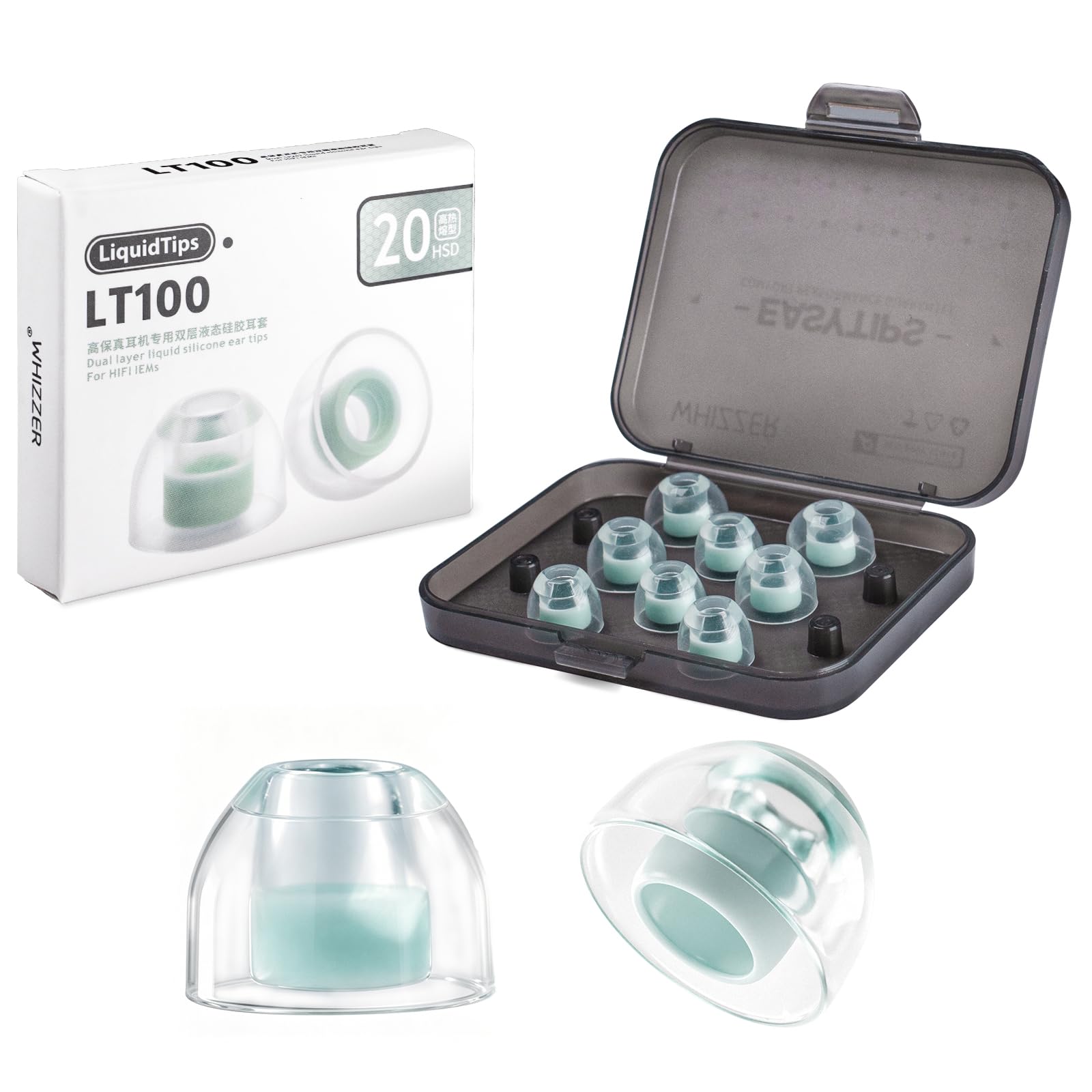
| WHIZZER LT100 Liquid SiliconeBest Value | Narrow or awkward nozzle tubes | Liquid silicone | 5-6.5mm | XS/S/M/L (4 pairs) | Amazon |
| Linsoul Kiwi Ears Flex | Waxy ears and open-nozzle IEMs | Silicone | Universal IEM | S/M/L (3 pairs) | Amazon |
| Comply 400 Core Series | Maximum noise blocking | Memory foam | Checked per model | Medium (6 tips) | Amazon |
| Divinus Velvet Wide Bore | Widening soundstage and treble | Silicone (matte) | 4-6mm | S, MS, M, ML, L | Amazon |
Detailed Reviews
1. Linsoul TANGZU Tang Sancai in Ear Monitor Ear Plugs, 3 Pairs
Our pick — over 4.5★ from 250+ verified ratings; the strongest balance of quality and price.
Vented silicone tips that release canal pressure during long listening sessions.
If you have ever pulled an IEM out and felt that little vacuum release, this is the pair built to end it. The Tang Sancai runs a 20 dB noise reduction rating — that is the measured amount of outside sound it blocks — and pairs that with medical-grade silicone, which the maker describes as non-toxic and hypoallergenic. You get three pairs in S, M and L, so you can find your size without buying twice.
The inner wall carries a ring of straight tooth grooves. TANGZU’s own description is that these help sound waves travel cleanly while dispersing unwanted high and low frequencies. In practice, listeners describe a wider, more open stage rather than a clamped-down one, and the reduced ear pressure is the thing that gets talked about most.
Here is the honest trade-off, and it is a real one for bassheads. Multiple long-term users report these lean the tuning bright: bass drops back while treble steps forward. One buyer put it plainly — “Leaps and bounds better than the OEM black tips that comes with Kiwi O Lites. No pressure build up, quicker seating & less heat!” — and another noted the bass does improve with more hours of use, though it stays lighter than a foam tip. Buy these for all-day comfort; buy foam if you want maximum thump.
What you gain
- 20 dB noise reduction rating with a vented design that lets pressure escape
- Medical-grade silicone described as non-toxic and hypoallergenic
- Matte texture that keeps its grip even through sweat and long sessions
- Three pairs in the box across S, M and L for easy size matching
Where it asks for patience
- Leans bright — low end pulls back compared with foam or narrow-bore tips
- The matte surface traps fine dust, so a quick wipe every week keeps it fresh
Reach for these if: you listen for hours and the pressure headache from sealed silicone is your daily annoyance.
Look elsewhere if: your playlist lives on sub-bass and you want the low end left untouched.
2. WHIZZER LT100 Liquid Silicone Ear Tips
Four sizes in one box, built for nozzles most tips simply cannot grip.
Narrow tubes are where cheap tips fail, and the LT100 is aimed straight at that problem. It is specified for 5-6.5mm nozzle diameter — a wider band than the Tang Sancai covers — and it ships four pairs across XS, S, M and L. People with genuinely small canals often find even standard small tips pop free during a walk.
Liquid silicone is softer and more pliable than regular silicone, so it seals against the canal wall rather than pressing on it. Buyers report it doing exactly that on hard-to-fit models: one owner with a 5.5mm nozzle said the stock tips were too small, lost the bass seal and slipped out, and these sealed and stayed put. The kit comes in a portable storage case and carries a 1-year warranty.
The XS difference: four sizes and a softer compound solve the two most common fit failures — tips too rigid for narrow canals and tips too loose for wide nozzles.
One caveat worth knowing: buyers reported these can block a charging case on some true-wireless earbuds, which means taking them off before every charge. On wired IEMs, that problem disappears entirely.
Confident buy for: anyone whose nozzle diameter sits outside the common range, or who needs an XS that actually seals.
Think twice if: you planned to fit these onto wireless earbuds that drop into a charging case.
3. Linsoul Kiwi Ears Flex Ear Tips

Silicone tips with a built-in wax guard and a chamber tuned to lift low frequencies.
An anti-earwax structure is the whole point here, and it is the detail that separates the Flex from every other silicone tip on this list. Sound has to pass through a built-in guard so wax never reaches the mesh on your IEM. That matters most on open-nozzle models, where dust and debris drop straight onto the driver housing.
Inside, the Flex uses a dedicated chamber tuned to lift low frequencies — a proper bass boost rather than the bass loss you get from some airy tips. Buyers describe a fuller low end arriving alongside clearer treble, and the design also relieves eardrum pressure with a rebound architecture the maker says mitigates fatigue over long sessions. The silicone is medical-grade and described as hypoallergenic. Sizes run S, M and L.
Two honest notes. Fitting them takes a moment on some IEMs — several owners describe needing effort to seat them on Moondrop models before they lock in securely — so budget thirty seconds, not a wrestling match. And the kit only comes as a three-size sampler, so if you know your size you are paying for two pairs you will not use.
The wax argument: if you have ever scraped wax off an IEM nozzle with a pin, this guard pays for itself.
Pick these up if: your IEMs run open nozzles, or your ears produce enough wax to clog mesh filters regularly.
Skip the multi-size kit if: you already know your exact tip size and would rather buy a single size in bulk.
4. Comply 400 Core Series Ear Tips

Body-heat memory foam that molds to your canal for maximum isolation, at the cost of a shorter lifespan.
Everything about the Comply 400 depends on one behavior: the foam is body-heat activated, so it softens in your ear and molds itself to your canal shape. Silicone pushes back against the canal wall. Foam fills whatever space it finds, and that is why its seal is stronger and its isolation deeper than any silicone tip here — so you hear less of the bus and more of your music.
You receive six foam tips in medium. The compatibility list is long and specific — Bose QuietComfort 20, Sennheiser IE300, IE 40 PRO and IE 400 PRO, Campfire Audio Andromeda, 7Hertz Timeless, NuraLoop, ikko OH10, TIN HiFi T4 among others — and the maker’s advice is blunt: check your exact model on their site before ordering, so you don’t end up with tips that won’t fit.
The flip side is lifespan. Foam is the one material on this list that softens, collects wax and eventually hardens with use, so it is a consumable rather than a one-time purchase. Buyers on the review pages repeatedly mention replacing sets over time. Care is simple: warm water and a soft cloth only, never alcohol-based cleaners or lotions.
Why the foam wins
- Body-heat activation molds the tip to your own canal for a customized fit
- Deeper isolation and better grip than silicone — tips stay put while you move
- Enhances clarity across lows, mids and highs on compatible models
- Six medium tips included, with warm-water cleaning advised
The ownership reality
- Foam is a consumable — it collects wax and hardens with age, so plan to re-buy
- Only medium is included, so ears outside that range need a different pack
- Model compatibility must be checked before buying
Tailor-made for: commuters and flyers who want the outside world turned down and the IEMs locked in place.
Wrong choice if: you want one purchase that lasts for years — silicone wins that argument.
5. Divinus Velvet Wide Bore Eartips

Wide-bore silicone tips that widen the soundstage and bring treble forward.
Wide bore is the headline and it does the heavy lifting. Instead of narrowing the sound path, the Velvet runs a broad tube structure that DIVINUS says boost both high and low ranges — closer to a speaker presentation than a pinched one. If your IEMs feel boxed in and shut down, this is the shape that opens them up.
The surface treatment is the second design idea. A high-pressure matte coating with a micro-embossed finish gives a soft velvet feel that repels dust, so your tips stay cleaner between wipe-downs. Sizing spans five steps — S, MS, M, ML and L — a wider ladder than most, which means a better chance of nailing your exact middle size rather than settling for close enough. This listing is the S three-pair pack, and it fits 4-6mm nozzles.
Compare the tuning against the TANGZU set above. Both are silicone and both reshape the sound, but they pull in different directions: the Tang Sancai trades bass for pressure relief and comfort, while the Velvet chases width and treble sparkle. Neither is the neutral choice — both are deliberate colorations. If you want your IEMs left exactly as tuned, a plain narrow tip is the safer call.
Why the bore matters here: a broad opening moves more air, and buyers describe being able to close their eyes and pinpoint individual sound sources across the stage.
Check the size before you order: this listing ships three pairs in a single size, so a mistake means three useless tips rather than a mixed sampler.
Built for: listeners who want a wider, airier stage and their treble brought forward.
Not the pick if: you need a bass-first sound or a sampler with multiple sizes in the box.
Know the Specs
Nozzle diameter
The outer width of the tube on your earphone, usually somewhere between 4mm and 6.5mm. A tip rated for 5-6.5mm stretches over the wider tubes; a tip rated for 4-6mm covers the slimmer end. Mismatch here is the number one reason a good tip falls off or bunches. Measure your existing nozzle with a ruler if you are unsure, or check your IEM’s published spec.
Noise reduction rating
Measured in decibels, this tells you how much outside sound the tip blocks. The Tang Sancai carries a 20 dB rating. Higher blocking means quieter listening at lower volume, which is the reason foam tips exist at all. Silicone tends to block less because it stays rigid, while foam expands to fill gaps and seals tighter.
Bore width
The size of the opening sound travels through. Wide bore moves more air and typically widens the stage while lifting treble — that is exactly what the Divinus Velvet is designed around. Narrower bores tighten the low end and calm bright highs. Your choice depends on whether your current IEMs are already bass-heavy or already sharp.
Material and lifespan
Silicone holds its shape, cleans easily and can last a long time with basic care. Memory foam adapts to your ear through body heat and seals harder, but softens, traps wax and hardens with age, making it a consumable. Clean silicone foam-free with warm water; never use alcohol-based cleaners on foam, as they break the material down.
Common Questions
How do I know which size ear tip I need?
Will these ear tips fit my existing IEM nozzles?
Do foam tips block more noise than silicone tips?
Why do some ear tips boost bass and others lose it?
How often should I replace my IEM ear tips?
What causes pressure buildup in my ears after long listening?
Can I use IEM ear tips on true wireless earbuds?
Is wide bore better than narrow bore for IEMs?
How do I clean silicone versus foam ear tips?
Do ear tips actually change the sound of my IEMs?
The Bottom Line
Match the tip to your ear canal and nozzle, not to the price tag. For most listeners, the ear tips for iems pick is the Linsoul TANGZU Tang Sancai, because it removes the pressure and the vacuum feeling that make long sessions uncomfortable while still sealing well enough to sharpen the sound. If your nozzle sits outside the usual range or you need a genuinely small size, grab the WHIZZER LT100 — four sizes in one case, so you can find your fit without guesswork. And when you want the outside world turned down and the bass left thick, the Comply 400 foam is still the one that shuts the door.
Buy a multi-size sampler first, confirm your size, then commit to the material that fits your listening habits.
How we choose
We do not accept paid placement. Every pick is matched to a real buyer and a real use-case; we do not hands-on test units.
Sources
Specifications: manufacturer listings and product documentation. Review insights: verified customer reviews, as of October 2026. Pricing: not shown on this page (it changes often); check the current price via the retailer link.
As an Amazon Associate, Aappliancez earns from qualifying purchases. This does not affect which products we feature.