Disclosure: Some links in this post are affiliate links. As an Amazon Associate I earn from qualifying purchases, at no extra cost to you. Learn more
Specs are compiled from manufacturer listings and verified buyer reviews and can change over time — please confirm the key details on the product page before buying.
Buying a dwarf Encore Azalea online is a gamble on the plant that actually lands on your porch, and the single thing that decides it is pot size. A 2-gallon plant is a smaller, younger shrub than a 3-gallon one, so it starts smaller and takes another season or two to fill out. Pick the right gallon size and you get a compact shrub that blooms in spring, summer, and fall. Get the spacing wrong and the canopies crowd into a woody tangle that never puts on a decent show.
This guide is built by comparing the manufacturers’ published specifications and the patterns across verified customer reviews, so you get each pick’s real strengths and trade-offs instead of marketing spin.
Below you will find the strongest options for dwarf encore azaleas ranked by how they actually arrive and grow.
Top Picks


How To Choose The Best Dwarf Encore Azaleas
You get three seasons of flowers from one shrub instead of a single spring show. A dwarf Encore Azalea is not one plant — it is a family of evergreens bred to bloom in spring, summer, and fall. That repeat bloom is the whole reason people pay more for the Encore name. Four things you can read straight off the listing separate a good buy from a disappointing one.
Check Your USDA Zone Before Anything Else
USDA hardiness zones are a temperature map of your area, and every azalea listing names the range it survives. The numbers differ across these shrubs: some are rated for zones 6a–10b, others for 6–10, others for 6–9, and one for 6–8. If you live in zone 5, none of these will reliably overwinter outside. Match the zone first, then look at colour and size.
Understand Pot Size (2-Gallon vs 3-Gallon)
Pot size tells you how mature the root ball is when the box opens. A 2-gallon azalea is a younger, lighter plant; a 3-gallon plant carries more rooted soil and typically arrives with more established branching. Bigger is not automatically better in a container, where a heavy potted shrub dries out faster and needs more room for its roots.
Do the Spacing Math Up Front
Spacing is the number most buyers skip, and it is the one that decides whether your shrubs merge into a hedge or sit apart like lonely bushes. The recommended gap tracks the mature width: one listing says 48 inches, another says 36–42 inches. Measure your bed before you order, not after.
Know What Reblooming Actually Asks For
A reblooming azalea needs light to repeat its show. Listed light needs here range from partial sun to full or partial sun, and one listing recommends at least 4–6 hours of direct sun daily. Too much shade cuts the summer and fall flushes — the plant lives, but it does not rebloom.
Side-by-Side Comparison
| Model | Best For | Pot Size | USDA Zone | Mature Size | Amazon |
|---|---|---|---|---|---|
| Encore Azalea 2 Gal. Autumn Twist Shrub★ Best Overall | Widest zone range and a repeat colour show | 2 Gallon | 6a–10b | 48 in. W x 54 in. H | Amazon |
| Encore Azalea 2 Gal. Autumn Embers ShrubBest Compact Pick | A compact red in a smaller bed | 2 Gallon | 6–10 | 42 in. W x 36 in. H | Amazon |
| Encore Autumn Embers 2 Gallon Red-Orange Shrub | Pollinator-friendly borders with full-sun light | 2 Gallon | 6–9 | About 3 ft tall x 3.5 ft wide | Amazon |
| Perfect Plants Autumn Bonfire Encore Azalea, 3 Gallon | A head start from a bigger root ball | 3 Gallon | — | Approximately 3 ft tall | Amazon |
| Azalea Encore Autumn Twist Shrub, #3 Container | White, pink and purple splashes up close | 3 Gallon | 6–8 | 4–5 ft tall x 3–4 ft spread | Amazon |
Detailed Reviews
1. Encore Azalea 2 Gal. Autumn Twist Shrub
Our pick — 4.5+★ from 400+ verified ratings; the strongest balance of quality and price.
Two-tone purple flowers, a zone range that runs from 6a to 10b, and a shrub that lived through a real winter.
This shrub survives winters that would kill narrower-rated plants. The number that covers the most ground is USDA zone 6a–10b — a cold-tolerance map that tells you the coldest winters a plant can take. For anyone who gardens in a state with real frost, that latitude is the reason this one takes the top spot. It is the widest range on this list — the Azure listed further down stops at zone 8.
Then there is the shape. It matures to 48 in. wide by 54 in. tall, so it is a shrub that goes wider than it is tall — good news in front of a low window, less good in a tight entry bed. The listing recommends 48 inches of spacing between plants. That is a wider gap than the 36–42 inches the Autumn Embers asks for, and it matters: give it the full 48 inches and the canopies meet into one flowering hedge instead of a row of separate bushes.
What wins people over is the quality of the plant that comes from the start — full branching, healthy foliage, and a potted root ball that is ready to go straight into the ground. The recurring honest gripe is bloom reliability: some plants arrive budded and blooming, others sit quiet for a while first. Expect the colour to shift a little too, with the bi-colour purple settling in as it opens. As buyers in zone 7a put it, shrubs “planted in my garden zone 7a in fall, survived this winter and got new leaves in April.” That is a two-season track record, and it is why this pick wins.
Where it earns its keep
- Zone 6a–10b is the widest cold tolerance across the five plants here
- 48 in. wide x 54 in. tall gives you a real hedge-height shrub
- Evergreen, so the bed keeps structure through winter
- Blooms across spring, summer and fall rather than a single flush
Plan around this
- 48-inch spacing needs a bigger bed than a compact landscape suggests
- Bloom timing varies by plant — some arrive budded, some wait
- The bi-colour purple can read more pink as the flowers age
Go for it if: you want a wide, low hedge in a cold-winter garden and can give each plant 48 inches.
Look elsewhere if: your bed is narrow and you want a tighter shrub at 42 inches across.
2. Encore Azalea 2 Gal. Autumn Embers Shrub
A red that keeps going into December in the right climate, in a footprint that fits a small bed.
If your garden bed is small but you still want the triple-season bloom, this is the one to size around. It matures to 42 in. wide by 36 in. tall — noticeably more compact than the Autumn Twist at 54 in. tall — and the recommended spacing is 36–42 inches instead of 48. On a patio border or beside a front door, those 12 fewer inches of width are the difference between fitting and crowding.
You get red flowers almost year-round in warm-winter areas. This plant is rated for zones 6–10 and wants moderate watering with partial sun. Owners in warm-winter areas describe the red blooms going nearly year-round. In Northern California — where summers touch 110°F and winters drop into the 20s — the plant has bloomed in spring, again in late summer and early fall, and was still flowering in December. That is a reblooming azalea doing exactly what it was bred to do.
The honest catch is that plant size varies from order to order. Buyers report “I ordered one of these and a plant a good 18″ tall arrived. I reordered and I got a barely potted 9″ plant that had no root system… dirt fell out of pot.” It is the most-discussed issue on this listing, so order early in a season when you can still swap a runt, and keep the box’s arrival week in mind. A few owners also lose plants to poor soil rather than the shrub itself, so site it in ground that drains.
Red that persists: in mild-winter zones this shrub holds flower colour far past the spring flush, which is the whole point of an Encore.
The catch to plan for: delivered height is inconsistent between orders, so treat the arrival as a starting point and not a finished plant.
Reach for this if: you have a small bed and want red blooms over three seasons.
Pass if: you need a guaranteed mature-size plant on day one of planting.
3. Encore Azalea Autumn Embers 2 Gallon

Orange-red blooms, a listed 4–6 hours of daily sun, and a shrub that brings butterflies to the border.
The defining fact here is the light requirement: full sun to partial shade, with at least 4–6 hours of direct sun a day. That is a firmer sun ask than the mostly-partial-sun descriptions on the others, and it steers where you plant. A west-facing bed that bakes all afternoon suits it. A shaded corner does not, and the shrub will flower thinly there.
It stays a controlled shrub rather than a hedge filler, at about 3 feet tall and 3.5 feet wide — middle of the group. Two extras come listed with it that the others do not spell out: it attracts pollinators, and it carries an extended bloom time. At 10 pounds for the potted plant, it is also the lighter of the two 2-to-3-gallon comparisons here, since the Perfect Plants 3-gallon shrub ships at 12 pounds — a bit easier to lift from the start and carry to the hole.
Healthiness is what the review pages keep returning to: full bushes, quick delivery, and plants that settle in and hold. The recurring complaint is the opposite end — the occasional box arrives with dried leaves, and the shrub then needs steady watering to recover. Spring is the listed planting period, and there is a seven-day window to report anything that arrives dead or damaged, so open the box the day it lands.
Why it belongs here: the sun and pollinator details are stated plainly, so you can match it to a specific bed instead of guessing.
What to watch: dried leaves in the box are the usual sour note, and recovery depends on how consistently you water that first month.
Best matched to: a sunny border where you want butterflies and an orange-red show.
Not for: deep shade, where the bloom count drops off.
4. Autumn Bonfire Encore Azalea 3 Gallon
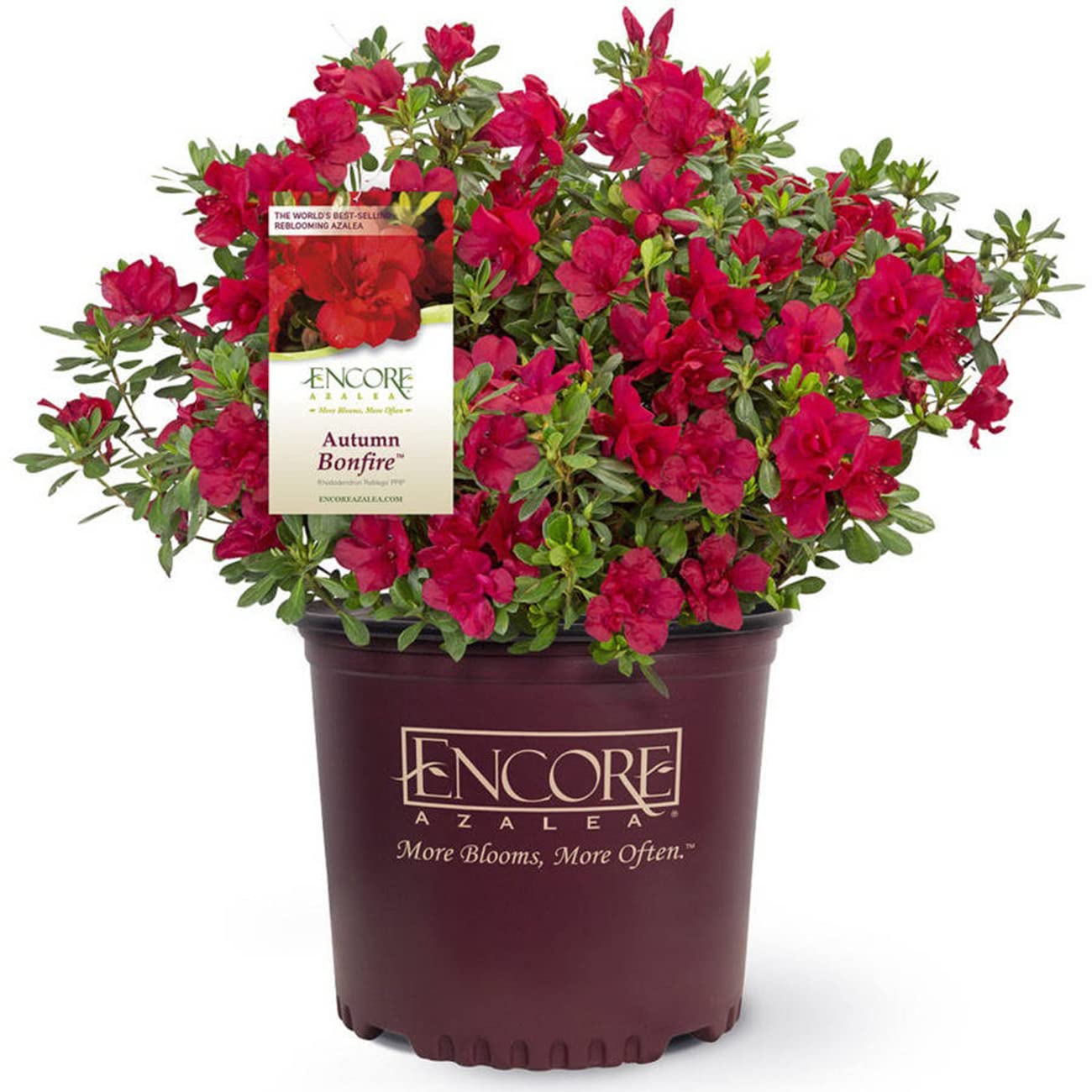
A 3-gallon start with glossy evergreen leaves and flame-red flowers that pull in birds and butterflies.
You get a head start with a 3-gallon pot — a more established root mass and more branching on arrival than a 2-gallon plant delivers, so you spend less time waiting for the shrub to look like a shrub. The plant tops out at roughly 3 feet, which keeps it genuinely dwarf in a landscape. It is listed as fast growing — useful when you are filling a tree line or a low hedge and do not want bare ground for two seasons.
It is a full-sun-to-partial-shade plant, with the caveat spelled out directly: without enough sun it will not bloom as full. Watering is listed as regular rather than occasional, and fertilizing 2–3 times during the growing season starting in early spring is recommended. Glossy evergreen foliage carries the bed through winter after the red flowers finish, and the sweet scent is noted as a pollinator draw.
Health is the trait that carries this plant’s reputation — full of new growth, arriving on time, and looking strong from the start. Fewer owners have weighed in on this listing than on the two 2-gallon Encore picks, so you are leaning more on the listed specs than on a long track record. The trade is straightforward: you pay more and lift more weight in exchange for a bigger plant on day one.
Arguments for the bigger pot
- 3-gallon root ball arrives more established than a 2-gallon plant
- Stays roughly 3 feet tall, so it fits a dwarf landscape plan
- Glossy evergreen leaves hold the bed through winter
- Listed as fast growing for hedge and tree-line use
The honest trade-offs
- At 12 pounds it is heavier to lift and position than a 2-gallon shrub
- Needs full sun to bloom at its best — shade thins the flowers
- Shallower review history than the two 2-gallon Encore plants
Worth it when: you want the fullest plant possible on planting day and have full sun.
Think twice when: you are planting into a shaded bed or moving pots alone.
5. Azalea Encore Autumn Twist #3 Container

White flowers splashed with pink and purple, shipped rooted in a 3-gallon trade pot from the nursery.
This is the pick for colour that reads as a pattern rather than a block. The flowers are listed as white with pink and purple splashes, so from a few feet away you get a mixed, watercolour look that a solid red or solid purple shrub cannot give you. It arrives fully rooted in a 3-gallon trade pot and can go straight into the ground on arrival, weather permitting — a real advantage over a bareroot plug or a small starter.
Check two numbers before you order. First, zones 6–8: that is the narrowest cold tolerance on this list, so if your winters run colder than zone 6, this is not the shrub for you. Second, the mature size of 4–5 ft tall by 3–4 ft spread — that is the tallest plant here by a clear margin. “Dwarf” on this listing still means it can reach eye level, so space accordingly if you plan a row.
What comes through in owner experience is care in packing and a plant that keeps performing: shipped carefully, flourishing months later, and producing flowers over many months before going quiet for winter. The trade-off is that your options here are fewer, so a dud order is harder to average out against a hundred other reports — worth ordering early in spring when the nursery has more stock.
The colour case: white with pink and purple splashes gives a varied bloom that solid-colour azaleas cannot match.
Size reality check: at 4–5 ft tall it is the tallest of the five, so plant it where the height works, not where you pictured a knee-high shrub.
Choose this if: you garden in zones 6–8 and want a multi-toned bloom in a larger shrub.
Skip if: your winter runs below zone 6, where this plant will not reliably survive.
Know the Specs
USDA Hardiness Zone
A zone is a number on a map of average winter low temperatures, and it is the first thing to check. A plant rated for zones 6–10 will survive a colder winter than one rated 6–8. If your zone is outside the listed range, no amount of watering will fix it — the shrub will die back in a hard freeze.
Pot Size (2-Gallon vs 3-Gallon)
Gallon size here means the volume of the nursery pot, which tells you roughly how much root mass you are buying. A 3-gallon plant typically arrives with more established branching than a 2-gallon one, but it also weighs more and costs more. Smaller pots are easier to handle; larger pots save a season of waiting.
Spacing
Spacing is the gap you leave between planted shrubs so their mature canopies meet without crowding. It tracks the mature width — one listing recommends 48 inches, another 36–42. Measure it out with a tape before you dig; planting too tight is the most common reason a hedge looks woody in the middle.
Sun Requirement
“Partial sun” means a few hours of direct light a day, while “full sun to partial shade” tolerates more. One listing here asks for at least 4–6 hours of direct sun daily. Reblooming azaleas need that light to put on their second and third flower flush, so watch where the sun lands in your yard before you buy.
Common Questions
Will a dwarf Encore Azalea survive my winter?
How far apart should I plant dwarf Encore Azaleas?
What is the difference between a 2-gallon and 3-gallon azalea?
Do Encore Azaleas really bloom more than once a year?
How much sun does a dwarf Encore Azalea need?
Will an azalea ordered online arrive alive and blooming?
Can I grow a dwarf Encore Azalea in a container?
When is the best time to plant a mail-order azalea?
How tall will a dwarf Encore Azalea actually get?
What kind of soil do these azaleas need?
The Bottom Line
For most gardeners, the dwarf encore azaleas winner is the Encore Azalea 2 Gal. Autumn Twist Shrub because its zone 6a–10b rating covers the widest range of winters on this list, and the 48 in. x 54 in. mature size makes a real hedge. If you need a compact red for a small bed, grab the Autumn Embers 2 Gallon, which tops out at 36 in. tall. And for a bigger root ball on planting day, the Perfect Plants Autumn Bonfire 3 Gallon is the one to reach for. Zone range is the first filter; every other spec is secondary to whether the shrub survives your winter.
How we choose
We do not accept paid placement. Every pick is matched to a real buyer and a real use-case; we do not hands-on test units.
Sources
Specifications: manufacturer listings and product documentation. Review insights: verified customer reviews, as of October 2026. Pricing: not shown on this page (it changes often); check the current price via the retailer link.
As an Amazon Associate, Aappliancez earns from qualifying purchases. This does not affect which products we feature.