Disclosure: Some links in this post are affiliate links. As an Amazon Associate I earn from qualifying purchases, at no extra cost to you. Learn more
Specs are compiled from manufacturer listings and verified buyer reviews and can change over time — please confirm the key details on the product page before buying.
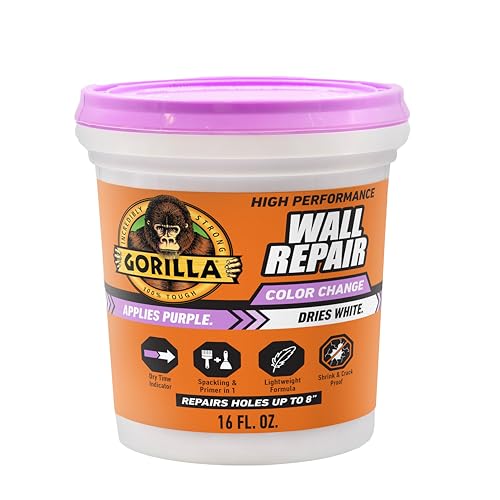
You want a patch that dries hard, sands smooth, and doesn’t leave a dimple behind. The fastest route is a color-change compound like the GORILLA tub, which goes on purple and turns white when it’s dry, so you stop guessing at sanding time. Below you’ll find the five compounds that actually earn a spot on your shelf, sorted by what each one is genuinely best at: spreadability, shrink resistance, one-coat depth, or sheer volume for a whole-house job.
This guide is built by comparing the manufacturers’ published specifications and the patterns across verified customer reviews, so you get each pick’s real strengths and trade-offs instead of marketing spin.
Some tubs are built for a quick patch behind a door and some are built for a full remodel, so the trick is matching the formula to the job rather than buying the biggest bucket. Here is how to pick from the best drywall joint compound options without overbuying or ending up with a tub that shrinks on you.
Top Picks

How To Choose The Best Drywall Joint Compound
A joint compound has one job: fill the hole, dry hard, and disappear under paint. Three things decide whether your patch looks invisible or shows a faint ring six months later. They are how much the compound shrinks as it dries, how easily it sands, and how deep you can lay it in one pass.
Shrinkage is the number nobody puts on the label
Traditional dense compounds are loaded with water, and that water has to go somewhere as it dries. As it leaves, the patch pulls inward and leaves a shallow dish in the middle of your repair. Lightweight formulas replace some of that density with air bubbles, so there is less material collapse once the moisture is gone. That’s the entire reason a “lightweight” tub can cost more per ounce and still be the smarter buy on anything wider than a dime. A dense paste spreads easier on the first knife stroke but will often dimple if you over-smooth the first coat.
Deep fills need a compound that stands up
On a flat wall, gravity is your friend — the compound just sits there. On a ceiling, or in a hole deeper than a shallow dent, gravity becomes the enemy and the material sags out of the cavity before it sets. Look for a non-sag claim on the tub if you’re working overhead or filling anything substantial. For anything deeper than a shallow layer, most makers advise building it up in layers and letting each one dry rather than shoving all the material in at once. Thick single-layer fills are the single biggest cause of cracks reappearing months later.
Sandability decides how much of your weekend disappears
Some compounds dry to a surface that fights the paper — you push, the grit clogs, and you’re back at the store. Others crumble into dust with two light passes. If you’re repairing a painted wall you’ll want a compound you can feather out past the edge of the repair, so the transition from patch to wall is gradual and invisible under raking light. A hi-tech detail that genuinely helps here is a dry-time indicator: the compound shifts color when the moisture has left, so you know the moment it’s safe to sand instead of guessing and tearing a half-set patch.
Match the tub size to the job
A small tub covers the patch behind the bathroom door. A gallon covers a whole room of nail pops and corner scrapes. Buying a big bucket for two holes means most of it skins over before you get back to it, and buying a small tub for a full remodel means running out halfway through the second wall. Check the stated coverage in square feet where the maker publishes it, and treat fluid ounces as a volume measure — they are not the same thing and shouldn’t be compared across products.
Side-by-Side Comparison
| Model | Best For | Container Size | Stated Coverage | Dry Time | Amazon |
|---|---|---|---|---|---|
| GORILLA High Performance Wall Repair★ Best Overall | First-time patchers | 16 fl oz tub | See package | Color-change indicator | Amazon |
| DAP Alex Plus SpacklingBiggest Coverage | Big remodeling jobs | 32 oz tub | 500 sq ft | Within 1 hour at 1/8″ depth | Amazon |
| DAP Fast ‘N Final Lightweight | Fast turnarounds | 1 qt | 120-198 sq ft | 30 minutes full cure | Amazon |
| Everbuild One Strike | Deep gap filling | One Strike tub | Fills to 75mm depth | 30 minutes | Amazon |
| Red Devil ONETIME Lightweight Spackle | Whole-house volume | 1 gallon | Not listed | Not listed | Amazon |
Detailed Reviews
1. GORILLA Wall Repair 16 oz
Our pick — 4.5+★ from 300+ verified ratings; the strongest balance of quality and price.
The tub that tells you when it’s dry instead of making you guess.
If you’ve ever sanded a patch too early and smeared it across the wall, this is the fix for that exact mistake. The GORILLA compound goes on purple and turns white once the moisture has left, so you get a visible green light before you touch it with paper. That single feature is why it takes the top spot: it removes the guesswork that ruins more beginner repairs than bad technique ever does.
The rest of the formula holds up too. It’s a lightweight paste that spreads without sagging, so a hole in a ceiling behaves roughly like a hole in a wall. GORILLA states the finish resists shrinking and cracking and paints like bare drywall. The 16 fl oz tub (16 fluid ounces of paste) suits touch-up work around the house rather than a full remodel. On volume, this tub holds 16 fl oz — double the 16 oz wall repair tub from GORILLA’s own sibling listing in the same aisle — so one tub handles a longer punch list than it looks like it will.
What wins people over is the combination of quality and straightforward performance; the finish sands easily and paints over without fuss. A buyer who knocked a toilet paper holder clean off the wall reported that it “worked perfectly for filling the holes” with a little filler tape behind it. Sealing matters more than people expect — the tub dries out if you leave the lid loose, and a buyer who kept it pressed down found it held up through multiple openings without hardening. The honest catch is temperature: the maker says not to apply it below 40°F, and it’s not built for continuous water submersion, so it’s the wrong tool for a shower wall or a cold garage in January.
What earns it first place
- The purple-to-white shift removes all drying-time guesswork
- Lightweight no-sag paste spreads smoothly on walls and ceilings
- Shrink- and crack-resistant finish that paints like drywall
- 16 fl oz tub is easy to seal and store between projects
Where it asks you to plan ahead
- Not recommended below 40°F or for continuous water submersion
- Tub is sized for repairs, not a whole-room remodel
Reach for this if: you want a confident, visible signal that the patch is ready to sand — especially on a first repair.
Plan around this: keep the lid pressed tight between uses and stay above 40°F, or the tub will skin over.
2. DAP Alex Plus Spackling, White, 32 Oz (7079818746)
Five hundred square feet of coverage in one tub — this is the remodeler’s pick.
Nothing else on this list comes close on stated coverage. DAP lists this tub at 500 sq ft (square feet of wall area it can treat). The Fast ‘N Final tub lists 120-198 sq ft. That gap is the difference between patching one room and working through a whole floor of nail pops and corner scrapes without running back to the store. It’s a professional-strength latex paste built for drywall, wood, and metal, and it holds up indoors and outdoors.
The formula is de-aired, which means it tools out smooth instead of dragging and tearing under the knife, and it cleans up with plain water. DAP states the patch dries within 1 hour at 1/8″ depth, and tells you to build deeper fills in two or more layers with drying between them. Sand it and it takes paint like bare drywall. One finish carpentry buyer found it especially good for covering joinery mistakes and shaping defects to blend into the background, noting it “spreads and shapes beautifully, dries quickly, sands easily, and doesn’t shrink.”
The trade-off is density. This is a heavier compound than the lightweight tubs, so it can dimple if you smooth the first coat perfectly flat before it sets. A buyer working across multiple rooms found it resists shrinkage but not entirely, and advised against over-smoothing on the first pass. It’s also not the fastest drier of the group compared with a lightweight formula. Get past those two quirks and the value math is excellent, because one tub goes a long way.
The coverage math: 500 sq ft stated on the label is the largest footprint here, so a single tub handles a full room of repairs instead of a single wall.
Where it’s slower: it’s a dense latex paste, so it dries slower than lightweight compounds and will dimple if you flatten the first coat too hard.
Best matched to: anyone with a long punch list across several rooms who wants one tub to finish the job.
Look elsewhere if: you’re filling a single pinhole and want the fastest possible turnaround.
3. DAP Fast ‘N Final Spackling 1 qt.
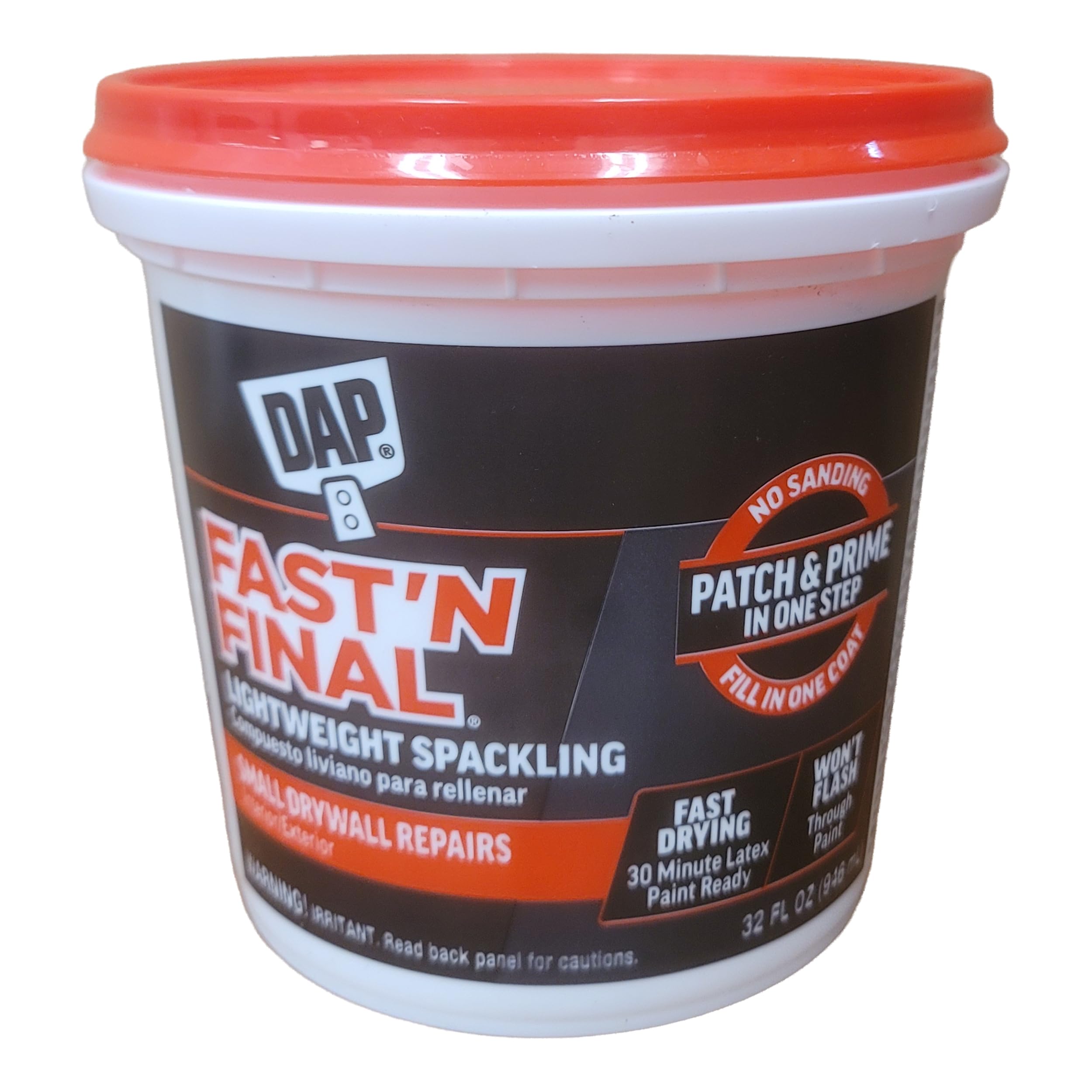
Half an hour from knife to paint — the fastest full cure on the list.
The headline number here is a 30-minute full cure, and the fast dry is exactly what buyers talk about most. It’s a lightweight paste, so it spreads like icing rather than dragging, and it feathers out easily at the edges of a repair. One tub covers 120-198 sq ft depending on how thick you lay it. Against the GORILLA tub’s 16 fl oz, this quart holds 32 fl oz — twice the volume for a longer run of patching.
It also carries a color cue of its own: it goes on pink and dries white, so you get a visual check on readiness without a separate indicator system. The lightweight body makes it a good match for small and large holes alike. Buyers have pushed it well past drywall — one reported patching stucco holes from golf ball damage and getting a durable, water-resistant fill that matched the texture once painted. That buyer applied it to high areas with a putty knife taped to a pole to skip the ladder. Crafters have adopted it too, using it for faux whipped cream and hot-cocoa mug toppers, which tells you how cleanly it holds a shape.
Two things to know before you commit. The consistency draws mixed feedback — some find it stays spongy well past the stated cure, and one buyer found it a touch grittier than ideal, guessing there’s a trade-off between microscopic smoothness and speed. Painting also divided opinion, with primer needed in some cases. Neither is a dealbreaker for small repairs, but on a wide, highly visible patch you may want to prime and plan an extra sanding pass.
Why speed-seekers like it
- 30-minute full cure gets you to paint the same morning
- Goes on pink, dries white — a built-in readiness check
- Lightweight paste feathers out cleanly at repair edges
- 120-198 sq ft of stated coverage per quart
Where it can disappoint
- Consistency can stay spongy longer than the stated cure
- Some patches need primer before paint
- Can feel slightly gritty compared with a dense paste
Pick this when: the wall has to be painted today and you want a lightweight compound that tells you when it’s ready.
Think twice if: your patch is broad and highly visible — budget an extra sanding pass and a coat of primer.
4. Everbuild One Strike Filler
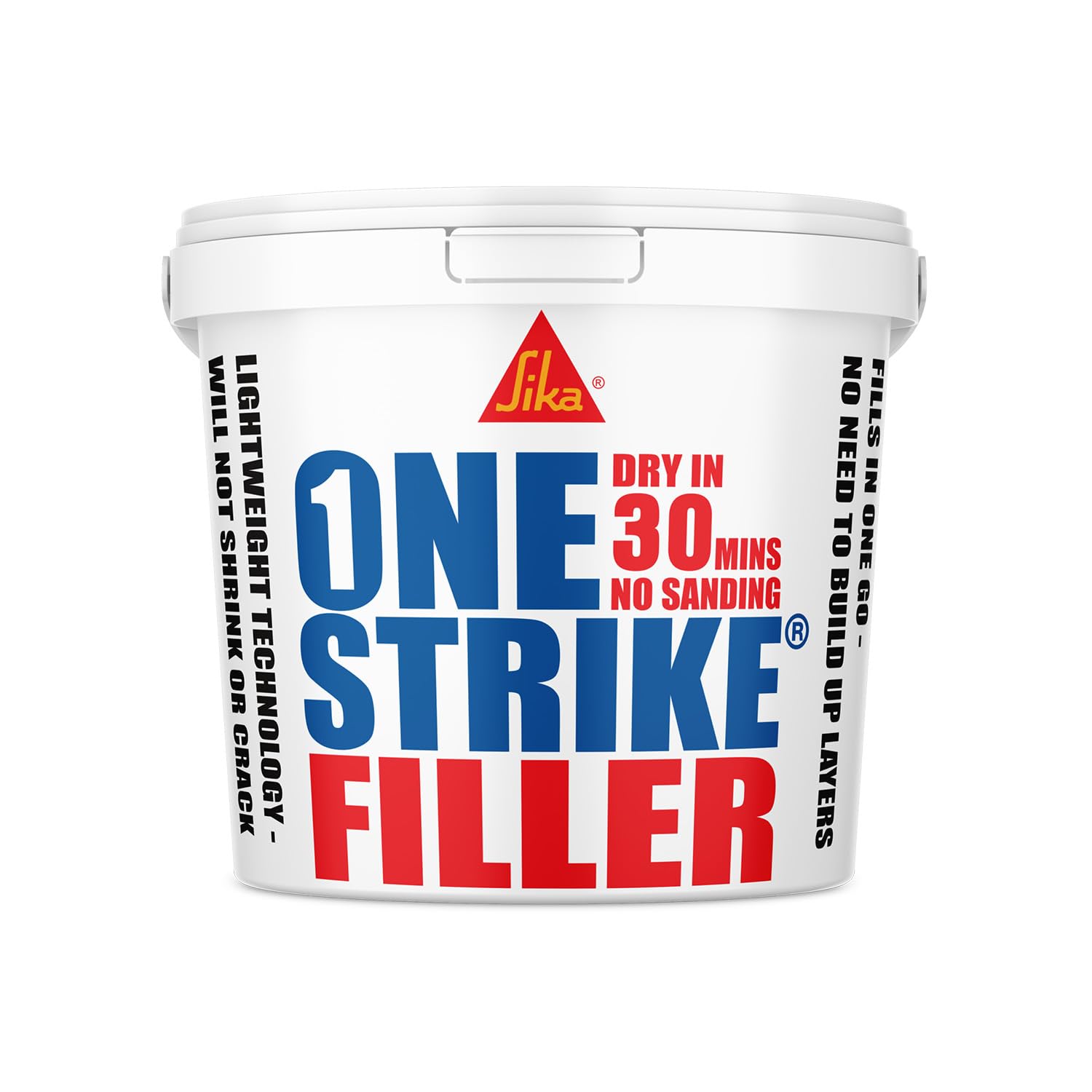
Built for the deep holes other compounds make you fill twice.
Most spackles want you to build depth in layers. This one doesn’t. Everbuild states it fills gaps and holes to a depth of 75mm in a single application, up to a maximum width of 50mm, which is why it sits alone in this group on pure gap-filling muscle. The non-sag formulation is what makes that possible — the material stays where you put it on walls and ceilings instead of slumping out of the cavity before it sets.
It’s ready to use straight from the tub, finishes to a smooth surface without any sanding or mixing, and dries brilliant white. The maker states you can paint or paper over it after 30 minutes. Buyers describe it as ultra-light in the pot, stirring like melted marshmallows and applying with almost no effort. It also sands smooth if you do choose to touch it up, and paint holds its true color rather than darkening over the filler.
Versatility is the other reason it’s here. It handles plaster, brick, stone, wood, and render, indoors and out, so it covers repairs that a drywall-only spackle would leave you short on. The realistic caveat: the ultra-light body means a heavy load in one spot can push the dry time past the stated half hour. Spread it in sensible passes rather than one thick heap and the timing holds. For small wall repairs it’s simply quick and clean, and for anyone who finds mixing and sanding a chore, the no-sand finish is the real selling point.
The one-strike advantage: a stated 75mm fill depth in a single pass means deep holes and chases don’t need a second tub or a second weekend.
What to watch: pile it on thick in one spot and the 30-minute dry time stretches — thin, even passes keep it on schedule.
Made for: deep holes, chases, and mixed surfaces like brick, stone, and render where a drywall-only spackle falls short.
Not ideal for: anyone who wants a traditional dense paste to shape and blend over fine detail work.
5. Red Devil 0541 ONETIME Spackle 1 Gallon

A full gallon for the homeowner who keeps finding more holes.
When the punch list runs through every room in the house, a small tub runs dry before the job does. This is a full gallon of lightweight spackle, formulated to fill holes, cracks, and dents in one application, and the no-sand formula is meant to leave a smooth, paint-ready surface without the dust cloud. It’s rated for drywall, plaster, wood, and stucco, indoors and outdoors, so it’s the most surface-versatile of the drywall-focused options here.
Red Devil states it won’t shrink, crack, or flake and is paintable in minutes — the claims that matter when you’re patching a whole room and don’t want to revisit a repair. The lightweight body sands easily, which matters at this volume because you’ll be sanding far more surface area than you would on a single repair. It’s made in the USA and it’s the largest container in this group by a wide margin.
The drying time is the honest weak spot — some buyers find it dries fast, others find it slow, so treat the claim as variable rather than guaranteed. It’s also a messy material to work with at this scale, and spreading a drop sheet before you start is worthwhile advice. The no-sand claim holds best on shallow fills; anything deeper is still going to want a light touch-up. For a garage, a rental turnover, or a full-house repaint, the volume makes it the practical choice.
The case for the gallon
- Full gallon covers a whole-house punch list in one buy
- No-sand formula aims for a paint-ready finish
- Rated for drywall, plaster, wood, and stucco, inside and out
- Lightweight body sands easily across large areas
The honest caveats
- Drying time is inconsistent — sometimes fast, sometimes slow
- Messy to work with at this volume; lay a drop sheet first
- No-sand finish works best on shallow fills
Right for: landlords, flippers, and anyone staring down a whole-house repaint who wants one big tub and no repeat trips.
Overkill for: a couple of nail holes — the gallon will skin over long before you use it up.
Know the Specs
Coverage in Square Feet vs Fluid Ounces
These two numbers measure different things and shouldn’t be swapped. Square feet is the wall area a tub can treat — DAP lists the Alex Plus tub at 500 sq ft and the Fast ‘N Final tub at 120-198 sq ft, so the first goes much further on a large job. Fluid ounces measure the volume of paste in the tub, like the GORILLA 16 fl oz and the Fast ‘N Final 32 fl oz. A tub with a big square-foot number suits a broad remodel. A tub with more fluid ounces suits repeated small repairs where you keep reopening the lid. Compare like with like, and never convert one into the other to guess.
Dry Time and Full Cure Time
Dry time is when the surface is safe to sand or paint; full cure is when the material has set all the way through. Everbuild lists both at 30 minutes, and DAP Fast ‘N Final shows a 30-minute full cure, while Alex Plus states it dries within 1 hour at 1/8″ depth. The catch is depth: a thick fill takes longer than a thin one whatever the label promises. Most makers advise building anything deeper than a shallow layer in multiple passes, letting each one dry. A color-change indicator, like the GORILLA purple-to-white shift, sidesteps the guesswork entirely by showing you the moment moisture has left.
Common Questions
Can I use spackle to repair a hole where a door handle punched through the drywall?
How deep can I fill in a single pass without it cracking later?
Do I have to sand a joint compound after it dries?
What does the purple-to-white color change on a spackle actually mean?
Will joint compound work outside on stucco or render?
How long does an opened tub of spackle last before it dries out?
Is lightweight spackle better than a dense traditional compound?
Can I paint over a spackle patch without priming it first?
Can I use drywall spackle for craft projects instead of wall repairs?
Does spackle work on ceilings without sagging?
The Bottom Line
For most people taking on a first patch, the drywall joint compound to reach for is the GORILLA High Performance Wall Repair, because the purple-to-white indicator removes the guesswork that ruins more beginner repairs than technique ever will. If you’re covering a whole room of nail pops and corner scrapes, grab the DAP Alex Plus Spackling and its 500 sq ft of stated coverage. And for a deep hole that a thin spackle would need three passes to fill, the Everbuild One Strike is the one to open.
The rule that matters most: match the tub size to the job, not to the biggest bucket on the shelf. A sealed 16 fl oz tub you finish beats a gallon that skins over before you reach the last room.
How we choose
We do not accept paid placement. Every pick is matched to a real buyer and a real use-case; we do not hands-on test units.
Sources
Specifications: manufacturer listings and product documentation. Review insights: verified customer reviews, as of October 2026. Pricing: not shown on this page (it changes often); check the current price via the retailer link.
As an Amazon Associate, Aappliancez earns from qualifying purchases. This does not affect which products we feature.