Disclosure: Some links in this post are affiliate links. As an Amazon Associate I earn from qualifying purchases, at no extra cost to you. Learn more
Specs are compiled from manufacturer listings and verified buyer reviews and can change over time — please confirm the key details on the product page before buying.
If your drone always seems to die right when the light gets good, the problem usually isn’t the drone — it’s the battery plan you bought into. To find the longest-flying drone, add up the total minutes across every battery in the box, then factor in how fast those batteries recharge. A single battery that takes five hours to charge ends your day sooner than a smaller pack that swaps in an hour. That’s the lens this guide uses on every pick below.
This guide is built by comparing the manufacturers’ published specifications and the patterns across verified customer reviews, so you get each pick’s real strengths and trade-offs instead of marketing spin.
Some drones here fly under 249 g and skip registration entirely, while others carry bigger batteries that demand it. Every pick below is judged on real airtime, honest recharge speed, and how it behaves when the wind picks up. That focus separates a genuinely useful drone for battery life from a spec sheet full of promises.
Top Picks

How To Choose The Best Drone for Battery Life
The flight time printed on the box is almost never the flight time you get in the air. Advertised flight time is measured in a lab, hovering in still air with the camera off. Real flying — climbing, fighting a breeze, recording video — burns through the pack faster. So the first thing to do is read every battery claim as a best case, then check how many batteries are actually in the box.
Count the total minutes, not the headline number
A drone with one large battery and a drone with three smaller ones can look similar on paper. The difference shows up on your third flight, when the single-battery pilot is still waiting on a charger and the other pilot has already swapped in a fresh pack. Kits that ship with two or three intelligent batteries (packs with built-in charge management) let you fly back-to-back instead of stopping to recharge.
Check the battery capacity in mAh
Battery capacity is measured in mAh, or milliamp-hours — think of it as the size of the fuel tank. A higher number generally means more minutes per charge, but it also means more weight, which is why makers balance capacity against staying light. Heavier packs often deliver longer flights but can push a drone over the 249 g line that triggers registration in the U.S.
Recharge time decides your afternoon
Slow charging quietly kills a flying session. A pack that needs a long top-up between flights turns a whole afternoon into a lot of waiting. Look for a fast-charging hub or PD (Power Delivery, a faster USB charging standard) support, and remember that some kits ship without a wall charger at all. If the box says “charger sold separately,” budget for one so you’re not stuck with painfully slow fills.
Side-by-Side Comparison
| Model | Best For | Total Flight Time | Battery Capacity | Weight | Amazon |
|---|---|---|---|---|---|
| Holy Stone HS790★ Best Overall | All-round long flights | 60 min (2 batteries) | 3200 mAh | 375.5 g | Amazon |
| Potensic ATOM LTBest for Travel | Registration-free travel | 80 min (2 batteries) | 3000 mAh | 249 g | Amazon |
| Ruko 4K DroneLongest Airtime | Marathon weekend sessions | 96 min (3 batteries) | 2200 mAh | 248 g | Amazon |
| DJI Flip | Palm-launch simplicity | 31 min max | 3110 mAh | 643 g | Amazon |
| Bwine F7GB2 Pro | High-altitude filming | 75 min (3 batteries) | 2600 mAh | 550 g | Amazon |
| Holy Stone HS600D | Windy-day stability | 80 min (2 batteries) | 3500 mAh | 603 g | Amazon |
| Bwine F7MINI | Built-in screen cockpit | 64 min (2 batteries) | 2200 mAh | 249 g | Amazon |
| DCX Volo X EZ | Payload and long range | 45 min max | 5000 mAh | 14.4 oz | Amazon |
| DJI Mini 5 Pro | Pro-level airtime | Up to 52 min each (3 batteries) | 52 mAh | 249 g | Amazon |
Detailed Reviews
1. Holy Stone HS790 6K Photo Drone
Our pick — over 4★ from 3,500+ verified ratings; the strongest balance of quality and price.
Two batteries, a charging hub that doubles as a power bank, and airtime that keeps the afternoon going.
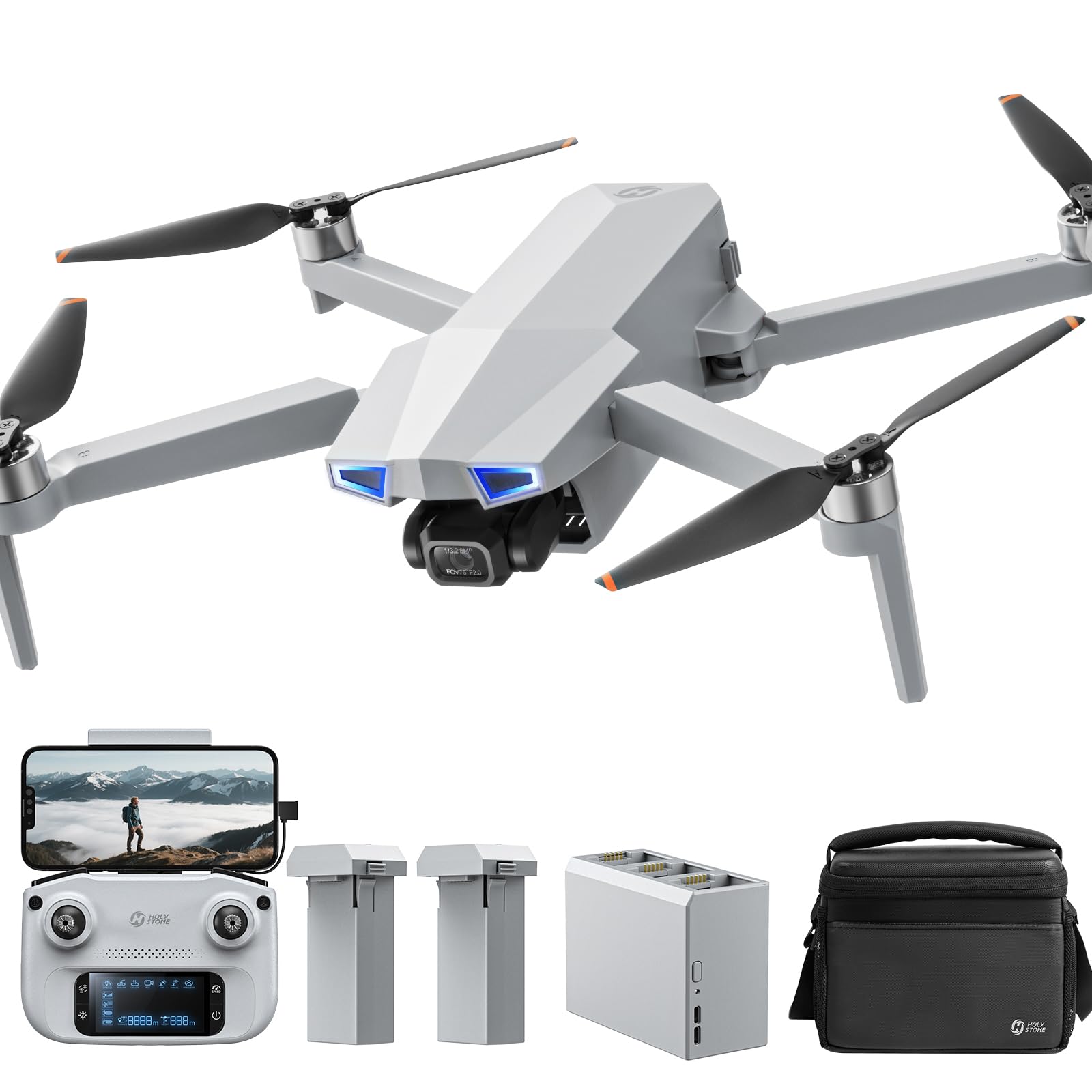
The HS790 is the pick for anyone who wants one box that solves the battery problem on day one. It ships with two modular batteries for up to 60 minutes of total flight, and the included Smart PD charging hub (PD stands for Power Delivery, a faster charging standard) also works as a power bank — so it can top up your phone between flights. A 3200 mAh lithium-polymer pack sits in each battery, the largest capacity in this roundup, which is why a single charge stretches as far as it does. Charging the whole set through that hub is far quicker than the slow trickle most budget drones demand.
What wins people over is overall performance — it is the single most-discussed strength of this drone by a wide margin, and owners describe it as a machine that practically flies itself. Ease of use follows close behind, with the one-key takeoff, altitude hold, and headless mode making early flights genuinely calm. The 6K photo capture, 4K/30FPS video, and mechanical three-axis gimbal keep footage steady when the wind pushes back, and the 9 km / 30,000 ft transmission range gives you room to explore without losing the feed.
Here’s the honest catch: some pilots report the drone occasionally veering out of control, and the transmitter screen can be hard to read in bright light. It also weighs 375.5 g, which puts it above the U.S. 249 g threshold — the cut-off that removes the need for FAA registration. Expect to register and take the free safety test. Against the DJI Flip, this pick is a longer-flight machine: the HS790’s 3200 mAh polymer pack outlasts the Flip’s 3110 mAh by enough to matter on a long shoot.
Where it earns its keep
- Two batteries plus a PD charging hub in the box means back-to-back flights, not down-time.
- 3200 mAh lithium-polymer pack — the biggest capacity here — delivers up to 60 minutes total.
- Three-axis mechanical gimbal keeps 4K/30FPS footage steady in wind and sudden movement.
What to weigh first
- 375.5 g take-off weight puts it over the U.S. 249 g line, so FAA registration applies.
- The transmitter display is hard to read in bright sunlight.
- A few pilots report occasional loss of control mid-flight.
Grab this one when: you want the most airtime per charge plus a hub that recharges fast and even powers your phone.
Look elsewhere when: you refuse to register a drone — the sub-249 g picks are the ones that skip that step.
2. Potensic ATOM LT GPS Drone
Two 3000 mAh packs, no registration paperwork, and a footprint small enough to live in a coat pocket.
Forty minutes per battery is the headline, and the ATOM LT backs it with two 3000 mAh lithium-ion packs for up to 80 minutes of total airtime. For scale, its 3000 mAh pack is only slightly smaller than the HS790’s 3200 mAh, yet the whole drone weighs 249 g — 51% lighter than the HS790’s 375.5 g. That weight gap is the entire story: at 249 g it flies under the FAA and Remote ID registration line, so you unfold it and go.
The camera side is deliberately modest. It shoots 2560×1440 stills and 2.5K@30fps video with ShakeVanish 2.0 stabilization, a 118° field of view, and a lens that tilts from +20° down to -90°. For comparison, the HS790’s effective still resolution is 38 mp against the ATOM’s 3.68 mp — a different league for stills, but entirely separate from flight time. Four satellite systems (GPS, GLONASS, Galileo, BeiDou) lock position for Auto Return Home, Follow Me, Waypoint Fly, and Circle Fly, and the brushless motors hold steady in Level 5 wind.
What the review pages rave about is raw drone quality, and the recurring gripe is the charging setup. Charging the pack through a phone cable is genuinely slow — a full fill can run toward a couple of hours — so budget for a dedicated wall charger from day one. One more quirk: the ATOM LT only flies in GPS mode, so you must start outdoors in an open area. As owners put it: “needs fast charger.”
Airtime math that sticks: two packs at 40 minutes each beats a single big battery hands down, and the 249 g body means zero registration friction.
The genuine trade-off: stills are 3.68 mp — fine for casual clips, not for printing — and the slow cable charging undercuts the long-flight advantage unless you add a proper charger.
Reach for this if: you want the most total minutes per dollar and you’d rather skip registration entirely.
Look elsewhere if: you need high-resolution stills or you plan to shoot mostly indoors.
3. Ruko Drone with Camera 4K Video & 8K Photo
Three batteries, 96 minutes of total airtime, and a camera sensor that punches well above this price bracket.
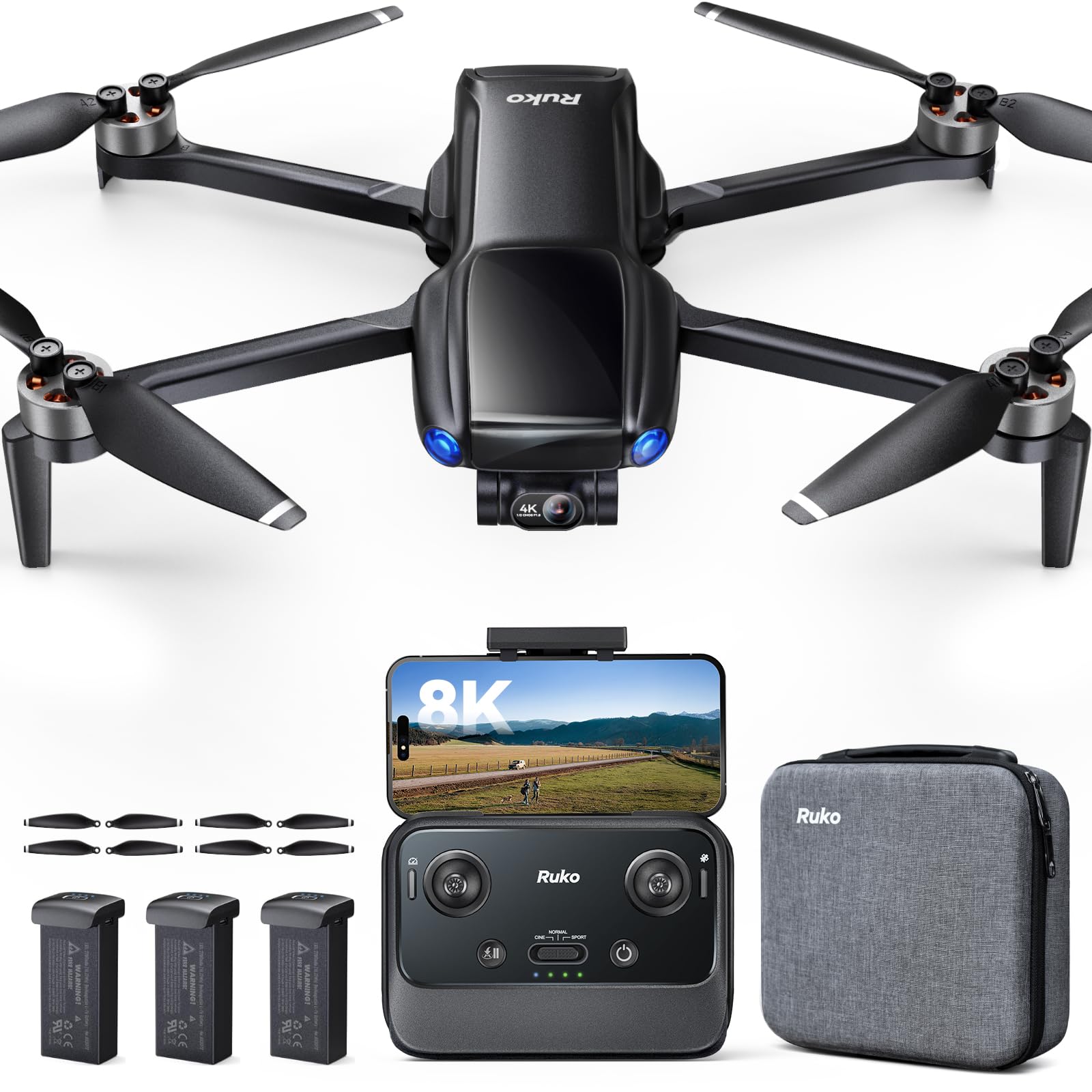
No other kit here offers more raw minutes in the box. Three 2200 mAh intelligent batteries give up to 96 minutes of total flight, with 32 minutes per pack — the highest combined total in this roundup. That’s the number that matters if your idea of a good afternoon is flying until your thumbs get tired, not until your battery warning beeps.
The camera is the other reason this one stands out. A 1/2″ 48MP CMOS sensor (a large image sensor that gathers more light) captures 8K photos and 4K/30fps video, and a three-axis brushless gimbal with EIS (Electronic Image Stabilization, which smooths out shake in software) keeps that footage level in the breeze. The R2 digital transmission system pushes a clear, interference-resistant feed out to 20,000 feet, and quadruple positioning — TOF, optical flow, barometer, and GPS — holds a firm hover. Weighing 248 g, it stays under the FAA registration threshold.
The pattern in owner feedback is overwhelmingly about build and picture quality, with flight performance praised for shrugging off wind gusts. The honest notes worth knowing: the on-screen battery readout is occasionally optimistic, one owner had a follow-mode glitch that a replacement unit fixed, and a single pack out of a set can arrive unable to hold a charge. All of those are launch-week headaches Ruko’s support team resolves quickly — the 24/7 line and 90-day warranty get consistent praise, which is rare at this price.
Why it leads on minutes: three swappable 2200 mAh batteries add up to 96 minutes — more than any other kit on this page — and the 248 g body stays registration-free.
One check before you commit: confirm support is available in your region before relying on the warranty, since that’s the safety net this drone leans on.
Best matched to: anyone who measures a drone by how many flights they get before lunch is over.
Think twice if: you’d rather not depend on a warranty process to sort out a dead battery.
4. DJI Flip (RC-N3)

Palm takeoff, full-coverage carbon-fiber guards, and a 44000 ft feed — this is the quick-launch option.
One 3110 mAh intelligent battery gives the Flip up to 31 minutes of flight. That’s a single-battery setup, so a full day of shooting means buying spares — a deliberate trade for a drone designed to launch and land from your hand in seconds. Full-coverage propeller guards made from carbon fiber protect your fingers and the drone when you fly close to people or tight spaces, which is exactly the kind of flying this pick encourages.
A 1/1.3-inch CMOS sensor pulls in more light for clearer stills, and it captures 4K HDR video at up to 60fps. Subject tracking keeps a person in frame automatically, so you can hike or walk while the drone handles the framing. Transmission reaches 44,000 ft / 13 km, and the 249 g body means no FAA registration or Remote ID requirement in America. Owners lean on the palm launch most — operating it by phone, or even from an Apple Watch, without a bulky controller.
The catch is real: in sport mode the flight time drops by roughly a third, so 31 minutes is a cruising number, not a sprinting one. It’s also the heaviest pick here at 643 g, so “under 249 g” on the drone itself doesn’t make the whole kit light. And note the app situation — the DJI Fly app isn’t on Google Play, so you’ll sideload it from DJI’s official site. Worth knowing before the first flight, not after.
What owners actually use
- Palm takeoff and landing with no controller needed — up to 31 minutes per battery.
- 1/1.3-inch CMOS sensor with 4K/60fps HDR video and automatic subject tracking.
- Carbon-fiber propeller guards protect hands and propellers in close-quarters flying.
Before you buy
- Sport mode cuts flight time significantly below the 31-minute ceiling.
- Single battery in the box — long sessions mean buying spares.
- The DJI Fly app must be downloaded from DJI’s site, not Google Play.
Suits you if: you value instant, no-fuss launches and you’re comfortable managing a single-battery rotation.
Skip this instead: the Ruko gives you three batteries and three times the total minutes for less setup frustration.
5. Bwine F7GB2 Pro

Three batteries, proven wind resistance, and a spec sheet built for thin air and mountain tops.
Three 2600 mAh lithium-ion batteries deliver a total of 75 minutes of flight time per trip. The packs comply with the UL 2054 safety standard, and Bwine quotes a full charge in about 1.5 hours when you pair them with the brand’s 65W fast charger — a charger that isn’t in the box, so plan for it. With a 1806 brushless motor, compass, gyroscope, and barometer on board, plus a 6-level wind resistance rating, the F7GB2 Pro is aimed squarely at pilots who fly at 2000 m elevation where the air is thin and the wind is a factor.
The camera hardware is a strong point here too. A one-click detachable 4K camera with a 120° field-of-view lens and a larger CMOS sensor works with a three-axis gimbal and 5x digital zoom, keeping shots steady as you change distance, direction, and composition. GPS handling is mature — auto-return triggers on low battery, lost signal, or one-key press, and Follow Me, Waypoint, and Orbit modes all work. The drone has completed FAA Remote ID certification, so it flies compliant in U.S. airspace.
Owners single out the image quality and the flying manners most — steady hovers, clean auto-landings with GPS accuracy measured in feet. The recurring note on the negative side: connecting a phone to the app is hit-or-miss for some pilots, and the remote’s screen washes out in sunlight. Neither is a dealbreaker, but if wireless pairing frustrates you, budget for patience on setup day.
Standout strength: 75 minutes across three batteries plus a 3000 m control range makes this a genuine high-altitude workhorse, with Remote ID compliance built in from the factory.
The honest caveat: no charger in the box and a pairing process that some owners find fussy — set aside setup time on day one.
Built for: pilots who fly in exposed, windy, high-elevation terrain and want three batteries to cover it.
Not the pick if: you want a dead-simple first flight with everything included.
6. Holy Stone Sentinel HS600D

Two 3500 mAh packs — the biggest here — and a body built to hold steady when the wind won’t quit.
Start with the fuel tank: two 3500 mAh lithium-polymer batteries, each larger than the cells in every other drone on this page, deliver up to 80 minutes total. That capacity is the reason this is the pick for windy days on an exposed ridge. The 603 g reinforced frame is heavy by design — extra mass fights gusts — and it pairs with a GNSS positioning chip, a three-axis gimbal, and EIS to keep footage level in level-6 wind.
The transmission system is the quiet upgrade. Instead of unstable Wi-Fi, the HS600D uses a wired-relay setup — the controller tethers to a relay device by cable — which holds a low-latency, interference-resistant HD feed out to 20,000 ft. A 1/2″ Sony CMOS sensor with an f/1.8 aperture captures 4K HDR video and 8K/48MP photos. One-tap takeoff, smart return, beginner mode, and automatic altitude limits make it approachable, and multi-sensor safety logic (TOF, GPS, optical flow) keeps low-altitude hover locked.
The trade-off you’ll notice first is charging speed — the batteries hold a lot, and they take their time refilling. Owners also mention overly sensitive controls from the start and a controller display that’s dim in sunlight, so plan on easing into the sticks. The bigger reality check: at 603 g it needs FAA registration and carries integrated Remote ID. That’s the cost of the bigger tank.
Why pilots pick it: the 3500 mAh packs are the largest capacity here, delivering up to 80 minutes and enough heft to shoot steady footage in level-6 wind.
The trade you accept: slow recharge times and a 603 g body that requires FAA registration — this is not the grab-and-go option.
Made for the pilot who: shoots coastal cliffs and mountain ridges where a lighter drone would get shoved around.
Choose another path if: you want a sub-249 g drone you never have to register.
7. Bwine F7MINI 8K Photo Drone
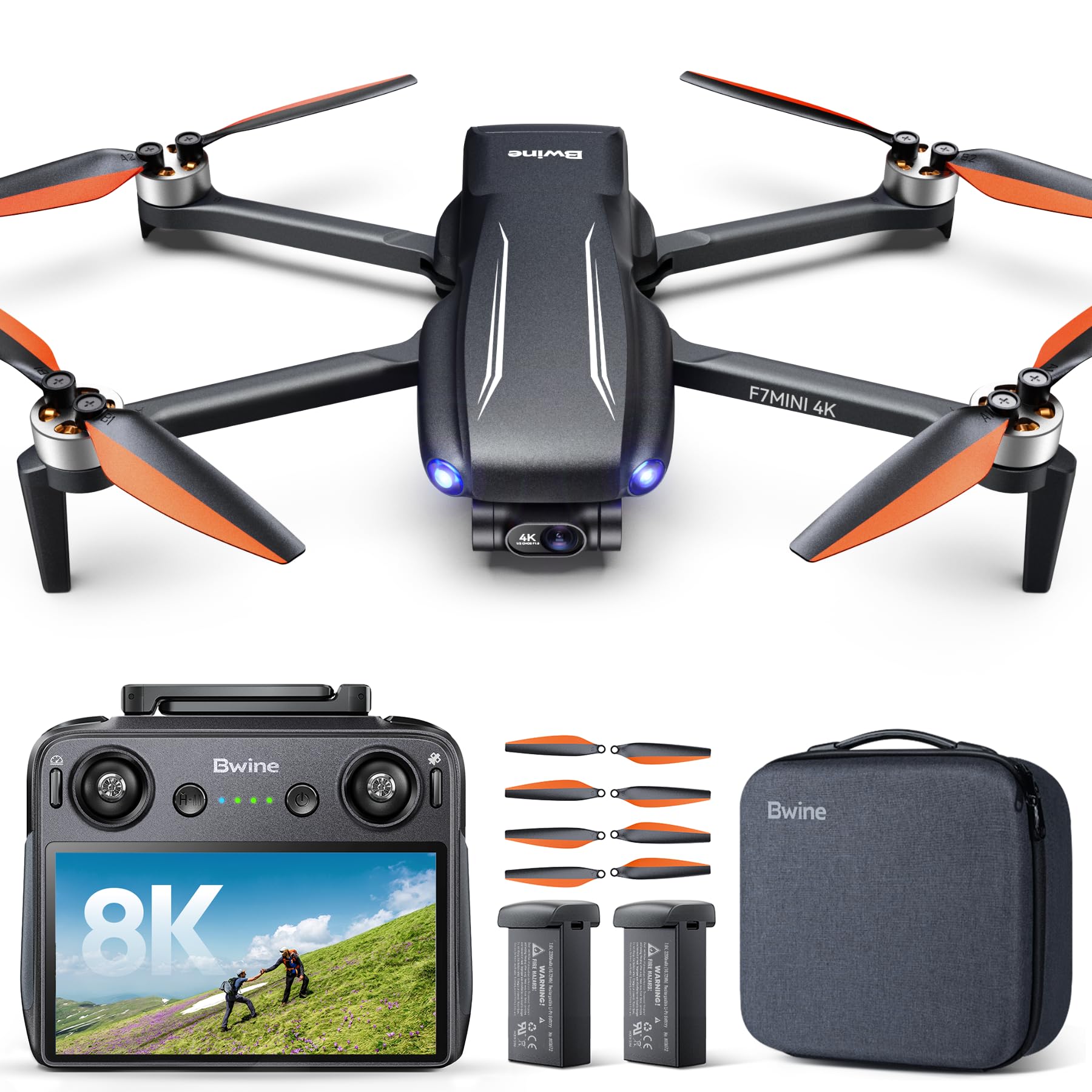
A controller with its own bright screen, so your phone stays in your pocket while you fly.
Two 2200 mAh high-capacity batteries give up to 64 minutes of flight, with 32 minutes on each pack, and PD 3.0 fast charging support tops them up quicker than the standard cable trickle — though you’ll need your own charger, since it’s sold separately. The distinguishing feature is the remote: a 5.5″ 1080P touchscreen at 60Hz and 500 nits, backed by 3 hours of remote runtime and 32GB of built-in storage for saving shots straight to the controller.
Under the hood, a 48MP camera with an f/1.8 aperture and 5x zoom sits on a three-axis brushless gimbal with EIS, capturing 8K photos and 4K video with vertical shooting and filters for instant social sharing. Transmission holds a rock-solid 6 km range with a stable 4.5 km signal even in urban areas at 0.1-second latency. At 249 g it stays under the FAA registration line, and a 120dB buzzer in the app helps you find it if it goes down out of sight. GPS modes cover Active Track at 0.5 m accuracy, Cruise Control, Orbit Flight, and Waypoint Planning.
Buyers describe it as a beginner drone that punches well above its class for pictures, with a controller readout complete enough to fly without a phone. The one thing to watch: the joysticks are sensitive, so in wind or at night, ease into the inputs until you know the feel. That’s a learning curve, not a flaw.
The feature you’ll actually use: that 5.5″ 1080P controller screen at 60Hz and 500 nits, plus 32GB of onboard storage, means no phone mount, no glare, no dead phone battery.
Worth noting: no wall charger in the box, and the sensitive joysticks ask for a gentle touch in wind.
Right for you if: you hate squinting at a phone screen and want the flight data right on the controller.
Pass if: you fly with a phone already and would rather not pay for a screen you don’t need.
8. DCX Volo X EZ AI Drone

A 5000 mAh pack, 45 minutes in the air, and 360° obstacle detection that helps it fly itself.
Look at the fuel tank: a 5000 mAh lithium-ion battery — the largest capacity on this page by a wide margin — delivers up to 45 minutes of flight time and a range of 4 miles. That’s one big battery rather than a swappable set, so a full day means topping it back up. The drone leans hard into automation to justify that setup: AI-assisted Follow Me, automatic Precision Return-to-Home, and 360° obstacle detection powered by LiDAR sensors (light-based distance scanners that see the world in 3D) to dodge collisions in tight spaces.
The camera is a 4K unit with a three-axis gimbal and Electronic Image Stabilization, flown from a controller that has its own screen. A Smart Night Mode and LED spotlight keep it usable after dark, and the foldable body is built with travel in mind. Most distinctive: a built-in payload release mechanism that carries and drops up to 1.2 lb on command — a genuinely unusual feature at any tier. It’s FAA Remote ID compliant, designed and supported in the U.S., and free of geofencing or height limits.
Here’s where to slow down. The camera’s effective still resolution is 12 mp — lower than every other pick on this list — so this is a video-first machine, not a stills machine. It also carries the lowest rating here, and the pattern in owner feedback points to reliability quirks: a controller losing sync and a screen freezing on an old frame. Owner reviews also mention that the AI stability held in 25MPH wind and landings were smooth. If you need the payload release or the night-flight setup, this is the option that offers both.
What it does that others can’t
- 5000 mAh battery — the biggest cell here — for up to 45 minutes and a 4-mile range.
- Built-in payload release that carries and drops up to 1.2 lb on command.
- 360° LiDAR obstacle sensing plus a Smart Night Mode and LED spotlight.
The honest fine print
- Single battery, so long sessions depend on recharge time.
- 12 mp still resolution is the lowest in this roundup.
- Some buyers report controller sync drops and a screen freezing on a stale image.
The pick for: anyone who needs the payload drop and night-flight sensing — no other drone here has either.
Not for you if: high-resolution stills or ironclad reliability matter most.
9. DJI Mini 5 Pro Fly More Combo Plus
Three batteries, each good for up to 52 minutes of flight, plus a sensor that sees in the dark.
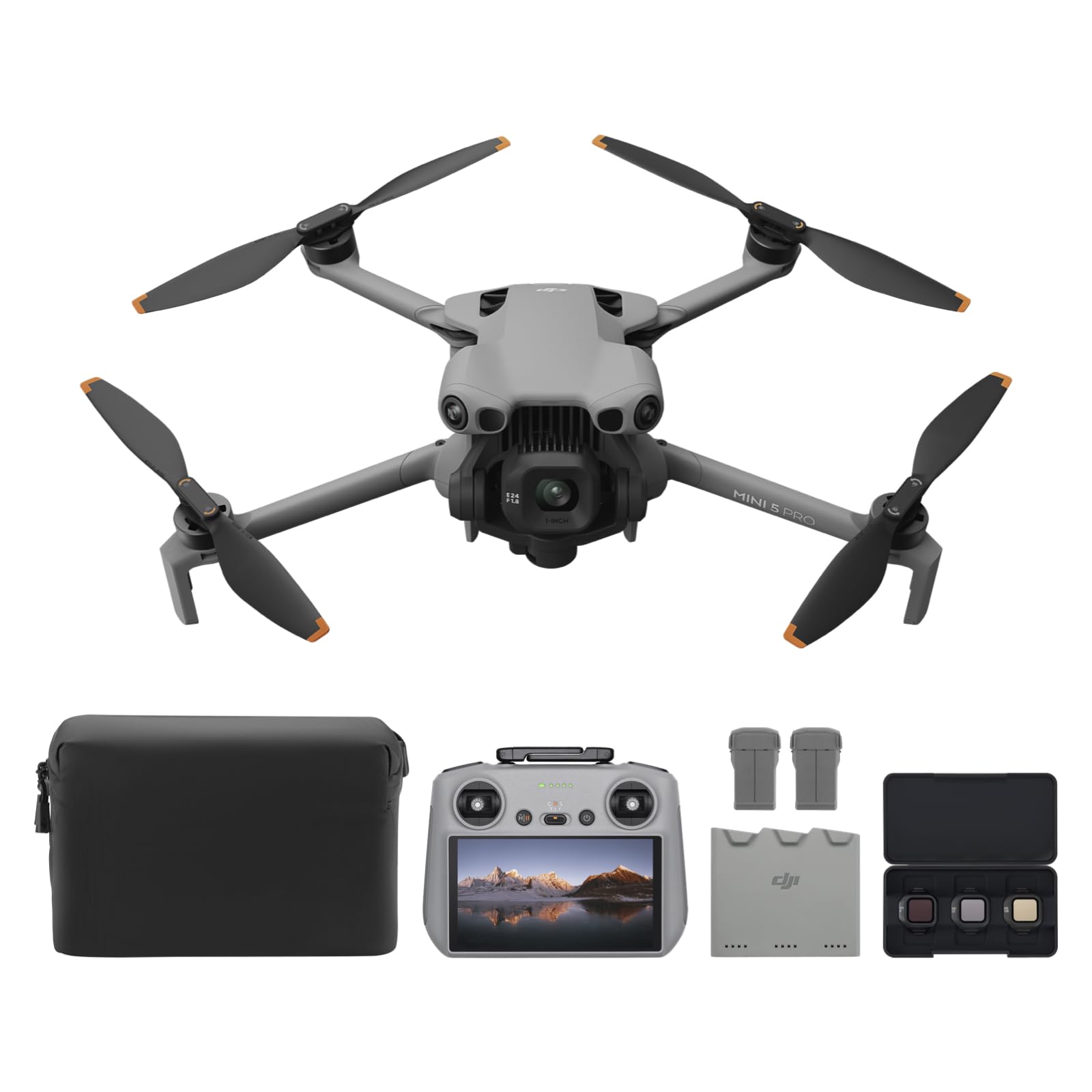
This is the flagship of the group. The Fly More Combo Plus ships three Intelligent Flight Battery Plus packs, and each one is rated for up to 52 minutes of flight — the longest single-battery figure on this page. A charging hub can refill all three in about 193 minutes. Do the math against a 31-minute-class drone and the difference across three packs is substantial: this is a kit you fly all morning without hunting for an outlet.
What separates it from the mid-range picks is what’s on board. A 1-inch CMOS sensor captures 4K/60fps HDR video with 50 mp effective still resolution. Omnidirectional obstacle sensing uses a forward-facing LiDAR sensor (a light-based scanner that measures distance) plus vision sensors to detect obstacles in every direction, including for night flights and auto return. Upgraded ActiveTrack 360° keeps a subject framed through complex moves, and the gimbal offers true vertical filming with 225° roll rotation. There’s also 42GB of internal storage, so you can fly without a memory card.
The honest context: this is the heaviest-hitting option here and priced as such, and the drone alone weighs about 249.9 g ± 4 g — close enough to the line that you should check local laws before flying. It’s also not a beginner’s machine; the review pages are full of pilots saying a crash on this drone is expensive. If you’re new, the Ruko or the HS790 is where to build your hours first. If you already fly, this is the ceiling.
Where it’s untouchable: three batteries at up to 52 minutes each, a 1-inch CMOS sensor, and omnidirectional LiDAR obstacle sensing — no other pick here combines all three.
Who should wait: first-time pilots, since the replacement cost after a crash is the highest in this roundup, and the ~249.9 g weight sits near the registration line.
The upgrade for: experienced pilots who want maximum single-flight minutes and pro-grade imaging in one kit.
Start smaller if: this is your first drone — build your reflexes on a cheaper airframe first.
Know the Specs
Battery Capacity (mAh) and Flight Time
Battery capacity is measured in mAh — milliamp-hours — and it tells you how big the fuel tank is. A higher number means more minutes per charge, but not in a straight line. The HS790’s 3200 mAh pack and the ATOM LT’s 3000 mAh pack fly for similar total times because the drone’s weight and motor efficiency matter just as much. The figure that actually helps you plan is total flight time across every battery in the box, since a two- or three-battery kit lets you swap and keep flying instead of waiting on a charger.
Charging Speed and Swappable Batteries
A long-flight drone with slow charging flies short in practice. Fast-charging hubs and PD (Power Delivery) support refill packs in a fraction of the time a standard cable takes, and some kits include a hub that doubles as a power bank. Just as important is whether the batteries are swappable. Drones that ship with two or three intelligent packs let you fly back-to-back; single-battery drones mean your day ends when the warning beeps. Before you buy, check whether a wall charger is included — several kits here sell one separately.
Common Questions
How long can a drone actually stay in the air on one battery?
Do I need more than one battery to fly a full afternoon?
What size battery do I need for long-distance flying?
Is a heavier drone better for battery life in wind?
Does a drone under 249 g have lower battery life?
How fast can these drone batteries recharge between flights?
Can I fly a drone with its battery at 100 percent all the time?
Are drones with three batteries worth it over a single large pack?
Does wind resistance affect how long a drone stays airborne?
Do these drones come with a charger in the box?
The Bottom Line
For most buyers chasing airtime, the drone for battery life winner is the Holy Stone HS790 because its 3200 mAh packs, 60-minute total, and PDcharging hub solve the problem in one box. If raw minutes are your only metric, grab the Ruko drone, whose three batteries add up to 96 minutes — the most here. And for registration-free flying with serious batteries, the Potensic ATOM LT is the one to reach for. On paper the HS790’s 3,599 ratings are the highest count in this group, but the Potensic ATOM LT actually holds the higher score at 4.5 stars — a reminder that a long flight kit and a perfect score don’t always travel together. Whichever you choose, buy a kit with at least two batteries and a fast charger, because a drone that flies for an hour and then charges for five ends your day early no matter how good the spec sheet looks.
How we choose
We do not accept paid placement. Every pick is matched to a real buyer and a real use-case; we do not hands-on test units.
Sources
Specifications: manufacturer listings and product documentation. Review insights: verified customer reviews, as of October 2026. Pricing: not shown on this page (it changes often); check the current price via the retailer link.
As an Amazon Associate, Aappliancez earns from qualifying purchases. This does not affect which products we feature.