Disclosure: Some links in this post are affiliate links. As an Amazon Associate I earn from qualifying purchases, at no extra cost to you. Learn more
Specs are compiled from manufacturer listings and verified buyer reviews and can change over time — please confirm the key details on the product page before buying.
If you want a kart that actually breaks traction on purpose, the answer is simpler than most listings make it look: pedal karts and low-speed electric drifters let you slide on purpose, while gas-powered off-road karts trade sideways play for hill-climbing power. The catch most buyers miss is that “drift” on a heavy gas kart usually means a solid rear axle and a lot of weight behind you — not the controlled, repeatable slides you see in videos. This guide sorts all nine picks by what they actually do on gravel, wet grass, and pavement.
This guide is built by comparing the manufacturers’ published specifications and the patterns across verified customer reviews, so you get each pick’s real strengths and trade-offs instead of marketing spin.
Weight, tire type, and axle design decide whether a kart slides predictably or just plows straight ahead, so those three details drive every recommendation below for a drift kart for adults. Everything here is pulled from published specs and owner experience, so you can match a kart to your surface, your rider size, and how much wrenching you are willing to do.
Top Picks

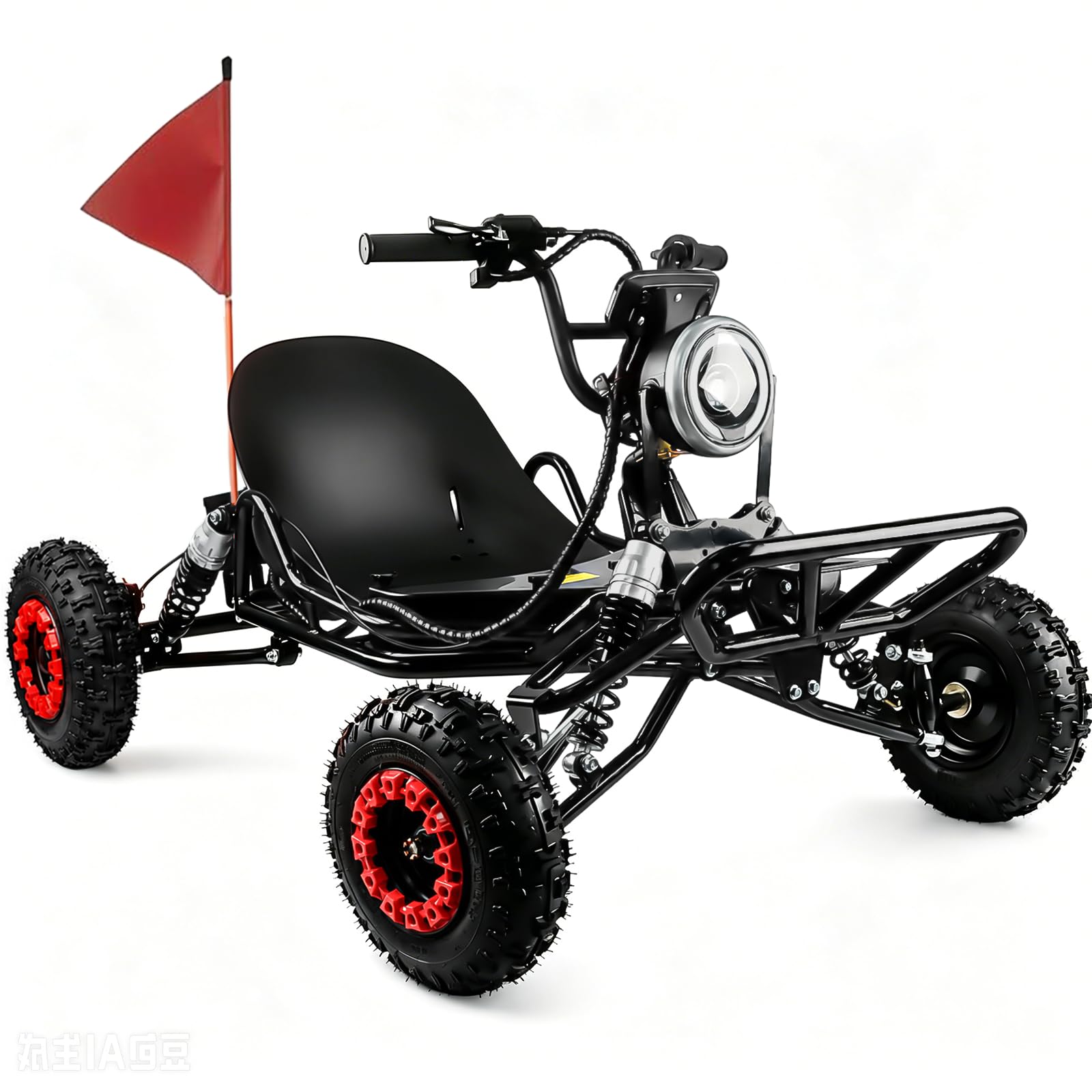
How To Choose The Best Drift Kart for Adults
The word “drift” gets stapled onto every go-kart listing, but the physics only work a few ways. A kart slides when the rear wheels break loose while the front wheels still steer — and the three things that decide whether that happens smoothly are tire compound, rim bearing quality, and how much weight sits over the rear axle. Get those three right and you have a kart that slides on command; get them wrong and you have a kart that either spins you or refuses to turn at all.
Tire Grip And Rim Bearings
Low-profile rubber tires with sealed bearings in each rim are the friendliest setup for controlled slides, because the tire deforms predictably under lateral load instead of skidding like hard plastic. One pick here runs 2 bearings in each 8-spoke rim — the kind of detail that decides whether a kart slides smoothly or grinds to a halt mid-corner. Six-inch all-terrain tires are the other common size, and they grip mud and gravel far harder, which means you need more power and more body weight to break them loose.
Drivetrain: Pedal, Gas, Or Electric
Pedal power with an auto-clutch gives you zero fuel cost and instant torque application from your own legs, which is the purest way to learn throttle control that translates to drifting. A 2-stroke or 4-stroke gas engine adds real horsepower but also adds chain maintenance, premix fuel, and noise. A lithium-battery electric drivetrain gives you instant torque off idle — often the snappiest way to kick the rear end out — but you are limited by range per charge and recharge time.
Weight, Load Capacity, And Rider Fit
A 28-pound kart and a 332-pound kart handle completely differently. Heavier karts plant harder and resist tipping at speed, but they also need a trailer or a truck bed, and they punish you if the terrain is soft. Check the maximum load figure against your real weight with gear on, then check the rider height range — a kart rated for a 6’3″ rider in one review can still feel cramped if the pedals are fixed.
Rear Axle And Brake Type
A solid (live) rear axle sends power to both rear wheels, which is what gives you the sideways bite you want on loose dirt. A one-wheel-drive axle spins the inside tire instead. Pair that with a hydraulic rear disc brake rather than a friction scrub brake — you will want the stopping power when you are sliding toward a fence at speed.
Side-by-Side Comparison
| Model | Best For | Power Source | Load / Rider Rating | Kart Weight | Amazon |
|---|---|---|---|---|---|
| hauck Sirocco Racing Clutch Free Go Kart★ Best Overall | Pedal-powered sliding on pavement | Pedal, auto-clutch | Ages 4–12 (48–144 months) | 28 lbs | Amazon |
| Razor Crazy Cart 24VPremium Pick | Controlled spins and drifts | 24V electric | Age 9 and above | 57 lbs | Amazon |
| Electric Go Kart 2000W (EISYROOD)Top Performer | Family off-road drifting on gravel | 2000W brushless electric | 440 lbs max load | 127 lbs | Amazon |
| MotoTec Mud 98cc | Rough-trail family karting | 98cc gas | Age 13 and up | 198 lbs | Amazon |
| HOVER HEART 79cc 4-Stroke | No-mix gas karting for teens | 79.5cc 4-stroke gas | Ages 13–18 (youth) | 135 lbs | Amazon |
| Zyliathor 212cc Gas Off-Road Go Kart | Adult-sized trail speed | 212cc 4-stroke gas | 440 lb max load | 170 lbs | Amazon |
| Gas Powered Go Kart 2 Stroke (EISYROOD) | Budget 2-stroke trail fun | 63.3cc 2-stroke gas | 265 lbs max load (age 10+) | — | Amazon |
| Zyliathor 63cc Gas Off-Road Go Kart | Backyard paths with throttle limiter | 63cc 2-stroke gas | 440 lb max load (age 12+) | 100 lbs | Amazon |
| Coleman Powersports GK200 | Two-seat off-road adventuring | 196cc gas | 275 lbs max load | 332 lbs | Amazon |
Detailed Reviews
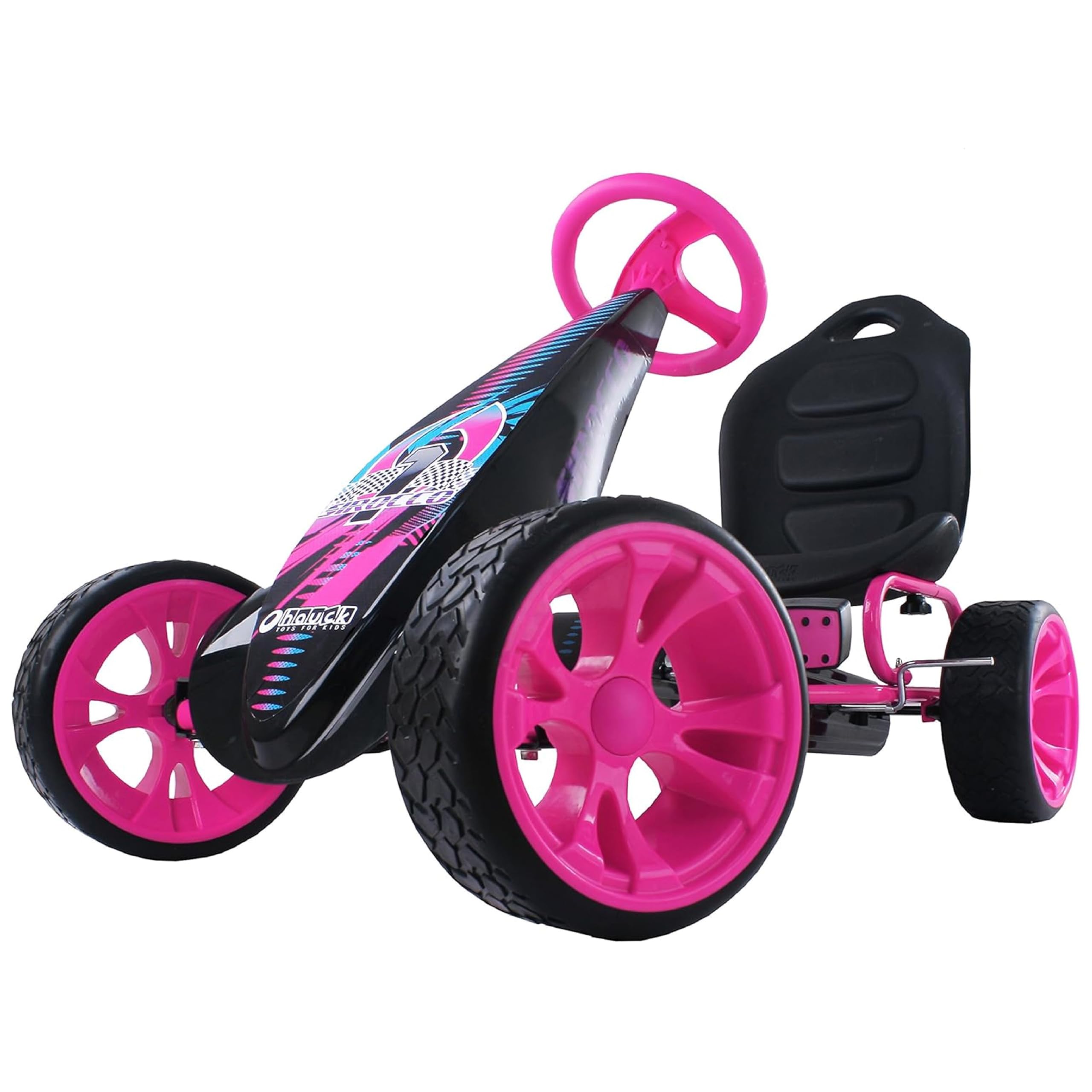
1. hauck Sirocco Racing Clutch Free Go Kart
Our pick — over 4.5★ from 650+ verified ratings; the strongest balance of quality and price.
Twenty-eight pounds of pedal-driven steel that slides before it ever gets tired.
The hauck Sirocco is the cleanest answer for anyone who wants to learn how a kart breaks traction without spending a dime on fuel. It is a pedal go-kart with an auto-clutch free-ride system, which means you can pedal to build speed, then coast and steer through a slide with your hands while your feet stay off the cranks. The powertrain is your own legs, so nothing overheats, nothing leaks, and there is no engine noise to fight over. What wins people over here is pure enjoyment — kids and adults both keep coming back to it, which is why it sits at 4.6 stars across 600+ ratings and why it takes the top spot in this list.
The rolling gear is what makes the sliding predictable. Low-profile rubber tires grip pavement and short grass without the hard-plastic skitter you get on cheaper pedal cars, and each 8-spoke rim carries 2 bearings instead of the usual single set. The tires grip the road well and do not slip the way some riding toys do, which owners point out as the main reason they upgraded from smaller models. The steel tube frame wears a powder-coat finish, and the bucket seat adjusts along with a 3-point sporty steering wheel, so a growing rider gets a couple of seasons out of one setup rather than one summer.
Here is the honest part. This kart is spec’d for ages 4 through 12, so by the time a kid hits their teens the cockpit gets tight — several owners describe it as cramped past age 7 or 8. Thick lawns are also its weak surface; the pedals push noticeably harder through tall grass than they do on sidewalk, street, or short grass, so a deep-lawn yard is not where this shines. And the brake lever presses a metal bar against the back tire, which wears that tire over time, plus the bar can scrape a calf if it swings upward. None of that stops it being the best-rounded choice for the money here — it is the one kart on this list where the fun-to-maintenance ratio is almost entirely fun.
What Pedal Power Buys You
- No fuel, no battery, no charging — the free-ride auto-clutch means you coast and steer through a slide without pedaling against resistance.
- Low-profile rubber tires plus 2 bearings in every 8-spoke rim give the free-spinning, predictable rear end you want for controlled slides.
- Adjustable bucket seat and a 3-point sporty steering wheel grow with the rider, and at 28 lbs one adult can carry it to the driveway.
- Buyers report it holds up to two rough boys across three years of hard use without falling apart.
Where It Wants Patience
- Rated for ages 4–12; older or taller riders find the seating position cramped.
- Thick lawn is slow going — pedaling gets hard in deep grass even though sidewalk and street are easy.
- The brake bar presses on the rear tire, so that tire wears and the bar can catch a leg when angled up.
- Seat adjustment is fiddly, and the assembly instructions are picture-only.
Reach for this if: you want the cheapest weekly-smile-per-mile on the whole list and a rider between 4 and 12 who will grow into it over several seasons.
Look elsewhere if: you need genuine adult-sized seating or a kart that climbs hills under its own power.
2. Razor Crazy Cart Electric Drifting Go Kart
The one kart here actually engineered around spinning in place instead of around it.
Most karts on this page drift by accident. The Razor Crazy Cart drifts on purpose, because the Drift Bar lets the driver steer the rear end independently of the front wheels — you point the nose, pull the bar, and the back steps out and holds. A variable-speed foot pedal takes you up to 12 mph, which sounds modest until you realize a 57-pound aluminum frame at 12 mph sideways is genuinely fast. Thirty-seven inches long and 19 inches wide, it is the most compact serious drifter in this group, and that short wheelbase is precisely why it rotates so eagerly.
What owners rave about is the sheer repeatability of the fun. It runs roughly 40 minutes or more on a single 24V charge and holds its performance through back-to-back sessions. Pneumatic front tire plus anti-tip caster wheels up front mean it will tuck a corner hard without biting you. The 24V battery is the long-term consumable: roughly a year of hard use before speed drops, and a fresh pack restores it. The pneumatic front tires wear fastest, needing replacement about every six months, but they are cheap and swap in a few minutes. Owners who keep up with that predictable maintenance report the kart still feels like new after three seasons.
Set expectations around the rider, though. This is rated for ages 9 and up and it is genuinely built around kids — teenagers fit on the seat, but their weight will accelerate wear on the frame and tires. The value question also divides owners, some of whom feel the money and time invested did not match the payoff. For a nine-year-old who wants to learn throttle control and rotation, there is nothing on this list that teaches it faster.
The drift-specific edge: the Drift Bar is the only control here that lets you steer the rear wheels as a separate input — next to the hauck’s pedal-and-coast approach, it is a fundamentally different, more intentional way to slide.
Budget the consumables: tires every six months and one battery a year is the real running cost, and both are cheap and quick to swap.
Who it beats: anything that asks you to learn drifting by feel alone — this one hands you the control directly.
Who should pass: full-grown adults wanting a kart sized and sprung for their weight.
3. Electric Go Kart 2000W Motor
Two thousand watts and a solid rear axle — the cheapest route to real sideways grip on gravel.
A 2000W brushless DC motor pushing a 127-pound steel kart up to 30 mph, with 440 lbs of maximum load capacity, is the most power-per-dollar on this page. Brushless means fewer moving parts to wear than a brushed motor, so you spend your weekends riding instead of rebuilding. Three speed modes split the difference for a mixed-age household: low for beginners and kids, medium for cruising, high for adults who want the full 30 mph. The 6-inch inflatable off-road tires are the key detail for drifting — they will break loose on gravel, dirt, and wet grass in a way the low-profile rubber tires on the hauck never can, and the solid rear axle keeps both rear wheels driving so the slide stays controllable instead of spinning you.
Owner experience matches the spec nicely. It drifts on gravel, dirt, and wet grass, and the low center of gravity makes it very hard to flip even when you provoke it. A 6’3″, 200-lb rider found it fun but cramped at the top end and wanted a longer footrest — useful context if you are tall. Range is 15–20 km per charge on the included lithium battery, and the 110–240V AC charger refills it in 3–4 hours — a real limitation for a full day of trail riding. The suspension and frame draw the most praise, and one owner mitigated the slow range by swapping in a 30ah golf cart battery.
Assembly is where buyers split. Front shocks, the steering wheel, and headlight are the fiddly bits, though the kart arrives mostly pre-assembled. The instructions come in for heavy criticism — bland, unlabeled, and the claimed 40-minute build time is unrealistic — and one of the 19-photo steps is only understandable if you watch the video. Seat fasteners are undersized and the takeoff is abrupt enough that some owners describe it as jerky, though a cheap motor-sprocket swap smooths it out. The single serious complaint in the review pool came from a unit that did not work at all from the start, which the buyer returned at their own expense. Support is generally described as responsive, including sending a free replacement wiring harness when a rider broke wires.
Why It Earns Third
- 2000W brushless motor and a 440 lbs load capacity mean adults and kids can ride the same kart without compromise.
- Three speed modes keep the low end kid-safe while leaving the 30 mph top end for grown-ups.
- Solid rear axle plus 6-inch inflatable tires slide predictably on gravel, dirt, and wet grass — the most controllable drift surface of any gas or electric here.
- Dual suspension front and rear, plus a hydraulic rear disc brake that stops hard from top speed.
What Will Annoy You
- Instructions are widely criticized — unlabeled parts, unrealistic assembly time, and non-standard terminology.
- 15–20 km of range per charge is limiting for a full trail day, with a 3–4 hour recharge.
- Takeoff is jerky and the seat is uncomfortable for longer rides; seat fasteners are undersized.
- Taller or heavier riders will find the cockpit tight.
Best for: a family who wants one kart that slides on dirt and gravel, seats a 200-lb adult, and needs only a standard outlet to refuel.
Plan around: the range ceiling and a genuinely frustrating first assembly — set aside an afternoon, not forty minutes.
4. MotoTec Mud 98cc Go Kart, Full Suspension, Blue
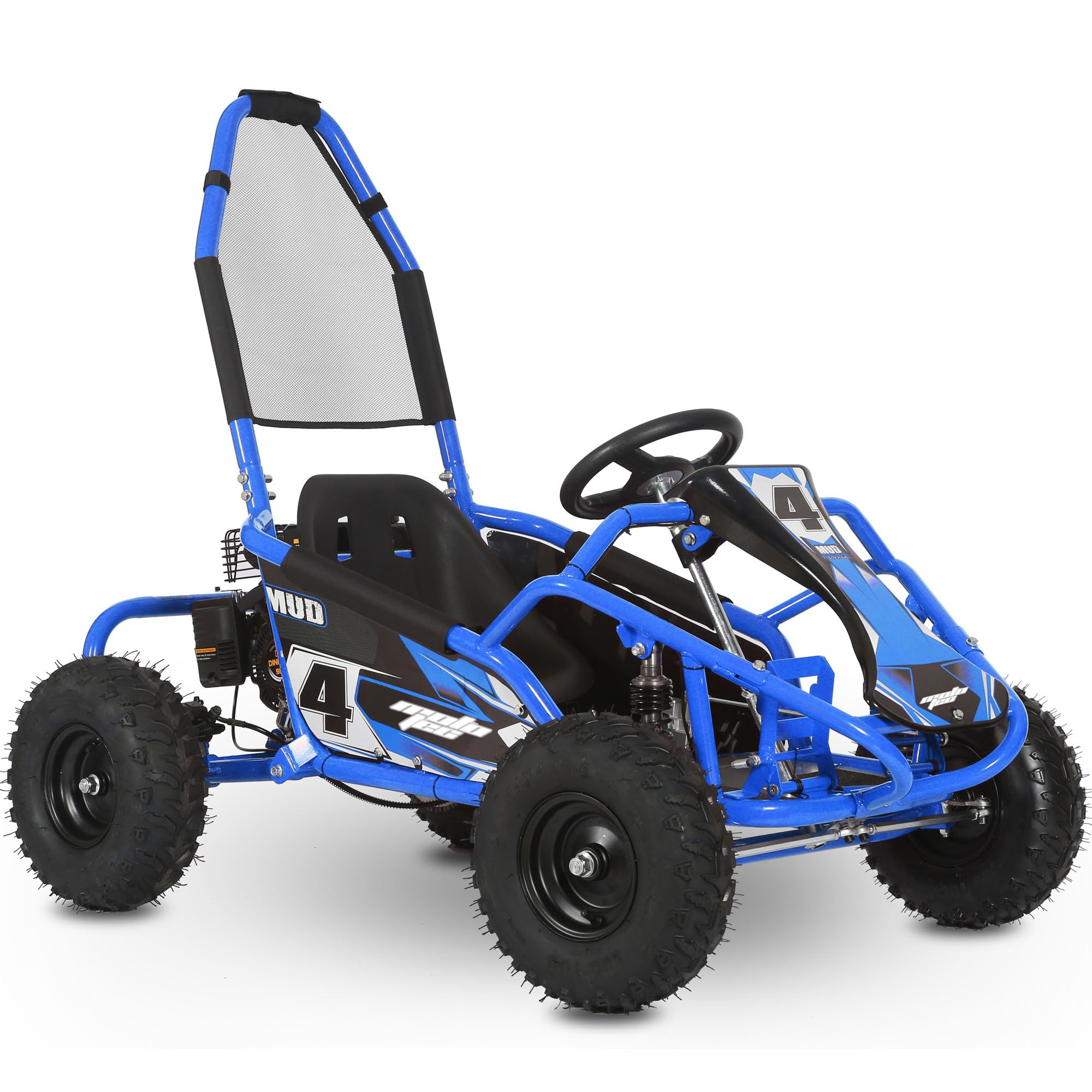
A 198-pound gas trail kart whose manual is worthless and whose owners still buy a second one.
This is the kart for someone whose property backs onto gravel, hills, or BLM trails and who is willing to become a part-time mechanic. The MotoTec Mud is a 98cc gas kart with full suspension, a hydraulic brake, an adjustable seat, and enough ground clearance to clear rough ground. One owner ran it a third of a mile through rough gravel and hills and reported the motor was only slightly warm afterward — more power than expected for a gas kart in this size class. It arrives well packaged in a metal frame, and the front roll bar, bumper, and shocks bolt on in under an hour.
The honest warning is the maintenance load, and owners are direct about it. Bolts arrive barely hand-tight and need checking before the first ride. Oil level was low from the factory on more than one unit. The chain stretches and needs regular adjustment — several owners recommend buying a spare chain, clutch, and chain breaker up front. The throttle and brake cables need constant adjustment as they loosen with use. One long-term owner ran it daily on 4 acres for a month, then replaced the rear bearings with better ones, a clutch under warranty (plus shipping), and heavier-duty rear tires after leaks and bulges. That is a realistic six-month picture for a hard-worked 98cc gas kart, not a defect list.
Two safety items stand out. The first start is hard until the fuel system primes, after which it is easy. More important, the accelerator pedal has been known to stick on some units — one owner had it happen twice and fixed it by re-tweaking the pedal hardware, and recommends checking the pedal before letting a child ride. The steering column, camber, and front-end adjustability also drew a complaint on this class of frame from a different brand’s owner, so verify the front end before first use. For a mechanically inclined buyer, this is a durable, genuinely fun gas kart that kids ride for years.
Read the maintenance schedule before you buy: chain tension, cable adjustment, bolt torque, and tire pressure are recurring tasks, not one-time setup items.
What it delivers in return: real ground clearance, full suspension, a hydraulic brake, and gas range that electric karts on this list cannot match on a long trail day.
Pick it if: you own a socket set, enjoy tuning, and have trail access that rewards suspension and clearance.
Leave it if: you want a kart you ride without ever opening the tool kit.
5. HOVER HEART 79cc 4-Stroke Gas Go Kart

No oil-and-gas mixing, thirteen-inch tires, and a rear axle that drives both wheels.
The 79.5cc overhead-valve 4-stroke engine is the headline for anyone who has done the 2-stroke premix dance before. There is no oil to measure into the fuel — you fill the tank with straight gas and go, which eliminates the single most common user error on small gas engines. An automatic centrifugal clutch handles shifting for you, so a rider just presses the pedal. A 2.5 hp engine driving through big 13-inch pneumatic tires puts power straight to the ground, and the non-slip rear axle sends it to both rear wheels rather than spinning one — a meaningful difference in loose dirt where a single-wheel-drive kart just digs a hole.
Safety hardware is more thorough than the price point suggests. The tubular steel frame includes an upper roll bar and side nerf bars, plus a full diamond pedal, a racing-style 4-point seat belt, and a padded steering wheel. The hydraulic rear disc brake with vented rotors pulls the kart down fast from both rear wheels. At 53 inches long and 135 pounds, it is a true single-seater rather than a two-person cruiser. For a parent who wants to skip the premix routine and hand a kid a straightforward pull-cord start, this is the simplest gas option on the page.
The caveat list is real. The kart is rated for youth, and one owner noted it fits a skinny 12-year-old boy while his tall twin sister was cramped in the same seat — build it around the smaller rider. The seatbelt has drawn specific criticism as poorly designed. Chain seizure on day one is a known occurrence, easily fixed with lubricant but requiring it before every ride afterward. Wheels have worked loose on some units and need thread-locker. Gas karts by nature need regular maintenance, and this one is no exception.
The 4-stroke advantage: no premix, no oil measuring, no fouled spark plugs from a bad mix ratio — the simplest gas engine here to live with day to day.
Sized for one: the 53-inch frame and single seat are built around a young rider; two-up riding is not its job.
Go here if: you want gas power without the mixing jug and your rider is a smaller, younger kid.
Size up if: your rider is tall or over about 12 years old — the cockpit will feel tight quickly.
6. Zyliathor 212cc Gas Off-Road Go Kart for Adults & Teens
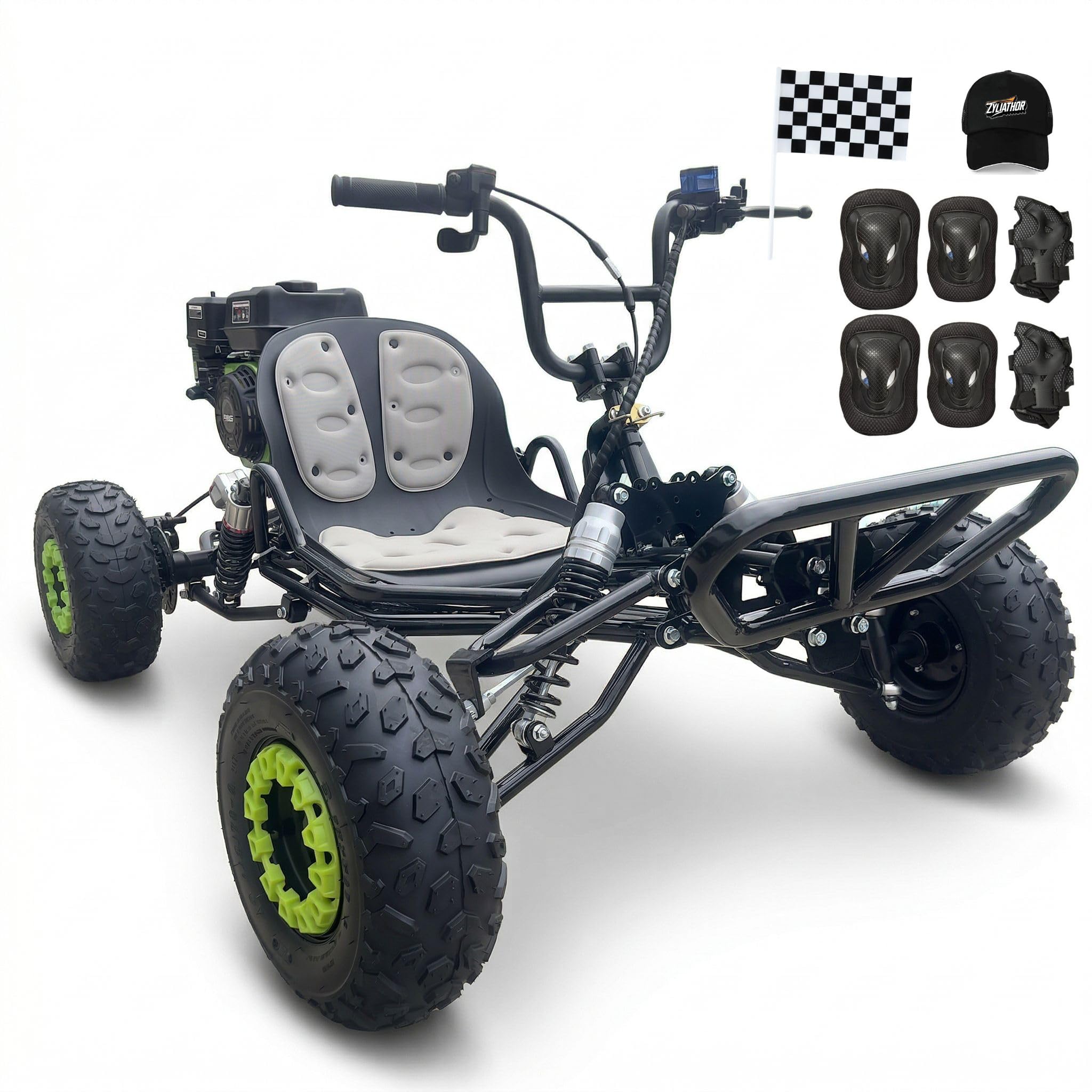
Seven and a half horsepower, a centered rear engine, and an extendable front section that actually fits tall riders.
The 212cc 4-stroke engine with a 7.5 hp output and a CVT automatic transmission is the biggest gas engine on this list, and it is built around adult-property trail riding rather than a driveway circle. Top speed reaches 35 mph under ideal conditions, and the 2.6L fuel tank goes the distance between fills. What the 212cc engine buys you over the 63cc and 98cc gas karts here is torque off the line — smaller 2-stroke displacement struggles to move an adult up a grade, while this one is designed to pull. The centered rear-mounted engine puts weight closer to the rear axle center than a typical side-mounted layout, improving balance and traction where the rear tires meet loose surfaces.
The frame details make it genuinely adult-friendly. It carries up to a 440 lb maximum load, supports riders from 4.5 ft to 6.5 ft, and the removable front bumper and extendable front section stretch the kart from 60.6″ to 64.6″ — the standout for tall riders who find most karts cramped. Four-wheel independent suspension with two front and two rear shocks absorbs bumps across dirt paths, gravel, grass, and packed trails. The rear hydraulic disc brake gives you the stopping control you want on a heavy machine, and the AT145/70-6 all-terrain tires with fluorescent green wheel rings put grip down where you need it. It ships semi-assembled with a video guide and tool kit, with final setup usually taking around two hours.
Where it fumbles is at the edges. One owner received a kart whose steering column would not install at all, making it impossible to assemble — the seller offered no fix and the buyer went through an Amazon A-Z claim. Several units arrived with wrong-model instructions, missing belts, or a wrong part, though WhatsApp support earned praise as very responsive. Assembly took one owner around four hours. The motor on/off switch arrived broken on another unit, but the handle kill switch still worked. The engine itself and the support line behind it are the strengths; the out-of-box experience is the risk.
The Adult-Sized Case
- 212cc 4-stroke with 7.5 hp and CVT automatic is the largest engine here — real torque where the small 2-strokes fall flat on grades.
- Extendable front section from 60.6″ to 64.6″ and a 4.5 ft–6.5 ft rider range genuinely fit tall adults.
- 440 lb max load, 4-wheel independent suspension, rear hydraulic disc brake, and a 35 mph top speed on private property.
- WhatsApp customer support is described as very responsive, with full parts availability for engine, chain, brake, tires, and clutch.
The Assembly Bet
- Instruction manuals arrive wrong-model or missing on multiple units; assembly realistically takes 2–4 hours.
- One unit shipped with an uninstallable steering column — the undisputed worst-case outcome.
- Minor factory defects like a broken on/off switch and missing belts appear on some units.
- Parts need checking against the video guide before you torque anything down.
Choose this if: you are a taller adult who needs frame length, real engine torque, and trail-ready suspension.
Think twice if: you are not prepared to spend half a day assembling and troubleshooting before you ride.
7. Gas Powered Go Kart 2 Stroke 63.3cc
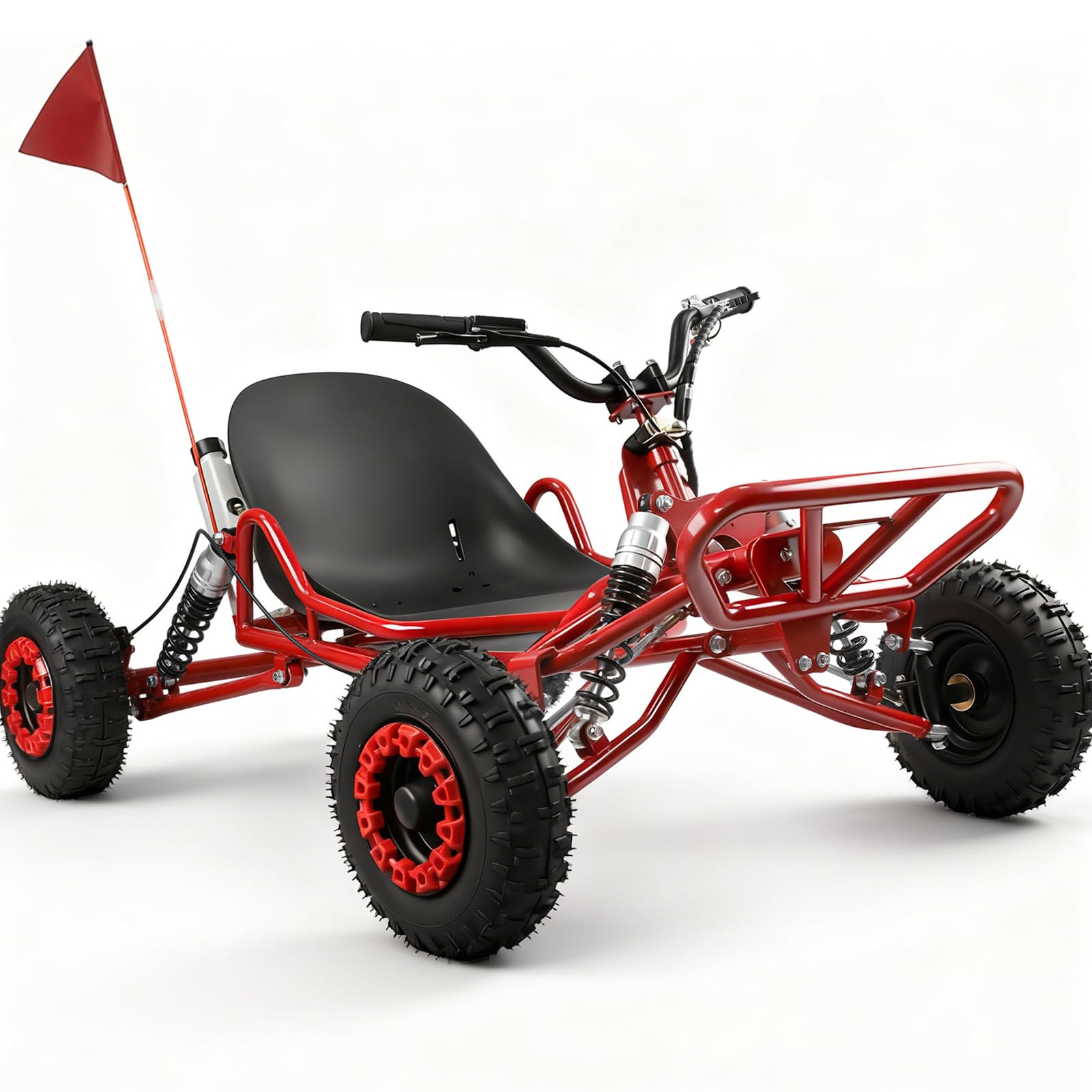
A 2.5-liter tank, a roll cage, and 21.7 miles of range on a kart that holds an adult comfortably.
For a first gas kart, the math here is simple. A 63.3cc single-cylinder air-cooled 2-stroke engine delivers a max output of 1.9kW at 7500 rpm — 2.2 horsepower — and gets you to 25 mph, which is enough for trail fun without being so fast it scares a beginner. The manual start system works across a -10C to 40C temperature range, so it fires in cold mornings as well as warm afternoons. The 2.5-liter fuel tank carries you over 21.7 miles per fill, which for a small-displacement engine means a long afternoon between refueling stops.
The chassis earns genuine praise. The steel frame includes an integrated roll cage to protect the rider on bumps and slopes, and it supports up to 265 lbs. A clutch-based P.T.O. (power take-off) delivers smooth power from engine to drivetrain, minimizing the jolt you feel on some chain-drive karts. A scooped seat and the struts and shocks drew specific praise from one owner who reported no jarring on rough ground. The 6-inch all-terrain tires grip mud, sand, grass, and rocky trails, and the bolt-on accessory system lets you upgrade the tires separately. Competition Mode and Family Mode let you switch the kart’s character to match the rider’s skill level.
Two things to weigh before buying. At high altitude, a 2-stroke loses power, and one rider at 7,700 feet found the 63.3cc engine low on power for adults at that elevation even though it was good for kids — if you ride high country, size up. The chain is the recurring weak point, with several owners reporting a break within the first month, and at least one buyer could not source a compatible replacement. It still earns a decent reputation for its chassis, price, and adult-friendly seating, but pack a spare chain.
The 2-stroke trade: more power per cc than the 4-strokes here and a lighter package, at the cost of premix fuel and more frequent chain attention.
Range story: a 2.5L tank over 21.7 miles is the most generous gas range in the budget gas group.
Worth it for: riders at low elevation who want a light, roll-caged gas kart that fits an adult and will not scare a beginner.
Not for you if: you ride at high altitude or want to avoid chain maintenance entirely.
8. Zyliathor 63cc Gas Off-Road Go Kart for Adults & Kids
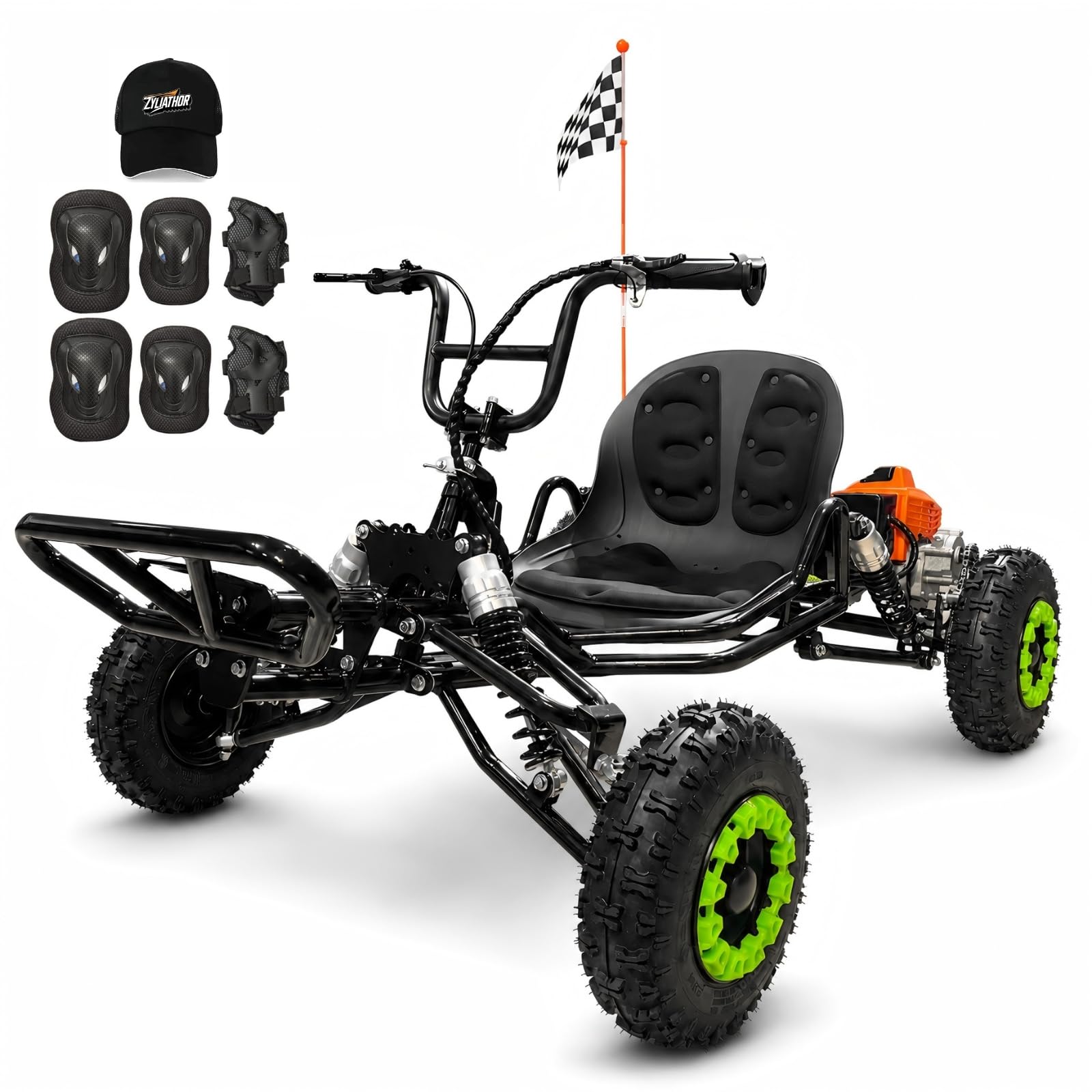
The only kart here with a dial that lets a parent cap the top speed.
An adjustable throttle limiter valve is the feature that separates this from every other gas kart on the list. Instead of relying on a rider’s discipline to stay slow, a parent can physically cap how far the throttle opens, then raise the ceiling as confidence grows. That makes it the most sensible gas kart for a mixed-ability household. The 63cc 2-stroke engine is EPA compliant and runs up to 28 mph, carries up to a 440 lb max load, and fits riders from 3’11” to 6’7″ — the broadest height range here after the 212cc model. On a 2.5L tank, it runs up to 31 miles and up to 6 hours per fill, both varying with rider weight, terrain, and throttle use.
Safety equipment and stability are built for backyard use. The reinforced tubular steel frame and low center of gravity support stable handling and reduce tipping risk on uneven ground, and the hydraulic rear disc brake adds confident stopping control. An adjustable throttle limiter plus a helmet-carrying friendly design make it workable as a kids’ kart under supervision and a teens’ kart for building confidence. The pull start with a push-button kill switch means quick shutoff when you need it.
The catch is the documentation and the low-end torque. One owner assembled it in two hours with no instructions — the manual simply never arrived. The instructions are also criticized as missing the governor speed setup, and some owners mention the kart will not climb hills with a 130 lb rider. This is a flat-backyard and gentle-trail kart, not an incline climber for a heavier rider. Regular gasoline with standard 2-stroke oil at 25:1 premix is required — there is no workaround — and 24/7 after-sales support is included.
The Parent-Friendly Angle
- Adjustable throttle limiter valve is unique on this list — physically cap top speed rather than trusting the rider to hold back.
- 440 lb max load and a 3’11″–6’7″ rider height range accommodate the widest mix of family members.
- Up to 31 miles and up to 6 hours per 2.5L tank, with EPA-compliant 2-stroke engineering.
- Hydraulic rear disc brake and low center of gravity for confident stopping and reduced tipping risk.
Where It Stumbles
- Instruction manual often missing and omits the governor setup; some report unclimbed hills under a 130 lb rider.
- Requires 25:1 premix — regular gas plus 2-stroke oil mixed by hand, no exceptions.
- Assembly may need to be figured out blind if the paperwork does not arrive.
- Low-end torque is thin, so hills demand a lighter rider or a flatter trail.
Perfect for: a parent who wants one gas kart that grows from a cautious first-timer to a confident teen via the throttle limiter.
Only if: your terrain is flat and you are comfortable mixing 25:1 fuel yourself.
9. Coleman Powersports GK200 196cc Gas Powered Go-Kart

A 196cc two-seater that weighs as much as a small motorcycle and carries two riders at once.
This is the only kart on the list designed for two. A 196cc gas engine, dual seats each with its own safety harness, reverse gear, and adjustable suspension make it the pick for a parent riding alongside a child or friends sharing an afternoon. It carries a 275 lb maximum load and rolls on a 67.3″L x 44″W x 47.2″H footprint — vastly larger than the hauck’s 47″L x 25″W x 28″H frame, which is the real difference between a single-rider toy and a two-person vehicle. LED headlights make low-light riding safer, and the pull-start design is meant to fire on the first pull.
What it does well, it does genuinely well. Families use it heavy on forested ORV trails and ATV dirt-track racing and report it handles sustained abuse. One 6 ft, 220-lb adult fit tightly but workably, with room to spare for a smaller passenger. Kids ride it comfortably, and the dual harnesses let a parent supervise directly. The seatbelts, though, are sized for adults rather than children, so a young passenger may not be held snugly — check the fit before every ride, and consider it an adult-priority belt.
The mixed reviews center on reliability under long sessions. One owner reports the unit stops working after an hour of use. A more concerning account describes a unit that arrived with only two wheels, had a documented motor issue dismissed as normal, drove for a day before returning to the shop, and was still having engine and gear issues five months later — with a gas pedal malfunction causing unintended acceleration and the 90-day warranty expiring while it sat in repair. That is the worst case, not the norm, but it is real. Some owners also report the stock chain tensioner breaks on day one and gets replaced with a transmission-bolt workaround. Maintenance is a requirement: brakes and oil changes are non-negotiable, and you will either need tools and the expertise or a mechanic on call.
The two-seat advantage: nobody else on this list carries two riders with separate harnesses, and reverse gear is rare here — that combination is why it wins the family category outright.
The maintenance reality: gas karts this size need brakes, oil, chain, and tensioner attention as routine care, and the 90-day warranty window is short.
Made for: a family who wants one machine that carries a driver and a passenger together, on trails, with reverse for tight spots.
Approach with care if: you want a low-maintenance kart or a warranty that covers you well past the first three months.
Know the Specs
Power Source: Pedal, Gas, Or Battery
A pedal kart with an auto-clutch builds speed with your legs and coasts when you stop pedaling — the purest way to slide because you feel exactly how much rear grip you have. Gas karts deliver the most sustained horsepower and the broadest range on a full tank, but they arrive with premix fuel requirements, chain maintenance, and noise. Electric karts give instant torque off idle from a rechargeable pack, which is the easiest way to kick the rear tires loose, at the cost of range per charge and a recharge pause between sessions.
Higher motor wattage or engine displacement generally means more torque for a heavier adult rider, but it also means more weight to slow down and more force if you lose control. Match the output to your surface: a low-displacement engine is plenty on flat pavement, while sand, mud, and hills demand more.
Tire Type, Rim Bearings, And Drift Control
Low-profile rubber tires with sealed bearings in each rim give the most predictable break-away, which is why the pedal kart with 2 bearings per 8-spoke rim handles slides so cleanly. Larger all-terrain tires — 6-inchand 13-inch sizes — grip loose surfaces far harder, so you need more power and body weight to break them loose. A solid rear axle that drives both wheels lets you slide the whole back end as one unit; a one-wheel-drive axle just spins the inside tire. Pair any high-grip setup with a hydraulic rear disc brake so you can stop the slide on command.
Maximum load capacity tells you who can ride, but check it against your real weight with gear on — and never assume an adult fits just because the number is high. Rider height range and cockpit length matter just as much, since a tall rider jammed against fixed pedals cannot control a slide.
Common Questions
Can an adult actually drift a pedal go kart?
What is the difference between a 2-stroke and a 4-stroke go kart engine?
How much weight can these go karts hold?
Do I need to mix oil and gas for a 2-stroke go kart?
How fast do these go karts actually go?
Is a solid rear axle better for drifting than a single-wheel drive setup?
How much assembly is required before riding?
How long does a battery or a tank last between rides?
Can two riders use one of these go karts at the same time?
What maintenance does a gas go kart need regularly?
The Bottom Line
For most people chasing a genuine drift kart for adults, the hauck Sirocco Racing Clutch Free Go Kart wins because its pedal auto-clutch and low-profile rubber tires with 2 bearings per 8-spoke rim deliver the most controllable, most repeatable sliding on pavement and short grass — and it never needs fuel, a charge, or a chain adjustment. If you want real off-road power with a solid rear axle that slides on gravel and dirt, the 2000W Electric Go Kart is the one to grab. And for a two-person trail machine the whole family can share, the Coleman Powersports GK200 is the only kart here that carries a passenger at all.
One last honest nudge: the picks that hold up best over time here are the ones with a simple drivetrain and easy consumables — the hauck’s pedal system and the Razor’s swappable battery and tires both cost almost nothing to keep running season after season, so weigh the upkeep as heavily as the first ride when you finally choose.
How we choose
We do not accept paid placement. Every pick is matched to a real buyer and a real use-case; we do not hands-on test units.
Sources
Specifications: manufacturer listings and product documentation. Review insights: verified customer reviews, as of October 2026. Pricing: not shown on this page (it changes often); check the current price via the retailer link.
As an Amazon Associate, Aappliancez earns from qualifying purchases. This does not affect which products we feature.