Disclosure: Some links in this post are affiliate links. As an Amazon Associate I earn from qualifying purchases, at no extra cost to you. Learn more
Specs are compiled from manufacturer listings and verified buyer reviews and can change over time — please confirm the key details on the product page before buying.
Bed sores need two things from a dressing at the same time: cushioning that takes pressure off the skin, and a seal that survives a shower, a shift in bed, and a body that moves. If the dressing lifts, the wound gets wet, dirty, and slower to heal. If it sticks too hard, every change turns into a fight. The five picks below split that difference in different ways, and the top choice is the one that keeps its grip through all of it — the Smith+Nephew ALLEVYN Life, the crowd favorite at 4.5+ stars across 700+ ratings.
This guide is built by comparing the manufacturers’ published specifications and the patterns across verified customer reviews, so you get each pick’s real strengths and trade-offs instead of marketing spin.
You will see how each pad handles moisture, pressure, and changes, so you can match one to a loved one’s skin instead of guessing. Here is where the best dressings for bed sores actually differ, and which ones hold up in daily care.
Top Picks


How To Choose The Best Dressings for Bed Sores
A bed sore, also called a pressure ulcer or bedsore, is damage to skin and tissue that happens when someone sits or lies in one spot for too long. A dressing does not cure that. What it does is cushion the spot, keep the wound bed moist but not soaked, and hold the whole thing in place while the person is shifted and moved. Choosing well means matching the pad to the wound stage, the amount of drainage, and how often a caregiver can change it.
Start with the shape and where the sore sits
Sores on the tailbone, the sacrum, are the most common spot for a bedbound person. A sacrum dressing is cut with a wider border and a contour that hugs that curve, so it does not bunch up under the hips. A flat square pad on the sacrum has to be taped at the edge, and that tape is usually the first thing to peel. If the sore is on the heel, elbow, or a shoulder blade, a standard foam pad in a smaller cut does the job.
Match absorbency to the drainage, not to the brand
A dry or lightly draining sore wants a dressing that keeps a moist healing environment without soaking the surrounding skin. A heavily draining sore wants a pad that pulls fluid away and locks it into the core so a change is not needed every few hours. Alginate pads are the heavy-duty option here — they are made from seaweed fiber that turns into a gel when it meets fluid. A thin transparent film is the opposite end: it protects but does not absorb, so it belongs over intact skin or a lightly dressed area.
Decide how gentle removal needs to be
Repeated dressing changes on fragile skin are where pain and damage add up. Silicone contact layers are the softer way to peel a pad off — they stick to dry skin around the wound but not to the wet wound bed itself. Standard acrylic adhesive holds harder and can lift with more grip, which helps through movement and showering. If the skin around the sore is thin or already broken, the softer border wins even if it costs more.
Side-by-Side Comparison
| Model | Best For | Dressing Size | Padding Type | Pack Count | Amazon |
|---|---|---|---|---|---|
| Smith+Nephew ALLEVYN Life★ Best Overall | Staying on through showers and movement | 5 in x 5 in | Foam with wide border | 10 | Amazon |
| Dimora Ag Silver Sacrum FoamSilver Defense | Sacrum sores with infection concerns | 7 in x 7 in | Silver foam with adhesive border | 5 | Amazon |
| Ceeport Transparent Film | Shower protection over a dressed area | 6 in x 8 in | Thin film, no padding | 20 | Amazon |
| LotFancy Calcium Alginate | Heavy drainage and larger wounds | 4 in x 8 in | Alginate pad, non-adherent | 10 | Amazon |
| EVERLIT Sacrum Silicone Foam | Larger body frames and long wear | 9 in x 9 in | Five-layer silicone foam | 10 | Amazon |
Detailed Reviews
1. Smith+Nephew ALLEVYN Life Wound Dressing 5″ in X 5″ in
Our pick — 4.5+★ from 700+ verified ratings; the strongest balance of quality and price.
The bordered foam dressing that stays sealed through a shower and peels off only when you mean it to.
For a caregiver whose biggest fear is the pad lifting halfway through a bath, this is the one that keeps its word. The standout is the quadrilobe shape — a four-lobed outline with a wide border that follows body contours instead of fighting them — and that border is what lets a patient shower without the dressing peeling loose. Smith+Nephew designed it to hold under pressure, which is exactly the condition a bed sore lives in every hour of the day.
Per the maker, the foam core locks fluid away and absorbs common wound odor in lab testing, so changes smell less. There is also a protective masking layer that dulls the look of strikethrough — the dark stain that show- throughs on a dressing — so the pad sitting under a nightgown does not broadcast itself to a visitor. At 5.01 ounces for the box, it is a hair lighter than the Ceeport film 20-pack at 10.86 ounces, though the two are not doing the same job.
What wins people over is the staying power through a shower — “I could take a shower and it didn’t peel off,” as buyers put it on the review pages, and that is the barrier a sore on a tailbone really needs. The other consistent theme is comfort across frequent changes: a flexible adhesive that sticks on curves, absorbs moderate-to-large drainage, and comes off without tearing the skin around it. As one of the strongest voices on the page sums it up, these were the best at “wicking away moisture, providing good protective cushioning, and not sticking to the sensitive skin around the wound” across eight months of daily dressing changes on a leg wound.
What holds up best
- Wide border and four-lobed shape hug the body and survive showering
- Fluid lockdown under pressure keeps drainage off the skin around the sore
- Comfortable through frequent changes with no irritation, per owner consensus
- Waterproof, absorbent, and easy on and off for a caregiver with gloves
What to plan around
- Premium-tier cost per box; owners say it is worth it but feel the hit
- Not shaped for every location — the lobes are cut with the sacrum and torso in mind
The main thing to know is that the 5 in x 5 in size is a modest landing zone. On a larger body frame or a wide sacrum sore, one pad may not span the whole area, and you will want to step up to a bigger cut. For most caregivers it is the right balance of grip and gentleness — the kind of pad you put on in the morning and forget about until the next change.
Reach for this if: the person you care for showers, shifts position in bed, and cannot afford a dressing that lifts at the first bit of moisture.
Think twice if: the sore is large and broad — the 5 in x 5 in coverage may leave edges to fill with a second pad.
2. Dimora Ag Silver Sacrum Foam Dressing 7″x7″
The sacrum cut with silver built in — for a sore that is already angry and showing signs of trouble.
Sores on the tailbone are the number one reason people end up buying a sacrum pad, and this one is cut for exactly that curve. The 7 in x 7 in border leaves a foam pad that covers roughly a 5.5 in x 4.9 in wound area, so it sits over a sacrum sore and its edges seal down around it. It comes in a 5-pack, and the numbers tell the real story: it is 75% more coverage per pad than the LotFancy alginate pad at 4 in x 8 in, and it is 23% bigger by package footprint than the Ceeport film box. For a wound that needs its whole bed shielded, that matters.
Where it earns its spot is the silver. Per the maker, the foam layer holds about 0.25-0.35 mg/cm2 of silver and releases silver ions on contact with wound fluid to help reduce bacterial colonization in the dressing itself. Caregivers describe a pressure sore improving “visibly in one day” with the silver and the adhesive together, and the adhesive side of the story is that the medical-grade silicone “makes it easy to get off and it remains in place.” That is the balance: soft contact to peel away, sticky border to stay put.
Healing is the thing the review pages return to most — the phrase that comes up again and again is pressure sores getting better, alongside the pad’s protective work keeping water and contaminants off the sore. Cushioning and comfort round out the list, and per the maker, the thick foam core absorbs up to 15 times its weight, and a nonwoven layer spreads drainage out instead of letting it pool. The honest catch: cost is where goodwill wobbles, and a few find the sticking power inconsistent from pad to pad. On a big open sore that also needs a waterproof outer cover, you may still find yourself layering this under a film dressing for showering.
Where the silver pays: inflamed sacrum sores, thicker drainage, and any spot where a caregiver is watching for a dressing that could harbor bacteria.
The trade-off to weigh: a 5-pack goes fast on a sore that needs changing every couple of days, and the premium per pad is real.
Pick this one when: the sore is on the sacrum, it is already inflamed, and you want the pad doing double duty with silver.
Look elsewhere when: you need the widest possible count per pack and can go without the silver — the Ceeport 20-pack stretches further per dressing.
3. Ceeport Waterproof Transparent Film Dressing 6″ x 8″

A thin, clear film — the outer shell that keeps a dressing dry while you can still see through it.
This is not a pad in the cushioning sense. It is a clear polyurethane film with a latex-free, hypoallergenic adhesive that goes over intact skin or a lightly dressed area to form a waterproof barrier. The 6 in x 8 in size is large enough to cover a dressing plus the margin around it, and the count is the showpiece: 20 individual sheets per box, four times the 5-pack that the Dimora sacrum pad comes in. For a caregiver whose need is a barrier on shower day rather than a padded sore cover, that math is compelling.
The design intent is on the front of the listing: a strong adhesive that conforms to skin contours, a transparent face so you can check the area without peeling it back, and a “not for prolonged immersion” caveat on water. Owners confirm it holds through a short shower when you prep the skin first — an alcohol wipe, apply, press firmly, peel the tab. Get that sequence right and the film stays put through a shower, clothing friction, and sleep, and the clear face lets you monitor without disturbing the dressing underneath. One owner of a surgically drained wound found it “waterproof and stay put in the shower,” which is about as clean a testimonial as the category offers.
The integrity of the seal is where you need to manage expectations honestly. A long 25-30 minute soak can let water in at the edges, and the very strong adhesive that makes removal a project on some skin. This is a barrier layer, not a substitute for a foam pad on an open pressure sore — the maker says as much, asking you not to apply it to deep or heavily exuding wounds without gauze or a non-woven pad underneath. Under a nightgown or a pair of briefs, though, it is a low-profile way to keep a dressing dry while a caregiver showers the person.
The clear advantage: the transparent face lets you eyeball the dressing without pulling it off, which cuts down on changes and on the wear-and-tear those changes cause.
One caution to note: it needs a skin prep and a firm press to seal — and it is not built for a long bath or a soak in a tub.
Best used as: the outer waterproof layer on shower day, covering a foam pad or a lightly dressed area.
Skip it for: a deep, heavily draining sore that needs absorbency — you will want the LotFancy alginate or a foam pad under this film, not instead of one.
4. LotFancy Calcium Alginate Wound Dressing 4”x8”
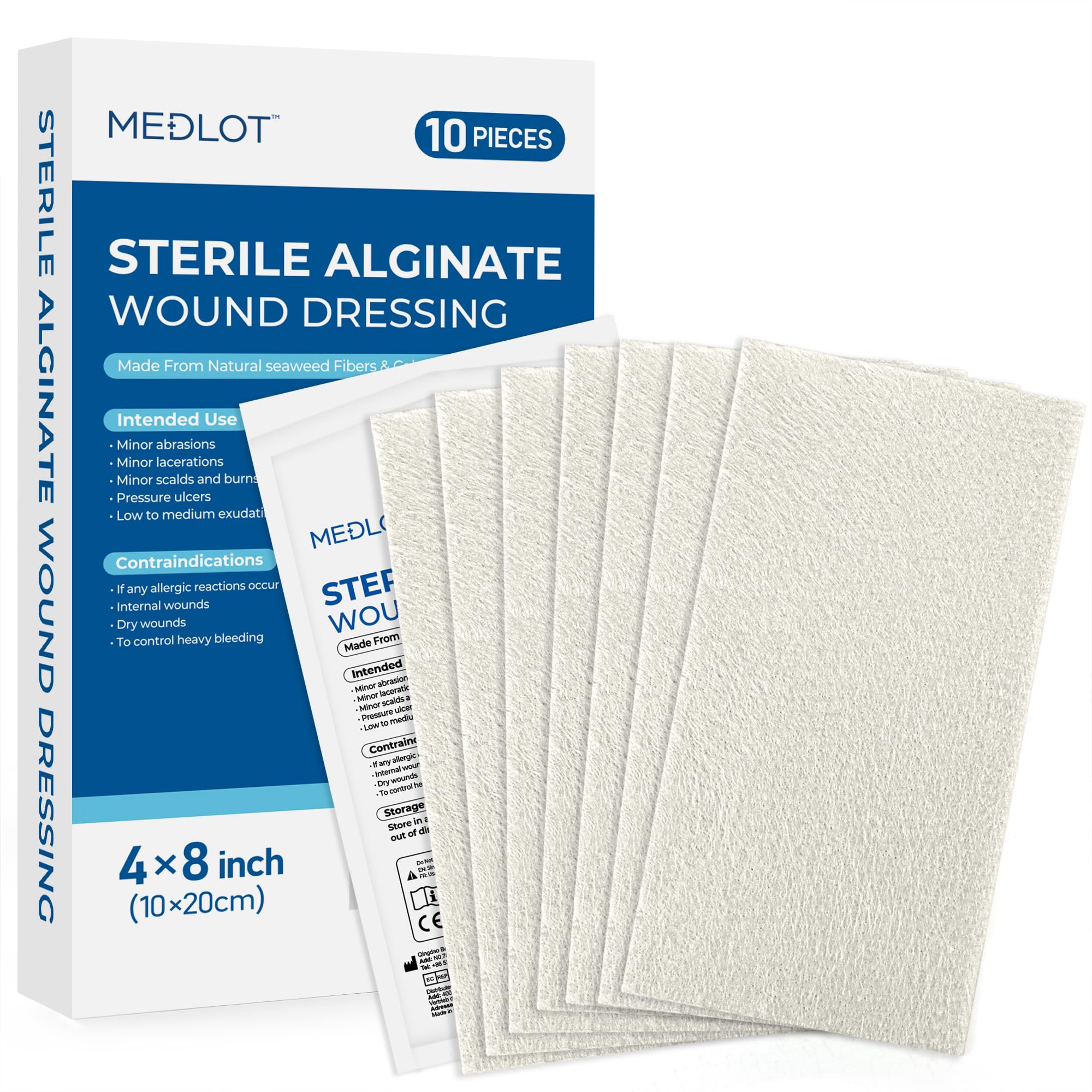
For a sore that is weeping hard, the seaweed pad that gels, holds the fluid, and peels off clean.
When a wound is putting out a lot of fluid, the challenge flips. You no longer need a sealing border; you need something that swallows drainage and will not turn into a crusted, stuck-on mess at change time. This pad is made from calcium alginate — natural seaweed fiber plus calcium ions — which gels on contact with wound fluid and, per the maker, absorbs up to 20 times its weight. That gelling layer keeps the wound bed moist in the good sense, and the pad is non-adherent, so it should not tear the new tissue when it comes off.
At 4 in x 8 in it is a long strip rather than a sacrum-shaped patch. It can be cut to the size you need and it conforms to body contours, so on a large sacrum sore you can shape it to the area and hold it under a secondary dressing. That is the pattern with alginate pads — they do the absorbing, and a separate cover does the holding. The thickness is where the pad earns its respect, with owners who have tried other brands saying it is thicker, absorbs more, and therefore needs changing less often. On value it comes out well ahead of a specialty pad by the count — 10 individually wrapped sterile pads in the box, each one cuttable, and the maker notes the product is FSA and HSA eligible.
The catch that shows up in the reviews is adhesion, and it is the thing to understand before you buy. This pad is not meant to stick to your skin; it is meant to be held in place, so on its own it will not survive a shift in bed. Pair it with a film or a foam pad with a border if the person is mobile. If the sore is dry or only lightly draining, this much absorbency is overkill and can dry out the wound bed — alginate is for the wetter end of the spectrum.
The strong suit: the gelling seaweed pad pulls heavy drainage away from the skin and lifts off clean instead of tearing a sore open at change time.
What to plan for: it has no border of its own, so it needs a tape, a film, or a bordered foam dressing over it to stay in place through movement.
Reach for this if: the wound is weeping heavily, the skin around it is fragile, and you want a pad that will not stick to the sore bed itself.
Look elsewhere if: the sore is dry or lightly draining — you want moisture balance, not a sponge.
5. EVERLIT Sacrum Silicone Foam Dressing, 9″ x 9″, 10 Pack

Nine inches across — the sacrum pad for a larger body that needs the whole area covered at once.
If you have ever taped two sacrum patches together because one did not span the area, this is the pick that solves that problem. The 9 in x 9 in pad gives you a much larger landing zone than the Dimora 7 in x 7 in and the Smith+Nephew 5 in x 5 in, which is the practical difference on a larger frame. Caregivers who measure in inches on a bigger person find that the larger cut gives them full coverage and a seal that stays down; the smaller cuts can leave you patching at the edges.
The build is a five-layer stack: a silicone contact layer for gentle but secure adhesion, a super-absorbent layer to pull and hold exudate, a non-woven spreading layer to spread drainage out, a foam layer to take up the excess moisture, and a breathable film on top that manages temperature and acts as a waterproof barrier. That film is what keeps a pad like this on through a shower, and the bordered, hypoallergenic, latex-free adhesive seals on all sides around the wound. The foam core also cushions the site — for a sacrum sore, the cushion is doing some of the work that a repositioning pillow does.
What the review pages show is that these fit and stay on, that the size is welcome on larger frames, and that the pad outlasts a thinner bandage, which matters for the change frequency and the cost per use. The honest caveat is moisture. A large silicone foam patch traps what comes off the skin, so if the person sweats heavily around the site, you have to stay ahead of it and let the wound get some air between changes. The 10-pack goes further than the Dimora 5-pack, but the pad is a premium buy at the top of this list — the coverage is the reason.
The win on size: a full 9 in x 9 in sacrum pad that covers the whole area in one piece, with the border sealing on all sides to keep the shower out.
The management note: it holds moisture in as well as out, so a heavy sweater around the site needs more frequent changes and a little air.
Choose this for: a larger body frame where a 7 in x 7 in patch leaves uncovered skin at the edges of the sore.
Consider the alternative if: the person sweats heavily at the site — a thinner, more breathable pad may suit better between showers.
Know the Specs
Dressing size and shape
The size is the border-to-border measurement of the pad, and it decides what the pad can cover. A 5 in x 5 in pad covers a small area; a 9 in x 9 in pad covers a large one. The shape is just as important: a sacrum dressing has a wider border and a contoured outline to follow the curve of the tailbone, while an alginate strip is a flat rectangle you cut to fit. Measure the sore and add a margin when you choose, so the adhesive border lands on intact skin, not on the wound or a pressure point.
Absorbency and moisture balance
Absorbency is how much fluid the pad can take up before it needs changing. A moist wound heals faster than a dry one, so aim for enough absorbency to keep drainage off the surrounding skin without drying out the wound bed. Foam cores lock fluid into the pad; alginate turns into a gel and is for the heavier end of the spectrum. A pad with silver in it, like the Dimora, adds a step beyond absorbency by releasing silver ions when it touches wound fluid.
Adhesion and the silicone border
The adhesive holds the pad in place while the person is shifted, dressed, and bathed. A wide border with a strong adhesive is what survives a shower and a move in bed, which is why bordered foam sacrum pads are the workhorse for a bedbound patient. A silicone contact layer is softer: it clings to dry skin around the wound and releases more gently at change time, which matters when the surrounding skin is thin or already damaged. If skin is fragile, choose the gentler stick even at a higher cost per pad.
Common Questions
Can a bed sore dressing stay on in the shower?
How often should a bed sore dressing be changed?
Is a sacrum dressing better than a regular square pad?
Does silver in a dressing make a difference for an infected sore?
Can I put a waterproof film over a foam pad?
Should I use an alginate pad on a bed sore with heavy drainage?
Is a silicone border easier to remove than a standard sticky border?
Can caregivers cut a dressing to fit a smaller sore?
Will a bed sore dressing prevent the sore from getting worse?
What if the dressing keeps peeling at the edge?
The Bottom Line
For most people caring for a bed sore at home, the pick that earns its place is the Smith+Nephew ALLEVYN Life, because the quadrilobe border is the one feature that keeps the pad down through a shower and a shift in bed, and that is the failure mode that ruins a dressing faster than anything else. If the sore is on the sacrum and already inflamed, the Dimora Ag Silver sacrum pad puts a silver layer into the same fight. For a larger frame or a sore that needs whole-area coverage, the EVERLIT 9 in x 9 in sacrum foam covers the area in one piece, and the LotFancy alginate pad is the one to reach for when the drainage is heavy. If your only job is keeping an already-dressed sore dry on shower day, the Ceeport film 20-pack is the low-cost outer layer to keep on the shelf. The real nudge: buy the dressing that matches the sore in front of you — match the shape, match the absorbency, and get a pack large enough to change it when it needs changing.
How we choose
We do not accept paid placement. Every pick is matched to a real buyer and a real use-case; we do not hands-on test units.
Sources
Specifications: manufacturer listings and product documentation. Review insights: verified customer reviews, as of October 2026. Pricing: not shown on this page (it changes often); check the current price via the retailer link.
As an Amazon Associate, Aappliancez earns from qualifying purchases. This does not affect which products we feature.