Disclosure: Some links in this post are affiliate links. As an Amazon Associate I earn from qualifying purchases, at no extra cost to you. Learn more
Specs are compiled from manufacturer listings and verified buyer reviews and can change over time — please confirm the key details on the product page before buying.
The wrong tape lifts off a layer of skin with it. The right one holds through a shower, a night’s sleep, and a full day of moving around — then comes away clean.
This guide is built by comparing the manufacturers’ published specifications and the patterns across verified customer reviews, so you get each pick’s real strengths and trade-offs instead of marketing spin.
You will see how each option handles stickiness, absorbency, and pain-free removal, so you can grab the one that fits the skin you are actually covering. The best dressing for skin tear protects the wound while it heals and lets go without taking skin with it.
Top Picks

How To Choose The Best Dressing For Skin Tear
A skin tear is a small flap of skin that has lifted or separated, usually on thin, fragile skin. The dressing you choose has to do two opposite things at once: stay put while the wound heals, and release without tearing the flap again. Get the adhesive wrong and the removal does more damage than the injury.
Start with the adhesive, not the pad
The single biggest factor is how the dressing sticks. Silicone adhesive (a soft, rubber-like grip that bonds gently) can be lifted and repositioned. Standard acrylic adhesive holds harder and often leaves residue or lifts skin on removal. For fragile arms and legs, silicone or a petrolatum contact layer is the safer bet.
Match absorbency to drainage
Lightly weeping wounds need a breathable contact layer that lets air reach the wound. Heavier drainage needs a superabsorbent core that pulls fluid away and locks it in, so the surrounding skin does not become soggy. Over-dressing a dry wound wastes material; under-dressing a wet one means daily changes that stress the skin.
Check the wear time and the border
A dressing with an adhesive border stays in place on its own — no separate tape required. Some foams are rated for wear times of up to several days, which means fewer changes and less disturbance to a healing tear. If a dressing relies on tape, that tape is a second chance to pull skin.
Side-by-Side Comparison
| Model | Best For | Size | Count | Adhesive Type | Amazon |
|---|---|---|---|---|---|
| Medline Optifoam Gentle EX Bordered Foam Adhesive Dressing★ Best Overall | Fragile, sensitive skin with moderate drainage | 3″ x 3″ | 10 | Gentle silicone | Amazon |
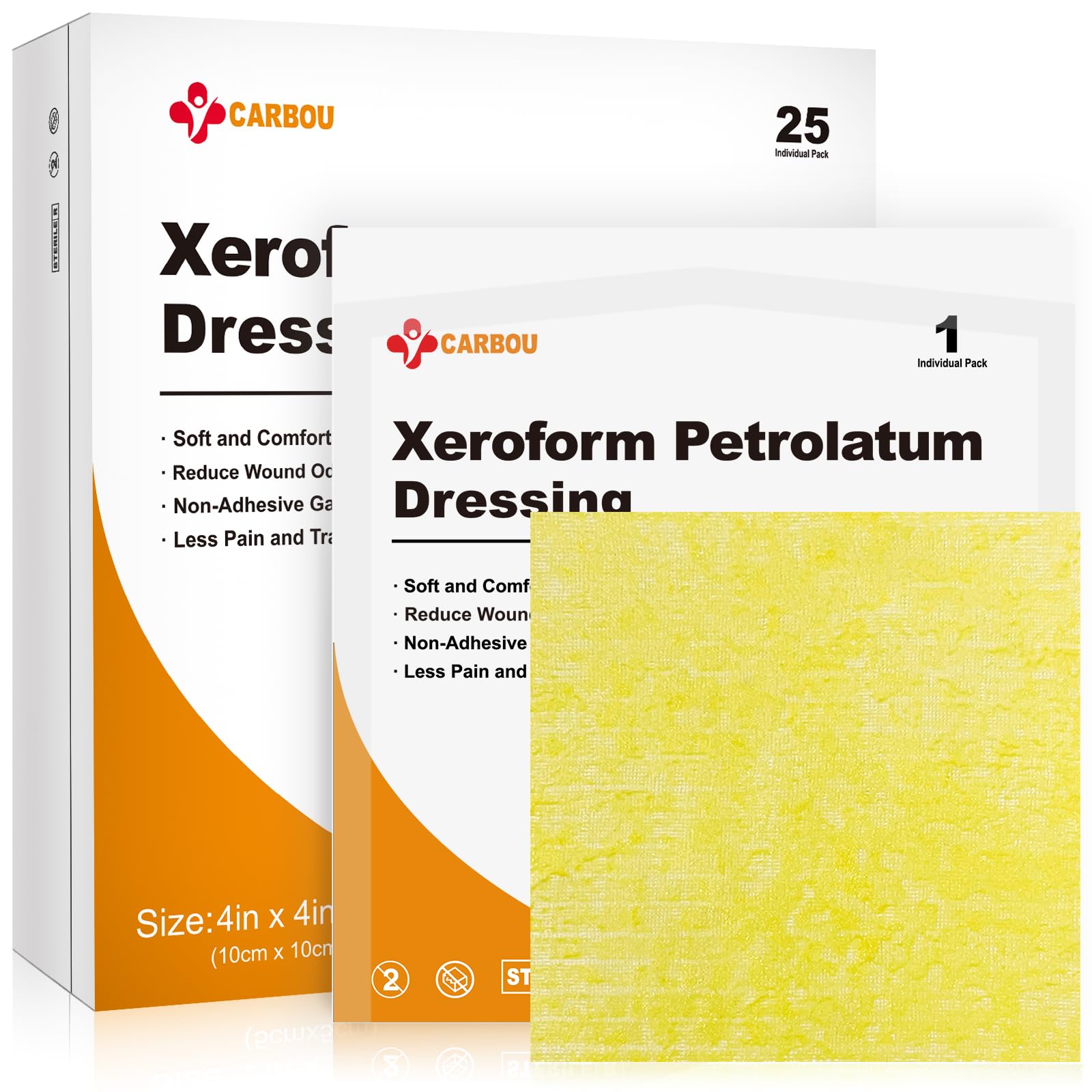
| Carbou Medical Xeroform Petrolatum DressingBest for Open Wounds | Non-stick contact layer over open wounds | 4″ x 4″ | 25 | Petrolatum non-adhesive mesh | Amazon |
| Telfa Kendal Ouchless Adherent Sterile Dressings | Value bulk supply for home first-aid kits | 3″ x 4″ | 100 | Adhesive on two sides | Amazon |
| Hysimedy Silicone Bandages Variety Pack | Kids and elderly with very thin skin | Small and large mix | 60 | Silicone, 4-side sealed | Amazon |
| Niceful Silicone Super Absorbent Wound Dressing | Large or heavily draining wounds | 4″ x 8″ | As listed | Silicone with adhesive borders | Amazon |
Detailed Reviews
1. Medline Optifoam Gentle EX Bordered Foam Adhesive Dressing 3″ x 3″
Our pick — over 4.5★ from 900+ verified ratings; the strongest balance of quality and price.
The dressing that lifts off without lifting skin — and can be reapplied if you place it wrong
For fragile skin with moderate drainage, this is the one to reach for. It is a five-layer foam dressing built around a superabsorbent core (a middle pad that soaks up fluid and traps it). That core pulls drainage away from the wound, turns it into a gel, and locks it there, so the skin around the tear does not get waterlogged.
What earns the trust of caregivers is the silicone adhesive. It bonds gently enough to be lifted and repositioned — one buyer covering dermatology stitches called it easy to remove and noted it does not pull skin. Another used it on a mother’s surgical site after her skin reacted to other bandages, and reported no reaction and a gentle removal. The low-profile build stays flexible over knuckles and ankles, and its moisture vapor transmission rate adjusts with the fluid level, so the dressing breathes more when the wound needs it. The design supports wear times of up to seven days on partial and full-thickness wounds with moderate drainage. That means far fewer changes across a healing tear.
Weighing 2.4 ounces for a 10-count box, it is dramatically lighter and smaller than the 100-count Telfa Kendal pack at 12 ounces. What you trade for that convenience is quantity: 10 dressings versus 100. The recurring note in the reviews is cost — it is a premium price for a smaller box, and the honest math only works in your favor when a single long-wear dressing replaces several standard changes a day.
What earns its place
- Silicone adhesive lifts and reapplies without yanking skin
- Superabsorbent core pulls drainage into a gel and locks it away
- Up to 7-day wear time on moderate-drainage wounds
- Breathable MVTR adjusts to fluid level
Where it asks more of you
- Only 10 dressings per box for the money
- 3″ x 3″ size limits coverage on larger wounds
- Premium cost rewards long-wear use, not quick swaps
Made for you if: you are dressing fragile or sensitive skin with moderate drainage and want fewer, gentler changes.
Think twice if: you need bulk coverage for a long recovery — the 100-count option below stretches further.
2. Carbou 4″x4″ Medical Xeroform Petrolatum Dressing 25 Pack
A petrolatum contact layer that refuses to grab the wound underneath
This one solves a different problem. Instead of sticking to the skin, the fine mesh gauze carries petrolatum (a soft petroleum jelly coating) and 3% Bismuth Tribromophenate. That combination keeps the mesh from bonding to the wound bed, so removal does not peel off new tissue. It is designed to sit as the primary contact layer directly over the wound, with your absorbent dressing on top.
Each sheet is 4″ x 4″ and cuttable to the shape and size of the wound, and every piece arrives in its own sterile single pack — handy for a kit you grab in a hurry. Buyers report it behaves like the hospital-grade material, only easier to apply because it is not pre-folded. It has earned its place over long stretches of wound care, and one reviewer’s experience on 2nd-3rd degree burns used with silvadene cream noted slight sticking but easy removal after a saline soak.
Where it falls short is how it handles time: one buyer used it for a chest tube site and found it dries out in about 24 hours, so it is not a long-wear option. It also needs a secondary dressing and tape to hold it, since it has no adhesive of its own. For a weeping skin tear that needs a gentle, breathable barrier changed daily, though, that layer of petrolatum is exactly what protects the fragile flap.
The daily-driver barrier: non-adherent petrolatum mesh that resists sticking to healing tissue, cuttable to any wound shape, individually wrapped sterile for kits.
What to plan around: it needs a second dressing and tape on top, and it loses effectiveness after about a day, so it suits daily changes rather than long wear.
Reach for this if: you need a non-stick contact layer over an open or draining wound changed once a day.
Look elsewhere if: you want a border that holds on its own — this one always needs a cover on top.
3. Telfa Kendal Ouchless Adherent 3″ x 4″ Sterile Dressings 100 Count
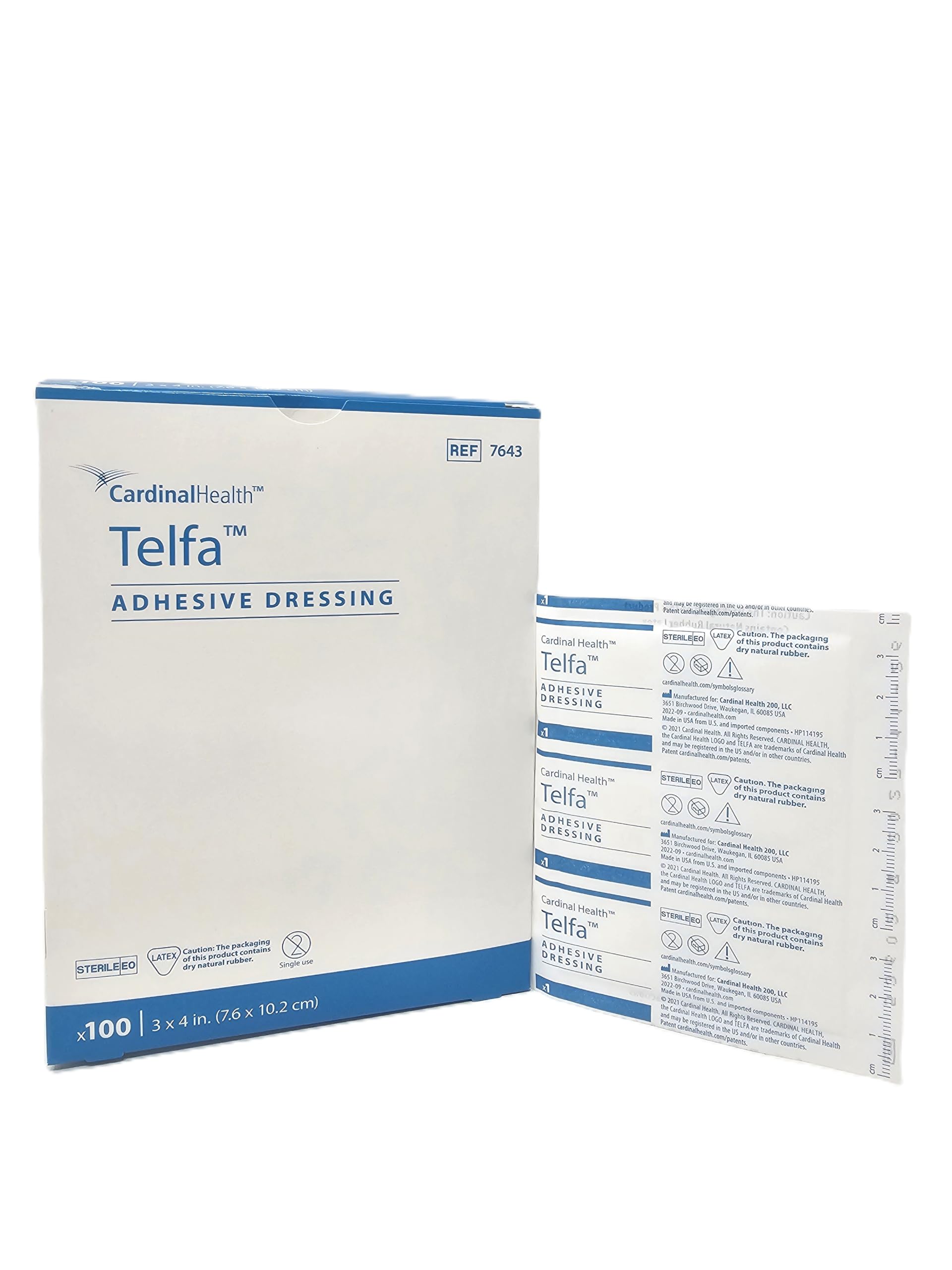
One hundred individually wrapped pads — you will not run out mid-recovery
When you are changing a dressing twice a day for weeks, quantity stops being a detail and becomes the whole point. This is a 100-count box of 3″ x 4″ pads, each sterile and individually wrapped, with adhesive on two long sides so the pad holds itself in place without separate tape. The double-coated center pad keeps the wound from sticking to the dressing and holds seepage in. The small adhesive area lets air reach the wound, which helps a scab form without needing a fresh pad every few hours.
It is the heavyweight here at 12 ounces for the box — the largest and heaviest option in this group — but that is simply the volume of 100 pads. The upside is enormous flexibility: you can cut each pad down to fit an awkward tear on a shin or forearm. What wins people over is the adhesive balance — it holds through athletic movement, lets go without the sting you get from ordinary bandage tape, and a frequent complaint about large adhesive gauze shifting has not shown up here.
The catch is on the adhesive itself. It sticks firmly, and pulling too fast can leave residue or tug at skin — remove it slowly. One buyer did find an allergy to the adhesive, and another flagged that the pad is white where the listing shows tan, so check what your care team expects before ordering. Even so, the value is hard to argue with across a long recovery, making this the box to keep stocked at home.
Bulk value, real flexibility: 100 individually wrapped 3″ x 4″ pads, cuttable to any wound size, with two-side adhesive that skips the extra tape.
The honest limit: strong adhesive rewards a slow removal, and the pad is white rather than the tan shown in the listing.
Right for: anyone dressing a wound at home for weeks who wants a large, tape-free supply that stretches the whole recovery.
Not the pick if: your skin reacts to standard adhesive — the silicone options above release more gently.
4. Hysimedy Silicone Bandages Variety Pack Large and Small
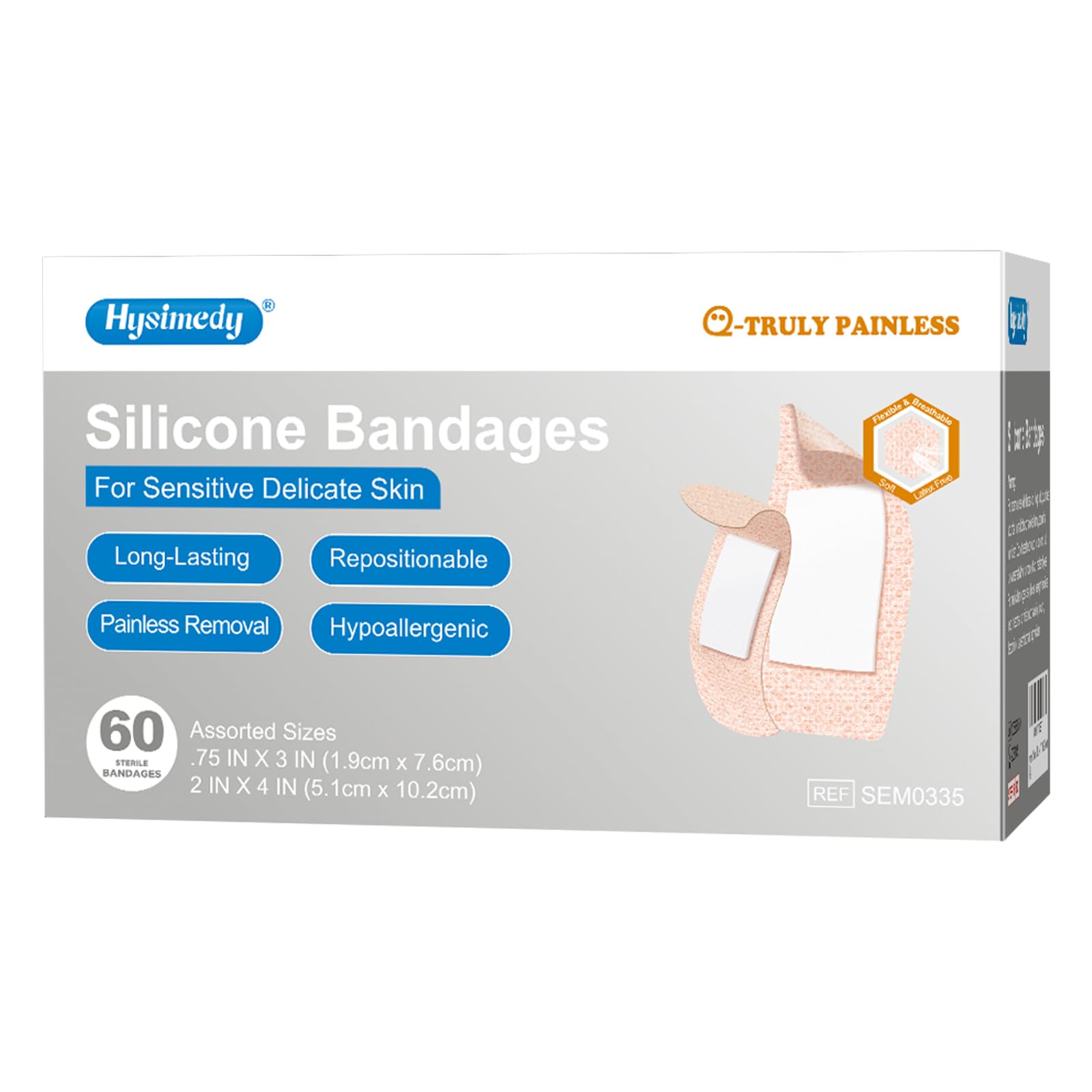
Sixty bandages built so that taking one off never takes skin with it
If your skin tears under ordinary adhesive bandages, this is the pack to try. Sixty bandages come in a mix of large and small, each with four-side sealed silicone adhesive (a soft grip that releases without pulling) and cotton pads that measure 0.47″ x 1.06″ on the small and 1.34″ x 2.05″ on the large. The material is latex-free and rubber-free, and the soft non-woven fabric conforms to joints while staying put during movement.
The thing everyone raves about is how these behave on thin, aging skin. Owners describe a lifetime of ripping skin with regular band-aids and finally finding one that peels off clean — one buyer described being 80 with very thin skin and said these come right off with no skin and no pain. Effectiveness is the quality buyers single out most, with skin-friendliness close behind. The silicone also lets you adjust the position mid-application; if it sits crooked, just lift it and try again without losing the grip.
Be ready for the trade-off in the adhesive. Because it is soft, it does not hold as hard as standard tape, and on sweaty, oily, or high-movement spots it can lift within an hour or less. One buyer who loved them elsewhere found them fall off on second use in those conditions. This is a dressing for fragile skin and low-stress placement, not for a wound that sees heavy friction.
The draw
- Silicone adhesive peels off without tearing thin skin
- 60 bandages in mixed large and small sizes
- Latex-free and rubber-free for reactive skin
- Repositionable — relift and reapply without losing stick
The reality check
- Gentle adhesive loosens on sweaty or high-movement areas
- Smaller pad sizes suit minor tears, not large wounds
The best fit for: older or thin-skinned users for whom removal pain is the deciding factor.
Keep looking if: the dressing sits over a joint under clothes all day and needs to stay put through sweat and friction.
5. Niceful Silicone Super Absorbent Wound Dressing 4″×8″

When the wound is long and weeping, this 4″ x 8″ sheet covers it in one piece
Most dressings in this group are pad-sized. This one is a sheet. At 4″ x 8″ with self-adhesive borders, it can cover a long surgical incision or a large, heavily draining wound that smaller pads would need several pieces to handle. The superabsorbent core is built to pull exudate away fast and lock it in an SAP polymer core, keeping the wound moist without letting it leak onto the surrounding skin.
What keeps this dressing in place is the border. It fits onto the wound and holds itself, no separate tape needed, and the silicone can flex over joints. It also releases easily when you are ready to change it — one reviewer noted it stays in place all day, covers an incision well, and does not stick to the wound on removal. Quality is the quality buyers rate highest here, with the edges holding up to movement while still lifting off gently.
Its 20-times absorption capacity handles heavy drainage that would overwhelm a thin gauze pad, so you change it once a day instead of several times. The one caution is moisture: on a spot that sweats, the edge can begin to release early, so a buyer using it on their armpits found it starting to come off when perspiration built up. It also carries a premium cost that some find steep — the value math works best when you are covering a genuinely large or draining wound.
Why it earns its spot
- 4″ x 8″ size covers long incisions and large wounds in one piece
- Superabsorbent core locks heavy drainage away from skin
- Self-adhesive borders hold without extra tape
- Soft contact layer lifts off without sticking to the wound
Before you buy
- Edges can loosen early in sweaty, high-friction spots
- Premium cost that suits large, draining wounds best
The one to choose for: a large, long, or heavily draining wound that needs one big sheet and true absorbent power.
Overkill for: a small skin tear where a bandage-sized silicone option would do the job just as gently.
Know the Specs
Adhesive type
How a dressing sticks decides how it comes off. Silicone adhesive bonds softly and can be lifted and repositioned, so it releases without pulling fragile skin. Petrolatum or non-adherent mesh does not stick to the wound at all — it sits as a contact layer and needs a cover on top. Standard acrylic adhesive holds harder and can leave residue or tug at skin, so for a fragile skin tear it takes more care on removal.
Absorbency and wear time
Absorbency is how much fluid a dressing pulls from the wound. A light, breathable pad suits a lightly weeping tear; a superabsorbent core handles heavy drainage by locking fluid into a gel and keeping the surrounding skin dry. Wear time follows the same logic — longer-wear dressings reduce how often you disturb the wound, which matters most when every change risks pulling the fragile flap again.
Common Questions
What is the best dressing for a skin tear on fragile, thin skin?
Should a skin tear be kept moist or left to dry out?
Can I cut a dressing to fit an awkward skin tear?
How often should I change a dressing on a skin tear?
What if my skin reacts to standard bandage adhesive?
Is a silicone bandage better than a regular adhesive bandage for a skin tear?
Can these dressings cover surgical incisions and stitches?
Are larger dressings worth it for a small skin tear?
Will these dressings stay on through a shower or a full day?
How do I remove a dressing without tearing the skin again?
The Bottom Line
For a fragile skin tear with moderate drainage, the Medline Optifoam Gentle EX Bordered Foam Adhesive Dressing is the strongest all-rounder — a gentle silicone grip you can lift and reposition, a superabsorbent core that locks drainage away, and wear times that let the wound rest. If you want a large sheet for a long or heavily draining wound, the Niceful Silicone Super Absorbent Wound Dressing covers it in one piece with an absorbent core built for heavy output. And if you are dressing a wound at home for weeks, the Telfa Kendal Ouchless Adherent Dressings give you 100 cut-to-size pads so you never run short mid-recovery. The Medline Optifoam is the crowd favorite, with 4.8 stars across 900+ owners.
How we choose
We do not accept paid placement. Every pick is matched to a real buyer and a real use-case; we do not hands-on test units.
Sources
Specifications: manufacturer listings and product documentation. Review insights: verified customer reviews, as of October 2026. Pricing: not shown on this page (it changes often); check the current price via the retailer link.
As an Amazon Associate, Aappliancez earns from qualifying purchases. This does not affect which products we feature.