Disclosure: Some links in this post are affiliate links. As an Amazon Associate I earn from qualifying purchases, at no extra cost to you. Learn more
Specs are compiled from manufacturer listings and verified buyer reviews and can change over time — please confirm the key details on the product page before buying.
If tiny flies keep appearing over your kitchen sink or shower drain no matter how many times you swat them, the swarm is not coming from your fruit bowl. It is coming from the thin film of organic sludge coating the inside of your drainpipe, where drain-fly larvae hatch. A drain cleaner built for this job has to do two things: cling to that pipe wall long enough to reach the breeding layer, and break down the gunk feeding it. The picks below are sorted by what they do once they hit the drain — cling, expand, or digest — so you can match one to your problem.
This guide is built by comparing the manufacturers’ published specifications and the patterns across verified customer reviews, so you get each pick’s real strengths and trade-offs instead of marketing spin.
Gel treatments cling and smother, foams expand into hidden pipe sections, and enzyme formulas digest the buildup over time. Below are the strengths and limits of each format, so you can pick the one that fits your drain.
Top Picks


How To Choose The Best Drain Cleaner for Fruit Flies
Before you buy anything, understand what you are actually fighting. Fruit flies and drain flies both lay eggs in the wet organic film that coats the inside of a drainpipe. Killing the adults you can see does nothing, because the next generation is already in that film. What you need is a product that reaches the film and breaks it down.
Gel, foam, or powder — what each one does
A thick gel pours down and clings to the pipe walls as it travels, which is exactly where the larvae live. An expanding foam pushes into voids and around bends that a liquid cannot reach, and it is the better tool when the breeding area sits past the P-trap (the curved water trap under your sink). A powder needs to be activated and poured, and its main advantage is measured dosing with a scoop so you do not over-treat or under-treat a single drain.
How much product one drain actually takes
Dosage is where most buyers get caught out. A single treatment is often a measured amount per drain — one gel here directs a pour of roughly 8 ounces into the problem drain, and one bio formula doses at 4 ounces per drain. If a bottle only holds a handful of full doses, a multi-day regimen will run dry before the job is done. Check the dose per drain and the number of treatments a bottle claims before you commit.
Safe for your pipes and septic system
Older plumbing, grease traps, and septic systems all react differently to harsh chemistry. Formulas built on enzymes, microbes, or citronella and cinnamon oils are the gentler route and are commonly labeled safe for pipes and septic systems when used as directed. If your home runs on a septic tank, make that label a hard requirement rather than a nice-to-have.
Side-by-Side Comparison
| Model | Best For | Format | Size | Dose Per Drain | Amazon |
|---|---|---|---|---|---|
| Mighty Mint Enzyme Drain Maintainer★ Best Overall | Ongoing odor control and buildup prevention | Liquid enzyme | 32 oz | — | Amazon |
| Green Gobbler Fruit Fly Killer PlusMost Widely Used | Large-scale fly problems on a repeat schedule | Thick gel | 32 oz | 8 oz | Amazon |
| Nisus Nibor-D Insecticide Foam with IGRDeepest Reach | Reaching past the P-trap into hidden pipe | Ready-to-use foam | 21 oz | — | Amazon |
| FLY-AWAY Drain Fly Killer | Coating every side of a stubborn drain | Gel / grease digester | — | 8 oz | Amazon |
| Rockwell Labs InVade Bio Drain | Microbe-and-citrus drain maintenance | Liquid, microbes + citrus oil | 32 oz | 4 oz | Amazon |
| Invade Hot Spot + | Spot-treating drains and overflow holes | Foam | 19 fl oz | — | Amazon |
| Invade Bio Cleaner | Multi-surface and drain cleanup | Liquid | 32 fl oz | — | Amazon |
| Natural Elements Fruit Fly Killer | Big-volume commercial-style treating | Citronella gel | 1 gallon | — | Amazon |
| Dr. Pooper Drain Fly Killer Powder | Measured dosing with a scoop | Powder, foaming | 16 oz | — | Amazon |
Detailed Reviews
1. Mighty Mint Enzyme Drain Maintainer
Our pick — 4.0+★ from 350+ verified ratings; the strongest balance of quality and price.
The enzyme formula that goes after the smell first and the buildup second.
This is the pick for the kitchen sink that drains fine but smells like a swamp, and for anyone who would rather prevent a fly problem than fight one. It is a 32-ounce liquid built on a specialized enzyme blend in a biodegradable formula, and those enzymes work on the fats, oils, and grease that coat pipe walls and feed larvae. You are not blasting the drain clear — you are denying the flies their food source.
What wins people over is the odor control, the thing this product is most praised for. The dirty-drain smell that draws flies in the first place tends to go away, and the recurring kitchen-sink funk after a treatment is noticeably absent. One buyer’s persistence is worth noting: they eliminated a stubborn sour bathroom odor after a single directed use and then reused the bottle periodically for months with no recurrence. Others describe the kitchen sink smell clearing overnight and needing a second application to finish the job.
The catch sits with the harder jobs. It is built for maintenance and smell, not for a drain that is genuinely slow or blocked, and a stubborn slow-running kitchen drain can shrug it off even after an overnight soak and a hot-water flush. The bottle also measures up noticeably taller and wider than the Green Gobbler gel — 10.2 inches high and 3.38 inches across versus 10 inches and 3.25 inches — which mostly matters for cupboard shelf space. It works on sinks, showers, tubs, floor drains, grease traps, and septic systems when used as directed.
Buyers report: “Smells amazing and it did the job. Drains were not blocked but not smelling great. Excellent product.”
Where it earns its place
- Enzyme blend targets the fats, oils, and grease that feed drain larvae
- Labeled safe for pipes, septic systems, and grease traps when used as directed
- Works across sinks, showers, tubs, and floor drains
The honest limits
- Maintenance formula, not a fix for a genuinely slow or blocked drain
- Smell control is the strength; raw clearing power is inconsistent
Reach for this if: your drains run fine but smell, and you want a septic-safe enzyme routine that keeps flies from settling in.
Look elsewhere if: the drain is already slow — you need a clinging gel or a foam, not a maintenance dose.
2. Green Gobbler Fruit Fly Killer Plus 32 oz Gel Treatment
A thick gel that sticks to the pipe wall instead of sliding straight past it.
Thirty-two ounces of thick gel, poured at 8 ounces per drain, gives you up to 16 treatments from one bottle — that math is the whole reason this one has become the default in so many bathrooms and restaurant kitchens. The gel clings to pipe walls and drain surfaces so it actually sits on the breeding layer, and the formula carries citronella oil and cinnamon oil. It is labeled safe for septic systems and works in garbage disposals, floor drains, kitchen sinks, bathroom sinks, and shower drains.
The scent is the pleasant surprise here, and it is the aspect this product gets the most positive feedback on. There is no chemical reek and no stinky mess to deal with afterward, which is a real consideration when the drain sits a metre from where you eat. Owners mention: “Eliminated sewer flies in 2 days after drain cleaner plus product, with drain cover closed.” That two-day window shows up in a lot of the feedback, though the results are not universal.
Be realistic about what a pour alone can do. Gel runs down the middle of the pipe, so the overflow hole and the rim of a sink or shower often get missed — and that is where flies breed in standing showers. The recurring advice is to coat the overflow drain as well, not just the main hole, and to expect to repeat the treatment daily rather than once. Set against the Mighty Mint bottle it is the shorter and slightly slimmer of the two at 10 inches tall and 3.25 inches wide, versus 10.2 and 3.38 inches — a small difference that shows up only on a tight shelf.
The dosing math: 8 ounces per drain and up to 16 treatments per 32-ounce bottle makes this the easiest one to run a full multi-day course with.
The follow-through: treat the overflow hole too, or you will be pouring again next week.
Built for: households ready to repeat a nightly pour across several drains until the cycle breaks.
Weak spot: a single pour misses the overflow and rim — plan the extra application or the flies return.
3. Nisus Nibor-D Insecticide Foam with IGR
The foam with a 17-inch hose that gets past the trap where a pour cannot go.
If you have already tried gels and they only slowed things down, this is the different approach. It is a ready-to-use foam that combines 5.000% Nibor-D with 0.018% IGR — an insect growth regulator, which is the part that stops juveniles from maturing so the breeding cycle breaks rather than just pausing. The 360-degree valve sprays in any direction, and the detachable 17-inch hose lets you reach beneath equipment and up into pipe you cannot see. No mixing, no special gear.
The reach is the reason this one earns its place. A buyer who had fought recurring shower drain flies for years through salt, baking soda, vinegar, and boiling water finally removed the drain cover, snaked out about 4 oz of organic material and hair, then applied one dose through the 17-inch flexible straw past the P-trap — and went nearly two months with no drain flies. That is the pattern here: the foam puts treatment where the larvae actually are, deep in the pipe, instead of on top of the grate.
The obvious follow-up question is about that hose, and the answer is honest — the attachment has its own problems. The can can lose the top during use, which makes fitting the tube awkward, and one buyer’s shipment arrived without the spout attachment at all, forcing improvisation on a product that is not much use without it. The foam also needs sitting time after application, and this is strictly for indoor use, so keep kids and pets clear while it works. It weighs 1.5 pounds against the Green Gobbler gel’s 2 pounds — noticeably the lighter can to hold overhead.
Why pros like it: the dual-action borate-plus-IGR formula hits on contact and disrupts growth, which is a two-front attack a plain gel does not offer.
Handle with care: the straw is the weak point — check it is in the box and seated firmly before you press.
The right call for: stubborn, deep-seated drain fly cycles that survived a gel, in bathrooms and commercial spaces.
Think twice if: you want a no-fuss pour — connecting and keeping that straw seated takes a steady hand.
4. FLY-AWAY Drain Fly Killer

The gel that tells you to coat all sides of the drain — and means it.
Most gel directions say pour and walk away. This one says apply roughly 8 ounces (1 cup) to all sides of the drain and let it cling to the pipe walls, and that instruction is the whole point. It is a non-caustic, non-corrosive formula, which means it kills flies on contact without corroding your pipes, garbage disposals, or septic system, and it doubles as a grease digester. Repeat daily until you see results.
Effectiveness is what this one gets praised for, followed by a refreshing scent and easy use. A plumber-recommended pick in at least one household, it cleared a fruit fly infestation that had spread from the kitchen into the bathroom inside about a week and a half. Another buyer used it on a severe drain fly problem in an elderly client’s kitchen and had it sorted quickly.
Here is the thing to plan around: the bottle is small for a full recommended course. The directions call for repeated daily pours, and running that for a full week takes more product than one container holds, which is a recurring gripe in the feedback. Smaller doses still work for some households, so the practical move is to treat the drains you have rather than trying to stretch one bottle across the whole house. It is also the heaviest of the gel-style options here at 2.14 pounds, so you will feel it in the hand while you coat a high shower drain.
What it does well
- Directions push full 360-degree coverage of the pipe walls
- Non-caustic and non-corrosive — labeled safe for pipes and septic systems
- Doubles as a grease digester
What to plan around
- Bottle runs short of a full multi-day course
- Value gets questioned when you have several drains to treat
Pick it when: you have one or two problem drains and are willing to coat all sides properly for several days running.
Size check: count your drains first — a whole house on one small bottle will leave you short.
5. Rockwell Labs InVade Bio Drain Quart

A four-ounce dose per drain that lives in the pipe and keeps working.
Thirty-two ounces at 4 ounces per drain means this quart covers eight drains per bottle, and it works differently from the gels. Instead of smothering larvae, it puts microbes and citrus oil into the drain and lets them digest the organic matter that flies lay eggs in. That makes it a maintenance tool rather than an emergency kill — the kind of thing you dose on a schedule so the breeding layer never rebuilds.
It is not limited to the drain either. The same liquid is meant for soda fountain drip trays, mop buckets, trash chutes, and urinals, which is why it turns up in commercial settings as much as home kitchens. Treated drains get a citrus note in place of the usual sour smell. The bottle stands 10.98 inches tall and 3.7 inches wide, so it needs a bit more cupboard headroom than the shorter gel bottles.
The honest caveat is the flip side of its strength — microbes take time to work through a heavy buildup, so this is the wrong tool for an active, visible infestation this week. It is the right tool for the household that wants to stay ahead of an infestation. Treat it as a routine, dosed on a regular schedule, and the drain stays clean-smelling and less inviting.
The maintenance angle: a 4-ounce dose per drain is a small, repeatable amount — easy to build into a monthly habit.
Not a rescue: if flies are already swarming, start with a clinging gel and switch here afterward.
Fits best: commercial drains, mop areas, and homes that want a scheduled microbe routine instead of a one-off purge.
Skip the wait: it will not clear an active swarm quickly — it is a prevention step, not a fast kill.
6. Invade Hot Spot +
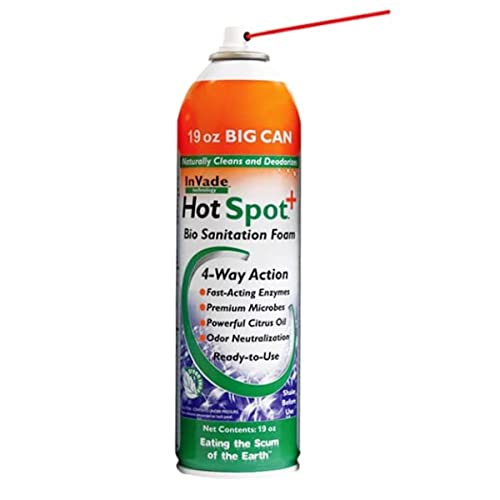
A foam that reaches into overflow holes and rims the pour-on bottles miss.
Nineteen fluid ounces of ready-to-use foam built around fast-acting enzymes, premium microbes, and citrus oil, with no bleach and no added scent. It is designed to break down the organic debris lining the drain rather than just douse the flies, and it comes out as a foam so it can sit against vertical surfaces instead of running straight down. That makes it the tool for the overflow hole, the rim, and the drain collar — the places a gel never touches.
Effectiveness is what gets praised here, and the pattern is consistent: the foam goes where the bugs breed and knocks them back quickly. One household used it on drains and had the fruit flies gone in short order and planned to restock. Others use it as part of a monthly routine through the summer, spraying every drain to head off the problem before it starts.
The straw is where this one lets you down, and it is worth knowing before you order. The attachment does not seat firmly in the nozzle, and at least one user had it shoot off into a filthy drain pipe and need fishing out. Without that straw seated properly, getting the foam down to where it needs to go becomes genuinely difficult. Durability and foam behavior are mixed too — it can escape around the top of the push mechanism. Treat the straw as the fragile piece and hold it in place while you press.
Its real job: spraying down overflow holes, rims, and drain collars that a liquid pour simply slides past.
Watch the nozzle: secure the straw before you press, or the foam comes out in the wrong place entirely.
Suits you if: the flies keep reappearing from a shower or sink overflow and you need targeted foam reach.
Know before buying: the straw fit is the weak link — a known frustration you will want to manage from the first press.
7. IBCC032 Invade Bio Cleaner

A quart of unscented cleaner that earns its keep away from the drain too.
Thirty-two fluid ounces of unscented liquid, listed with drain as its specific use but genuinely useful on countertops and general surfaces as well. It weighs 2.18 pounds and stands 10 inches tall in a bottle that saves shelf space. Designed to go after gnats and drain flies in the summer months, when the sink becomes a nursery.
What owners like is how far it stretches. It handles summer drain gnats and does double duty on kitchen surfaces, which means one bottle covers the drain maintenance and the counter wipe-down. The unscented formula also means no lingering perfume in a small kitchen. One important note in the listing: it ships with no spray heads, so if you were expecting a sprayer, plan to supply your own bottle.
The one real caveat is the bottle size for a full drain treatment — the feedback runs small enough that a whole-house course will want the larger jug. The bigger context here is that drain flies are a summer pattern, so a quart cycled through a few drains across a season makes sense, while a year-round problem may need more volume. There is also a trend among users of pairing this orange product alongside a dedicated drain-fly gel, using each for what it does best.
Best use case: seasonal maintenance across sinks and counters, with a gnat-fighting focus in summer.
Check the box: no spray heads are included — have a sprayer ready if you plan to use it that way.
Good for you if: you want one unscented liquid for both drain duty and everyday surface cleanup.
Consider the jug: a quart may run short across many drains — heavier use favors the larger format.
8. Natural Elements Fruit Fly Killer

A full gallon of citronella gel for anyone with more than a few drains to treat.
One gallon — 128 fluid ounces — of thick, citronella-infused gel that is built to be poured across many drains rather than one. The gel is formulated for universal drain compatibility regardless of pipe material, and the maker describes it as lab-tested to be non-toxic, biodegradable, and food-safe. It is aimed at homes as well as restaurants, hotels, and grocery stores, which is why the format is this large.
Where this earns its keep is volume. A gallon of clinging gel on a repeat schedule means you never run dry mid-course, which is the exact trap that sinks a smaller bottle on a multi-drain job. When it works, it works convincingly — one buyer went from catching 50-plus flies a day on sticky cards to under 10 the day after pouring about 5 ounces down two drains, and down to single digits by day two. The trick that shows up again and again is applying around the full 360-degree circumference of the drain, not just a squirt down the middle.
Plan for the scent. The citronella is strong, and some buyers appreciate it while others find it noticeable in a small kitchen, so ventilate while you treat. Effectiveness is mixed in the wider feedback, and the practical answer is that the method matters as much as the bottle — coating the whole drain mouth and repeating for a few days does the work, not a single pour.
Why the gallon wins
- 128 fluid ounces covers a full multi-drain, multi-day course without running out
- Thick citronella gel clings to pipe walls instead of draining away
- Described as non-toxic, biodegradable, and food-safe, and compatible with any drain material
What you give up
- The citronella scent is pronounced while working
- A single pour is not enough — success depends on full-circle coverage and repeats
Go big if: you have a whole house, a rental, or a commercial kitchen and need product that will not quit mid-treatment.
Start small if: it is one drain and a mild problem — a gallon is far more than that job needs.
9. Dr. Pooper Drain Fly Killer Powder

A powder that foams up on contact, dosed with a scoop so nothing goes to waste.
Sixteen ounces of powder that turns into a thick, expanding foam once it hits the water in your trap, reaching deep into the drain to dissolve organic buildup and the breeding grounds behind it. It arrives with a small scoop and gives you four complete treatments across 16 individual doses, which makes measuring exact and spillage rare. No harsh chemicals, so it is aimed squarely at homes with septic systems, older plumbing, or delicate drain lines.
Ease of use is the standout — the scoop does the thinking, and following the printed directions is simply pour, wait, repeat. One buyer worked it four days straight and then twice weekly, and the drain pests stopped coming back. For some households the results are close to complete: “It took a few days but it absolutely worked after a couple of rounds. It is not 100%, I would say 99%. I can eat and drink my coffee in peace.”
Two things to know before you order. First, and most importantly, powder is moisture-sensitive — a pack that has taken on humidity arrives crystallized and hard to pour in small amounts, so check the seal on arrival and store it dry. Second, the pack is a modest size relative to the number of drains in a home, and a few buyers feel the quantity is small for what they paid. Work out how many drains you have before committing. The 16-ounce count covers the four full treatments as listed, so match that to your drain count.
The dosing edge: an included scoop makes each treatment exact and repeatable — no guessing at volumes.
Storage matters: keep the powder bone dry, or it clumps and loses its foam-on-contact behavior.
Worth it for: septic-system owners who want precise, repeatable doses without harsh chemicals.
Count your drains: the four-treatment pack suits a focused job, not a whole house at once.
Know the Specs
Gel vs foam vs powder
A gel is a thick liquid that clings to the pipe wall as it flows down, which is what you want when the breeding layer sits on the vertical surface of the drain. A foam expands and pushes into voids, bends, and overflow holes that a liquid cannot reach — that is why products pairing a foam with a long detachable hose exist. A powder is dosed with a scoop and activated by the water in the trap, so it gives you exact, repeatable amounts. All three work; the difference is where in the drain each one can land.
Dose per drain and treatment count
Read the label’s dose, not just the bottle size. One gel here calls for roughly 8 ounces per drain and claims up to 16 treatments from 32 ounces; a microbe liquid doses at 4 ounces per drain. A bottle that looks generous can empty in a few days if you are treating a whole house on a repeat schedule. Match the product volume to the number of drains you actually have, and remember that most fly treatments need several consecutive pours, not one.
IGR and insect growth regulator
An IGR is a compound that stops insects from maturing into breeding adults, so the population cannot refresh itself. It is a different idea from a poison that kills on contact. A formula that pairs an insecticide with an IGR attacks both the adults and the next generation — which is useful in a drain where larvae keep hatching. Look for the IGR percentage on the label if breaking the cycle is your goal rather than just knocking down today’s flies.
Septic-safe and pipe-safe formulas
Harsh chemistry can be hard on older plumbing, grease traps, and septic tanks. Enzyme blends, microbes, citrus oils, and non-caustic non-corrosive gels are the gentler options, and the labels commonly state they are safe for pipes and septic systems when used as directed. If your home relies on a septic tank, make that statement on the label a requirement. It is also note which products state they are food-safe or non-toxic if they will be used near prep surfaces.
Common Questions
Will a drain cleaner actually get rid of fruit flies, or just the smell?
How much product should I pour down one drain?
Do I need to treat my drain more than once?
Are these drain cleaners safe for septic systems?
Is a foam better than a gel for drain flies?
What is an IGR and do I need one in a drain cleaner?
Why do drain flies keep coming back after I treat the drain?
Can I use boiling water instead of a drain cleaner?
Will these products damage old pipes or garbage disposals?
How long does a bottle last if I have several drains?
The Bottom Line
For most households fighting fruit flies in drains, the Mighty Mint Enzyme Drain Maintainer is the winner — it is the septic-safe maintenance formula that goes after the smelly buildup drawing flies in the first place, and it works across sinks, showers, tubs, and floor drains. If you want raw reach and a real cycle-breaking attack, the Nisus Nibor-D foam with its 17-inch hose and 0.018% IGR gets treatment past the P-trap where a gel simply slides by. And for volume, the Natural Elements gallon keeps a whole-house course going without running dry mid-treatment. Match the format to your problem — cling, reach, or volume — and repeat the treatment until the drain stays clean.
How we choose
We do not accept paid placement. Every pick is matched to a real buyer and a real use-case; we do not hands-on test units.
Sources
Specifications: manufacturer listings and product documentation. Review insights: verified customer reviews, as of October 2026. Pricing: not shown on this page (it changes often); check the current price via the retailer link.
As an Amazon Associate, Aappliancez earns from qualifying purchases. This does not affect which products we feature.