Disclosure: Some links in this post are affiliate links. As an Amazon Associate I earn from qualifying purchases, at no extra cost to you. Learn more
Specs are compiled from manufacturer listings and verified buyer reviews and can change over time — please confirm the key details on the product page before buying.
You want real gas cooking without a bulky hood hanging over your head — that is the whole appeal of a downdraft setup. The trick is knowing which ranges actually pair with a downdraft vent and which ones leave you cutting a hole in the wall anyway. The short answer: a rangetop like the ZLINE Legacy RT36 is the cleanest starting point, it slides into your counter and vents down through the cabinet instead of roaring overhead. Below you get seven real gas ranges and rangetops, each placed where it belongs by what it does well, so you can pick the one that fits your kitchen instead of the one that fits a showroom.
This guide is built by comparing the manufacturers’ published specifications and the patterns across verified customer reviews, so you get each pick’s real strengths and trade-offs instead of marketing spin.
Downdraft cooking is not the same as hood cooking, and it never will be — the vent pulls from counter level, so it catches smoke before it rises past your elbows. That one fact shapes everything else: burner layout, oven size, cabinet clearance, and how much noise you will live with. The picks below are ordered by what they do best, not by how much they cost, so the first entry is the one most people should start with. downdraft gas range shopping gets a lot simpler once you know which specs actually decide the fit.
Top Picks

How To Choose The Best Downdraft Gas Range
A downdraft gas range is two appliances wearing one coat: a gas cooktop that wants a lot of heat, and a ventilation system that pulls that heat and smoke down and away. Get the pairing right and your kitchen stays breathable without a hood stealing your sightlines. Get it wrong and you end up with a range that fights its own vent.
Start with the vent, not the burners
The vent is the part you cannot change later. A downdraft unit pulls air from the counter surface and pushes it outside through ducting or filters it and recirculates it back into the room. Ducted setups move more air, but they need a path through your cabinets and wall. Ductless recirculating setups skip the ductwork entirely and just filter the air — easier to install, but they trap grease and odors rather than ejecting them. Decide which one your kitchen can physically support before you fall in love with a cooktop.
Match burner BTU to how you actually cook
BTU (British thermal units) is just a heat-output number — bigger means hotter. High-output burners around 18,000 to 25,000 BTU give you a real sear on a steak or a fast rolling boil. Low-output burners down around 1,000 to 6,000 BTU let you hold a delicate sauce without scorching it. A range with a wide spread between its highest and lowest burner is more versatile than one with six identical mid-range burners. If you stir-fry, look for a dedicated wok burner or a burner rated at the top of the range’s spread.
Measure your cut-out before anything else
Downdraft ranges drop into a cabinet opening, so the cut-out dimensions matter more than the glossy photo. Measure the width, depth and height of the opening you have, then compare that to the range’s stated cut-out — not its overall size. A 30-inch unit typically wants a 30-inch cabinet, and a 36-inch unit wants a 36-inch cabinet. Depth is the sneaky one: a deeper range can push past your countertop edge and leave a gap behind it.
Decide if you want an oven attached
Some downdraft setups are rangetops only — burners with no oven underneath. Others are full ranges with a convection oven, broiler and sometimes air fry built in. A rangetop gives you more counter flexibility and lets you keep a separate wall oven. A full range keeps everything in one footprint. Neither is better; it depends on whether your kitchen has room for a second appliance.
Side-by-Side Comparison
| Model | Best For | Burner Count | Top Burner BTU | Oven Capacity | Amazon |
|---|---|---|---|---|---|
| ZLINE Legacy RT36★ Best Overall | Slide-in rangetop without an oven | 6 | 18,000 BTU | — | Amazon |
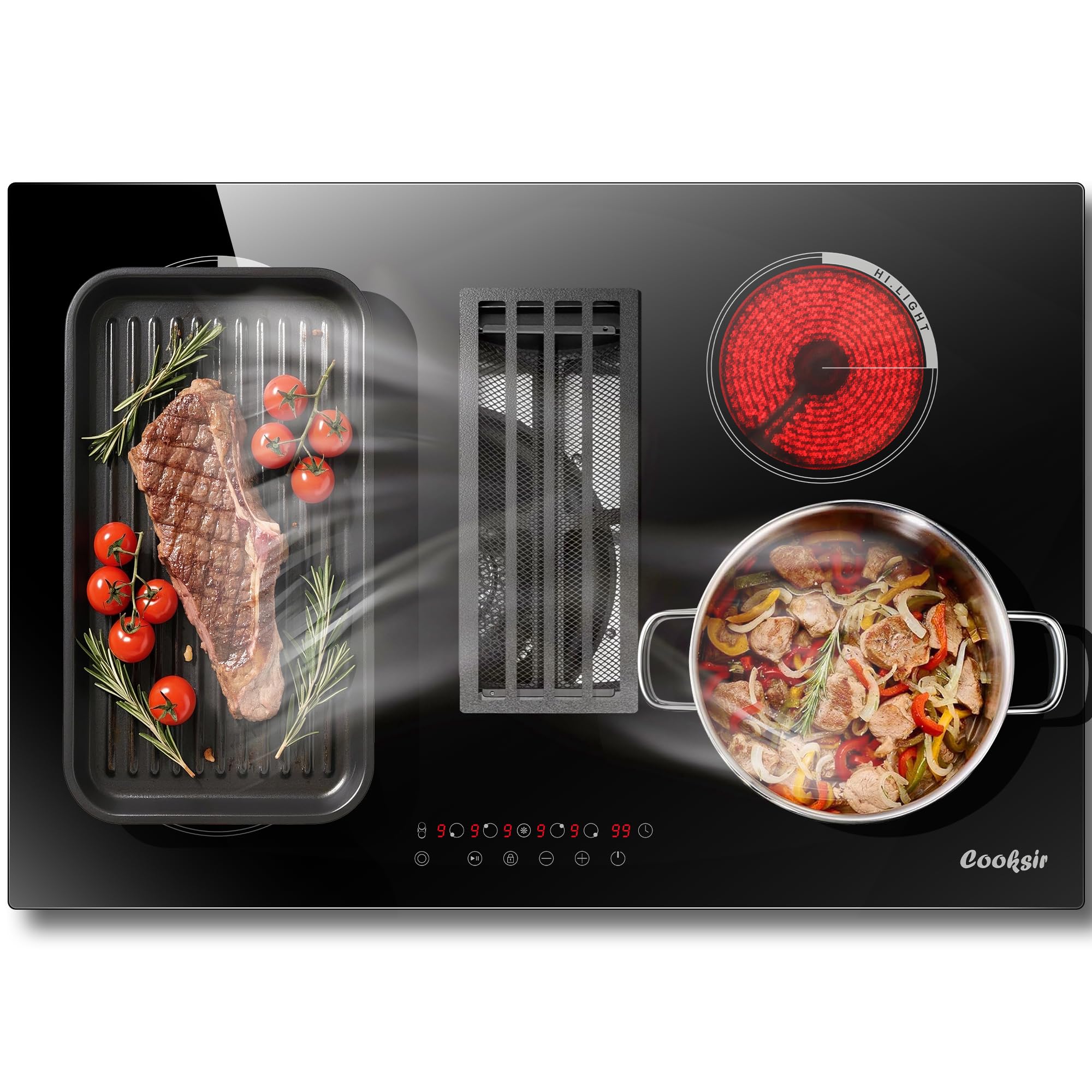
| Cooksir 30″ Electric Downdraft CooktopDuctless Pick | Ductless recirculating venting | 2 | 3,900W bridge burner | — | Amazon |
| Rangaire RRG303GS | Air fry plus self-clean in one range | 4 | 21,000 BTU | 5.1 cu ft | Amazon |
| COSMO Nebula 36″ | Convection oven on a budget | 5 | 18,000 BTU | 4.4 cu ft | Amazon |
| COSMO Vista 36″ | Six burners with a big convection oven | 6 | 22,000 BTU bake burner | 5.4 cu ft | Amazon |
| Empava 36″ Pro Gas Range | Commercial-grade total output | 6 | 20,000 BTU double flame | 5.2 cu ft | Amazon |
| Empava PRO 36″ | Maximum heat per burner | 6 | 25,000 BTU | 5.2 cu ft | Amazon |
Detailed Reviews
1. ZLINE RT36 Gas Rangetop
Our pick — 4.0+★ from 70+ verified ratings; the strongest balance of quality and price.
The six-burner rangetop that lets you skip the oven and the overhead hood.
The RT36 is a rangetop, not a full range — six sealed burners in stainless steel, no oven underneath. That matters for downdraft kitchens because it lets you pair the burners with the venting and oven setup your space actually allows. The burners are the star: six Italian-made sealed burners that run all the way down to 1,000 BTU for a bare simmer and up to 18,000 BTU for a hard sear.
You get the feel of a higher-end cooktop without the higher-end price. The surface is 304-grade stainless steel, which resists rust and corrosion, so it keeps its look through daily spills. The heavy cast iron grates are built with a high strength-to-weight ratio, so big pots sit steady without adding bulk. The one-piece porcelain cooktop is hand-finished and wipes down easily after a boil-over. Installation is slide-in, and at 85 pounds this is one of the lighter units to move into place — the COSMO Vista 36″ is 206.2 pounds, so the ZLINE is more of a two-person lift than a four-person job. LP conversion (switching the range to liquid propane fuel) is included, though a professional has to do it.
The honest catch is the base itself. Owners who followed the manufacturer’s leveling-feet setup found the unit rocked, and the fix is adhesive rubber pads with the leveling feet removed for a solid flat base. The other thing to know is electrical: it needs its own dedicated 120V, 60Hz, 15-amp circuit with a NEMA 5-15 plug, which is a normal household circuit but does need to be dedicated. The burner warranty is a limited lifetime on the Italian burners, with parts coverage for burners and caps.
Why cooks gravitate to it
- Widest heat spread here: 1,000 BTU simmer up to 18,000 BTU sear on six sealed burners
- 85 pounds makes it one of the easier rangetops to position
- Porcelain one-piece top wipes clean in one pass
- Limited lifetime warranty on the Italian burners
Where it demands attention
- No oven — this is a rangetop only, so plan a separate wall oven
- Needs a dedicated 15-amp circuit to run the electronic ignition
- LP conversion must be done by a professional
Most kitchens should start here: a six-burner rangetop that slides into your counter, pairs with the venting you have, and gives you a genuine 1,000-to-18,000 BTU spread.
Think twice if: you want an oven built in — the RT36 is burners only, and adding a wall oven changes your cabinet plan.
2. 30 Inch Electric Cooktop Downdraft
The one that vents without a duct, for kitchens where a hole in the wall is not happening.
If your kitchen has no path to outside air, this is the option that solves the actual problem. The Cooksir combines a ceramic electric cooktop and a downdraft hood in one unit, and it recirculates — it filters cooking fumes and releases the air back into the room rather than pushing it through ducting. No exhaust pipe, no duct arrangement, no wall surgery. It drops into a standard 30-inch cabinet opening and the cut-out does not have to be exact: anything smaller than the top glass but larger than the bottom works.
The cooktop side is electric, not gas, so be clear on that before you commit. Total power is 7,400 watts across two radiant elements — one dual-ring burner at 1,100/2,300W for flexible heat, and one bridge BBQ burner at 3,900W for large-area cooking. The downdraft hood runs at 135W total. You also get a child lock, a timer, and a pause function for when something boils over mid-cook.
Here is what to weigh honestly. This unit runs on 220V (a higher-voltage circuit than a typical household outlet), so budget for an electrician to wire it. Heating takes a while before it reaches temperature, though it holds steady once it gets there. The glass surface wants care to avoid scratches. The makers are clear on one point: these vent hoods pull air down at counter level, which is a different pull than an overhead hood, so leave a clear path around your pans.
Space-saving logic: because the vent and cooktop share one housing, you free up the wall space an overhead hood would have taken — a real win in a compact kitchen or an island without vertical clearance.
Plan the circuit first: the 220V requirement is the gating detail; if your kitchen does not have that line, the install cost climbs before the cooktop even goes in.
Reach for this if: you want downdraft venting but genuinely cannot run ductwork — the recirculating design and flexible cut-out make it the most install-friendly pick here.
Look elsewhere if: you want gas flames under your pans; this is an electric radiant cooktop through and through.
3. Rangaire RRG303GS 30″ Glass Touch Gas Range, Stainless Steel

A gas range that folds air frying, convection and self-cleaning into one slide-in footprint.
Most downdraft-friendly gas ranges make you pick between cooking modes. This Rangaire gives you all of them: a FlameMaster 21,000 BTU dual-ring dual-valve burner (BTU measures heat output, so 21,000 is strong searing power), a PowerFlame 18,000 BTU dual-ring burner, a TrueAire convection oven (a fan spreads heat evenly), an AirFry mode, Keep Warm, a meat probe, and a self-cleaning cycle that turns food residue to ash so you just wipe it out. That is a lot of capability for a 30-inch slide-in.
The touch controls are glass, which is the visual upgrade — you get a flat panel that wipes clean instead of knobs that collect grease. Underneath is a 5.1 cubic foot sealed-burner oven with a storage drawer, and it ships with an air fry basket, a wok grate attachment, an install kit and an LP conversion kit. The 25-inch depth fits a standard countertop without jutting past the edge, and the full-width grates make the top easier to clean than narrow single-burner grates.
At 197.5 pounds this is a genuinely heavy appliance — the ZLINE rangetop above is 85 pounds, so plan for two strong people or a delivery team that will place it, not just drop it. The quality of the cooktop itself is what buyers keep coming back to, and the look lands well in a remodeled kitchen. The streakier story is reliability: a few units have arrived with damaged door glass or a broken oven, and the fix window can be long. Treat that as a delivery-luck and warranty-service issue rather than a design flaw, and test the oven thoroughly in the return window.
What earns it a place
- AirFry plus convection plus self-clean in one range
- 21,000 BTU dual-ring burner for hard searing
- Meat probe and Keep Warm make long cooks easier
- 5.1 cu ft sealed-burner oven with storage drawer
What to plan around
- 197.5 pounds — this needs a real install plan
- Reliability is the streakier story; verify the oven fully inside the return window
- Full feature set means more controls to learn than a plain knob range
For the all-in-one cook: if you want air fry, convection and self-clean without buying a second appliance, this is the range that packs them in.
The weight is the catch: at 197.5 pounds, budget for a proper install crew rather than a solo lift.
4. Nebula Coll Gas Range

Five burners and a convection oven at the friendlier end of the full-range price ladder.
The Nebula is the range for someone who wants a 36-inch gas cooker with a real convection oven and does not want to stretch to the premium tier. Five sealed burners give you a spread from 18,000 BTU at the top, through an 8,800 and two 6,900s, down to 5,000 BTU at the low end. The 4.4 cubic foot oven adds fan-assisted convection with five functions — Bake, Roast, Broil, Fan Convection, Light — plus a 14,000 BTU bake burner and a 5,800 BTU broil burner.
The construction is aimed at keeping grease from becoming a chore. You get corrosion-resistant 403-grade stainless steel, heavy cast iron grates that hold heat and spread it evenly, and a fingerprint-resistant finish that wipes clean. Push-and-turn ignition knobs are a small safety touch that stops a child from turning a burner on by accident. Installation is freestanding, at 35.5 inches wide with a depth of 23.63 inches, or 24.94 inches with the backsplash — worth measuring against your counter before you commit.
The one thing nearly everyone notices is the oven temperature readout. There is no indicator that tells you when the oven has actually reached your set temperature, so the practical move is a separate oven thermometer and a little patience during preheat. The oven also looks smaller than the spec suggests, though a 30-pound turkey fits. Treat those as quirks to work around, not reasons to walk.
The value read: a five-burner 36-inch range with fan convection and a corrosion-resistant stainless finish is a strong starting configuration for a kitchen remodel.
The preheat quirk: no temperature-reached indicator means an oven thermometer is the smart add-on — cheap insurance for consistent baking.
Pick it if: you want a 36-inch convection range with five sealed burners and a finish that stays clean-looking.
Look elsewhere if: you insist on a digital temperature indicator — you will be adding your own thermometer here.
5. Vista Coll Gas Range
The bigger-oven answer when a 36-inch range has to feed a crowd.
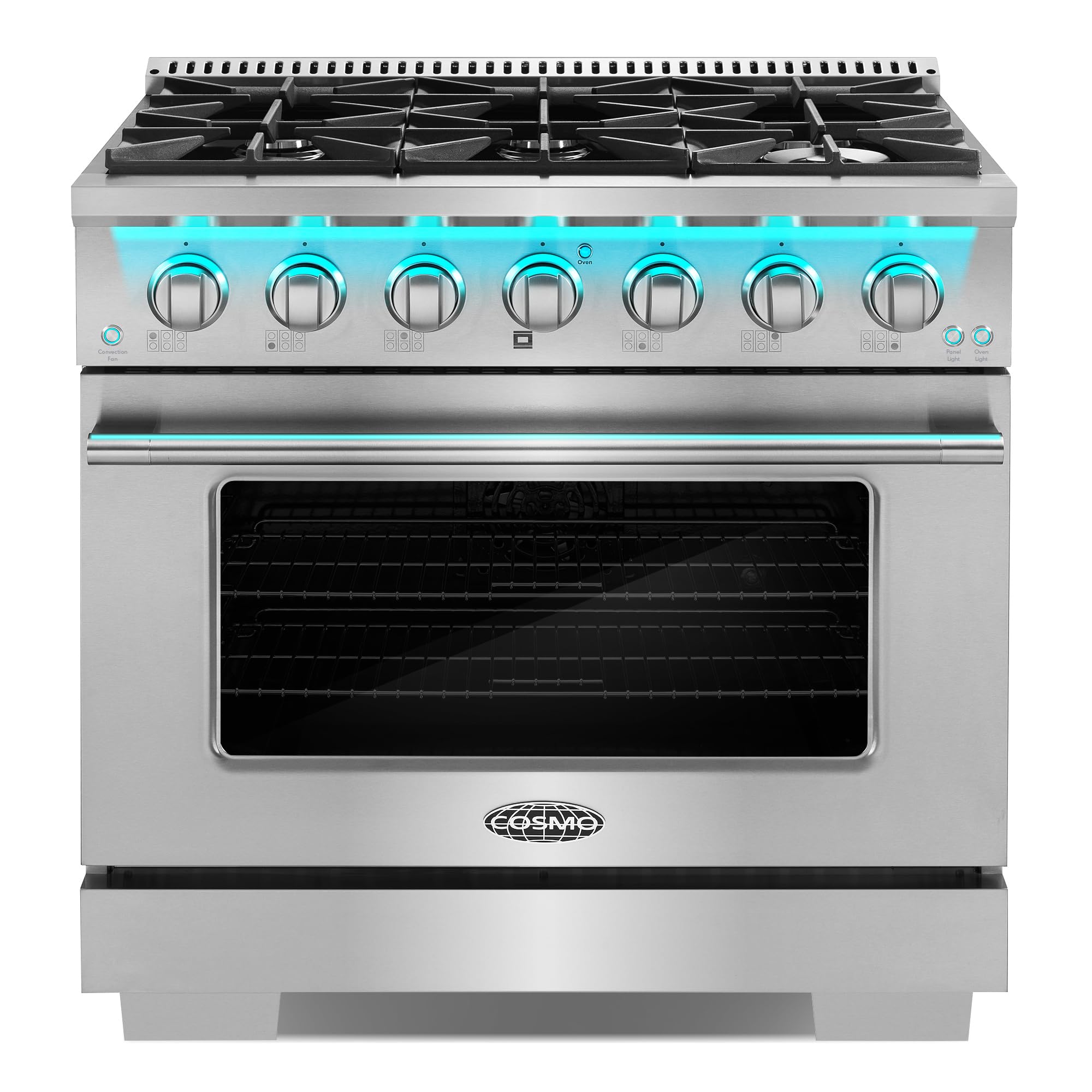
You get six burners and 5.4 cubic feet of oven space — that gap over the Nebula’s 4.4 cubic feet is the whole pitch, enough to fit a big holiday roast with room to spare. The Vista runs Rapid Convection (a fan circulates heat for even baking) with four oven functions (Bake, Broil, Convection Bake, Convection Roast). It pairs a 22,000 BTU bake burner with a 10,000 BTU broil burner, so the oven side has real heat, not just the stovetop.
The construction is the same 304-grade stainless and heavy cast iron grate recipe that makes the difference in daily cleanup — fingerprint and smudge resistant, wipes clean. You get a wok attachment for the cooktop, a full control panel across the front, and a single convection oven with an interior light. It runs on a 120V/8.73A three-prong plug and natural gas, and the LP kit is sold separately if you are on propane.
The thing that sells people on it is straightforward: it holds temperature true, the broiler works, and a 20-year-old Dynasty owner who moved to this one still wanted to keep the sliding oven racks. Two trade-offs are worth knowing. The cooktop is a sealed porcelain surface with grates over it rather than fully removable grates, which changes how you clean around the burners. And the timer and ignition on at least one long-term unit gave out after four years of steady use, so treat the warranty window as something to register and actually use.
Standout strengths
- 5.4 cu ft oven — the biggest in the mid-tier here, by a full cubic foot over the Nebula
- 22,000 BTU bake burner for real oven heat
- Six sealed burners with a wok attachment
- 304-grade stainless with fingerprint-resistant finish
Trade-offs to weigh
- LP conversion kit sold separately
- Sealed porcelain cooktop is less removable for cleaning than drop-in grates
- Long-term ignition and timer durability is the part to watch
The 36-inch crowd feeder: 5.4 cubic feet of oven and six burners is the configuration to pick when one range has to do holiday dinners.
The one caveat: sealed porcelain means a different cleaning routine than removable grates — check that you are okay with it before you commit.
6. Empava 36 Inch Gas Range
A commercial-minded range with a wok burner and defrost and dehydrate modes.
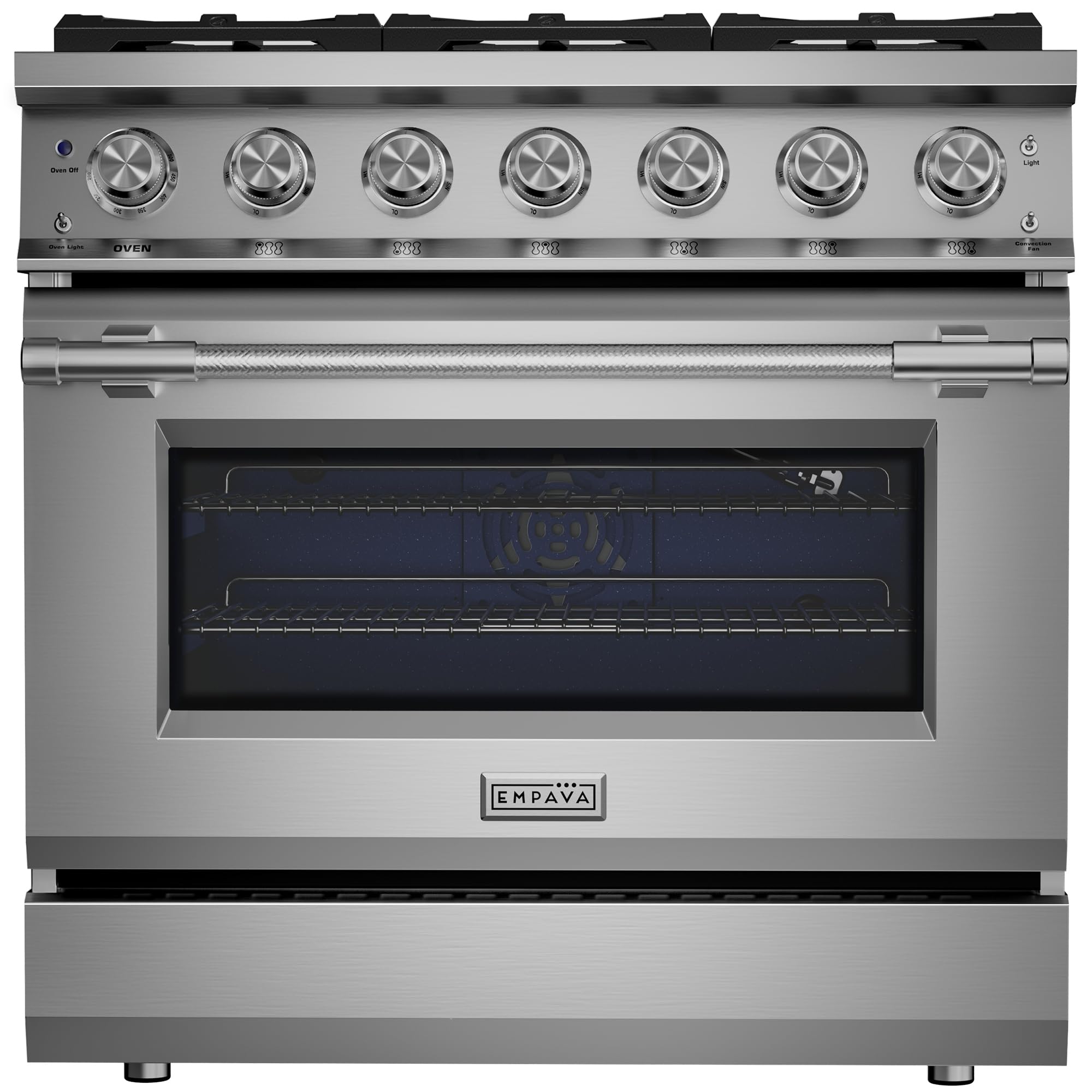
Total output is the number that defines this Empava: 103,000 BTU across six sealed burners. That breaks down into a 20,000 BTU double flame burner for rapid boiling and searing, a 6,000 BTU auxiliary burner for delicate simmering, and a dedicated wok burner in the mix. The sealed burner system matters practically — a spill sits on top instead of running into the gas lines, which keeps everything consistent over time.
The oven gives you a 5.2 cubic foot porcelain-interior cavity with true convection (a fan moves heat evenly around the food), plus Defrost and Dehydrate functions a plain bake-and-broil oven cannot do — handy for drying fruit or thawing meat without a microwave. Heavy-duty cast iron grates hold large pans and a wok steady, and the smooth stainless top is designed for easy wipe-down. The full spec sheet says it fits standard cabinet cut-outs at 36.4 inches high by 26 inches deep by 36 inches wide, and it comes with a two-year manufacturer’s warranty.
Where this pick asks you to be careful is the service story. The documented concerns involve burners not lighting on delivery and an oven ignition that needs parts across multiple repair visits. There is also a real design note that matters for a downdraft install: the depth is shallow for large pans, and heat can leak through the door seams. If your cabinets sit tight against the range, give the side surfaces a little breathing room.
Heat on tap: 103,000 BTU total with a 20,000 BTU double flame burner is a genuine step up in cooktop intensity — the kind of power that makes a wok worth owning.
The service read: the warranty gives you two years of parts coverage, so use that window to test every burner and the oven ignition early rather than living with a slow fix.
Built for the power cook: wok work, hard sears and dehydrating are all on the menu here in a way they are not on the plainer ranges.
The real caveat: door-seam heat and shallow depth mean you want clearance around your cabinet sides, not a snug fit.
7. Empava PRO Gas Range

Six burners with four rated at 25,000 BTU — the hottest range in this lineup.
If you want searing power above everything else, this is the numbers winner. The PRO 36 runs four 25,000 BTU sealed burners and two 18,000 BTU burners, so most of the cooktop operates at the highest heat band rather than dropping to mid-range on the outer rings. That is a different philosophy from the Empava 36 above, which spreads its BTUs more evenly across a 103,000 BTU total.
Under the cooktop sits a 5.2 cubic foot convection oven with a 22,000 BTU bake burner and a 10,000 BTU broiler, so you can roast and finish under the broiler without moving pans. Electronic ignition handles startup, and automatic re-ignition is designed to restore the flame if a burner gets blown out mid-cook. Heavy-duty cast iron grates give you a wide surface for multiple pans. The unit is ETL certified (a safety standard mark), runs on natural gas with an LP kit included, and installs freestanding or slide-in at 26 inches deep by 36 inches wide by 36.4 inches high.
The straight talk on longevity: the wide burner spread is the draw, but at least one owner reported the oven dying within the first few days and needing a warranty repair that stretched past two weeks on parts. The good news is that coverage was honored — this pick comes with a two-year parts window, so register it and file anything that misbehaves immediately.
Why it earns the premium slot
- Four burners at 25,000 BTU — the top heat rating in this group
- Auto re-ignition restores a flame that gets blown out
- 5.2 cu ft convection oven with a 22,000 BTU bake burner
- ETL certified and LP conversion kit included
The honest side
- Parts delays can stretch out a repair even when the warranty is honored
- High-output burners demand a venting setup that can keep up
- Heavier and pricier than the mid-tier empava sibling above
The searing specialist: four 25,000 BTU burners make this the pick for steak night and wok cooking where heat is the whole point.
The patience needed: warranty work gets honored but can lag on parts, so test the oven inside the first week rather than the first month.
Know the Specs
BTU per burner
BTU is a heat-output rating — the higher the number, the hotter the burner can get. A 25,000 BTU burner sears a steak hard and boils a big pot fast; a 1,000 BTU setting is what lets you hold a delicate sauce without scorching it. The useful measure is the spread between the highest and lowest burner, because a range that can only go high is a range that cannot simmer. Look at both numbers before you buy.
Downdraft venting type
A ducted downdraft pulls air down and pushes it outside through a pipe in your cabinet or wall, which moves more air and ejects odors entirely. A ductless recirculating downdraft filters the air and releases it back into the room, which skips the ductwork but traps grease and smell rather than removing them. If your kitchen cannot support a duct run, recirculating is the only realistic path.
Cut-out and clearance
Your cut-out is the opening in the cabinet the range drops into — not the outside dimensions of the unit. A 30-inch unit wants a 30-inch opening; a 36-inch unit wants a 36-inch opening. Depth matters too, because a deep range can push past the countertop and leave a gap. Measure the opening, check it against the stated cut-out, and add a little breathing room around the sides if the range has heat-leak concerns.
Oven capacity and convection
Capacity in cubic feet tells you what fits — a 4.4 cubic foot oven holds a 30-pound turkey, and a 5.4 cubic foot oven gives you more room for multiple racks. Convection means a fan circulates heated air through the cavity, which evens out hot spots and can speed roasting. A dedicated convection element plus a fan is a more complete setup than a fan that just moves air around.
Common Questions
Can any gas range be paired with a downdraft vent?
Is a ductless recirculating downdraft as effective as ducted?
What is a good BTU rating for a downdraft gas range?
Do I need a dedicated electrical circuit for a gas range?
Can I convert a downdraft gas range to liquid propane?
How do I measure my cabinet cut-out for a 36-inch downdraft gas range?
Is convection worth it on a gas range with a downdraft?
How long do the burners and igniters typically last?
Can a downdraft cooktop work in a kitchen island?
What should I check on delivery before signing off?
The Bottom Line
For most kitchens, the downdraft gas range decision lands on the ZLINE Legacy RT36. It gives you the widest heat spread, from 1,000 BTU to 18,000 BTU across six burners, so you can simmer a delicate sauce and sear a steak on the same cooktop. It slides in at 85 pounds, lighter than every full range here, and the lifetime burner warranty covers the part that matters most. If you need an oven built in and want air fry plus self-clean in one footprint, the Rangaire RRG303GS is the most complete all-in-one. And if your kitchen simply has no path to a duct, the recirculating Cooksir 30 Inch Electric Downdraft Cooktop solves the install problem before the cooking problem. Measure your cut-out, confirm your voltage, and pick the burner spread that matches how you actually cook — that is the whole decision.
How we choose
We do not accept paid placement. Every pick is matched to a real buyer and a real use-case; we do not hands-on test units.
Sources
Specifications: manufacturer listings and product documentation. Review insights: verified customer reviews, as of October 2026. Pricing: not shown on this page (it changes often); check the current price via the retailer link.
As an Amazon Associate, Aappliancez earns from qualifying purchases. This does not affect which products we feature.