Disclosure: Some links in this post are affiliate links. As an Amazon Associate I earn from qualifying purchases, at no extra cost to you. Learn more
Specs are compiled from manufacturer listings and verified buyer reviews and can change over time — please confirm the key details on the product page before buying.
Your child has worked out the door handle, and now the hallway, the pantry, and the front door are all fair game. That is the exact problem this list solves. Below you will find seven locks that stop a determined child without turning your home into a fortress — some mount out of reach at the top of the frame, some clamp a lever handle shut, and some keep kitchen cabinets sealed. Each pick is here because it does one specific job well, and each one comes with an honest limit so you know exactly what you are getting before you buy.
This guide is built by comparing the manufacturers’ published specifications and the patterns across verified customer reviews, so you get each pick’s real strengths and trade-offs instead of marketing spin.
Safety hardware fails in predictable ways, so the picks below are grouped by where the lock actually sits: the top of the frame, the lever handle, or the cabinet door. Match the lock to the spot your child keeps reaching for — frame top, lever, or cabinet door — and you fix it once. These are the door locks for autistic child worth fitting.
Top Picks

How To Choose The Best Door Locks for Autistic Child
The mistake most families make is buying a lock that sits exactly where the child already knows to reach. A lever guard on a handle your child can see and touch every day is a puzzle to be solved, and many children solve it. Height is the quieter answer. A lock mounted at the top of the door frame is simply not in the child’s field of reach, which removes the daily standoff instead of escalating it.
Start with the door, not the lock
Measure the thickness of the door and the width of the frame trim before anything else. The GlideLok pick here fits hinged doors up to 1-3/8 inches thick, or up to 1-13/16 inches once its spacer bar comes off, and it will not work on pocket doors, bifold doors, or anything that slides on a track. Many children leave their room at night. Knowing whether that door is hinged or sliding decides your whole shortlist in about thirty seconds.
Decide whether the room needs to open from both sides
A one-sided lock is a real hazard in a house with a child who may shut a door behind themselves. Look for a lock an adult can release from either side, so nobody ends up stuck in a pantry or a bedroom. This is also why top-of-frame latches are popular: the child cannot reach them, but a grown-up walking through can slide them from the hallway side or the room side without hunting for a key.
Adhesive or screw, and what each one asks of you
Adhesive locks install in minutes with no tools and no holes in the door, which matters if you rent. The trade-off is that adhesive grip depends on a clean, flat surface and can loosen on high-traffic doors over time. Screwed-in locks ask for a drill and one hole, but they hold against real force. Neither is better in the abstract — pick the one that matches how much your child pushes and how much you are allowed to modify the door.
Side-by-Side Comparison
| Model | Best For | Lock Style | Mounting | Pack Size | Amazon |
|---|---|---|---|---|---|
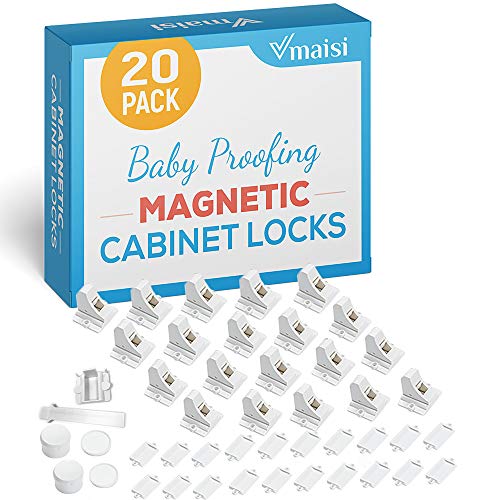
| Vmaisi 20 Pack Magnetic Cabinet Locks★ Best Overall | Kitchen and bathroom cabinets | Hidden magnetic lock and key | 3M adhesive or screws | 20 locks, 2 keys | Amazon |
| GlideLok Child Safety Door Top LockAlso Great | Doors a child keeps opening at night | Top-of-frame slide latch | One included screw | 2 pack | Amazon |
| AST French Door Lock | Double doors and French doors | Keyed double-door lockout bar | No drilling, removable | 1 lock, 3 keys | Amazon |
| Tuut Door Lever Lock | Lever handles throughout the house | Button-release lever guard | Peel-and-stick adhesive | 6 pack | Amazon |
| FaheyDM Pet Proof Lever Lock | Adhesive-free lever guarding | Button-release lever guard | Screw loosening, no adhesive | 4 pack | Amazon |
| DOORWING Portable Door Lock | Keeping a door cracked but guarded | Knob-mount adjustable arm | Clamp on, no adhesive | 1 count | Amazon |
| Vmaisi 20 Pack Cabinet Locks Easy Install | Drawers and cupboards on a budget | Hidden latch, no key | Peel-and-stick, optional screws | 20 pack | Amazon |
Detailed Reviews
1. Vmaisi 20 Pack Magnetic Cabinet Locks with 2 Keys
Our pick — 4.5+★ from 20,500+ verified ratings; the strongest balance of quality and price.
Twenty hidden locks that leave your kitchen looking untouched, with a magnet to open them.
A child who opens doors will eventually get into the cabinets, and that is where the chemicals and the knives live. This Vmaisi set puts a lock inside the cabinet or drawer, completely out of sight. There is no handle to rattle, no visible latch to figure out. An adult holds the magnetic key on the outside of the closed door and the lock releases. Twenty locks and two keys come in the box, which is enough to cover a full kitchen run plus a bathroom or two. The locks are rated to work on cabinet doors up to 2 inches thick.
The clever part is the on/off option. When the grandchildren are over or when the house is in a calm stretch, you can disengage the lock and use the cabinet normally. That switch turns twenty always-on latches into hardware you only notice when a child is in the house. Installation is peel-and-stick with 3M adhesive, so there are no tools and no holes, and a template helps you line them up. The adhesive can be backed up with screws if you want the extra hold. Buyers report the setup holds up — as one put it from three years of use: “”
The honest complication is the installation itself. The locks can be triggered by ferrous metal hidden inside a cabinet door — screws, nails, staples — and you may have to move a lock around before you stick it down to find a spot where it releases. Rush that step and you will get one that misbehaves. Adhesion is the other variable: it is strong on a clean flat surface, weaker on a high-traffic drawer that sees daily yanking, which is where screws are worth considering. A handful of owners find a lock that will not seat properly and need to reposition it. Neither issue is a design failure, but both reward a careful install over a fast one. For a home with a determined child, this covers the cabinets and drawers that a lever guard or frame latch never reaches.
Where it shines: completely hidden from a child’s sight and reach, with a key that turns twenty locked cabinets into an easy responsibility.
The install matters: test for hidden metal in the door and clean the surface before you stick, because both decide whether the lock releases cleanly.
Best for: households that need cabinets and drawers secured everywhere, not just one door, and want the hardware invisible.
The limit to know: an adhesive lock on a high-traffic drawer needs screws or a re-press eventually, so plan for that.
2. GlideLok Child Safety Door Top Lock (2 Pack)
The lock your child can see, but cannot reach, mounted at the top of the frame.
Here is why this one sits at the top of the list. Every other pick on this page asks your child to fail at something they can touch — a handle, a knob, a cabinet pull. The GlideLok removes the handle from the equation entirely. It rides over the top of the door on a painted metal body and slides between locked and open up positions, so the thing your child rattles is a metal bar well above their reach. It fits most hinged doors up to 1-3/8 inches thick, or up to 1-13/16 inches once you take the spacer bar out, and that covers many interior, exterior, and French doors — including doors with knobs, levers, oversized handles, and unusually shaped handles.
The feature that separates it from the French door lock below is the two-sided release. Because the unit overhangs both sides of the door, an adult can slide it into place from the hallway or from inside the room. That matters in a house where a child may shut a door behind themselves and start to panic. The picking order flips on that point alone: if you need a lock nobody can become trapped behind, this is the one, and if you just need a lever capped, the Tuut guard does that job for less.
The honest catch is real and worth repeating before you drill. Everything rests on one included screw, and this is a drilled lock, not an adhesive one — on most inward-opening exterior doors that screw goes into the outside portion of the frame. With the metal spacer in place it stays put under repeated pushing, but removing the rear plate or adding felt invites too much play and lets the latch walk off its post. A determined child who throws their full weight at the door over and over can eventually work the jamb loose. The lock is a deterrent and a barrier, not a barricade. Sizing is the other thing to check: pocket doors, bifold doors, sliding glass doors, storm doors, and metal frames are all off the list.
What earns its place up top
- Mounts at the top of the frame, out of reach of small hands and paws
- Slides open from either side of the door, so no one gets shut in
- Fits hinged doors up to 1-3/8 inches thick, expanding to 1-13/16 inches with the spacer bar out
- Painted metal body that stands up to daily sliding
What you should know before drilling
- The whole latch hangs on a single included screw
- Needs a drill — no adhesive option here
- Repeated hard pushing can loosen the door jamb over time
- Will not fit pocket, bifold, sliding glass, or metal-framed doors
Reach for this if: your child can already work a standard handle and you want the lock above the problem, with adults free to open it from either side.
Size it first: measure your door thickness and confirm it is hinged and not a slider — this latch simply cannot go on a track door.
3. AST French Door Lock

A solid-metal lock bar that clamps double doors shut and hands the only way in to you.
If your home has French doors or a double-door closet, none of the latch-style picks above will help you. Double doors swing from a meeting point in the middle, and that gap is exactly what a curious child finds. This AST unit is a keyed lockout bar built from diecast aluminum alloy and brass in a single unibody, and it spans the two leaves with an adjustment range of 4 to 8.1 inches (102 to 206 mm) so it can be set to the span of most knobset and some handleset pairings. Three brass keys come in the box, key-differ, so the door stays locked from the inside against small hands and still opens with a key when you need it.
The value that is easy to miss is the fit range. A plastic lever guard measures a couple of inches and fends off one handle; this bar covers a whole double-door span, and because it is removable and drill-free it moves with you if you rearrange rooms. It weighs 1.6 pounds and measures 11.81 by 5.87 by 1.57 inches, so it is genuinely portable rather than permanently bolted on. If you have a double-door front entry or an interior French pair and have watched your child slide that middle leaf open, this is the piece that closes it.
One caution worth taking seriously: the maker states plainly that this adds security but cannot replace the normal handleset or knobset for safety on its own. Treat it as a second layer over a door you trust, not a substitute for one.
The adjustment question: the range is generous, but the lock asks you to verify your own door span before ordering — a French door with an unusually wide meeting gap can fall outside it.
Good match: a household with French or double doors that a child has learned to nudge apart, where a keyed layer of security is welcome.
Not the one if: you have a single standard interior door — this bar is designed for two leaves meeting, and a frame latch will serve you better.
4. Tuut Door Lever Lock Child Proof (6 Pack)
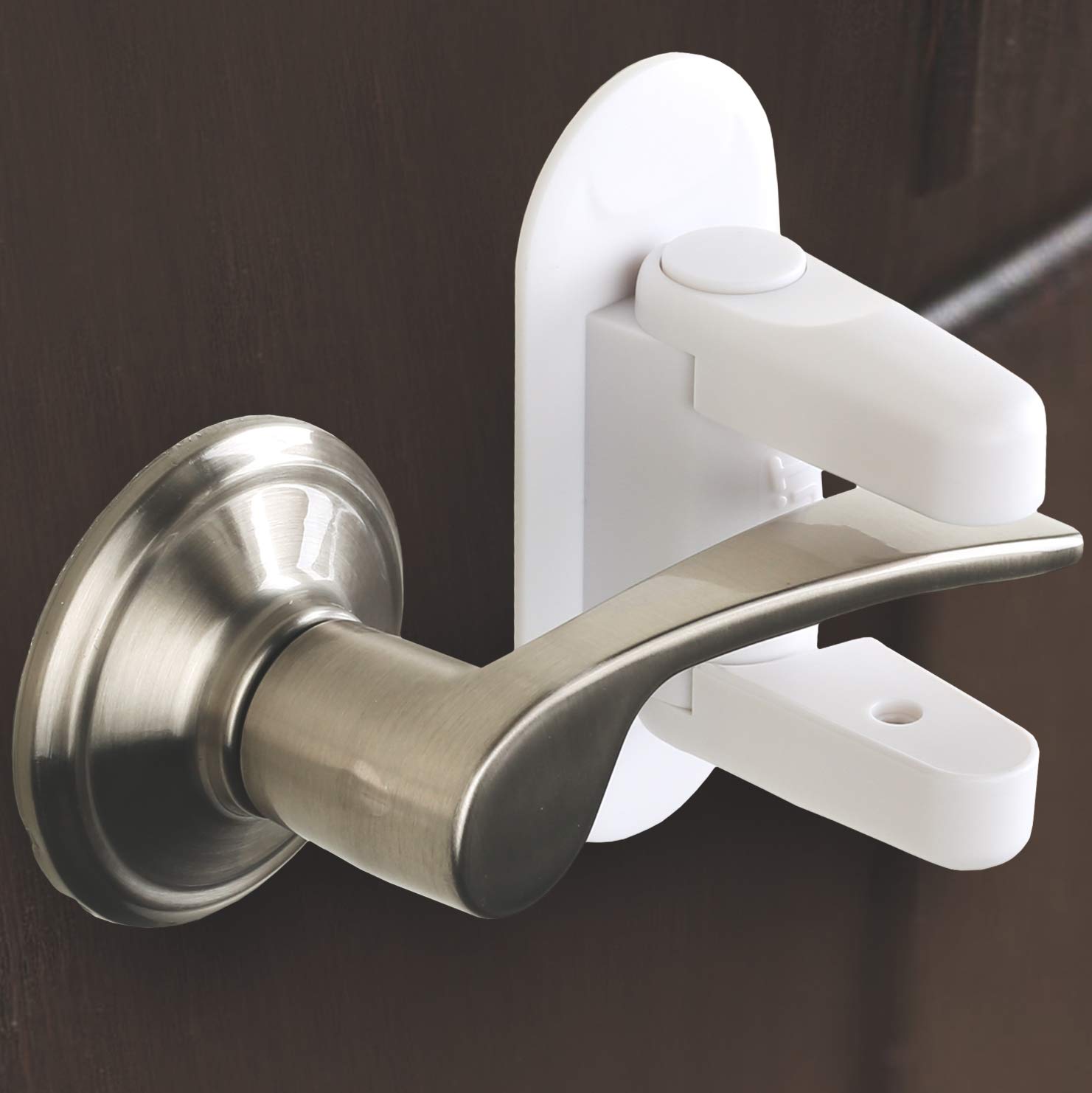
Six lever guards that turn a handle your child can press into one they cannot.
A lever handle is the easiest thing in the house for a child to work — it is a button they can push with a whole body. The Tuut guard interrupts that motion. It fits over a standard lever handle, and the only way to release the lever is to press the two buttons, which a small hand cannot do at the same time as pulling the door. Nothing happens when your child pushes down, because the lever is caged. The peel-and-stick adhesive means no tools and no holes, and a six pack covers a hallway of doors in one purchase.
What makes this a family pick rather than a single-door purchase is the no-lock-in design. The guard’s whole job is to stop the lever moving, so a child can never lock themselves into a room from the inside. If your household’s worry is a bedroom door getting locked during a meltdown, having six of these across the doors you care about is a cheaper, simpler answer than one keyed device in one place. They are made of plastic and finished in white, so they fade into a normal white door rather than reading as equipment.
Where the honest picture gets more textured is adhesion. The pad grips a clean, flat door surface well, but a door that sees heavy use or a painted surface that is not perfectly flat can loosen over time, and the fix is a careful re-press rather than a tool. A few buyers have also noted the plastic can develop wear after months of daily pressing. For soft, standard residential doors this is not a problem in practice — but if you have a child who throws their body at the lever, an adhesive guard is a guard, not a barricade, and a top-of-frame latch is the stronger answer. For an adult carrying a laundry basket, the two-button release is a quick one-handed press rather than a fiddly latch.
Where the value sits: six guards, no tools, and no lock you can accidentally trap a child behind.
The fit check: measure your lever before you order — the design is built for standard levers, and an oversized or unusually shaped handle needs a different approach.
A clean fit for: lever handles on the main rooms a child keeps entering, especially when you want to cover several doors at once.
One honest limit: adhesive does the holding here, so a door your child pushes on hard every day needs the grip re-checked from time to time.
5. FaheyDM Pet Proof Door Lever Lock (4 Pack)

The lever guard that skips the sticky pad and screws on instead, four to a box.
Some doors simply do not accept adhesive — a textured surface, a freshly painted door, or a rental where you would rather not leave a residue. This FaheyDM set answers that directly. There is no adhesive anywhere on it. You loosen the handle’s existing screws without taking them off, and the guard clamps into place around the lever. It is plastic, measures 2 3/4 inches, and comes four to a pack in white, black, brown, and silver so it can match the door hardware rather than clash with it.
Keeping a pet out and keeping a child out are the same mechanics here, which is why it works as both. A cat that has learned to nudge a lever open, or a dog that jumps at a door, is stopped by the same button cage. One household reports it keeping a cat out of a room that was unsafe for it — the same button-cage that stops a child from pushing a lever open.
Honesty requires flagging two things. The first is that the screws are the same screws already in your handle, so a handle that is already loose or worn may not give you a firm clamp. The second is durability: a small number of units have been reported broken within the first few days of use, so this is a guard you fit and keep an eye on in the first week rather than one you set and forget. It is also a smaller, simpler tool than the Tuut multi-pack, and the sizing is fixed at 2 3/4 inches, so check your lever shape before you commit. Used within those limits, it is a neat adhesive-free solution for the door that adhesive cannot reach.
What it does without adhesive
- Clamps into existing handle screws — nothing sticky on the door
- Four colors in one pack to match your hardware
- Works against both pets and small children
- Four units, so several doors per purchase
Where it asks for care
- Relies on the door’s own screws, so a loose handle gives a loose fit
- A few units have failed early — check it in the first days of use
- Fixed at 2 3/4 inches, so the lever shape has to suit it
Worth fitting when: your door will not hold an adhesive pad, or you want four matching guards without a sticky residue.
Consider the alternative if: your child is a heavy pusher — a lever guard is a soft barrier, and the top-of-frame latch above takes far more.
6. DOORWING Portable Door Lock for Pets & Childproofing

Holds a door open just enough to let air in, and just short of letting your child through.
There is a specific situation this solves that the other six do not: a door that needs to sit partly open for airflow or for a pet, while a child stays out. DOORWING is a knob-mounted arm with an adjustable stop. It fits doors between 1.2 and 1.8 inches thick and door frames up to 8.5 inches wide, and it holds the door in a slightly open position — up to a 5-inch gap — so a cat can slip through while a toddler cannot follow. No adhesives, no drill, no holes. You mount it, squeeze to release, and move it from door to door. The soft rubber pads protect the surfaces it touches, and the arm folds flat when not in use.
The safety design is quietly good. open up happens from both sides, so it cannot become a lock-in device, and the arm doubles as a finger-pinch guard against door slams. In a home that needs a door cracked for comfort without turning a room into a sealed box, that combination is hard to match — the top-of-frame latch above is genuinely stronger against force, but it also seals the door, which is the wrong answer if airflow is the point.
The trade-off is durability, and it is worth stating plainly rather than hiding. The body is plastic and the arm puts real stress on a small moving part. Reports of the top button misaligning after a few months, or of the device breaking within weeks of hard use, follow a common path: it is a careful-use device, not a force barrier. Three practical notes for anyone fitting one: the door will not fully close while the lock is engaged, doors with jamb trim over 6 inches may not open wide enough for a large cat, and rounded or angled door trims can cause it to latch poorly. Check your trim before you order, and treat this as a room-flow solution rather than a barricade.
The trade you are making: an adjustable gap and no damage, in exchange for a plastic part that asks to be handled with care.
One detail that is a feature, not a fault: the door will not close fully once the lock is engaged — the bumper stops it, and that is how the airflow and finger-pinch protection work.
Made for: the door that has to stay cracked for air or for a cat, while a child or dog is kept on the other side.
Look elsewhere if: your child is a door slammer or a pusher — this needs gentle handling, and the GlideLok latch is the one built for force.
7. Vmaisi 20 Pack Cabinet Locks Child Safety Latches

The keyless, no-magnet cabinet latch that hides inside the door and just works.
Not everyone wants to keep track of a magnet. This second Vmaisi pack drops the key entirely. The latch installs inside the cabinet or drawer, out of sight, and an adult reaches in and presses the release. Twenty locks come in one box, so you can cover the kitchen, the bathroom, and the laundry cupboard in a single go. The peel-and-stick install needs no tools at all, and if your drawer has a bar or edge to hook onto, you do not even have to stick the buckle down. That no-tools, no-key fitting is why twenty latches go on in one afternoon instead of sitting in the box.
What is different from the magnetic set above is the daily interaction. There is no key to misplace and no sticking a magnet onto the door to trigger it. The catch is that the release action itself is a small manual one, so an adult with their hands full may find the magnet version easier — the trade between the two is convenience versus simplicity. For a house where the cabinets are opened many times a day, this is the fuss-free choice; for one where the magnet is more intuitive, the sibling pick wins.
Adhesive is where the honesty bites. The pad is strong on some surfaces and weaker on others, and a drawer that gets pulled hard every day can defeat a peel-and-stick base — in that case, the optional screws are the answer. Some owners have found the latch can be pulled open if it is not firmly seated, which again is an install issue rather than a flaw in the concept. Fit it carefully, keep a screwdriver nearby for the heavy drawers, and it will hold. For covering twenty spots on a tight budget with no keys to lose, this is the practical pick.
The plain benefit: twenty hidden latches, no magnet, no key, and no tools needed to fit them.
The honest catch: the pad and the latch both depend on a careful fit — a drawer that gets yanked needs the screws, not just the tape.
The right buy if: you want wide cabinet coverage without a magnet to keep track of, and you are willing to spend five minutes fitting each one properly.
Try the magnetic version if: you would rather press a key against the door than reach inside for a hidden release every time.
Know the Specs
Mounting height and reach
Where a lock sits on the door decides how much it can do. A top-of-frame latch like the GlideLok puts the mechanism above the child’s reach entirely, so there is nothing to practice at. A lever guard sits on the handle your child already knows, and wins only because the release requires two buttons at once. Match the height to what your child actually does, and you stop losing that daily argument.
Door thickness and frame width
Every lock has a range it will fit, and outside that range it will not work no matter how good the reviews are. The GlideLok takes doors up to 1-3/8 inches thick, expanding to 1-13/16 inches with its spacer removed. DOORWING takes doors between 1.2 and 1.8 inches. Measure the door and the frame trim before you order, and note any range the listing gives — the fix for a mismatch is a different lock, not a workaround.
Adhesive versus screws
An adhesive pad needs a clean, flat, and slightly smooth surface to grip well, and it can loosen on a door or drawer that gets pushed hard. Screws hold against force and last, but require a drill and mark the door permanently. Both can be right for a household — the decision rests on whether your child leans hard on the door, and whether you are allowed to drill at all.
Release from both sides
A lock that opens only from one side can hold a child inside a room. Look for a latch that open up from either side of the door, so a grown-up can release it from whichever side they are on. The GlideLok and DOORWING both work this way, and the Tuut guard avoids the problem entirely by never letting a child lock the door in the first place.
Common Questions
Will a top-of-door latch work if my child is tall?
Do these locks hold against a child who pushes hard?
Which lock should I pick for a door that slides on a track?
Can a child lock themselves in a room with these?
Will an adhesive lock damage the door when I remove it?
Is the magnetic cabinet lock better than the keyless latch version?
What door thickness does the GlideLok accept?
Does the DOORWING stop a dog pushing the door open?
Can one lock cover both a door and a kitchen cabinet?
How do I stop a curious child from simply unscrewing the lock?
The Bottom Line
For most homes, the winner is the GlideLok Child Safety Door Top Lock, because it moves the barrier out of your child’s reach and lets an adult open it from either side. The catch is that it asks for a drill and one screw, and it cannot go on a sliding or metal-framed door. If your child keeps at a lever handle inside arm’s length, the Tuut Door Lever Lock covers six doors with a sticky pad and no tools. And if the real worry is the kitchen, the Vmaisi Magnetic Cabinet Locks hide twenty locks inside the doors and let you switch them off when the house is calm.
One closing note on choosing: match the lock to the exact spot your child opens. A lever guard cannot stop a cabinet, a top latch does nothing for a drawer, and a cracked-open door needs a door-holder, not a barricade. The picks above are grouped by those jobs, so the right answer depends on which door you are standing in front of right now.
How we choose
We do not accept paid placement. Every pick is matched to a real buyer and a real use-case; we do not hands-on test units.
Sources
Specifications: manufacturer listings and product documentation. Review insights: verified customer reviews, as of October 2026. Pricing: not shown on this page (it changes often); check the current price via the retailer link.
As an Amazon Associate, Aappliancez earns from qualifying purchases. This does not affect which products we feature.