Disclosure: Some links in this post are affiliate links. As an Amazon Associate I earn from qualifying purchases, at no extra cost to you. Learn more
Specs are compiled from manufacturer listings and verified buyer reviews and can change over time — please confirm the key details on the product page before buying.
Doors and trim get touched more than any other surface in your home — hands, shoes, mops, and damp cloths all land there first. So the paint has to do two jobs at once: look smooth enough to pass close inspection and dry hard enough to survive weekly wiping. The picks below split along exactly that line, from a urethane acrylic that cures to a factory-style shell to a recycled latex that goes on thick and costs less per gallon.
This guide is built by comparing the manufacturers’ published specifications and the patterns across verified customer reviews, so you get each pick’s real strengths and trade-offs instead of marketing spin.
What separates a trim paint that lasts from one that scuffs in a month is rarely the color name — it is the resin, the sheen level, and how the can behaves on a brush. This breakdown of the door and trim paint market keeps the trade-offs front and center so you buy the right gallon once.
Top Picks


How To Choose The Best Door and Trim Paint
Trim is a small surface with a big workload. A door frame takes knuckle knocks, a baseboard takes a mop, and a cabinet face takes greasy fingertips. A paint built for that abuse means one repaint, not yearly touch-ups. A wall paint on the same trim will need touching up by winter.
Sheen decides how well it wipes
Semi-gloss is the workhorse here. It has enough shine to shrug off a damp cloth without looking like lacquer. A high-gloss enamel pushes durability further and throws more reflection, which suits black doors and craft pieces more than long white runs of casing. Eggshell sits below semi-gloss — softer looking, less scrubbable.
The resin matters more than the label
A urethane acrylic resin, like the one in the INSL-X Cabinet Coat, cures to a harder shell than a standard latex. That hardness is what stops a fingernail from lifting a scuff. Plain acrylic latex still works well on trim, but expect it to mark sooner in a hallway.
Primer and prep: what self-priming really saves
Self-priming paint lets you skip a separate primer coat on sound, clean surfaces. It does not rescue peeling paint, grease film, or bare knots. If your trim is glossy from an old coat, scuff-sand it first regardless of what the can claims.
Read the coverage number before you buy
Coverage per gallon (the square footage one can covers in a coat) tells you how far a can stretches. A door plus its frame runs roughly in the tens of square feet, so a gallon goes a long way on trim — but dark-to-light color changes eat more coats. Buy one can at a time when you are unsure; extra gallons of tinted paint are hard to return.
Side-by-Side Comparison
| Model | Best For | Finish | Coverage | Volume | Amazon |
|---|---|---|---|---|---|
| INSL-X Cabinet Coat★ Best Overall | Hard-wearing doors and cabinets | Semi-Gloss | 350–450 sq ft/gal | 1 gallon | Amazon |
| BACKDROP Trim & DoorsPremium Pick | Designer color on trim | Semi-Gloss | 200 sq ft | 0.5 gallons | Amazon |
| RECOLOR Interior Latex | Budget-friendly repaints | Eggshell | 450 sq ft | 1 gallon | Amazon |
| Diamond Brite Kitchen & Bath | Humid kitchen and bath walls | Gloss | 300 sq ft/gal | 1 gallon | Amazon |
| EVOLVE Ultimate White | Paint-and-primer shortcut | Semi-Gloss | 300–400 sq ft/gal | 1 gallon | Amazon |
| Diamond Brite Gloss Enamel | High-gloss black doors and crafts | High-Gloss | 250–300 sq ft/gal | 1 gallon | Amazon |
| PRESTIGE Paint & Primer | Matching a Sherwin-Williams white | Semi-Gloss | 250–400 sq ft/gal | 1 gallon | Amazon |
Detailed Reviews
1. INSL-X Cabinet Coat White 1 Gallon
Our pick — 4.5+★ from 550+ verified ratings; the strongest balance of quality and price.
The urethane-acrylic hardcoat that turns a scuffed door into a wipe-clean surface.
This is the pick for a hallway door that takes daily knuckle traffic or kitchen cabinet fronts that see grease. The urethane acrylic resin cures to a hard, semi-gloss shell — that hardness is the whole point, because it is what stops a fingernail or a ring from lifting the paint. You get 1 gallon, which the maker rates at 350 to 450 square feet per coat.
What wins people over is the durability of the cured finish. Owners describe it holding up on high-traffic doors and resisting the light scratches that cheaper latex gives up quickly, and they say it sticks to hard-to-coat surfaces straight without a primer. A long-time user of Benjamin Moore products put it plainly: “This is awesome paint. I won’t use anything else on interior doors or cabinets.” The consensus quality read is the strongest thing about this can.
The catch is patience. Dry time is listed at 24 hours, so this is not a Sunday-morning-and-done job — you plan a door at a time. Coverage is the mixed part of the story: on rough or poorly prepped surfaces you will need two coats. Application also asks for care, and dried paint on hardware is a nuisance to lift off, so tape the knobs before you start. A few owners will chip an edge, which is why buying one gallon at a time beats stocking up.
Where it earns its keep
- Urethane acrylic resin cures hard, so doors resist scuffing and fingernail marks
- Semi-gloss shell stands up to grease, food stains and water
- Sticks to hard-to-coat surfaces without a separate primer
- 350–450 square feet of coverage per gallon leaves plenty spare for touch-ups
What to plan around
- 24-hour dry time means one door per session, not a whole run in an afternoon
- Rough or unprepped surfaces need a second coat
- Dried paint clings to door hardware, so mask knobs and hinges first
Made for: anyone repainting interior doors, cabinets or crown molding who wants to do it once and stop thinking about it.
Plan the schedule: budget a full day of drying per coat, and buy a single gallon at a time rather than over-ordering.
2. BACKDROP Semi-Gloss Weekend Upstate 0.5 Gallon
A designer dark green with blue undertones, mixed thick as honey for one-coat trim.
If you have a specific dark green in mind, this is the one to look at. Weekend Upstate is a dark, dusty green with strong blue undertones, and the 30% sheen semi-gloss gives just enough gloss to be washable without glaring off a door. It is 0.5 gallons, self-priming, and rated low odor by the maker — the kind of can you open in a bathroom with the patio door cracked.
Color is what carries this line, and the pigment load is high. The paint rolls on thick and honey-like, and it dries quick: the maker lists 60 minutes to touch and 3-4 hours to recoat, with full cure at 4 hours. For people wary of paint fumes, this one earns its keep. As buyers report, a first-timer painting their own accent wall got the color exactly as advertised, with no smell beyond an open patio door, and used only half a gallon for one-coat coverage. It even comes in a can designed to open and close without a tool.
Half a gallon is the number to respect here. BACKDROP rates it at 200 square feet, which is fine for a door or two and a run of casing but tight for a whole room of trim. The green also stains white trim if it drips, so keep a wet rag moving. And a few users find the thickness shows streaks over paneling at certain angles, which means real second coats rather than a touch-up pass.
Smoothness you can feel: the high pigment load and honey-thick body lay down color that reads like a designer mix, and the self-priming formula means one fewer step on sound trim. A careful amateur can get a clean accent result with a single coat.
Give it the second coat: over dark walls, paneling, or anything with texture, budget for two full coats as the maker advises — the first pass shows its streaks otherwise.
Reach for this if: you want a specific deep green on a bathroom door or a short trim run and care about low odor while it dries.
Size up your job first: at 200 square feet of coverage per half gallon, a full hallway of casing will take more than one can.
3. RECOLOR Eggshell Canvas 1 Gallon

A full gallon of recycled latex with the thickest, fastest body in this lineup.
Where this one leads is dry time and volume. Dry time is 2 hours to the touch — against 24 hours for the INSL-X — so you can recoat trim the same afternoon. Full cure lands at 6 hours. You get 1 gallon rated at 450 square feet, the highest coverage figure here, made from screened and reprocessed recycled paint in a women-owned US operation.
Owners consistently describe it as thick and rich, spreading well and building to a full finish at two coats. One verified review summed it up: “Excellent quality paint. Thick and rich spreads well and two coats makes it perfect.” A professional painter used it on a New York co-op job and passed the result to a happy owner, and people who normally buy a hardware-store brand report it covering just as well.
Two honest limits. This is an eggshell finish, which is softer and less scrubbable than the semi-gloss options — brilliant on a bedroom wall, not ideal for a door that gets kicked. Colors vary by batch, and the maker recommends bulking cans from different batches to keep the color uniform, so buy your whole project at once. The color and coverage scores are the mixed part of the record: neutral whites land well, but a dark-to-light switch can take three coats.
Speed and stretch: two-hour touch dry plus 450 square feet per gallon is the fastest, furthest-reaching can in this group, and the recycled content keeps the environmental cost down.
Batch and sheen caution: buy every gallon you need in one order for matching color, and keep this on walls rather than high-traffic doors where eggshell will mark.
Suits you if: you are repainting walls or a low-traffic surface on a tight budget and want quick recoats without the fumes.
Look elsewhere if: you need a scrubbable shell for a door that sees daily hands — that calls for a semi-gloss or gloss.
4. Diamond Brite Kitchen and Bath Brite White 1 Gallon

White gloss built to shrug off steam, splashes and a scrubbing brush in kitchens and baths.
The moisture-resistant formula resists the brown spotting humidity leaves on kitchen and bath walls, and the gloss wipes clean. Coverage runs about 300 square feet per gallon with a two-coat application, and it works on drywall, plaster and wood. It is made in Cary, Illinois, in a can recycled in Chicago. One note the maker prints in bold: it is not for bathtubs, showers or sinks.
What buyers keep coming back to is the bright white and how far it stretches on a prepared surface. Two coats over an acrylic-primed laminate vanity will read showroom-new. Over a stained ceiling after a skim coat, owners mention both coats hiding the stains, with the semi-gloss easy to clean and almost no odor. It performs well for the price as a small-project white where you need just a bit of paint.
Consistency is the split. Some find it sticky even after stirring and shaking, and one longtime painter would choose a thicker self-leveling paint next time for a 71-year-old plaster wall. Over dark wood it wants primer first and two to three coats to cover. Treat it as a trim and vanity white that needs proper prep, not a magic one-coat fix.
Why it fits bathrooms
- Moisture-resistant formula aimed at humidity spotting on kitchen and bath surfaces
- Bright white gloss makes vanities look refinished
- Washable finish copes with water splashes and steady cleaning
- Made in the USA with a recycled-plastic can
Where it tests patience
- Consistency can feel sticky, which makes it prone to runs for a novice
- Dark wood needs primer plus two to three coats
- Not intended for tubs, showers or sinks
Best fit: a vanity, a bathroom ceiling or a kitchen cabinet face that faces steam and a regular wipe-down.
Prep is the price: count on primer over dark surfaces and a steady hand, because this gloss rewards patience and punishes a rushed coat.
5. EVOLVE Semi-Gloss 1 Gallon
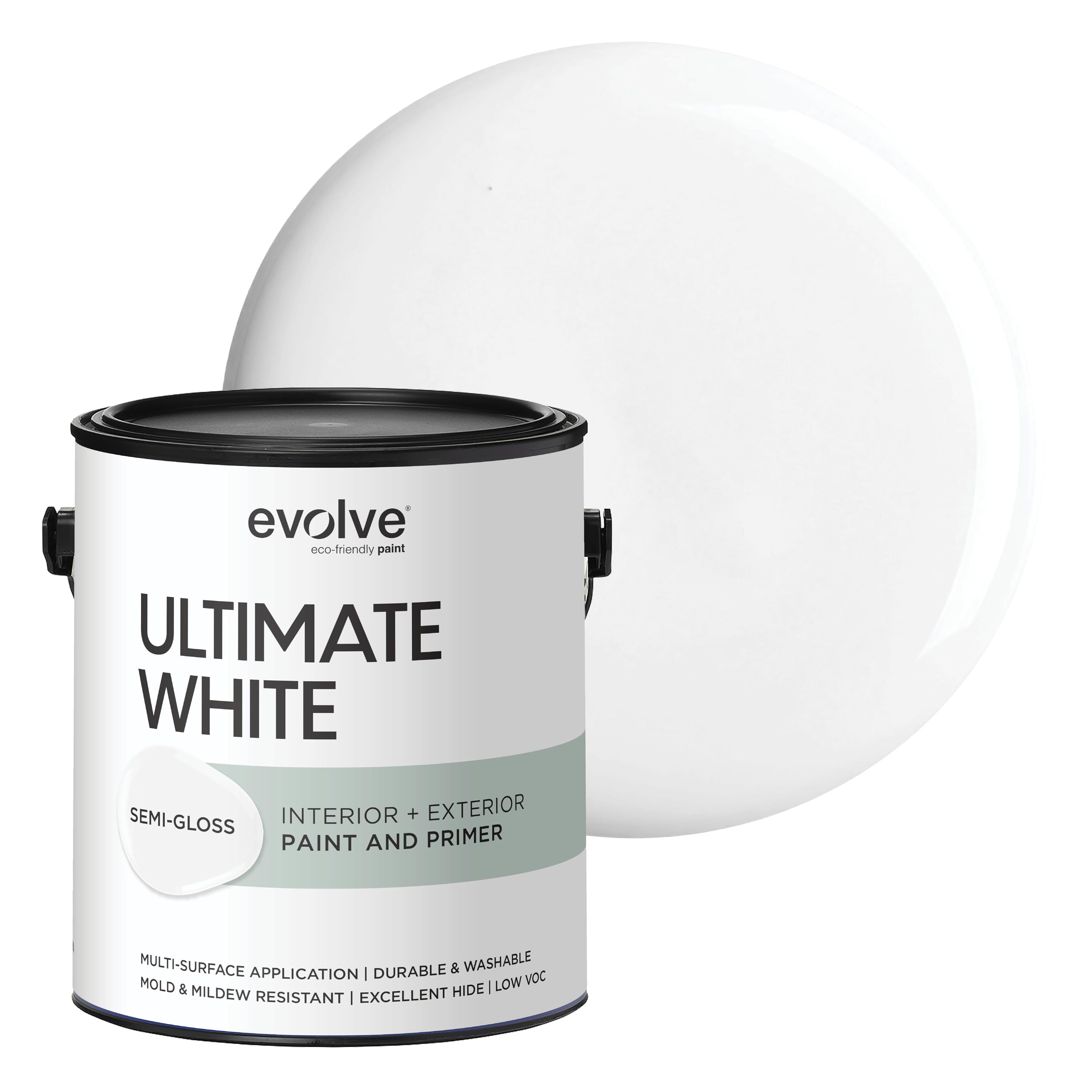
Primer and finish in one can, for trim and doors when you want to skip a step.
The pitch is simple: seal, prime and finish in one pass. The semi-gloss sheen gives a reflective, durable surface for trim, doors, cabinets and high-touch areas, and the water-based formula cleans up with soap and water. Coverage is rated 300-400 square feet per gallon, and full cure is 24 hours. It is the can for large trim and door runs when you want to skip a separate primer coat.
Owners find it works well in kitchens and covers well on things like textured wallpaper and ceilings, going on thick and smooth and drying to a soft sheen. Over an old mobile home it took two coats to reach a bright white, and the result read as a genuine face-lift for the money. Clean-up with regular soap and water was a repeated plus.
The paint-and-primer claim is the part to measure expectations against. Over cabinets and drawers with a dark finish, that one-coat promise can stretch to three coats, and a thin consistency with a stronger odor shows up in those cases. If an old color is showing through, plan two coats minimum and buy generously — this is a coverage-and-cost play, not a shortcut past prep.
Good for volume jobs: one can that primes and finishes is a real time saver across trim, doors and ceilings, and the water-based clean-up keeps brushes alive.
Set your coat count: over dark or greasy surfaces, treat “one-coat” as a starting point and budget two or three passes.
Choose this for: large interior jobs where skipping a primer coat saves a full afternoon of work.
Expect more coats: dark cabinet fronts or doors will need extra passes, so buy a little more than the coverage chart suggests.
6. Diamond Brite Gloss Black 1 Gallon
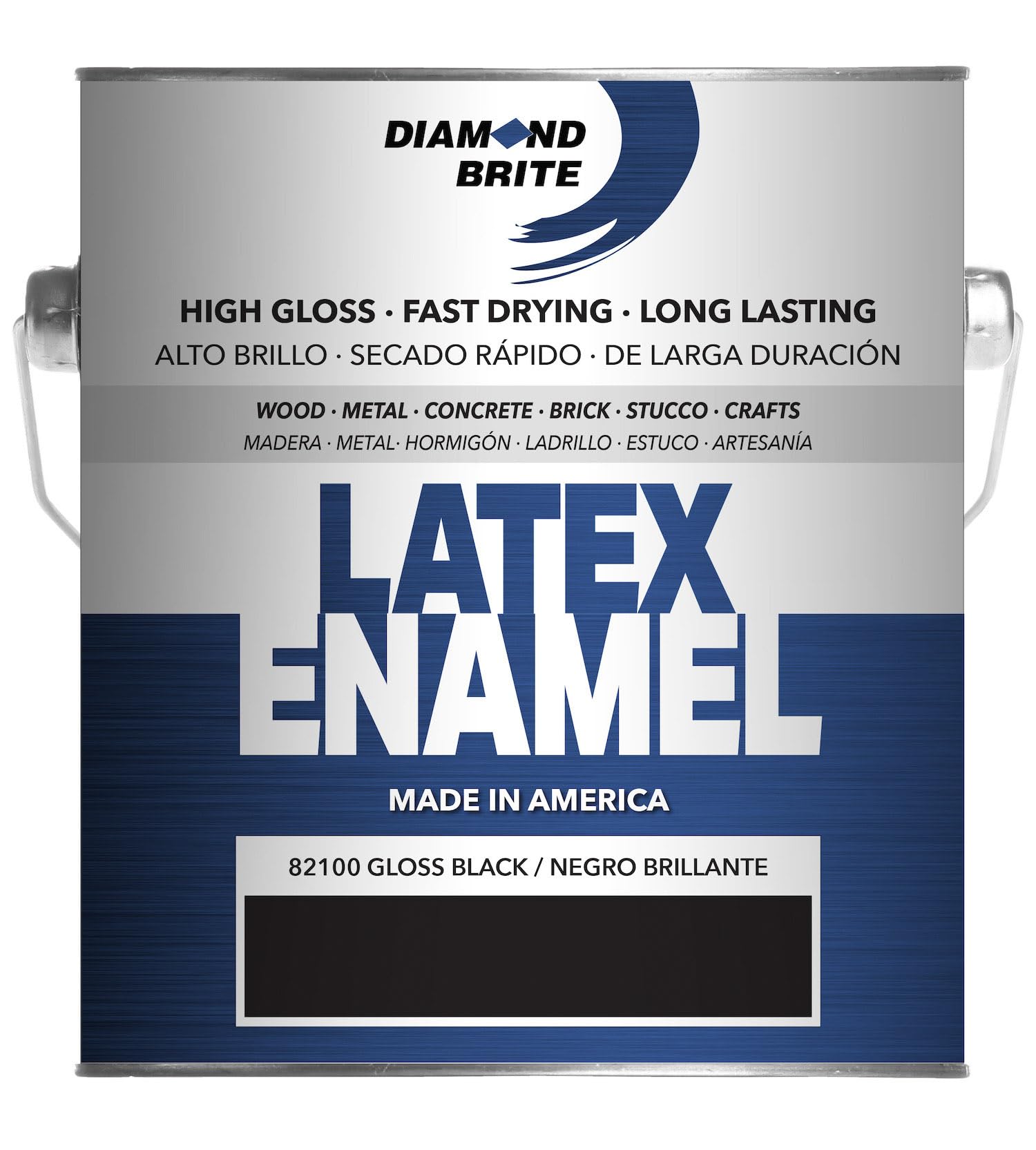
A jet-black high-gloss enamel that dries hard enough for doors and carousel horses alike.
For a black interior door, a piece of painted furniture or a craft project that needs a wet-look shine, this is the can. It is an interior/exterior high-gloss enamel with strong adhesion and moisture resistance, suited to wood, metal, ceramics, concrete, brick and stucco, and it can be brushed, rolled or sprayed. Coverage is 250-300 square feet per gallon — a bigger can than most jobs need, since a pint often does a door.
The gloss is what sells it. On a carousel horse restoration, it self-leveled to an airbrush-like finish with no brush strokes and dried hard and water-repellent. On black cabinets, doors and trim, a little goes a long way and it lays down smooth. Clean-up is soap and water, and customers note “No odor, good coverage, easy to clean.” A 35-year painter compares the texture and quality to the big professional brands.
The real risk is batch consistency on the shine itself. Black gloss is unforgiving: it shows every sanding mark, dust speck and drip. A few cans have come through satin at best, so test a hidden spot before you commit the whole door. If you want a true mirror finish, check the can first, and thin your coats rather than laying it on thick.
The shine is the draw: a high-gloss, self-leveling enamel that sprays or brushes to a smooth finish, with soap-and-water clean-up.
Test and sand: verify the gloss level on a scrap board and sand thoroughly before the first coat, because black high-gloss reveals everything.
Go for it if: you want a glossy black door, furniture piece or craft project with a hard, washable surface.
Keep a scrap handy: check the can’s shine on a test piece before committing, and plan on careful sanding between coats.
7. PRESTIGE Semi-Gloss Extra White Match 1 Gallon

A cool-toned off-white matched to a familiar Sherwin-Williams shade, in one can.
If you have a white you love but not the line’s price or availability, this is the route. It is a 100% acrylic latex with a semi-gloss finish, created as a comparable color match to a Sherwin-Williams Extra White — a brand Prestige is not affiliated with. Low VOC at under 5 g/l before tinting means a faint smell rather than a lingering one. Coverage is 250-400 square feet per gallon, full cure 4 hours, and it ships with a can opener and stir stick.
Owners describe it going on smooth and building to fully opaque with brushes or rollers, and the faint paint smell doesn’t hang around the house. Reviewers who tried it against much pricier paint were impressed. The color is a bright white with a cool undertone, and it dries to a clean semi-gloss.
Don’t treat “paint and primer in one” as a one-coat guarantee. Over turquoise walls it can take the entire gallon to cover two walls with two coats. The color is a close comparison, not a guarantee the gallon matches the swatch chip you held up, so prime a sample board first if the exact white matters. Buy a gallon more than the coverage chart suggests, since tinted paint is hard to return.
What it does well
- Cool-toned white that reads clean against warm floors and wood
- 100% acrylic latex for easy soap-and-water clean-up
- Low VOC under 5 g/l before tinting
- Semi-gloss finish wipes down on trim and doors
Where it needs care
- A color match, not the exact big-name paint — check a sample first
- Dark underlying colors can need two coats or more
- A gallon may not stretch to a whole room of dark walls
Good match for: anyone chasing a specific cool white on trim or a bathroom without paying for the original brand’s line.
Sample before you buy: cover a board first to confirm the tone matches your chip, and order enough to finish the job.
Know the Specs
Sheen: Semi-Gloss vs Gloss
Sheen is how much light the dried finish throws back. Higher gloss means a tougher, more washable surface, which is why trim, doors and vanities lean toward it. A 30% sheen semi-gloss — like the BACKDROP — gives you a washable film without a mirror glare. A true high-gloss enamel, like the Diamond Brite Gloss Black, gives the hardest, shiniest surface but shows every flaw. Match the sheen to the traffic: semi-gloss for doors and casing, gloss for a deliberate black door or craft piece.
Dry Time vs Full Cure
These are two different clocks. Dry time (touch-dry) is when you can recoat — as short as 2 hours on the RECOLOR. Full cure is when the film reaches its final hardness — 4 hours on the BACKDROP and PRESTIGE, 6 hours on the RECOLOR, 24 hours on the INSL-X and EVOLVE. If you want to close a door the same day, dry time is what matters. If you want to move furniture back against a wall, wait for full cure.
Coverage Per Gallon
Coverage is the square footage one gallon covers in a coat. It tells you how far a can stretches on doors and trim. Higher coverage — like the RECOLOR’s 450 square feet — means fewer cans for a big project; lower figures like 200 square feet mean you buy more. Coverage shrinks when you are painting dark surfaces light, so treat the number as best case on a prepared wall.
Primer and Low VOC
“Self-priming” and “paint and primer in one” mean the formula is built to seal a sound surface as it colors it — a real time saver. They do not replace prep for peeling, glossy or greasy trim. Low VOC means fewer solvent fumes, measured in grams per litre; the PRESTIGE lists under 5 g/l before tinting, and the BACKDROP is certified Ultra Low VOC. Lower VOC means less odor indoors during the job.
Common Questions
Is semi-gloss or gloss better for interior doors and trim?
Do I need a separate primer before painting trim?
How long before I can close a freshly painted door?
What is the difference between dry time and full cure time?
How many square feet does a gallon of trim paint cover?
Can I use these paints on kitchen cabinets as well as doors?
What does low VOC mean and does it reduce the smell?
Can I paint over a glossy or dark-colored door without priming?
Will one can be enough for a whole set of trim?
The Bottom Line
For most interior doors, cabinets and molding, the strongest choice is the INSL-X Cabinet Coat — a urethane acrylic that cures to a hard, scuff-resistant semi-gloss and resists grease and food stains. It scores highest among the high-traffic picks, and owners single out the cured finish’s durability. If you want a designer dark green with low odor and one-coat pigment, the BACKDROP Trim & Doors is the one to reach for. And for a budget-friendly repaint with the fastest recoats, the RECOLOR Interior Latex gives you a full gallon at 450 square feet. Buy the right gallon once, prep properly, and let each coat cure before the next.
How we choose
We do not accept paid placement. Every pick is matched to a real buyer and a real use-case; we do not hands-on test units.
Sources
Specifications: manufacturer listings and product documentation. Review insights: verified customer reviews, as of October 2026. Pricing: not shown on this page (it changes often); check the current price via the retailer link.
As an Amazon Associate, Aappliancez earns from qualifying purchases. This does not affect which products we feature.