Disclosure: Some links in this post are affiliate links. As an Amazon Associate I earn from qualifying purchases, at no extra cost to you. Learn more
Specs are compiled from manufacturer listings and verified buyer reviews and can change over time — please confirm the key details on the product page before buying.
A subscription-free tracker earns its keep the moment your dog slips a collar or follows a scent into the treeline: you get a direction and a distance instead of a panicked search. The trick is knowing which no-fee systems hold a signal in brush and hills, and which ones only work when the dog is in plain sight. This guide covers nine real options, all of them running without a monthly plan, and explains in plain language what each one does well and where it stops.
This guide is built by comparing the manufacturers’ published specifications and the patterns across verified customer reviews, so you get each pick’s real strengths and trade-offs instead of marketing spin.
Some units need a handheld, some use plain radio waves, and a couple are fences rather than finders — so the right choice depends on your yard, your terrain, and your dog. Picking among options for a dog tracking device without subscription starts with one question: do you need live direction out in open country, or a boundary that keeps your dog home?
Top Picks


How To Choose The Best Dog Tracking Device Without Subscription
Every product here skips the monthly bill, and that is the easy part. What separates them is how they find a dog once he is out of your sight. Before you spend, sort yourself into one of three camps: a yard owner who wants a boundary, an off-leash trainer who wants range and correction, or a hiker who wants a simple arrow pointing home. That decision narrows nine picks down to two or three.
Radio waves versus satellite signals
A radio-frequency system (often called RF) talks directly between a handheld and the tag on your dog’s collar. It needs no cell towers, no WiFi, and no data plan, so it keeps working deep in a forest where your phone shows no bars. A satellite-based system reads GPS coordinates and needs a clear view of the sky; dense buildings and heavy canopy can slow it down or blur the reading. If your walks happen where cell service vanishes, radio is the safer backbone.
Range and what it really means
Range is usually quoted for open, flat ground with a clear line of sight. The moment you add hills, brush, or walls, that number shrinks. A tracker rated for 9 miles in the open may only reach a fraction of that under dense trees. Honest judgment: pick a system with more range than you think you need, because real-world distance almost always runs shorter than the box claims.
Battery life — two very different numbers
You will see battery life quoted two ways: hours of continuous tracking and days of typical use. Continuous tracking drains a battery fast; a unit that runs 24 hours straight might last well over a week if it only wakes for an hour a day. Match the number to how you actually use it — a full day in the field needs continuous hours, while a suburban dog on a leash walk just needs days of standby. If your dog swims or runs wet brush, check for a waterproof rating (an IP code, like IP67 or IPX9K, that tells you how well water is kept out).
Side-by-Side Comparison
| Model | Best For | Tracking Type | Stated Range | Battery | Amazon |
|---|---|---|---|---|---|
| Garmin Alpha TT 25★ Best Overall | Training and tracking together | GPS with handheld | Up to 9 miles | Up to 68 hrs (dynamic tracking) | Amazon |
| Garmin T 5 Mini GPS CollarCompact Pick | Compact all-weather tracking | GPS with handheld | Up to 4 miles | Several 4-hour runs per charge | Amazon |
| PETLOC8 GPS TrackerCity Walker | City walks and quick finds | Cellular with app | — | Up to 14 days | Amazon |
| Moto Watchdog Wired Tracker | Vehicle and trailer protection | Cellular with app | 170+ countries | No battery (wired to power) | Amazon |
| Dogtra GPS Fence | Keeping dogs home, no wires | GPS containment (no live track) | Custom fences, 3/4 acre+ | All day | Amazon |
| Aorkuler GPS Dog Tracker | Off-grid hiking and farms | GPS with handheld | Up to 3.5 miles | Up to 24 hrs continuous | Amazon |
| Marco Polo RF Tracker | Rural, hill, no-cell areas | Radio frequency (RF) | Up to 2 miles | Up to 6 weeks (tag) | Amazon |
| Dogtra Pathfinder 2 | Hunting and wide-open tracking | GPS with app connector | Up to 9 miles | — | Amazon |
| SpotOn Omni GPS Fence Collar | Large-property containment | GPS containment (subscription optional) | 1/2 acre to 100k+ acres | 40+ hrs (without subscription) | Amazon |
Detailed Reviews
1. Garmin Alpha® TT 25, GPS Dog Tracking & Training Collar
Our pick — 4.5+★ from 150+ verified ratings; the strongest balance of quality and price.
The collar that reaches nine miles and trains while it tracks, no subscription anywhere.
If you train off-leash and want one collar doing both jobs, this is the pick. Paired with a compatible Garmin handheld (sold separately), it tracks up to 9 miles with location updates as often as every 2.5 seconds — that refresh rate is what keeps a moving dog a live dot on the screen rather than a stale pin. For scale, the T 5 Mini below reaches 4 miles, so the TT 25 covers well over twice the open-ground distance (9 miles versus 4).
On the training side, it delivers 18 levels of continuous or momentary stimulation plus audible tone and vibration, all controlled from the same handheld. The band is universally sized for large and small breeds, and it is user-replaceable, so a chewed strap does not end the collar’s life. A large multicolor LED in yellow, magenta, cyan, white, green, red, or blue lets you spot the right dog in the dark or sort out which collar belongs to whom. At 1.3 ounces the collar itself stays light, and battery runs up to 68 hours with dynamic tracking mode, or 136 hours if you swap in the expanded pack — both battery packs are user-replaceable.
Owners keep coming back to its build quality and accurate tracking, and it holds signal where you would expect a consumer gadget to quit. The recurring annoyance is the connection routine: satellite lock can take a few minutes, so plan on waiting at the trailhead rather than turning it on as you leave the truck. Buyers report owning several — as one puts it, “I love the TT25. I have purchased 4 of them.”
Why it earns the top slot
- 9-mile range with 2.5-second updates for a live, moving fix
- 18 correction levels plus tone and vibration from one handheld
- 68-hour dynamic-tracking battery, 136 with the expanded pack
- User-replaceable flex band and multicolor night LED
Where it asks for patience
- Handheld is sold separately and is required to operate
- Satellite connection can take several minutes before you set off
- Not built for swimming use, per owner experience
Reach for this if: you want training and long-range tracking in one collar and already plan to carry a handheld.
Think twice if: you need live tracking on a phone with no extra device — this one needs the Garmin handheld to work.
2. Garmin T5 Mini GPS Collar
A small tracker built to take a dunking and still light the way home.
This is the collar for the dog that lives outdoors — hunting, ranging, swimming. It is water-resistant to 10 meters, so a creek crossing or a pond swim is not the end of the day, and the top-mounted high-sensitivity GPS/GLONASS receiver (a dual-system antenna that pulls in both satellite networks) tracks up to 4 miles away with a compatible handheld. Compared with the TT 25 above, its 4-mile range is the head-to-head gap: the Alpha holds far more open-ground reach at 9 miles.
The beacon lights are the sleeper feature. Activated from the handheld, they stay visible up to 100 yards away in low light and at night, which makes spotting a dog under a porch or deep in brush much quicker. Owners also value the tracking history — one describes using it to see where a dog has been and which areas were missed in a search. As one buyer reports of real-world range: in a dense forest it reached “300-400 yards with handheld indoors, slightly better outdoors,” and then reacquired the signal as they walked closer.
The honest catch is that thick cover eats into that 4-mile number fast, so treat the headline range as open-ground only and get comfortable with the handheld showing the last known location. The battery also expects regular charging — several four-hour runs per charge is the realistic rhythm. The included 18.5-inch antenna, 3/4-inch collar strap, and vehicle power cable round out a complete kit.
The short version: light, weatherproof, and reliable for a ranging dog, provided you already run a Garmin handheld and do not expect a forest to behave like a parking lot.
Best for: active dogs who get wet, muddy, and far from the porch.
Pair it with: a compatible Garmin handheld — it does not track on its own.
3. PETLOC8 Dog GPS Tracker – Real-Time Location with App
The app-based finder that shows a live map pin over city blocks.
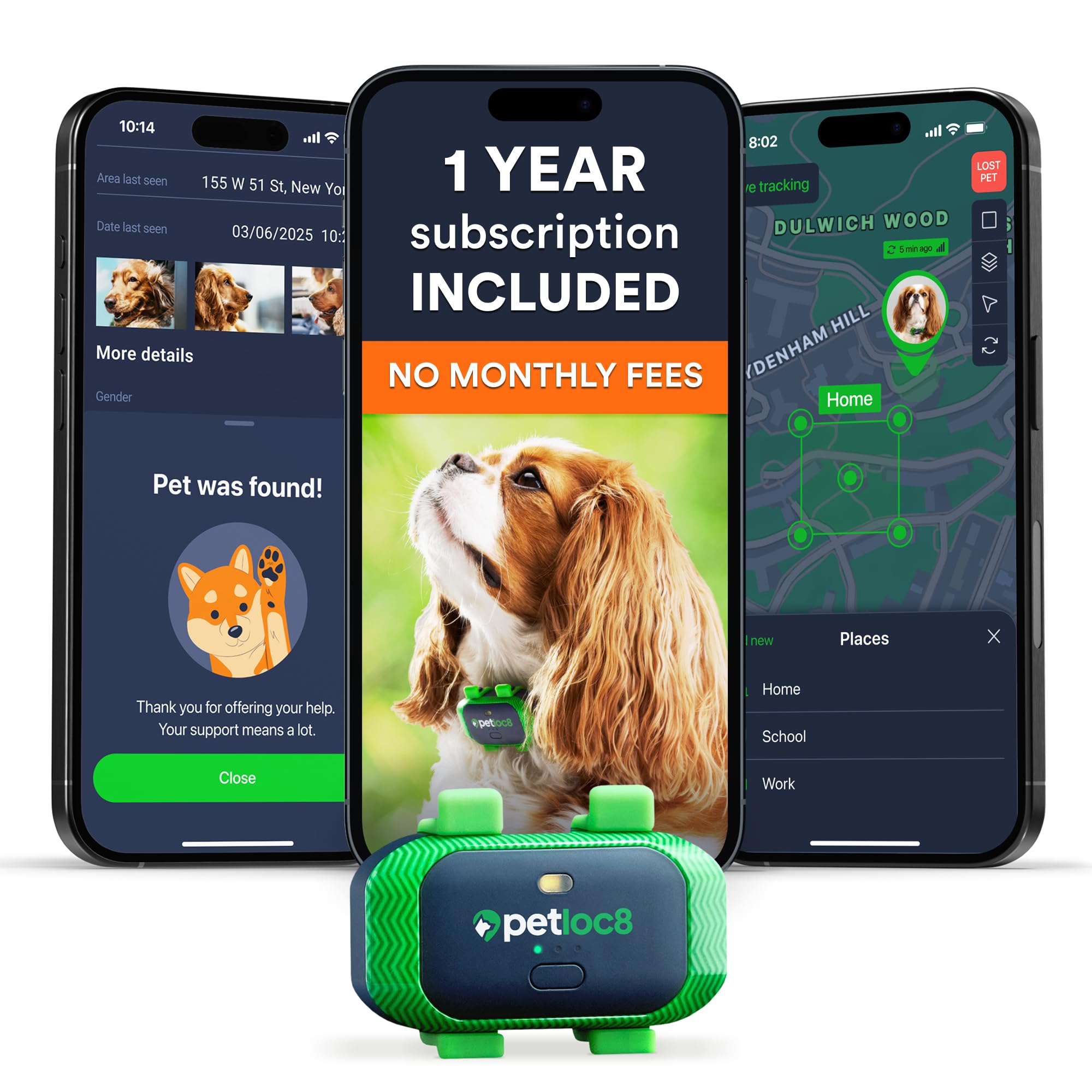
Picture a dog that bolts through an open gate onto a suburban street. This tracker runs on cellular — it talks to the Petloc8 app over a mobile network, so as long as there is coverage, you get a real-time position on a map, plus smart alerts and custom geo-fence zones that ping you when your dog wanders too far. It weighs 1.23 ounces and carries an IP67 waterproof rating (kept sealed against dust and brief immersion), so rain and puddles are fine. At 1.23 ounces it is the lightest of the app-driven picks.
Battery is quoted at up to 14 days of use, and owners mention it delivering — as one buyer puts it, “I was able to track her for almost 3 days on less than half a charge.” The 12-month subscription bundled at purchase is worth understanding plainly: the device itself carries no ongoing bill during that first year, but continuing beyond it means choosing a paid plan. Setup is a little fiddly on first run, and the app has a learning curve.
The real limit is coverage-dependent. In city streets and yards it shines; out in rural stretches with sparse cell service, the map can lose its pin. One owner in a remote valley reported the tracker losing location entirely despite nearby towers, so this is a city and suburban tool first. The silicone collar bands have also been reported to wear quickly, so check the mount now and then.
Pick this: if your dog roams neighborhoods, parks, and yards where your phone has signal.
Skip the rural use: it depends on cell coverage, and a dead zone means a lost pin.
4. Moto Watchdog Wired GPS Tracker for Vehicles
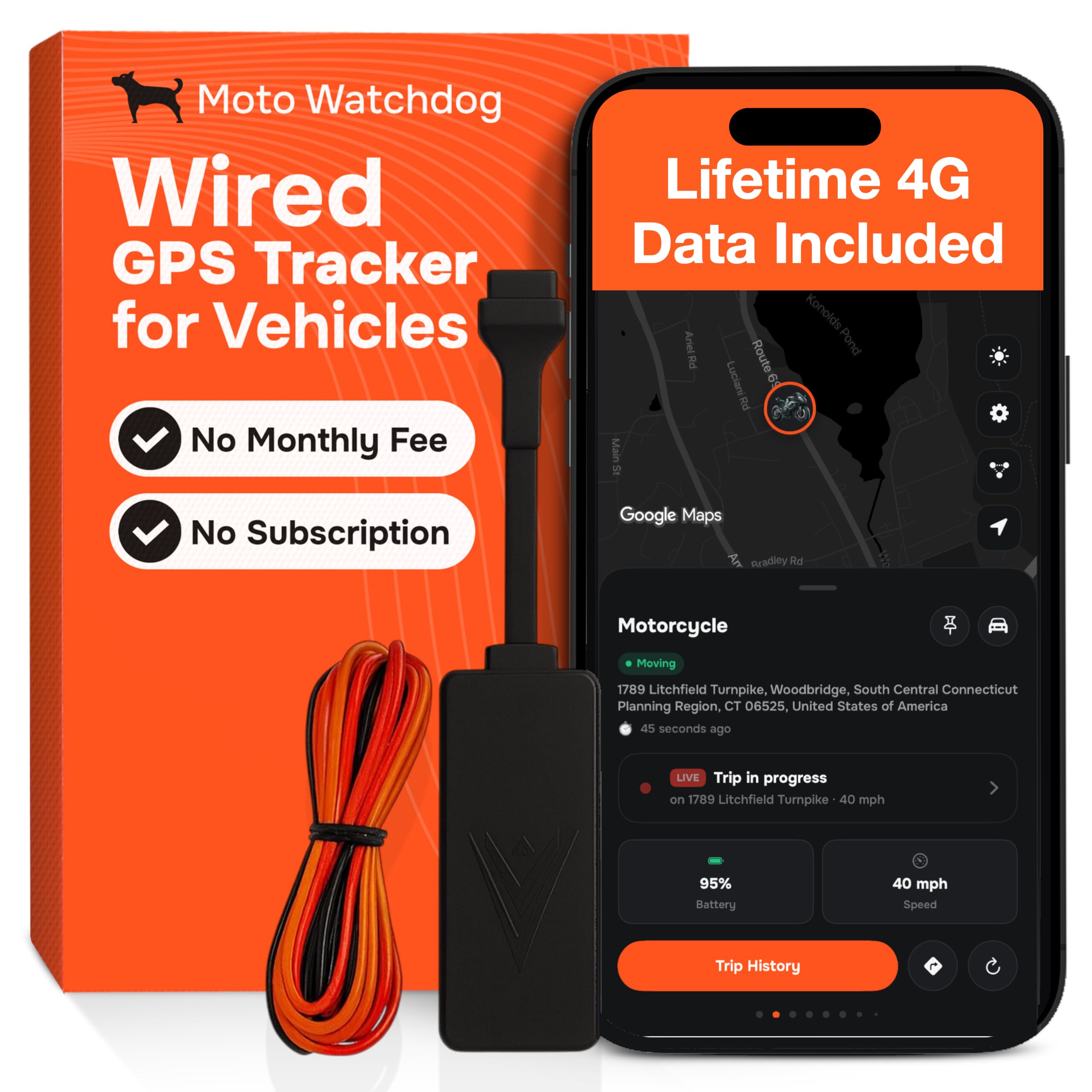
Not a collar — a hard-wired tracker that watches the vehicle your dog rides in.
This belongs on the list for one honest reason: if your worry is the truck, trailer, or kennel van rather than the collar, a no-subscription wire-in unit solves a different problem. It runs directly off vehicle power, so unlike a charge-it-every-few-days tracker, it never needs plugging in — the device simply sleeps a few minutes after the ignition cuts off. It carries no subscription, activation, or hidden fees, and works in 170+ countries including the US, Canada, and Mexico.
Installation is a 2-wire (positive and negative) job, or an optional 3-wire setup adding ACC. Real-time location, instant alerts, customizable geo-fencing, and push notifications all come through the app, and you can watch a whole fleet on one screen. Owners consistently point to how easy setup is and how accurately it tracks; one reports it delivered a strong signal even inside an enclosed trailer. A short calibration drive — roughly 12 miles — is needed before anything shows up in the app, and during that window the unit looks dead.
The trade-off is that it is cellular, so it needs a data connection and is not a pet-tracking replacement. It also occasionally logs a false movement alert even at low sensitivity. But for a vehicle-based setup, the no-fee angle is real, and the hardwire design sidesteps the recharge chore entirely.
Read the intent: buy this when the tracking target is a vehicle, not a dog on a walk — for that job it is accurate, stealthy, and fee-free.
Good fit: trailers, work trucks, and family vehicles you want to locate without a monthly plan.
Not the one: if you need to find a dog on foot — it lives in the dash, not on a collar.
5. Dogtra GPS Fence

A virtual fence you draw once, then the collar guards the yard on its own.
If your goal is keeping a dog home — not chasing a live dot across the county — this is a containment system, and the maker says so plainly: it does not include live tracking or notifications. You set circular or custom boundaries in the free Dogtra app, drawing up to 30 unique fences, and after setup the collar works independently with no phone connection needed. Layered protection means a warning zone, a primary fence, and two backup fences. Each boundary can be set to tone, vibration, or stimulation, with 100 adjustable levels, and smart detection disables correction while your dog is returning while a continuous beep guides him back.
The physical build suits real weather and real dogs. It carries an IPX9K waterproof rating (a high-pressure-wash standard) and fits dogs 15 lbs and up with necks from 10″–30″ on a 3/4″ strap. Three dogs can share one fence profile. It is designed for properties 3/4 acre or larger, and should come off indoors. Owners praise the setup simplicity and the wireless swap for tired in-ground wire — one rural owner running four acres moved off a 10-year-old buried system with no trenching required.
Set your expectations on battery and on the buckle. Owners describe needing a charge roughly daily or every couple of days — treat nightly charging as part of the routine — and the traditional buckle is fiddly on an excited dog, with several opting to swap in a quick-release strap. It is a yard tool, not a backpacking finder.
What makes the yard work
- Layered zones with a return cue that stops correction on the way home
- 100 adjustable levels, tone or vibration option per boundary
- No wires, base stations, or monthly fees
Plan around these
- Containment only — no live tracking or escape alerts
- Battery wants a charge most days
- Standard buckle and wide default warning zone take some tuning
Choose it if: you want a wire-free boundary for a fenced-size yard and your dog stays home anyway.
Look elsewhere if: you need to follow a dog that leaves — this one holds a line rather than finds a runaway.
6. Aorkuler GPS Dog Tracker
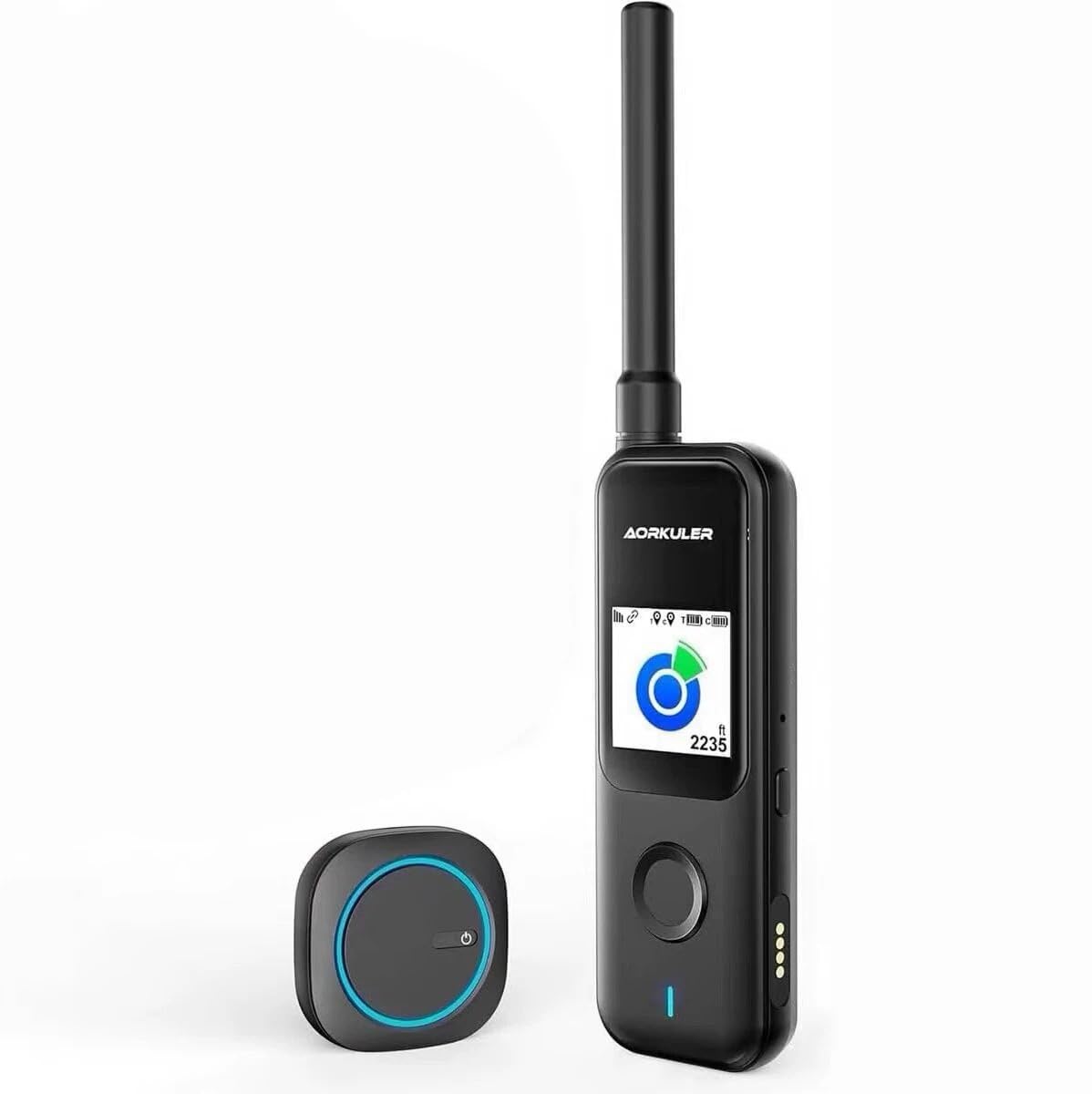
No phone, no bars, no app — just a green arrow pointing to your dog.
For hikers and farm owners who lose cell service the moment they leave the driveway, this tracker’s whole design is the sell. It runs entirely on GPS with no phone, no network, and no monthly fees, showing direction and distance on a handheld controller every 3 seconds up to 3.5 miles. The green arrow is the point — you are not decoding a map, you are walking toward a bearing. At 1.08 ounces the collar tag stays unnoticeable on the dog, and a 2–3 hour charge gives up to 24 hours of continuous tracking, or 10+ days if your walks only run an hour or two a day.
What the field reports confirm is that it earns its keep in open country. One buyer tested the range over hills and brush and found the direction stayed accurate even when distance was harder to judge; another rated it a great option for rural areas with poor cell service, calling it accurate up to 3.5 miles. Among the features owners lean on most is plain functionality — the thing simply works as a standalone unit without cell service.
Be honest about the trade-offs. Accuracy is mixed once buildings or dense canopy block the sky, and it is best with clear line of sight to satellites — indoors and among tall buildings it can drift. Battery runs closer to 8 hours under continuous use, so charge it before a long day. The strap has drawn complaints for being hard to remove, and first-time setup has a learning curve on the light-and-button sequence.
Who it clicks with: the off-grid walker who wants a simple bearing and does not want a monthly bill.
The fair warning: dense city streets and heavy forest are its weak spots — it wants open sky, so keep it for trails and fields.
Best for: hiking, farms, and remote trails with little or no cell coverage.
Test it first: take both units outside and let the tracker lock before you let the dog run — connection can lag on the first try.
7. Marco Polo Advanced Pet Tracker
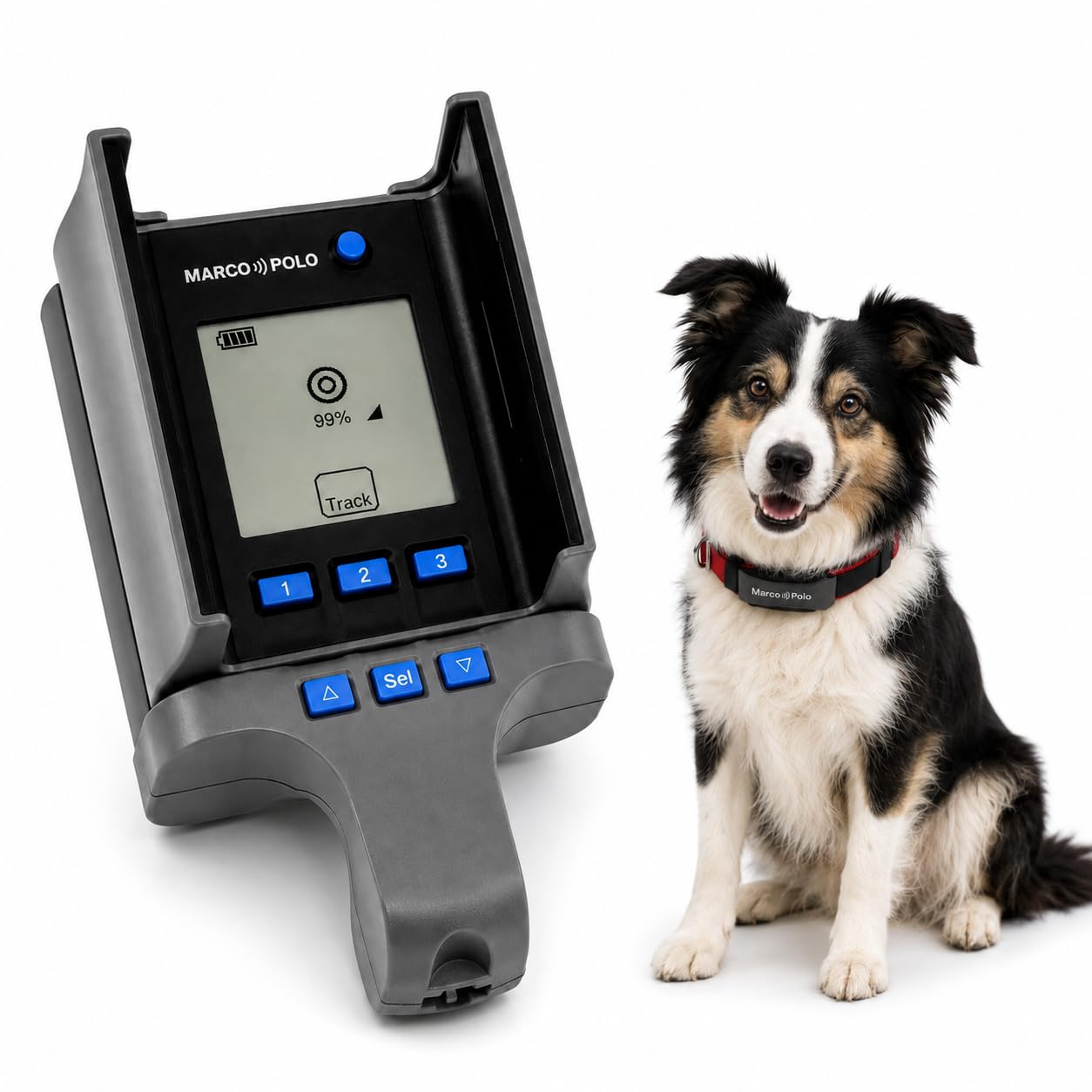
A personal radar for pets, built to work where GPS and cell towers quit.
In rural hill country and deep forest, satellite and cellular trackers go quiet. This system sidesteps both by using long-range radio frequency to find a pet up to 2 miles away with no internet, no cell connection, and no subscription. It behaves like a handheld radar: the locator gives real-time audio and visual feedback that guides you step by step toward the dog, rather than showing a dot you hope is current. It suits cats and dogs 5 lbs and larger, and the tag is IP67 rated for swimming, mud, and rough play.
The battery math is the standout. The collar tag lasts up to 6 weeks on a charge, while the handheld runs 8 continuous hours of searching or 30 days on standby. Reliability is what owners cite most — again and again they describe it finding a wandering pet every time, in terrain where other systems fail. One rural user with satellite internet calls it their security blanket for letting the dog be a dog; a long-term owner tracked a cat across 15–20 acres of forest and hills with success on every one of many searches.
The requires-practice caveat is real. The signal can bounce in hilly ground, distance readings need calibrating, and you learn to sweep the handheld rather than point and expect a pin. The collar holder is the fragile piece — it wears out with water and hard use, and replacements run about twenty dollars; plan to check it. It handles wet grass and rain but is not for full submersion of the tag.
Where the radio wins
- Works with zero cell service or internet — ideal for rural and RV life
- 6-week tag battery, 8-hour handheld search time
- Directional audio and visual guidance, not just a map dot
Set expectations here
- Learning curve on signal bounce and distance calibration
- Collar holder wears and needs occasional replacement
- Tag handles wet grass and rain, not submersion
Made for: rural, hilly, and no-signal properties where a dot on a map never loads.
Keep in mind: it rewards practice — spend an afternoon learning the sweep before you need it in a panic.
8. Dogtra Pathfinder 2 GPS Dog Tracker e Collar

A whole-hunt tracking rig that runs off a phone app with no monthly map bill.
This is built for the field, and it shows in the spec sheet: up to 9 miles of range and the ability to track up to 21 dogs in real time, all through the free Pathfinder 2 app with no subscriptions or monthly fees. You get General, Satellite, and Terrain map views powered by Map Box, plus offline maps you can download before you lose signal — exactly what a hunt or a long backcountry push needs. The GPS Connector and a smartphone are required to operate, and the connector is not included, so factor that in.
On the training side, you get Nick, Constant, and Audible tone, plus an LED locate light and pager vibration, from either the connector or the app. Smartwatch support covers Apple Watch Series 5 and Galaxy Watch4 Series and above, with compass, maps, and e-collar controls on your wrist. Owners rate its functionality first and its ease of use close behind — it simply works as a complete system. One first-time GPS collar user found it held a connection through heavy forest the entire time, to both handheld and phone.
The honest limits: accuracy and connectivity bring some mixed reports, so give the connection a beat to settle, and the power button needs a deliberate three-count press. The e-fence rejects very small areas. And the app does not share a live location to a second phone, so one person runs the tracking. Still, in wet, hot, cold, and salt water, customers note it holding up with a freshwater rinse.
Right for you: hunters and wide-open adventurers who want 9-mile range and multi-dog tracking in one app.
Budget the extra: the required GPS Connector is a separate purchase, so price the whole system before you commit.
9. SpotOn Omni GPS Dog Fence Collar, Large Dogs 19-26 Inch Neck
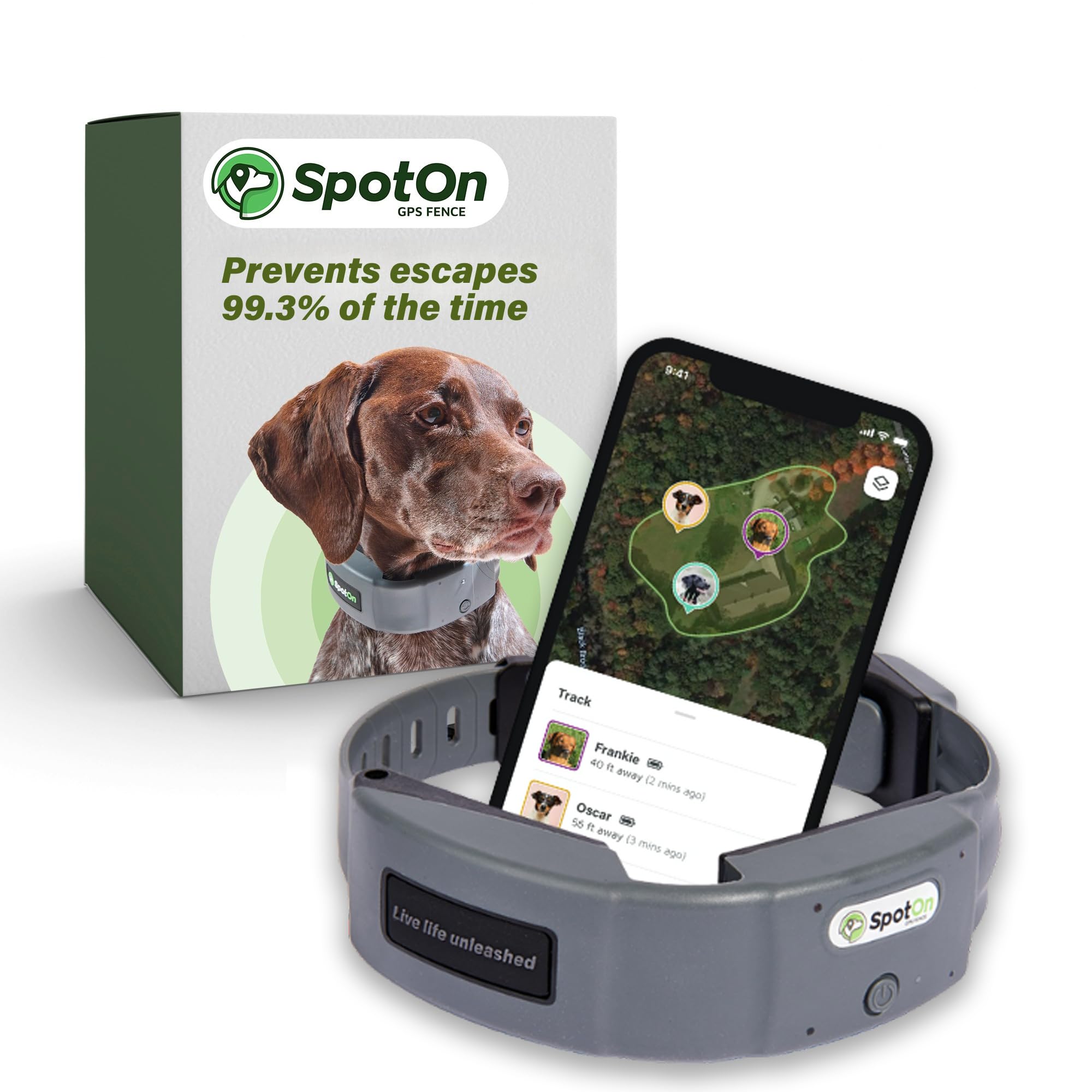
The large-acreage fence that draws precise boundaries even under heavy tree cover.
For a big property — from a half acre up to 100k+ acres — this collar draws boundaries of any shape and holds them. It connects to 128 satellites and uses a dual-feed GPS antenna, which is the maker’s case for keeping the boundary solid in heavy woods. You can add off-limits areas and correction-free zones, and it supports overlapping fences. Setup is done from your phone: walk the fence or draw it in the app, and the system works from the start without a subscription. No base stations, no buried wire.
Two modes matter for the fee-free buyer. If you opt out of a tracking subscription, the rechargeable battery provides 40+ hours of runtime, and off-grid mode lets you build fences with no cell service or internet at all — rare among GPS fences. A free 30-minute one-on-one session with a certified trainer is included to teach boundary tones. Owners point to build and privacy: it holds escape artists in for months, with fast breach alerts when the dog pushes the line.
Battery is the main friction — reviewers point out needing a daily charge to make it through the day, and a few wish for a larger battery option on big dogs. The unit is bulky on the neck, and a rare unit has thrown random warnings inside the safe zone. Treat training time — up to two weeks of short daily sessions — as part of the purchase, not an afterthought.
The big-acreage read: if your yard is measured in acres and you want wire-free containment that works offline, this is the most capable fence here.
The trade you accept: a daily charging habit and a bulky collar in exchange for precise, subscription-free boundaries.
Buy it when: you have acreage, want no wires, and need a fence that keeps working without cell service.
Weigh the size: it fits large necks (19″–26″) and is a substantial collar — smaller dogs will not wear this comfortably.
Know the Specs
Range in miles versus yards
A range figure is the farthest a signal will travel under clear, open conditions. The moment trees, hills, or walls get in the way, it shrinks — sometimes to a fraction of the box number. That is why a 9-mile collar may read as a few hundred yards in dense forest. Choose more range than you think you need, and test the real reach on your own property before you rely on it.
Radio frequency versus GPS versus cellular
Radio frequency (RF) talks directly between two units and needs no towers — it keeps working with no cell service. GPS reads satellite coordinates and needs a clear view of the sky. Cellular uses a mobile network and goes dead in a no-signal zone. If your terrain has poor coverage, RF is the most dependable, while cellular gives you a live map pin but only where bars exist.
How to read battery claims
Battery life is quoted two ways: hours of continuous tracking and days of typical use. Continuous tracking drains fast — a full day in the field needs a large continuous number. A unit that only wakes for an hour or two a day can last well over a week on standby. Match the number to your routine, and lean on a unit with replaceable batteries if long life matters most.
Waterproof ratings explained
An IP code tells you how well a device keeps water out. IP67 means it is sealed against dust and survives brief immersion. A higher mark like IPX9K indicates resistance to high-pressure water. If your dog swims or works wet brush, check this rating, and note that some tags handle rain and wet grass but not full submersion.
Common Questions
Do I really avoid a monthly fee with these trackers?
Will a GPS tracker work in an area with no cell service?
What is the difference between a tracking collar and a GPS fence?
How far will these trackers reach in real tree cover?
Can I track more than one dog on the same system?
How long does the battery really last between charges?
Is the collar safe for a small dog or a cat?
Do these systems need a smartphone to work?
What happens if the tracker loses the dog’s signal?
Are these waterproof enough for a dog that swims?
The Bottom Line
For most people hunting a dog tracking device without subscription, the Garmin Alpha TT 25 is the one to beat — 9 miles of tracking with 2.5-second updates, 18 training levels, and a battery that runs 68 to 136 hours, all with no monthly bill. If you mostly need a compact, weatherproof collar for a ranging dog, the Garmin T 5 Mini covers 4 miles and takes a dunking. And for rural, hilly ground where cell service vanishes, the Marco Polo reaches 2 miles on pure radio and keeps a tag alive for up to 6 weeks. One nudge worth acting on: the crowd favorite here is the highest-rated of the lot at 4.5+ stars across 190+ ratings — a strong sign the extra gear cost earns its keep on the trail.
How we choose
We do not accept paid placement. Every pick is matched to a real buyer and a real use-case; we do not hands-on test units.
Sources
Specifications: manufacturer listings and product documentation. Review insights: verified customer reviews, as of October 2026. Pricing: not shown on this page (it changes often); check the current price via the retailer link.
As an Amazon Associate, Aappliancez earns from qualifying purchases. This does not affect which products we feature.