Disclosure: Some links in this post are affiliate links. As an Amazon Associate I earn from qualifying purchases, at no extra cost to you. Learn more
Specs are compiled from manufacturer listings and verified buyer reviews and can change over time — please confirm the key details on the product page before buying.
Your dock stain should protect the wood through sun and rain, and the right one depends on your wood, not the label. A coating that soaks in protects the boards; one that sits on top can flake off after a season. Dense exotic hardwood like ipe (a very hard tropical wood) drinks oil differently than pressure-treated pine. A semi-transparent film coat (a tinted layer that sits on the surface) also behaves nothing like a transparent one on a hot, sun-baked boardwalk. Match the stain to your wood and your dock survives the weather with a couple of hours of work. Get it wrong and you will be sanding again by next spring.
This guide is built by comparing the manufacturers’ published specifications and the patterns across verified customer reviews, so you get each pick’s real strengths and trade-offs instead of marketing spin.
Below you will find the coverage numbers, finish types and real buyer experiences that separate a stain built for a dock from one meant for a fence. Everything here is aimed at helping you choose the best Dock Stain for your specific wood and climate.
Top Picks


How To Choose The Best Dock Stain
Start with your wood, not the color card. A dock built from pressure-treated pine or cedar absorbs a penetrating stain readily. A dock built from dense exotic hardwood like ipe barely drinks at all, so excess oil has to be wiped off or it turns sticky and slow to dry. If you skip that step, you get a finish that never fully cures. That single rule decides more outcomes than any brand name on this list.
Oil-based penetrating stains versus acrylic film-forming stains
An oil-based stain soaks into the wood pores and protects from the inside out. It leaves the grain visible and feels like bare wood underfoot, which matters on a wet dock. An acrylic stain forms a coating on the surface and offers a satin sheen, but it sits on top of the board. Neither is wrong. A penetrating oil suits hardwood and high-traffic boards; an acrylic suits a deck you want a uniform sheen on. On a dock, oil wins more often because it does not trap water under a film.
Coverage per gallon and how many coats you actually need
Coverage numbers range widely here, from 100-150 square feet per gallon up to 350 square feet depending on the product. Those figures assume an ideal surface, and dry, thirsty wood will drink far more than the label suggests. Plan on buying more than the can claims, especially on a first coat over weathered lumber. Thin, dry consistency means one coat often soaks straight in, and a second coat is what actually builds the color and the water barrier.
Transparent, semi-transparent and smooth finishes explained
A transparent finish (a clear coat with no added color) lets you see the wood texture through the color. A semi-transparent finish (a partly tinted coat) still shows the grain but hides some of the natural tone underneath. On a dock, semi-transparent gives more UV blocking (protection from sun damage) because the pigment load is higher. Transparent looks more like raw wood but fades and weathers in a different pattern. Pick based on if you want the boards to look freshly milled or richly tinted.
Drying time and slip resistance on wet boards
A dock stays wet longer than a fence or a back deck, so drying time matters for more than scheduling. An oil that stays tacky for days in humid weather traps dirt and cushions. Acrylic stains dry fast but can feel slippery when wet. Look for a finish that cures hard while keeping the grain texture exposed, because texture is what gives you grip on a rain-soaked board.
Side-by-Side Comparison
| Model | Best For | Finish Type | Coverage | Base | Amazon |
|---|---|---|---|---|---|
| Ready Seal Stain & Sealer (Pecan)★ Best Overall | All-in-one deck and dock protection | Oil | 125 sqft per gallon | Oil-based | Amazon |
| Thompson’s WaterSeal Transparent (Natural Cedar)Fastest Coverage | Fast, budget-friendly full deck coverage | Transparent | 150–400 ft²/gal | Wood | Amazon |
| Thompson’s WaterSeal Semi-Transparent (Chestnut Brown) | Rich color with proven water beading | Semi-Transparent | 150–400 ft²/gal | Wood | Amazon |
| Thompson’s WaterSeal Semi-Transparent (Sedona Red) | Warm red tone for cedar and redwood | Smooth | 150–400 ft²/gal | Water-based | Amazon |
| SaverSystems #1 Deck Wood Fence Stain & Sealer | Dock and fence with a fast sprayer job | Flat | 100–150 sq ft (two coats) | Water Based | Amazon |
| KILZ Waterproofing Semi-Transparent (Cedar Naturaltone) | Long-lasting acrylic protection on big decks | Satin | 250–500 sq. ft. | Acrylic | Amazon |
| Penofin Deep Penetrating Oil (Exotic Hardwood) | Ipe and dense exotic dock decking | Oil | 350 sqft | Wood | Amazon |
Detailed Reviews
1. Ready Seal Pecan 1 Gallon
Our pick — 4.5+★ from 150+ verified ratings; the strongest balance of quality and price.
A stain and sealer in one can that skips the primer entirely.
Ready Seal earns the top slot for the buyer who wants one product to do the whole job. It is an oil-based stain and sealer combined — no primer, no thinning, and no back-brushing after you spray. Each gallon covers 125 square feet, which is enough to dress a modest dock or a full fence run with careful measuring. The self-blending formula is designed to avoid the lap marks that show up when a stain dries too fast in the sun.
What wins people over is the finished result. The warm Pecan tone accents the natural character of the wood without going too dark, and it preserves the grain rather than hiding it. Buyers report applying it with a roller on an extension pole and getting an even coat without fuss. One dock and fence owner put it simply: “Best fence stain around. Won’t use anything else.” Longevity is the other half of the story — one seasoned user reports a deck still holding up 20 years later, with only occasional reapplication. That is the kind of result that pays back the effort of a good prep job.
The catch is preparation and quantity. You need to pressure wash and sand before applying, and dry wood will absorb heavily, so buy extra cans beyond your first estimate. Stir it thoroughly throughout application, because unmixed stain settles and leaves dark streaks that require sanding to fix. The Pecan shade also runs lighter than some buyers expect, so if you want a deep brown, plan accordingly.
What the can promises
- Stain and sealer combined means one application, not two
- No priming, thinning or back-brushing required
- Self-blending formula aimed at preventing lap marks
- 125 sqft per gallon gives a predictable coverage baseline
What to plan around
- Dry wood absorbs heavily, so your real usage runs above the label
- Must be stirred continuously or the pigment settles into streaks
- Pecan reads lighter than a true deep brown
Go for this if: you want a single-can one-step product for a dock or fence in weathered condition and you are willing to prep properly. Look elsewhere if: you cannot stir your can regularly through the job.
2. Thompson’s WaterSeal Natural Cedar 1 Gallon
The one you can spray over a whole deck in a single afternoon.
If your dock is already in decent shape and you want to knock out the whole job in one loop around the boards, this Thompson’s transparent coat goes down fast. Coverage swings from 150 to 400 square feet per gallon depending on your surface, and the formula works on damp or dry wood, so you are not waiting for perfect conditions. The can runs 6.63 x 4.19 x 10.25 inches — that is 10% more gap in the packaging than the Ready Seal can above, but it pours the same single gallon. The fade-resistant polymers are built to resist UV damage while keeping the color steady through the seasons.
Where this gets tricky is the word “transparent.” It does not behave like a clear coat on weathered timber. On a mahogany board or an older fence, the tint lands far heavier than most people picture from the can, and the finish hides the wood grain while still letting texture show through. That is fine if you want a rich cedar appearance. It is a problem if you expected your boards to look nearly untouched. A pressure pump sprayer is the common way people apply it, and owners mention finishing full sections in just a few hours.
Honest color caution: The biggest split in feedback is over the Natural Cedar tone, with some buyers finding it a few shades too bold for weathered or reddish wood. Test it on an offcut first.
Where it wins: Quality and water resistance are the areas buyers praise most, and the water-beading behavior is consistent once it cures.
The short version: a solid pick for a cedar dock or fence where you want fast, uniform tint and strong waterproofing. Pause first if: you need transparent to mean nearly invisible on old, dark wood.
3. Thompson’s WaterSeal Chestnut Brown 1 Gallon

Semi-transparent coverage that turns rough boards into finished ones.
Chestnut Brown is the middle ground between a clear coat and a paint. The semi-transparent finish hides the wood grain but leaves the texture underneath so the boards still read as wood. Coverage runs 150 to 400 square feet per gallon, and it goes on damp or dry, which takes the guesswork out of your prep window. The coating exceeds ASTM D-4446, the industry benchmark for how well a wood stain sheds water instead of absorbing it.
The thing everyone raves about is how far the color and seal go. Rough boards fill in at the grooves and the finish reads uniform over a whole dock. Water beads up on the surface after a single coat, and the dilution is thin enough to apply with a roller, a pump sprayer, a paint sprayer or a brush. One deck owner who applied it at 64 with knee arthritis finished a whole section solo using a long-handled brush — a good sign that the consistency stays workable even for slow, careful jobs.
Here is the plain caveat: on dry, sun-baked wood the first coat soaks straight in and does not seal on its own. The recurring gripe is that this needs a second coat in hot, exposed climates, and buying enough for two passes raises the total volume you need. Thin consistency also means the color can look a bit chalky while wet before it settles darker as it dries.
Why it holds up
- Semi-transparent pigment blocks more UV than a clear coat
- Works on damp or dry wood, relaxing your timing
- Exceeds the ASTM D-4446 waterproofing standard
- Water beads up after a single coat on moderate surfaces
Where your budget grows
- Dry, hot, sun-exposed wood drinks the first coat and needs a second
- Thin consistency can look chalky while drying
The buyer this suits: a dock or fence with weathered boards where you want a warmer brown and a finish that beads water. Plan for double: the second coat on a sun-facing deck is not optional if you want real protection.
4. Thompson’s WaterSeal Sedona Red 1 Gallon

Red tone, same water-beading seal, for cedar and redwood boards.
Sedona Red is the version to grab if you want the finished look to run warm and reddish rather than brown. The semi-transparent pigment hides the grain but keeps the wood’s texture on show, and it covers 150 to 400 square feet per gallon. The base here is water-based and the finish type is smooth, so the coating sits flatter on the board than its Chestnut Brown sibling above. Fade-resistant polymers keep the color steady under UV exposure, and the whole product meets the ASTM D-4446 waterproofing standard.
Application is the same easy loop as the rest of the line. One coat on a garden box, planter or small project is enough to protect and tint in a single pass, and dried boards read as sealed rather than soaked. The spraying route with a pump sprayer is common and quick, and the formula cleans up as you go. On a dock, expect the same water-beading behavior once the second coat cures.
Color is the honest decision here, not performance. If your wood already leans red or the boards are a warm cedar, this tone can look like a deliberate design choice or like too much of a statement, depending on your taste. Sample it first on a spare plank.
The tested territory: Water resistance and smooth coverage score well, and the seal behaves consistently with the Thompson’s lineage.
The tint trap: This red tone runs bold. If you are protecting already-red timber, dial down to a natural or clear option to avoid a double-saturation look.
Reach for it when: you want a smooth red finish and strong water shedding on a cedar dock or redwood deck. Pass when: your boards are already reddish — the color doubles down rather than balances out.
5. SaverSystems #1 Deck Light Walnut 1 Gal
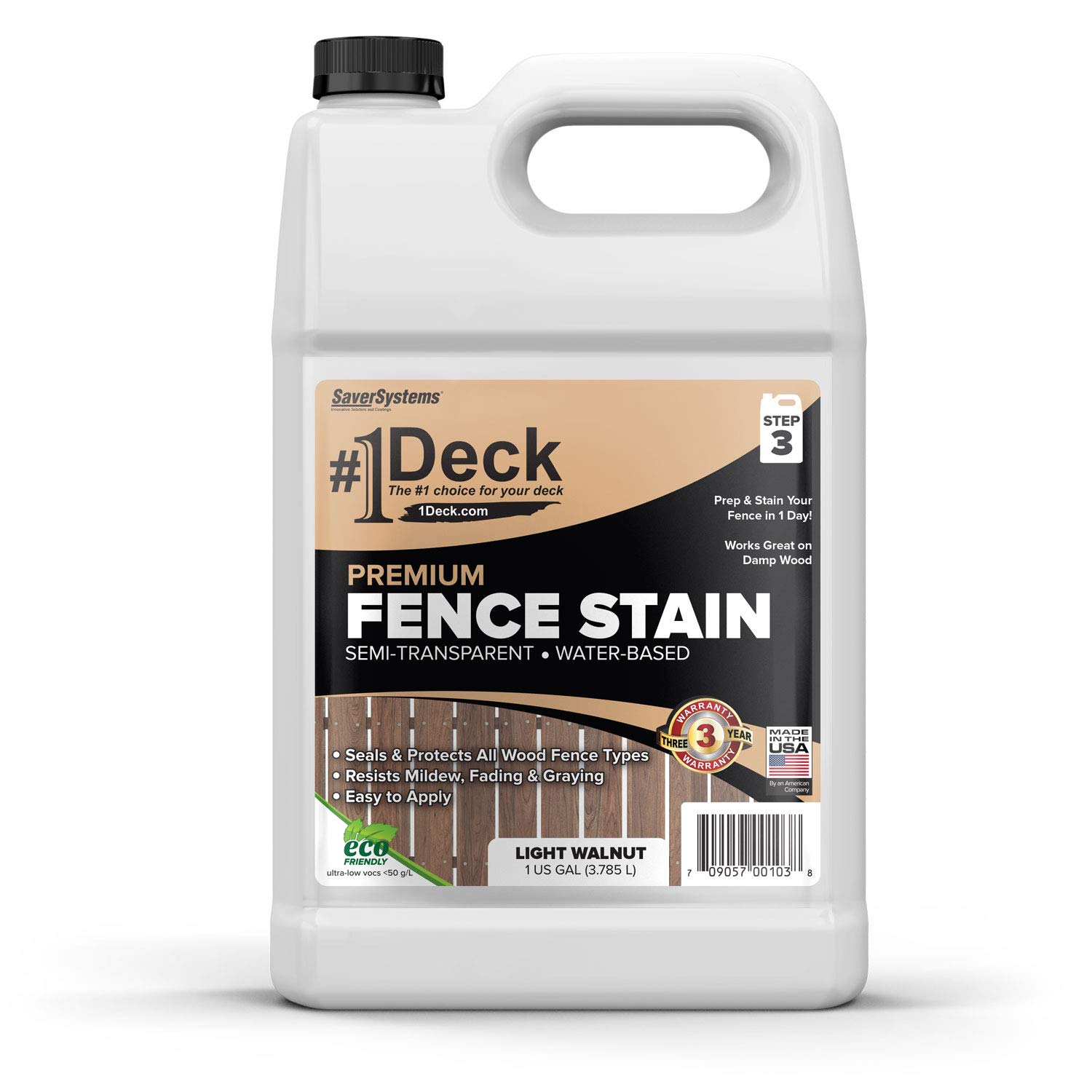
Soaks deep into the pores and goes on with a sprayer and a back-brush.
If you are a sprayer-first person, this SaverSystems water-based formula was built for your workflow. Apply it with a pump-up or airless sprayer and back-brush the wet coat, or use a nylon or polyester brush for smaller jobs. Each gallon covers 100-150 square feet in two wet-on-damp coats, and the low-odor formula keeps VOC content under 250 g/L — a measure of how much solvent escapes into the air as it dries. That matters on a dock where you are standing on the boards you are coating.
The selling point beyond the sprayer is depth. This is a semi-transparent stain that soaks into the wood pores rather than building a film, so the natural grain still shows through. Light Walnut dries to a flat, natural tone, and the product is made for pressure-treated pine, cedar and redwood fences, siding and decks alike. Customers note using a small sprayer to finish a whole fence in about 20 minutes. One owner who stained a wooden pond dock found the color still holding 60 days in.
The trade-off is spill management. It runs quite drippy, so you need to catch splashes and drips before they land on concrete or plants, and it does not clean off easily with plain soap and water. Wear gloves and long sleeves. A slightly thinner second coat about a week after the first is the application pattern that gets the best results.
Designed for speed
- Sprayer-and-back-brush application is quick and even
- VOC content under 250 g/L keeps odor low
- Water-based formula cleans up without harsh solvents
- Works on pressure-treated pine, cedar and redwood
Prep clothing and drop cloths
- Drippy consistency needs active drip-catching
- Hard to remove from skin and brushes with soap alone
The right match: a sprayer-driven job on a fence or dock where you want deep pore absorption and a flat, natural Walnut tone. Worth noting: budget extra drop cloths and gloves — this one marks everything it touches.
6. KILZ Cedar Naturaltone 1-Gallon

A film-forming acrylic that carries a three-to-five year warranty.
KILZ takes a different route than the oils above. This is a 100% acrylic semi-transparent coating with a satin finish, and the maker warrants it for 3 years on decks and 5 years on fences and siding. The formula is built to protect against rain, snow and sun while offering mildew resistance — useful on a dock that never fully dries. One gallon covers roughly 250-300 square feet on the first coat and 500-600 on the second, which is the biggest per-can spread in this lineup.
The surface prep window is generous too, since it works on unsealed exterior wood with 0-10 years of exposure. Once it cures it resists UV and fade, and after 72 hours the coating can be washed. What owners notice most is the protective look: a resanded deck comes back with a sheer color over the grain while giving up none of the wood’s texture. Reviewers point out water beading up after storms and no thinning after a month and a half in the elements.
Two things to plan for. First, it genuinely needs two coats, and the second one is where the waterproofing really builds. Second, on a fresh can the coverage number is a bit optimistic for a thirsty deck, so a larger surface will need more gallons than the label suggests. Get both right and you get the longest warranty on this list.
Where it shines: Cleanup is as easy as soap and water, and the acrylic film shrugs off a hot summer and repeated rain without dulling.
The second-coat truth: A single pass looks good but the durability and water resistance you paid for show up after the second coat, so buy accordingly.
Best fit: a large dock or deck where you want the warranty comfort of a film-forming acrylic and a satin sheen over the wood grain. Watch out for: the coverage estimate — dry boards will pull more gallons than the can claims.
7. Penofin IPE Finish 1 Gallon

Built for ipe, and it makes forty-year-old decking look new again.
Dense exotic hardwood is a different animal from pine, and Penofin is formulated specifically for it. This oil-based treatment penetrates the tight grain of ipe and similar species instead of sitting on the surface, and one gallon covers up to 350 square feet — the widest reach on this list. The finish is a transparent natural tone that lets the wood show itself, with added ultraviolet protection and advanced mildew protection built in.
The application is what decides your results. Apply a thin coat, wait a few minutes, then wipe off the excess. Ipe absorbs very little, so extra oil left on the boards turns sticky and slow to dry. On a 250-square-foot ipe deck, one detailed application took two people about two and a half hours with exactly one gallon. A cheap garden sprayer gets into thin slat cracks better than a brush, so many users go that route and finish with a brush or roller.
Two honest notes to set expectations. First, this oil has a strong smell that lingers for weeks outdoors and contacts clothes so thoroughly that it resists even several washes. Second, the finish reads darker than a wet, high-shine look, so if you want that glassy gloss, this is not it. Buy the smallest can you can finish, since leftover product can gel in storage.
what separates it
- Formulated to penetrate dense exotic hardwoods
- 350 sqft per gallon gives the best coverage on this list
- Transparent natural tone keeps the grain on display
- Mildew protection and UV protection built in
Wear the right clothes
- Strong odor that lingers for weeks in outdoor conditions
- Oil stains clothing beyond laundering
- Finished color runs darker than a wet look
Made for this: ipe and exotic hardwood dock decking where you want a deep penetrating oil and the widest coverage per gallon. Dedicated clothes required: the oil stains fabric permanently, so keep a set of work clothes just for staining.
Know the Specs
Coverage per gallon
This figure tells you how much square footage one can will treat, and it is the number most likely to blow your budget. The range here runs from 100-150 square feet on a heavy water-based stain to 350 square feet on a penetrating oil for dense hardwood. Treat the label as a best-case estimate on a perfectly prepared surface. Weathered, thirsty wood pulls far more product, and dry, sun-baked boards especially drink the first coat. Order extra and keep a sealed can for touch-ups rather than running short mid-job.
Finish type and what it hides
A transparent finish keeps the wood texture visible while still adding color, and it lets the boards look closer to their natural state. A semi-transparent finish shows the grain but hides more of the underlying tone, so it delivers stronger UV blocking with the higher pigment load. A smooth or satin finish adds a slight sheen on top, which looks more polished but takes away some of the bare-board feel. On a wet dock, texture matters for grip, so weigh the polish against the traction.
Common Questions
Can I use a deck stain on a wooden dock?
How much stain do I need for a dock?
Is an oil-based or water-based stain better for a dock?
Why does my dock stain turn sticky and never dry?
How long does dock stain last before you need to reapply?
Do I have to prime or back-brush before staining?
What is the difference between transparent and semi-transparent wood stain?
Will stain stop my dock boards from feeling slippery when wet?
Can I use the same stain on my fence and my dock?
Why did my stain color look different from the can?
The Bottom Line
For most docks, the best dock stain is the Ready Seal Stain & Sealer, because one oil-based can does both jobs — no primer, no thinning, no back-brushing — and 125 square feet per gallon with a warm Pecan tone makes for an easy first project. If your priority is sheer pace over a large surface, the Thompson’s WaterSeal Semi-Transparent in Chestnut Brown gets you a richer pigment and a second-coat path to real water beading. And if your dock is exotic hardwood like ipe, the Penofin Deep Penetrating Oil is the one built to soak into dense grain at up to 350 square feet per gallon. Start with your wood species, then your schedule, and the rest falls into place.
How we choose
We do not accept paid placement. Every pick is matched to a real buyer and a real use-case; we do not hands-on test units.
Sources
Specifications: manufacturer listings and product documentation. Review insights: verified customer reviews, as of October 2026. Pricing: not shown on this page (it changes often); check the current price via the retailer link.
As an Amazon Associate, Aappliancez earns from qualifying purchases. This does not affect which products we feature.