Disclosure: Some links in this post are affiliate links. As an Amazon Associate I earn from qualifying purchases, at no extra cost to you. Learn more
Specs are compiled from manufacturer listings and verified buyer reviews and can change over time — please confirm the key details on the product page before buying.
The hardest part of a DIY mini split isn’t hanging the indoor head or drilling the wall hole — it’s knowing which systems genuinely let a handy homeowner finish the job and which ones quietly require a licensed tech. This guide separates the two. Some units here arrive pre-charged with a line set you can run yourself; others are labeled “DIY” in the listing but demand a vacuum pump, nitrogen test, and 230V hardwiring. Knowing which bucket a system falls into before you order saves you a weekend of frustration and a surprise service call.
This guide is built by comparing the manufacturers’ published specifications and the patterns across verified customer reviews, so you get each pick’s real strengths and trade-offs instead of marketing spin.
Every system below is judged on the same handful of things that actually matter for a self-installer: whether the outdoor unit comes pre-charged, what voltage and fuse size it needs, how loud the indoor head runs, and how much square footage it realistically covers. If you want the short version, the best DIY mini split systems balance pre-charged lines and 115V simplicity against real BTU coverage.
Top Picks


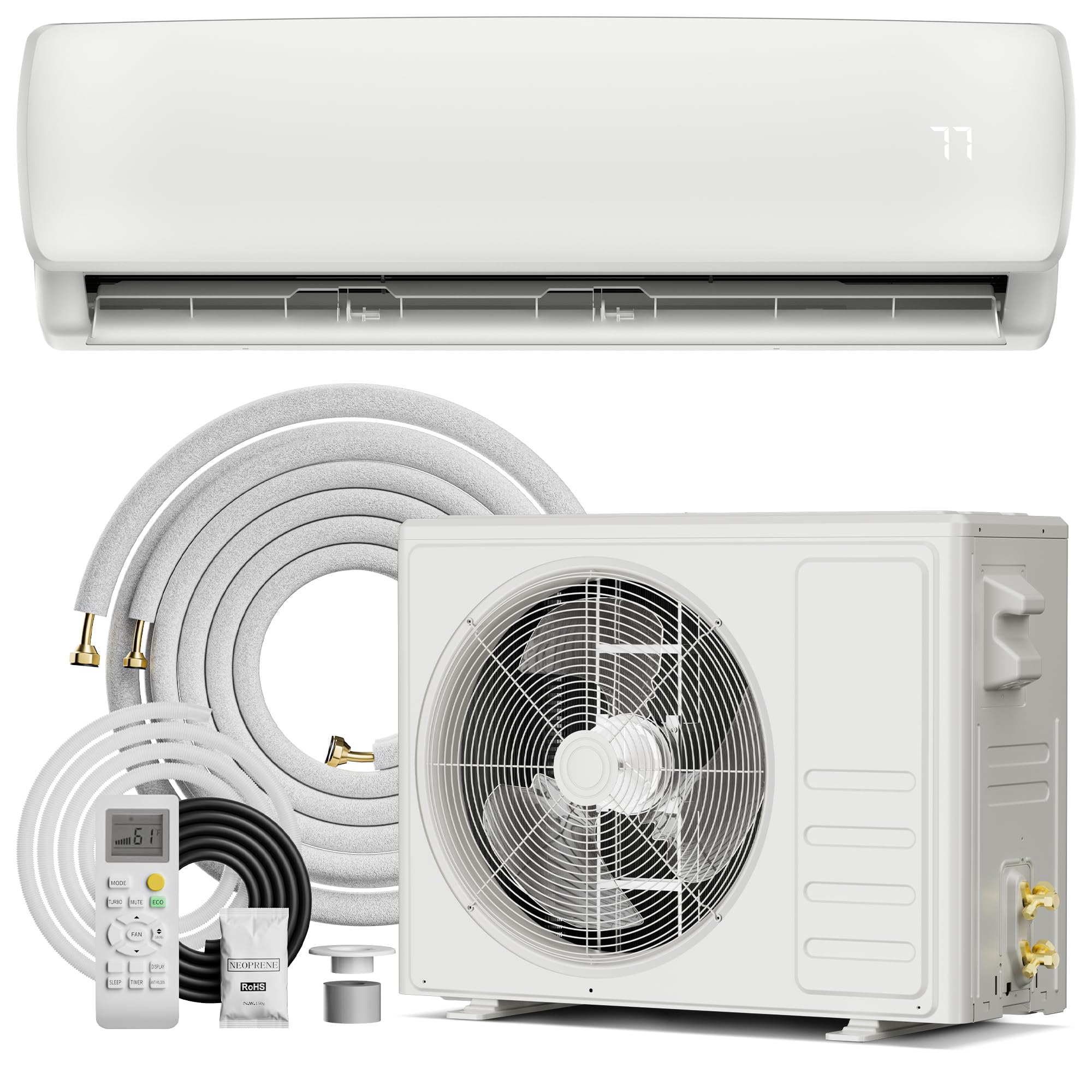
How To Choose The Best DIY Mini Split Systems
The word “DIY” on a mini split listing covers a wide range of reality. At one end, a pre-charged system ships with refrigerant already sealed in the outdoor unit and a factory line set you bolt on. At the other, a contractor-grade unit expects a nitrogen pressure test, a deep vacuum, and a licensed electrician to run the circuit. Before you compare BTU numbers, decide which side of that line you are actually on.
Pre-charged versus professional install
A pre-charged condenser arrives with its refrigerant already measured in, so you are not buying cans of R32 or R410A and charging the system yourself. That is the single biggest time-saver for a homeowner. Even with a pre-charged unit, most manufacturers still call for pulling a vacuum on the line set to remove moisture and air — something many owners hire a tech to do for a few hours rather than buy the pump themselves. If you already own a vacuum pump and manifold gauges, you can finish the job solo. If you don’t, budget for a short technician visit even on a “DIY” system.
Matching BTU to your square footage
Mini splits live or die by sizing. A 9,000 BTU head suits a large bedroom or a small shop up to about 450 square feet, while a 24,000 BTU system can carry 1,200 to 1,500 square feet of open space. Undersize it and the unit runs flat out and never quite catches up on a 100°F afternoon. Oversize it and you get short cycling — rapid on-off bursts that cool the room unevenly and waste power. Measure your space honestly, then match the BTU rating on the box.
Voltage, circuits, and fuse size
Smaller units run on standard household 110-120V and can plug into an existing outlet, which is why they are the friendlier DIY choice. Anything in the 208-230V class needs its own dedicated circuit and a breaker sized to the unit — some list a maximum fuse size of 20A, others 25A. That part is almost never a true DIY job. If your panel is far from the install spot, price the electrical run before you buy, because it can rival the cost of the unit itself.
Side-by-Side Comparison
| Model | Best For | Cooling Power | Coverage | Voltage / Efficiency | Amazon |
|---|---|---|---|---|---|
| Senville AURA 24,000 BTU★ Best Overall | Whole-home or commercial floor cooling | 24,000 BTU | 1,250 sq. ft. | 208-230V / 21.5 SEER | Amazon |
| DELLA Vario Series 12,000 BTUMost Popular Pick | Homeowners who want the biggest install crowd behind them | 12,000 BTU | 550 sq. ft. | 110-120V / 20.5 SEER2 | Amazon |
| Mountman 18,000 BTUBest for Workshops | Garages, shops, and mixed-use rooms | 18,000 BTU | 1,250 sq. ft. | 208-230V / 19 SEER2 | Amazon |
| TOSOT Aoraki 24,000 BTU | Cold-climate shops and fresh-air needs | 22,000 BTU | 1,500 sq. ft. | 208-230V / 24 SEER2 | Amazon |
| MrCool Easy Pro 24k BTU 5th Gen | Large garages and sunrooms with pre-charged lines | 24,000 BTU | 1,200 sq. ft. | 208-230V / 18.9 SEER2 | Amazon |
| Cooper & Hunter MIA 24,000 BTU | Bedrooms and offices needing fast pulls | 24,000 BTU | 600 sq. ft. | 230V / 18.7 SEER2 | Amazon |
| Daikin Entra 18,000 BTU | Sunrooms, attics, and additions | 18,000 BTU | 1,000 sq. ft. | 208-230V / 18 SEER2 | Amazon |
| MRCOOL Easy Pro 12,000 BTU | Budget-friendly single-room DIY with voice control | 12,000 BTU | 550 sq. ft. | 115V / 2 Star | Amazon |
| Hykolity 24,000 BTU WiFi | Big open rooms on a tighter budget | 24,000 BTU | 1,500 sq. ft. | 230V / 20 SEER2 | Amazon |
| DELLA Vario Series 18,000 BTU | Garages needing year-round heat and cold | 18,000 BTU | 1,000 sq. ft. | 208-230V / 21 SEER2 | Amazon |
| Albott 24,000 BTU | Large shops where quiet running matters | 24,000 BTU | 1,550 sq. ft. | 208-230V / SEER2 18 | Amazon |
| IDEALHOUSE 9,000 BTU | A single bedroom or small office | 9,000 BTU | 450 sq. ft. | 20 SEER2 inverter | Amazon |
Detailed Reviews
1. Senville AURA Mini Split Air Conditioner 24000 BTU
Our pick — 4.5+★ from 550+ verified ratings; the strongest balance of quality and price.
The 24,000 BTU workhorse that self-installers keep coming back to
Here is a 24,000 BTU system — that is 2 tons of cooling power — sized for up to 1,250 square feet, and it carries a 21.5 SEER rating, the yardstick for how efficiently it turns electricity into cold air. In plain terms: this is a machine that can carry a whole small home or a commercial floor, not just a bedroom. For context, it holds 2 tons against the DELLA Vario 18,000 BTU unit’s 1.5 tons, and it covers 1,500 square feet versus the DELLA’s 1,000 on the Hykolity comparison — though Senville’s own listed floor area is 1,250 square feet. Read the spec sheet carefully and pick by your actual room.
What makes it a genuine DIY candidate is the self-install experience the review pages describe again and again. It comes with an indoor air handler, an outdoor condenser, and a 16 ft line set plus communication wire. Buyers report getting it running in about six hours when swapping an old unit, and one hunting-cabin owner had it drop a 1,000 sq ft space from 84°F to 68°F in two hours, controlled through Alexa over a Starlink connection. The system moves more air when you switch it to turbo, and it runs quietly enough indoors and out that it disappears into the background of a shop.
The trade-off is up front in the listing: Senville states professional installation is required, and this is not a DIY mini split AC. You will also want a vacuum pump and gauges on hand — the install crowd reports using them to pull the lines down. One warning worth heeding: at least one owner ordered a line set two feet too short and had to buy a longer run, so measure your wall distance before ordering. The 208-230V power feed also means a dedicated circuit rather than a wall outlet.
What owners rave about
- Fast, strong cooling — one DIY install took a 1,000 sq ft cabin from 84°F to 68°F in two hours
- Quiet enough indoors and out for a shop or restaurant setting
- Alexa and app control with custom scheduling from anywhere
- Energy Star Certified, UL Listed, and AHRI Certified, rated for conditions down to -22°F/-30°C
Where it stumbles
- Manufacturer states professional installation is required — this is not a turnkey DIY unit
- Line-set length must be measured carefully; under-ordering means a second purchase
- 208-230V feed needs a dedicated circuit, not a standard outlet
Grab this one if: you are cooling a whole house, a workshop, or a commercial floor up to 1,250 sq ft and you are comfortable with a measuring tape, a vacuum pump, and a dedicated 230V circuit.
Look elsewhere if: you want a plug-and-play unit that runs off a normal household outlet — the line set and voltage here demand more planning.
2. DELLA Vario Series 12000 BTU Mini Split AC
Runs on a standard outlet and sips power at just 28 dBa
For anyone who wants to avoid an electrician entirely, this is the one. It runs on 110-120V — standard household current you can feed from an outlet rather than a dedicated 230V circuit — and it chills up to 550 square feet with 12,000 BTU and a 20.5 SEER2 rating. Della also rates its heat pump for environments as cold as -4°F/-20°C, so it is not purely a summer purchase. Compare that to the Cooper & Hunter 24,000 BTU unit, which pulls 230V and only lists coverage at 600 square feet on a much larger output — the DELLA gets more room per BTU because it is sized honestly for a single zone.
The install story is where this model has built its following. Della includes the full installation kit, with standard 1/4″ and 3/8″ outer-dimension copper pipes and a 78.7″ drain pipe. The unit senses room temperature at the remote rather than the indoor head when cooling, then adjusts airflow accordingly, which owners describe as genuinely more comfortable than a fixed thermostat. Quiet operation earns heavy praise — 28 dBa is roughly the sound of a whisper, and owners mention running it around the clock without their power bill spiking. One caveat the listing states outright: line-set vacuuming is required, and if you change the line-set length you must adjust the refrigerant, so this is not quite a screwdriver-only job.
Why it holds the crowd: the sheer number of installed units behind it means questions get answered fast, and the 115V feed removes the biggest DIY barrier — no breaker to add, no conduit to run.
The honest downside is maintenance. More than one owner notes that the up/down blades don’t easily detach for cleaning, which makes an annual mold check a hands-and-knees job rather than a quick wipe. It is a manageable chore, not a fault, but budget an afternoon each year if your climate runs humid.
Best first mini split: a single bedroom, home office, or 550 sq ft zone where you want outlet power and a strong install community.
Think twice if: you dread annual filter-and-blade cleaning or need to cover a large open floor in one shot.
3. Mountman 18000 BTU Mini Split AC/Heating System, 19 SEER2
An 18,000 BTU inverter that turns a sweltering garage into an office
Picture a 30×20 insulated shop on a 95°F day with 70% humidity — that is exactly the kind of room this 18,000 BTU (1.5-ton) unit targets, and it cools up to 1,250 square feet with a 19 SEER2 rating. It runs four modes — Cool, Heat, Dry, and Fan — across four fan speeds, and its Sleep Mode drops to 26 dB, which is quieter than most refrigerators. The self-clean cycle keeps the indoor coil dry and the washable anti-dust filter rinses under a tap monthly. Turbo Boost handles the “I just walked in and it’s an oven” moment.
The most useful owner background here is that the manual is unusually thorough — it includes torque specs, wiring diagrams, and vacuum steps — but a few buyers still recommend watching a YouTube walkthrough because the translation is rough in places. One recurring lesson: don’t hide the pipes behind a shroud; use the side knockout instead, and seal the wall opening with foam. The unit draws about 12A at maximum demand on 208-230V, and owners note you must partially release the high-line valve correctly to keep air out of the system. Get those steps right and the install is genuinely straightforward for a first-timer.
What the reviews confirm: it outperforms expectations against pricier units, with owners reporting it keeps a 30×20 insulated shop comfortable year-round.
Two honest caveats. The instructions are the weak point — a few owners note missing charging pressures and distance specs, so have a second reference ready. And the 208-230V feed still needs a real circuit; this is not a plug-in unit despite the friendly manual.
Built for: the homeowner turning a garage, shop, or mixed-use room into a livable space on a mid-range budget.
Skip if: you want plug-in convenience — the 230V circuit and DIY vacuum work are on you here.
4. TOSOT 24,000 BTU 24 SEER2 Mini Split, Aoraki Series
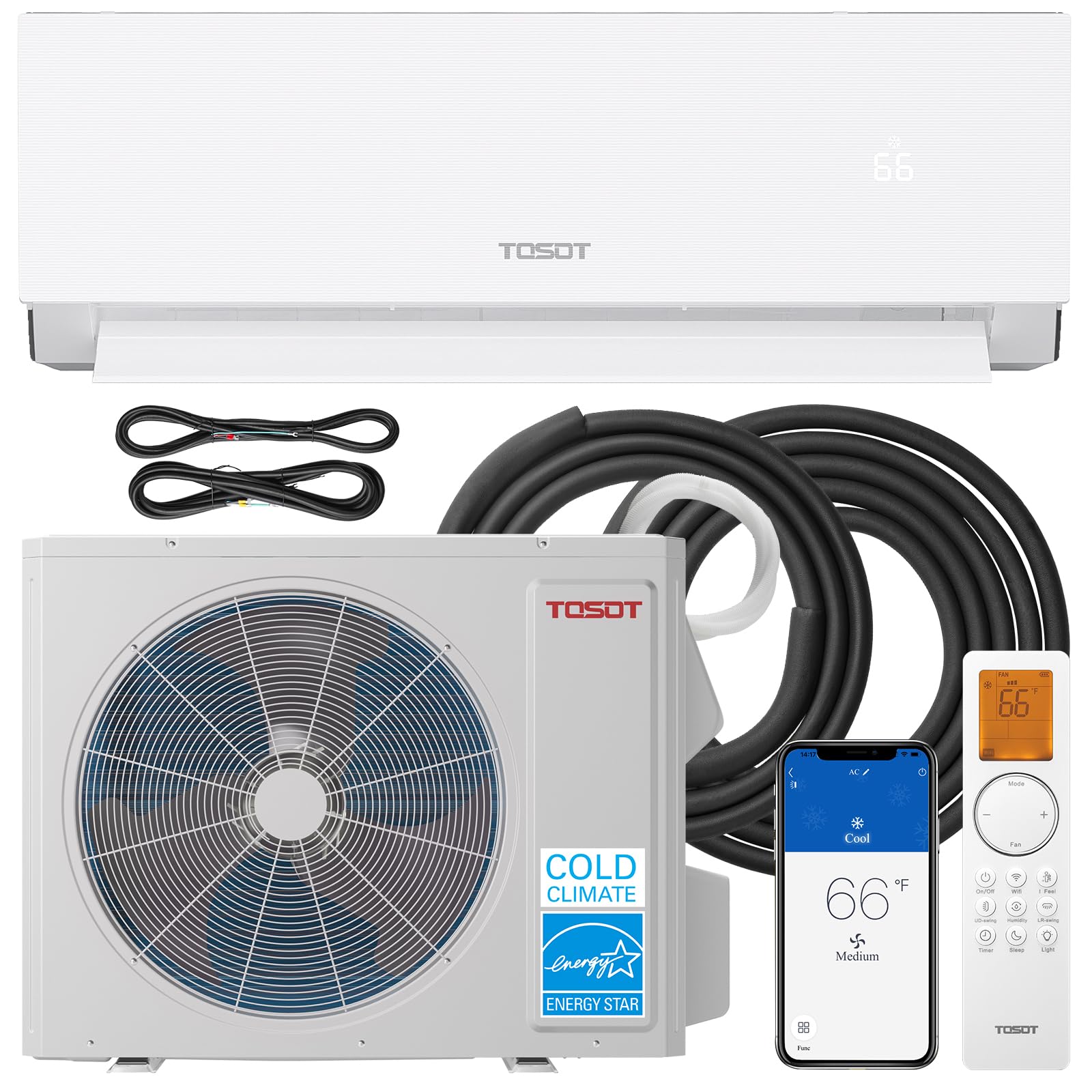
The 24 SEER2 system built for -22°F nights and fresh-air upgrades
If your winters bite hard, this is the pick. TOSOT builds this 24,000 BTU unit around a 24 SEER2 rating — the highest efficiency score in this group — and rates it for an operating range of -22°F to 122°F. It carries ENERGY STAR, COLD CLIMATE, ETL, and AHRI certifications and qualifies for tax credits. Crucially, it uses a dual electric heating belt to keep working in deep cold, which is why a plumbing contractor reported it heating a 1940s building on single-digit-temperature days. It covers up to 1,500 square feet, and the cooling capacity is listed at 22,000 BTU.
The standout feature is the optional ERV integration — that is an energy recovery ventilator, a separate accessory that swaps stale exhaust air for filtered fresh air while recycling the temperature and humidity. TOSOT notes the ERV needs additional wall vents and is sold separately, but for workshops with smoke or fumes it is the reason to choose this unit over the rest. Noise is excellent too: the indoor head runs as low as 30 dB, and night mode drops the outdoor unit to 61 dB so it won’t wake the neighbors. One owner had it pull a 24×40 garage from 94°F to 70°F in two hours.
Watch the packaging: units ship in the 90lb class and arrive freight-freighted; one buyer went through three outdoor units before keeping the least-damaged one. Inspect on arrival and photograph anything dented.
Two realities here. The ERV is an add-on, not a built-in — budget for the extra accessory and the wall vents if fresh-air exchange is your goal. And like the other 24,000 BTU systems in this guide, it runs on 208-230V and asks for professional installation after all packages arrive.
Top choice for: cold-climate shops, garages, and large rooms where you also want filtered fresh air.
Know going in: the fresh-air ERV feature is a separate purchase and needs its own wall penetrations.
5. MrCool Easy Pro 24k BTU Ductless Heat Pump Split System
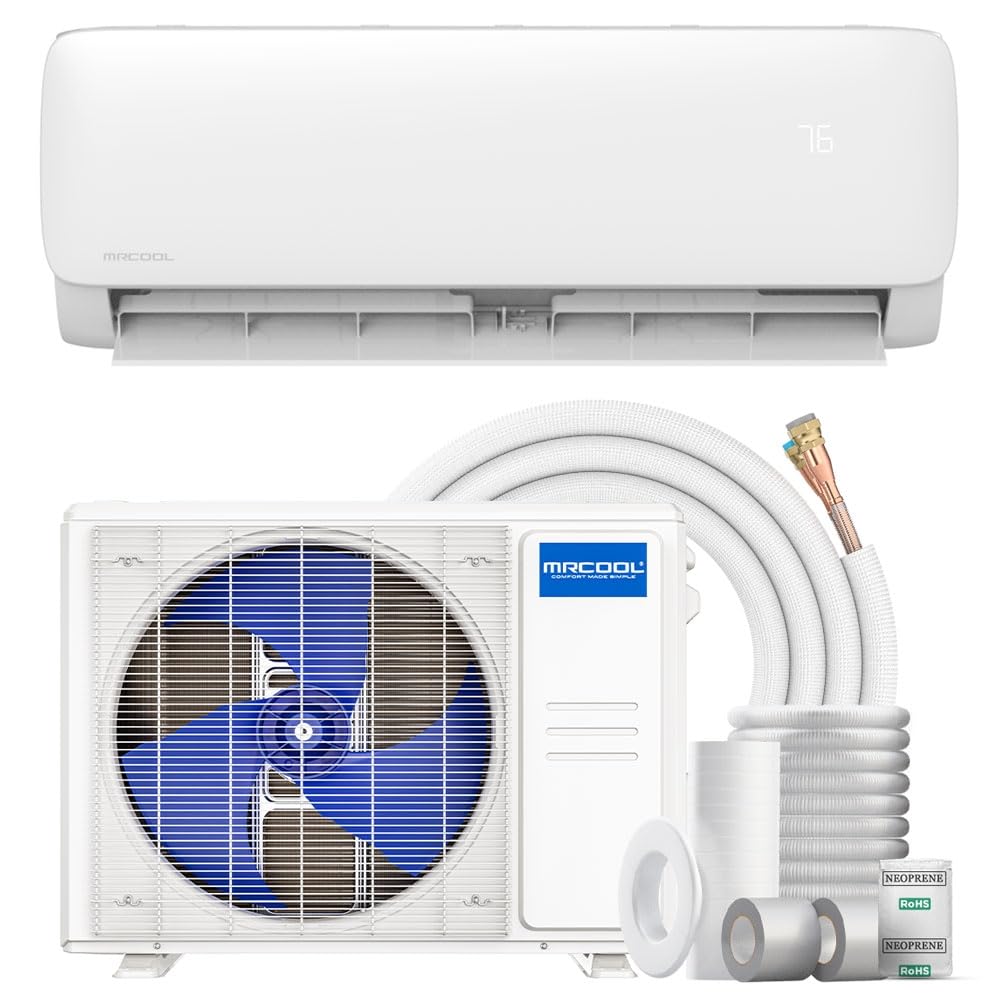
Pre-charged lines you bend by hand, no crimping and no gauges
This is the purest DIY option in the group. The 5th-generation MrCool Easy Pro packs 24,000 BTU of cooling into a system rated 18.9-20.2 SEER2, covering garages, game rooms, and sunrooms from under 500 up to 1,200 square feet. The refrigerant lines come pre-charged and, in owner reports, spiral bend without crimping — meaning the trickiest part of a traditional install is designed away. One buyer on their fifth mini-split install called it the first fully engineered unit they’d handled, running from arrival to startup in five hours solo through a brick wall. The line set is 16 feet, and IWAE backs it with a 1-year labor warranty.
The details matter for a self-installer. It carries a Gold Fin condenser coating to resist corrosion and an 11.2 HSPF2 rating — that is heating efficiency, the number that predicts winter performance — and it is rated to perform in an Iowa winter. Owners find the pre-charged spiral lines easy to route, and shipping arrives well packaged with no damage. If your HOA requires the compressor beyond the wall, note that you may need to run additional wiring.
Where the money sneaks in: a few customers note spending roughly extra on 8-gauge wire, conduit, boxes, an outdoor cable cover, and wall brackets. Price those in before you commit.
Two caveats from real installs. The included 16 ft line set may be more than you need — one owner with a 9 ft run coiled the extra 7 ft against the wall, which looks unfinished. And one reviewer notes that without garage insulation, a unit this powerful can run energy-inefficiently. Insulate first if you can.
Pick this if: you want the most genuinely self-installable 24,000 BTU system, with pre-charged bend-by-hand lines and a labor warranty.
Plan around: the extra electrical materials and the fixed 16 ft line-set length.
6. Cooper & Hunter 24,000 BTU Mini Split AC

A 2-ton bedroom cooler that drops 1,500 sq ft in Phoenix heat
Cooper & Hunter is the name that turns up in HVAC conversations, and this MIA Series unit is a 24,000 BTU (2-ton) 230V system rated 18.7 SEER2. The coverage listed here is 600 square feet, which makes it a fast, powerful choice for a bedroom, home office, or addition rather than a whole-floor solution — one owner reports it cooling 1,500+ sq ft at 75°F in Phoenix 110°F+ heat in an 80-year-old home. Another describes it pre-cooling the bedroom after vacation so the room is already cold when they walk in. The system comes with a smart kit for smartphone scheduling, and it ships with a 16FT insulated copper line set, communication cable, drainage extension, and accessories.
This one earns its spot on quiet and ease of install. Owners consistently describe it as near-silent and easy to get running, and it heats down to an ambient of 5°F. The outdoor condenser arrives pre-charged, and U.S.-based technical support is offered should something go wrong. But the listing is blunt: this is not a DIY system, and professional installation is required. It also ships via freight due to size and weight and lands at the nearest accessible point outside your home.
The durability question: a minority of reviewers point out board failures within a short window, while others report years of steady running — one unit needed a soldered line repair on arrival and has since run for over two years. Size the risk to the price you pay.
Two things to plan around. Freight delivery means coordinating with the carrier for the drop-off, and you’ll want help moving a 2-ton condenser into place. And because it needs a 230V circuit and professional install, factor in the technician cost before ordering.
Choose this for: a bedroom or office where you want very fast cooling, near-silent running, and a trusted HVAC name.
Not the pick if: you’re committed to a no-tech DIY install — Cooper & Hunter explicitly calls for professional work here.
7. Daikin 18,000 BTU Entra R32 Series Heat Pump Mini Split

An 18,000 BTU Entra with a photocatalytic filter and 3.30 COP
Daikin stands behind its ductless systems with the Entra series, and this 18,000 BTU model is built around a 3.30 COP — that’s coefficient of performance, a measure of how much heat or cool you get per unit of electricity, and 3.30 is a strong figure. It builds in DC Inverter technology, an 18 SEER2 rating, 9 HSPF2, 10.5 EER2, and covers up to 1,000 square feet. The Entra’s party piece is a Titanium Apatite Photocatalytic Air Purifying Filter, which the listing frames as part of the unit’s air-quality story. It cools from 50°F to 115°F and heats from 5°F to 65°F, so it works across a wide range of climates.
The included kit is genuinely complete: an 18,000 BTU wall-mount indoor fan coil, a smart DC inverter condenser pre-charged with R-32 refrigerant, a remote, a 15 ft Maxwell refrigerant line, interconnection cables, and a wall-mounting bracket — so you aren’t hunting down a line set separately.
Owner sentiment leans to the positive: reviews describe it as very quiet compared to a window unit, cooling a big room, and heating the space well. One shop owner runs it in a 24x40ft insulated metal building with 10ft walls and points out the same compressor cooling uses a line-set vacuum pump for best efficiency — Daikin notes it works in renovations, new builds, sunrooms, basements, attics, and garages.
Install note: the review pages suggest using a pump to clear excess air from the line for better efficiency — Daikin’s listing doesn’t hide that a proper vacuum is part of a clean setup.
Daikin equipment carries real brand weight, but this is not a plug-in system — it runs on 208-230V and the listing assumes professional or competent install. The included 15 ft line set may also be shorter than a long wall run needs.
The fit: a sunroom, basement, attic, or garage where air quality and brand trust matter, and you’ve got a 230V circuit in play.
Reconsider if: you want a 115V plug-in or a line set longer than 15 feet from the start.
8. MRCOOL Easy Pro 12000 BTU Ductless Mini Split Air Conditioner
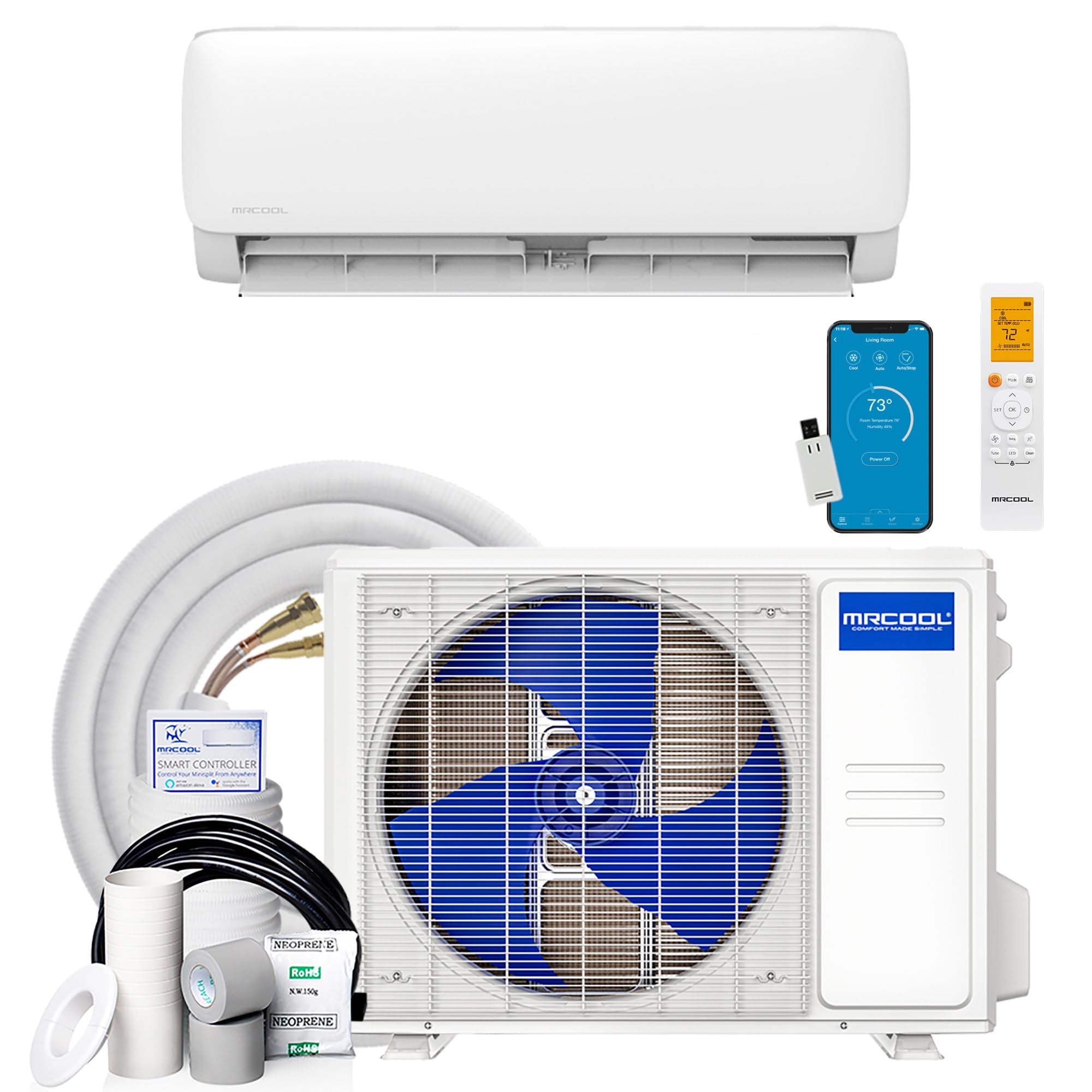
A 115V Easy Pro that installs with a wrench and rinses clean
For a bedroom, living room, or small office up to 550 square feet, this MRCOOL Easy Pro does 12,000 BTU on standard 115V current — no dedicated 230V circuit needed. That is the single most useful fact for a first-time self-installer, because it plugs into the electrical setup you already have. It’s built as a true DIY unit, with the manufacturer stating no special tools, equipment, or expertise are required — a rarity in this category. It carries Google Assistant and Amazon Alexa support, comes with a washable filter that rinses under the tap, and the line set is included.
Owners back that up honestly. One who cooled a one-bedroom apartment found the lineset easy to install with a wrench and was considering a second unit. Others note the electrical hookup, though straightforward, can still require a professional on some setups, and a couple advise pricing that work before buying so the true cost is clear from the start.
The catch worth knowing: the included 5 ft drain hose ran short for one owner who needed 10 ft, and standard torque wrench kits top out at 19mm while this unit’s fittings call for 21-27mm — so you may need to add a bigger crowfoot. The Wi-Fi sensor also sits on the upper panel, which made it tricky to locate on the first try.
On durability: some shoppers say leaks forming at weld points, while others describe years of happy use. It’s a mixed record — treat the low entry price as offsetting some of that risk, and register the warranty early.
Worth pairing with a correctly sized space — this is a single-zone unit, so don’t ask 12,000 BTU to carry a whole floor. Size it right and it performs.
Ideal for: a renter-friendly single-room upgrade where an existing outlet powers the unit and you want voice control and easy filter care.
Best avoided if: your space runs past 550 sq ft or you want a long factory drain hose and standard-size fittings.
9. Hykolity 24,000 BTU Mini Split Air Conditioner & Heater

2 tons of coverage up to 1,500 sq ft with 4D airflow and app control
This Hykolity unit is the biggest room-hogger here, covering up to 1,500 square feet with 24,000 BTU (2 tons) at a 20 SEER2 rating — head and shoulders above the DELLA Vario 18,000 BTU unit’s 1,000 square feet and 1.5 tons on that comparison. It holds temperatures between 61°F and 88°F, and the built-in 2-ton heat pump runs both directions for year-round use. Variable-frequency technology paired with a 9.5 HSPF2 rating and an automatic defrost function keeps efficiency stable, and the listed noise floor is just 34 dB in mute mode. It also includes 4D airflow, an I Feel mode, a 24-hour timer, sleep mode, and Eco, Turbo, and Auto settings.
The install side is where owners give it the most credit. The kit ships complete with an indoor fan coil, outdoor condenser, wireless remote with holder, a 16 ft line set, installation accessories, and vibration-absorber feet for the condenser. Buyers describe the directions as straightforward and one first-timer had no trouble. In a 500 sq ft taxidermy shop, the dry mode held around 66°F and 55% humidity. A 3-year compressor warranty backs it.
Two honest notes. The system ships in three separate boxes, and the manufacturer asks that you wait until all three arrive before installing — so plan your weekend around the slowest package. And because it’s a 230V unit, it needs a dedicated circuit; one owner even needed a transformer for their voltage setup.
Strengths that stand out
- 24,000 BTU covers 1,500 sq ft — the largest listed coverage in this lineup
- 20 SEER2 and 9.5 HSPF2 efficiency with automatic defrost for steady heating
- 34 dB mute mode keeps a shop or commercial space quiet
- Complete accessory kit and 3-year compressor warranty
Things to weigh
- Buyers report mixed feelings on long-term durability vs. the low price
- Ships in three boxes — don’t start install until all arrive
- 230V system requires a dedicated circuit
Great fit for: a large workshop, open-plan room, or commercial space where you want maximum coverage at a value price.
Think again if: you need a long-term, proven-reliability unit or can’t add a 230V circuit.
10. DELLA Vario Series 18000 BTU Mini Split AC

A 1.5-ton garage cooler with 4D airflow and year-round heat
This DELLA Vario is the 18,000 BTU sibling of the popular 12,000 BTU model above, sized for 1,000 square feet with a 21 SEER2 rating and a 1.5-ton heat pump. It carries the same smart-function set: 4D air flow that moves up-down and left-right, an I Feel mode, a 24-hour timer, sleep mode, eco energy saving mode, multiple fan speeds, turbo, and heating, cooling, and dry modes for dehumidifying. The maximum fuse size is 20A, so plan the breaker accordingly.
One owner reports it cooling and heating a 400 sq ft garage to 72°F year-round through 90°F summer heat and 20°F cold. That matches the listed 1,000 sq ft coverage with room to spare. It runs on 208-230V, so the circuit matters for the install.
The catch: the outdoor unit generates noticeable noise on this model, and the same buyer was planning a noise barrier — worth thinking about if you sleep near the condenser. The listing also states it isn’t truly DIY, and that same owner paid a professional for installation.
Realistic install picture: the smart controls and app make daily use easy, but the electrical side is the same 230V job as the larger DELLA — budget for a pro if you aren’t confident there.
If you want the smallest DELLA with the fewest install headaches, the 12,000 BTU model above is the easier path. This one is for the bigger garage that still wants the DELLA app ecosystem.
Suits: a 1,000 sq ft garage or open room that needs both seasons of comfort and full app control.
A word of warning: the outdoor condenser is louder than peers, and the listing calls for professional installation.
11. Albott Mini Split Air Conditioner and Heater 24,000 BTU

24,000 BTU that runs below 29 dB and covers 1,550 sq ft
Albott’s 24,000 BTU system is a four-in-one: cooling, heating, dehumidifying, and fan modes, with settings from 61°F to 90°F, a 24-hour timer, and sleep mode. It’s rated SEER2 18 and covers up to 1,550 square feet, and the standout figure is noise — it runs below 29 dB, quieter than the Hykolity’s 34 dB mute floor. That’s the number that matters if this is going in a workspace where you actually want to hear yourself think. It also carries a 5-year compressor and 7-year parts warranty plus self-cleaning and removable filters and air blades.
Owners give the cooling performance real credit here. One describes cooling a 2,100 sq ft dome home on roughly 200W of solar and calling it far more efficient than their existing HVAC. Another says it cools an 1,800 sq ft shop effectively for the price. Several note the packaging arrived damage-free and the customer service resolved issues promptly.
The catch involves temperature-holding behavior. One owner’s sole complaint is that the unit never seems to shut off — it holds the shop at the set temperature but runs around the clock. And an occasional unit arrives with an app-connection snag that turns out to be a user-side setting, not a hardware fault.
Quiet champion: at under 29 dB the indoor head is the quietest listed unit here, and the 1,550 sq ft coverage is the widest at this BTU level — a strong pairing of space and silence.
Choose this for: a large shop or living area where quiet running and the widest coverage beat a lower price tag.
The trade-off: SEER2 18 is efficient but sits below the 24 and 20 SEER2 systems here, and the unit tends to run on rather than cycle off.
12. IDEALHOUSE 9000 BTU Mini Split AC/Heating System
The entry-level 9,000 BTU for bedrooms and small offices
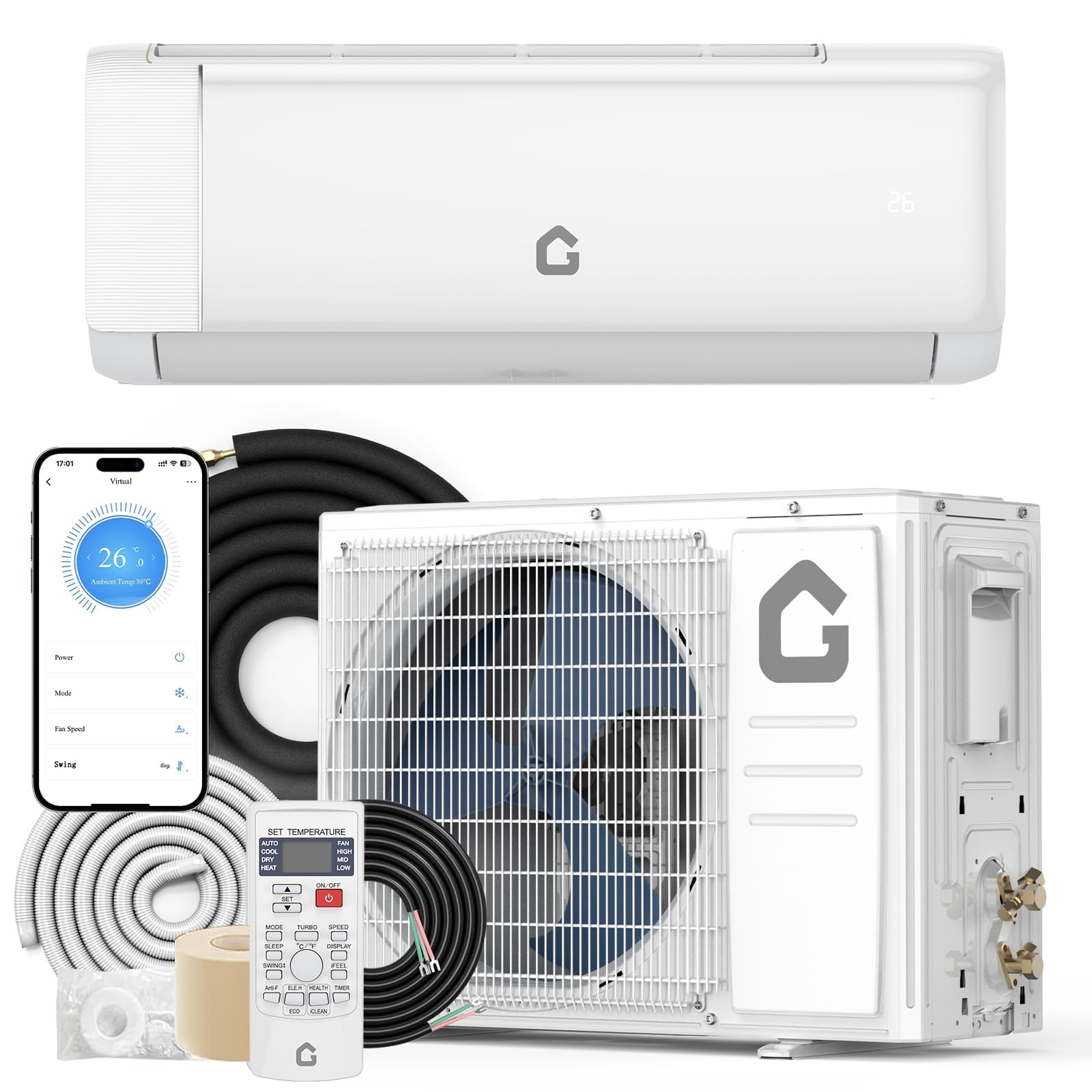
This is the smallest system in the lineup, and that’s its job: a 9,000 BTU inverter unit rated 20 SEER2 that the manufacturer sizes for bedrooms, living rooms, offices, and shops up to 450 square feet. It runs four modes — Cool, Heat, Dry, and Fan — with a 24-hour timer, sleep mode, and adjustable temperatures from 60°F to 89°F. The double-layer sound insulation keeps it at 42 dB, and the app and voice control let you adjust from anywhere. It’s the natural fit for a single room where a bigger unit would be overkill and short-cycle constantly.
Installer reports here are positive on the fundamentals. One owner mounted it with a construction-savvy husband, hired an HVAC tech only for the vacuum step on the pre-charged lines, and cooled an entire mobile home to 70°F in hot, humid southern weather. Another notes the equipment includes the accessories needed for a clean install and arrives in two shipments.
The honest concern is heat output consistency — the listing shows the heating capacity at 17,700 BTU/h, but some owners mention the heat mode failing to produce warmth while others say it works fine, so the heat side is decidedly mixed. One buyer also hit a remote-to-app sync problem where the remote kept resetting to Celsius and had to be restored through the phone app.
For a small room that needs dependable cooling and only occasional heating, it does the job. If your winters are serious, the larger systems up this list handle heat with more confidence.
Size it right: 9,000 BTU is built for a single bedroom, small office, or snug shop, and using it in a bigger space will leave it running flat out.
Reach for this if: you’re cooling one room up to 450 sq ft and want a low-cost, app-controlled inverter unit.
skip it if: reliable heating is a priority — the heat performance here is inconsistent in owner reports.
Know the Specs
BTU and Square Footage
BTU is short for British Thermal Unit — it describes how much heat a system can move per hour, and it’s the master spec for sizing. Roughly, 9,000 BTU handles a large bedroom or small shop, 12,000 BTU covers a standard room, 18,000 BTU (1.5 tons) suits a garage or open living area, and 24,000 BTU (2 tons) can carry a whole small home or commercial floor. One ton of cooling equals 12,000 BTU. Match the rating to your square footage, and don’t oversize it — an overpowered unit cools in short bursts and leaves the room uneven.
SEER2, HSPF2, and Inverter Compressors
SEER2 is the efficiency score for cooling, and a higher number means less electricity for the same cold output. HSPF2 does the same job for heating. Both are what you should watch when your goal is a lower power bill. An inverter compressor is the technology behind those scores — it varies its speed continuously rather than switching fully on and off, which steadies the temperature and cuts wasted energy. That’s why a 24 SEER2 system is worth a look if you run the unit most of the day.
Voltage and Circuit Requirements
Mini splits come in two electrical flavors. Smaller units run on 110-120V, which is standard household current and can often plug into an existing outlet — the friendlier DIY path. The 208-230V units in this guide need a dedicated circuit and a breaker matched to the unit, with maximum fuse sizes running from 20A to 25A depending on the model. That electrical work is where a licensed electrician usually enters the picture. Price the circuit run before you buy a 230V unit if your panel is far from the install spot.
Pre-Charged Systems and DIY Readiness
A pre-charged condenser ships with its refrigerant sealed inside and a factory line set included, so you aren’t measuring and charging refrigerant yourself — the single biggest time-saver for a homeowner. Even then, most manufacturers still call for pulling a vacuum on the lines to clear moisture and air, and some advise releasing the high-line valve carefully to avoid air entering the system. Read the listing’s installation note closely: some units are marketed as friendly to self-installers while the manufacturer still requires professional work, and knowing which is which before you order is the difference between a weekend project and a service call.
Common Questions
Can I really install a mini split myself without an HVAC license?
What size mini split do I need for a 400 square foot room?
Do I need a separate electrician for a 115V mini split?
What does pre-charged mean on a mini split and does it save installation cost?
Is a higher SEER2 rating worth it for a DIY mini split?
How quiet are these mini split systems at night?
What is the difference between 115V and 230V mini split systems?
Can a mini split both heat and cool my garage year round?
How long do these mini split systems typically last?
Are wall mount mini splits suitable for a metal garage or insulated shop?
The Bottom Line
For most people shopping for diy mini split systems, the smartest starting point is the Senville AURA 24,000 BTU — it brings 2 tons of cooling, a 21.5 SEER rating, and 1,250 sq ft of coverage with energy certifications that back up the numbers. If you want the least fuss on the electrical side, the DELLA Vario Series 12000 BTU runs on standard current and gives you a huge install reputation behind it. And if you want the most genuinely self-installable 24,000 BTU system with pre-charged spiral lines, the MrCool Easy Pro 24k BTU 5th Generation is the one to reach for — it’s also the only pick that pairs a labor warranty with the DIY design.
How we choose
We do not accept paid placement. Every pick is matched to a real buyer and a real use-case; we do not hands-on test units.
Sources
Specifications: manufacturer listings and product documentation. Review insights: verified customer reviews, as of October 2026. Pricing: not shown on this page (it changes often); check the current price via the retailer link.
As an Amazon Associate, Aappliancez earns from qualifying purchases. This does not affect which products we feature.