Disclosure: Some links in this post are affiliate links. As an Amazon Associate I earn from qualifying purchases, at no extra cost to you. Learn more
Specs are compiled from manufacturer listings and verified buyer reviews and can change over time — please confirm the key details on the product page before buying.
This guide is built by comparing the manufacturers’ published specifications and the patterns across verified customer reviews, so you get each pick’s real strengths and trade-offs instead of marketing spin.
Mouse waste turns up in garages, pantries, and basements, so you want something that wets and kills rather than just wipes. Here is how the leading disinfectants handle that job, and which ones are worth keeping on the shelf as the best disinfectant for mouse droppings.
Top Picks

How To Choose The Best Disinfectant for Mouse Droppings
The job is not really “cleaning.” The job is killing germs in rodent waste without launching them into the air. That single rule shapes everything else — the form of the product, the surface it can touch, and how long it has to stay wet to actually work.
Wet it, do not sweep it
The biggest mistake is dry-sweeping or vacuuming droppings, which is exactly how airborne particles carry Hantavirus into your lungs. You want a wet product you can spray or pour directly onto the mess so it soaks through instead of puffing up. A ready-to-use spray is fastest for this. A concentrate works too, as long as you mix it correctly first.
Check for the EPA label and a real kill claim
Match the surface to the product
A spray that dries fast is great on counters and sealed concrete but can leave a white film on dark gear. A no-rinse concentrate is handy on floors and walls, while a ready-to-use spray suits soft surfaces like upholstery. Think about where the mice have been — garage, pantry, basement, or laundry room — before you pick a form.
Concentrate or ready-to-use
A concentrate lets you mix your own strength in a spray bottle, so one bottle covers a lot of ground. The trade-off is you have to measure it and often wear gloves. A ready-to-use spray costs more per use but skips the mixing entirely, which matters when you want to act the moment you spot a dropping.
Side-by-Side Comparison
| Model | Best For | Form | EPA Registered | Hantavirus Claim | Amazon |
|---|---|---|---|---|---|
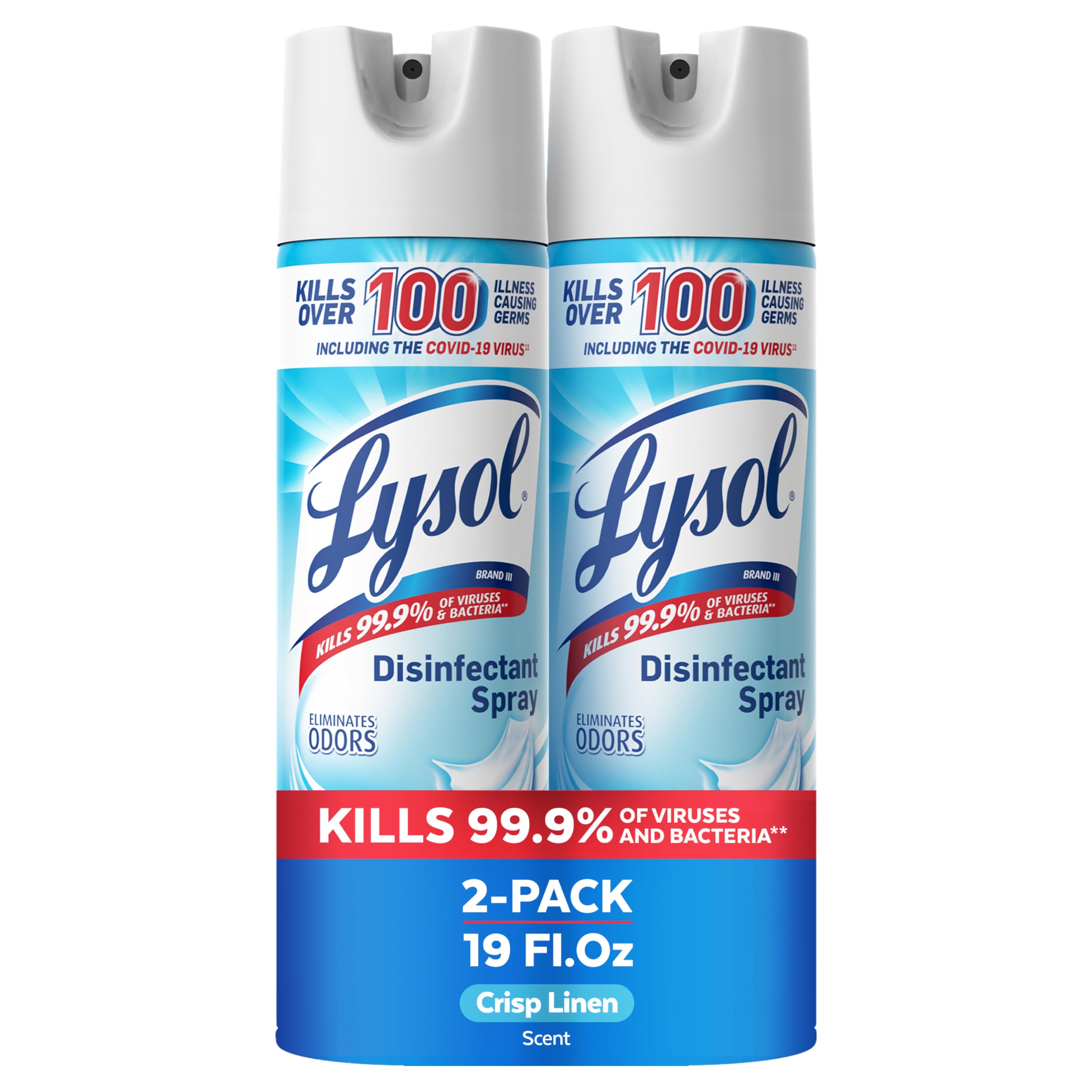
| Lysol Disinfectant Spray, Crisp Linen, 19 oz, 2 Pack★ Best Overall | Fast ready-to-use spraying of droppings | Ready-to-use aerosol | Yes | Yes | Amazon |
| OdoBan Disinfectant Concentrate, 2 GallonsBest for Big Cleanups | Big messes and deodorizing whole rooms | Concentrate | — | — | Amazon |
| Control LLL Concentrate Disinfectant Germicide 16oz | Small precise jobs and equipment soaking | Concentrate | Yes | — | Amazon |
| Clear Gear Disinfectant and Deodorizer, 32 Oz | Gear, footwear, and soft surfaces | Ready-to-use spray | Yes | — | Amazon |
| Simple Green d Pro 5 Disinfectant, 1 gal | Floors, walls, and food-area surfaces | Concentrate | — | — | Amazon |
Detailed Reviews
1. Lysol Disinfectant Spray Crisp Linen 19 oz 2 Pack
Our pick — over 4.5★ from 70,500+ verified ratings; the strongest balance of quality and price.
The label names Hantavirus outright, and that is the whole reason it wins.
If you have found droppings and want to deal with them today, this is the pick the whole list is built around. It is a ready-to-use spray, so there is no measuring and no mixing — you wet the dropping and the surface around it, then let the label’s contact time do the work. On hard, non-porous surfaces like garage slabs and tile, it kills 99.9% of viruses and bacteria and Hantavirus in 30 seconds. A garage slab, a sealed shelf, and a tile floor are all hard, non-porous surfaces, which is exactly what this spray is rated for.
The Hantavirus claim is the standout, because that is the germ most closely tied to rodent waste. The label also lists 30-second kills for Rhinovirus Type 39 and Influenza A (H1N1) on those surfaces, and SARS-CoV-2 in 15 seconds. It covers over 100 illness-causing germs and neutralizes odor-causing bacteria, so a musty garage corner smells fresher afterward. The Crisp Linen version leaves a fresh scent behind instead of the sharp chemical smell people expect.
It is not just for hard surfaces. This spray disinfects hard, non-porous contact surfaces and sanitizes soft surfaces, so it can follow the mice onto fabric too — think rugs, a couch, or a pair of shoes near the trail. The label tells you to rinse food-contact surfaces and plastic toys with water after use, and it is not recommended on brass, copper, or aluminum because those metals can tarnish.
What earns it the top spot
- Names Hantavirus directly and kills it in 30 seconds on hard, non-porous surfaces
- Ready-to-use, so you can wet down droppings the moment you spot them
- Tested and proven to kill 99.9% of viruses and bacteria, including Norovirus and cold and flu germs
- Also sanitizes soft surfaces like upholstery and deodorizes odor-causing bacteria
- Two 19 oz cans, so you keep one in the garage and one in the house
Where it stops short
- You must rinse food-contact surfaces and toys with water afterward
- Avoid brass, copper, and aluminum, which the label flags for tarnishing
- As a ready-to-use spray it costs more per use than mixing a concentrate
Pass it by if: Your main surface is bare aluminum, copper, or brass, where the label advises against use.
2. OdoBan Disinfectant Concentrate Original Eucalyptus 2 Gallons
Two full gallons of concentrate for a long-running mouse problem.
When mice have been through a whole crawl space, a closet, or a basement, you want volume — and this is the one you mix yourself. It is a concentrate, so you dilute it and then spray or sponge, following the label. The formula is built to clean, disinfect, freshen, and kill the odors that come with a rodent problem, all in one pass, so you are not switching products between the disinfecting step and the deodorizing step.
The cleaning checklist here is unusually long. It works on upholstery, carpets, bedding, showers, walls, and floors, and it doubles as an air freshener or a laundry refresher. The maker lists it for day cares, hospitals, cafeterias, restaurants, public transit, and locker rooms, gyms, and shower areas. It arrives as a set of two one-gallon jugs with the original eucalyptus scent. One thing worth knowing: the instructions say to spray 6 to 8 inches away from the surface, clean with a sponge, brush, or cloth, and not to breathe the spray. At 17.9 pounds for the pair, this is the heaviest box in the group.
A couple of honest notes. Buyers shopping for pet odors pair it well — as owners put it, they use it “to deodorize my back patio once a week if one of my fur babies decides to not go to the grass.” One review does flag that a floor seemed to streak with greasy dirt after use, though the same note allows it may have been a prior floor shine or hard water reacting, so treat floors as a spot-test-first job. The trade-off versus the Lysol pick above: OdoBan has no listed Hantavirus claim, so if your main worry is the germ link and not the smell, the Lysol label is the direct answer and this one is not.
What it covers: Upholstery, carpet, bedding, walls, floors, laundry, and even the air, using two one-gallon jugs of the original eucalyptus scent.
The catch to plan around: No Hantavirus claim on the label, so on a fresh dropping the Lysol spray above is the more specific tool.
Built for: Anyone disinfecting a large area — a basement, crawl space, or multi-room trail — who wants one concentrate to handle surfaces and odor at once.
Think twice if: You need the exact Hantavirus claim on the label, which this product does not carry.
3. Control LLL Concentrate Disinfectant Germicide 16oz

A small, powerful bottle that keeps its strength for weeks at a time.
If you want to sanitize small, awkward spots — under a sink, around a pipe, inside a drawer — without dragging out a gallon jug, this is the compact answer. It is a concentrate, EPA-approved, marked non-toxic, and its special features are listed as concentrated and non-toxic. It carries a 5-year shelf life, so a bottle on the shelf is not a wasted purchase. Its active ingredients, dimethyl benzyl ammonium chloride and ethyl benzyl ammonium chloride, are the same quaternary ammonium chemistry used in many hospitals.
What wins people over is the scent — buyers describe a light clean smell after rinsing, which is a big deal when you are working in a closed pantry or garage. The concentration is the second most-praised trait, and owners keep noting how far a capful stretches. The label’s specific uses list laundry, and it recommends metal surfaces, so it suits the steel and sealed areas a mouse trail tends to cross. The dilution is also documented to last up to two weeks and yield multiple soaks before it needs changing, which is unusually efficient for a 16 oz bottle.
Here is the honest trade-off: the safety and skin-irritation feedback is genuinely mixed. Some users find it gentle, while others warn it is tough on skin, and several reviews say plainly to wear gloves when handling it. Diluted solution keeps its strength for about two weeks, and there is no obvious expiry clue on the bottle, so you have to track that yourself. There is no listed Hantavirus claim either, so it is a general germ killer rather than a rodent-specific one.
Where it shines: EPA-approved, a 5-year shelf life, and capful-strength dilution that stays active for about two weeks, ideal for tight spots and laundry use.
Handle with care: The skin-irritation feedback is mixed — several owners say to wear gloves, and the absence of an expiry mark means you track the age yourself.
Good fit for: Small, targeted jobs and anyone who wants a long-lasting concentrate in a compact bottle with an EPA-approved label and laundry on the approved-use list.
Look elsewhere if: You want a ready-to-use spray you can grab with bare hands — this one mixes by the capful and asks for gloves.
4. Clear Gear Disinfectant Deodorizer 32 Oz Bottle

A no-rinse spray for the soft things a mouse walked across.
Mouse droppings do not stay on the floor. They land on gym bags, shoes, and stored gear, and that is where this pick earns its place. It is a ready-to-use spray that is EPA-registered and made in the USA, and the formula is water-based with a low toxicity rating, non-corrosive to surfaces, and free of bleach, alcohol, and ammonia. The label says no wiping or rinsing is necessary, which makes it one of the easiest to use on soft surfaces and fabrics, where a wet sponge would just push the mess around.
The places it is built for are equipment, communal surfaces, and high-touch areas. The maker lists healthcare facilities, emergency and rescue vehicles, offices, bathrooms, counters, reception areas, and gear such as masks, gloves, face and eye protectors, uniforms, and footwear. It also names bed rails, gurneys, examining tables, and countertops. For a home, that translates simply: it is the one you spray on the boxing gloves, the sneakers, the helmet, and the gym bag after they have been near a rodent. On hard, non-porous surfaces it kills 99.9% of germs, viruses, and bacteria on contact, and its light scent avoids a harsh chemical smell.
Two things to weigh. The bottle has a date or code on it, but the maker says that is a lot or manufacturer date, not an expiration date. And the residue feedback is split — several users report a white film left on equipment, so on dark rubber or black fabric you may want to test a hidden spot first. Unlike the Simple Green d Pro 5 below, which is built for floors and food-area surfaces, this one is aimed at gear rather than bare concrete.
Why it earns its place
- No-rinse, ready-to-use spray that suits soft surfaces and fabrics
- EPA-registered, water-based, and free of bleach, alcohol, and ammonia
- Designed for footwear, uniforms, helmets, and gym bags, plus high-touch gear
- Kills 99.9% of germs, viruses, and bacteria on contact
- Lightly scented and one-step, so it fits in a gear bag for quick use
The catches to know
- No listed Hantavirus claim, so it is a gear spray rather than a rodent-specific one
- Residue feedback is mixed — some users see a white film on equipment
- The code on the bottle is a lot date, not an expiration date
Grab this when: The droppings landed on shoes, bags, helmets, or fabric and you want a no-rinse spray that will not damage the material.
Not the one for: You need a floor-and-counter concentrate — reach for the Simple Green d Pro 5 or OdoBan instead.
5. Simple Green d Pro 5 Disinfectant, 1 gal Bottle

One gallon of concentrate that stretches across the whole house.
This is a one-step disinfectant concentrate with a high level of active ingredients, which is the label’s way of saying it is meant to work hard and stretch far. Because what wins people over is the effectiveness, and the second most-praised trait is the scent, it has earned a strong following among people cleaning large spaces. It is listed for food production, processing, and service facilities, so it is built to handle surfaces where food touches.
For a mouse problem, the food-safe angle matters. The maker lists it as food-safe with no rinsing, which suits counters and pantry shelves where you cannot flood the area with water. It is also highly dilutable — owners note that a small amount mixed into a gallon of water goes a long way. It is listed as biodegradable, and the label’s efficacy list includes Hepatitis B and C, Canine Distemper Virus, and Avian Influenza. It is also listed for athletic facilities, beauty salons, office buildings, cafeterias, and day care centers.
The current knowledge among buyers is that you must dilute to the right strength: the no-rinse sanitizing step is far more concentrated in the bottle than the disinfecting step, which needs a longer wet time. Several owners warn to use gloves when handling the concentrate, since it is potent before mixing. And there is no listed Hantavirus claim on the label, so on the specific germ tied to mouse waste, the Lysol spray above still has the more direct answer. It is also the heaviest jug here at 8.5 pounds for a single gallon.
Strongest angle: One gallon of biodegradable concentrate that dilutes with water, is listed food-safe without rinsing, and covers large floor and wall areas.
The part to respect: It is potent before mixing — wear gloves, and note the no Hantavirus claim on the label.
Pick this if: You are cleaning broad surfaces — floors, walls, counters, and food areas — and want a concentrate that dilutes with water and stays food-safe.
Look elsewhere if: Your priority is a label that names Hantavirus specifically, which this one does not.
Know the Specs
Contact time and why “wet” matters
Contact time is how long a surface must stay visibly wet for the product to kill what the label claims. A spray that says it kills Hantavirus in 30 seconds, or a concentrate that needs a 10-minute wet time when diluted, only works if you let it stay wet that long. Read the label’s contact time and do not wipe it dry early — that is the single most common reason a disinfectant underperforms.
Ready-to-use versus concentrate
A ready-to-use spray arrives at working strength, so there is no measuring and no guesswork — you spray and go. A concentrate must be diluted to a set ratio before it disinfects, which stretches a bottle much further but adds a step and often calls for gloves. For a one-time droppings cleanup, a ready-to-use spray is faster; for ongoing rodent control across a whole house, a concentrate costs less per use.
EPA registration and kill claims
An EPA-registered product has been reviewed by the Environmental Protection Agency for the germ claims on its label, so that registration is the proof behind phrases like “kills 99.9%.” A formula can be registered yet still not list every germ — some carry a Hantavirus claim and some do not. Match the specific claim on the label to the specific germ you are worried about.
Soft surfaces versus hard surfaces
A surface is “hard and non-porous” if liquid beads on it — sealed concrete, tile, laminate, metal, and most counters qualify. Fabric, carpet, and upholstery are soft surfaces, and not every disinfectant is approved for them. If your mouse trail crossed a couch, rug, or bag, pick a product labeled for soft surfaces or fabrics, like a ready-to-use gear spray.
Common Questions
Do I need a disinfectant that specifically kills Hantavirus?
Can I use these disinfectants on a soft surface like fabric or a couch?
Is a concentrate or a ready-to-use spray better for cleaning up mouse droppings?
How long does a diluted disinfectant stay effective after mixing?
Are these disinfectants safe to use around pets and children?
Will a disinfectant damage my floors or counters?
Do I need to wash droppings away after disinfecting, or does spraying kill the germs alone?
What does EPA-registered mean on a disinfectant label?
How long does an unopened bottle of disinfectant last on the shelf?
Is one disinfectant enough for droppings on floors, counters, and gear?
The Bottom Line
For most people cleaning up after mice, the strongest pick as the disinfectant for mouse droppings is the Lysol Disinfectant Spray, Crisp Linen, 2 Pack, because its label names Hantavirus and lists a 30-second kill time on hard, non-porous surfaces — the exact germs and surfaces a rodent trail involves. If you are disinfecting a large area and want one concentrate to handle surfaces and odor, grab the OdoBan 2 Gallon Concentrate. And for gear, shoes, and fabric the mice walked across, the no-rinse Clear Gear Spray is the one to reach for.
How we choose
We do not accept paid placement. Every pick is matched to a real buyer and a real use-case; we do not hands-on test units.
Sources
Specifications: manufacturer listings and product documentation. Review insights: verified customer reviews, as of October 2026. Pricing: not shown on this page (it changes often); check the current price via the retailer link.
As an Amazon Associate, Aappliancez earns from qualifying purchases. This does not affect which products we feature.