Disclosure: Some links in this post are affiliate links. As an Amazon Associate I earn from qualifying purchases, at no extra cost to you. Learn more
Specs are compiled from manufacturer listings and verified buyer reviews and can change over time — please confirm the key details on the product page before buying.
You want vacation photos and short videos that look better than your phone, without spending like a professional. The good news: the Kodak PIXPRO FZ55 delivers that for under $150, and it is not the one with the biggest number on the box. The trick is telling a real 5x optical zoom from a digital “16X” badge.
This guide is built by comparing the manufacturers’ published specifications and the patterns across verified customer reviews, so you get each pick’s real strengths and trade-offs instead of marketing spin.
Below you get seven cameras split into easy, pocketable point-and-shoots and step-up models with real interchangeable glass. Every pick is chosen for a beginner who wants good pictures without a steep learning curve. Here is the honest shortlist of the digital camera under $150.
Top Picks

How To Choose The Best Digital Camera Under $150
Budget cameras live or die on three things: honest resolution, real focus speed, and a sensor that can handle a dim room. Get those right and daylight photos come out sharp. Get them wrong and you have paid for a camera that only shoots blurry, grainy frames.
Ignore the headline megapixel and 8K badges
A megapixel is just a count of the dots in a photo — more dots do not automatically mean a better picture. On a budget body, a huge “88MP” or “8K” label often means the camera is digitally upscaling a smaller image. Look instead for a sensor spec you can verify, like the Kodak’s 16MP CMOS sensor (a light-catching chip that records the image).
Optical zoom beats digital zoom every time
Optical zoom moves the lens glass physically, so a zoomed photo stays sharp. Digital zoom just crops and stretches pixels, so far subjects go soft. The Kodak gives you 5x optical zoom and a 28mm wide-angle lens — a real, moving lens. Many budget cams list “16X” but mean digital only, which is why distant shots disappoint.
Check what is actually in the box
A memory card, batteries, and a charger can add up fast if you have to buy them separately. Several picks here bundle a card and spare batteries, which is a real cost saver. The Kodak, by contrast, ships without a card, so read the included-accessories line before you commit.
Side-by-Side Comparison
| Model | Best For | Photo Resolution | Video | Zoom | Amazon |
|---|---|---|---|---|---|
| FLATIC 6K 64MP★ Best Overall | All-in bundle for creators | 64 MP | 6K | 16x digital | Amazon |
| G-Anica 4K VloggingBest Value | First-timers and teens | 48 MP | 4K/30fps | 16x digital | Amazon |
| XNSIAKXA 8K 88MP | Big-screen vlogging | 88 MP | 8K | 16x digital | Amazon |
| Yatao 6K Flip Screen | Selfie and gimbal work | 64 MP | 6K | 16x | Amazon |
| FlyFrost 8K 88MP | Family trips and gifts | 88 MP | 8K | 16x digital | Amazon |
| Kodak PIXPRO FZ55 | Pocket travel camera | 16 MP | 1080p | 5x optical | Amazon |
| Canon EOS R100 Bundle | Stepping up to mirrorless | 24.1 MP | 4K 24p | 18-45mm lens | Amazon |
Detailed Reviews
1. FLATIC 6K 64MP Digital Camera with WiFi & Microphone
The bundle that starts a hobby without dragging you into a whole ecosystem.
This is the pick for the parent buying a first real camera, the teen who wants a dedicated TikTok shooter, or anyone stepping up from a phone. You get 64MP photos and 6K video, plus an external microphone (a clip-on mic that records your voice cleanly) that makes spoken videos sound far better than a phone’s built-in audio. The 64GB card, two batteries, macro and wide-angle lenses, and a card reader are all in the box, so you can shoot the day it arrives.
What earns it the top spot is how much of the daily workflow is already handled. WiFi means you send clips straight to your phone without hunting for a cable. The self-timer sets a 3S/5S/10S/20S delay, which is genuinely handy for group shots and tripod work where you want zero shake. It even handles slow motion, time-lapse, and loop recording, so a beginner can experiment without buying more gear.
Here is the honest catch: the picture quality reads as mixed. Many owners call it easy to use and beginner-friendly, and one dad summed up the value nicely: “quality is good for the price.” But a few describe video going grainy and dark after real-world use, and others call the mic only “OK.” Think of this as a confident starter that shines in good light — not a pro replacement.
What lands it the crown
- 64MP photos and 6K video from one compact body
- External microphone for clean spoken audio
- Full bundle: 64GB card, two batteries, two lenses, reader
- Self-timer with 3S/5S/10S/20S delays for group shots
Where it asks patience
- Picture quality is rated mixed — best in good light
- Mic sound is serviceable, not studio-grade
- No optical zoom; the 16x is digital only
Reach for this if: you want one package that covers photos, vlogging, and accessories without add-ons.
Hold off if: you shoot a lot of dim indoor footage or need true telephoto reach.
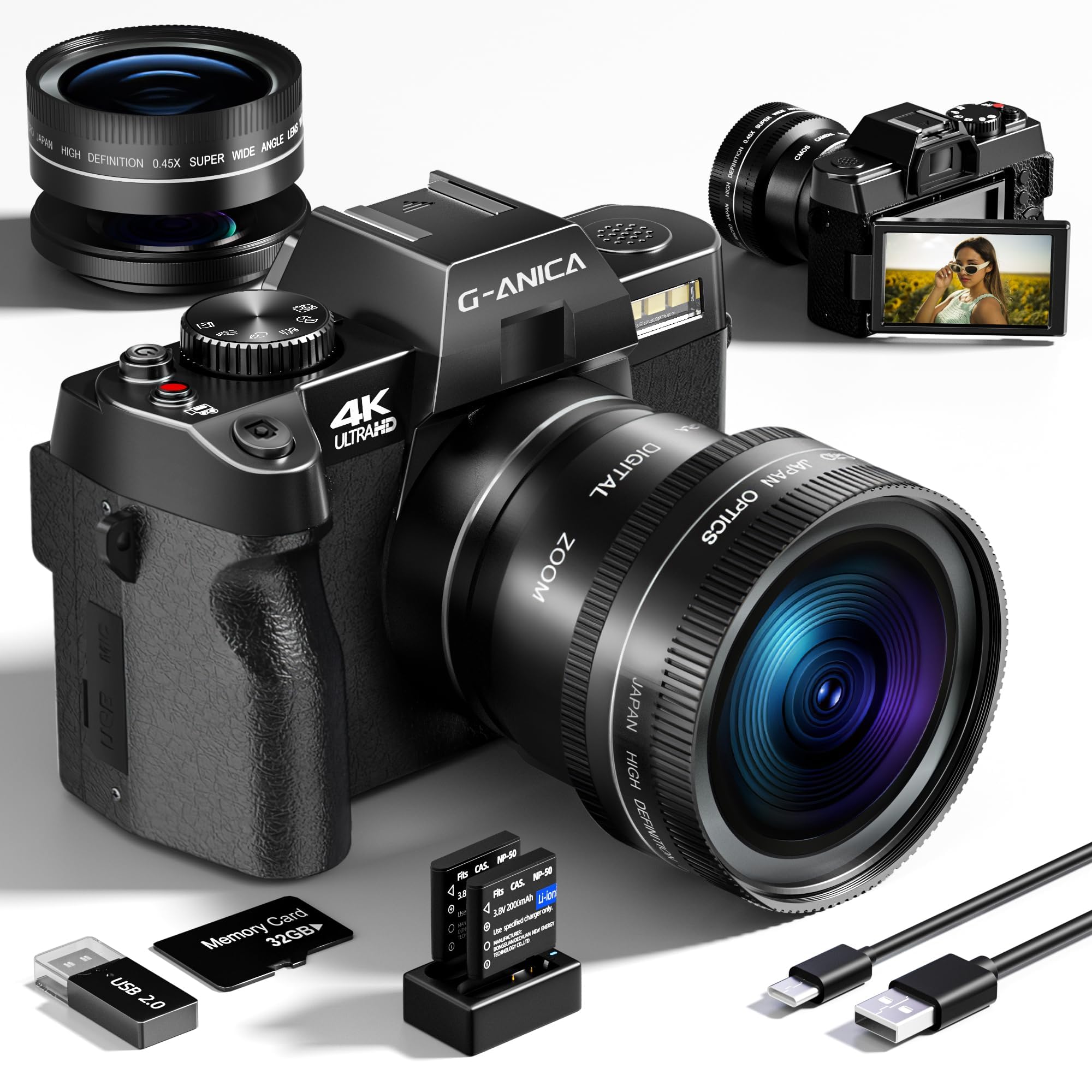
2. G-Anica 4K Vlogging Camera with Detachable Lens Kit
A 4K/30fps clip-shooter that leans toward video over stills, and says so.
If your plan is YouTube and TikTok rather than framed prints, this G-Anica is aimed right at you. It records 4K at 30fps (frames per second, the smoothness of your video) and takes 48MP stills, and the maker makes a fair point: true 4K keeps files manageable so you are not endlessly swapping cards. It ships with a 32GB card, two rechargeable batteries, and a detachable macro (close-up) and wide-angle lens pair.
Where the numbers put it in perspective: its 4K video and 48MP stills sit below the XNSIAKXA’s 8K and 88MP on paper. But it also carries 12 Bit depth against the FLATIC’s 10 Bit, which is more colour data per pixel to work with when you edit. Autofocus uses phase detection (a fast focus method that tracks moving subjects) and the camera supports WiFi and app control for phone transfers.
Owners find it a great starter and worth the money, with teens taking to it fast. The honest fit-note is the image quality, which reads mixed — good days and soft days. One buyer hit a snag worth knowing: “The camera could not format the micro SD card. We had to format the card in an other camera.” Budget a few minutes to format your card before a trip.
For a first vlogging body with real lenses in the box, this is a smart, low-risk entry point.
Video-first lean: 4K/30fps and a detachable macro and wide lens suit talking-head and travel clips more than gallery prints.
The trade-off: stills are hit-or-miss, and you will want a spare card on hand in case formatting gets fussy.
Great for: teens and first-time creators who mainly shoot video and want lenses included.
Think twice if: crisp stills matter more to you than smooth clips.
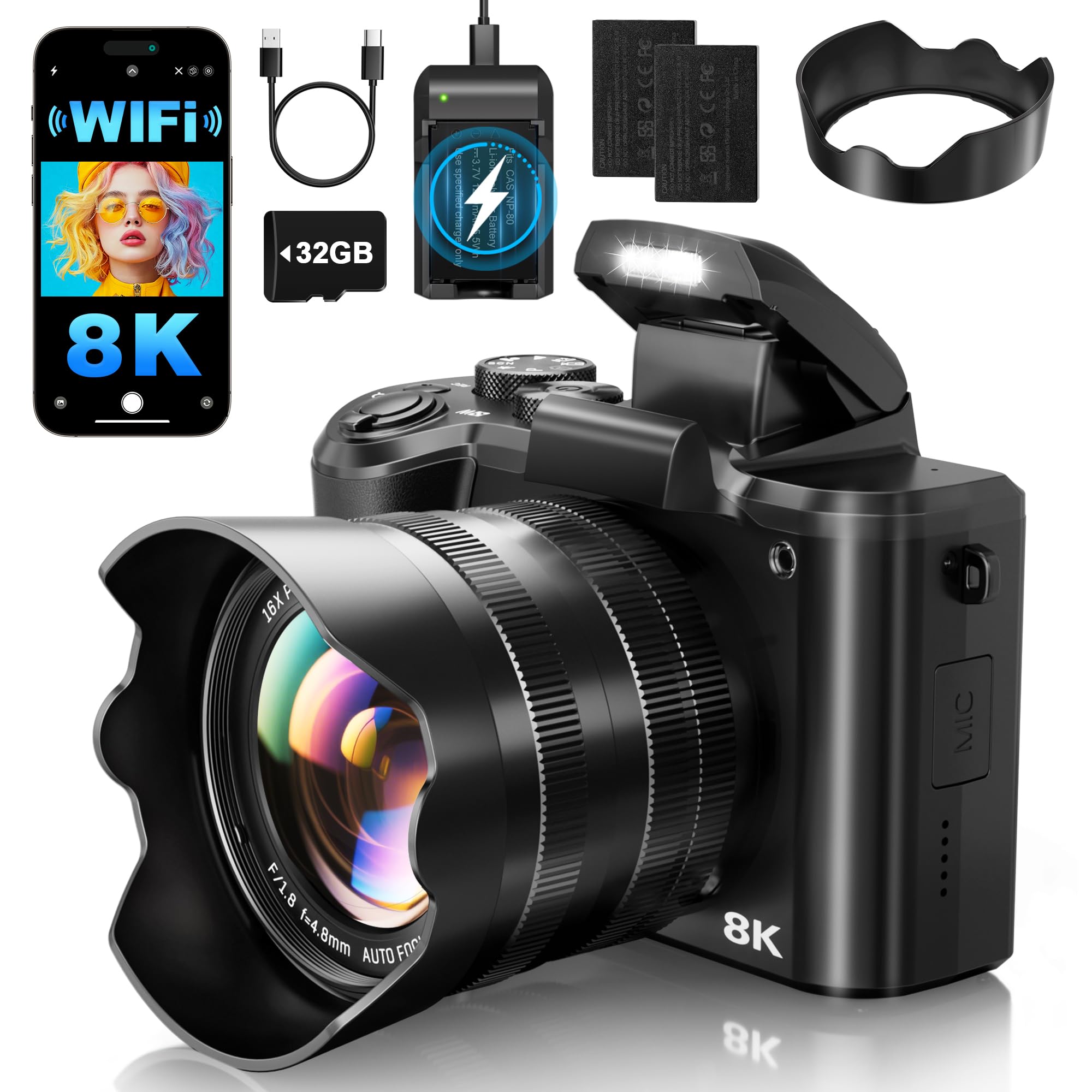
3. XNSIAKXA 8K 88MP Digital Camera with Dual-Lens
Dual lenses, a 3.2-inch touch screen, and the friendliest controls in the group.
This XNSIAKXA is the one to grab if you want a camera that feels touch-friendly and modern in the hand. Front and rear lenses make selfies and vlogs a one-tap switch, and the 3.2-inch IPS touch screen (a vivid panel you tap to focus and shoot) makes framing simple. It lists 8K video and 88MP photos, with fast autofocus that locks when you half-press the shutter.
Its edge over the G-Anica is real: 8K video against 4K, and 88MP stills against 48MP. A 6-axis stabilization system (it senses shake in several directions and steadies the shot) keeps handheld clips smoother, and the 360° rotary dial flips between Time-Lapse, Slow Motion, and other modes. The bundle includes a 32GB card, two batteries, a charging stand, and a lens hood.
The genuinely useful part is focus and weight — it stays small and light enough to carry all day. But image quality, autofocus in tricky light, and battery life are each listed as mixed, and a few buyers report blurry shots or features misbehaving. One summed up the learning curve well: “Little difficult at first because it has so many features. But, once you learn what the camera can do it’s better than I thought.”
Why it climbs high: front and rear lenses plus a 3.2-inch touch screen make it the least fiddly of the budget bunch for vlogging and fast sharing over WiFi.
Be realistic: dim light and quick-moving subjects are where it may wobble, so lean on good-daylight shooting.
Pick this if: a big touch screen and easy selfie/vlog switching matter most to you.
Not for: buyers chasing perfect low-light photos over convenience.
4. Yatao 6K WiFi Flip Screen Digital Camera

The kit built for talking heads and selfie framing right from the start.
Anyone who films themselves talking will appreciate this Yatao. The flip screen (a display that faces you) makes selfie framing easy, and the bundle is unusually complete for the category: a microphone for clear narration, a bi-colour fill light (a small lamp with warm and cool tones) for face lighting, a lens hood to cut glare, and a 64GB card with two batteries. Photo resolution is 64MP and video tops out at 6K.
The lens system is a wide-angle plus macro pair with 16x zoom, so you can shoot a landscape and then flip to a tight close-up. USB-C lets it double as a webcam for live streaming, and WiFi pushes clips to your phone. It is the only pick here with a dedicated fill light, which is a real plus for dim bedrooms and evening vlogs.
The biggest thing to plan around is battery life, which is marked mixed — owners say a spare is essential for longer shoots. A couple of assembly gripes appear too, like a lens hood that did not fit as expected. But the stills and value win people over: “Awesome camera! Very good quality for price. Takes pictures as well as video.”
The selfie-shooter’s edge
- Flip screen for accurate self-framing
- Mic plus bi-colour fill light included
- 64GB card, two batteries, wide and macro lenses in the box
- USB-C webcam mode for streaming
Plan around this
- Battery life runs short on longer shoots
- Occasional fit issues on the lens hood and light bracket
Best matched to: vloggers and selfie shooters who want lighting and audio handled.
Look elsewhere if: you need all-day battery without a pocket full of spares.
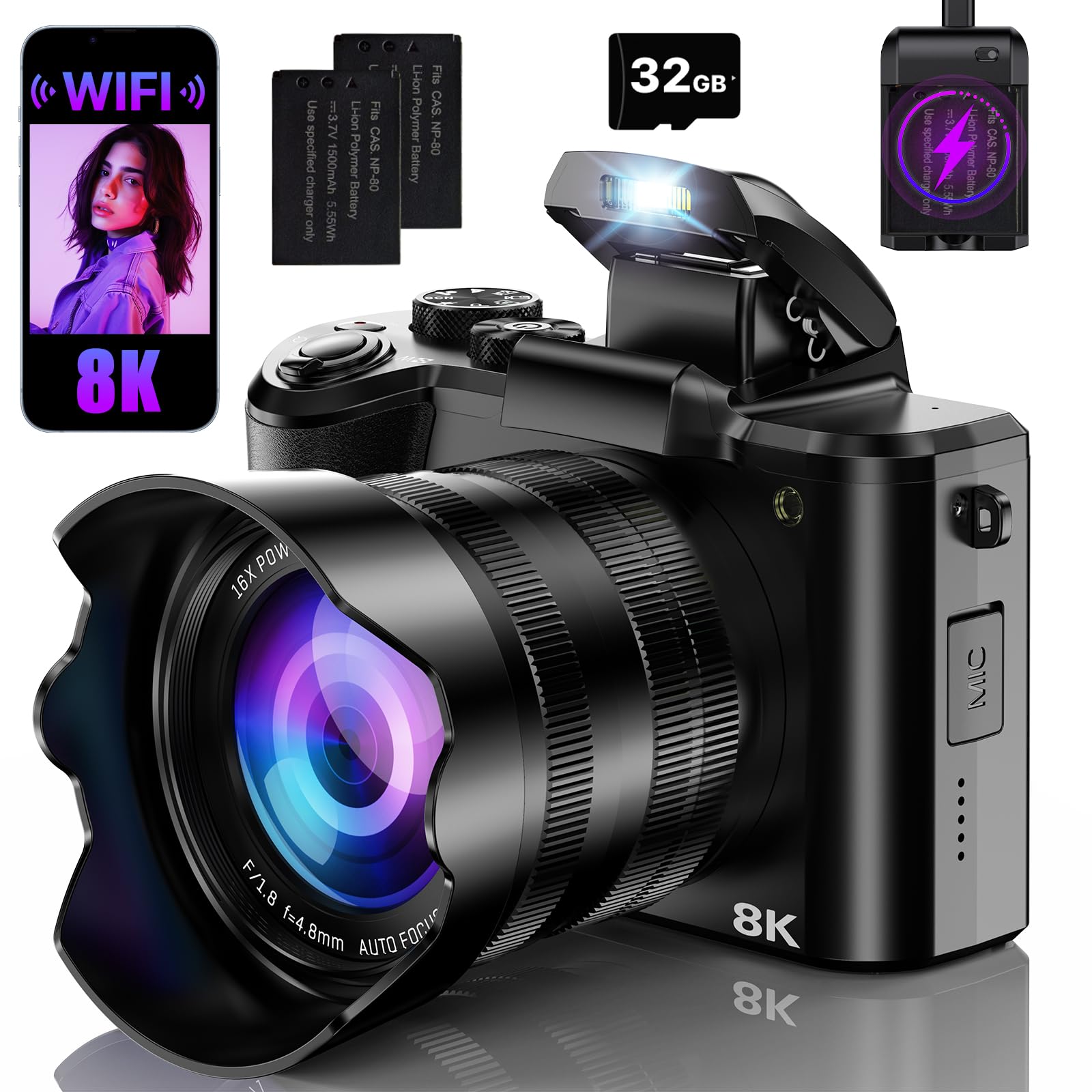
5. FlyFrost 8K 88MP Point and Shoot Camera
Big spec sheet and an easy learning curve, aimed at family trips and gifts.
This FlyFrost sticks out for how approachable it is on day one. Front and rear lenses with a 3.2-inch touch screen and a 360° rotary dial keep mode-switching simple, and it lists 8K video plus 88MP photos. Two rechargeable batteries and a 32GB card ship in the box, so the power and memory worries are handled up front — a genuine help for a birthday or holiday gift.
Its 6-axis stabilization smooths handheld shooting, and WiFi with the companion app pushes photos to your phone for quick posting. Autofocus uses contrast and eye detection to lock onto faces, which suits family shots. Owners describe it as beginner-friendly and better than expected for casual use.
The fair caveat is picture quality, which reads mixed and gets soft in low light — this is a daylight and indoor-with-good-lighting camera, not a night shooter. Autofocus also takes a couple of seconds, so fast-moving kids can slip out of focus. Still, for a first camera and the occasional family video, it does the job: one buyer captured it plainly — “Does it work, yes. Does it take the best pictures, no.”
The gift-friendly angle: dual batteries, an included card, and a simple dial make it easy for a beginner to just start shooting.
Where to temper hopes: low-light stills and slow focus mean it rewards patient, well-lit shooting.
Suits: families and gift-givers who want a ready-to-shoot bundle for daylight memories.
Skip for: dim venues or fast-action photos where you need instant focus.
6. Kodak PIXPRO FZ55 16MP Compact Digital Camera

The name-brand point-and-shoot that fits in a small bag and just works.
Here is the pick for the traveler and the beginner who wants something small enough to forget in a pocket. The Kodak’s real strength is honest optics: a 16MP CMOS sensor (the chip that captures the image) behind a 5x optical zoom and a 28mm wide-angle lens. That optical zoom physically moves glass, so a zoomed shot stays sharp — unlike the digital-only “16X” on a few rivals above.
It records 1080p video for travel clips and family moments, and it works with Class 10 SD, SDHC, or SDXC cards up to 512GB. The included LB-012 lithium-ion battery charges in-camera over USB in about 2 hours; charge it at least 4 hours before first use to get the most life. What wins people over is picture quality and portability — owners call it small enough to fit in a small bag and great for the money.
The catch: no memory card is included, so you must buy a card (and a transfer adapter) to get going. Battery life and reliability read mixed — a few mention a short charge and the occasional dead unit. That said, this is the most polished pocket cam here, and its lifespan in reviews is measured in years, like the owner still shooting on it after a full year of use.
Why the brand name earns its keep
- Real 5x optical zoom with 28mm wide-angle framing
- 16MP CMOS sensor for clean daylight photos
- Pocketable body, simple controls for beginners
- Charges over USB in about 2 hours
Know before you check out
- No memory card in the box — budget for one
- Battery life runs short on long days out
Most at home: travelers and beginners who want brand reliability and true optical zoom in a pocket body.
Only if you plan ahead: you must add a memory card and transfer adapter yourself.
7. Canon EOS R100 Mirrorless Camera with RF-S 18-45mm Lens

The real-camera upgrade path, with a genuine interchangeable lens and autofocus that tracks faces.
This is the pick for the buyer who wants to grow, not just grab a starter. It is a mirrorless camera (a compact design with no flipping mirror inside) built around a 24.1MP APS-C sensor and a DIGIC 8 image processor, and it comes with a real RF-S 18-45mm lens that you can swap later. Where the budget cams lean on digital zoom, this uses a zoom lens with built-in image stabilization for steady handheld shots.
Its Dual Pixel autofocus, with 143 AF zones (focus points spread across the frame), locks onto faces and people reliably — the tech that separates it from every digital-only model here. It shoots 4K 24p video and bursts at 6.5 fps with the electronic shutter, and a 2.36m-dot OLED electronic viewfinder gives you a clear eye-level view. Wi-Fi and Bluetooth handle sharing, and the charger and strap round out the kit.
The trade-off is simple: this is the priciest path, but it is the one that will still be relevant years from now instead of bottlenecked by a fixed digital zoom. As a family camera it is approachable too — “Easy to use and can easily upgrade the camera with a more powerful lens if you really wanted.” Just treat the neck strap gently; it has been known to slip off.
Where it pulls ahead: 143 autofocus zones, a 24.1MP APS-C sensor, and a swappable lens mean sharp results today and room to grow.
The honest limit: it costs the most of the group and leans on accessory care — keep an eye on that strap.
Choose it if: you want a real lens system and reliable face-tracking focus to grow into.
Not the one for: anyone who wants everything included in the box with zero add-ons.
Know the Specs
Optical vs digital zoom
Optical zoom moves the lens glass to magnify the subject, so a zoomed photo keeps its detail. Digital zoom crops the center of the frame and stretches it, which softens distant shots. The Kodak’s 5x optical zoom is the real thing; most budget “16x” figures are digital only. If reach matters, favour optical.
Megapixels and sensor type
A megapixel is a dot count, and a bigger number does not fix a small sensor. A CMOS sensor is the chip that turns light into the image, and its size matters more than the badge. A 16MP CMOS sensor (Kodak) can beat a digital-upscaled “88MP” claim in real sharpness. Trust the sensor spec, not the headline number.
Autofocus technology
Phase-detection autofocus uses sensors that judge distance quickly, so it tracks moving faces well. Contrast-detection hunts a little more in low light. Eye detection keeps focus locked on a face as it moves. If you shoot kids or pets, favour the phase-detection of the G-Anica or the 143-zone Dual Pixel AF of the Canon.
Batteries and memory
Budget cameras run on small lithium-ion cells, so a spare battery is close to essential for a full day out. Check the card slot specification: the Kodak takes Class 10 SD, SDHC, or SDXC up to 512GB, while several picks bundle a 32GB or 64GB card. A bundled card and second battery saves you a separate purchase.
Common Questions
Is a budget camera like these actually better than my phone?
Why do these cameras say 8K or 88MP if the sensor is small?
Will a Canon RF-S lens fit the budget point-and-shoots?
What memory card do I need and is one included?
How long does the battery last on a day out?
Can these cameras work as a webcam for streaming?
Do I need to format a new memory card before shooting?
Are these good enough for kids and first-time users?
What is the difference between 4K and 8K on these budget bodies?
The Bottom Line
For most buyers, the digital camera under $150 winner is the FLATIC 6K 64MP because it covers photos, vlogging, and every accessory you need in one bundle. If a big touch screen and front-rear lenses suit your shooting style, grab the XNSIAKXA 8K 88MP. And for the traveler who wants true optical zoom in a pocket body, the Kodak PIXPRO FZ55 is the one to reach for. Whichever you pick, skip the headline-number trap and choose on real focus, honest zoom, and a bundle that already includes a card and a spare battery.
How we choose
We do not accept paid placement. Every pick is matched to a real buyer and a real use-case; we do not hands-on test units.
Sources
Specifications: manufacturer listings and product documentation. Review insights: verified customer reviews, as of October 2026. Pricing: not shown on this page (it changes often); check the current price via the retailer link.
As an Amazon Associate, Aappliancez earns from qualifying purchases. This does not affect which products we feature.