Disclosure: Some links in this post are affiliate links. As an Amazon Associate I earn from qualifying purchases, at no extra cost to you. Learn more
Specs are compiled from manufacturer listings and verified buyer reviews and can change over time — please confirm the key details on the product page before buying.
Here is the short answer: the best digital antenna for you depends almost entirely on how far you live from the broadcast towers. If you are inside 30 miles of the transmitters, a compact amplified model pulls in everything you want. If you are out in the country with 60 or 70 miles of open ground between you and the nearest tower, you need a big directional antenna with a strong built-in amplifier. The remote, the app, and the extra outputs matter far less than that one distance number.
This guide is built by comparing the manufacturers’ published specifications and the patterns across verified customer reviews, so you get each pick’s real strengths and trade-offs instead of marketing spin.
Mounting height and aiming matter nearly as much as the antenna itself, and a channel scan you re-run after every move. The goal is a reliable digital antenna setup that puts local news, live sports, and network shows on your screen without a monthly bill.
Top Picks

How To Choose The Best Digital Antenna
Two antennas with the same mileage printed on the box can behave completely differently at your house, because what actually reaches your roof is set by the terrain between you and the towers. Trees, hills, the neighbor’s two-storey wall, and even the height of your own mounting pole change the result more than any single spec on a listing page. Look up your distance from your local transmitters, then read the picks below against that number.
Directional or rotating — pick your aiming style
A directional antenna throws all of its strength in one direction, so you point it at your tower cluster once and leave it. Choose directional when every station you want sits in the same direction. A rotating antenna has a motor inside so you can swing the whole unit from the couch with a remote, which is what you want if your channels come from two or three different directions. The trade-off is moving parts: a motor is one more thing that can wear out, and several rotating models are built to survive about a season in salt-heavy, hurricane-prone air.
VHF and UHF are not the same problem
Channels split into two bands, and an antenna that is strong on one can be weak on the other. UHF carries most modern digital stations and needs shorter, tightly packed elements. VHF sits at lower frequencies and needs longer elements to catch it — which is exactly why some antennas pull 80 channels but drop the one ABC affiliate in your market. A model with dedicated High VHF elements plus a UHF array is the safer pick if you cannot afford to lose a major network.
Amplifiers help until they hurt
A built-in amplifier boosts a weak signal on its way down the coax, and it is the difference between a usable picture and nothing at 60 miles. But amplification is not a dial you simply turn up. Too much gain on a strong local signal overloads the tuner and makes pictures worse, which is why the smart models adjust gain automatically per band rather than blasting everything at one level. Look for a model that can also pass signal in passive mode if the power ever goes out.
Mount it high and run one clean cable
Height matters more than any spec on the box. Every foot you climb pulls you clear of rooftops, foliage, and the ground clutter that eats signal. Run a single unbroken length of coax from the antenna to the TV, keep it as short as you reasonably can, and avoid splitters and joins where possible — each one costs you signal. Then, after the install, run a fresh channel scan on your TV; that scan is what actually programs the tuner to the stations the antenna is now delivering.
Side-by-Side Comparison
| Model | Best For | Rated Range | VHF/UHF Gain | Rotating Motor | Amazon |
|---|---|---|---|---|---|
| Televes DAT BOSS Mix LR 149884★ Best Overall | Fringe rural reception | Up to 100 mi | 38 dBi / 46 dBi | No | Amazon |
| TV Outdoor Yagi Antenna (McDuory UHD-3968)Budget Champ | Tight-budget attic installs | 150 mi total, 70+ mi from towers | Passive, no amplifier | No | Amazon |
| Digital Outdoor Amplified HD TV Antenna (Yeceny) | Two TVs, towers in different directions | 150 mi | Built-in low-noise amplifier | Yes — 360° | Amazon |
| Five Star HDTV Antenna 150 Miles (FSA-5809A) | Up to five TVs on one roof antenna | 150 mi | High gain, low-noise amplifier | Yes — 360° | Amazon |
| Five Star Outdoor HDTV Antenna 200 Mile (B0B7R81MFX) | Attic or roof, deep-fringe swing | 200 mi | 11 dB VHF gain | No | Amazon |
| Televes DiNova Boss Mix 144286 | Attic, balcony, or HOA-friendly rooflines | Up to 50 mi | 29 dBi / 34 dBi | No | Amazon |
| Winegard Elite WE7550A | Rural long-range with minimal amp noise | 70+ mi | 1.0 dB noise level | No | Amazon |
Detailed Reviews
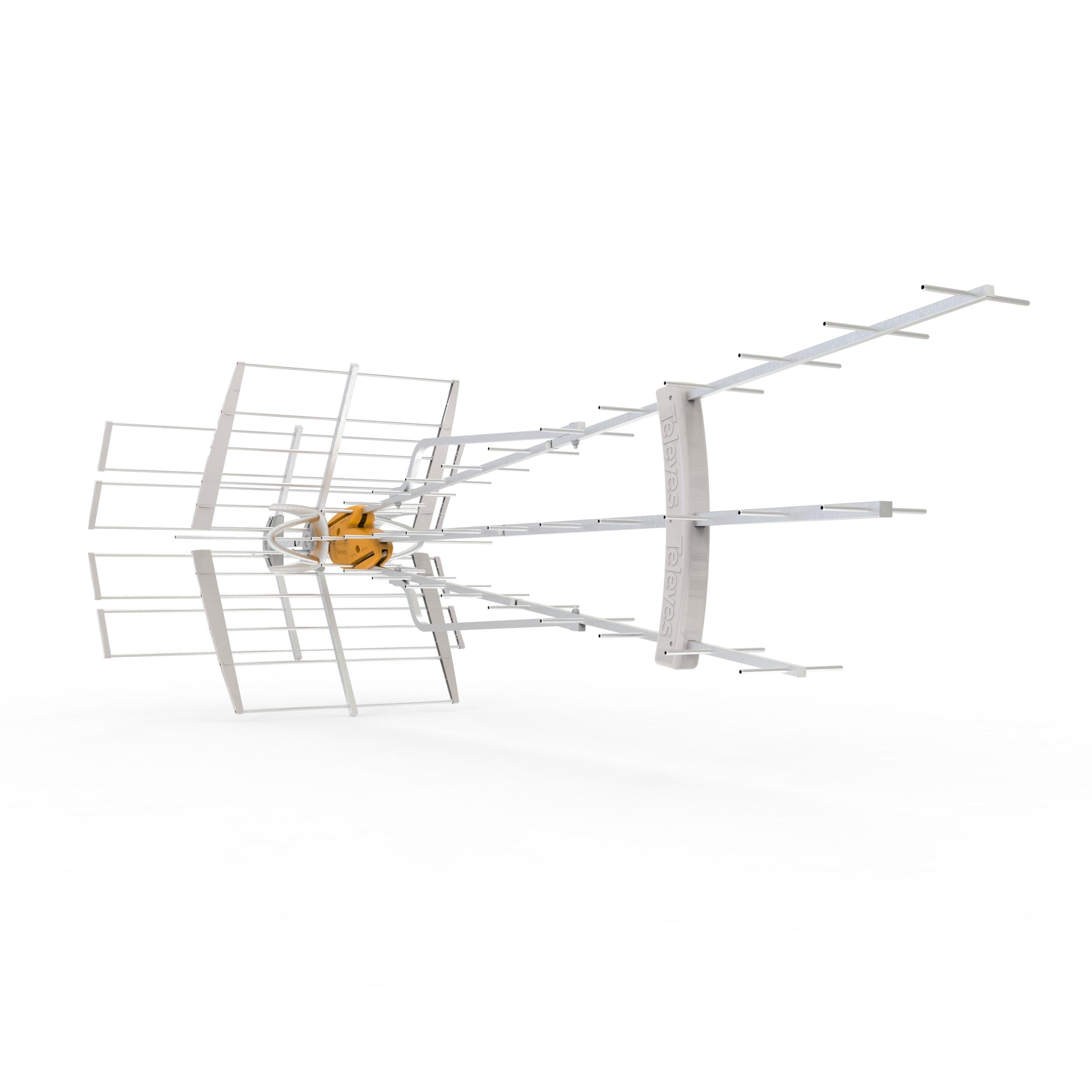
1. Televes DAT BOSS Mix LR 149884 HDTV Antenna
Our pick — 4.5+★ from 450+ verified ratings; the strongest balance of quality and price.
Two separately tuned amplifiers, one for each band — the setup that saves fringe reception.
This is the pick for the house at the end of the road. Televes rates it for up to 100 miles from the transmitters, and that number is backed by real engineering: a TForce amplifier that adjusts gain independently for High VHF at 38 dBi and UHF at 46 dBi. dBi is just a measure of how much signal boost an amplifier adds, and splitting the boost by band is the difference between pulling a weak distant station and drowning a strong nearby one in noise. Built-in FM, LTE, 4G, and 5G filtering strips out the interference that phones and cell towers pour into your coax.
What wins people over is the build. The stacked triple-boom layout throws a narrow, powerful beam toward the towers, and Televes quotes front-to-back ratios of 12 dB on High VHF and 25 dB on UHF — that ratio is a measure of how well the antenna ignores signals arriving from behind it, which is what keeps a strong local station from bleeding into the distant one you are chasing. Buyers report jumping from a weaker antenna to 88 clear channels, and long-range installs 60+ miles out still land solid HD. The aluminium elements sit on stainless hardware with ABS plastics, so rain, UV, and humidity are not a worry.
The catch is the footprint and the aim. At 84.13 inches long, this is a serious antenna, which is why you have to plan where it lives — a couple of buyers have tucked it into an attic despite the size, and one notes it needs a good aim because the beam is narrow. Assembly also draws the most mixed feedback of anything here: the parts go together fine, but it is a real build rather than a snap-fit, and it does not ship with coax, so budget for a run of your own cable before install day.
The long-range case for it
- 38 dBi High VHF and 46 dBi UHF amplification, tuned per band so weak and strong stations coexist
- 5G, LTE, 4G, and FM filtering built into the antenna itself
- Keeps passing signal in passive mode if the power cuts out
- Aluminium, stainless steel, and ABS construction rated for exposed outdoor use
Where it fights back
- 84.13 inches long — you need real mounting real estate and a plan
- The narrow beam rewards careful aiming; set-and-forget works only if all your towers sit in one direction
- No coaxial cable in the box, so add one to your install list
Buy this if: you live far out, your stations all sit roughly the same way, and you want an antenna that does the gain math for you.
Look past it if: you are inside 25 miles of the towers or your roofline has no room for a 84.13-inch boom.
2. McDuory UHD-3968 Outdoor Yagi Antenna
A passive Yagi that costs a fraction of the amplified giants and still grabs triple-digit channels in an attic.
Here is the math that makes this one interesting. The listing claims a 150 mile total range, but the honest figure — and the one buyers keep repeating — is up to 70+ miles from the broadcast towers. That is a big gap on paper, and it is worth knowing before you buy, because it lines this antenna up against models rated in the same 70-to-100 mile band for a fraction of the outlay. It is a passive Yagi, meaning there is no amplifier inside at all; the antenna just collects what arrives and passes it down the coax. Working frequency is VHF 170~230MHz and UHF 470~860MHz, covering 720p, 1080i, 1080p, and 4K broadcasts.
What it does brilliantly is the classic attic install. One buyer swapped a picture-frame indoor antenna for this, ran 40 feet of coax to an HDHomeRun tuner, and went from roughly 65 pixelated channels to 101 perfect ones. Another mounted it in an attic about 30 miles from the towers, pointed it straight, and pulled every major network — Fox, NBC, ABC, and CBS — plus extras in clear HD with full signal bars. This is also where the value story lives: owners mention it beating more expensive antennas, with one long-range comparison seeing channels climb from about 65 pixelated to 101 perfect.
The honest catch is assembly and hardware. The long elements have to seat fully into the plastic sockets, and if a rod does not make metal-to-metal contact with the spine, that band simply will not come in — one buyer verified the connection with a multimeter, and another fixed a loose fit with pop rivets. Some owners also note the included hardware can rust over time, so a quick stainless upgrade is cheap insurance. Point it at your towers, keep it within 50 miles of them, and this low-cost Yagi earns its place.
The value read: the build is aluminium and plastic with no amplifier to fail, so the only real maintenance is checking that every element is tight in its socket and the coax run is clean.
Set your expectations: this antenna works best inside about 50 miles; push past 70+ and you are asking more than a passive Yagi can give.
Worth it when: you have a spare attic, towers within about 50 miles, and no interest in paying amplified prices.
Not your pick when: you are chasing stations 70 miles out or you would rather not fiddle with element seating at all.
3. Digital Outdoor Amplified HD TV Antenna 150 Miles

Point it at a new tower cluster without climbing down off the roof again.
If your stations scatter across two or three directions, this is the fix that saves you a ladder trip. A built-in 360-degree motor swings the whole antenna from a wireless remote you keep indoors, so you can hunt for the best angle on a stubborn channel without touching the mast. There is a low-noise amplifier built in and a 40ft RG6 coax cable in the box, so the run from roof to living room is covered out of the gate. It supports 4K, 1080p, 1080i, and 720p broadcasts, and — the part multi-TV households love — it feeds two televisions at once with no splitter and no special adapter.
The reception numbers here are genuinely strong for the price bracket. One buyer in north-east Alabama, mounted 20 feet up, picked up 80+ channels at 70+ miles; another in a rural pocket between Jacksonville, Gainesville, Ocala, and Orlando reported 100+ channels. That spread is exactly what the rotator is for, because those markets do not share a single beam direction. Assembly is a snap-on job with no tools, and it mounts to roof, attic, chimney, eave, mast, or wall — though note the mount takes a 3/4-inch pole specifically.
The thing to go in knowing is that a motor is a moving part, and moving parts in salt air and hurricane wind have a service life. Owners in storm-exposed regions report these units lasting roughly a year before the rotor gives out — and once the rotor quits, the antenna becomes a weather vane. The good news is that the geometry is standard, so you swap only the outdoor head with a compatible replacement rather than re-running everything. Power is also worth a thought: one owner had the power box fail and got a free replacement after contacting the company directly, which says something about standing behind the product.
Why the remote changes the job
- 360-degree motor aimed from a wireless remote indoors
- Feeds two TVs at once with no splitter or extra adapter
- 40ft RG6 coax and power supply included
- Lightning protection built in for exposed mounting spots
The motor conversation
- The rotor is the first part to wear — expect a season or so in storm-prone, salty air
- Wants a 3/4-inch pole, so check your existing mast before ordering
- Rated 150 miles on the box, but real-world reach tracks your terrain, not the sticker
The right call for: anyone whose channels live in different directions and who wants to re-aim from the couch instead of the roof.
Skip this one if: all your towers sit in one cluster — a fixed directional antenna gets there with fewer moving parts to fail.
4. Five Star HDTV Antenna 150 Miles

One roof antenna, up to five televisions, and a J pole in the box so nothing extra to source.
For the household with a screen in every room, this is the practical pick. It handles two TVs straight from the start and, with the included splitter, up to five total. That is a different job from the single-TV antennas above: you are buying one install that blankets the whole house, which is why the kit is unusually complete — remote, power supply, 40ft RG6 coax, instructions, mounting kit, splitter, and J pole all included. The full-band receiver covers 45-860MHz for VHF and UHF, and supports 4K, 1080i, 1080p, and 720p broadcasts. A built-in high-gain, low-noise amplifier runs the signal, and an LTE filter strips out interference from 4G phone signals nearby so the picture stays clean.
The reach stories from the field are strong when the setup is right. One buyer in California’s Inland Empire, out of line of sight of the LA transmitters, replaced an old 12-foot antenna mounted 33 feet above grade and pulled every LA channel — including one station that had never come in before. Another, 60 miles from the towers, got far more stations than expected with sharp picture, and even reported FM stereo radio improving from poor to excellent. The remote rotation is what makes those fringe catches possible: you tune it to find the spot where a weak station snaps into place.
Where this one asks for care is consistency. Reception draws the most back-and-forth of any aspect here — some installs deliver plenty of channels, others get only about 15, which usually traces back to aim, height, or the amplifier’s need for a live power feed. The rotation also turns a single direction on the controller, which takes some getting used to when you are dialing in a station. Worth knowing before you climb: the active amplifier needs power at the antenna end, so plan an outlet or an injector point if you want the boost working. Treat it as a solid mid-range option when your towers are reachable and you want five sets fed from one pole.
The multi-room angle: five TVs from a single antenna and one 40ft run is the whole reason to pick this model over a single-output design.
The install reality: skip your old satellite splitters in the path — several owners found leaving them in cost them signal — and make sure the amp has power before you judge the picture.
Reach for this if: you are feeding several televisions and want the mast, splitter, and cable all in one box.
Think twice if: you want a single TV fed simply, or you are far enough out that only a better-aimed directional antenna will do it.
5. Five Star Outdoor HDTV Antenna 200 Mile

Bigger elements, a longer boom, and a 200-mile rating for installs where nothing else reaches.
When smaller antennas fail, longer elements and a bigger boom are the fix. This Five Star stretches its receiving elements longer and wider than the smaller antennas in the range, which is how it earns a 200 mile rating and stronger VHF performance. It handles both VHF and UHF for 1080p and 4K, arrives ATSC 3.0 ready, and comes as a full kit — antenna, mounting bracket, J pole, TV splitter, and instructions — so it can go on a roof, in an attic, on a chimney, under an eave, or on an outside mast, with or without line of sight to the towers.
The field reports from deep-fringe installs are the proof. One buyer in a rural area about 50 miles from the stations had it on the porch facing south and picked up 77 channels instantly, after indoor antennas had failed completely. Another mounted it about 7 feet above the roofline at 7,300 feet elevation, 46 miles from the towers, and pulled 90 channels with 72 coming in clear. In a mountain-obstructed spot 45 miles out, an owner went from 26 channels on an indoor amplified antenna to 60 with this unit. That jump — from indoor to a big outdoor directional — is the single most common pattern in the reviews.
Two practical notes before you buy. First, it is a large antenna, and one buyer summed it up as quite large but a breeze to assemble — the size is the price of the reach. Second, a few owners flagged the assembly instructions as unclear on how the VHF elements should align, and getting them seated the wrong way can stress the plastic, so follow the diagram carefully. If you have a long coax run, keep an eye on signal loss at the far end; one reviewer noted a 175ft run cost them a low-power station. And skip your old satellite splitters in the path — several installs improved once those came out.
What the extra metal buys you
- 200 mile rating with extended receiving elements for stronger VHF pickup
- ATSC 3.0 ready for modern over-the-air broadcasts
- Complete kit with bracket, J pole, and splitter included
- Roof, attic, chimney, eave, or mast mounting, line of sight or not
Worth knowing first
- It is a physically large antenna — give it room and a solid mount
- The VHF element alignment in the instructions is easy to misread, so seat it carefully
- Very long coax runs cost you signal on distant low-power stations
Made for: the rural or mountainous address where nothing smaller has worked and you need raw reach.
Not for you if: rooftop space is tight or a compact amplified antenna already covers your towers.
6. Televes DiNova Boss Mix 144286 Attic/Outdoor HDTV Antenna

A tidy white radome that hides serious signal processing behind a low-profile shell.
Some homes can’t take a giant boom on the roof, and this Televes is the answer for those. It is rated up to 50 miles and comes sealed inside a compact white ABS radome — a protective plastic shell that houses all the electronics — with Zamak mounting parts. There is no assembly at all, unlike the DAT BOSS above; you mount it and go. Inside, the same TForce system tunes the amplifier per band, with 29 dBi High VHF and 34 dBi UHF gain, adjusted automatically to keep the output steady whether the incoming signal is weak or strong. FM, LTE, 4G, and 5G filtering is built in, and it keeps working in passive mode if the power goes out.
The flexibility is the real selling point. It works on a roof, a wall, a balcony, or in an attic, and the small footprint is specifically suited to historic buildings and HOA communities where a big antenna is not an option. The setup comes with a 12V dual-output power inserter and a J-mount bracket, though you supply the fasteners for your surface. Customers note strong results in cities and suburbs alike: one urban San Diego install jumped from about 40 to about 100 channels, including stations that had been missing before, and credit the built-in filtering for cutting cell-tower interference. Another attic install picked up 42 stations, including a network affiliate 90 miles away — surprisingly far for a unit rated to 50.
The honest note is that this is a 50-mile-rated antenna, so it is not the pick for deep fringe. If you are inside that radius with towers roughly in one direction and nothing blocking them, the performance is excellent. One owner who replaced a 12-year-old unit found the new one worked great and suspected the old amplifier had simply worn out — a useful reminder that amplifiers have a service life. Sizing is a plus, too: it weighs 2.7 kg, so mounting is manageable for one person.
The city-and-HOA fit: compact radome, no assembly, and 5G filtering make this the clean choice where a big boom is ruled out.
Where it stops: 50 miles is its rated ceiling, so if your towers sit further out, step up to the DAT BOSS instead.
Suits you if: you want a discreet, assembly-free antenna for a roof, balcony, or attic inside the 50-mile band.
Step up instead if: your transmitters are beyond the rated range or you are chasing weak distant stations.
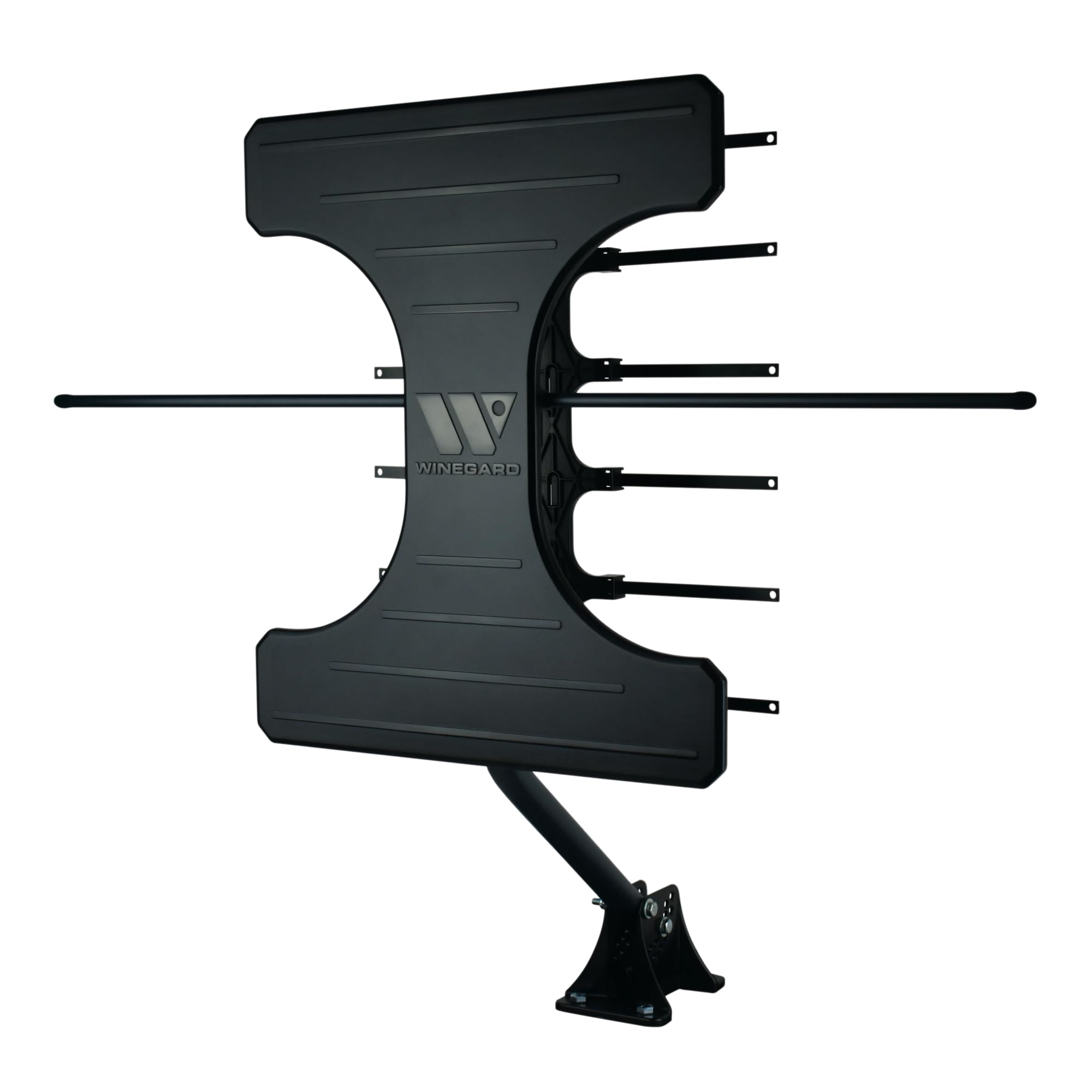
7. Winegard Elite WE7550A Outdoor TV Antenna
The amplifier you barely notice — built to add gain without adding hiss.
Amplification and noise are a trade-off, and this Winegard tilts hard toward the quiet side. Its integrated boost amplifier uses Clear Circuit Technology to hold a 1.0 dB noise level — that figure describes how much background static the amp itself introduces, and lower is better, because every decibel of amp noise you add is a decibel of clean picture you lose. The antenna is rated for 70+ miles in rural areas where long-range reception is the whole problem, comes NextGen TV compatible, and is a compact directional unit aimed at your towers and left alone.
The install story here is genuinely friendly. It arrives with an inline 5V power inverter with an LED indicator, a 3-foot USB power cable with a 110V adapter, and mounting supplies including a pipe and foot — so unlike some of the antennas above, the mounting hardware is in the box. It weighs 16 ounces, which makes it easy to handle on a mast or roof. Build is American-designed, and several owners have found a Winegard indoor antenna to be hit-or-miss before moving up to this outdoor unit — one reported the TV showing a 20 dB signal improvement and near-flawless reception over weeks.
The fair caveats are worth a clear look. The most common are cable and screws: this shipss without coaxial cable or mounting screws in some cases, so check the box contents before your install day. Durability draws the odd negative note as well — one owner had the coaxial bulkhead connector fail after a year because the connector spins, and support declined coverage past the warranty. That is a rare case, not the norm, but it is the kind of thing to keep in mind when you are running cable. And realistically, reviewers point out more like 45-50 miles of practical reach than the 70+ on the box, so treat the rating as a ceiling. Aim it well — one buyer used the TV SignalFinder app to point it — and it rewards the effort.
The quiet-amp advantage
- 1.0 dB noise level from the Clear Circuit amplifier — minimal self-introduced static
- Mounting pipe, foot, and hardware included
- 16 ounces, easy for one person to hoist and aim
- NextGen TV compatible for modern broadcast reception
Check before you buy
- Coaxial cable may not be included — have your run ready
- A small number of shoppers say the coaxial connector is a weak point over time
- Practical reach tends to land closer to 45-50 miles than the 70+ rating
Choose this if: you are in a rural spot with a clean line to your towers and you care most about a low-noise, low-static picture.
Look elsewhere if: you need an included coax run or you want the raw reach of a much larger boom.
Know the Specs
Rated Range (Miles)
The mileage on the box is the best-case number the manufacturer quotes for an unobstructed line of sight to the towers, and it is almost always optimistic. That is why a 150 mile antenna and a 200 mile antenna can feel identical at your address — your terrain, not the sticker, decides. The useful move is to check your real distance and treat the rating as a ceiling, not a promise. In practice you will want some headroom between that rating and your actual distance, because trees, hills, and buildings eat signal before it ever reaches the antenna.
dBi Gain and Noise
dBi measures how much an amplifier boosts the signal, and dB (noise) measures how much background static it adds along the way. A model rated at 46 dBi UHF is pushing hard, and one rated at 1.0 dB noise is adding almost nothing on top of your signal. These two work against each other: pushing gain amplifies the noise floor too, so a strong signal in a strong-signal area can actually look worse amplified than not. That is why the smarter designs adjust gain per band automatically, and why a model that can also pass signal in passive mode gives you a fallback when the local signal is already strong enough.
VHF vs UHF
Your channels split across two frequency bands, and they are not interchangeable. UHF handles most current digital stations and uses a compact array of short elements. VHF sits lower and needs much longer elements to catch, which is why a UHF-heavy antenna can ignore a weak VHF network affiliate while pulling dozens of other channels. If one of your must-have networks sits on VHF and it keeps dropping, the antenna’s VHF elements are the part to check, not the amplifier.
Motor and Aiming
A directional antenna throws its gain in one direction; a motorised one swings the whole housing so you can re-aim without climbing down. The motor is genuinely useful when your stations sit in different directions, but it adds a moving part that can wear out — particularly in salt-heavy coastal air or storm zones. If all of your towers cluster in one direction, a fixed directional antenna skips the motor entirely and has less to go wrong. Either way, how high you mount it and how carefully you point it will outweigh any single specification on the box.
Common Questions
How do I know if a digital antenna will work at my address?
Do I need an amplified antenna or can a passive one work?
Will a digital antenna pick up both VHF and UHF channels?
How high should I mount an outdoor digital antenna?
Why does my antenna pull 80 channels but pixelate on one of them?
Do rotating antennas need a special pole to mount?
Will a digital antenna work with an older TV?
How long does a digital antenna last?
Is a cheap passive antenna better than an amplified one?
What is ATSC 3.0 and do I need it now?
The Bottom Line
For most people chasing the digital antenna that actually earns its spot on the roof, the winner is the Televes DAT BOSS Mix LR 149884 — it tunes its amplification separately for High VHF and UHF, filters out cellular and FM interference, and is rated for up to 100 miles of reach. If you want a rotating model that re-aims with a remote and feeds two TVs from the start, the Yeceny 150 Mile Motorized 360 Degree Antenna is the one to reach for. And for a tight-budget install inside 50 miles of the towers, the McDuory TV Outdoor Yagi Antenna does the job for a fraction of the amplified models. Whichever you pick, mount it high, run one clean coax, and re-scan for channels after every move.
How we choose
We do not accept paid placement. Every pick is matched to a real buyer and a real use-case; we do not hands-on test units.
Sources
Specifications: manufacturer listings and product documentation. Review insights: verified customer reviews, as of October 2026. Pricing: not shown on this page (it changes often); check the current price via the retailer link.
As an Amazon Associate, Aappliancez earns from qualifying purchases. This does not affect which products we feature.