Disclosure: Some links in this post are affiliate links. As an Amazon Associate I earn from qualifying purchases, at no extra cost to you. Learn more
Specs are compiled from manufacturer listings and verified buyer reviews and can change over time — please confirm the key details on the product page before buying.
If your diesel feels like it lost its shove — slow to build boost, smokier at startup, or coasting into limp mode on a hill — the fix is usually a clogged turbo and soot-packed fuel path, not a dead turbocharger. A good diesel turbo cleaner is a fluid you pour into the fuel tank or feed through the intake to dissolve the carbon and soot that choke the variable vanes and injectors. Below are the five worth buying, each matched to a different problem, so you pick the one that fits your engine before you spend money replacing hardware.
This guide is built by comparing the manufacturers’ published specifications and the patterns across verified customer reviews, so you get each pick’s real strengths and trade-offs instead of marketing spin.
You will see which formulas clean what — turbo vanes, DPF filters, injectors, intake valves — and which ones are diesel-only. Match the fluid to your symptom and the right diesel turbo cleaner does the job without a trip to the mechanic.
Top Picks
How To Choose The Best Diesel Turbo Cleaner
The single mistake most diesel owners make is grabbing the first bottle that says “cleaner” and pouring it into a tank that needs something completely different. A turbo that sticks because of soot on its vanes needs a fuel-system treatment that burns through that soot. A clogged DPF needs a formula tuned to lower soot burn-off temperature. An injector that rattles needs a purge. Get the wrong one and you waste a tank of fuel and a weekend chasing the wrong fault.
Match the product to the symptom you actually have
If your truck feels gutless and slow to spool, look for a turbo-specific cleaner that names soot reduction and power restoration. If your dashboard throws a P242F code or the regeneration light keeps coming back, you want a DPF and emissions cleaner. If the engine runs rough and smokes at startup, an injection purge is the tool. Read the “about this item” line on any bottle — a real turbo cleaner says so plainly.
Check the dosing and the driving routine it demands
Most of these products are not pour-and-park. Several need the engine held at high rpm for a stretch so the cleaner actually passes through the turbo and exhaust. One JLM product, for example, asks you to run the engine in 4th gear at 3000 rpm for 30 to 40 minutes. Budget the driving time, not just the fluid.
Confirm it fits your fuel type and emissions hardware
Diesel cleaners are for diesel engines only. Some intake sprays are gasoline-only and explicitly say “not for use in diesel engines” — pouring one into a diesel does nothing useful. If your truck has a DPF, SCR, or DEF system, check the label lists compatibility before you commit. Prefer a bottle that states it won’t void your manufacturer’s new-vehicle warranty.
Read the value claims with clear eyes
Bottles love to promise fuel savings and restored power. Treat fuel-savings and power claims as reasons to try, not guarantees. A good bottle is one whose owners consistently report the outcome you want: smoother running, no warning light, or a turbo that spools again.
Side-by-Side Comparison
| Model | Best For | Targets | Size / Form | Diesel Safe | Amazon |
|---|---|---|---|---|---|
| Hot Shot’s Secret Fuel Duo Kit★ Best Overall | Overall fuel-system revival | Injectors + cetane | Duo pack, 2.2 lb | Yes, diesel only | Amazon |
| JLM Diesel Turbo CleanerTurbo Specialist | Stuck turbo vanes | Turbo soot + power | 500ml, 1.07 lb | Yes | Amazon |
| Rislone 4744 DPF Clean | DPF codes & regen | DPF + emissions | 16.9 oz, 1 bottle | Yes (ULSD, biodiesel) | Amazon |
| Liqui-Moly Diesel Purge | Injector purge | Injectors + smoke | 16.9 oz, set of 2 | Yes | Amazon |
| Berryman 2611 Intake Cleaner | Gasoline intake carbon | Intake valves (GDI/PFI) | 16 oz aerosol, 1.33 lb | No — gas engines only | Amazon |
Detailed Reviews
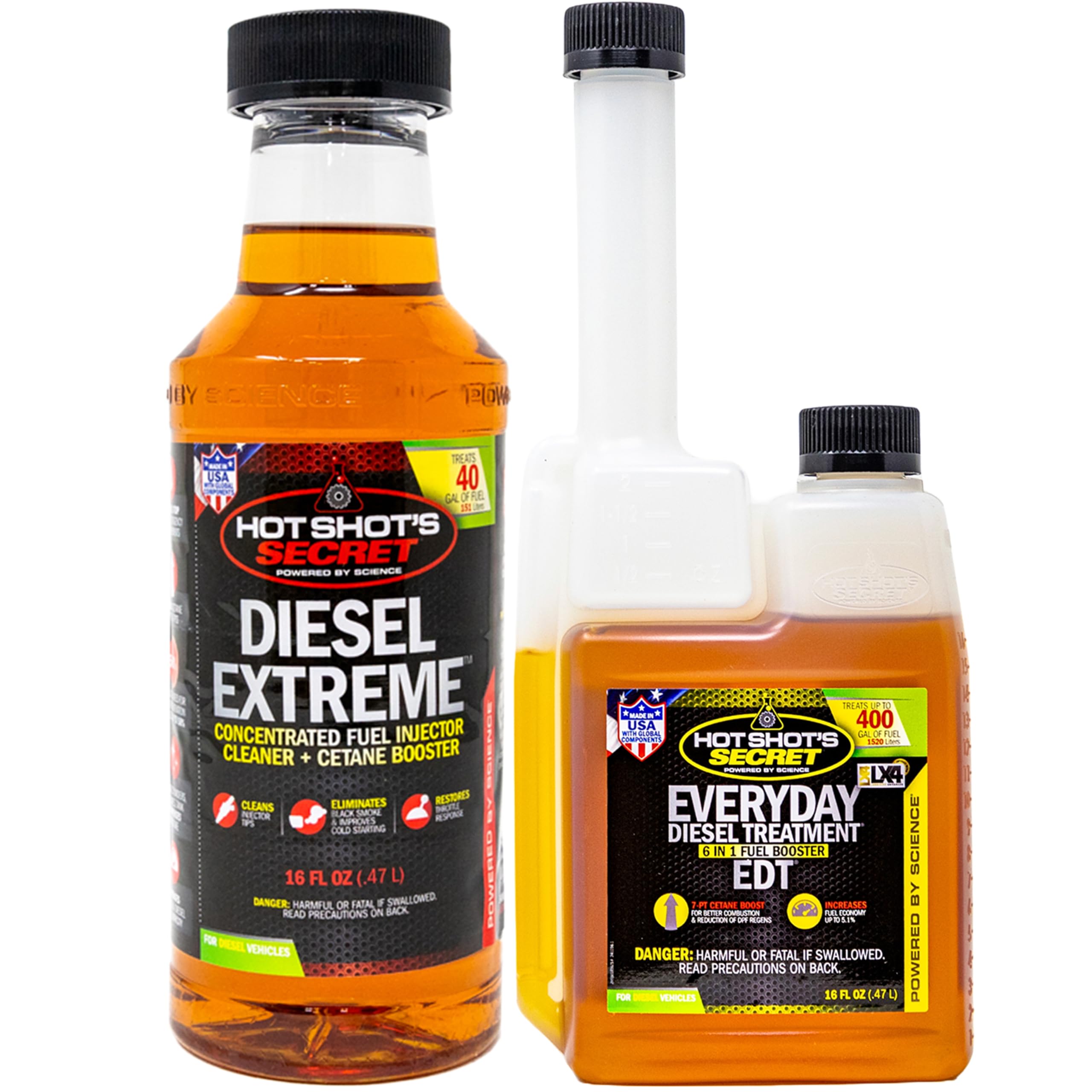
1. Hot Shot’s Secret Fuel Duo Diesel Fuel Additive Kit
Our pick — 4.5+★ from 800+ verified ratings; the strongest balance of quality and price.
The two-bottle kit that wakes up a sluggish truck and keeps it running clean.
This is the pick for the diesel owner who wants one box that handles the whole fuel path, not a single symptom. It pairs Diesel Extreme — a concentrated injector and fuel-system cleaner — with Everyday Diesel Treatment (EDT), a maintenance additive. The cleaner side clears internal and external injector deposits and restores throttle response, which is exactly the path that feeds a turbo. The maintenance side boosts the fuel’s cetane number (a measure of how readily diesel ignites) by up to 7 points, so combustion is more complete and the engine runs smoother.
What wins people over is pure effectiveness — the majority of the feedback centers on how well it works. Buyers report better truck performance and up to 2 mpg gains, with a few saying the engine “came alive” after treatment. It is rated for all diesel engines and made for diesel only — do not put it near a gasoline engine. At 2.2 pounds and 2.1 x 4.5 x 10.63 inches, the duo box sits neatly on a garage shelf between fill-ups. For comparison on bulk, it is a heavier package than the JLM 500ml bottle at 1.07 pounds, because you are getting two treatments rather than one.
The one thing to plan around is dosing — this is a maintenance-style product you add at fill-ups, not a one-and-done flush, so it rewards owners who keep using it. Some buyers also stay loyal to competing brands like Opti-Lube alongside it, so there is no cult requirement here. The honest follow-up question: will it fix a turbo that is already stuck? It cleans the fuel system feeding that turbo, which helps, but for a vanes-stuck turbo the JLM pick below is the more direct tool. The crowd favorite — 4.5+ stars across 800+ ratings — is a sound place to start for general revival.
What makes it the front-runner
- Two-part kit cleans the fuel system and maintains it
- Boosts cetane number by up to 7 points for smoother ignition
- Restores throttle response by clearing injector deposits
- Maker claims it cuts DPF regeneration cycles by up to 50 percent
Where it asks a little of you
- Maintenance dosing means repeated use, not a one-time flush
- Diesel engines only — never for gasoline
Reach for this if: you want a box that covers injectors and everyday fuel conditioning in one go, for general diesel revival.
Look elsewhere if: your turbo is already fully stuck and you need a turbo-specific treatment first.
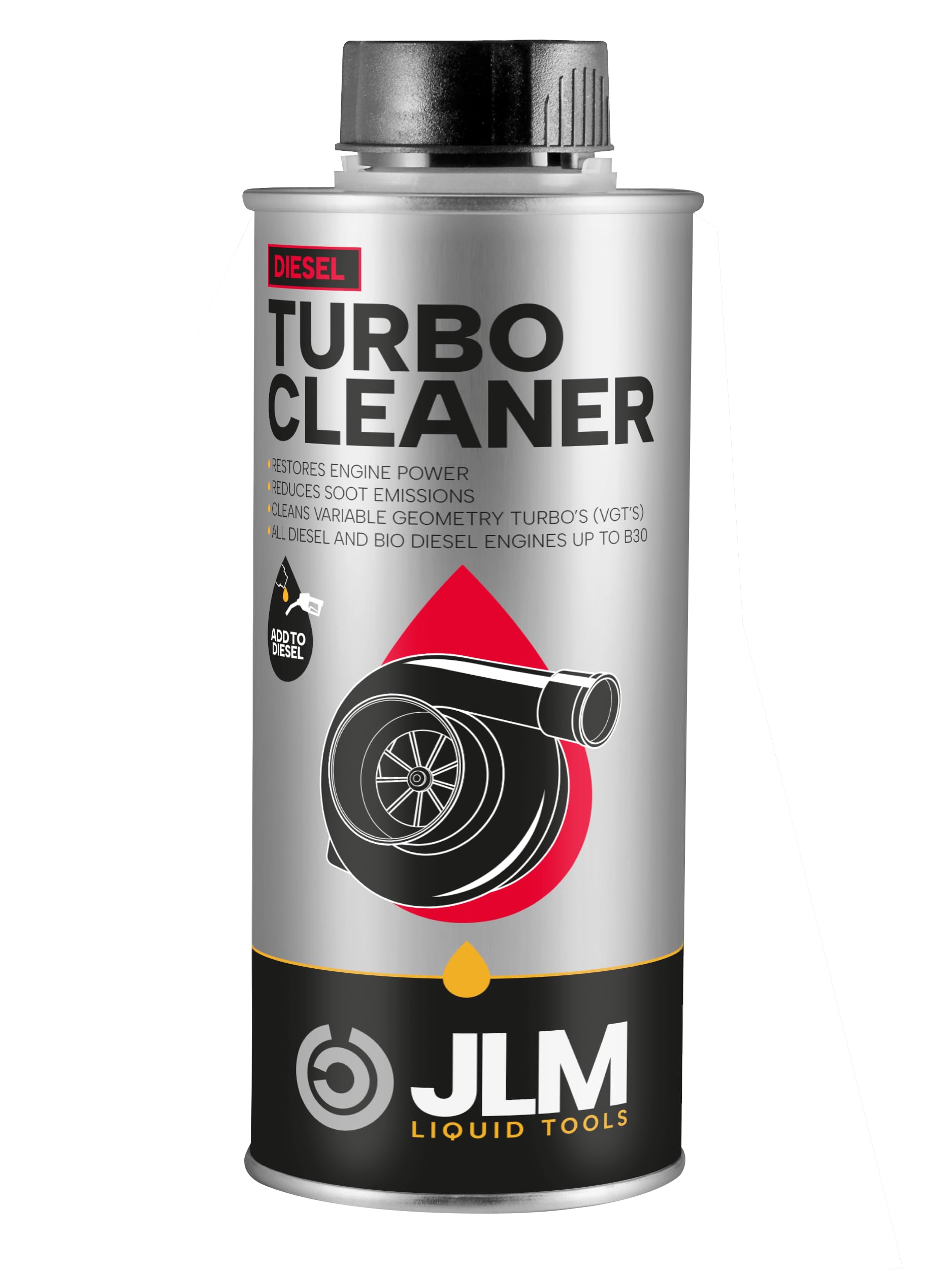
2. JLM Diesel Turbo Cleaner (500ml) – J02380
A single bottle aimed squarely at a turbo that has lost its puff.
If your diesel feels like it has “no power,” this is the fluid the symptom points to. JLM makes two claims and sticks to them: reduce soot emissions and restore engine power. There is no long feature list here — it is a targeted 500ml treatment you add to the fuel, and the job is specifically the soot that clogs a turbo and steals its response. The bottle is light at 1.07 pounds and compact at 2.95 x 6.3 x 2.95 inches, so it stores easily until you use it.
The outcome buyers chase is a turbo that spools again — restored power and better exhaust-brake and turbo response after treatment. One vehicle case sums up how to use it right: “Follow instructions and run that engine in 4th gear to hit 3000 rpm and sustain it for 30 to 40 min.” That driving routine matters. In longer road-trip accounts, owners who drove at high rpm for extended stretches came back reporting the turbo freed up, no limp mode, and no warning lights. It also sorted a Land Rover style vibration and cruise-cutting turbo issue when used on a long high-rpm trip.
The catch is real but fair: this wants a near-empty tank and a proper high-rpm run to work. Short city hops will not give it what it needs, and the improvement is often gradual rather than instant. DPF-coded trucks with a regen warning may be better served by the Rislone pick below, which targets the filter directly. This is the most turbo-specific bottle on the list, and it does one thing rather than covering maintenance.
Where it shines: a direct, turbo-named cleaner that has restored power and cleared turbos in owner accounts when driven correctly.
The fair caveat: it needs a long high-rpm drive on a near-empty tank to deliver, so it is not for a quick town run.
Best matched to: a driver with a gutless turbo and a highway trip planned.
Think twice if: you only do short city journeys — this cleaner needs the high-rpm drive to work.
3. Rislone 4744 DPF Clean

The one for the regen warning and the P242F code you keep clearing.
When the dashboard throws a P242F or the regeneration light will not stay off, the problem is soot packed into the DPF (diesel particulate filter — the canister that traps soot). This 16.9 oz bottle is built to clean the entire emissions and exhaust system, plus the fuel system, rather than just the injectors. It lowers the ignition temperature inside the DPF so the soot and particulate matter burn off more easily, which suits vehicles that do a lot of short, infrequent highway runs where a natural regen never fully happens.
Compatibility is where this one earns its keep. It is stated safe for DOC catalytic converters, DPF particulate filters, SCR selective catalytic reduction devices, and DEF systems. It works with ULSD, regular and off-road diesel, biodiesel blends B2, B5 and B20, and direct-injected, common-rail, indirect-injected, TDI and turbocharged engines. It won’t void a manufacturer’s new-vehicle warranty, and dosing every 5,000 miles keeps the system clean and the CEL from returning. Effectiveness is the thing people praise most, and owners mention results showing up after 200 miles of driving or so.
The value question is genuinely mixed — some owners feel it earns its place, others less so, and check-light outcomes vary by vehicle. Treat it as a maintenance and code-clearing tool, not a guaranteed engine-check light eraser for every fault. Compared with the Hot Shot’s kit above, which is a two-part fuel treatment, this one is more of a single DPF-and-emissions focus. For fleets and plant maintenance it is listed as a recommended use, which fits its keep-it-clean role.
Where it earns its place
- Cleans DPF, exhaust, emissions and fuel system in one bottle
- Stated safe for DOC, DPF, SCR and DEF hardware
- Clears P242F and other OBD codes (product claim)
- Won’t void a manufacturer’s new-vehicle warranty
What to weigh honestly
- Value and check-light results split opinion by vehicle
- Maintenance dosing every 5,000 miles, not a single fix
Choose this when: a DPF code and recurring regen light are your main pain.
Pass it over if: your truck has no emissions fault and simply needs a turbo power boost.
4. Liqui-Moly Diesel Purge Injection Cleaner 500 ml

Two cans of the smoke-killer for a rough-running, rattling diesel.
For an engine that smokes at startup and runs rough, the job is clearing the injectors — and that is exactly what this purge does. You get two 16.9 fl oz cans, 33.8 fluid ounces total, so one treatment now and one saved for next year’s cleaning. It goes to work on the injectors themselves, reducing smoke, noise and roughness, and getting the engine back to a smooth idle. A 2003 VW TDI comparison captures it well: rough and smoking at startup before, running perfectly smooth with no smoke after.
The stories on this one are the kind you remember. One full can poured into a fresh fuel filter and a run through varying rpm brought faster acceleration and killed the startup smoke on a 207k-mile Jetta TDI. Older and tougher iron gets moving too — “Got a 40 year old backhoe to run after we tried everything.” Owners across several TDI generations and a Cruze diesel report that mileage and response improve after using it. Effectiveness is what draws the most praise here by a clear margin.
The proviso is that it is a purge, not a permanent filter — it is best used as an annual clean rather than a turbo-vane soak. A couple of owners also use a daily treatment like Hot Shot’s for upkeep and reach for this purge when a deeper clean is due, which is a fair way to run it. If your issue is specifically DPF codes, the Rislone bottle above is the more direct match. Gloves are not included, so have your own on hand — the fluid is meant for engine and metal surfaces, not skin.
The standout result: a genuine injector purge that has smoothed out rough-running, smoking diesels from modern TDIs to a 40-year-old backhoe.
One honest note: it is a periodic deep clean, not a cure for a stuck turbo on its own, and gloves come separately.
Worth grabbing if: your diesel is smoky and rough and you want an annual injector purge.
Not the pick for: a turbo that needs freeing or a DPF that keeps coding.
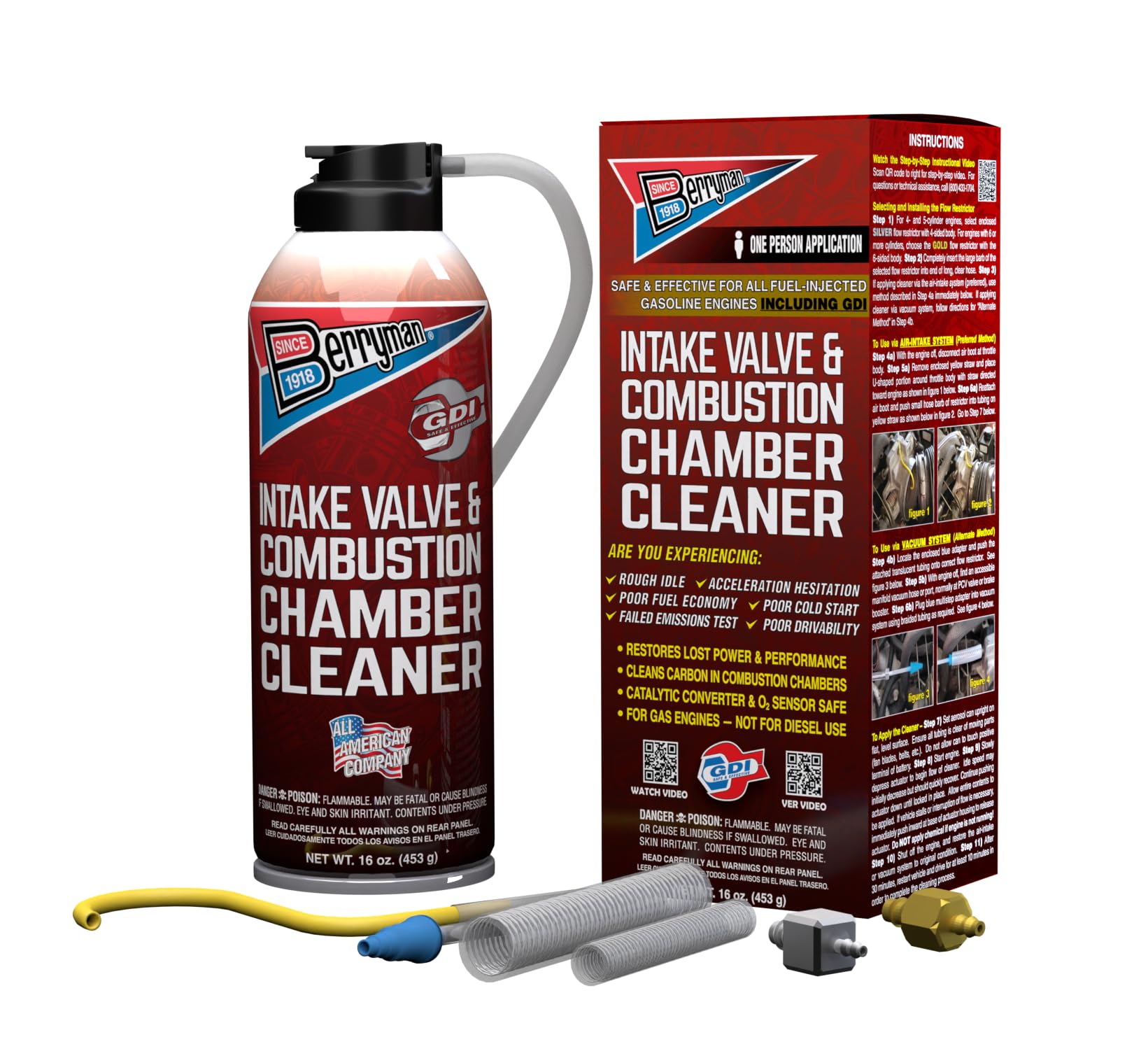
5. Berryman Products 2611 Intake Valve and Combustion Chamber Cleaner
A gasoline intake spray — read the label before you aim it at a diesel.
This one has to come with a straight warning up front: it is formulated for fuel-injected gasoline engines, including GDI, and it is explicitly not for use in diesel engines. So why is it here? Because plenty of diesel owners run a second gasoline vehicle, and plenty of readers land on turbo-cleaner pages while actually chasing carbon in a gas engine’s intake. For that job it is a serious tool — it contains polyetheramine, or PEA, a solvent that dissolves carbon buildup in combustion chambers, and it cleans all intake-valve types found in PFI, TBI and GDI engines. It is stated safe on catalytic converters and oxygen sensors.
In practice it is a self-attaching-hose aerosol with a total-release valve and an idle-speed flow, set up so one person can run it in a few minutes without stalling. The result owners chase is smoother running and sharper throttle response, sometimes with a big smoke cloud during the treatment and a rough first drive that clears. Effectiveness and ease of use are what earn the most approval here. One 2012 Jeep Liberty V6 case showed acceleration gains and an MPG bump, and a Chevy Sonic case saw a sputtering engine smooth out.
The trade-offs are visible in the same accounts: expect smoke during the process, and a first drive that may run rough with a temporary light before it clears. A pinhole leak at a kinked hose has been noted — inspect the line and shut the valve if it leaks, and keep the solvent away from your eyes. The can is 1.33 pounds at 3.5 x 3.5 x 8.2 inches, a bit taller and bulkier than the light JLM bottle at 1.07 pounds. For a gasoline intake carbon job it delivers; for a diesel turbo it is the wrong fluid entirely.
Strengths for gas engines
- PEA formula dissolves carbon in combustion chambers
- Cleans PFI, TBI and GDI intake valves
- Single-helper design runs at idle without stalling
- Stated safe on catalytic converters and oxygen sensors
Limits to respect
- Not for diesel engines — wrong fluid for a turbo diesel
- Smoke during treatment and a rough first drive are normal
- Inspect the hose; leaks have been reported
Buy it if: you have a gasoline GDI or PFI engine with carbon-buildup symptoms.
Skip it for: any diesel — this spray is gas-engine hardware only.
Know the Specs
Cetane number
Cetane measures how readily diesel fuel ignites under compression — higher cetane means quicker, more complete combustion and less delay. A product that boosts cetane by up to 7 points, like the Hot Shot’s EDT side, is aiming at smoother running and less smoke. You will see it cited as an ignition-quality number, not a power number.
DPF and regeneration
The DPF (diesel particulate filter) traps soot, then burns it off in a “regen” cycle. Short trips mean the cycle never finishes, so soot packs in and a code appears. A DPF cleaner lowers the burn-off temperature so that soot clears more easily. Regular dosing keeps the filter working instead of warning you on the dash.
Polyetheramine (PEA)
PEA is a solvent that breaks down carbon deposits in combustion chambers and on intake valves. It appears in gasoline intake cleaners and is stated safe on catalytic converters and oxygen sensors. It is a gasoline-engine chemistry, so it does not belong in a diesel fuel system.
Injection purge vs. fuel additive
A purge is a concentrated clean aimed at the injectors to clear smoke and roughness. A fuel additive is a maintenance treatment you add at fill-ups to keep the system clean. A stuck turbo may need a turbo-specific fuel treatment plus a proper high-rpm drive — the driving routine is as important as the fluid.
Common Questions
Will a diesel turbo cleaner actually free a stuck turbo?
Can I use a turbo cleaner on a truck with a DPF?
Do these cleaners work with biodiesel blends?
How long before I see results from a diesel turbo cleaner?
Is diesel turbo cleaner the same as an injector cleaner?
Will these products void my vehicle warranty?
Can I use a gasoline intake cleaner in my diesel?
How often should I add a diesel turbo or fuel cleaner?
Do I need a high-rpm drive after adding a turbo cleaner?
The Bottom Line
For most diesel owners chasing general sluggishness, the winner is the Hot Shot’s Secret Fuel Duo Kit — it cleans the fuel path and keeps it conditioned, and its 4.5+ star standing across 800+ ratings makes it the crowd favorite to start from. If your turbo is the specific problem, the JLM Diesel Turbo Cleaner points straight at soot and power and rewards a proper high-rpm drive. And when a DPF code keeps flashing, the Rislone 4744 DPF Clean is the one built for the filter, with a warranty-safe, emissions-system formula that covers the hardware your diesel already has.
How we choose
We do not accept paid placement. Every pick is matched to a real buyer and a real use-case; we do not hands-on test units.
Sources
Specifications: manufacturer listings and product documentation. Review insights: verified customer reviews, as of October 2026. Pricing: not shown on this page (it changes often); check the current price via the retailer link.
As an Amazon Associate, Aappliancez earns from qualifying purchases. This does not affect which products we feature.