Disclosure: Some links in this post are affiliate links. As an Amazon Associate I earn from qualifying purchases, at no extra cost to you. Learn more
Specs are compiled from manufacturer listings and verified buyer reviews and can change over time — please confirm the key details on the product page before buying.
The short answer: if you want the widest safety margin and the easiest learning curve, buy the Hutsuls pocket kit — you get the strop and the compound together, so you can’t get the pairing wrong. If you already own a strop and only need the abrasive, a single bar of chromium oxide or a graded diamond paste set does the job better than any bargain multi-pack. The catch most first-time buyers hit is simple: they buy a compound too coarse for their edge, or they buy paste with no strop to put it on.
This guide is built by comparing the manufacturers’ published specifications and the patterns across verified customer reviews, so you get each pick’s real strengths and trade-offs instead of marketing spin.
An abrasive bar or paste only works if it ends up on leather, wood or a buffing wheel that you already have. This breakdown covers which grit suits which steel, which formats load evenly, and where each pick falls short, so you can match a compound to your blades instead of guessing. Here is how to pick a diamond stropping compound that actually cuts and polishes instead of just smearing wax.
Top Picks


How To Choose The Best Diamond Stropping Compound
Stropping is not sharpening. A stone grinds a new bevel into the steel; a strop, charged with abrasive, straightens the fine edge that is left and buffs it to a polish. The compound is the abrasive half of that job, and picking the wrong one wastes both your money and the edge you just built.
Match the grit to the stone you finished on
A compound is a finishing step, not a repair tool. If your finest stone is roughly 1,000 grit, a 60,000-grit bar is chasing a polish your scratch pattern will not support. Roughly 3,000 to 6,000 grit is the usual hand-off point for kitchen knives and carving chisels, and the ultra-fine pastes take over from there.
This matters because grit does not gate progress on its own. Particles need to be smaller than the scratches they are meant to erase. Start a 0.5-micron paste on a bevel that still carries 1,000-grit grooves and you polish the tops of the ridges, leaving the valleys untouched.
Bars versus pastes — the real difference
A wax bar rubs onto leather like a crayon and bonds as the friction warms the surface. That makes a bar the friendliest format for a beginner, and a single bar lasts a very long time because so little transfers per pass. A paste or oil-based compound is applied sparingly and thins down, which suits buffing wheels, syringes and precise low-waste work on small parts.
Know your strop before you buy. Bars want leather or wood. Pastes want buffs, felt, cotton and cleaned leather. A jar of paste with nothing to put it on is a shelf ornament.
Grading you can actually trust
High-grit compounds are the hardest to grade honestly, because contamination with a few larger particles shows up immediately as a gouge. Lower grits are forgiving; pastes at 30,000 and above are not. Ask what particle size in microns the maker publishes. A number like 0.5 microns is checkable; a bare “80,000 grit” label with no micron figure is a marketing claim until you test it.
Side-by-Side Comparison
| Model | Best For | Format | Grit / Micron Range | Weight | Amazon |
|---|---|---|---|---|---|
| Hutsuls Pocket Knife Strop Kit★ Best Overall | Buying strop and compound as one unit | Leather strop + compound | Coarse and Fine | 3.2 ounces | Amazon |
| BeaverCraft Stropping Compound KitTwo-Bar Value | Two spare bars for a shop with several strops | 2 wax bars | 3000 grit | 4 oz | Amazon |
| Taytools Chromium Oxide Bar | Pure finishing polish on leather or wood | Single wax bar | 0.5 microns / 60000 grit | 1.2 ounces | Amazon |
| Angerstone 100g Diamond Kit | Full grit ladder from stock removal to mirror | 10 syringes of paste | 450 to 80000 grit | 6.35 ounces | Amazon |
| Tryuunion Diamond Polishing Compound | Jewelry, watch crystals and small-part polishing | 5 syringes of oil paste | 1500 to 80000 grit | 18 g | Amazon |
Detailed Reviews
1. Hutsuls Pocket Knife Strop Kit
Our pick — 4.5+★ from 450+ verified ratings; the strongest balance of quality and price.
A strop and its compound in one package, small enough to vanish into a jeans pocket.
The first thing a new stropper gets wrong is buying the abrasive and the strop separately, then discovering the bar does not bond to the leather they bought. This kit removes that failure mode entirely. It ships with a 100% genuine leather strop, a compound bar and a solid wooden base, plus a step-by-step how-to-use guide that walks a total beginner through the first pass.
What wins people over is how well the whole package actually performs together. Folding knives off a 1,000-grit diamond stone come off this leather popping hairs, and it handles carving axes, sloyd knives and hook knives just as well. The leather is described by buyers as durable without being rock-hard, which is the right balance — stiff enough to hold a flat surface, supple enough that the abrasive bites in. At 3.2 ounces it is a genuinely pocketable piece of kit, and set against the Taytools bar at 1.2 ounces you are carrying the strop as well, which is exactly why it costs you those extra grams.
It is worth knowing where this kit stops. The compound is coarse and fine rather than a graded micron figure, so if you are chasing a true mirror on a sushi knife or a straight razor you will want a dedicated ultra-fine bar later. The leather also wants an occasional conditioning to stay flat. Neither is a fault — this is an everyday honing tool, and it does that job without fuss.
What earns the top spot
- Strop, compound and wooden base arrive matched, so there is no pairing guesswork
- Double-sided 100% genuine leather gives you two working surfaces
- Includes a step-by-step how-to-use guide for first-timers
- 3.2 ounces and 7.67 inches long — fits a front pocket or a backpack side pouch
- Handles axes, broadheads, plane blades and bushcraft tools, not just pocket knives
Where it runs out of room
- Grit is listed only as coarse and fine — no micron figure to plan a sequence around
- Not the tool for a full mirror polish on razors or fine kitchen steel
- The leather needs occasional conditioning to stay flat and honest
Buy this if: you are new to stropping and want one purchase that works on the first try, or you want a field kit for camping and hunting trips.
Look past it if: you already own a good strop and only need an ultra-fine finishing abrasive.
2. BeaverCraft Stropping Compound Kit
Two soft green bars that load a strop fast and bring a dulled chisel back without a re-grind.
If you keep more than one strop loaded — one for gouges, one for knives, one for the bench chisels — a single bar runs out at exactly the wrong moment. This pack answers that with two green compounds in one purchase and throws in eBooks on stropping. The 3000-grit grade is the sensible middle ground: fine enough to polish a carving tool, coarse enough that it still does visible work on a blade that has gone slightly round.
Buyers report these bars spread easily, yield a mirror finish, and suit stainless steel and other metals. The wax behaves well in practice — soft enough to spread without a hairdryer warm-up, and it holds for a reasonable number of passes before you reapply. Wood carvers and knife owners both get along with it, and the 4 oz total means you are not rationing.
Two honest notes. The bars can arrive closer to a white or gray-green than the green shown in the photos, so judge it by the finish on your steel, not the color on the label. And if a bar sits cold, it wants a warm strop to bond properly rather than flaking off mid-pass. Store it somewhere room-temperature and both issues disappear.
The loading experience: soft wax that spreads like a crayon, bonds without much reheating, and survives a decent run of passes before it needs topping up again.
One detail to expect: the color can read closer to gray-green than the vivid green pictured, so let the polished edge be your measure of whether it is working.
Reach for this when: you want spare bars on the shelf and a 3000-grit grade that serves carvers and knife owners equally well.
Pass it by when: you are specifically after a single ultra-fine bar for mirror work — this grade sits mid-range on purpose.
3. Taytools Chromium Oxide Bar

A hard green crayon of a bar with 0.5-micron particles that turn a polished bevel into a near-mirror.
Half a micron is the number that defines this pick — that is the particle size, and it works out to a 60,000-grit edge. For scale, the BeaverCraft bars above sit at 3000 grit, so this is the last step in a sequence, not the first. You rub the 1.2-ounce bar on leather, wood or a synthetic strop like a crayon, then finish on bare leather for the cleanest result.
Quality is what the bargain hunters come back for. The waxy bar bonds to any of those surfaces without powdering, and a little covers a lot of leather, so the small footprint is not the limitation it looks like. Owners mention it cuts quickly on 63 Rockwell knife steel and leaves a polished, scalpel-like edge. Mixing in a few drops of light oil and buffing gives a very even, bonded coating if you want to stretch it further.
The plain warning is that this bar will not rescue a damaged edge. A compound this fine straightens and polishes; it cannot grind out a chip or reset a bevel. If your finest stone stops well short of the ultra-fine range, you will see a shine but not the full benefit. That is a sequence question, not a product flaw — but it is the reason this bar belongs on a shelf beside coarser abrasives rather than alone.
Why the finish crowd likes it
- 0.5-micron chromium oxide delivers a 60000-grit equivalent edge
- Works on leather, wood and synthetic strops
- Bonds by rubbing, no powdering or heat gun required
- A 1.2-ounce bar covers a lot of leather — the small size is not a shortfall
What to plan around
- Pure finishing compound — no use on chips or significant edge damage
- Wants a warm strop and an even rub to load best
- The compact bar can read smaller than expected next to a big multi-pack
This is the one for: carvers, razor owners and woodworkers whose abrasives already reach the ultra-fine range and who want the last polish done right.
Hold off if: you have not yet built a coarse-to-fine stone sequence — this bar cannot substitute for one.
4. Angerstone 100g Diamond Polishing Compound Kit
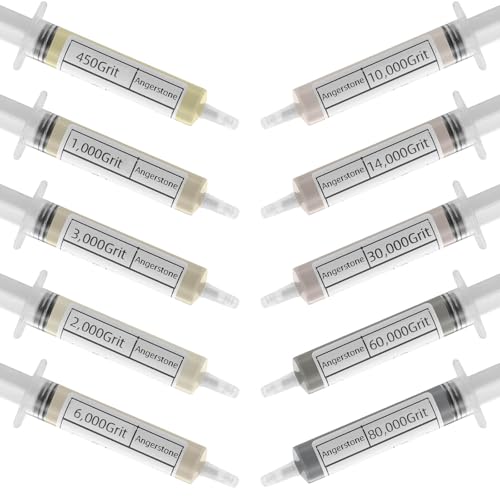
Ten tubes covering everything from 450 grit stock removal to an 80000-grit mirror polish.
Ten separate grades in a single box is the whole point here. The ladder runs 450, 1,000, 2,000, 3,000, 6,000, 10,000, 14,000, 30,000, 60,000 and 80,000 grit, which means you can walk a workpiece through the entire sequence without shopping for the next stage. Diamond is the abrasive throughout, at a stated 40% concentration, and the formula takes both oil and water carriers.
The volume is the other quiet advantage. You get 100g in total across ten tubes of 10g each, which is a lot of polishing material for one purchase. Customers note it works well on buffing wheels for knives, and the syringes let you lay down small, even dots rather than overloading a surface. If a paste feels too thick on leather or felt, a drop of water thins it so it embeds properly instead of sitting on top. It covers glass, metal, ceramics, gemstones, marble, aluminum and more besides.
The known limit sits at the top of the ladder. Reviewers point out the higher grits can carry occasional larger particles that haze or gouge soft brass, so test the finest tubes on scrap first. The lower grits, meanwhile, do exactly what they are asked. If a flawless mirror at 80,000 grit is the entire goal, treat that final stage with patience and a test pass.
What the ten grades buy you: one purchase that covers the whole sequence, so you are never stuck mid-polish waiting on the next grit to arrive.
The patience tax: the finest tubes are where contamination shows up first — a scrap test before a finished workpiece saves real frustration.
Built for: people working mixed materials — stones, glass, brass, watches — who want every grade on hand rather than buying them one at a time.
Think twice if: you only need one grade, or you are chasing an immaculate 80,000-grit mirror with no tolerance for a test pass.
5. Tryuunion Diamond Polishing Compound

Five oil-based syringes that take a scratched watch crystal from dull to glossy without a workshop.
This set is tooled for small, delicate surfaces. Five syringes cover 1500 grit for stock removal, 6000 and 12000 for fine polish, 40000 for mirror work and 80000 for the final pass — the equivalent range of 0.25 to 14 microns. The oil base washes off cleanly with water once you are done, which matters when the workpiece is a ring or a coin rather than a chisel.
Quality is what carries this one. Shoppers say it brings jewelry to a mirror finish and gives soapstone carvings a glossy polish, applied with wool buffs, leather strops, cotton swabs or a clean cloth. Buyers report a deeply scratched sapphire watch crystal clears faster than expected when worked through the grits with a rotary tool. The syringes let you apply a precise, low-waste amount.
Two limits are worth naming plainly. The syringes themselves feel like cheap plastic and the paste keeps flowing, so a light hand helps. And scratch removal is the frequent complaint — deep scratches on a pocket knife or a rock often need repeated passes on the lowest grit before the finer grades have anything to polish. It is a finishing kit, not a repair kit, and it rewards patience over pressure.
The case for the oil-based syringes
- Graded from 1500 to 80000 grit, covering 0.25 to 14 microns
- Oil base washes off with water once the work is done
- Syringes give precise, low-waste application on small parts
- Works on jewelry, watch crystals, coins, gemstones and metals
The honest caveats
- The syringe plastic feels cheap and the paste can flow faster than you want
- Deep scratches often need several lowest-grit passes before finer grades bite
- Paste alone does nothing — you need a buff, strop or cloth to work it
Point this at: rings, watch crystals, coins and gemstones — anything small, detailed and oil-tolerant.
Avoid it if: you expect a single pass to erase a deep gouge; bring patience and the low grits.
Know the Specs
Grit numbers versus microns
Grit is a count of how many abrasive particles fit a given area; microns measure a single particle across. The two move in opposite directions — a higher grit means smaller particles, and a smaller micron number is finer still. That is why a 0.5-micron bar and a 60,000-grit bar can describe the same thing. When you compare compounds, convert both to microns if you can, because a bare grit figure at the extreme end is easier to inflate than a measured particle size.
Concentration and carrier
Concentration is how much abrasive sits in the paste or bar. A stated 40% diamond concentration means four parts in ten are diamond powder; the rest is carrier that helps it spread and bond. The carrier matters as much as the abrasive — hard wax bars rub onto leather and set as they warm, while oil pastes thin down and wash off. Pick the carrier that suits the surface you already own, not the one with the bigger grit number on the label.
Particle size and contamination
On an ultra-fine compound, one oversized particle acts like a pebble under your edge and carves a visible line. This is why the top of a grit ladder is the hardest to make well. Keep each grade on its own strop or buff, wipe the workpiece between grades, and the scratch pattern stays clean. Cross-contamination between stages causes more ruined finishes than a bad compound ever does.
Stropping technique and angle
Stropping is done edge-trailing: you pull the blade away from the edge so the leather drags the steel straight rather than cutting into it. Light pressure, a flat contact and a consistent angle do the work. Press hard and the leather rounds the edge you just polished. The compound assists that motion; it cannot make up for a blade held at a wobbling angle.
Common Questions
Can I use diamond paste on the same leather strop as a chromium oxide bar?
What grit should I finish a kitchen knife at?
How long does a 1.2-ounce bar of compound last?
Will diamond compound sharpen a chipped blade?
Do I need a strop to use a polishing compound?
Is a 40% diamond concentration enough?
How do I stop diamond paste flaking off my strop?
Can diamond compound remove scratches from a watch crystal?
Does the color of a green compound tell me its grit?
The Bottom Line
For most people who have never stropped before, the Hutsuls Pocket Knife Strop Kit is the right buy because everything arrives matched — the leather, the compound and the guide — so there is no wrong pairing to make. If you own a strop and want the last polish in a sequence, reach for the Taytools Chromium Oxide Bar; at 0.5 microns and 60000 grit, it is the finest finish on this list. And for a full grit ladder in one box, the Angerstone 100g Diamond Kit covers 450 through 80000 grit so you never stop mid-polish.
How we choose
We do not accept paid placement. Every pick is matched to a real buyer and a real use-case; we do not hands-on test units.
Sources
Specifications: manufacturer listings and product documentation. Review insights: verified customer reviews, as of October 2026. Pricing: not shown on this page (it changes often); check the current price via the retailer link.
As an Amazon Associate, Aappliancez earns from qualifying purchases. This does not affect which products we feature.