Disclosure: Some links in this post are affiliate links. As an Amazon Associate I earn from qualifying purchases, at no extra cost to you. Learn more
Specs are compiled from manufacturer listings and verified buyer reviews and can change over time — please confirm the key details on the product page before buying.
If your knives and chisels drag through food or wood instead of slicing it, the fastest fix is a diamond plate — a steel plate coated in diamond grit (tiny diamond particles) that cuts hard steel flat and stays flat. The picks below cover three real jobs: kitchen knives, woodworking chisels, and pocket knives on the trail. Want one self-contained bench unit with three surfaces? Start with the Smith’s Tri-Hone.
This guide is built by comparing the manufacturers’ published specifications and the patterns across verified customer reviews, so you get each pick’s real strengths and trade-offs instead of marketing spin.
A diamond plate works dry, needs no soaking, and never dishes out of shape the way a water stone can. To pick well you only need to match the grit range and plate size to the blades you actually own: diamond sharpening stone set.
Top Picks

How To Choose The Best Diamond Sharpening Stone Set
The wrong assumption most beginners bring here is that a diamond stone is just a fancier whetstone. It is not the same tool at all. A diamond plate is a steel slab with diamond grit bonded to the outside, so it cuts hard steel quickly, works without oil or a long soak, and holds its flatness. That flatness is the whole point: a dished, hollowed stone can never give you a straight edge.
Match the grit pair to the job you actually do
Grit is just a measure of how coarse the diamond particles are — a lower number cuts faster and leaves a rougher edge, a higher number polishes. A coarse side around 325 grit is for repairing chips and reshaping a badly worn bevel. A fine side in the 600 to 1200 range is what you use for the weekly touch-up that keeps a knife slicing cleanly. A set that skips the coarse end can’t rescue a damaged blade, and a set with only coarse will never finish an edge nicely.
Plate size decides which blades you can sharpen
A full-size plate of roughly 8 inches by 3 inches gives a chef’s knife room to run the whole edge across in one stroke. A pocket-sized hone is for touching up a hunting knife on a log or a lathe tool at the bench. Be honest about which one you are. If most of your sharpening is kitchen knives at home, a large plate earns its place. If it is field repair, small is the whole advantage.
Decide if you want a guide or freehand
An angle guide is a small wedge or holder that props the blade at a fixed tilt so your bevel stays consistent. It genuinely helps a beginner, and several of these sets include one. But experienced hands often set it aside because a guide can collect metal dust and scratch the blade face. Neither approach is wrong, so pick the style you will actually keep using.
Side-by-Side Comparison
| Model | Best For | Grit Range | Plate Size | Weight | Amazon |
|---|---|---|---|---|---|
| Smith’s 50448 Diamond Tri-Hone★ Best Overall | One self-contained bench unit | Coarse, Fine, Natural Arkansas | 3 stones at 6″ x 1.63″ | 1.4 lb | Amazon |
| DMT DuoSharp 8″ Double-SidedBest for Kitchen Knives | Kitchen knives and shop tools | 325 / 600 | 8″ bench stone | 516 g | Amazon |
| DMT DiaSharp Mini-Hone Kit (D2K) | Field and pocket carry | 325 / 600 / 1200 | 2.5″ hones | 1.6 oz each | Amazon |
| Saker Chisel Sharpening Jig | Chisels and plane irons | Super Fine | 0.2″–2.55″ blade width | 1.1 lb | Amazon |
| SHARPAL 168H 8″ x 3″ | Hard super steels | 325 / 1000 | 8″ x 3″ | 0.62 kg | Amazon |
| Goodjob 3-Sided 400/600/1000 | Beginners wanting three grits | 400 / 600 / 1000 | Extra large 3-sided | 2.4 lb | Amazon |
| Schaaf Tools 325/1200 | Chisels plus knives in one kit | 325 / 1200 | 8″ x 2.75″ | 2.1 lb | Amazon |
Detailed Reviews
1. Smith’s 50448 6” Diamond Tri-Hone Stone Sharpening System
Our pick — 4.5+★ from 400+ verified ratings; the strongest balance of quality and price.
Three stones on a rotating base, so you never hunt for the next grit mid-job.
What you get here is a complete sharpening station rather than a bare plate. It carries one coarse diamond stone, one fine diamond stone, and one Natural Arkansas stone, all three measuring 6” x 1.63” and colour coded so you can tell them apart at a glance. The whole thing sits on a moulded plastic base with nonskid rubber feet, so it stays put while you push a blade across it. For a home cook or a hunter who wants one box that does everything, that combination is hard to argue with.
The reason it takes the top spot is the kit around the stones. You get a sharpening angle guide that keeps your bevel at a correct tilt every time, a “V” trough that catches oil drippings, and a 1 oz bottle of Honing Solution included in the box. The diamond stones use an interrupted surface — small gaps in the diamond coating that speed cutting — plus a micro-tool pad for knife tips and small cutting tools. Buyers report roughly 10 swipes per side per surface gets a razor edge on a kitchen knife. The rotation between stones is the quiet luxury: coarse to fine to Arkansas without lifting anything off the bench.
Do size this against your knives. The 6” stone is happiest with pocket, fillet, hunting, and standard kitchen blades, and it will feel cramped on a long slicer. The Arkansas stone and the base connection are the two spots to treat gently — a few of these arrive with the top stone only lightly attached, and a dab of glue fixes it for good. The base can also shift slightly under a hard forward push if you really lean on it.
What earns it the top slot
- Three surfaces — coarse diamond, fine diamond, Natural Arkansas — in one bench unit
- Includes an angle guide and a 1 oz bottle of Honing Solution, so you can start the same day
- Nonskid rubber feet and a “V” trough keep oil contained and the base steady
- Interrupted diamond surface plus a micro-tool pad covers knife tips and small tools
Where it asks for care
- 6” stones feel short under a long kitchen slicer
- Arkansas stone can arrive only lightly fixed to the base — easy to re-glue
- Base can creep a little under a heavy forward push
Made for: the buyer who wants one box that handles kitchen knives, hunting blades, and the odd pair of scissors without buying three separate tools.
Think twice if: your main blade is a long chef’s knife that needs an 8-inch runway — the DMT DuoSharp below gives you that.
2. DMT DuoSharp Double-Sided Diamond Whetstone 8 Inches
Two diamond surfaces, one long slab — a chipped chef’s knife back to slicing in about five minutes.
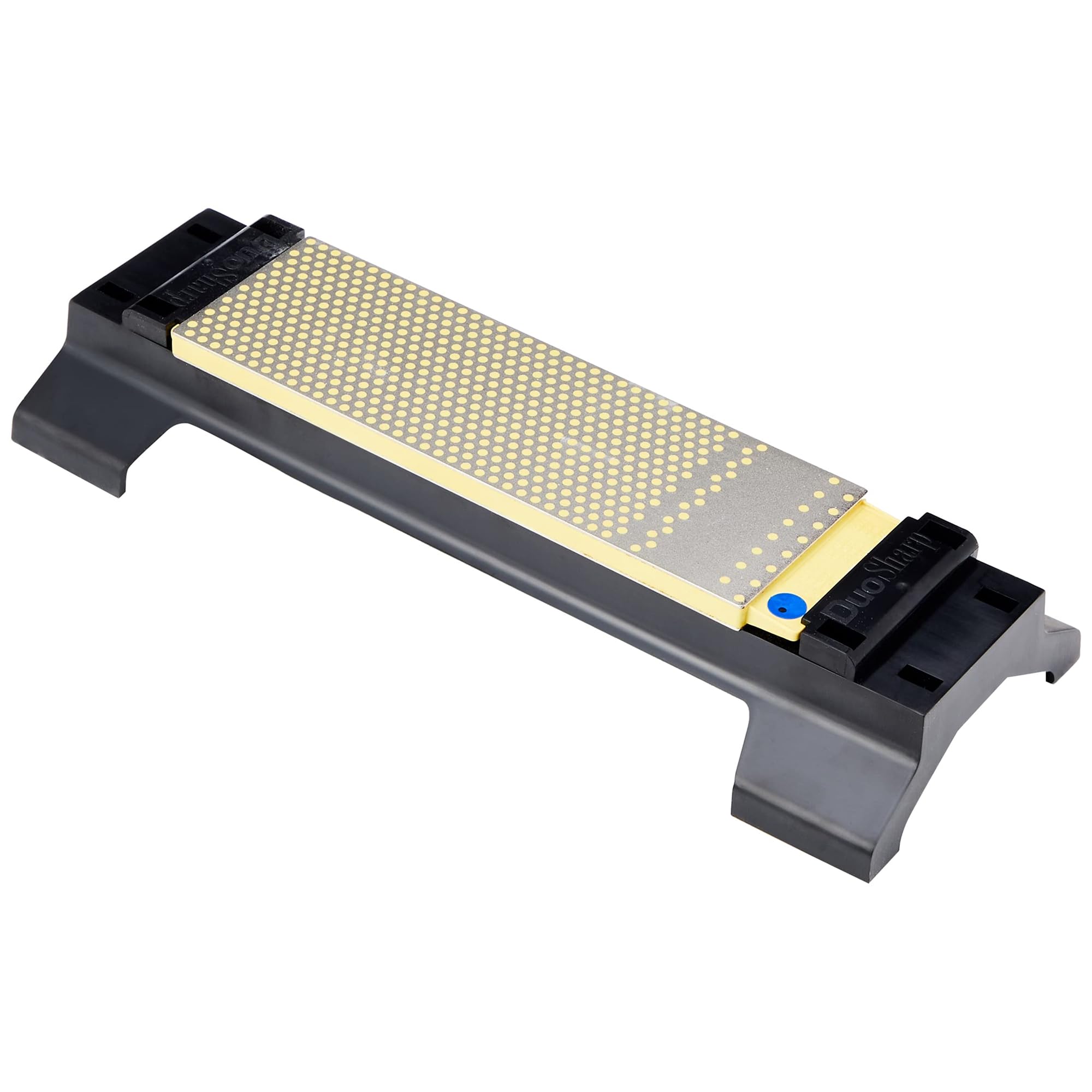
This is the plate that gives you room if you sharpen at the kitchen counter. The 8-inch diamond surface handles a full chef’s knife and a paring knife without you running off the end. The coarse side is 45 micron / 325 mesh (a grit rating — lower numbers cut faster) for restoring a dull or chipped edge. The fine side is 25 micron / 600 mesh for honing it to a finished edge. Owners mention it brings a dull chef’s knife back to razor sharp in roughly five minutes. On size, this sits on a completely different scale from the Smith’s — the DMT lists item dimensions of 13.25″L x 13.25″W x 11.5″H against the Smith’s 8.9″L x 3″W x 3.05″H, so plan real counter space for it.
The diamond is micronized monocrystalline, bonded in DMT’s signature polka-dot pattern — those tiny wells trap metal debris so fresh diamond stays in contact with the edge. The base is stable with rubber feet, and clips hold the stone flat and firm so it does not slide while you work. It sharpens dry or with a splash of water, which means no oil mess and no soaking. That matters if you sharpen in short bursts between cooking tasks. Owners regularly describe it as the best bench stone they have used, and heavy users report it outlasting several cheap plates.
One honest limit: the coarse side needs patience on seriously damaged knives. It removes material steadily but not brutally, and a deeply chipped blade may want an even coarser grit first. There is a reason for the restraint — light pressure on this plate preserves blade steel instead of grinding it away, which is exactly what you want on a good knife. Treat it as a finishing tool that can also do repair, not a belt grinder in a box.
The size advantage: an 8-inch diamond zone means one continuous stroke across a chef’s knife, so your bevel stays even from heel to tip.
The measured trade-off: deep chips take time on the 325 side — expect to work at it rather than watch it vanish.
Reach for this if: home kitchen knives are your main job and you want one serious plate that will still be flat years from now.
Look elsewhere if: you sharpen at a campsite or a job site — this one wants a bench under it.
3. DMT DiaSharp Diamond Mini-Hone Kit D2K
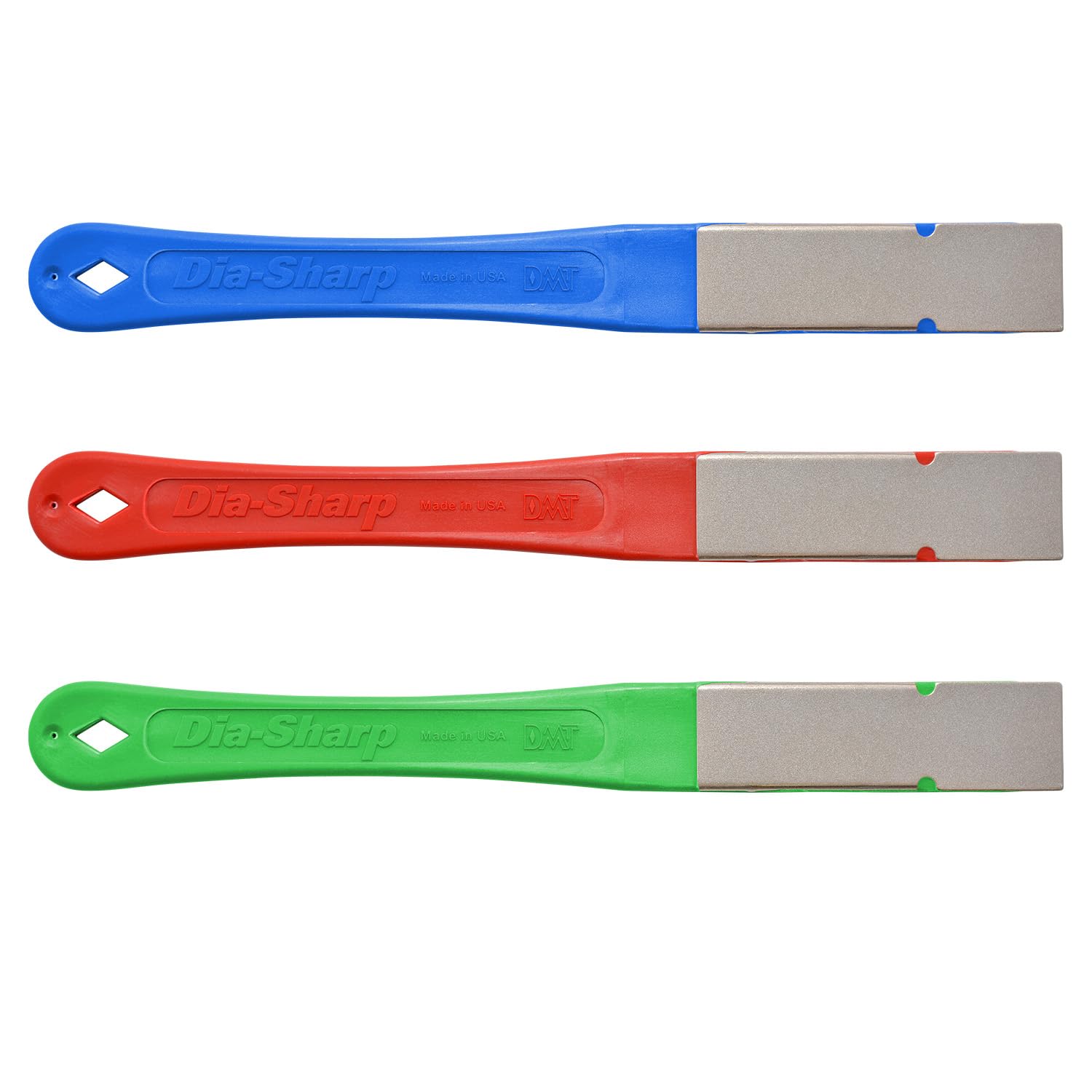
Three grits that live in a jacket pocket and still bring a blade back on the trail.
A 1.6 oz stone is the entire pitch. Each of the three hones in this kit weighs only 1.6 ounces and slips into a pocket, which is the difference between sharpening your knife on a trip and living with a dull one until you get home. You get coarse at 45 micron / 325 mesh for neglected edges, fine at 25 micron / 600 mesh for the working edge, and extra-fine at 9 micron / 1200 mesh for polishing and refining. They are colour coded so you can grab the right one by feel in low light. Sharpen dry or with water — no oil bottle to pack.
Where this set earns its keep is versatility. It handles hardened tool steel, lathe tools, and small blades with equal ease, and the compact size is ideal for tips and fine-point work where a full plate would be overkill. The monocrystalline diamond is securely bonded, and the dotted pattern keeps the surface clear so it cuts fast and consistently. Woodturners and hunters both tend to keep a set in the bag for exactly this reason.
Set your expectations on the handles, though. These are lightweight, skinny hones meant to be held in the fingers, and they feel insubstantial next to a full bench stone. That is not a fault so much as the design brief — portability has a cost in hand-filling mass. Every so often the extra-fine surface can arrive looking uneven, with visible clusters in the grit. It does not stop the stone working, but it is worth a look when yours arrives. And while plenty of buyers consider the kit money well spent, the per-stone value math is less kind than on a large plate.
Why it goes in the pack
- Three grits (325, 600, 1200) in a kit that fits a pocket
- Each hone weighs just 1.6 oz
- Works dry or with water — nothing else to carry
- Colour coding makes grit selection instant
The honest caveats
- Light, thin handles feel flimsy next to a bench stone
- Occasional unit shows inconsistent grit on the extra-fine surface
Built for: the hunter, angler, or turner who needs a real edge away from the bench and will not carry a full plate.
Not the pick if: all your sharpening happens at home over a big chef’s knife — buy plate size instead.
4. Saker Chisel Sharpening Jig

A honing guide that clamps a chisel square and rolls it flat — no more rounded bevels.
Chisels are where freehand sharpening falls apart. A blade 0.2 to 2.55 inches wide has to sit perfectly square on the stone or you grind a skewed, rounded bevel that no amount of practice fixes. This jig solves that by locking the blade in place with a metal stud and letting you roll it on a wide bearings-based roller at the bottom. Adjust the distance between the top of the chisel and the guide and you set the bevel angle. The upgraded off-centre roller design helps with shorter planer blades, which are notoriously hard to hold. The body is aluminium alloy — heavy enough to hold most chisels steady and, per the maker, rust-free.
Woodworkers who put it to work on a set of neglected Stanley chisels came away with gleaming, even edges after working through grits on a two-sided stone. The roller rotates smoothly with no flat spot and cleans up easily. The flared base stays stable under hard downward and rolling force, and the tight clamp keeps square-edged chisels from twisting. If you already own a diamond plate and want your chisels and plane irons to hit a repeatable angle, this is the piece that turns a stone into a sharpening system.
Now the parts that need saying plainly. The instructions are thin — you get a paper showing the blade projection needed for specific chisel angles, and that is about it. Some blades sit slightly off-square in the clamp, so check yours before you commit to a stroke. And the diamond substrate on the included stone needs to be broken in first: scrub an old blade flat across it before you trust it on a good chisel. Keep the metal dry before you store it, or the steel will rust.
The wide-roller win: a broad bearings roller gives the guide stability that narrow-roller jigs lack, so short planer blades do not tip mid-stroke.
Pick it when: your chisels and plane irons keep coming out uneven and you want a repeatable angle without years of freehand practice.
Pass if: you only sharpen knives — the clamp is sized for square-edged woodworking blades.
5. SHARPAL 168H Diamond Sharpening Stone
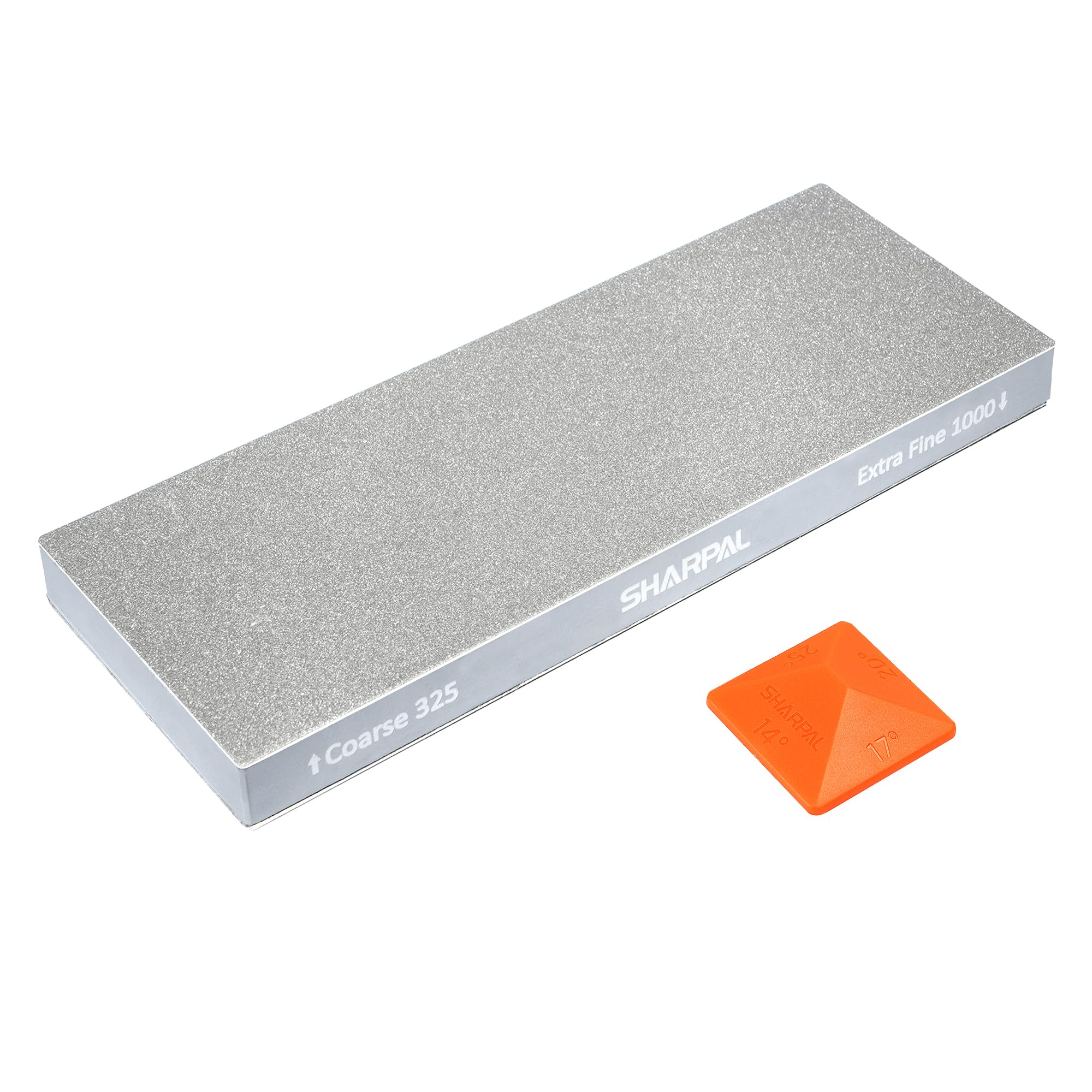
A flatness tolerance of plus or minus 0.002 inch — this plate means exactly what it says.
Hard super steels are the reason this stone exists. Steels like CPM-series, M390, and Elmax chew up softer stones, but diamond cuts them without flinching. This plate pairs a 325 grit (45 micron) coarse side for restoring dull edges with a 1000 grit (15 micron) extra-fine side for the finished edge. The 8″ x 3″ working surface gives a full chef’s knife a proper runway. And the MirrorFlat technology holds flatness to within ±0.002 inch (0.05 mm), so every stroke contacts the same plane and your edge geometry stays true.
The construction details are what separate it. The monocrystalline diamond is anchored by a three-times electroplating process that controls how far the abrasive sits proud of the surface — that is what keeps the cutting face consistently sharp instead of stripping bare. You get a 4-angle guide marked at 14°, 17°, 20°, and 25° so you can set your bevel to a known angle, plus a non-slip pad that keeps the stone planted and protects your counter. It sharpens dry with no mess. Customers note about two minutes to restore a badly angled edge, which is fast work by any measure.
Two things to weigh. The 1000 side is a strong choice for touch-ups on kitchen knives, but this plate works best as a maintenance and light-repair stone — a truly wrecked blade wants the coarse side and patience. And the stone does load up with metal quickly, which makes cleaning the one chore in the routine; brush it and vacuum the residue rather than rinsing with water. A few buyers also find the plate too thin to hand-hold for large knives and build a simple wooden holder to improve it.
Where it pulls ahead
- Precision flat to ±0.002 inch for even, repeatable edge contact
- Dual 325/1000 grit covers repair through finishing on one plate
- Bundled 4-angle guide (14°, 17°, 20°, 25°) and non-slip pad
- Handles hard super steels that defeat softer stones
What to expect
- Loads up and needs regular cleaning — brush and vacuum, not water
- Too thin for confident hand-holding on big kitchen blades
- Works as a maintenance stone more than a heavy repair tool
Choose this for: a precise, flat, single-plate sharpener for kitchen and shop knives, especially if you work in hard super steels.
skip it if: you want a thick stone you can grip in one hand without a holder.
6. Goodjob Diamond Sharpening Stone 3-Sided
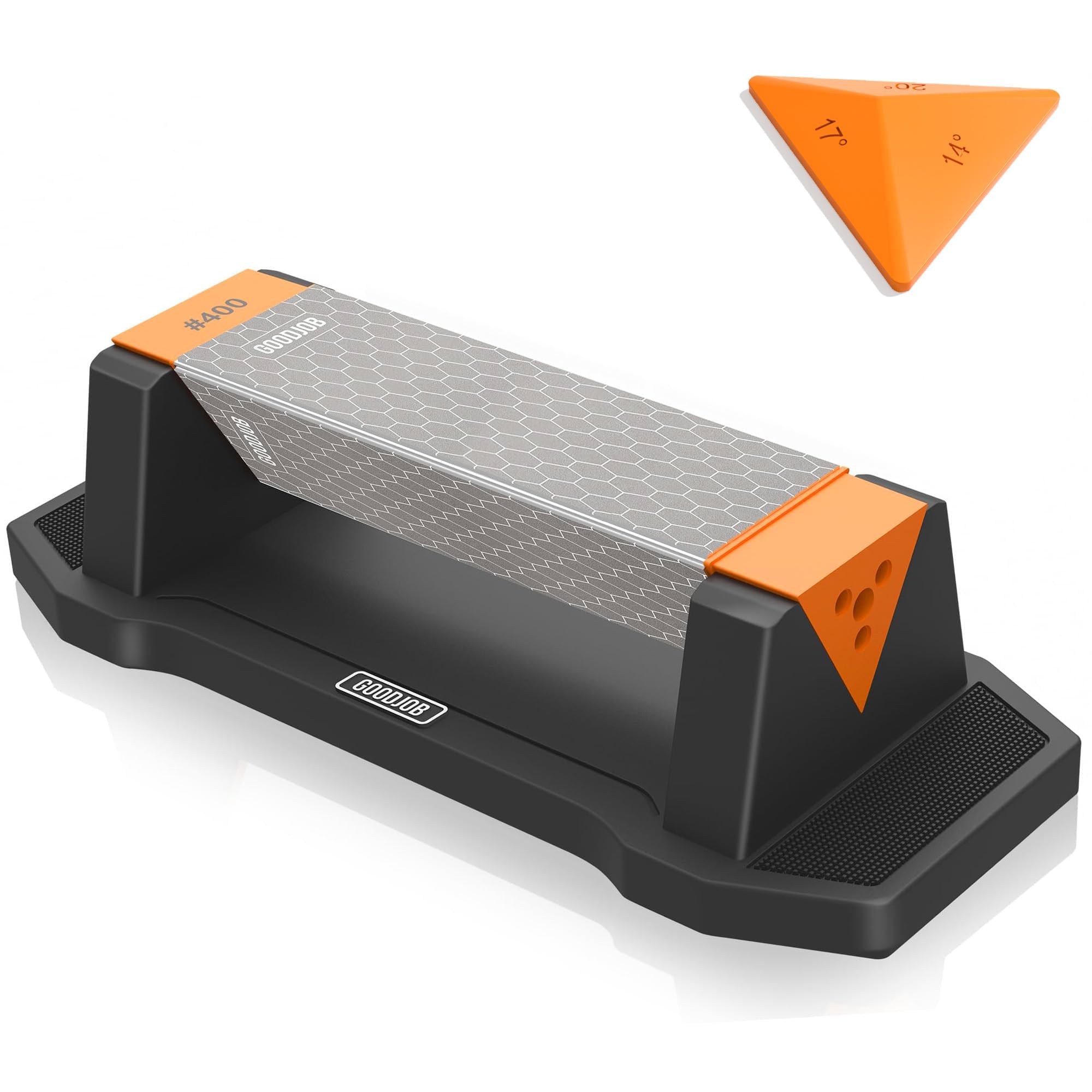
Three grits stacked on one block, with a non-slip base wide enough to keep it planted.
Three gradations in one block is a genuinely useful format for a beginner. This set stacks a 400 grit side for repairing large gaps and restoring basic sharpness, a 600 grit side for routine maintenance and honing, and a 1000 grit side for fine polishing. That covers the whole arc from a nicked blade to a finished edge without swapping stones. It is a 2.4 lb unit on a wide non-slip plastic base, with an angle guide marked 14/17/20° to hold a consistent tilt. It works with water or honing oil and cleans up with either.
Where it shines is the whole-hardness claim: the diamond handles steels of varying hardness, so it does not care whether you are touching up a cheap kitchen knife or a harder alloy. Woodworkers and cooks both find the coarse diamond useful for reshaping a bevel, say from 20° down to 17°, while the fine side finishes the edge keenly enough that some owners skip the strop. The block stays put under pressure, and the angle guide gives a clear read on your bevel angle as you work. The unit carries a 3-year after-sales service, which makes it a low-risk first bench stone.
The one thing to plan for is the base — it is larger than the plate and roughly football-sized in footprint, so give it storage space rather than a crowded drawer. The angle finder is useful for feel, but metal and diamond dust can collect in it and scratch a polished blade, so use it to set your tilt and then work freehand. And while this is a solid beginner set, a high-volume sharpener who grinds daily would be better served by a heavier-duty plate.
The 3-grit logic: 400 for repair, 600 for maintenance, 1000 for polish — one block, no juggling between steps.
The storage catch: the base footprint is much bigger than the plate itself, so set aside real shelf room before you commit.
Good fit for: a beginner who wants all three grits in one place and a base that will not dance around the counter.
Look past it if: you sharpen professionally every day and need a plate built for constant heavy use.
7. Schaaf Tools Diamond Sharpening Stone, 325/1200
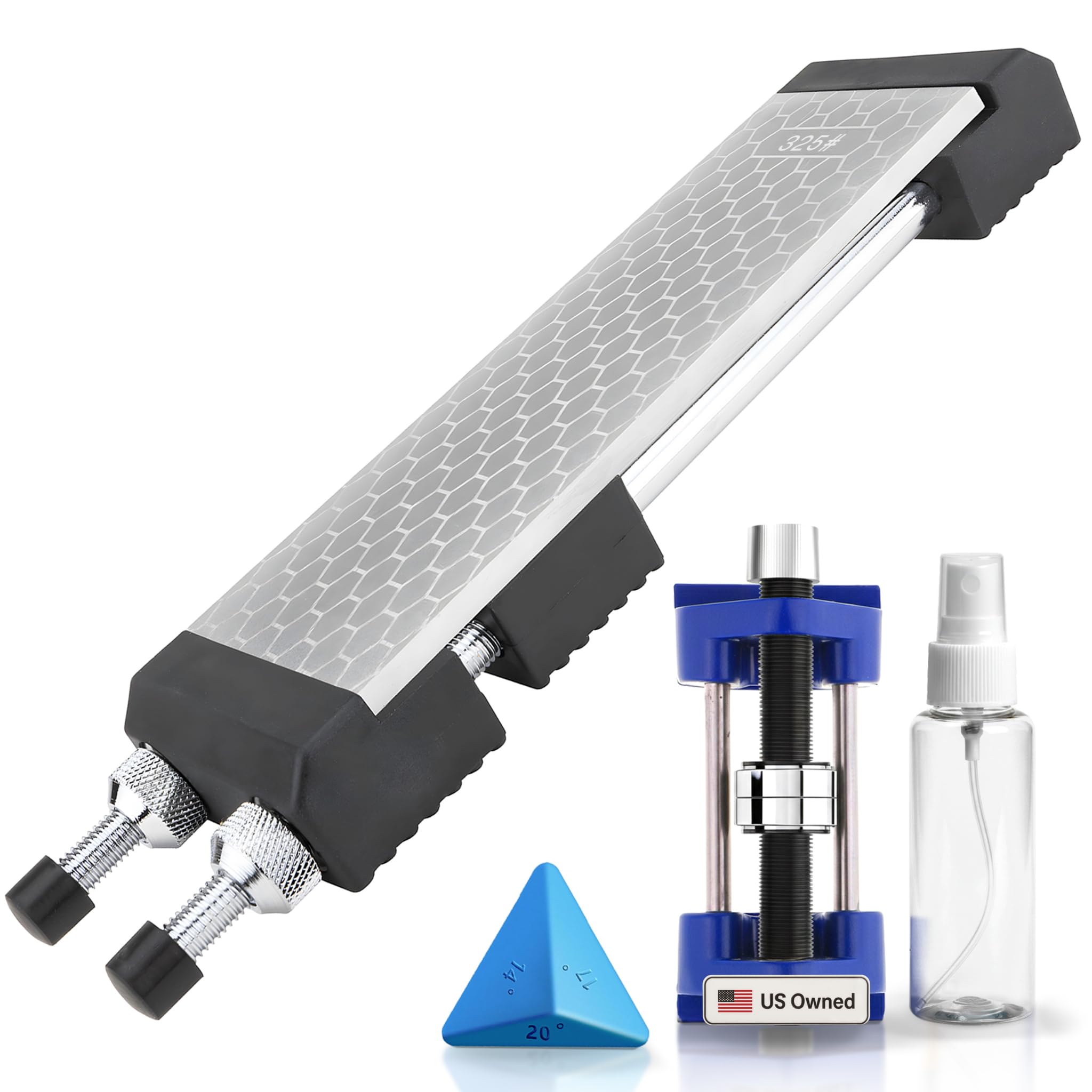
One box that sharpens chisels, plane irons, and knives — jig, guide, and spray bottle included.
Woodworkers get the most complete kit here. The 8″ x 2.75″ dual-grit plate pairs 325 coarse with 1200 extra fine (two grit ratings — one for reshaping, one for polishing). The box also throws in an adjustable base, a 3-sided knife angle guide marked 14°/17°/20° (three preset sharpening angles), a chisel sharpening jig for chisels 1/8″ to 1-7/8″ and plane irons 1-3/8″ to 3-1/8″, and a spray bottle for wetting the surface. That is a full sharpening setup in one purchase rather than a pile of separate parts. The plate itself is 8 inches long, long enough for a kitchen knife and every chisel in a standard set.
The build is why it holds up. Diamonds are electroplated onto a solid steel plate, and a honeycomb surface pattern keeps swarf from clogging the cutting face while the plate stays flat. It works with a light water spray — no soaking required, so you can pull it out and sharpen in the middle of a project. Owners put it through real work: three chipped ceramic knives brought to a paper-cutting edge in about fifteen minutes each, and two bench plane blades taken to razor sharp in about ten minutes each with a honing guide. The adjustable holder with non-slip rubber feet keeps the plate steady, and the included angle reference charts walk you through grit progression.
The trade-offs are small but real. A couple of units arrive with a slight hollow on the 1200 side, though a strop refines those light scratches out. The coarse 325 side is fast on repair, but you may find yourself leaning on the fine side for most touch-ups. And the chisel jig is only as good as your technique — a novice still will not hit razor sharpness on the first try. Learn the projection numbers and give it a few passes before you judge it.
The full kit read: a plate, a base, an angle guide, a chisel jig, and a spray bottle — everything needed for both knives and woodworking blades, which is rare in this category.
The one niggle: the 1200 side can arrive with a faint hollow, so plan to break it in with a strop.
Best match for: a woodworker who wants to sharpen chisels, plane irons, and knives from one kit with the jig already included.
Not ideal if: you only touch up kitchen knives and would rather not pay for the chisel jig you will never use.
Know the Specs
Grit (325 vs 1000 vs 1200)
Grit is the size of the diamond particles — a lower number cuts faster and rougher, a higher number polishes finer. A coarse 325 side is for reshaping a worn bevel or grinding out a chip; a 1000 or 1200 side is for finishing and daily touch-ups. That is why the best sets bracket both ends: repair on one face, refine on the other. If a set lists only one grit, ask yourself whether you ever need to rescue a damaged edge.
Surface Flatness and the Interrupted Pattern
Diamond plates stay flat by nature, but exact flatness still matters — SHARPAL publishes a ±0.002 inch (0.05 mm) tolerance so every stroke hits the same plane. The other spec to notice is the interrupted or dotted surface: small wells of missing diamond trap metal debris and keep fresh grit in contact with the edge. A honeycomb pattern does the same job on the Schaaf plate. It is why diamond cuts cleanly without the loading problems of a solid abrasive.
Plate Size and Working Room
Plate size is about how much blade you can lay down at once. An 8-inch plate lets a chef’s knife run heel to tip in one stroke; a 2.5-inch mini-hone is for tips and field touch-ups only. Match the size to your longest common blade, not your shortest. And check the base footprint, not just the stone — some bases are much wider than the plate and need storage room.
Angle Guides and Honing Jigs
An angle guide props the blade at a fixed tilt (common settings are 14°, 17°, 20°, and 25°) so your bevel stays consistent. A honing jig goes further, clamping chisels and plane irons square and rolling them flat for a repeatable edge. Guides help beginners and freehand sharpeners alike; experienced hands often set them aside. The honest rule: a guide only helps if you actually use it and learn from it.
Common Questions
Do diamond sharpening stones need oil or water?
What grit should I use for a dull kitchen knife?
How long does a diamond sharpening stone last?
Do diamond stones stay flat like I need for a chisel?
Can a diamond stone sharpen already-hardened tool steel?
How wide a chisel can a honing guide hold?
Should I use an angle guide or sharpen freehand?
How do I clean metal swarf off a diamond plate?
Is a full-size diamond plate worth it over a small hone?
Can diamond plates sharpen ceramic knives or glass-hard blades?
The Bottom Line
Want one box that handles kitchen knives, hunting blades, and the odd chisel without juggling separate tools? The Smith’s 50448 Diamond Tri-Hone is the winner — three surfaces, a rotating base, an angle guide, and a 1 oz bottle of honing solution included. For a long kitchen knife and a serious bench stone that stays flat, grab the DMT DuoSharp 8-inch. And if your sharpening happens on a trail or a job site, the DMT DiaSharp Mini-Hone Kit is the pocket-sized answer. One low-risk way to start: the Tri-Hone has built a strong, consistent reputation across hundreds of owners at 4.5+ stars — a complete three-stone bench unit is the safest first buy for most people.
How we choose
We do not accept paid placement. Every pick is matched to a real buyer and a real use-case; we do not hands-on test units.
Sources
Specifications: manufacturer listings and product documentation. Review insights: verified customer reviews, as of October 2026. Pricing: not shown on this page (it changes often); check the current price via the retailer link.
As an Amazon Associate, Aappliancez earns from qualifying purchases. This does not affect which products we feature.