Disclosure: Some links in this post are affiliate links. As an Amazon Associate I earn from qualifying purchases, at no extra cost to you. Learn more
Specs are compiled from manufacturer listings and verified buyer reviews and can change over time — please confirm the key details on the product page before buying.
Thatch is the brown, spongy layer of dead grass sitting between your green blades and the soil, and once it thickens, water and fertilizer stop reaching the roots. The right dethatcher pulls that layer out in a few passes instead of a full weekend on your knees with a rake. Below you get eleven machines across three real jobs: walk-behind corded units for typical suburban lawns, and tow-behind rigs for acreage, with the specs that actually decide which one fits your yard.
This guide is built by comparing the manufacturers’ published specifications and the patterns across verified customer reviews, so you get each pick’s real strengths and trade-offs instead of marketing spin.
The picks below span 12.6- to 48-inch widths, so there is a machine for a small suburban lot and one for acreage.
Top Picks


How To Choose The Best Dethatcher
Most buyers get this wrong by shopping on price alone, then discovering their new machine fills a bag every ten feet or cannot reach the depth their soil needs. Start with your lawn’s square footage and how thick the thatch layer is, then narrow by width and depth settings.
Match cutting width to how much lawn you own
Cutting width is the strip of grass the machine cleans in one pass. A 12.6-inch unit like the Sun Joe trims a narrow lane and needs more laps around a big yard. A 16-inch machine like the BILT HARD or the EVEAGE covers more ground per pass, which matters once your lawn runs past a quarter acre.
Read motor amps like a muscle rating
Amps measure how hard the motor can push through resistance. A 12-amp motor handles routine thatch on a maintained lawn, while a 15-amp motor keeps its speed through dense, matted buildup. Higher amps also pair with more RPM, so the tines strike faster and finish sooner.
Know your tines from your scarifying blades
Dethatching tines are spring-steel fingers that rake dead grass up and out. Scarifying blades are sharper and slice shallow grooves into the soil so seed and water can settle in. Most 2-in-1 machines ship with both, and you swap the cylinder in seconds on the ones that use a quick-lock knob.
Plan for the bag, or plan to rake
Every corded unit here collects debris in a rear bag, but those bags fill fast in heavy thatch. Many owners simply run bagless and rake or mow up the debris afterward. Decide now if you want bag convenience for a light lawn or don’t mind a follow-up pass on a thick one.
Side-by-Side Comparison
| Model | Best For | Cutting Width | Motor | Style | Amazon |
|---|---|---|---|---|---|
| WEN DT1315★ Best Overall | All-around walk-behind | 15 inches | 13 amp / 3300 RPM | Corded walk-behind | Amazon |
| SOYUS SY-DS01Budget Starter | First-time buyers on a budget | 13 inches | 12 amp / 3000 RPM | Corded walk-behind | Amazon |
| SENIX SCE13-MBig Bag Pick | Big bag on a mid lawn | 15 inches | 13 amp | Corded walk-behind | Amazon |
| Westinghouse W13ADAC | Storage and maneuverability | 13 inches | 12 amp / 3300 RPM | Corded walk-behind | Amazon |
| Sun Joe AJ798E | Small to mid-sized lawns | 12.6 inches | 12 amp | Corded walk-behind | Amazon |
| BILT HARD TIA-1002 | Widest corded pass | 16 inches | 15 amp / 3300 RPM | Corded walk-behind | Amazon |
| BUCOTOD WR5028 | Speed on larger lawns | 16 inches | 15 amp / 3500 RPM | Corded walk-behind | Amazon |
| CRAFTSMAN CMXGZBF7124315 | Tractor owners on home lawns | 40 inches | Tow-behind | Tow behind | Amazon |
| Suchtale 48-Inch | Steel build on a budget | 48 inches | Tow-behind | Tow behind | Amazon |
| EVEAGE SCJ | Thick thatch on a big yard | 16 inches | 15 amp / 3300 RPM | Corded walk-behind | Amazon |
| Brinly DT-480BH-A2 | Acreage behind a riding mower | 48 inches | Tow-behind | Tow behind | Amazon |
Detailed Reviews
1. WEN DT1315 Dethatcher
Our pick — 4.5+★ from 500+ verified ratings; the strongest balance of quality and price.
A 15-inch corded machine that rakes a 2000-square-foot yard in a single afternoon and still folds into a corner.
The WEN DT1315 is the pick that keeps coming up when owners compare notes, and the numbers explain why. You get a 13-amp motor that spins up to 3300 RPM (revs per minute, the speed the tines strike the grass) across a 15-inch clearing path. Stack that against the SOYUS, which runs a 12-amp motor and 3000 RPM over a 13-inch cut, and the WEN posts a 10% speed edge and 2 more inches of width so you walk fewer laps.
Two heads come in the box. The dethatching cylinder carries 24 steel tines (springy metal fingers that comb dead grass up and out) and the scarifying head holds 16 blades that slice shallow grooves into the soil so air, water and fertilizer reach the roots. A 5-position height lever ranges from a +1/4 to -1/2-inch raking depth, so you can start gentle on a thin lawn and go aggressive on a matted one. The two-year warranty covers the motor.
The detachable thatch bag holds 12 gallons, and here is where the honest caveat sits. Compare it to the SENIX at 13.2 gallons and the WEN’s bag is the smaller of the two, so on a thick first pass you will be dumping it often — expect to keep a bucket or tarp nearby. That is the trade-off the review pages flag most: the collection bag fills fast on heavy thatch. Given a 4.5+ star record across 500+ owners, most buyers treat the bag as a minor annoyance next to how cleanly the machine lifts a season of dead grass.
What works
- 15-inch path and 3300 RPM clear a 2000-square-foot yard in one session.
- Dethatcher and scarifier heads swap out in seconds with a single bolt and the included tools.
- 5-position depth from +1/4 to -1/2 inch lets you tune aggression to the lawn.
- Automatic overload shutdown protects the motor if the tines jam.
Where it asks a little back
- 12-gallon bag is smaller than the SENIX’s 13.2-gallon, so it fills fast on heavy thatch.
- The cord is a nuisance to manage on long rows compared with a gas unit.
Grab this one if: you own a typical suburban lawn and want the all-rounder with the widest head and the most trusted track record on this list.
Pause if: you are dethatching an acre — you want a wide tow-behind like the Brinly instead.
2. SOYUS 13-Inch Dethatcher
The entry ticket into powered dethatching — a 12-amp motor and a 13-inch cut that beat a rented machine on cost and effort.
At 12 amps and 13 inches, it is the cheapest way to try powered dethatching before spending on a wider machine.
Two heads come included. The dethatching blade pulls thick layers of dead grass and the scarifying blade cuts the surface roots so new growth can push through. It also doubles as a rake on its highest setting, scooping leaves and thatch into the bag instead of making a second chore. The 30L collection bag (roughly 8 gallons) reduces how often you dump, though owners still empty it every pass on heavy thatch.
Understand what the cash savings cost you. The bag runs small and the 13-inch head is slower moving than a 15-inch machine, so a large lawn turns into a long session. There is also a little plastic in the build — treat the depth lever gently, as it can pinch your hand if you are careless. As a first dethatcher, its 12-amp motor and 13-inch cut handle a small-to-medium yard for a season without the premium price.
Where it lands: a genuinely capable starter that turns a rented-machine chore into an owned one, at the low end of the price ladder.
The honest limit: that small bag and 13-inch width mean it wants small-to-medium lawns, not acreage.
Start here if: you are testing the dethatching waters and want the proof that a corded machine beats hand raking before spending up.
Step up if: your lawn is broad — the extra width of a 15 or 16-inch unit saves real time.
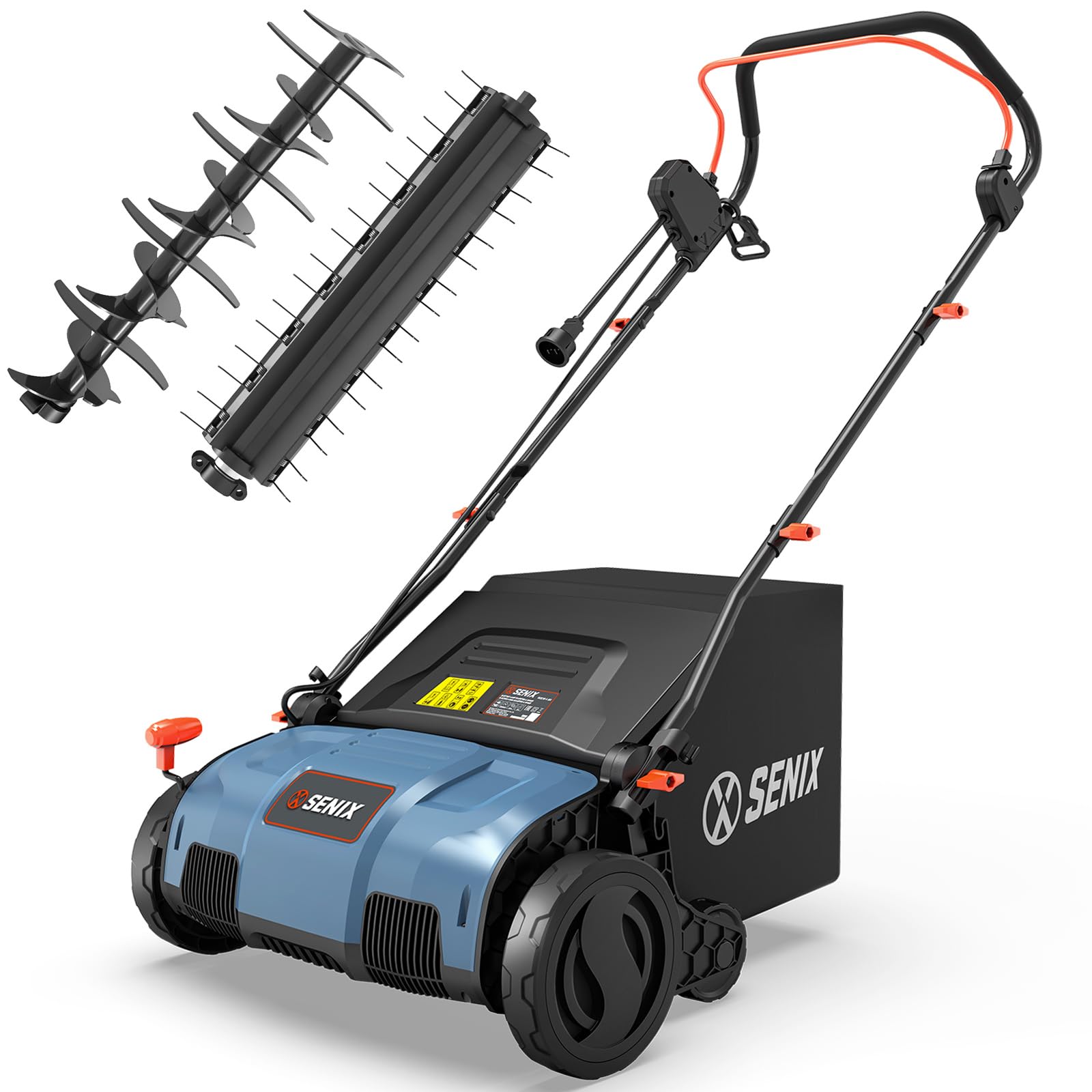
3. SENIX SCE13-M Dethatcher
The widest collection bag in the walk-behind group means fewer dump stops on a matted lawn.
If your thinnest patience is for emptying a bag, the SENIX SCE13-M answers that directly. It carries a 13.2-gallon collection bag, the largest walk-behind bag on this list, and slots a 13-amp motor into a 15-inch cutting path — an amp above the SOYUS’s 12-amp and 2 inches wider than its 13-inch cut. That extra capacity and width add up to fewer stops on a lawn that has not been touched in a few seasons.
The dethatching side runs 24 durable 1.5mm spring steel tines at a fixed 0.4-inch height for combing dead grass out, and a dedicated scarifying cylinder holds 26 sharp blades that slice the soil surface at 0.4 inches to prep for overseeding. The 5-position depth control lets you dial the aggression, and the quick-fold handle brings the whole thing down for storage.
One point a buyer should weigh honestly: the bag fills quickly on heavy growth, and a few owners find the assembly fiddly and the plastic-heavy build less than premium. Choose it knowing the 3-year limited warranty and SGS certification back the frame, and the light 24.8-pound body is easy to push through a busy afternoon. On a mid-size lawn, the 13.2-gallon bag and 15-inch cut mean fewer dump stops per session.
Biggest appeal: that 13.2-gallon bag — the largest of any walk-behind here — plus a 3-year limited warranty that outruns most of the group.
The catch: expect a quick fill on thick thatch and a build that leans plastic, so store it out of the weather.
Choose it for: a mid-size lawn where a bigger bag and a longer warranty are worth more than the absolute lowest price.
Look past it if: you need a pro-grade metal machine — this one is a capable home unit, not a commercial tool.
4. Westinghouse 13″ Dethatcher
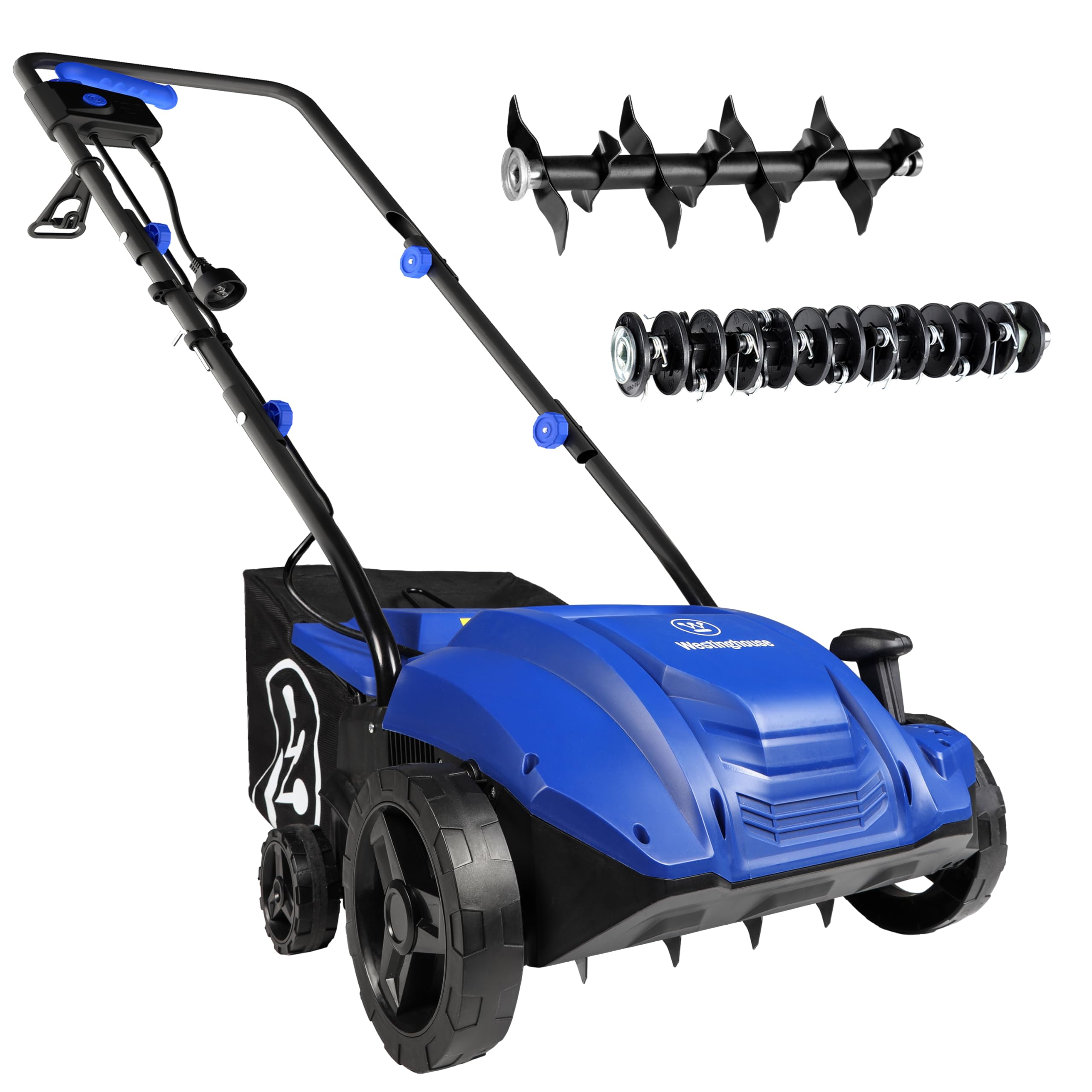
A tidy 22.9-pound machine with a folding handle that lifts off a shelf, does the job and disappears again.
Not every yard needs a workhorse. The Westinghouse pairs a 12-amp motor spinning up to 3300 RPM with a 13-inch working path, and the whole thing weighs 22.9 pounds with a folding handle. It is easy to lift onto a shelf or into a corner of the garage between uses — that storage convenience is its real reason to exist. Two heads do the work: a 20-tine dethatching head that rakes buried thatch out, and a 16-blade scarifier that slices narrow channels into compacted soil for water and air. Swapping heads takes seconds.
The 4-position depth runs from -0.5 to +0.16 inches, so you can leave it light for a maintenance rake or drop it deep for a spring reset. A rear collection bag catches the debris to cut down raking. A 2-year limited warranty and lifetime technical support from Westinghouse back the motor.
Weigh the limits before you buy. The 8-gallon bag is the smallest on this list and fills in a short 2-foot pass on thick thatch, so many owners simply run it bagless and mow up the debris afterward. It also bogs down and wants extra passes on dense growth. On a small yard with light-to-medium thatch, its 22.9-pound body and folding handle store where a 16-inch unit will not fit.
Strong at: fitting into a tight garage and lifting onto a shelf, thanks to that 22.9-pound weight and folding handle.
Not for: heavy thatch or a big yard — the 8-gallon bag and 12-amp motor want lighter duty.
Reach for this if: storage is tight and your yard is small, so a light, maneuverable machine wins over raw power.
Think bigger if: you have a broad lawn and thick buildup — go for a 15 or 16-inch unit.
5. Sun Joe AJ798E Dethatcher
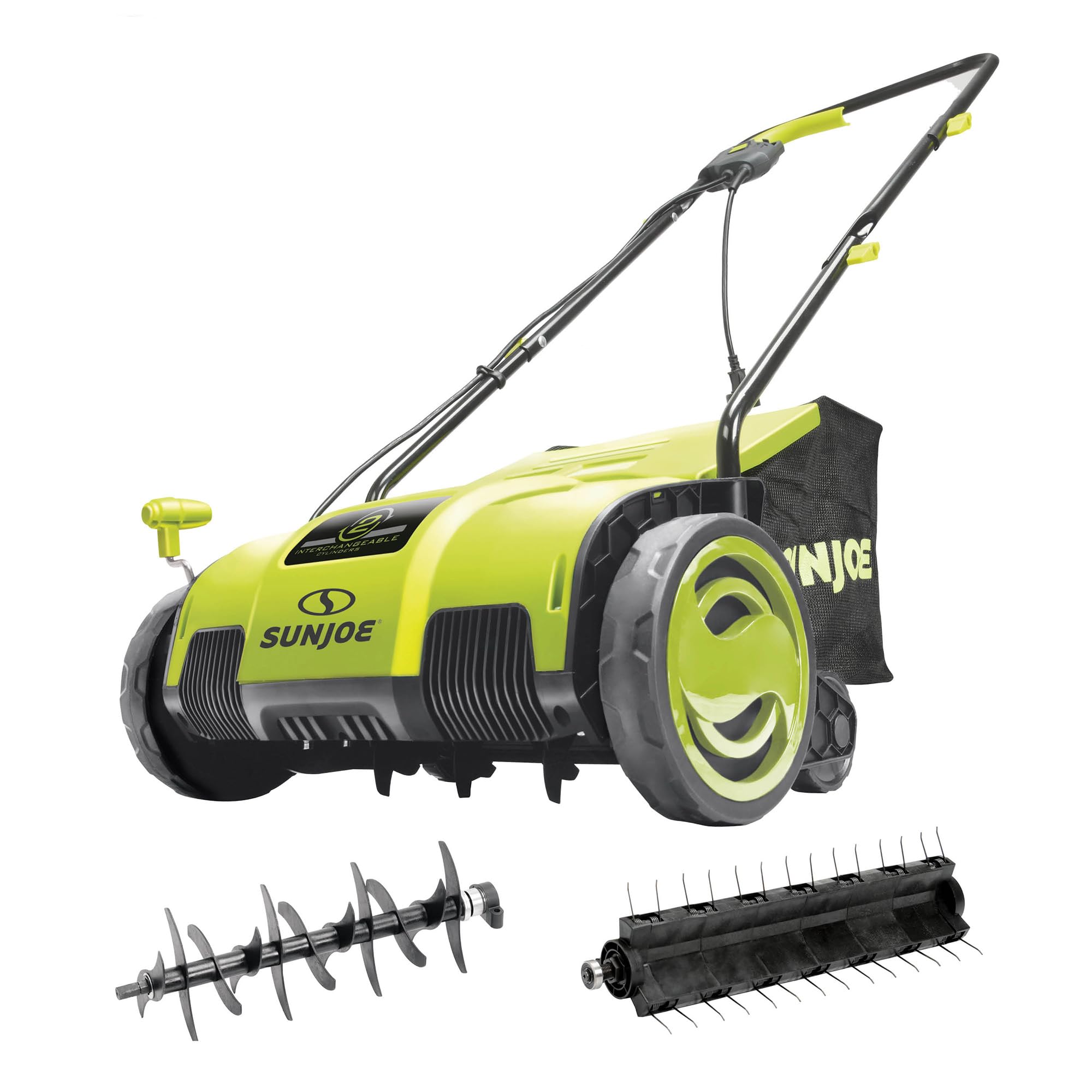
A 12.6-inch cut with AirBoost tines that clear 800 square feet of dead grass in about two hours.
The Sun Joe AJ798E is the machine owners reach for on small to mid-size lawns. A 12-amp motor clears a 12.6-inch wide path in one pass — narrower than the 15 or 16-inch units here, but paired with a light 21-pound body that is easy to steer through tight beds. The spring steel tines carry what Sun Joe calls AirBoost technology, which is a design that boost how much thatch the tines pick up while pulling airflow through the grass to help the roots.
A 5-position depth lever lets you go from a light rake to a deeper scarify to match what your lawn needs, and the removable 8-gallon bag catches the debris. Buyers report it scarifying 800 square feet in roughly two hours, grooving the soil for seeding without stressing the live grass underneath.
Be fair about the weak spots. That 8-gallon bag fills on a single long pass, so plan to empty it often, and the plastic-heavy body is DIY-grade rather than commercial. Treat it well and it delivers real value on a manageable lawn — the brand backs the motor with a 2-year warranty. Two scarifying passes a season on an 800-square-foot lawn is all this 12-amp corded unit needs to justify its price.
The case for it
- 12.6-inch path and 12-amp motor handle small to mid-size lawns cleanly.
- 5-position depth adjustment spans light raking to a deeper scarify.
- Light 21-pound body and 2-year warranty keep it easy to live with.
The fine print
- 8-gallon bag fills fast, so expect frequent stops on heavy thatch.
- Mostly plastic build is home-grade, not commercial-grade.
Best fit for: a homeowner scarifying a small-to-mid lawn who wants proven brand support behind an affordable machine.
Not the one if: you are covering a large plot — the 12.6-inch width makes for slow going.
6. BILT HARD 16 Inch Dethatcher Scarifier, 15 Amp Copper Motor
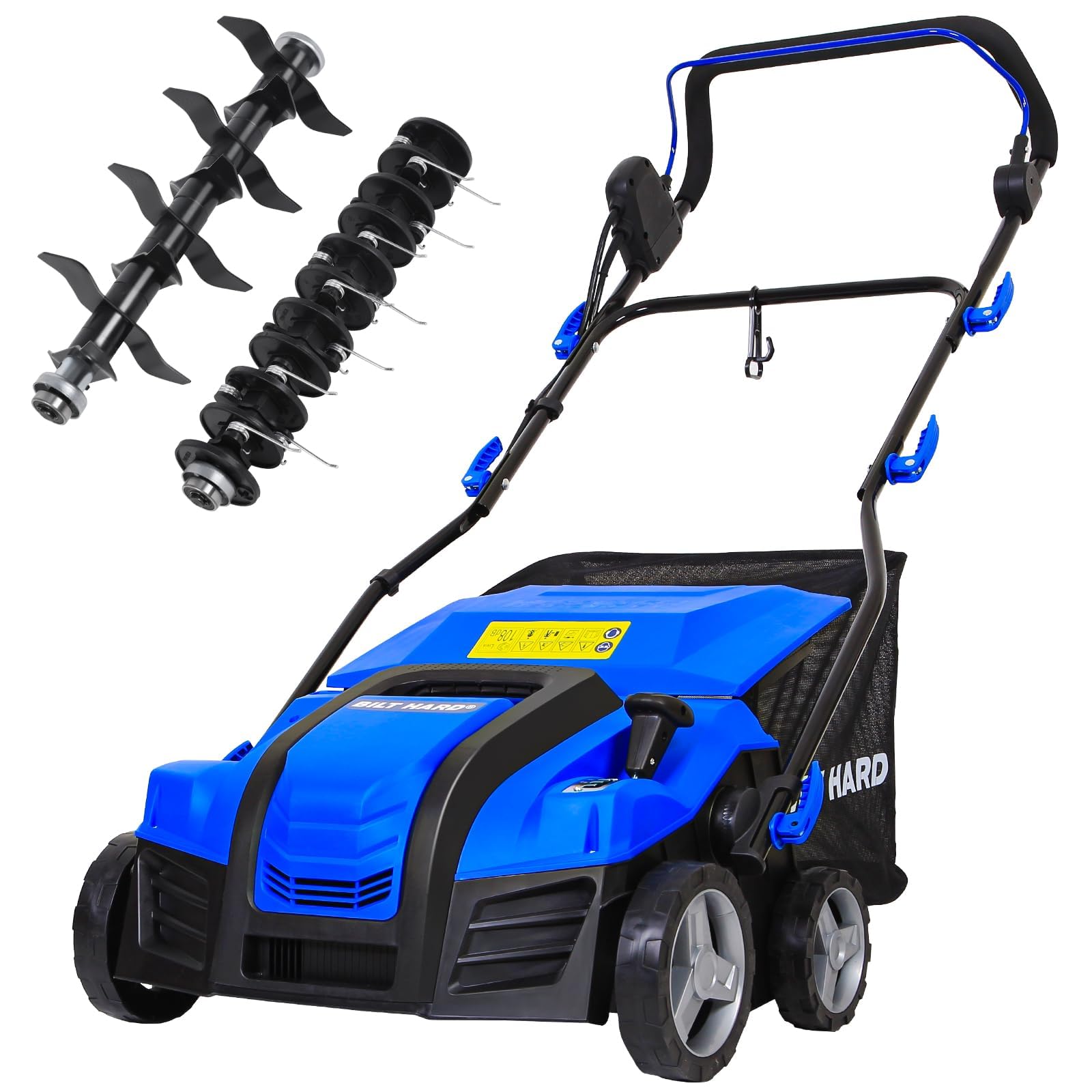
A 16-inch, 15-amp machine that turns a full-lawn dethatching session into a once-a-year errand.
When lawn coverage is the game, width and amps decide it. The BILT HARD runs a 15-amp copper motor up to 3300 RPM across a 16-inch raking path — the widest corded pass on this list alongside the BUCOTOD and the EVEAGE. That extra width shortens the number of laps, and the 15-amp motor holds speed through thick buildup. It swaps between a 20-tine dethatching roller and a 16-blade scarifying roller, and a tool-free quick-lock knob makes the swap fast.
The 14.5-gallon removable bag catches debris, and 7-inch front and 6-inch rear flat-free wheels keep it tracking across uneven ground. A 5-position depth lever ranges from -0.47 to 0.24 inches, so you can rake light or slice deeper for overseeding. Mowing first is recommended to help the tines reach the soil.
Here is the reality check. The bag is genuinely useful on a light lawn, but on heavy thatch the tines lack the suction of a mower, so it fills quickly and some owners run bagless and rake the debris up after. The corded setup also calls for cord management you will not have to think about with a gas machine. For yards under a quarter acre, though, this is among the most efficient corded picks — 16 inches of width and 15 amps of push at a home-friendly build.
Why it stands out: 16-inch width plus a 15-amp motor makes it one of the fastest corded walk-behinds here, and that big 14.5-gallon bag holds a lot before a dump.
What to plan around: the bag fills fast on heavy thatch and the cord needs managing — run bagless and rake if your buildup is thick.
Pick it up for: a quarter-acre or smaller lawn where the wide pass and 15-amp motor save real time each season.
skip it if: you want something you can walk away from without a cord — this is a plug-in machine through and through.
7. BUCOTOD 16″ Dethatcher

The highest no-load speed in the group — a 15-amp motor spinning up to 3500 RPM over 16 inches.
Speed fanatics will like this one. The BUCOTOD’s 15-amp motor tops out at a 3500 RPM no-load speed, quicker than the 3300 RPM on the BILT HARD and WEN and the 3000 RPM on the SOYUS, and it drives a 16-inch rake path. On a lawn where thatch has built up over years, that faster strike rate chews through the layer with fewer passes.
Two interchangeable heads let you dethatch or scarify, and the 5-position lever ranges from -0.47 to 0.4 inches for seasonal flexibility. The 55L collection bag is one of the largest in the corded group, so you walk off more ground before each dump. Two switches guard against accidental starts, and a 3-position adjustable rod fits different user heights.
One honest note from the ownership experience: some units develop a high-pitched whine over time, though it does not affect performance. The bag, large as it is, still fills fast on bad thatch — owners empty it every 10 to 20 feet on a neglected lawn and often run bagless. For a year of buildup on a normal yard, though, the 3500 RPM and 16-inch width make short work of it.
Fastest head here: 3500 RPM beats every other corded unit on this list, and the 55L bag is among the largest.
Worth knowing: a whine can develop on some units, and the big bag still fills fast on heavy thatch.
Suits you if: you want the quickest corded pass available and value a large bag for a medium-to-large yard.
Reconsider if: a quiet machine matters to you — the reported whine is a real trade-off.
8. CRAFTSMAN CMXGZBF7124315 Dethatcher

A 40-inch tow-behind that hooks to any lawn tractor and rakes a whole yard without a single extension cord.
If you already own a lawn tractor, a tow-behind makes more sense than a corded walk-behind. The CRAFTSMAN CMXGZBF7124315 spans 40 inches of working width with 20 spring steel tines and an automatic raking action that lifts dead grass and debris so you can mow or mulch it away. A universal hitch attaches to any lawn tractor regardless of brand, and a cantilever transport handle raises and lowers the tines without you leaving the seat. A weight tray holds up to 70 pounds to push the tines deeper into the lawn.
The trade-off buyers should know is assembly. The build is solid and the raking works — owners clean up crabgrass and thick thatch in a single pass once it is set — but some find putting it together one of the more demanding jobs in the group. The upside of a 3-year limited warranty and a made-in-the-USA build softens that. One tip from using it: add some weight for deeper penetration, but not too much or it bounces off balance.
The CRAFTSMAN best suits a homeowner with a rider and a home-lawn-sized plot. It does not need a battery or a cord, just a hitch and a little patience at assembly time, and then it turns dethatching into a drive around the yard.
What it brings
- 40-inch working width with 20 spring steel tines clears a home lawn fast behind a tractor.
- Universal hitch fits any lawn tractor brand, and the transport handle lifts the tines from the seat.
- 70-pound weight tray pushes the tines deeper; 3-year limited warranty backs the frame.
What you give up
- Assembly is the sticking point — set aside real time and follow the instructions in order.
- Needs a tractor to pull it — no good without a riding mower.
Made for: the homeowner with a riding lawn tractor who wants to dethatch without buying a corded machine.
Not for: you if you lack a tractor or want a tool that sets up in minutes — assembly here takes patience.
9. Suchtale 48 Inch Dethatcher

A 48-inch steel tow-behind that reads like a much pricier unit — powder-coated frame, rubber tires, comfortable price.
Owners who compare this against the big-box equivalents tend to come away surprised. The Suchtale spans 48 inches of working width with 24 heat-treated spring steel tines that flex over the surface, set in a full steel frame with bearing-supported wheels for stable towing. The construction gets the most praise: thick metal parts, a powder-coated frame, rubber-gripped handle and bolted-in tines. The 70-pound ballast platform adds tine contact when a lawn needs deeper digging.
It connects to compatible riding mowers and ATVs with a pin-style hitch, and the transport handle raises and lowers the tines for working, moving and storage. Assembly instructions are clear, and the kit includes wrenches and gloves to get you underway.
The honest friction points come from the little details. The wheel assembly bar direction is easy to flip wrong — face it the right way or the lifting handle will not attach — and the transport wheel-lock lever on some units is fiddly enough to be annoying. Those are setup quirks, not performance problems. For acreage behind a tractor, it pulls up thatch across a wide swath and stores compactly when the handle comes off.
Build that punches up: powder-coated steel and rubber tires make it feel sturdier than its price suggests, and the 48-inch width covers ground fast behind a tractor.
Set aside setup time: pay close attention to the wheel assembly direction and the transport lever, or you will fight it later.
Grab this if: you have a riding mower and a big yard and want a wide steel dethatcher that feels built past its price.
Hold off if: you have no tow vehicle — a corded walk-behind is your route.
10. EVEAGE 16-Inch 2-in-1 Electric Dethatcher & Scarifier (SCJ)
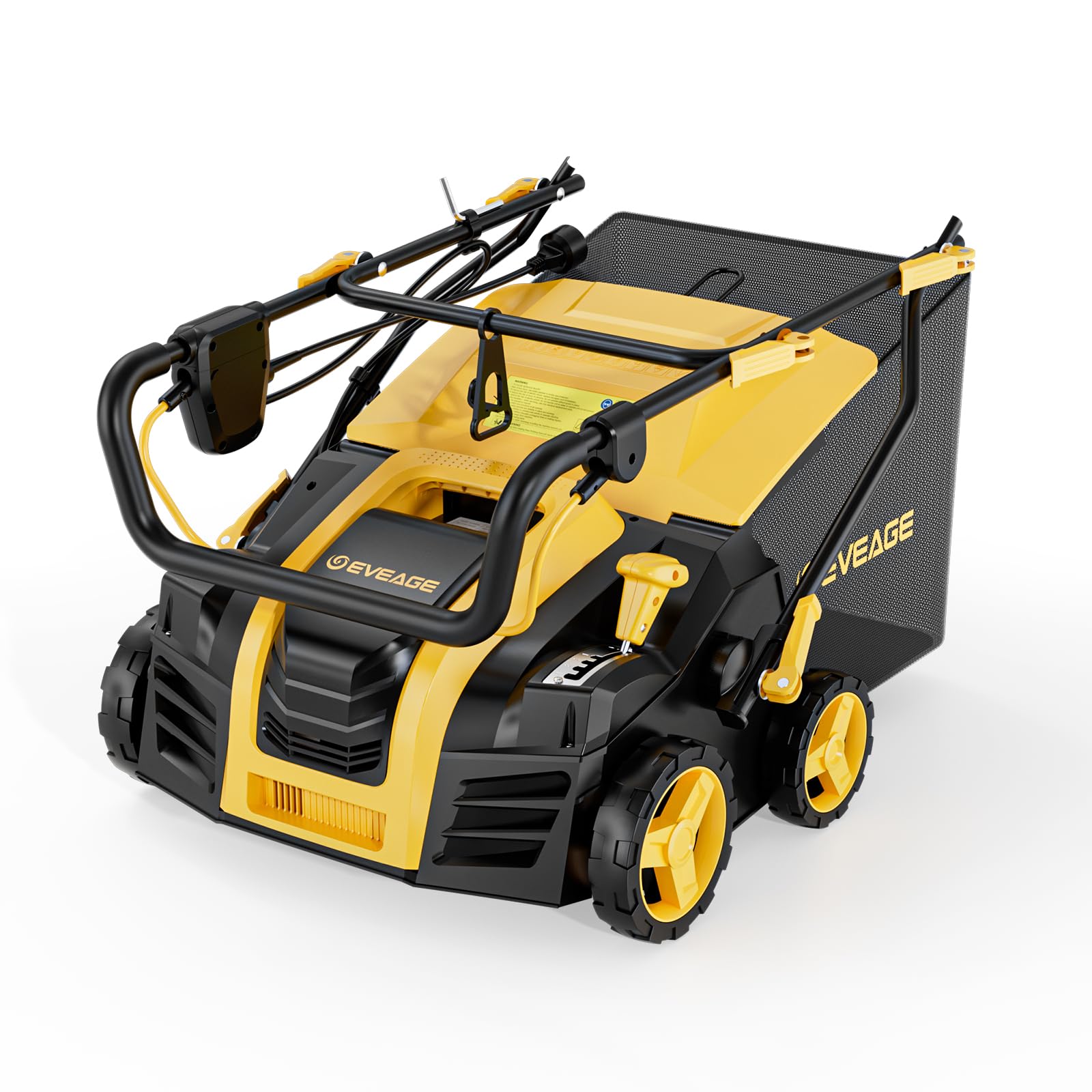
A 16-inch, 15-amp walk-behind with a cooling system and a handle that adjusts to your height.
The EVEAGE SCJ is built for the homeowner who wants the walk-behind feel but not the narrow, slow pass. A 15-amp copper motor delivers up to 3300 RPM over a 16-inch rake path — matching the BILT HARD’s width and amperage, and wider than the 15-inch WEN and SENIX. An integrated cooling system helps the motor run stable over a long session. Two interchangeable heads cover dethatching (drops dead grass and thatch) and scarifying (loosens soil for airflow and stronger roots), with separate depth ranges: the dethatcher runs -0.32 to 0.39 inches, the scarifier -0.47 to 0.24 inches.
Comfort is where it pulls ahead. The handle adjusts through 3 positions from 37.4 to 42.5 inches to suit different user heights, and the 5-position depth lever gives precise control. A 14.5-gallon collection bag holds a solid volume so you are not dumping with every short pass.
Weigh the trade-offs. The bag, generous as it is, still fills quickly on heavy thatch — some owners keep raking by choice — and you are paying a premium for the cooling system and height-adjustable handle. For a medium-to-large yard where one session should handle the whole thing, those extras earn their keep. The quick-fold design also brings it down small for storage.
Comfort plus power: a 15-amp motor with cooling runs a 16-inch path, and the 3-position handle adjusts to your frame.
The premium cost: you pay more for that comfort and cooling, and the bag still fills fast on dense thatch.
Ideal when: you want a full-feature 16-inch walk-behind with an adjustable handle and a cooled motor for longer sessions.
Keep looking if: you just need a basic rake for a small lawn — the comfort extras are wasted there.
11. Brinly 48″ Tow Behind Grass Dethatcher (DT-480BH-A2)

A 48-inch, all-steel tow-behind built to comb thatch off acres without asking you to add a single brick of weight.
For a genuinely large property, the Brinly DT-480BH-A2 is the top tool here. A 48-inch working width with 2 rows of 12 independently flexing spring steel tines combs through a lawn and lifts thatch up where a mower or mulcher can collect it. Those 24 triple-coil, 3/16-inch diameter spring steel tines stay flexible and, per owner experience, often do the job with no added ballast — a contrast to the CRAFTSMAN, which some owners load with bricks. A safety rod catches a tine if one ever breaks, keeping it away from mower blades.
Construction is all steel with 8-inch never-flat transport wheels set behind and in line with the tray to keep the footprint narrow and the unit level. Owners mention running it across 2.3 acres, and it holds up to the elements without rusting. It tows behind a riding mower with no added weight needed in most cases.
The known snag is assembly. The instructions could be clearer — some find them a challenge for a novice — and leveling the tow arm on a flat surface before you start is essential to a square setup. A few units arrive with a part or two short, though the brand ships replacements quickly. Set up correctly, this is the machine that covers acreage in a fraction of the walk-behind time.
Built for real acreage
- 48-inch width and 24 triple-coil spring steel tines cover large lawns quickly.
- All-steel build with 8-inch never-flat wheels and a safety rod for tine protection.
- Often needs no added weight — a contrast to weighted tow-behinds.
Assembly is the homework
- Instructions could be clearer and setup demands care to level the tow arm.
- Occasional missing parts mean waiting for replacements — check the box on arrival.
Choose it for: an acre or more behind a riding mower, where all-steel build and a wide 48-inch pass are worth a careful setup.
Keep away if: you have no tractor or want something that assembles in minutes — this is a tow-behind for the acreage owner.
Know the Specs
Cutting width (the pass that decides your day)
The width of grass the machine cleans in one sweep. A 12.6-inch unit like the Sun Joe means more laps around a lawn than a 16-inch BILT HARD. Wider is faster on big plots, but a narrower head steers around beds and tight corners more easily on a compact yard.
Motor amps and RPM (how hard it pushes)
Amps measure how much force the motor can throw at resistance, and RPM is how fast the tines strike. A 12-amp unit handles routine thatch; a 15-amp unit at 3300 RPM or higher holds its speed through matted buildup. Higher amp and RPM together mean fewer passes on dense turf.
Tines versus scarifying blades
Dethatching tines are springy fingers that rake dead grass up out of the lawn. Scarifying blades slice shallow grooves into the soil, which lets seed, water and fertilizer settle in. Most 2-in-1 machines carry both, and swapping the cylinder takes a tool or two on most units.
Depth settings (light rake todeep slice)
A depth lever with several positions lets you choose how aggressively the tines bite. A shallow setting suits a light maintenance rake on a healthy lawn. A deeper setting, measured in fractions of an inch like the -0.47 to 0.24 range, digs into matted thatch. Start shallow, then go deeper over repeat passes to avoid tearing live grass.
Common Questions
What is the difference between dethatching and scarifying?
Do I need a tow-behind or a corded walk-behind dethatcher?
How wide a cutting path do I actually need?
Will a dethatcher damage my healthy grass?
Why does my dethatcher bag fill up so fast?
Can I use a corded dethatcher on a large lawn?
When is the best time of year to dethatch?
Do I have to add weight to a tow-behind dethatcher?
How do I stop the machine from tearing up thin or patchy grass?
Is a two-year warranty normal for a dethatcher?
The Bottom Line
For most homeowners, the strongest pick for a dethatcher is the WEN DT1315, because it balances a 15-inch path, a 3300 RPM 13-amp motor and two quick-swap heads with the most trusted ownership record in this group — 4.5+ stars across 500+ owners. That combination of width, speed and reliability is hard to argue with on a normal suburban lawn.
If sheer width is your priority, the BILT HARD TIA-1002 gives you a 16-inch cut with a 15-amp motor, and the BUCOTOD WR5028 pushes the fastest head here at 3500 RPM. For a large property behind a riding mower, the Brinly DT-480BH-A2 covers 48 inches of ground per pass and its triple-coil tines often need no added weight — a genuine time-saver across acres.
The smart move is to match width and style to the yard you actually have. A quarter acre or less points to a 15 or 16-inch corded walk-behind, while anything larger rewards a wide tow-behind. Match the width and style to your actual square footage, and a corded or tow-behind unit costs less over a few seasons than repeated rentals.
How we choose
We do not accept paid placement. Every pick is matched to a real buyer and a real use-case; we do not hands-on test units.
Sources
Specifications: manufacturer listings and product documentation. Review insights: verified customer reviews, as of October 2026. Pricing: not shown on this page (it changes often); check the current price via the retailer link.
As an Amazon Associate, Aappliancez earns from qualifying purchases. This does not affect which products we feature.