Disclosure: Some links in this post are affiliate links. As an Amazon Associate I earn from qualifying purchases, at no extra cost to you. Learn more
Specs are compiled from manufacturer listings and verified buyer reviews and can change over time — please confirm the key details on the product page before buying.
If your basement walls sweat every summer and the musty smell never really leaves, the fix is matching a dehumidifier’s real pints-per-day number to your room’s square footage — not the biggest claim on the box. A desiccant dehumidifier pulls moisture out of cool, damp air and holds your space at a set humidity level, so the real question is which unit actually delivers. Below you will find the ones that hold up under real basement conditions.
This guide is built by comparing the manufacturers’ published specifications and the patterns across verified customer reviews, so you get each pick’s real strengths and trade-offs instead of marketing spin.
You want a machine that drops the damp, keeps running without babysitting, and doesn’t quit in year two. This breakdown of the best desiccant dehumidifier covers pints per day, drainage options, and the noise you will actually live with.
Top Picks

How To Choose The Best Desiccant Dehumidifier
The first thing to understand is that “desiccant” describes how a unit pulls moisture — and most household basement dehumidifiers use a compressor instead. Compressor units cool the air so water condenses out, while a true desiccant wheel uses a rotating moisture-absorbing material that keeps working in cold air. Both types appear in this list, so know which you are buying before you compare numbers.
Match pints per day to your actual square footage
Pints per day (how much water the unit removes in 24 hours) is the number that decides whether a machine can keep up with your space. An 8-pint unit for a 1,800 sq ft room is a light-duty helper, while a 155-pint commercial unit handles 6,000 sq ft. Oversizing is safer than undersizing, because a unit that runs constantly never gets ahead of the damp.
Decide how you will get rid of the water
A manual tank means carrying water to a drain, sometimes several times a day in a wet basement. Continuous drainage with a hose lets the unit run unattended, and a built-in pump lets you push water uphill to a sink or window when there is no floor drain nearby. If you will be away for days at a time, the pump option is the one that keeps drying without you.
Check the temperature your basement actually reaches
Cool basements and crawl spaces frost up compressor coils, which is why auto-defrost matters — it melts the ice so the unit keeps running. If your space drops near 65°F regularly, look for a unit with a working defrost cycle. A unit without it can simply stop removing moisture in the cold.
Plan for the noise
Decibel (dB) ratings measure how loud the unit runs — lower is quieter. A unit near 35dB is whisper-quiet enough for a bedroom, while a 45dB machine is a background hum you will notice in a quiet room. Placement matters too: a basement or garage absorbs sound better than a nursery.
Side-by-Side Comparison
| Model | Best For | Pints Per Day | Coverage | Drainage | Amazon |
|---|---|---|---|---|---|
| Gasbye DryPrime 115-Pint★ Best Overall | Best Overall | 115 pints | 4,500 sq ft | Tank, hose, or garden hose | Amazon |
| Ludatido 80-PintQuietest Pick | Quiet Bedroom Use | 80 pints | 5,000 sq ft | 1.72 gal tank or continuous | Amazon |
| PLUSCENT 52-PintCompact Pick | Compact Rooms | 52 pints | 5,000 sq ft | 59-inch hose or tank | Amazon |
| hOmeLabs 8-Pint | Smart Control | 8 pints (24 max) | 1,800 sq ft | 3.3 ft drain hose | Amazon |
| AEOCKY LEO-Lite 74-Pint | Energy Efficiency | 74 pints | 5,000 sq ft | Drain hose | Amazon |
| AEOCKY LEO-001 80-Pint | Built-In Pump | 80 pints | 4,500 sq ft | 5m pump hose | Amazon |
| DECIUU 100-Pint | No Floor Drain | 100 pints | 5,000 sq ft | Pump, hose, or garden hose | Amazon |
| DREO 110-Pint | Smart Home Control | 110 pints | 4,500 sq ft | 2 gal tank or drain hose | Amazon |
| Moiswell Defender M145 | Crawl Space Unit | 155 pints | 6,000 sq ft | Drain hose | Amazon |
| Yaufey AYD 158-Pint | Commercial Grade | 158 pints | 7,500 sq ft | Pump or gravity hose | Amazon |
| MOUNTO 310-Pint LGR | Restoration Jobs | 310 pints | 5,000 sq ft | Built-in pump, 25ft hose | Amazon |
Detailed Reviews
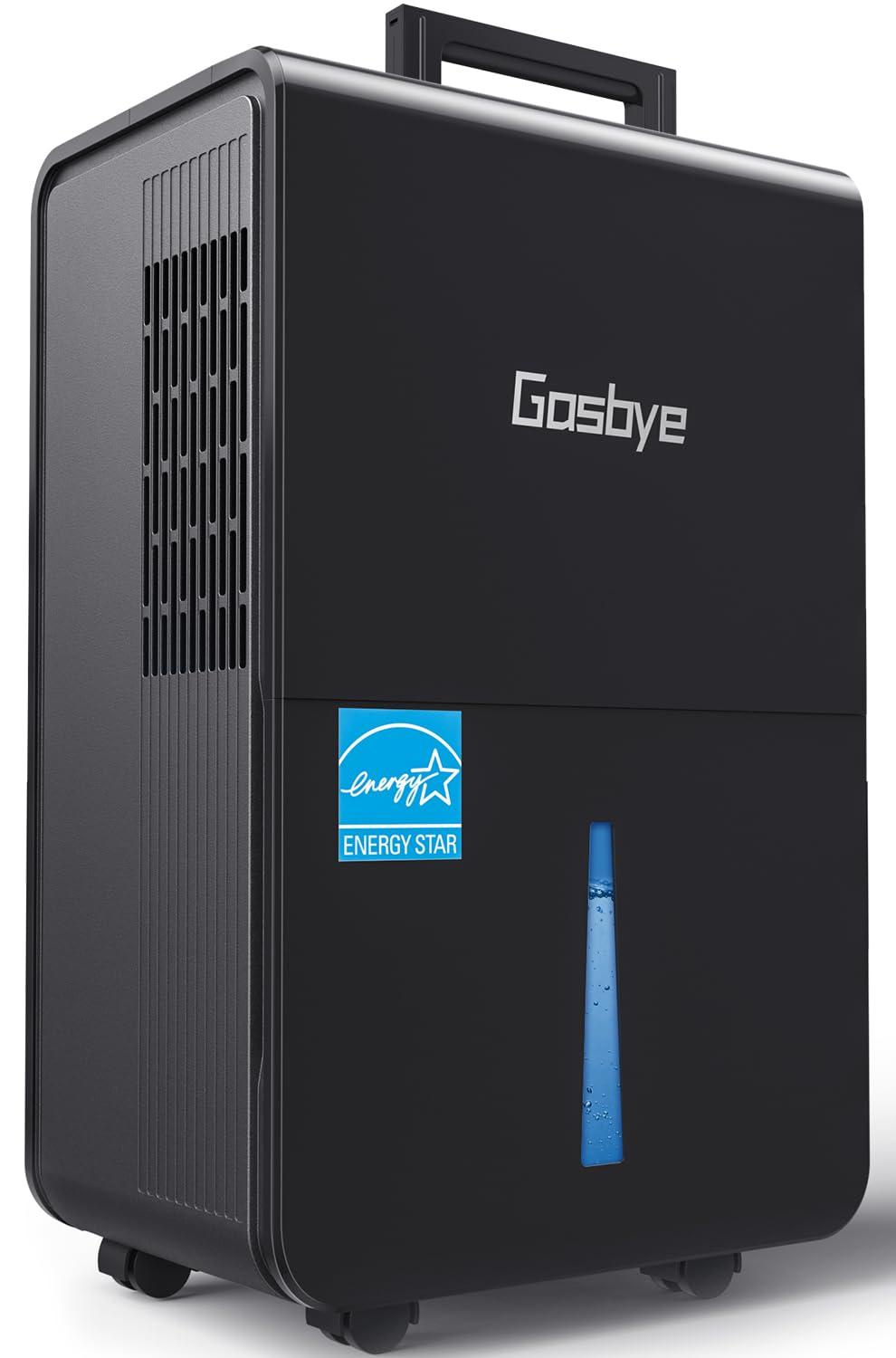
1. Gasbye 6000 Sq.Ft Energy Star Dehumidifier Max 115 Pints/Day
Our pick — 4.5+★ from 900+ verified ratings; the strongest balance of quality and price.
The 43-pound basement workhorse that tells you the truth about its pint rating
The Gasbye DryPrime earns the top spot because it does one thing most budget dehumidifiers refuse to do: it publishes honest numbers. It pulls up to 115 pints per day at 86°F and 80% humidity, 73 pints per day at 80°F and 60%, and 50 pints per day at 65°F and 60%. That last figure is the one that matters in a cool basement, where a lot of machines quietly underperform their box claims.
Build quality is where this unit separates itself. It uses thickened copper tubing in a five-tier copper coil, and Gasbye designed it specifically to counter the units that die after a year or two — a real frustration if you have replaced a dehumidifier already. Coverage reaches 4,500 sq ft, and the smart control shuts the compressor off when humidity drops 3% below your target, then restarts it when humidity climbs 3% above. After an outage it resumes your last settings on its own.
Drainage gives you three routes: the 1.7-gallon tank, the included 5-foot hose for a floor drain, or a standard 3/4-inch garden hose threaded onto the back outlet. The 45dB compressor is quiet enough that buyers describe chatting and watching TV in the same room without issue, and one long-term basement owner reported that it “Cut humidity 75%→60% in first hour, basement to 50% RH then auto-off.” The Noise level sits second among what buyers praise most, just behind how effective it is at pulling moisture.
What Earns It First Place
- Publishes three honest pint ratings at different temperatures instead of one inflated headline figure
- Thickened copper tubing designed against the one-to-two-year failure pattern
- Three drainage options including a 5-foot hose and a garden-hose thread
- Auto shut-off and restart within a 3% humidity band, plus power-outage memory
The Honest Trade-Off
- At 11″ D × 15″ W × 24″ H and 43 pounds, it is a big machine that needs floor space
- Durability is the one aspect buyers raise most critically, even though the two-year refund-or-replacement coverage backs it
- The 45dB hum is quieter than many peers but audible in a silent bedroom
It is the crowd favorite here at 4.5+ stars across 900+ ratings.
Skip it for: a tight closet or bedroom nook — the 43-pound footprint and 45dB hum suit a big open space, not a nightstand corner.
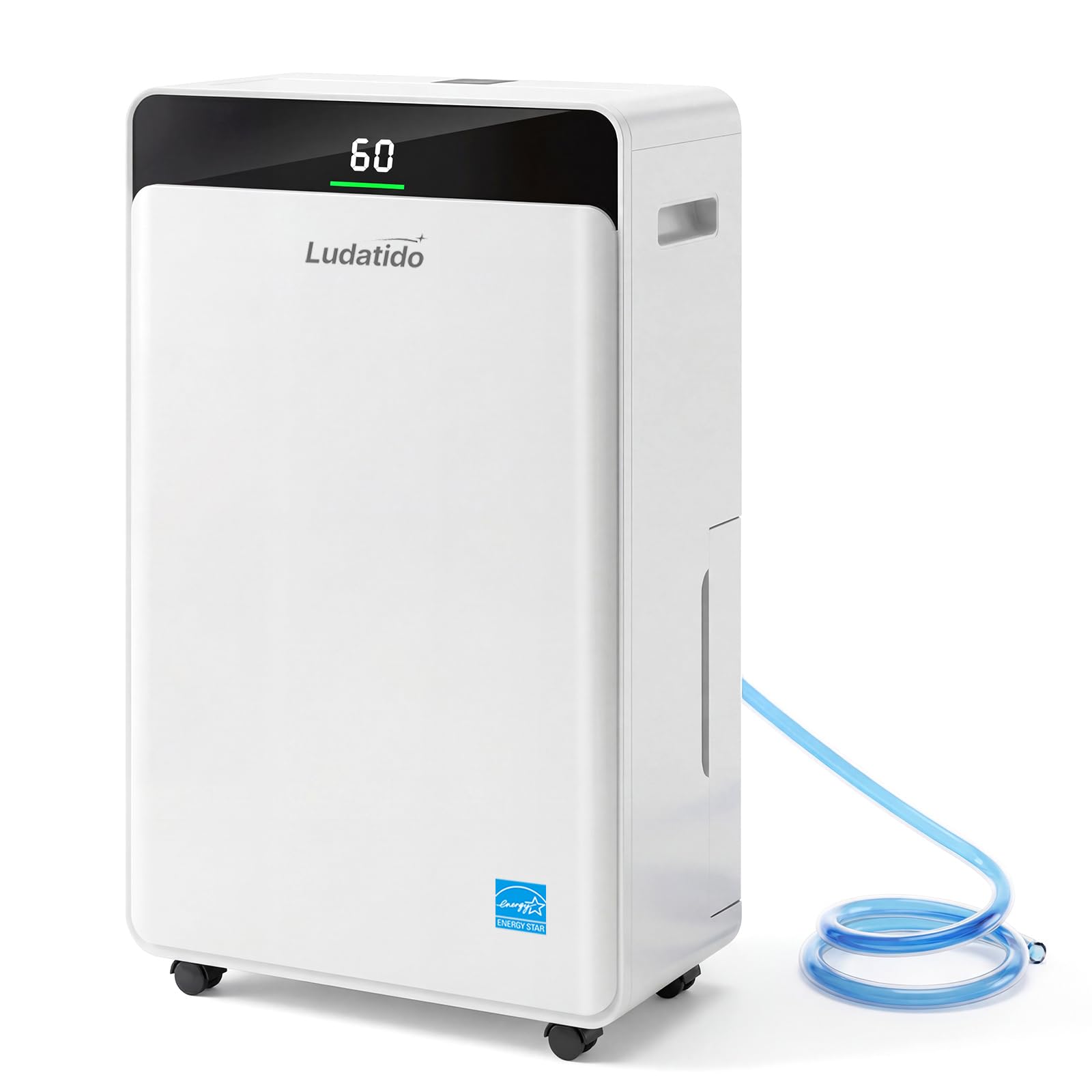
2. Ludatido 80-Pint Dehumidifier
At 35dB, this is the unit you can run in a nursery without waking anyone
Noise is the number this machine wins on. The Ludatido runs at a minimum of 35dB — quieter than the Gasbye’s 45dB and quiet enough to sit in a bedroom overnight. It covers up to 5,000 sq ft, removes up to 80 pints per day, and carries 2026 ENERGY STAR certification for lower running costs. Four modes handle the day: Dry for fast moisture removal, Sleep for quiet nights, Fan for circulation, and a 24-hour timer you can preset.
The small details show thought for families. A child lock stops kids or pets from changing settings, overheat protection adds a safety layer, and the 1.72-gallon tank has an auto shut-off so it never overflows while you are out. The continuous drain option connects to a floor drain for hands-free operation. Buyers who run it alongside a whole-house system report it held every room at 48-51% on an auto setting without running constantly.
Here is the catch worth knowing: the water tank sits on the rear of the unit, so emptying it means turning the machine around and giving the tank a firm pull. A few owners also point out the tank can splash when full. Those are design quirks, not deal breakers, and they do not touch the quiet operation or the moisture removal that most buyers come for.
Why it earns its place: the 35dB minimum makes it the pick for a bedroom, nursery, or any room where you will be sleeping six feet away from the machine.
One thing to plan around: rear-mounted tank position — a hose to a floor drain sidesteps the awkward emptying entirely.
Reach for this if: you need quiet above all and want 5,000 sq ft of coverage from a 35dB unit.
Look elsewhere if: you want a front-access tank you can pull without turning the whole machine around.
3. PLUSCENT 5000 Sq Ft 52 Pint Compressor Dehumidifier
A 350W compressor unit small enough to wheel from kitchen to bedroom
At 8.9″ D × 12.6″ W × 19.3″ H, this PLUSCENT fits where the big basement machines cannot. It still claims 52 pints per day at 95°F and 90% humidity and covers 5,000 sq ft, driven by a 350W motor that extracts moisture faster so the unit runs less. Auto-Defrost keeps it working through cold winter months without icing over.
The fourth mode is the one people underestimate. Along with DEHU for daily comfort, DRY for indoor laundry, and CONTINUOUS for constant extraction, there is a SLEEP mode that drops sound to 40dB. The 24-hour timer lets you run it only when you need it. A 59-inch drain hose handles continuous drainage, and the 68.5-inch power cord gives some reach. Effectiveness leads what buyers praise most here, ahead of build quality, and one buyer put it plainly: “This dehumidifier works great! It’s compact and doesn’t take up much space, but works efficiently to dry up damp spaces.”
The tank is the trade-off to accept going in. It holds 2.5 liters, so in a genuinely wet basement you will be emptying it daily — the hose solves that, but plan for it. A few owners also found the fan less powerful than expected in a large open basement, so treat the 5,000 sq ft figure as a ceiling rather than a guarantee for a wide-open space.
The reason it made the list: 40dB sleep mode in a body you can roll between rooms — rare at this compact size.
What to weigh first: the 2.5-liter tank fills fast in heavy damp, so budget for the drain hose from day one.
Best fit: apartment dwellers and smaller homes that move the unit room to room.
Not for: a fully flooded open basement where you need maximum pull from a fixed position.
4. hOmeLabs Dehumidifier 1,800 Sq Ft 8 Pint Wi-Fi Model

A light-duty helper you control from your phone, not a basement bruiser
This hOmeLabs unit is built for a different job than the big machines: small spaces where you want quiet and app control. It removes up to 8 pints per day at 80°F and 60% humidity, and up to 24 pints at 95°F and 90%, covering 1,800 sq ft. It runs at 38dB, so it disappears into a bedroom, nursery, or home office, and at 22.3 pounds with a carrying handle you can move it easily.
The Wi-Fi is the standout. You set humidity levels, timers, and auto mode through the app or by voice, and the 3.3-foot drain hose lets it run continuously without you emptying a tank. A washable filter and removable tank keep maintenance simple, and auto shut-off stops overflow. For a small bedroom or laundry room that stays clammy, that combination is genuinely convenient.
Just size your expectations correctly. This is a light-duty unit, and a buyer moving from a large 7,000 sq ft model noted the smaller one is slow — roughly 8 hours to bring a bedroom from 65% down to 50-55%. It does its best work in a closed room, not an open basement. If your space is genuinely big and wet, this is the wrong tool.
What It Does Well
- Wi-Fi control through an app or voice assistant for remote humidity and timer settings
- 38dB operation quiet enough for a nursery or office
- 3.3-foot drain hose for continuous, hands-off draining
- 22.3 pounds with a handle — easy to relocate
Where It Stops Short
- 8 pints per day is light output for a large or very wet space
- Water capacity draws mixed feedback — expect small-tank maintenance
- Durability history is mixed, so register the warranty
Choose it for: a bedroom, nursery, or office where you want quiet, app control, and light moisture removal.
Pass on it if: you need to dry a full basement fast — move up to a higher-pint machine.
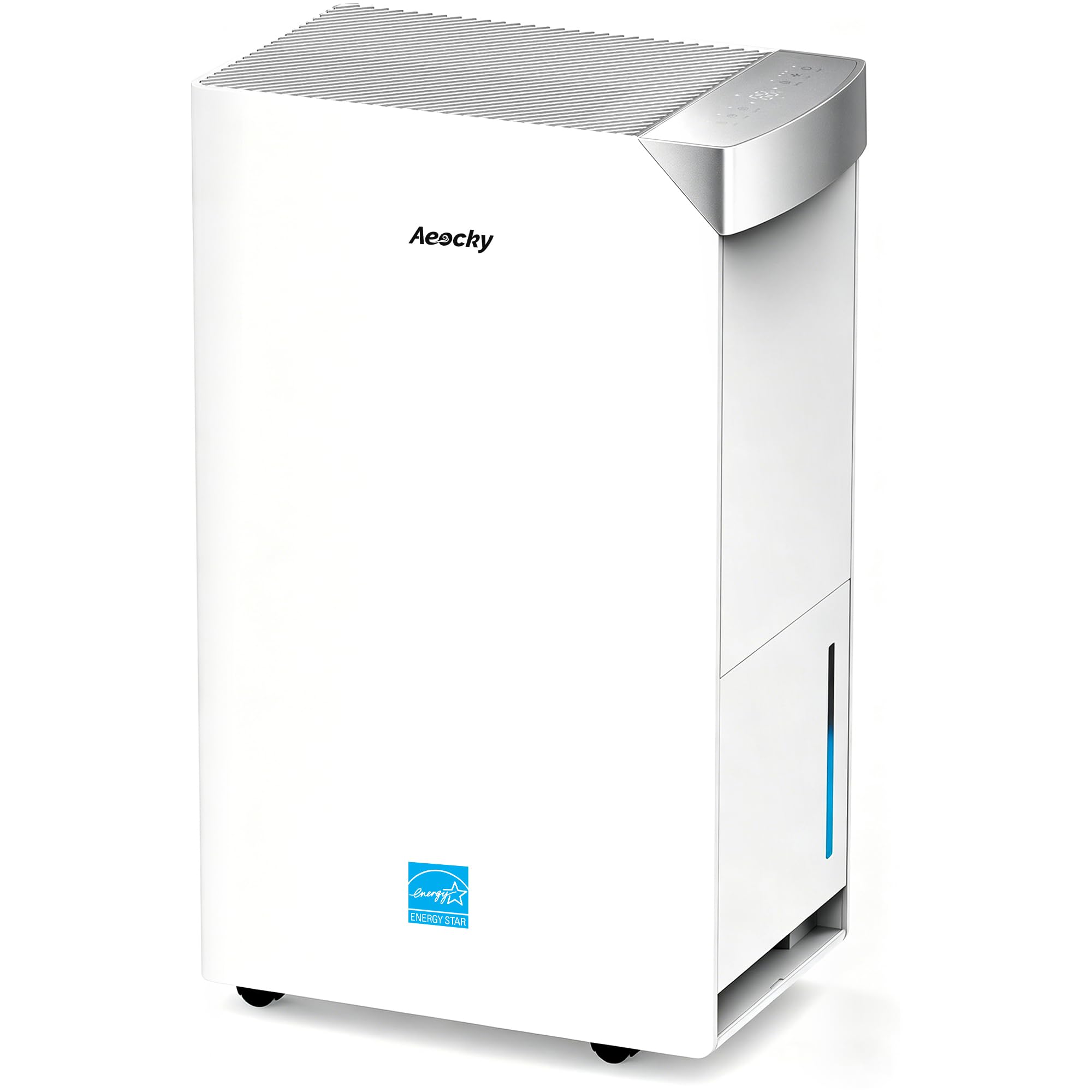
5. AEOCKY 5000Sq.Ft Dehumidifier
The flagship-built value pick with a 44dB floor and honest Version 6.0 certification
AEOCKY went after a real market problem here: fake “Energy Star 2025” labels. The LEO-Lite adheres to the actual Energy Star Version 6.0 standard, pulls 74 pints per day in humid mid-summer and 52 pints per day in a warm damp basement, and covers up to 5,000 sq ft. It shares core components with AEOCKY’s flagship, using a “3+2” evaporator and condenser structure and 7mm pure copper tubing instead of aluminum.
Two numbers stand out. The lowest fan speed runs at just 44dB — quieter than several non-pump rivals at their lowest setting — and the smart humidity control uses millisecond-level detection to hold your target. Auto-defrost kicks in around the 65°F threshold where ordinary units frost up and shut down, so a chilly basement keeps drying. The power-off memory resumes your settings after an outage. Ease of use earns strong praise from buyers, several noting it is ready to run almost immediately.
What wins people over beyond the spec sheet is support. Owners who hit a failure just past a year described replacements arriving without argument, backed by the 3-year coverage. The recurring gripe is the small tank, which means frequent emptying unless you attach the drain hose. Plan the hose and that concern disappears.
What sells it: flagship internals under cut-rate branding — a 44dB low fan, copper tubing, and a genuine Version 6.0 seal.
The recurring gripe: the tank is small for constant basement use, so run a drain hose and forget it.
Your pick if: you want flagship-tier build and low noise at a value price, and you can route a drain hose.
Think again if: you refuse to use a hose and want a big tank you empty only once a week.
6. AEOCKY LEO-001 Dehumidifier with Pump, 80 Pints/Day
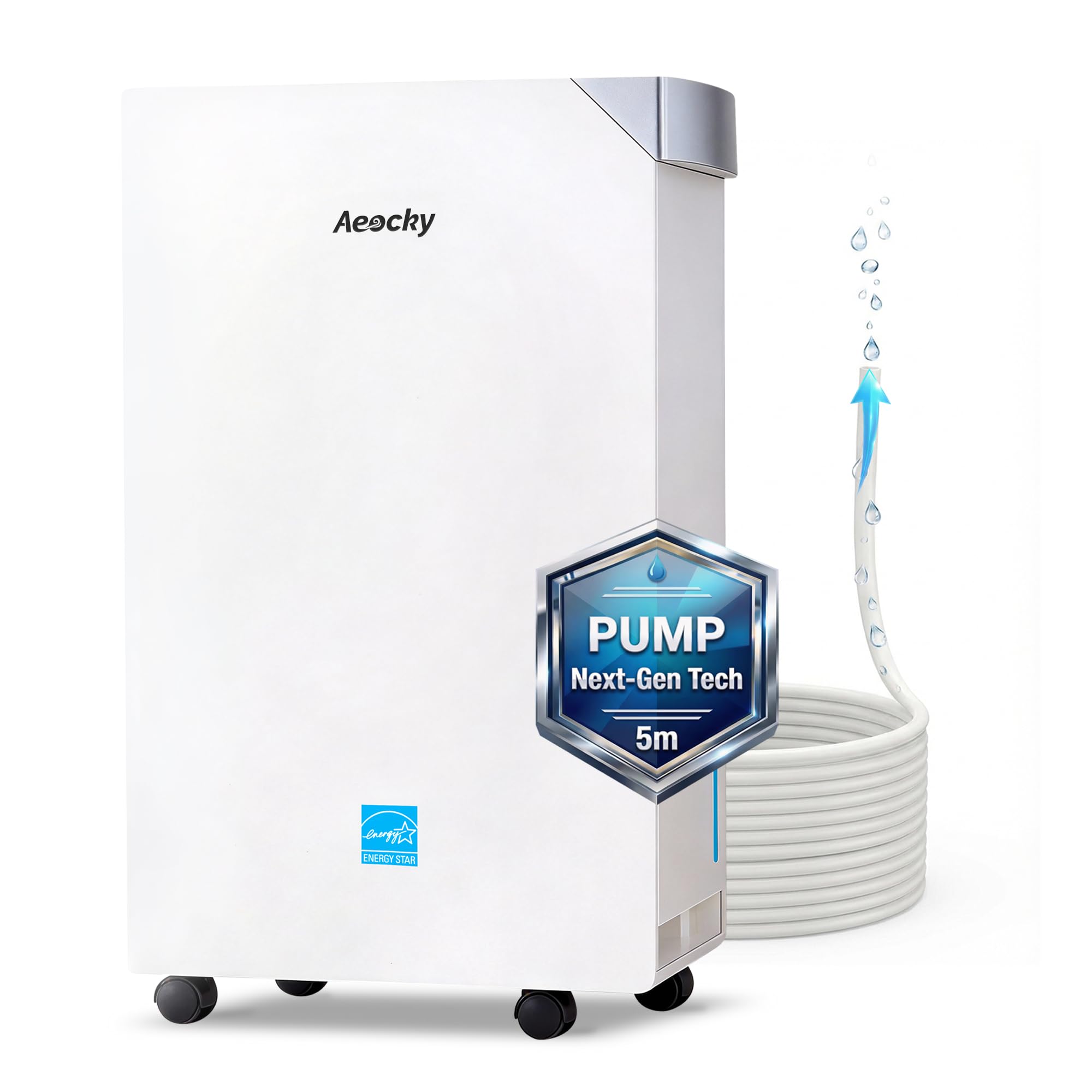
No floor drain in your basement? This pump pushes water 5 meters uphill
The LEO-001 solves a problem most basement dehumidifiers ignore: gravity. Its built-in pump actively pushes collected water upward through the included 5m hose, so you can drain into a sink, utility tub, or window instead of hauling a bucket. Output is 80 pints per day at 95°F and 95% humidity, or 56 pints per day at 86°F and 80%, covering 4,500 sq ft. It holds the ENERGY STAR Most Efficient 2025 certification.
The pump itself is engineered for the long haul. AEOCKY built its electromagnetic pump from the ground up and ran it through over 10,000 reliability tests, with a dual-sensor system to prevent dry running. Paired with a “3+3” core structure and 7mm pure copper tubing, the hardware is aimed at the pump models that fail early. The company backs it with 3-year coverage.
The honest trade-off is the tank. It is small, and in a very wet space you will still see it reaching nearly full before the pump clears it, so the hose routing matters. A few owners also wished the pump hose were wider for faster clearing. Neither issue stops it doing its job — it just means you set it up properly rather than tossing it in a corner.
The pump is the whole story: 5m of upward lift means a basement with no drain still runs unattended 24/7.
Set it up right: the small tank plus a narrow pump hose rewards proper hose routing from the start.
This one is for: basements, closets, and garages with no nearby floor drain that need true set-and-forget drying.
Only skip it if: you have a floor drain at hand — then gravity drainage and no pump keeps things simpler.
7. DECIUU 5000 Sq.Ft Dehumidifier with Pump, 100 Pint
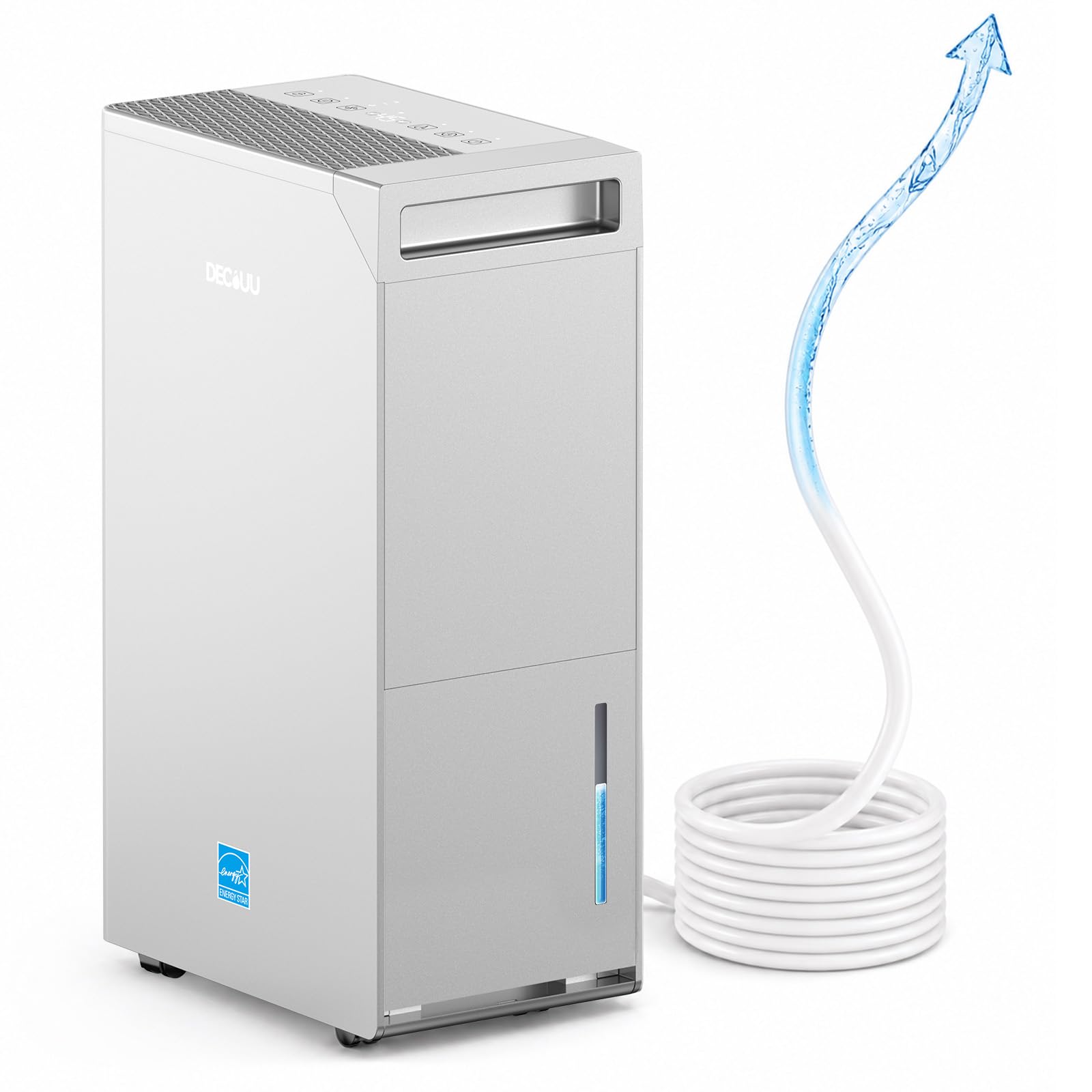
100 pints a day and a pump that climbs 16.4 feet to the nearest sink
If you want maximum output with a drain-anywhere pump, the DECIUU is the one to beat. It removes up to 100 pints per day at 95°F and 90% humidity, or 70 pints at 86°F and 80%, covering 5,000 sq ft. The built-in condensate pump lifts water up to 16.4 feet, so a basement with no floor drain can still drain into a sink or utility tub. It holds ENERGY STAR Most Efficient 2024 certification.
Three drainage routes keep maintenance low: the 5.5L tank, the included 6.56-foot hose, or a standard 3/4-inch garden hose for extended runs. You set humidity anywhere from 35% to 80% RH and let the auto-defrost and smart control handle the rest. Smooth 360° casters and a hidden handle make it easy to move despite its size, and the washable filter keeps upkeep simple. Effectiveness leads what buyers praise here, with humidity control close behind.
The catch is reliability. The pump is a genuine convenience when it works, but the recurring note across the review pages is pump failures within months on some units. That is the most-mentioned negative, so register the two-year protection and test the pump on arrival. Buy from a seller with easy returns and you are well covered.
The draw: the highest pint rating in this group to offer 16.4 feet of vertical pump lift.
The thing to check: pump longevity — test it on day one and confirm your warranty is registered.
Best for: large basements and garages needing high output and uphill drainage.
Be ready for: verifying the pump works early and keeping the warranty on file.
8. DREO 110-Pint Smart Dehumidifier for Basement, 4500 Ft²

110 pints a day, a 2-gallon tank, and a phone app that actually works
DREO built this one for people who want to control their basement from the couch. It removes 50 to 110 pints per day at 86°F and 90% humidity across 4,500 sq ft, with a 2-gallon (8L) tank that runs over 8 hours before needing a dump. Beyond the pint rating, it does more than 4.0 pints per kWh — higher than the 3.8 pints per kWh mark of the Energy Star 2024 standard it references.
The smart features carry the day. Three modes — Comfort, Auto, and Continuous — let you set a target humidity and let the sensor pick the fan speed within a 5% tolerance. The DREO app shows real-time humidity, schedules, and full-tank alerts, and Alexa and Google Home handle voice commands. For safety it is ETL-certified, powers off if tilted 90°, and adds thermal and overcurrent protection. Effectiveness leads what buyers praise, with build quality close behind.
The downsides are heat and noise. A compressor dehumidifier puts out some warmth, and owners of small enclosed spaces notice the room warming up. Noise draws mixed reactions — fine as background white noise in a basement, less welcome in a bedroom you want dead quiet. Use it where its power fits and those points stop mattering.
Why It’s Worth A Look
- 110 pints per day and a 2-gallon tank for over 8 hours between dumps
- DREO app plus Alexa and Google Home for remote control
- Auto mode holds target humidity within 5% tolerance
- ETL-certified with tilt, thermal, and overcurrent protection
Where It Gives Ground
- Warms the room — expect noticeable heat in a small enclosed space
- Noise gets mixed feedback; better suited to a basement than a silent bedroom
- Durability is the most critical aspect across some buyers
Great choice if: you want serious output plus app and voice control for a basement or large room.
Think twice if: the space is small and you need silent overnight operation — the heat and noise suit a live-in basement less.
9. Moiswell Defender M145 155-Pint Commercial Dehumidifier
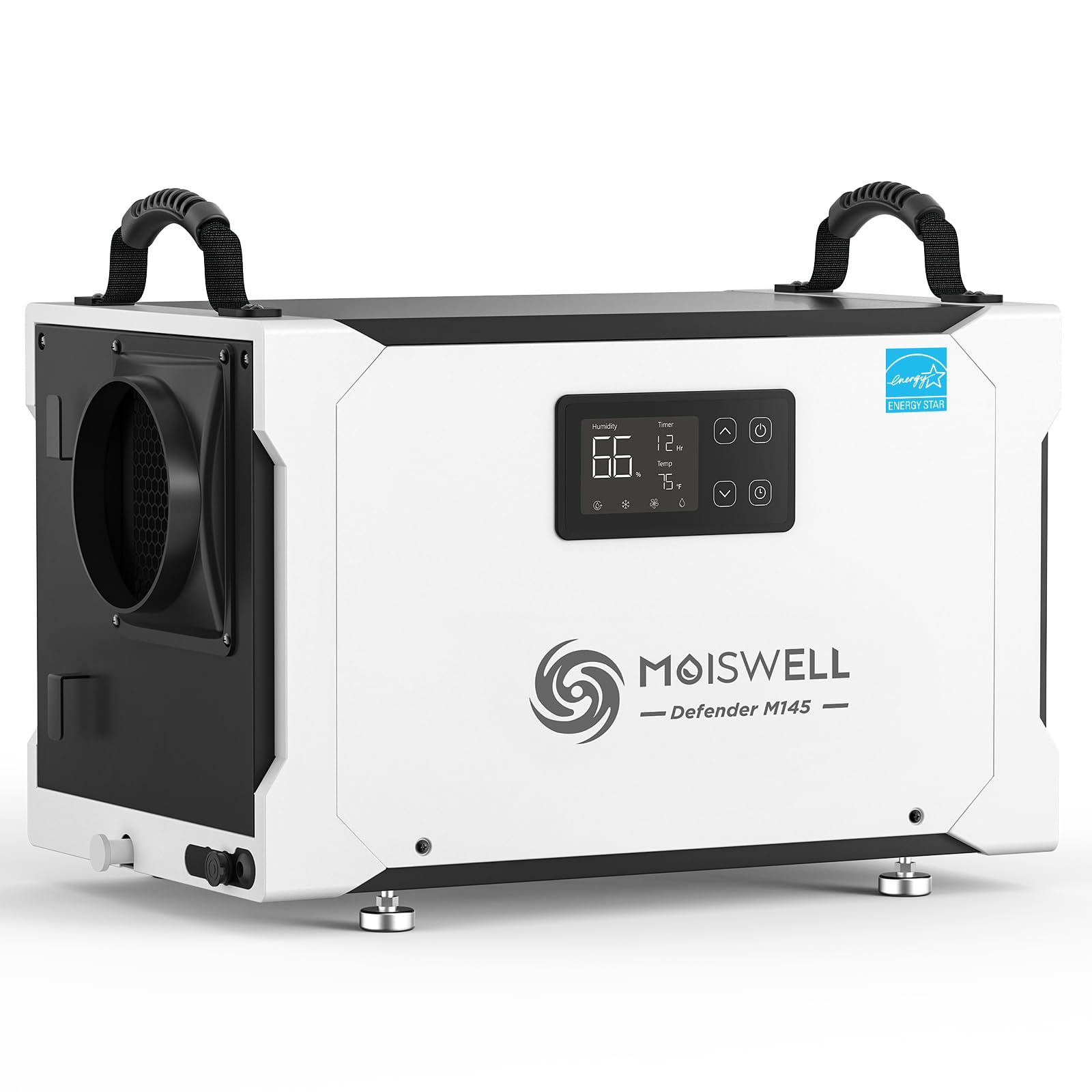
Built horizontal to slide between floor joists where no upright unit fits
The Moiswell M145 earns its place on shape alone. Its 22.5 × 14 × 14.7-inch horizontal body slips between floor joists and into low-clearance crawl spaces, and you can mount it on the floor or overhead. It removes up to 155 pints per day maximum, 70 pints per day at AHAM conditions, with 265 CFM of airflow across up to 6,000 sq ft. It is Energy Star certified and comes with a 5-year limited warranty.
Setup is simple by design — set your target humidity and the unit cycles on and off to hold it, with a 24-hour timer, auto drain, auto defrost, and auto restart after an outage filling in the rest. In a spray-foamed upstate New York crawl space, buyers report it cleared window condensation and frost within hours. The build is genuinely commercial: an alloy steel frame, removable access panels, and a ducting collar included.
The trade-off is that “155 pints” is a maximum figure, while 70 pints per day at AHAM is the everyday benchmark — a 63-pound commercial unit like this buys you headroom, not a magic multiplier. Routing the drain line correctly without kinks matters, since a trapped hose will back water up. Fix that and the quiet, steady drying is exactly what a crawl space needs.
The unique advantage: a 14-inch horizontal profile that fits where upright machines simply cannot.
Plan the plumbing: run the drain hose kink-free and the unit will dry a crawl space on its own for years.
Built for: crawl spaces, tight basements, and between-joist installs that need commercial airflow.
Not the pick if: you have an open basement floor and only need a freestanding unit.
10. Yaufey AYD 158-Pint Commercial Dehumidifier with Pump
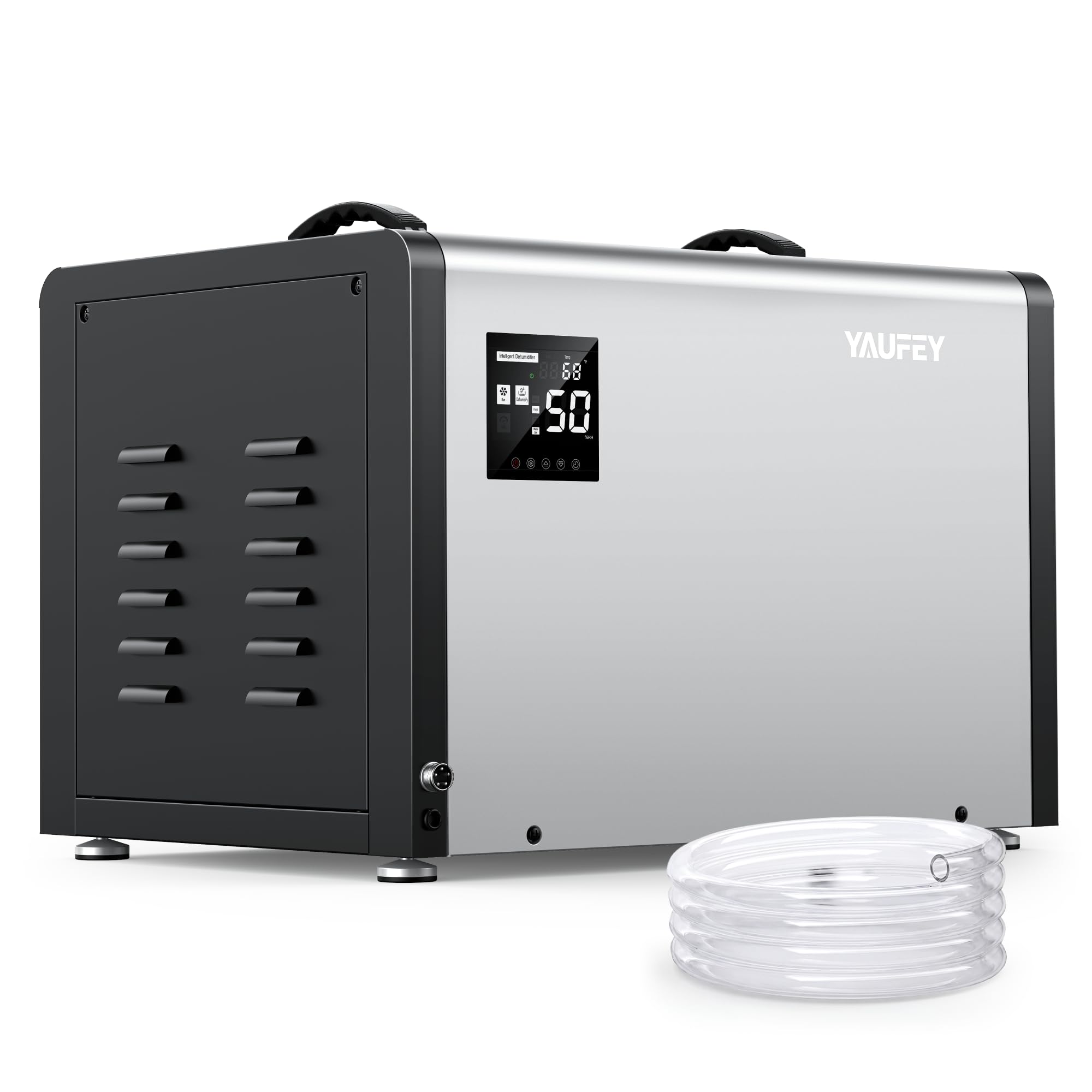
158 pints a day in an all-metal shell, for spaces big enough to need it
This Yaufey is for jobs that overwhelm a household machine. It removes up to 158 pints per day at 95°F and 90% humidity, moves 206 CFM of airflow, and covers up to 7,500 sq ft across basements, warehouses, and industrial sites. The corrosion-resistant all-metal shell is built for damp, dusty conditions, and it runs on R32 refrigerant for lower environmental impact.
Two features make it a true commercial tool. The built-in pump lifts water up to 16.4 feet through its hose, while a 6.56-foot gravity drain offers the alternative — so it runs 24/7 unattended. Humidity control ranges from 10% to 90% RH, wider than the typical 30-80% of home units, which is what makes it suitable for archives, server rooms, and wine cellars. Auto-defrost keeps it working in cold crawl spaces.
The downside is the fit, not the engine. It weighs 73 pounds and lands at a commercial price, which is only justified when the space is genuinely large and wet — for a small basement, it is oversized. A few owners also note the discharge pump can be finicky, though most report Yaufey support walks them through it promptly. Match it to a big job and the reliability is there.
What it brings: a 10% to 90% RH control window, 16.4 feet of pump lift, and a metal shell built for harsh rooms.
The fit question: 73 pounds and a wide control range only make sense for genuinely large, very wet spaces.
Reach for this if: you are drying a warehouse, large basement, or moisture-sensitive room that needs a wide humidity range.
Look past it if: a single small room is all you are drying — this is built for bigger problems.
11. MOUNTO 310 Pint LGR Dehumidifier

The 310-pint LGR built for flood damage, not a damp bedroom
This is a different class of machine. The MOUNTO 310 is an LGR (low grain refrigerant) commercial unit that pulls up to 310 pints per day at saturation and 165 pints per day at AHAM conditions, while drawing 10.5A of power. Its built-in condensate pump lifts water up to 15 feet, so it drains below-grade spaces without a bucket, and 25-foot drain hoses are included. It suits water-damage restoration, carpet cleaning, and furniture drying.
The controls are built for job sites. A digital humidistat gives real-time inlet and outlet temperature plus relative humidity, so you track drying progress as it happens. The automatic restart and memory function resume operation at your last settings after an outage, which is what you want for a basement running through a storm. Owners running a commercial property with poor grading watched it drop a 4,500 sq ft space from 70% to 50% humidity and eliminate the musty smell. Humidity control is what buyers praise most, alongside value.
Weigh this honestly: it is a 125-pound commercial unit priced for restoration pros, and it makes little sense for a single damp room. It also had a couple of reports of slow drying from a unit that may have lost refrigerant in shipping. For a genuine water-damage job, though, it is the one that clears a soaked space fastest.
For the pros: 310 pints per day, 15 feet of pump lift, and job-site humidity readouts built for restoration work.
Be realistic: 125 pounds and a commercial price tag mean it is meant for restoration, not a one-room fix.
The right tool for: water-damage restoration, flood recovery, and large commercial drying jobs.
Overkill if: you just want to keep a single basement dry — a household unit handles that at a fraction of the size.
Know the Specs
Pints Per Day and Your Space
Pints per day measures how much water a unit removes in 24 hours at a stated temperature and humidity — higher numbers suit bigger, wetter spaces. A rating at 95°F and 90% humidity will read higher than one at 80°F and 60%, so compare units at the same conditions or expect a gap. Cool basements pull less moisture, which is why honest models like the Gasbye publish ratings at several temperatures.
Coverage Square Footage
Coverage tells you the room size a maker expects the unit to keep dry, ranging here from 1,800 sq ft to 7,500 sq ft. An open-concept basement dries differently than a same-sized crawl space split by joists, so treat the figure as a guide, not a guarantee. Matching coverage to a slightly bigger area than you have beats undersizing and running the machine nonstop.
Auto-Defrost and Cold Air
Auto-defrost melts the ice that builds on a compressor coil in cool air, so the unit keeps removing moisture instead of freezing and shutting off. A space near 65°F is where ordinary units begin to frost, so a working defrost cycle decides whether a cold basement or crawl space actually gets dried. Desiccant-based units handle cold air differently by absorbing moisture rather than condensing it.
Tank Versus Continuous Drainage
A water tank holds the collected moisture until you empty it, while continuous drainage routes water to a hose and away. A built-in pump lets you push that water uphill when no floor drain is nearby — the LEO-001 and DECIUU lift it several feet to reach a sink. For unattended drying, a hose or pump is the option that keeps working while you are gone.
Common Questions
Is a desiccant dehumidifier better than a compressor dehumidifier for a basement?
How many pints per day doHow many pints per day do I need for my basement size?Match the rating to the square footage and how wet the space is. Light-duty units like the hOmeLabs at 8 pints per day suit a small bedroom or office, mid-range machines at 52 to 110 pints per day handle a typical basement, and commercial units at 155 pints per day or more cover crawl spaces and warehouses. Sizing slightly big beats undersizing, because a unit that runs constantly never gets ahead of the damp.Can I run a dehumidifier without a floor drain nearby?Yes, if the unit has a built-in pump. The AEOCKY LEO-001 pushes water upward through a 5m hose, and the DECIUU lifts it up to 16.4 feet to reach a sink or utility tub. Without a pump you are limited to gravity drainage, which needs a drain point at or below the outlet. A pump turns an unattended basement into a real option.How often will I have to empty the water tank?It depends on tank size and how wet the air is. The Gasbye holds 1.7 gallons, the Ludatido 1.72 gallons, the DREO 2 gallons, and the PLUSCENT just 2.5 liters — smaller tanks in very damp spaces can fill in a day or less. If emptying sounds like a chore, route the included drain hose and the tank stops being a concern.Will a dehumidifier work in a cold crawl space?It can, provided the unit has a working auto-defrost cycle. Cool air frosts up a compressor coil, and a unit without defrost will stop removing moisture once it ices over. The Moiswell M145 and Yaufey AYD both include auto-defrost and are built for crawl spaces, while the AEOCKY LEO-Lite defrosts around the 65°F mark where ordinary units struggle.How loud is a dehumidifier in a bedroom?Look at the decibel rating and the mode. The Ludatido runs as low as 35dB and the hOmeLabs at 38dB — both quiet enough for a bedroom or nursery. A 44 to 45dB unit like the AEOCKY LEO-Lite or Gasbye is a background hum you notice in a silent room. Sleep modes on the PLUSCENT drop it to 40dB for overnight use.Do I need to let a new dehumidifier sit upright before using it?Yes, if it uses a compressor. A refrigerant unit that traveled on its side should stand upright for several hours so the oil settles before you power it on — owners of the DECIUU and PLUSCENT both mention this step. Running it too soon can shorten the compressor’s life. A desiccant unit without a compressor does not have the same requirement.What does ENERGY STAR Most Efficient mean versus plain ENERGY STAR?Plain ENERGY STAR marks a unit that meets an efficiency baseline, while Most Efficient is a stricter tier for the top-performing models. The AEOCKY LEO-001 and the DECIUU both carry the Most Efficient certification, and AEOCKY’s LEO-Lite follows the Energy Star Version 6.0 standard. A higher tier points to lower running costs over years of continuous use.Can I connect a dehumidifier to a garden hose for constant drainage?Some units, yes. The Gasbye has a threaded drain outlet on the back that takes a standard 3/4-inch garden hose, and the DECIUU also accepts a 3/4-inch garden hose alongside its 6.56-foot drain hose. That gives you a longer run to a floor drain or outside without buying a special line. Check the outlet thread before you rely on it.Is a 52-pint unit enough for a large open basement?It can be, but it depends how wet the air is. The PLUSCENT rates 52 pints per day and 5,000 sq ft of coverage, which suits a smaller or moderately damp basement well. A wide-open, very humid basement dries faster with a higher rating — the Gasbye at 115 pints or the DREO at 110 pints move more water per day. When in doubt, go a step higher than the label suggests.?
The Bottom Line
For most damp basements, the desiccant dehumidifier that balances honest output, build quality, and long-term support is the Gasbye DryPrime 115-Pint. It publishes real pint ratings at three temperatures, uses thickened copper tubing built against early failure, and backs it with two-year refund-or-replacement coverage. If quiet matters most, the Ludatido 80-Pint runs at 35dB and covers 5,000 sq ft. And if you have no floor drain at all, the AEOCKY LEO-001 pumps water 5m uphill so you never empty a tank again. Whichever you choose, route a drain hose on day one — it turns every one of these units into a hands-off machine.
How we choose
We do not accept paid placement. Every pick is matched to a real buyer and a real use-case; we do not hands-on test units.
Sources
Specifications: manufacturer listings and product documentation. Review insights: verified customer reviews, as of October 2026. Pricing: not shown on this page (it changes often); check the current price via the retailer link.
As an Amazon Associate, Aappliancez earns from qualifying purchases. This does not affect which products we feature.