Disclosure: Some links in this post are affiliate links. As an Amazon Associate I earn from qualifying purchases, at no extra cost to you. Learn more
Specs are compiled from manufacturer listings and verified buyer reviews and can change over time — please confirm the key details on the product page before buying.
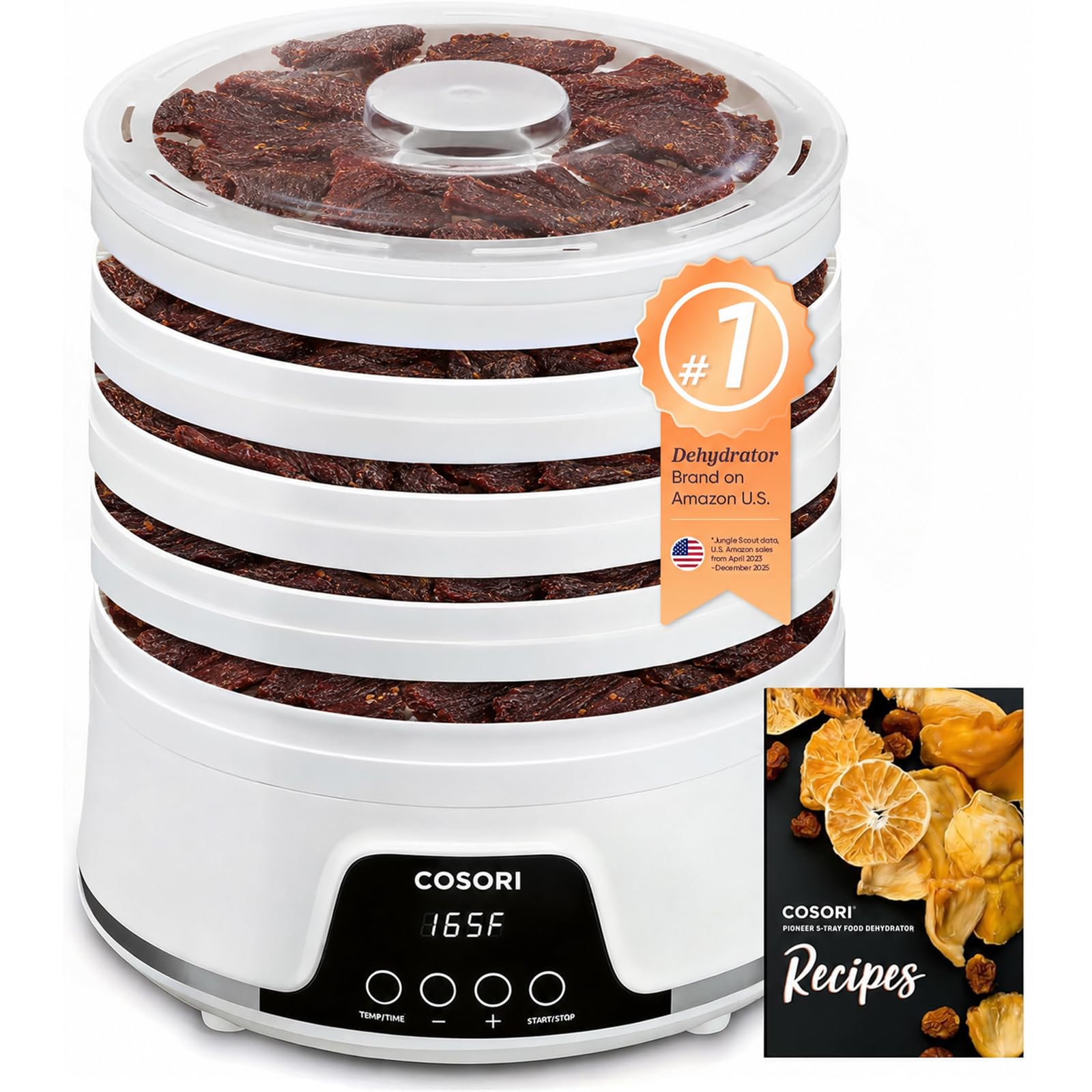
Carrying your own dinners up a mountain means ditching the water weight, and a dehydrator does exactly that: it removes moisture from food so the same meal weighs a fraction of its fresh weight. The picks below are chosen for that job — drying jerky, fruit, vegetables, and full meals that rehydrate on the trail. Most backpackers start with a compact countertop unit, and the Cosori at number one is the one we keep coming back to.
This guide is built by comparing the manufacturers’ published specifications and the patterns across verified customer reviews, so you get each pick’s real strengths and trade-offs instead of marketing spin.
Temperature range, tray capacity, and even heat movement through the stack separate a good backpacking dehydrator from a frustrating one — get those three right and jarred jerky and rehydrated chili stop being a gamble. This breakdown of the best dehydrator for backpacking meals covers the range that actually matters.
Top Picks
How To Choose The Best Dehydrator for Backpacking Meals
A dehydrator for backpacking meals has to do two things at once: dry food thoroughly enough that it will not spoil in a pack, and dry it evenly enough that you are not throwing out half a batch. The specs that decide this are temperature range, tray count, and wattage. Here is what each one means for your actual trip.
Temperature range is your safety net
Temperature control sets the ceiling for what you can safely dry. Beef jerky needs a higher finishing temperature than delicate herbs, so a machine that tops out around 158°F is workable but leaves less headroom than one that reaches 165°F or 167°F. Look for a range that starts low, around 95°F, so you can dry herbs and fruit leather without cooking them — and check that it moves in small steps rather than big jumps.
Tray count and adjustable heights
More trays mean a bigger single batch, which matters when you are prepping a week of trail dinners in one session. Five trays is the common starting point, and some units let you raise individual trays to fit thicker cuts. Stackable trays that adjust in height are more useful for jerky than thin fixed shelves.
Side-by-Side Comparison
| Model | Best For | Max Temp | Trays | Power | Amazon |
|---|---|---|---|---|---|
| Cosori Food Dehydrator★ Best Overall | Jerky, fruit & herbs in one batch | 165°F | 5 (expandable to 7) | 350W | Amazon |
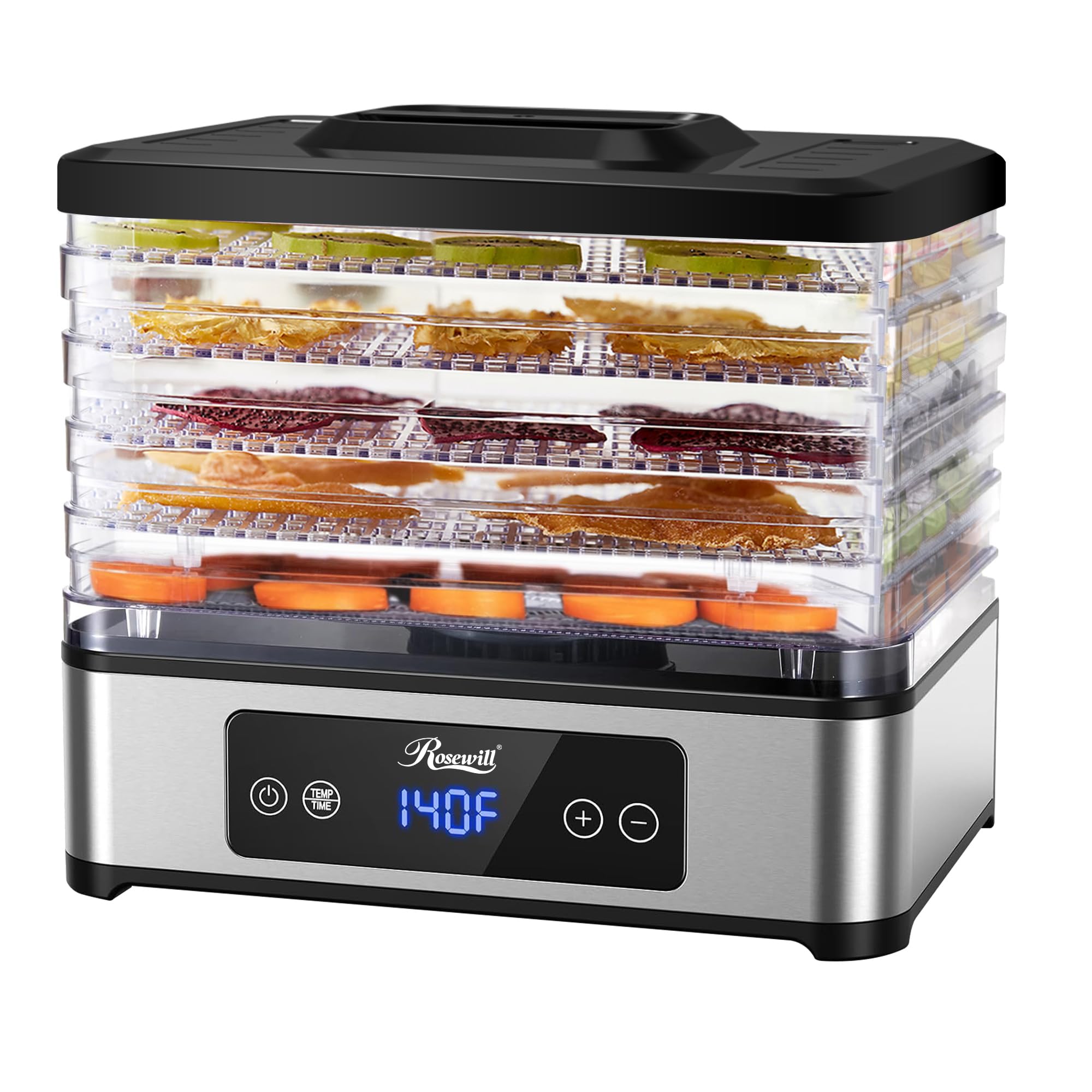
| Rosewill Compact Food DehydratorBest Capacity | Thick-cut jerky & big batches | 158°F | 5 (adjustable height) | 400W | Amazon |
| vassillias Small Food Dehydrator (904) | Countertop herb & fruit drying | 158°F | 5 | 400W | Amazon |
| Mountain House Emergency Meal Assortment Kit | Trail dinners with zero prep | — | — | — | Amazon |
| PSIIDAN Food Dehydrator Machine | Large-batch jerky & meal prep | 167°F | 8 stainless steel | 650W | Amazon |
| Reemix 5-Tier Compact Food Dehydrator | Light home drying on a budget | 167°F | 5 | 250W | Amazon |
| vassillias Small Food Dehydrator (704M) | Small-batch snacking | 158°F | 5 | 280W | Amazon |
Detailed Reviews
1. Cosori Food Dehydrator 5 Trays
Our pick — over 4.5★ from 9,500+ verified ratings; the strongest balance of quality and price.
The 165°F ceiling that lets jerky finish safely while herbs stay gentle.
This is the one to buy if you want a dehydrator that handles the full spread of backpacking prep without babysitting it. Temperature control runs between 95°F and 165°F in 1°F steps, so you can drop to the low end for herbs and fruit leather and push up for beef jerky. The timer runs up to 48 hours in 30-minute increments, which means you can set a long jerky run before bed and let it finish overnight.
Five BPA-free trays come included, and you can expand the stack to 7 by adding two more trays. Each tray is 12.2″ across on the outside and 11.6″ inside, so a single layer holds a real amount of sliced meat or apple rings. Adjustable tray heights let you raise individual trays to fit thicker cuts rather than squashing them under a fixed shelf. That flexibility is what makes it useful beyond just jerky — thick-cut vegetables and fruit leather both need that room.
The one real trade-off is pace: the Cosori runs slow and steady rather than fast, and the bottom trays finish ahead of the top ones. You will get better results rotating the stack partway through a long dry. Some owners also note that accessory fruit-leather mats are not included — you need to buy those separately, and universal mats may need trimming to fit. At 4.9 pounds it is easy to pull out of a cabinet, and it runs at under 47 dB, so it is quiet enough to leave going overnight in a kitchen.
What makes it the top pick
- 95°F to 165°F range in 1°F steps covers herbs through jerky
- 48-hour timer in 30-minute increments for unattended overnight runs
- Expandable from 5 to 7 BPA-free trays as your batches grow
- Under 47 dB operation and adjustable tray heights for thick cuts
Where it asks a little patience
- Dries slowly and unevenly between top and bottom trays, so rotation helps
- Fruit-leather mats sell separately
Buy it for: A do-everything first dehydrator where jerky, fruit, and herbs all have to share one machine.
Think twice if: You want to run huge batches fast — the expandable tray count only pays off if you add the extra trays.
2. Rosewill Compact Food Dehydrator 5 Trays
A sturdy steel-bodied dryer with trays you can raise to 1.5 inches for thick cuts.
The Rosewill earns its spot on the strength of its tray design. Each of the five food-grade, BPA-free trays sits at 0.8 inches of standard height, but you can raise any one of them to 1.5 inches with a 180° rotation. That extra room is exactly what thick-cut jerky and large vegetable slices need, and it is the reason this unit stays popular with people who dry more than just fruit.
Where it differs from the Cosori is weight and heft. The Rosewill is a 14.7-pound machine in an alloy steel body, while the Cosori is a 4.9-pound unit — a real difference if you plan to move it between counter and shelf, but a point in its favor if you want a base that does not shift during a long dry. The 400W drying capacity with 360° hot air circulation drives heat all the way around the stack rather than straight up the middle. Temperature runs 95°F to 158°F with a 0.5 to 48-hour timer, and automatic shut-off ends the cycle for you.
Buyers report the controls need no instructions, the trays clean easily, and the temperature and timer hold accurately. One owner fit a two-pound round roast on a single tray. The recurring gripe is drying time — some find it fast, others say it takes forever to dehydrate anything. That spread usually depends on what is being dried and how thick it is sliced. Pair it with a little patience and it delivers.
Why it holds up: The adjustable 1.5-inch tray mode and 360° airflow give thick jerky the circulation it needs, and the 400W draw beats smaller units on raw drying capacity.
One thing to know: Prepare to shuffle trays if you want an even finish — the 14.7-pound frame is built to sit still, not to be rotated casually.
Reach for this if: Jerky and thick-cut vegetables are your main targets and you want tray height that adjusts to the cut.
Look elsewhere if: You want a featherweight unit that lives in a cabinet — this steel body prefers a permanent counter spot.
3. vassillias Small Food Dehydrator Model 904
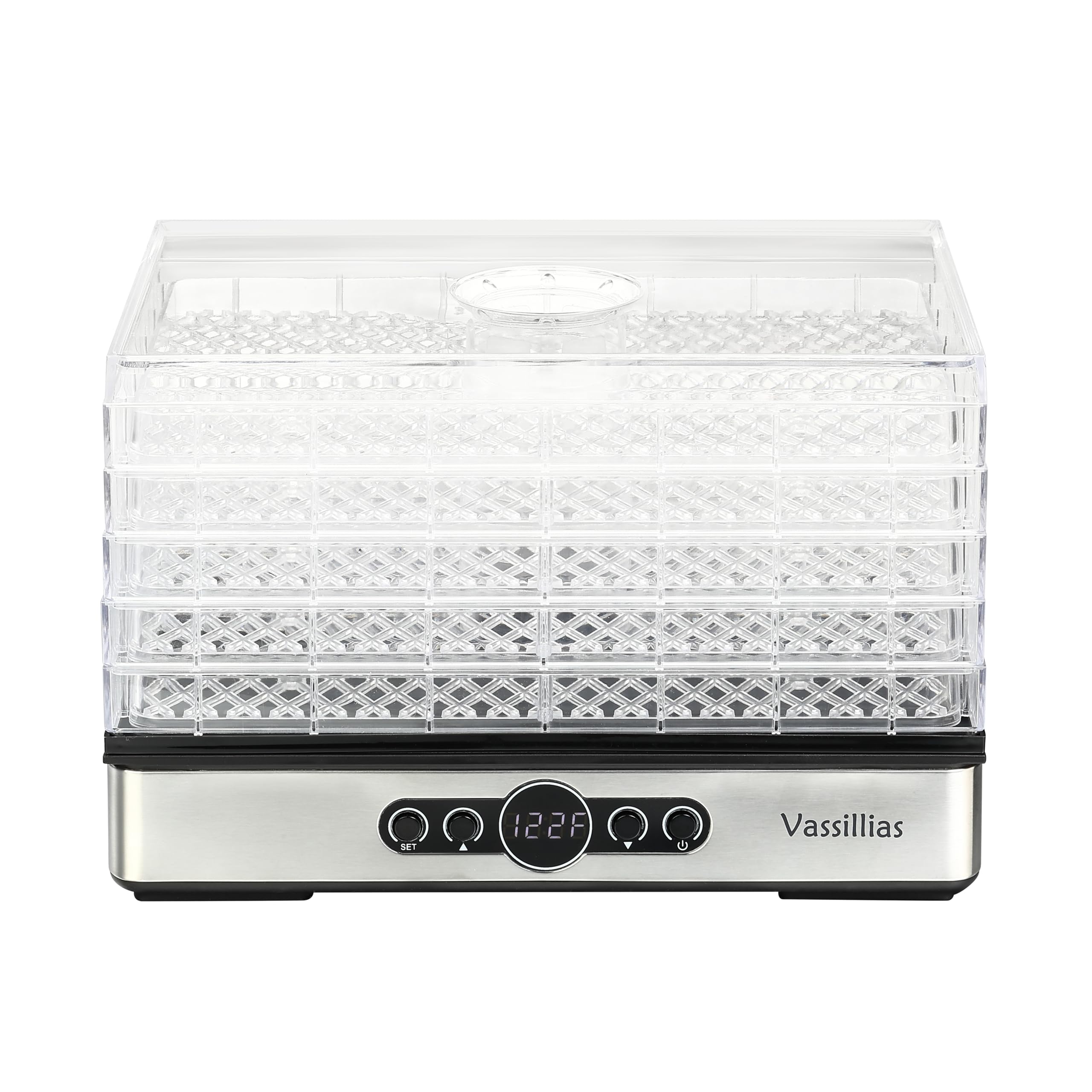
Square tray racks with a generous air gap and 400W pushing through every layer.
For someone drying herbs and fruit for trail snacks rather than bulk jerky, this model 904 unit from vassillias is the sensible middle ground. Each of its five layers keeps a 0.79-inch gap, and the fan moves air evenly through the whole stack for meat, jerky, fruit, vegetable, mushroom, and herb. Temperature is adjustable from 95°F to 158°F, and a built-in overheating protection system shuts the machine down automatically if something goes wrong.
The trays are 11.4″ by 7.5″, which is a genuinely small footprint on a counter. The 400W draw is the same figure the Rosewill carries, so you are getting comparable raw power in a lighter, more portable package. What owners praise most is quality — it is the leading theme in the reviews — with effectiveness close behind. People find it easy to use and easy to clean, and the operating noise stays low, which matters if you like to run a batch overnight.
There is one catch worth flagging before you buy. Hot air only gets produced above roughly 122°F on this model, so the lowest temperature settings on the dial will not give you the gentle, barely-warm air that delicate herbs sometimes want. If your whole plan is dehydrating at low temperature, factor that in. For fruits, jerky, and vegetables that want real heat, it does the job.
Best for small kitchens: The 11.4″ x 7.5″ trays and square shape tuck onto a crowded counter without dominating it.
Safety built in: Automatic overheat shutdown plus BPA-free food-grade material gives confidence during unattended runs.
The honest limitation: No real heat output below about 122°F, so it is not the pick for ultra-low-temp herb drying.
Suits you if: You dry fruit, veggies, and jerky at normal temperatures and want a compact square unit with real wattage.
Not for you if: Your recipes call for drying at 100°F to 120°F — this machine starts producing heat higher up the dial.
4. Mountain House Emergency Meal Assortment Kits
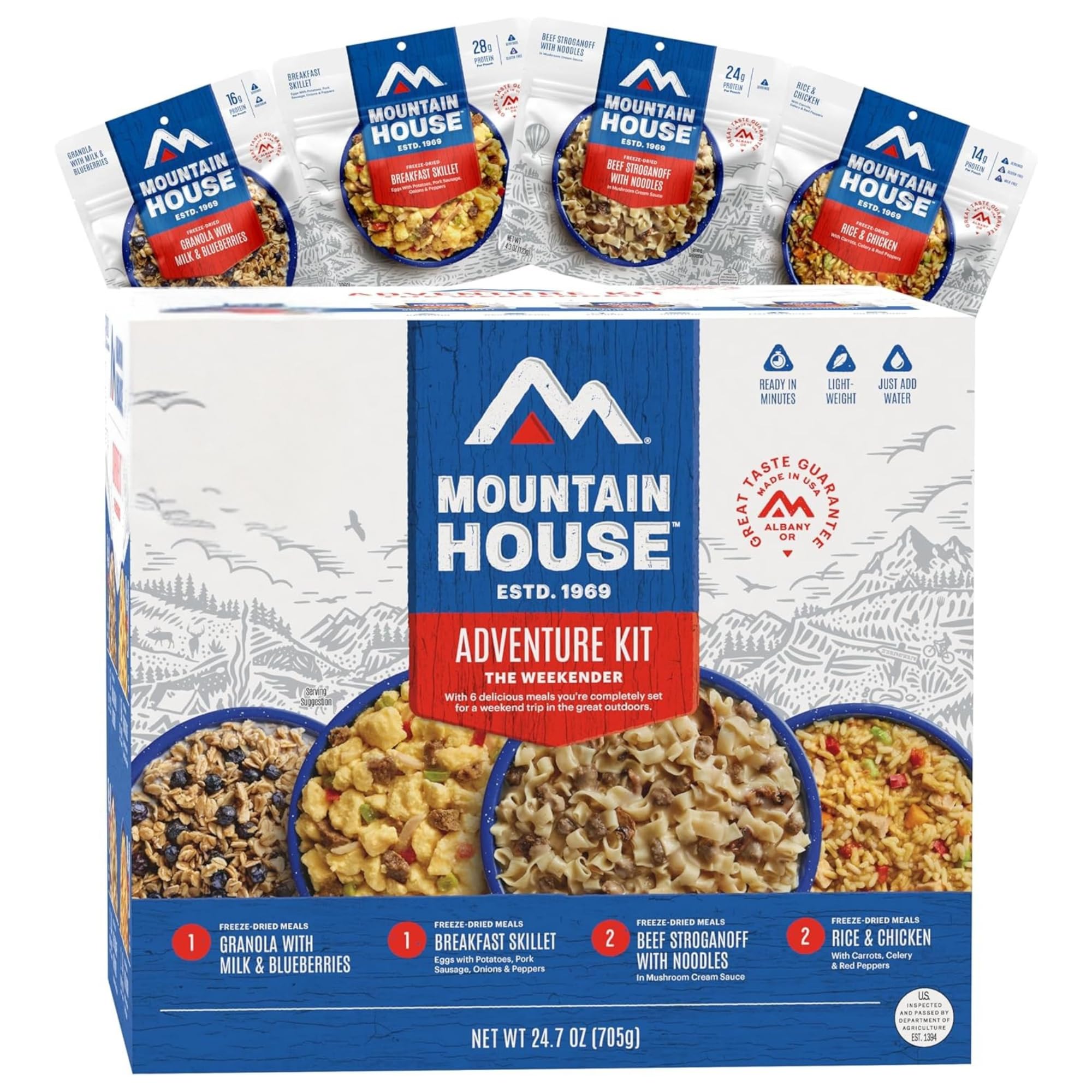
The no-machine answer: six pouches, twelve servings, and water does the rest.
Not every backpacking meal has to come out of your own dehydrator. This Mountain House kit is the shortcut — six pouches covering breakfast, lunch, and dinner, made up of Granola with Milk & Blueberries, Breakfast Skillet, Rice & Chicken, and Beef Stroganoff with Noodles. Add water and eat straight from the pouch in under 10 minutes, with no cleanup and no drying time. The kit’s 12 servings average about 1,645 calories per day.
Taste is the headline here, and it is the overwhelming reason buyers keep coming back — it is the most-praised quality by a wide margin. People who have carried these on weekend trips and at places like Isle Royale report the meals hold up. The granola with blueberries and milk draws the strongest reactions, and the beef stroganoff is described as filling with real meat rather than filler. One buyer’s verdict: “My husband LOVED these.”
The catch is prep accuracy. Water measurements and suggested sit times can be unreliable — some meals come out soupy if you follow the pouch to the letter, others need extra time to fully soften. The common tip is to use less water than suggested and, if you can, simmer the food on a stove to concentrate the seasoning. Portion size also splits opinion, and the zip-lock top does not always stay sealed, which is worth taping shut before you pack it.
Why hikers keep buying it
- Ready in under 10 minutes with no cleanup and no dehydrating
- Six pouches and 12 servings spread across breakfast, lunch, and dinner
- 1.5-pound kit with a 30-year shelf life
What to watch
- Pouch water measurements and sit times can run off — use less water than suggested
- Portion size draws mixed reactions, and the resealable top does not always hold
Pick this for: A first backpacking trip or an emergency kit where you want zero prep and no machine.
Skip this for: A strict per-day calorie plan or a very tight pack — portions vary and the bag is sized for two meals.
5. PSIIDAN Food Dehydrator Machine 8 Trays
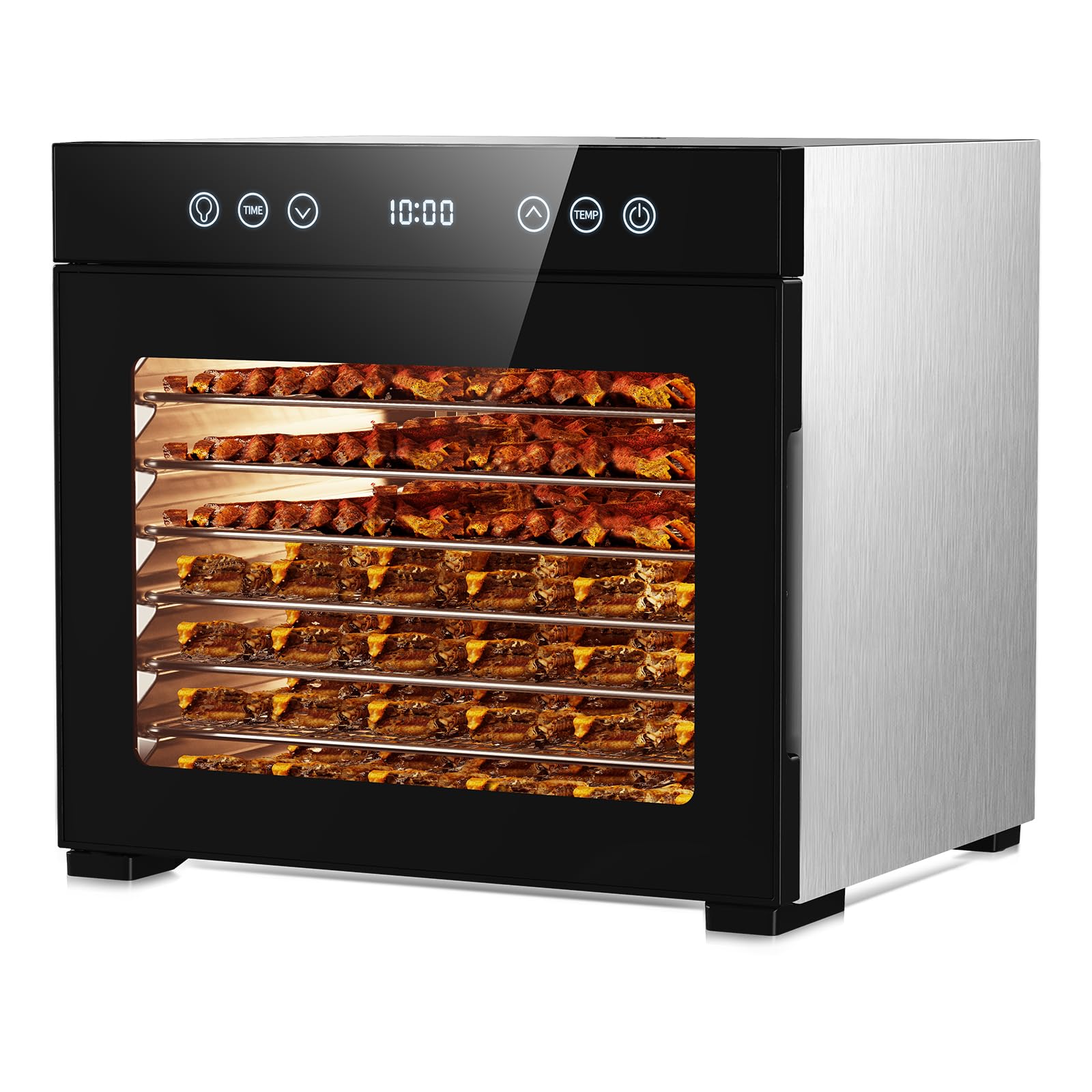
Eight steel trays and a 650W motor for people prepping a week of meals at once.
If jerky is the goal and you want to do a lot of it in one session, the PSIIDAN is the capacity play in this lineup. Eight stainless steel trays are stacked under a 650W motor, and the temperature climbs to 167°F with a timer that runs to 48 hours. Its footprint is 13.00″ x 13.31″ x 12.01″, so it needs a real slice of counter space, but it packs a serious amount of drying surface into that shape.
On paper the gap between it and the Cosori is straightforward: higher top-end heat at 167°F vs 165°F, and more trays at 8 vs 5 before the Cosori is expanded. What it lacks is expandability — you cannot add trays the way you can on the Cosori. What it adds is a mesh tray for small items like nuts and seeds, a drip tray for fruit roll-ups and juicy foods, and a recipe guide to get you started. Dual-layer insulation keeps the exterior cool during long runs, which is a meaningful detail in a kitchen with kids or pets underfoot.
What owners rave about most is performance, and ease of use follows close behind. It is quiet enough that you rarely notice it running, it shuts off as soon as the timer ends, and the steel shelves clean in seconds. One buyer who compared it with an older round unit got faster, more even drying. The trade-off is counter space and dollars — this is the top-tier pick here, and it asks for both.
The capacity case: Eight steel trays plus a 650W motor means one big jerky or fruit run covers your whole trip instead of two long sessions.
Built-in extras: Mesh tray, drip tray, and recipe guide arrive in the box, so there is nothing else to buy before your first batch.
The trade-off: Fixed at eight trays with no expansion path, and it wants a permanent spot on the counter.
Worth it for: Big-batch prep where eight trays at once beats five, and you want the highest heat ceiling on the list.
skip it if: Counter space is tight or you would rather start small and grow the tray count over time — this one is fixed at eight.
6. Reemix 5-Tier Compact Food Dehydrator with BPA-Free Trays

A touch-panel five-tray dryer for someone testing the hobby before going all in.
The Reemix is the lightest commitment in this roundup, and it makes a reasonable first dehydrator for someone who wants to try drying fruit and jerky occasionally. It runs a 250W heating element under five stackable BPA-free trays with a stainless steel base, and the touch panel handles temperature from 95°F to 167°F and a timer from 1 to 48 hours. That is a wide temperature span on paper — the widest low-to-high reach in the group alongside the PSIIDAN.
The circular airflow system is designed to spread warm air around each tray rather than leave hot spots, and the LCD screen shows your time and temperature as they run. Trays and the steel base wipe clean, and the low-power element is meant to run efficiently for daily use. For vanilla beans, spices, and light fruit drying, this handles the basics without much fuss.
It is worth being clear about where this one lands. The biggest theme owners mention is functionality — it does work — but how well it dehydrates draws a split reaction. Some report great results, others find it needs a temperature balance and want the trays rotated mid-run to dry evenly. The buttons can be finicky and the bottom drip area is fiddly to clean. If you dry small batches occasionally, that is a fair trade; if you are prepping a full trip’s meals, look at the higher-wattage picks.
What earns its place
- 95°F to 167°F touch-panel control with a 1–48 hour timer
- Five BPA-free trays on a stainless steel base for a light starting price tier
- Compact, quiet profile suited to a small counter
Where it falls short
- 250W is the lowest draw here, so long thick cuts can take a while
- Finicky buttons and a hard-to-reach drip area; trays want rotating for even drying
A fair opener for: Small-batch fruit, herb, and spice drying where you want touch controls without a big spend.
Pass if: You plan to run back-to-back jerky batches — the lower wattage means slower, more careful drying.
7. vassillias Small Food Dehydrator Model 704M
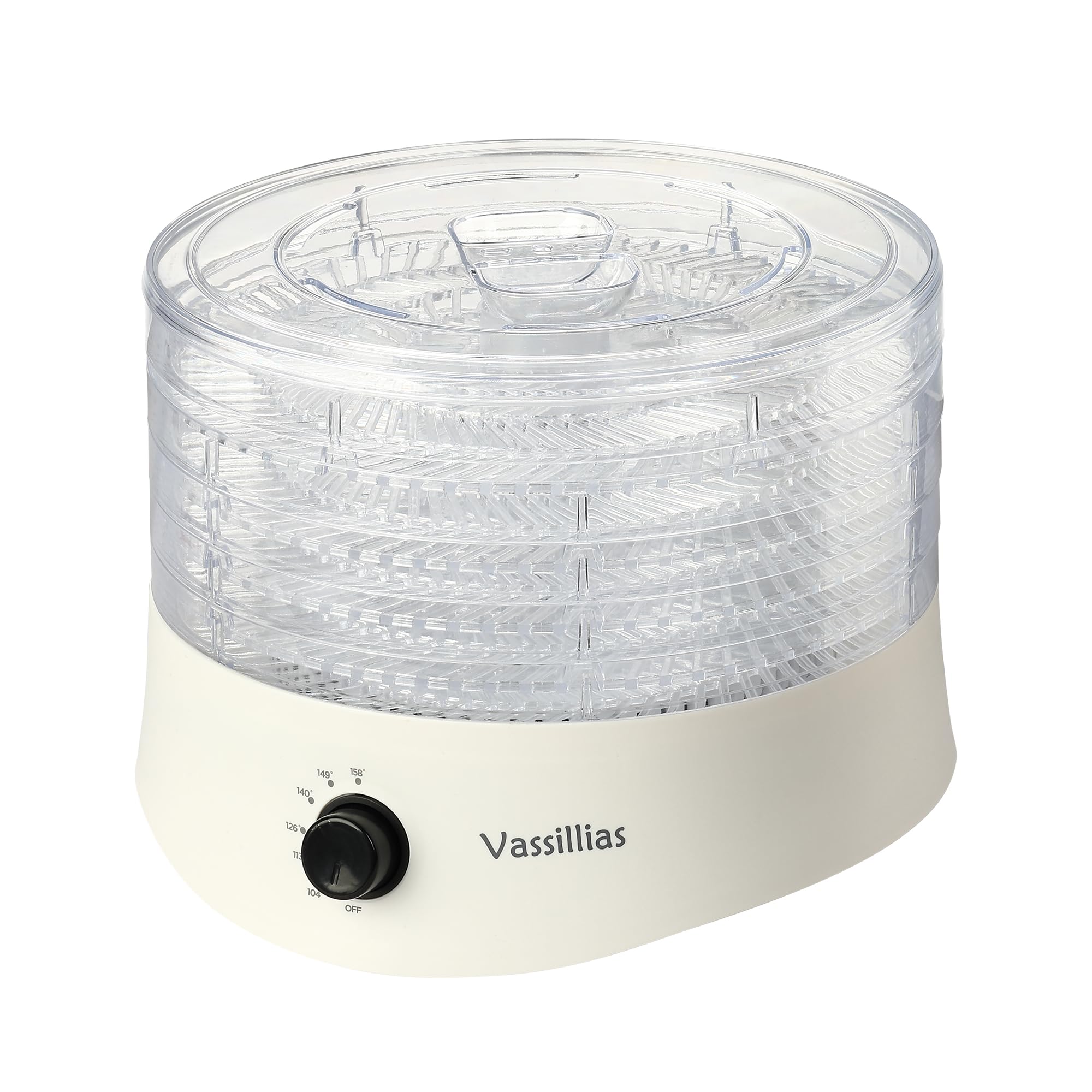
The smallest-footprint option, built for a snack drawer rather than a trail bag.
This 704M model is the other vassillias unit here, and it splits from its 904 sibling on wattage — 280W against the 904’s 400W. Each of its five layers keeps the same generous 0.79-inch gap, and a fan pushes even airflow across meat, jerky, fruit, vegetable, mushroom, and herb. The adjustable range is 104°F to 158°F, with an overheating protection system that shuts the unit down if something goes wrong. Removable trays measure 10.23″ x 10.23″, which makes for quick cleanup.
Where this one earns its place is size and small-batch convenience. What owners mention most often is ease of use, with value for money right behind it — the two leading themes in the reviews. It is easy to clean, does not make much noise, and the temperature settings land where people expect. For overnight fruit and herb drying and small jerky batches, it does what it says at the lightest power draw in this group.
The one thing to weigh honestly is the size, which draws the most discussion of anything about this unit — and not all of it flattering. Some buyers find it smaller than they pictured, and one described it as underpowered and small for large quantities. It is not the machine for a week of backpacking dinners. Its 10.23″ x 10.23″ trays fit a narrow countertop — “perfect countertop size,” as owners put it.
Why people like it: Easy setup, easy cleaning, and quiet running make it a low-fuss counter machine for everyday fruit and herb drying.
The value angle: It delivers temperature control and five BPA-free trays at the lightest power draw of any unit here.
Sizing reality: Smaller than many expect, and best kept to light batches rather than bulk meal prep.
Good match if: You want a small, quiet dryer for herbs, fruit, and small jerky runs on a narrow countertop.
Not the pick if: You are drying in large quantities — this is the compact end of the lineup, and it shows.
Know the Specs
Temperature range
The temperature range is the low-to-high window the machine can hold, measured in degrees Fahrenheit. A wider window is more flexible — a low floor around 95°F lets you dry herbs and fruit leather gently without cooking them, while a higher ceiling like 165°F or 167°F gives beef jerky the finishing heat it needs. A model that tops out near 158°F is still usable, but it leaves less headroom.
Wattage and drying capacity
Wattage is how much power the heating element and fan draw, and it drives how fast and how evenly things dry. Higher-wattage units like the 650W PSIIDAN and the 400W machines generally move more air and hold temperature better under a full load of trays. Lower-wattage units, like the 250W and 280W models here, work fine for small batches but take longer when the stack is full and loaded thick.
Tray count and adjustability
Tray count is simply how many drying layers you get per batch. Five is the common starting point, while eight trays lets you dry a much larger load in one session. Some trays adjust in height, letting you raise a layer to fit thicker cuts — that matters for jerky. Stackable designs let you store the unit with the trays nested when it is not in use.
Timer and auto shut-off
The timer sets how long the dehydrator runs before it stops. Long timers in the 48-hour range let you start a batch and walk away, and adjustable increments let you fine-tune. Auto shut-off ends the cycle when the timer runs out, so you can run it overnight without staying up to switch it off.
Common Questions
What temperature should I dry beef jerky at for backpacking?
How many trays do I need to prep a week of backpacking meals?
Can I dehydrate a full meal or just snacks?
Are BPA-free trays really necessary?
Can I leave a dehydrator running overnight while I sleep?
How long does it take to dry fruit versus jerky?
Do I need a fruit leather mat to make roll-ups?
Can I use a home dehydrator to dry food for a long trip?
Do the trays need rotating during a drying cycle?
Is a stainless steel tray better than plastic for jerky?
The Bottom Line
For most backpackers, the dehydrator for backpacking meals winner is the Cosori Food Dehydrator because its 165°F ceiling and 95°F floor handle jerky, fruit, and herbs in the same machine, its timer runs 48 hours, and it expands from 5 to 7 trays as your batches grow. If large batches are your priority, the PSIIDAN gives you eight steel trays and a 650W motor. For thick-cut jerky, the Rosewill tray heights adjust up to 1.5 inches. And if you would rather skip the prep, the Mountain House kit just needs water.
How we choose
We do not accept paid placement. Every pick is matched to a real buyer and a real use-case; we do not hands-on test units.
Sources
Specifications: manufacturer listings and product documentation. Review insights: verified customer reviews, as of October 2026. Pricing: not shown on this page (it changes often); check the current price via the retailer link.
As an Amazon Associate, Aappliancez earns from qualifying purchases. This does not affect which products we feature.