Disclosure: Some links in this post are affiliate links. As an Amazon Associate I earn from qualifying purchases, at no extra cost to you. Learn more
Specs are compiled from manufacturer listings and verified buyer reviews and can change over time — please confirm the key details on the product page before buying.
Rot on a deck almost never starts on top. It starts where the boards sit on the joists, in that thin dark gap that never dries out, and it takes years before you notice the screws won’t bite any more. The fix is cheap and boring and takes an afternoon: a strip of waterproof butyl tape over the top of every joist, beam, and rim board before the decking goes down. This guide ranks five real rolls on how well they seal, how wide they run, and how they behave in cold weather and hot sun.
This guide is built by comparing the manufacturers’ published specifications and the patterns across verified customer reviews, so you get each pick’s real strengths and trade-offs instead of marketing spin.
You will see how roll width, backing paper, and temperature ratings change the install, and where a wider roll saves you time. Each pick below is matched to a specific job, so you can skip straight to the one that fits your deck — the following five rolls are the strongest options for deck joist tape.
Top Picks

How To Choose The Best Deck Joist Tape
The job of this tape is narrow and specific: it keeps water off the top face of a joist so the wood can dry out instead of soaking. After you lay it, the decking sits right on top of it and the gap between board and joist becomes a covered, sealed surface. Seal the joist tops and the frame can outlast the decking nailed over it.
Width decides how much fiddling you do
A standard joist is 1.5 inches across the top, so a 2-inch roll gives you a little overhang on each side to wrap over the edges. A 1-5/8″ roll is a close fit with very little spare, while a 4″ roll covers the joist and folds down the sides in one pass. Wider is faster; narrower is tidier on tight framing.
Temperature rating tells you when to install
Butyl is a rubber adhesive, and rubber gets stiff when it gets cold. Some rolls are rated well below freezing, while others ask for a warm day and a hair dryer to soften the glue. If you are framing in late autumn, check the low end of the temperature range before you buy.
Backing paper is the quiet make-or-break
A thin film backing tears and fights you all afternoon; a proper release paper peels away in one clean pull. A release-paper backing peels in one pull and sets the pace for the whole taping job.
Side-by-Side Comparison
| Model | Best For | Roll Size | Adhesive Material | Temperature Range | Amazon |
|---|---|---|---|---|---|
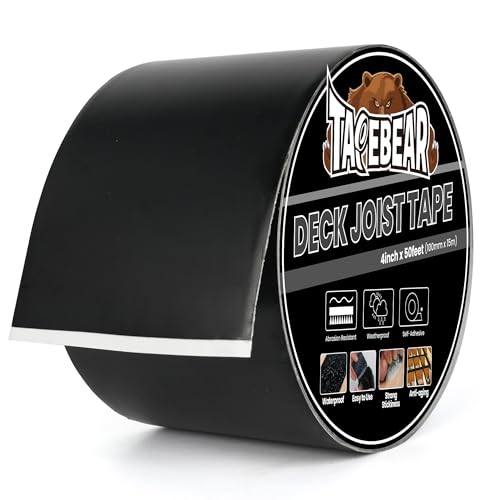
| TAPEBEAR Joist Tape★ Best Overall | Overall sealing and length of run | 4″ × 50′ | Butyl | -20°F to 230°F | Amazon |
| LLPT Waterproof Patch and Seal TapeMost Versatile | Patch repairs and general waterproofing | 4″ × 13 Ft | Thermoplastic olefin | — | Amazon |
| Amazing Works Joist Tape | Blacked-out deck edges | 4″ × 50′ | Butyl | Above 50°F recommended | Amazon |
| VIVIDA Joist Tape | Full deck kit with tools | 2″ × 50′ (2 rolls) | Butyl rubber | -40°F to 248°F | Amazon |
| Imus Seal Butyl Joist Tape | Tight framing, clean finish | 1-5/8″ × 50′ (2 rolls) | Butyl | — | Amazon |
Detailed Reviews
1. TAPEBEAR Joist Tape 4″×50′
Our pick — 4.5+★ from 1,000+ verified ratings; the strongest balance of quality and price.
A four-inch by fifty-foot butyl roll that covers a joist and folds over both edges in one pass.
Here is the pitch in one sentence: 50 feet of 4-inch waterproof butyl tape, rated from -20°F to 230°F, for a deck frame you want to stop worrying about. That width is the headline. Four inches spans a 1.5-inch joist top with enough left over to wrap down both sides, which is exactly the wrap-over-the-edges coverage the instructions ask for. On a rim board or a doubled beam it finally feels like you have tape to spare instead of tape to ration.
The temperature window is the number that separates this roll from the pack. A range of -20°F to 230°F means it is built for climates that swing hard in both directions, and the maker still notes that cold weather stiffens the butyl and a hair dryer helps before you lay it. It sticks to wood, metal, plastic, and rubber, so joist hangers and treated lumber are both fair game. The backing is release paper rather than a thin film, which sounds dull until you are 40 joists in and still peeling cleanly.
What it does well in the field, owners say, is hold. As buyers report, one framing job on treated 2×4 went down fast and held even on wood that was not perfectly clean or dry. The honest catch is the same thing in reverse: once this glue bites, cleanup is a chore, and soap, alcohol and acetone all failed where a dedicated adhesive remover worked. It also reaches full grip over 24 hours rather than instantly, so do not stretch it and do not judge it on the first hour. It runs 50 feet with a single roll where the LLPT roll gives you 13, so a full deck frame is one purchase, not four.
Where it earns the top slot
- 4-inch width wraps over joist edges in one pass
- -20°F to 230°F range suits hard-swinging climates
- Release-paper backing peels in one clean pull
- Bonds to wood, metal, plastic and rubber, so hangers are covered
The fair warning
- Full adhesion takes 24 hours, not minutes
- Residue on tools resists soap, alcohol and acetone
- Cold weather needs a hair dryer to soften the butyl first
Reach for this if: you are taping a whole frame and want one wide roll to do it — the 4″ × 50′ size covers a lot of joist.
Plan around this: surfaces must be dry and debris-free, and you will want an adhesive remover on hand for your cutting tools.
2. LLPT Waterproof Patch and Seal Tape 4″ x 13 Ft 1 Pack, Black
The short roll that earns its keep on fixes, not framing — 13 feet of waterproof patch tape.
This one is a different animal from the framing rolls, and worth being clear about up front. It is 13 feet long and 4 inches wide, made from thermoplastic olefin rather than butyl, and engineered as a patch and seal tape that resists rain, UV rays, and extreme temperature swings. That makes it a smart thing to keep in the truck for a torn pool liner, a leaking gutter seam, a boat cover, or a threshold that is letting water in. On a deck frame it is simply too short to run a full set of joists, so treat it as the repair roll rather than the build roll.
Where it shines is grip on awkward surfaces. It bonds to plastic, metal, rubber, wood, vinyl, glass and tile, and the maker says it will even stick underwater on a clean surface. The stated bond life runs up to 15 years, which is a manufacturer figure rather than a measured one, but it explains the intent: this is meant to be a permanent patch you do not revisit. Reviewers keep citing the same repair: a cracked fiberglass tub, taped to length over a break that several patch kits could not hold.
The fair caveat is quality control at the edges. Some rolls arrive with the edge cut poorly, so adhesive is exposed along the sides and the tape grabs itself before you can place it. That makes it fussy to handle on a long run but fine for a small patch where you cut to length first. Compare it to the Imus Seal roll above, which is 50 feet at a similar outlay — the LLPT tape is the one you buy for range of surfaces, not range of length.
Best use case: an emergency repair roll for leaks and cracks across plastic, metal, rubber, wood, vinyl, glass and tile, with a stated bond life up to 15 years.
Know before you buy: 13 feet goes fast on a deck, and a badly cut edge can leave exposed adhesive that sticks to itself.
Buy it for the patch drawer: a leaking sunroof, a split skirting panel, or a tub crack it can seal in one strip.
Look past it for framing: with only 13 feet on the roll, a full deck frame will eat several packs.
3. Amazing Works Joist Tape 4″ x 50′

Fifty feet of blacked-out butyl built for decks where the gaps between boards get seen.
Most joist tape hides under the decking and never gets a second look. This roll matters when it does get seen — a deck around a hot tub, a bench, an open rail section where you can peek between boards. The backing is all black with no white printing, so nothing pale shows through the gaps. An all-black backing disappears in the shadow between boards instead of flashing white through the gaps.
The rest of the build is conventional but solid: 4-inch width, 50 feet per roll, butyl adhesive on one side, waterproof and weather resistant, and a non-skid top surface that makes walking the joists during install a bit less of a gamble. The maker recommends installing above 50°F (10°C), which is a fair-weather roll rather than a winter one. It is rated for wood, and the stated purpose is to act as a barrier between the lumber and the galvanized metal of joist hangers as well as to keep water off the top face.
Reviewers most often say the roll simply works on a real frame, and buyers keep coming back to the price per foot. The backing is the trade-off. It grabs hard, which is what you want on the joist, but it also makes the peel stubborn and the roll fights you until you find a rhythm. A builder with decades on decks raised the fair question of whether any joist tape might trap moisture rather than shed it, which is worth knowing as a debate in the trade rather than a flaw specific to this roll. At 4 inches wide it beats the 1-5/8″ Imus Seal roll for coverage per pass.
Why it stands out
- All-black backing hides between deck boards
- 4″ × 50′ covers a full frame in one roll
- Non-skid top surface for safer install walking
- Acts as a barrier between wood and galvanized hangers
What to expect
- Backing sticks and slows the peel until you find a rhythm
- Rated for installation above 50°F, so cold-weather framing needs a warm day
- Some builders question whether taping traps moisture at all
Pick this one if: your deck has visible gaps and you want the frame to disappear into the shadow instead of flashing white.
Set aside time: the peel is the slow part, so budget for it and warm the roll on a cool morning.
4. VIVIDA Joist Tape 2 in × 50 Ft 2 Roll
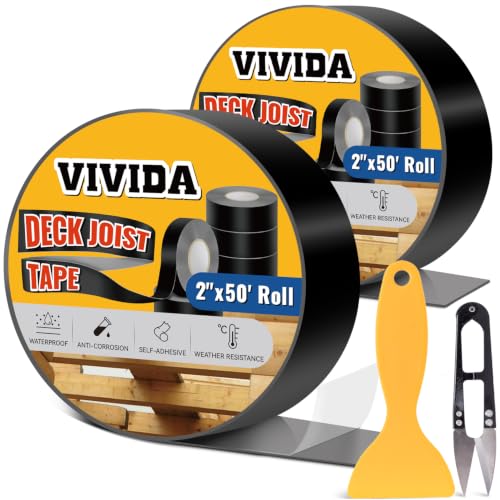
Two rolls, a putty knife and a pair of scissors — the only pick that arrives ready to work.
Two rolls of 2-inch by 50-foot butyl tape, plus a plastic putty knife and a u-shaped pair of scissors, means you can start the moment the box lands. The scissors cut the tape cleanly, the knife scrapes residue off the joist, and the 2-inch width folds over a 1.5-inch joist top with a comfortable overhang on each side. That kit is what lifts it above the bare rolls for a first-time deck builder.
The temperature range is the widest here at -40°F to 248°F, which is a huge working window and the reason this roll handles blazing sun, rain and snow. The butyl rubber is thick enough to give a real sealing effect, and the peel-away backing is substantial enough that it does not tear in the middle of a pull — a detail that matters far more on a long run than it sounds. It bonds to wood, metal and plastic, and the maker suggests wrapping it over the joist edges for the best result.
Buyers praise the build quality and the easy application, and that is where the feedback is strongest. The recurring honest note is stickiness: it is not as aggressive as the premium brands, and some buyers find it needs care to stay put on a dusty joist. Cold weather is the other variable — the maker says to warm the tape with a hair dryer first when it is cold so the butyl softens. Compared to the TAPEBEAR roll, you give up 2 inches of width per pass and gain a second roll and a set of tools.
What the kit gives you: two 2″ × 50′ rolls plus a plastic putty knife and u-shaped scissors, with a -40°F to 248°F range.
The honest limit: the adhesive is less aggressive than some premium rolls, so it wants a clean, dry surface and a warm day to really lock down.
Start here if: you are taping your first deck and want everything in the box, including the cutting tools.
Watch the weather: below freezing you will want to soften the butyl with a hair dryer before it will grab.
5. Imus Seal Butyl Joist Tape
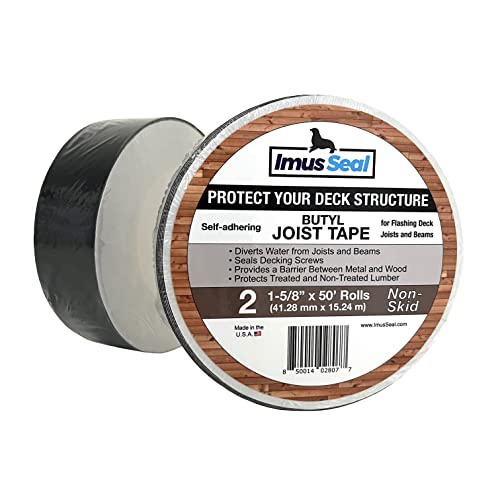
A trim 1-5/8-inch roll that hugs a joist instead of wrapping it, made in the USA.
Framing a deck tight against a house, a step, or a stringer leaves little room for a wide roll to fold back on itself. This Imus Seal tape is 1-5/8 inches wide by 50 feet, sold as two rolls, and that near-exact fit to a 1.5-inch joist is the whole point. You get very little overhang, so the install is neat rather than fast. If you have ever fought a 4-inch roll trying to wrap itself around a stair stringer, this is the roll that stays where you put it.
What it is built to do is straightforward: it self-adheres to joists and beams to divert water, it seals the decking screws, and it provides a barrier between metal and wood. It protects both treated and non-treated lumber, resists UV light and water, and carries a non-skid top surface. The butyl and polypropylene build is clean and neat, with none of the gooey ooze that some imported rolls leave behind.
The trade-offs come down to size and heat. The 1-5/8-inch width leaves almost no wiggle room, so a slightly off-square joist shows; a wider roll forgives that. In high summer above 80°F the tape can turn soft and gooey and get awkward to place, which is a summer-morning job rather than a midday one. It also runs in smaller packs than the 50-foot-wide rolls, which makes the per-foot value a fair question if you are taping a large frame. What wins people over is the clean, tidy finish and the way it stays put once it is down.
The finishing-tape case
- 1-5/8″ width fits tight framing and stair stringers
- Clean butyl with no oozing adhesive
- UV and water resistant, protects treated and non-treated lumber
- Non-skid surface and two rolls per pack
The size tax
- Minimal overhang leaves no margin on an off-square joist
- Gets soft and gooey above 80°F
- Smaller two-roll packs make per-foot value worth checking
Choose it for close quarters: stringers, steps and rim boards where a 4-inch roll would buckle.
Time your install: lay it on a cool morning, because above 80°F the butyl turns gooey and fights you.
Know the Specs
Butyl vs Thermoplastic Olefin
Butyl is a rubber adhesive that stays tacky and grips hard once it is down; it is the standard for framing tape. Thermoplastic olefin, the material in the LLPT roll, is a synthetic film that bonds to a wider range of surfaces including glass and tile. Butyl is what you want on wood joists; olefin is what you want on a repair across mixed materials.
Temperature Range
A high rated range does not mean the tape works instantly in a snowstorm. It means the adhesive will survive those temperatures once applied. Installation is a separate matter: the butyl softens with heat, so a cold-weather install usually wants a hair dryer to warm the roll first.
Release Paper vs Film Backing
The backing is the layer you peel off to expose the glue. A thin film tears and fights you; a proper release paper peels in a single pull and speeds up the whole job. Backing type rarely gets a second look on the label, yet it decides how fast the roll goes down.
Roll Width and Overhang
A standard joist is 1.5 inches wide. A 2-inch roll folds over both edges with a little to spare; a 1-5/8″ roll hugs the joist; a 4-inch roll wraps the top and both sides in one pass. Match the width to how much wrapping you actually need.
Common Questions
Does deck joist tape actually stop rot?
What width joist tape do I need for a 2×8 or 2×10 joist?
Can I install joist tape in cold weather?
Do I need to clean the joist before taping?
Should I stretch the tape as I apply it?
Does the tape go under joist hangers or only on top of the joist?
Can I use deck joist tape on a flat roof or as general flashing tape?
Will the tape show between my deck boards?
How long does a roll of joist tape last?
Do I tape every joist or only the ones near the house?
The Bottom Line
If you want one roll to do the whole frame, reach for the TAPEBEAR Joist Tape — the 4″ × 50′ roll wraps over the joist edges in one pass and is rated from -20°F to 230°F, so it works in climates that swing both ways. For a first deck where you want the tools in the box, the VIVIDA two-roll set throws in a putty knife and scissors and covers the same 50 feet per roll with a wider -40°F to 248°F range. And if your framing is tight against a house or a stringer, the Imus Seal 1-5/8″ rolls hug the joist instead of fighting it. Whichever you pick, taping the frame now costs an afternoon and saves you a joist rebuild later.
How we choose
We do not accept paid placement. Every pick is matched to a real buyer and a real use-case; we do not hands-on test units.
Sources
Specifications: manufacturer listings and product documentation. Review insights: verified customer reviews, as of October 2026. Pricing: not shown on this page (it changes often); check the current price via the retailer link.
As an Amazon Associate, Aappliancez earns from qualifying purchases. This does not affect which products we feature.