Disclosure: Some links in this post are affiliate links. As an Amazon Associate I earn from qualifying purchases, at no extra cost to you. Learn more
Specs are compiled from manufacturer listings and verified buyer reviews and can change over time — please confirm the key details on the product page before buying.
If your feet run wide, you already know the drill: a deck boot that fits at the heel usually pinches across the toes by lunchtime. The fix is to stop trusting the size number and start reading the construction — how thick the neoprene is, how the shaft is cut, and whether the shell has any give at all. Every pick below was chosen because its build actually leaves room for a wide forefoot while still holding a grip on a wet deck.
This guide is built by comparing the manufacturers’ published specifications and the patterns across verified customer reviews, so you get each pick’s real strengths and trade-offs instead of marketing spin.
A deck boot is a slip-on ankle boot with a rubber shell and a sole built to stick on wet fiberglass. Wide-foot buyers need neoprene that stretches, a toe box that doesn’t taper hard, and a sole that won’t slide when the deck tilts. Below you’ll find the picks that handle all three, which is the whole point of this list of the deck boots for wide feet.
Top Picks
How To Choose The Best Deck Boots for Wide Feet
Wide feet change the shopping list. Instead of chasing the softest lining or the lightest weight, you’re hunting for a boot whose upper can give a little and whose toe box stays full-width to the end. Three things decide that.
Neoprene thickness is your stretch budget
Neoprene is the spongy synthetic rubber that makes a deck boot feel like a wetsuit. Measured in millimeters, it’s the part that stretches over a wide forefoot. A boot with 3.5mm neoprene, like the TIDEWE pair here, gives your toes somewhere to go. Thinner uppers hold shape better but press harder on a wide foot. If your feet swell through a long day on the water, thicker neoprene forgives that too.
Look at the shaft height before the size number
A 6-inch ankle boot clears your ankle bone and stops there; a model with a 7.36-inch shaft, like the TIDEWE, comes up a bit higher. Height matters for wide feet because a taller shaft wraps more of your instep. That extra wrap can feel supportive or tight, depending on your arch. Shorter ankle cuts are easier to pull on but do less to lock the heel.
Half sizes and how to size up
Many deck boots skip half sizes entirely, so a wide-footed buyer between sizes has to choose. The rule most makers publish is simple: go up. TIDEWE tells buyers to size up for half sizes and to check the insole length first. XTRATUF states plainly that most of its boots and deck shoes don’t come in half sizes. That makes the insole spec the number to read, not the tag.
Slip resistance you can actually name
Deck soles are rated for slip resistance by standard. SRA covers grip on wet floors. SRB adds traction on wet and oily surfaces. SRC combines both and is the highest rating of the three. On a boat, oily bilge water is real, so any boot rated to SRC is doing more work than one rated SRA alone. XTRATUF publishes that its footwear is tested to ISO standards for exactly this.
Side-by-Side Comparison
| Model | Best For | Upper Material | Boot Height | Waterproof Claim | Amazon |
|---|---|---|---|---|---|
| XTRATUF 6” Ankle Deck Boot Sport★ Best Overall | All-day comfort on a wide foot | — | 6 inch | 100% Waterproof | Amazon |
| TIDEWE Deck Boots for MenBest Value | Budget-friendly wet-deck grip | 3.5mm Neoprene | 7.36 inches | 100% Waterproof | Amazon |
| BASSDASH Explorer-DG 6” | Soft insole comfort for long days | Rubber | 6 inch | Waterproof | Amazon |
| Sperry Billfish Slip On | Deck-to-dinner versatility | Full Grain Leather and Mesh | — | — | Amazon |
| Gator Waders Men’s Deck Boots | USA-made premium build | — | — | 100% Waterproof | Amazon |
| LaCrosse Alpha Deck 6″ | Wide fit in a 6-inch cut | Rubber | 6 inch | Waterproof | Amazon |
| Grundéns Deviation 6″ | Anglers who want quality rubber | — | 6 inch | Waterproof | Amazon |
Detailed Reviews
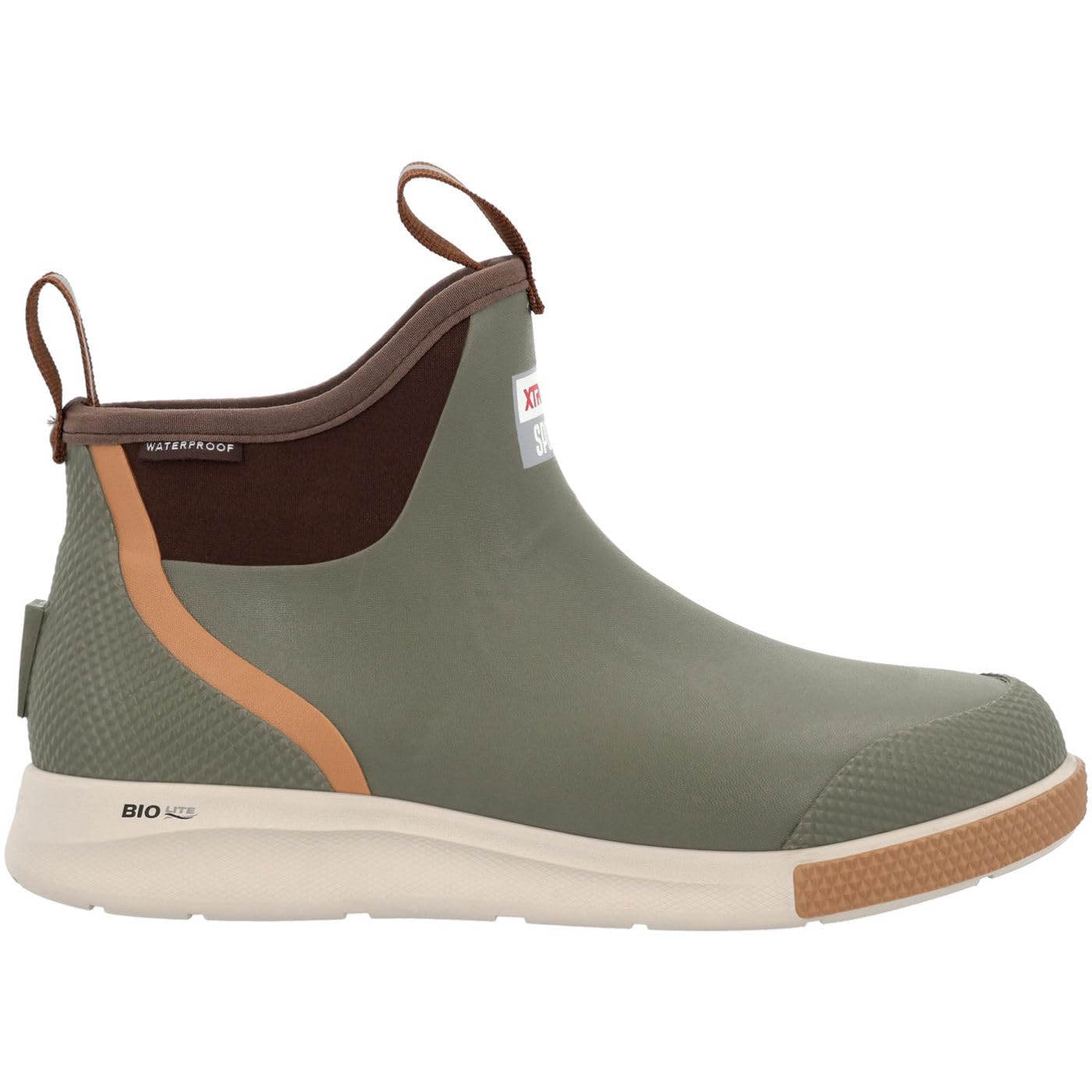
1. XTRATUF 6” Men’s Ankle Deck Boot Sport
Our pick — 4.5+★ from 450+ verified ratings; the strongest balance of quality and price.
The wide-foot deck boot that earns its keep in comfort, not just in rubber.
Here’s the number that decides it: a 6-inch ankle cut. That short shaft clears your ankle bone and leaves the top of your foot free, which is exactly where a wide foot usually feels squeezed first. On a wide forefoot, a lower boot simply has less material pressing down on you. The 6-inch height also means you can pull it on without a fight.
Comfort is what wins people over here, and it’s not luck. The sport build stays lightweight enough that owners describe wearing them through a full day without thinking about their feet, and they report the fit runs true to size. What surprises wide-footed buyers most is the balance: they stay dry and warm without the heavyweight feel of a full rubber deck boot.
XTRATUF tests its footwear to ISO standards for slip resistance, and the ratings break down plainly. SRA means grip on wet floors. SRB adds traction on wet and oily surfaces. SRC combines both for the highest slip-resistance rating of the three. That matters when the deck is slick with spray or bait water. One thing to plan around: XTRATUF states that most of its boots and deck shoes are not available in half sizes. If you sit between sizes, try the larger one rather than squeezing into the smaller.
What carries the day
- The 6-inch ankle cut leaves the top of a wide foot free instead of pressing down on it.
- Buyers report wearing them through a full day on the water without foot fatigue.
- ISO-tested slip resistance, published as SRA, SRB and SRC ratings.
- Lightweight enough to forget you have them on, with a true-to-size fit.
Where the friction lives
- Most sizes skip half sizes, so wide-footed buyers between sizes must choose up or down.
- Some owners mention the rubber sole separating after about four months.
- Store them upright and keep an eye on the sole seam.
Reach for this if: you want comfort-first deck boots that fit a wide foot without a heavyweight feel.
Neither of these: you need a half-size match or you plan to pound the same pair hard through every season.
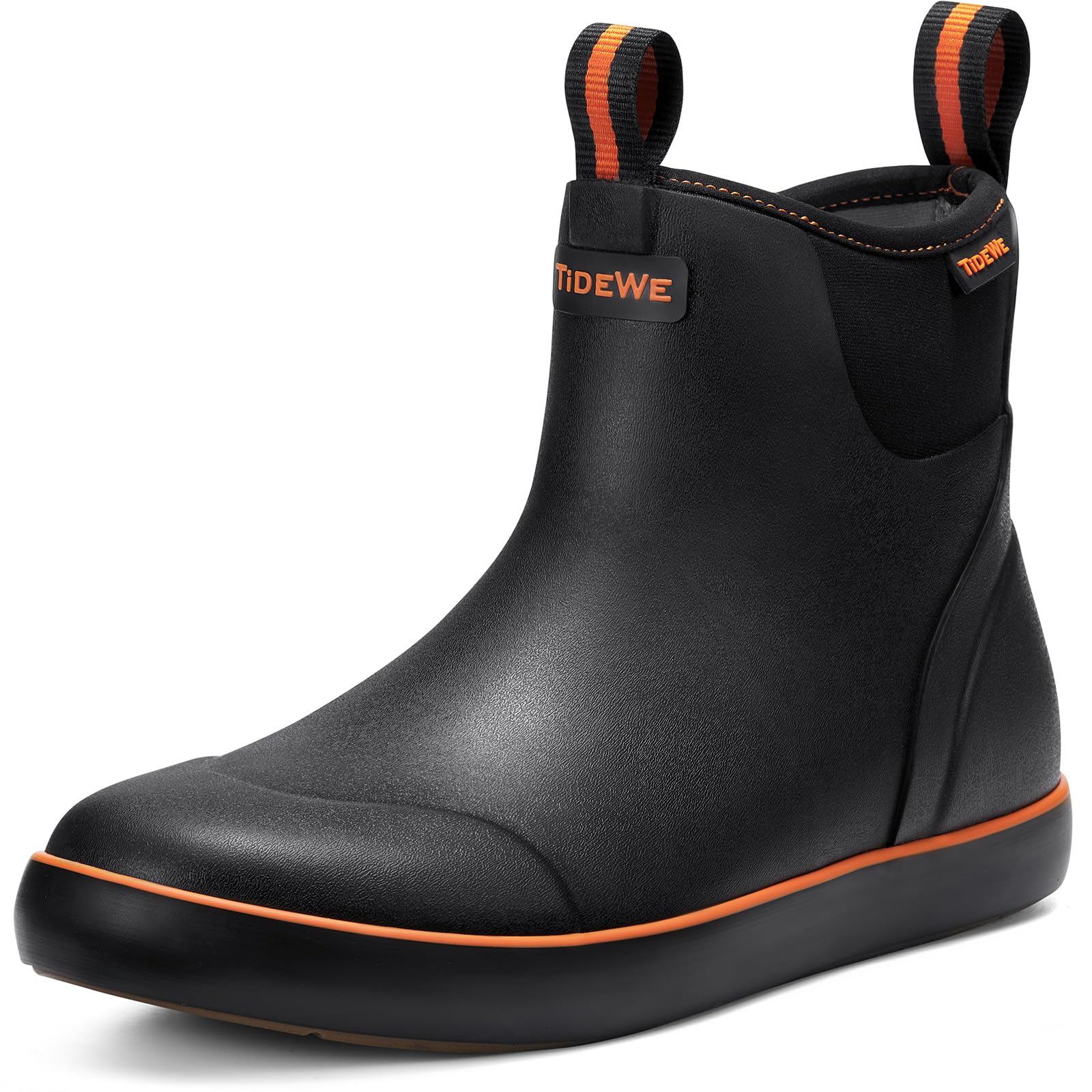
2. TIDEWE Deck Boots for Men, Waterproof Fishing Boots
Thick neoprene gives a wide forefoot somewhere to stretch without a premium outlay.
Three-and-a-half millimeters of neoprene is the headline. That’s a spongy synthetic rubber with real give, so the upper works with a wide forefoot rather than pressing on it. It’s also the part that keeps the boot 100% waterproof by design. The rubber outer shell holds up to long hours on the water, and the reinforced rubber over the toe and heel takes the scuffs instead of your foot.
The sole is the other piece worth knowing about. TIDEWE cuts tiny drainage channels into it so water squeezes out from under you, and the material is upgraded so it won’t scuff the deck. A high-tech moisture-wicking lining regulates foot temperature, and the removable EVA insole gives you a soft layer you can swap if your arch needs a different shape.
On fit, the brand is direct: check the size chart, look at the insole length, and size up for half sizes. That guidance matters more for a wide foot than for anyone else. The shaft runs 7.36 inches, so it comes up a little higher than a straight 6-inch boot and wraps more of your instep. A kick tab and heel loop let you pull them on without sitting down. Owners reach for these on rainy days and wet boats alike, and plenty wear them for work as well as fishing.
Money well spent: 3.5mm neoprene plus a drainage-channel sole is a lot of wet-deck engineering for an entry-level boot.
The honest trade-off: a 7.36-inch shaft wraps the instep more than a 6-inch cut, so an arch that runs high may feel that extra wrap.
Good match for: wide-footed anglers who want a stretchy neoprene upper without paying a premium.
Think again if: you specifically need a low 6-inch cut or you want a slim, low-profile profile on deck.
3. BASSDASH Explorer-DG Men’s 6” Waterproof Deck Boots

Build quality is the story, and the soft insole does the quiet work underneath.
What buyers notice first on the Explorer-DG is how solidly it’s put together. The quality read carries the most weight in owner feedback by a wide margin, and comfort follows right behind. That pairing is what a wide-footed buyer wants: a shell stiff enough to protect, over an insole soft enough to absorb a long day on a moving deck.
The 6-inch ankle cut keeps the profile low, which gives a wide forefoot less material to fight against than a taller boot would. Rubber construction means this is a shell you have to maintain, not a fabric you can toss in a bag wet. BASSDASH spells out the routine: clean with mild soap, condition the rubber parts regularly so they stay flexible, and store upright or hang upside down on a boot rack so the shell doesn’t crack or split.
Customers note easy on-and-off and dry feet through a full day. Owners say the color reads brighter in person than the listing photos show. The rubber shell is the piece to watch over time — durability draws mixed comments, and a rubber boot that dries out between trips is the one that cracks.
Where it shines: a stiff, well-made shell with a soft insole underfoot — comfort that holds up while the boot protects your foot.
Know before you buy: rubber needs mild soap, regular conditioning and upside-down storage to avoid cracking, per the brand’s own care tips.
Suits you if: you want a 6-inch rubber deck boot with real build quality and a soft insole for fishing days.
skip it if: you want a boot you can neglect — this one rewards a simple care routine.
4. Sperry Men’s Billfish Slip on
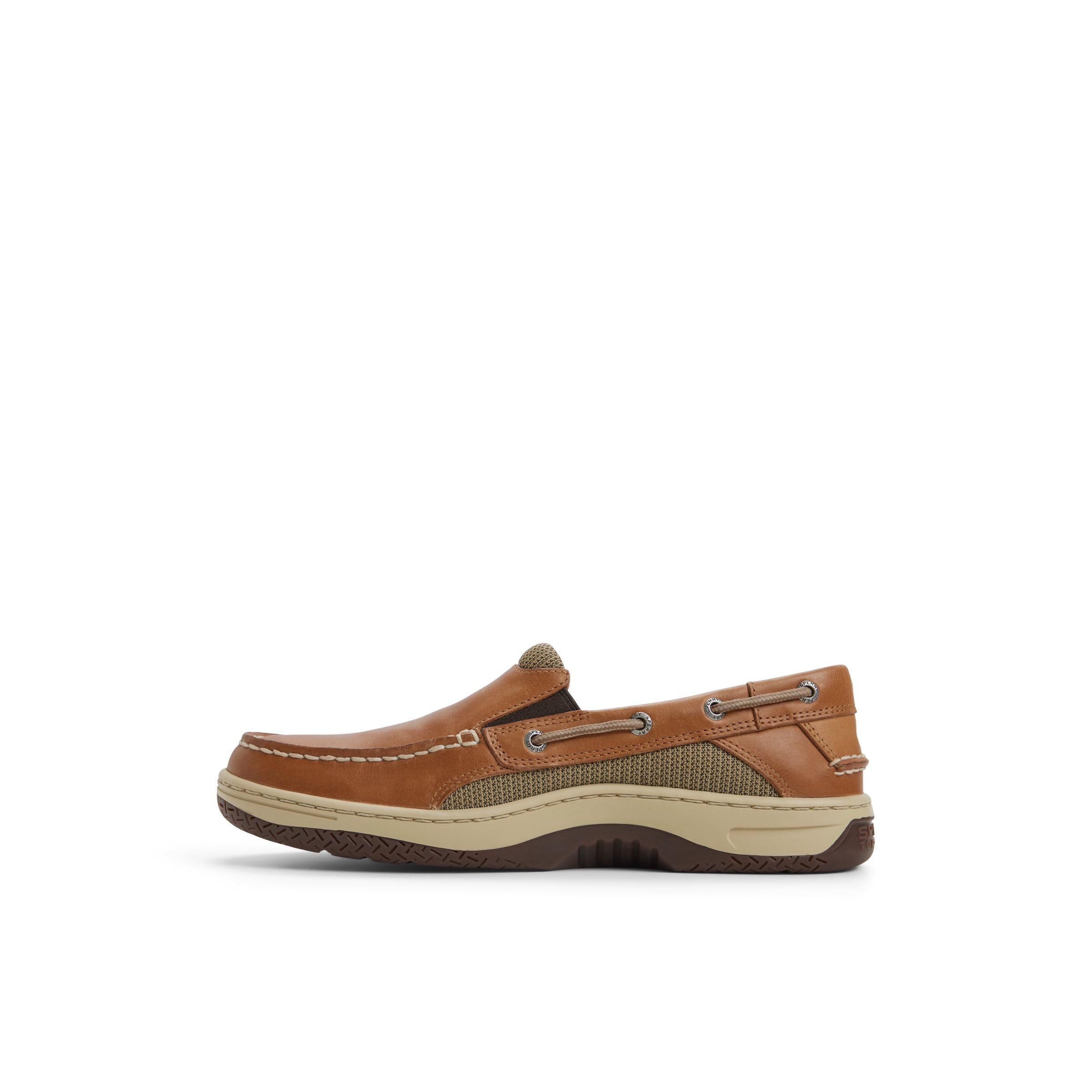
A leather-and-mesh deck shoe for the buyer who wants one pair from the boat to the bar.
This isn’t a rubber deck boot, and that’s the point. The Billfish is built from full grain leather with mesh panelling, classic moccasin stitching, and a full-length cushioned midsole. The 360° Lacing System lets you tighten the upper across the whole foot rather than at one point. For a wide foot, adjustable lace tension is the whole game — you can loosen across the forefoot and still lock the heel down.
Owners describe the feel as walking in sneakers, and the comfort carries that comparison. The build quality is the biggest strength in owner feedback, followed by comfort and appearance. It looks right with slacks or swim shorts on deck and dresses up for dinner on land with trousers or jeans.
The trade-off is honest: leather and mesh aren’t a rubber deck boot. If you’re wading through bilge water or hosing down the deck, a full rubber model like the LaCrosse above is the better tool. Fit draws mixed notes too, with some owners finding it runs differently than expected, so treat the lacing system as your adjustment. Buy it for the deck-to-dinner life, not for standing in water.
Pick this when: you want one slip-on that looks sharp on a boat and still passes at dinner on land.
Look elsewhere when: your days involve standing in water — this is a leather deck shoe, not a rubber boot.
5. Gator Waders Men’s Deck Boots

A USA-made, fully waterproof deck boot with a clean anti-slip build and little else published.
Gator Waders keeps this one simple on paper. It’s a 100% waterproof deck boot with an anti-slip sole, made in the USA, and built for fishing, camping, boating and farming. The manufacturer lists it as a men’s boot under the model number HCBBL14. That anti-slip sole is exactly what a wet deck asks for, and the fully waterproof claim covers the whole boot.
Here’s the honest catch: there’s almost no published detail to read beyond that. No shaft height, no material breakdown, no neoprene thickness. If a wide forefoot is your make-or-break concern, this boot gives you nothing to compare against the TIDEWE’s 3.5mm neoprene or the LaCrosse’s wide fit notes. You’d be buying on the brand name and the USA-made claim alone.
That makes it a fit for a specific buyer. If you’re still working out whether a boot will fit a wide foot, pick a model that publishes its construction instead.
The appeal: a 100% waterproof, anti-slip, made-in-USA deck boot built for fishing and farm work alike.
The gap: with no published shaft height or material spec, a wide-footed buyer has nothing concrete to plan around.
Best for: buyers loyal to the Gator Waders brand who want USA-made rubber on their feet.
Not for: wide-footed shoppers who need to read specs before committing — this one leaves you guessing.
6. LaCrosse Alpha Deck 6″ Rubber Boots
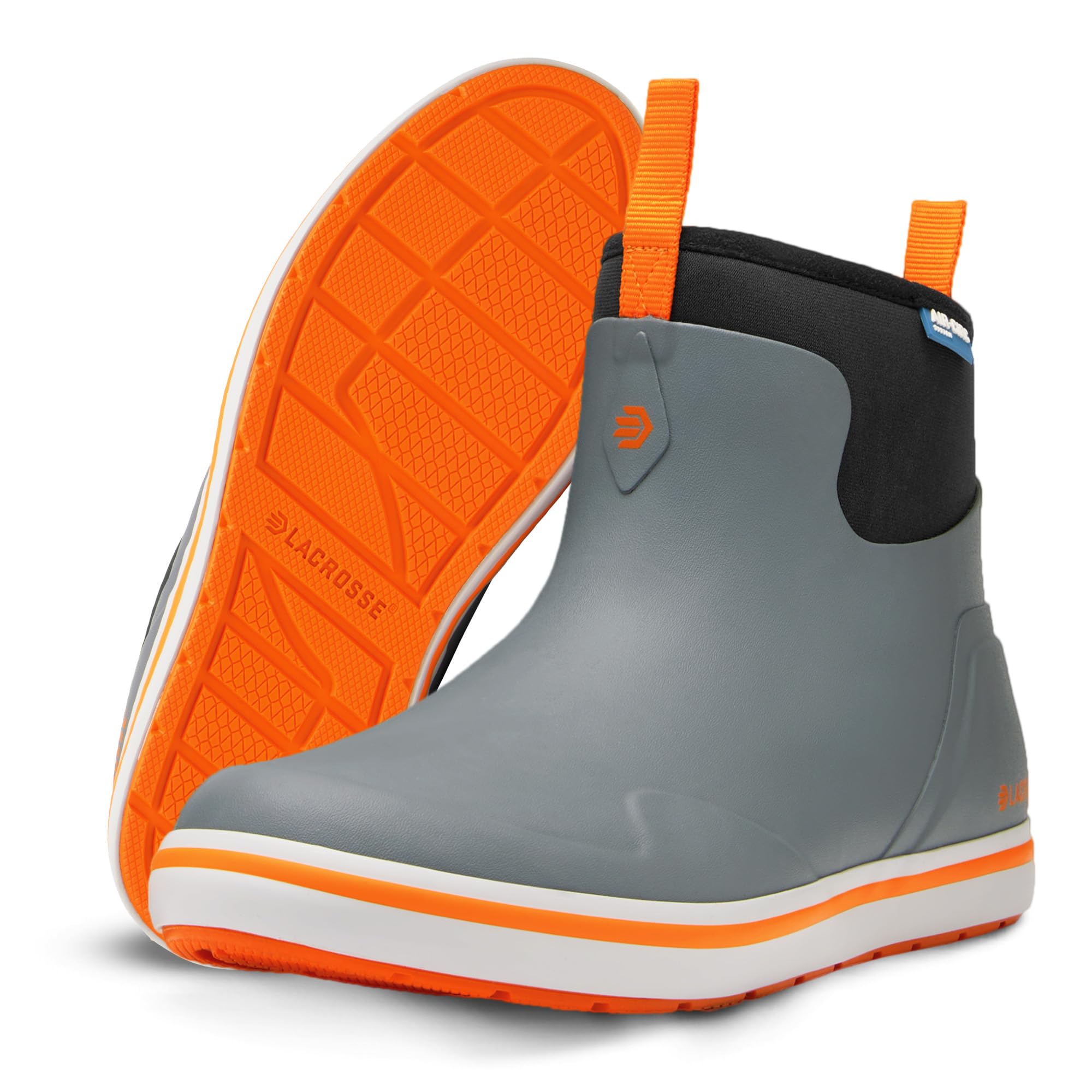
The one boot here whose owners say the wide fit out loud — and mean it.
If wide feet are the whole reason you’re reading, start here. The Alpha Deck’s 6-inch cut shaves material off the top of the boot, and its owners describe an actual wide fit, not just a generous size. That’s rarer than it sounds. Many boots claim to run roomy and still taper hard at the toe.
Build quality lands as the strongest theme in owner feedback, with fit and comfort close behind. The boot is waterproof rubber, and it slips on and off with no need to bend over and wrestle with it. That slip-on entry matters most when your hands are full at the dock. Owners also rate it durable and good-looking.
The one fair warning: value for money draws mixed notes. That’s a premium-feeling rubber boot, so you’re paying for the build and the wide fit rather than squeezing the most boot per dollar. If your budget is tight, the TIDEWE above covers a lot of the same deck work for far less, though it doesn’t publish a wide fit the way this one does. For a wide forefoot, the fit alone justifies the jump.
The wide-foot payoff: a real wide fit in a 6-inch rubber boot, paired with a slip-on entry that never makes you bend down.
The fair warning: value for money is the mixed note — you pay for the fit and build, not for cheapness.
Make this yours if: a genuinely wide fit is your first and last requirement in a deck boot.
Keep looking if: the entry-level tier is where your budget comfortably sits.
7. Grundéns Men’s Deviation 6 Inch Ankle Boot
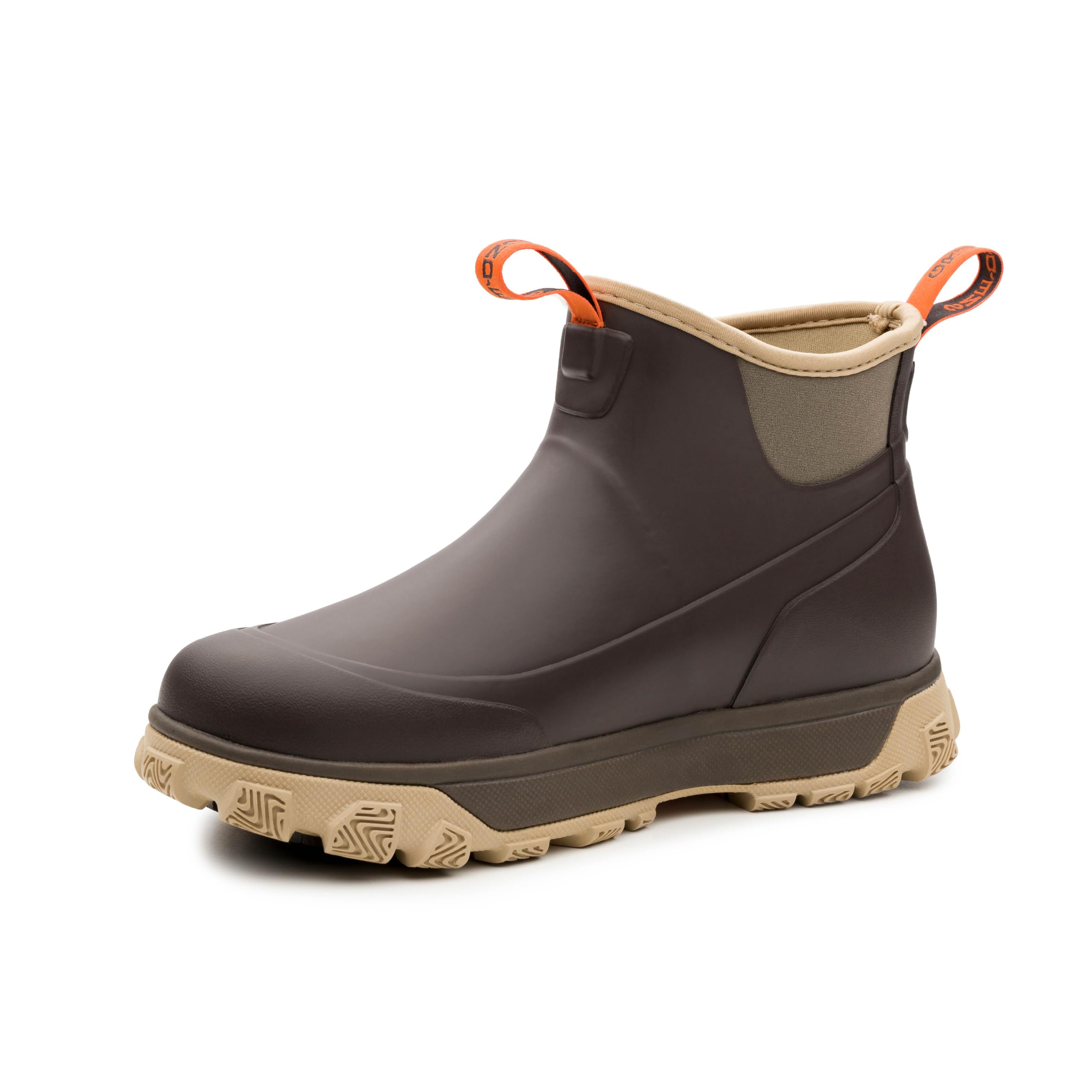
Built with on-water and off-deck in mind, with quality that shows and fit that doesn’t always agree.
Grundéns designed the Deviation to work both on the water and off it, and the 6-inch ankle version is the low cut of that family. The maker describes it as a comfortable, performance-driven footwear option built to hold up on and off the water. Same brand lineage as the Deviation Tall and the Sherpa version, but here in the shorter ankle form.
Quality is the strongest thing in owner feedback, with cushioning and easy slip-on entry right behind. It’s waterproof and durable in the ways that matter when you’re standing in spray all morning. The cushioning underfoot is what keeps a fishing day from turning into a foot ache by noon.
The confidence stops at fit, and it’s the one thing to weigh carefully before you buy. Feedback splits: some find the Deviation runs big, others call it a little tight. That’s a confusing signal for a wide-footed buyer. Soles splitting and separating come up as well, so treat the boot well between trips. Grundéns clearly makes a quality rubber boot — just confirm the size works for your foot before you commit.
Why anglers reach for it
- Quality leads in owner feedback, with comfortable cushioning close behind.
- Waterproof and durable for spray-heavy days on the water.
- Slips on and off without a struggle at the dock.
- The 6-inch ankle cut keeps the profile low for wide-foot clearance.
What to weigh first
- Fit feedback splits between running big and running a little tight.
- Sole splitting and separation come up as a durability concern over time.
- Value for money is a mixed note for a premium-tier boot.
Well matched to: anglers who want a quality 6-inch rubber deck boot and know their Grundéns size.
Think twice if: you’re buying sight-unseen for a hard-to-fit wide foot — confirm sizing first.
Know the Specs
Neoprene Thickness (mm)
Neoprene is a spongy synthetic rubber used in the upper of deck boots. The thickness in millimeters tells you how much stretch and cushioning the boot offers. At 3.5mm, a boot like the TIDEWE has real give, which lets a wide forefoot spread out instead of being pressed down. Thin uppers save weight but hold the shape harder, which a wide foot feels fast.
Boot Shaft Height (inches)
Shaft height is how far up your ankle the boot climbs. A 6-inch cut clears the ankle bone and leaves the top of the foot free. A 7.36-inch shaft comes up higher and wraps more of the instep. For wide feet, the shorter cut usually feels looser across the top, while a taller shaft gives more support but more pressure.
Slip-Resistance Ratings (SRA, SRB, SRC)
These are standard ratings for how well a sole grips a slippery surface. SRA is tested for wet floors. SRB adds wet and oily surfaces. SRC combines both and is the highest of the three. On a boat, oily water is common, so a boot rated higher is doing more work under your feet.
Waterproof vs Water-Resistant
A 100% waterproof boot keeps water out from every direction, which is what you want standing in a wet deck. Water-resistant means the boot handles splashes but not a soak. For deck work, look for the waterproof claim stated plainly, as the TIDEWE, Gator Waders and XTRATUF all do.
Common Questions
Do deck boots run wide for a broad forefoot?
Should I size up if I’m a half size and have wide feet?
What does SRA, SRB and SRC slip resistance mean on a deck boot?
Are rubber deck boots or leather deck shoes better for a boat?
How should I store rubber deck boots so they don’t crack?
Can I wear deck boots for work, not just fishing?
Why do some deck boots skip half sizes?
Do neoprene deck boots keep feet warm in cold weather?
Will a 6-inch deck boot keep a wide foot more comfortable than a taller boot?
Are the XTRATUF deck boots made for people between sizes?
The Bottom Line
For most wide-footed buyers, the deck boots for wide feet winner is the XTRATUF 6” Ankle Deck Boot Sport because its 6-inch cut frees the top of the foot while comfort carries the day — a solid all-around boot. If a genuinely wide fit is your first requirement, reach for the LaCrosse Alpha Deck 6″, the boot whose owners describe a wide fit out loud. And if the entry-level tier is where your budget believes it belongs, the TIDEWE Deck Boots pack 3.5mm neoprene and a drainage-channel sole without the premium outlay.
One quiet nudge before you decide: the TIDEWE pick draws more owner comments than the other waterproof rubber boot on this list, which says a lot about how many anglers trust it on a wet deck. Match that crowd appeal to your own foot, and you’re set for the season.
How we choose
We do not accept paid placement. Every pick is matched to a real buyer and a real use-case; we do not hands-on test units.
Sources
Specifications: manufacturer listings and product documentation. Review insights: verified customer reviews, as of October 2026. Pricing: not shown on this page (it changes often); check the current price via the retailer link.
As an Amazon Associate, Aappliancez earns from qualifying purchases. This does not affect which products we feature.