Disclosure: Some links in this post are affiliate links. As an Amazon Associate I earn from qualifying purchases, at no extra cost to you. Learn more
Specs are compiled from manufacturer listings and verified buyer reviews and can change over time — please confirm the key details on the product page before buying.
Loop recording is the one dash cam feature that actually decides whether you win an insurance argument. It means the camera keeps writing new clips over the oldest ones, so your card never fills up and the camera never quietly stops filming. Get it wrong and you find out the hard way — a full card, a missing clip, or footage that locked itself by accident. This guide covers seven cameras where loop recording, emergency locking, and card handling are done properly.
This guide is built by comparing the manufacturers’ published specifications and the patterns across verified customer reviews, so you get each pick’s real strengths and trade-offs instead of marketing spin.
You will see exactly how each camera overwrites old files, what triggers an emergency lock, and how big a card it will swallow. Below you get the plain-English read on loop settings, card limits, and the heat problems that quietly kill dash cams, so you can pick the right dash cam loop recording setup for your car on the first try.
Top Picks
How To Choose The Best Dash Cam Loop Recording
Almost every dash cam sold today claims loop recording (it overwrites the oldest clip when the card fills up). What separates a camera that protects you from one that leaves a hole in your footage depends on three things: how the overwrite behaves, what locks a file so it is never erased, and whether the memory card can keep up.
The overwrite has to skip your locked files
A correct loop recording system deletes the oldest open up clip and keeps the newest footage rolling — you never touch the card. The moment a G-sensor (a small motion sensor that detects a sudden jolt) fires, that clip gets locked so it cannot be overwritten. That is exactly what you want after a bump. The catch is sensitivity: a camera that locks on every pothole slowly fills the card with locked junk until nothing new can record. Look for a camera whose collision sensitivity you can dial down, or one with a manual lock button so you decide what gets saved.
Card size sets how far back you can look
Recording three channels at once eats storage fast, so the maximum card size matters more here than on a single-lens camera. Some of these cameras top out at 128GB, some take 256GB, and a couple swallow 512GB. Bigger cards buy you more days of history before old clips roll off. Whatever the size, you want a high-endurance card (one built for constant rewriting) because ordinary cards wear out quickly under loop duty.
Heat is the real enemy of continuous recording
A camera that records all day in a sun-baked windshield gets hot, and cheap lithium batteries inside dash cams do not enjoy that. Several of these cameras use a supercapacitor instead — a component that stores power without the battery chemistry that fails in heat. That single choice often decides whether your loop recording still works in August. If your car sits in direct sun, weight heat tolerance heavily.
Side-by-Side Comparison
| Model | Best For | Channels & Resolution | Max Card | Field of View | Amazon |
|---|---|---|---|---|---|
| ROVE R2-4K Dual★ Best Overall | Balanced front-and-rear protection | Front (2.5K upscaled to 4K) + 1080P rear | 1 TB | 150 degrees | Amazon |
| FAIMEE F6Best Value | Reading plates in 4K on a budget | 4K front + 2K rear | 256 GB | 170 degrees | Amazon |
| galphi 2.5K 3 Channel | Watching front, back, and cabin | 2.5K front + 1080P rear + 1080P inside | 512 GB | — | Amazon |
| Huntermax J12 | Triple-channel coverage, ready to run | 4K front + 1080P inside + 1080P rear | 128 GB | 170 degrees front | Amazon |
| 70mai T800E | Rideshare drivers and hot climates | 4K front + 1080P inside + 1080P rear | 512 GB | 402 degrees (combined) | Amazon |
| FAIMEE 4K WDR | Big-card recording with 4K detail | 4K front + 2K rear | 256 GB | 170 degrees | Amazon |
| REDTIGER F17 Elite | Color night footage across three views | 4K front + 2.5K rear + 1080P cabin | 512 GB | — | Amazon |
Detailed Reviews
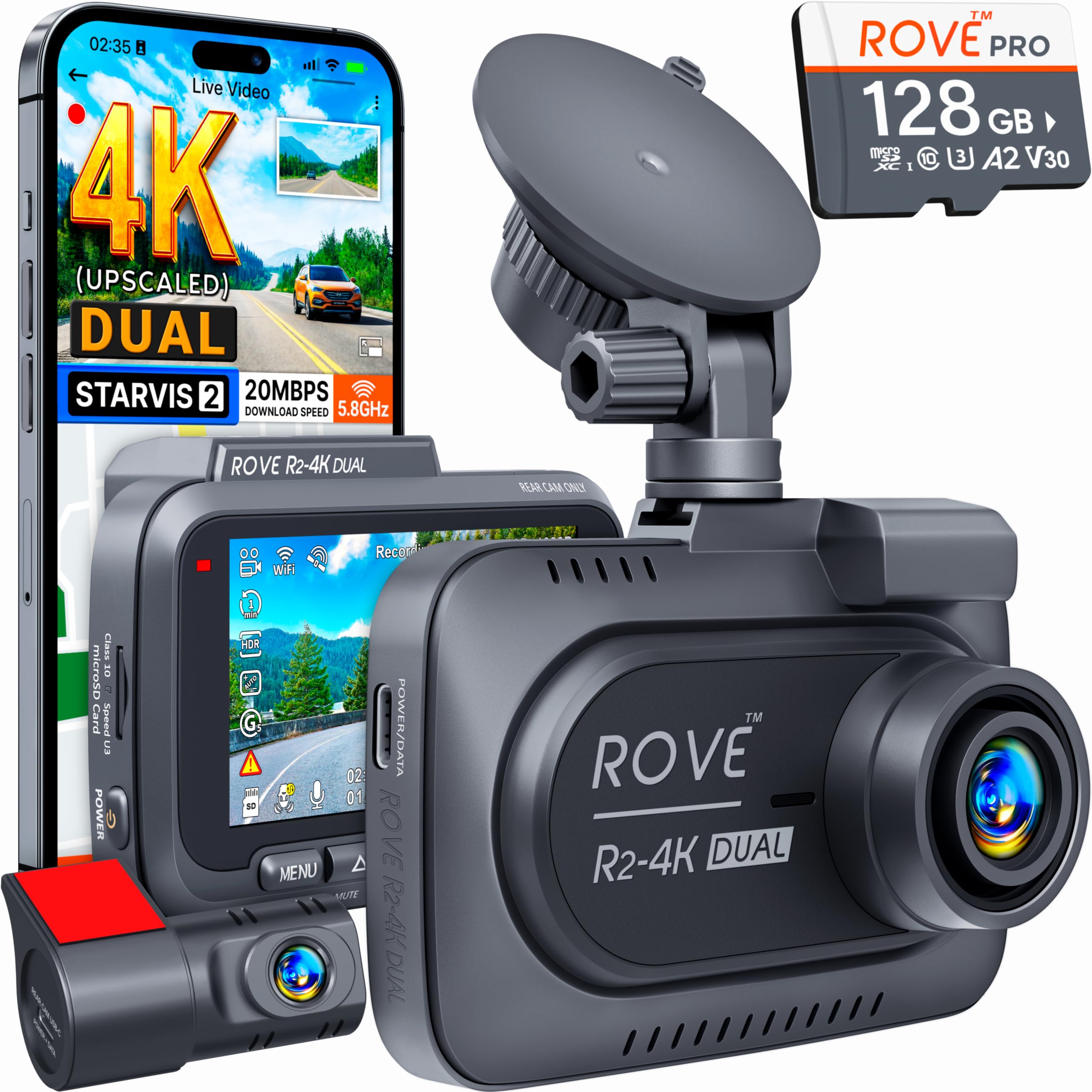
1. ROVE R2-4K Dual Dash Cam Front and Rear
Our pick — 4.0+★ from 14,500+ verified ratings; the strongest balance of quality and price.
The one camera here that never runs out of room, because 1 TB of card space outlasts every rival.
If you want a front-and-rear camera that keeps recording long after a tiny card would have rolled over, this is the pick. The R2-4K DUAL takes microSD cards up to a full 1 TB — 2.0x the ceiling of the FAIMEE 4K WDR front-and-rear model, whose stated maximum is 256 GB. In plain terms, that is a much longer history to hand your insurer when an incident happened days ago and you need the clip.
What you actually record is a front picture the camera upscales to 4K and a 1080P rear view, so you get detail behind you without paying for a second high-end sensor. The front lens is a Sony STARVIS 2 IMX675 5MP sensor with a wide F1.5 aperture, which together pull in more light on dark roads, in tunnels, and at dusk. A built-in supercapacitor handles the heat side: no lithium battery to cook in a hot windshield, which is the component that tends to fail first in continuous recording. A free 128GB ROVE PRO card arrives in the box, so loop recording starts the day it lands.
One trade-off to note honestly: the front footage is upscaled 4K rather than native 4K, so a plate at long distance may look softer than the true-4K FAIMEE units. And the 24-hour parking mode needs a hardwire kit that is not in the box. For daily driving and rear coverage, though, this is the package to beat.
Where This Camera Wins
- MicroSD support up to 1 TB — the longest loop history in the group
- Supercapacitor instead of lithium, so heat is far less of a threat
- Sony STARVIS 2 IMX675 sensor with F1.5 front aperture for low-light pulls
- 128GB ROVE PRO card included, so you record from day one
- Built-in GPS stamps speed, route, and compass onto your footage
What To Weigh Before You Commit
- Front video is upscaled 4K, not native 4K
- Hardwire kit for the 24-hour parking mode sold separately
- 150 degrees is narrower than the 170 degrees on the FAIMEE pair
Reach for this if: you want the deepest storage headroom and a heat-proof supercapacitor in one front-and-rear kit.
Look elsewhere if: you specifically need native 4K front footage or a wider lens.
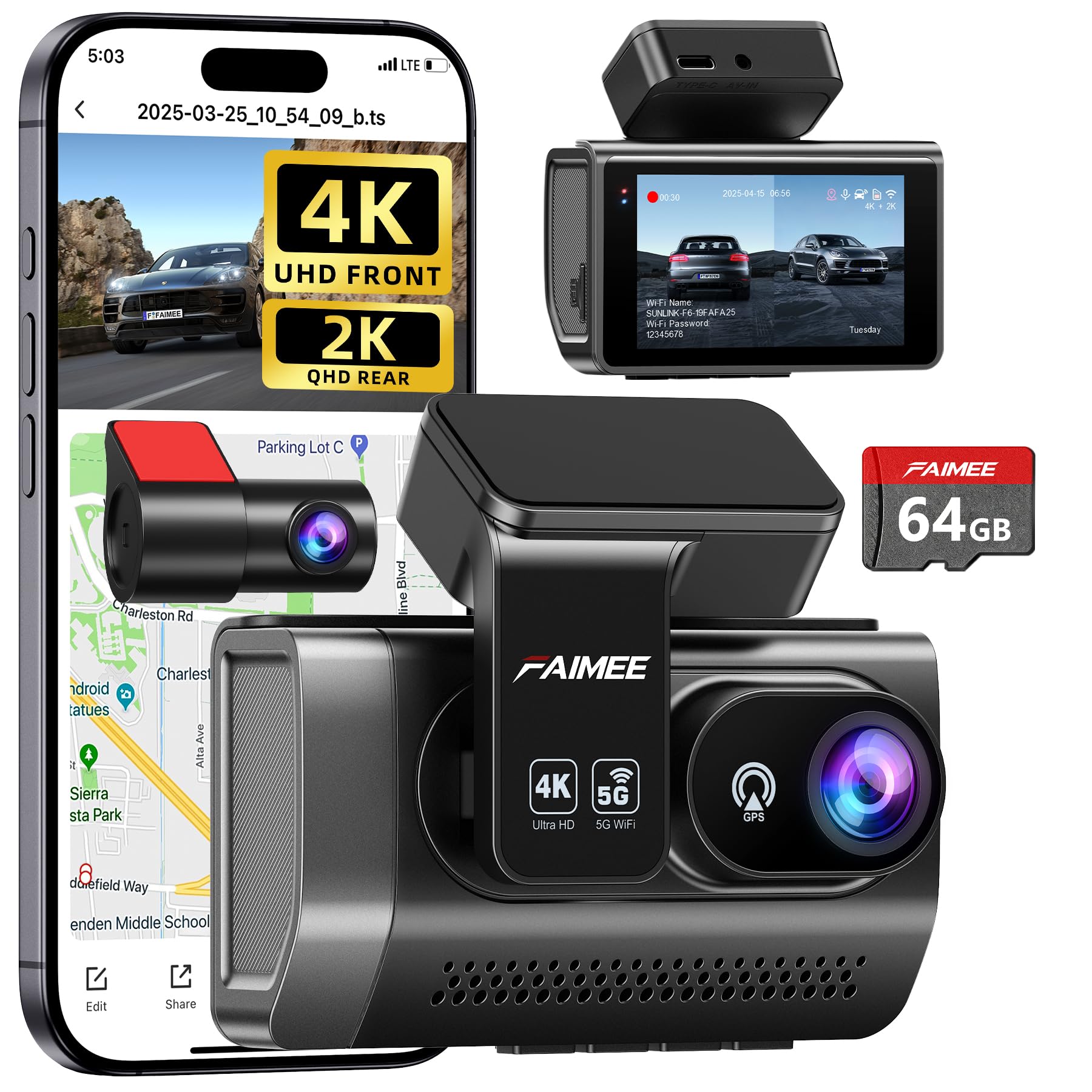
2. FAIMEE F6 4K Dash Cam Front and Rear
True 4K up front and a 170-degree sweep that catches six lanes of trouble.
The FAIMEE F6 records a real 4K UHD (3840×2160P) front picture and a 2K (2304x1296P) rear, and that front detail is what makes plate-reading realistic rather than wishful. Its 170-degree lens also out-sweeps the ROVE R2-4K Dual — 170 degrees against 150 — so parked-lot scrapes along the side have a better chance of landing in frame.
Value is the headline here, and owners feel it clearly. The card in the box is a 64GB high-endurance unit, expandable to 256GB, and loop recording overwrites the oldest clip automatically once it fills. When the G-sensor feels a hit, the current clip locks so the evidence stays. Rear-camera wiring takes a handy owner roughly 45 minutes, using only the tools in the box.
Cold and heat is a quiet strength — buyers report it keeps recording through a summer dashboard in full sun, where earlier cameras shut down. The honest catch is parking drain: if the car sits for days, unplug it so the battery is not pulled down. Night footage is decent, though plates can be hard to read after dark.
Why it earns its spot: genuine 4K front plus 2K rear, a 170-degree lens, and a card already in the box make this the value that does not skimp on detail.
The real limit to know: night-time plate reading is imperfect and the camera wants unplugging for long parked stretches.
Suits you when: you want true 4K front footage and six-lane coverage without paying top tier.
Think again if: you plan on multi-day parking without unplugging.
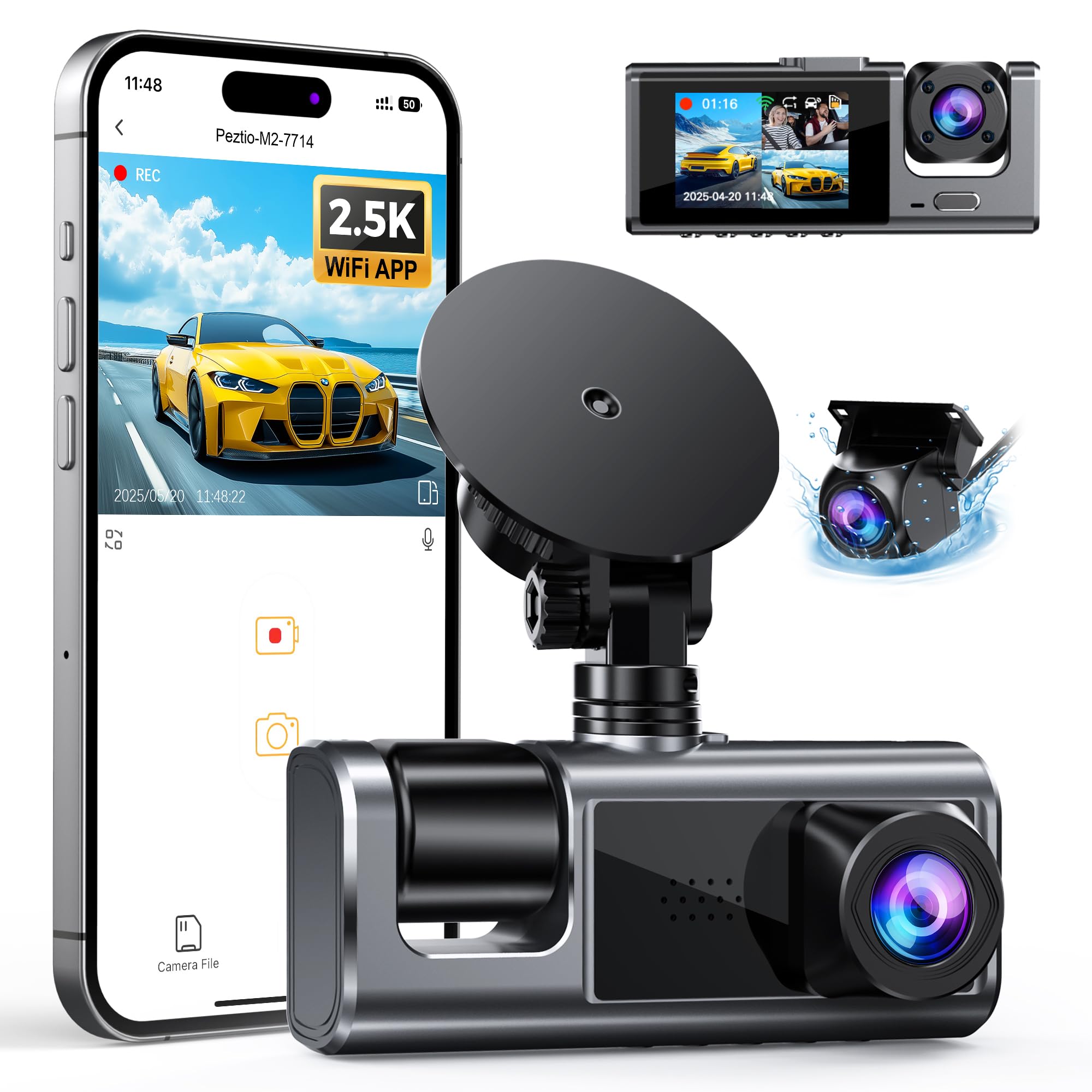
3. galphi 2.5K 3 Channel Dash Cam Front and Rear Inside
Front, back, and cabin in one frame — the recording you want if road-side incidents become arguments.
Three lenses running at once is the reason to pick the galphi. It records 2.5K out front, 1080P out the rear, and 1080P into the cabin by infrared, so all three angles land in a single timeline. Storage headroom is generous too: this one takes microSD up to 512GB, and the card is not included, so buy your own Class 10 or U3 card before the first drive. Loop recording overwrites the oldest clip as the card fills, and a 3-axis G-sensor locks footage when an impact hits.
The low-profile hidden body mounts cleanly behind the mirror, all three heads adjust independently, and voice alerts report camera status without pulling your eyes off the road. WiFi to the phone app lets you review and download without pulling the card. Owners say the night footage stays clear enough to catch plates and faces after dark.
The follow-up question is storage discipline: if the collision sensitivity runs hot, locked clips will pile up on a card you supplied yourself, so dial it down. That is a setting to tune, not a reason to pass. The compact 168 g body also keeps the windshield tidy.
The defining spec: three simultaneous channels at 2.5K front, 1080P rear, and 1080P interior, with 512GB of card support behind it.
The honest follow-up: you supply the card, so factor a high-endurance one into the plan.
Best fit for: rideshare work or family trips where the cabin view matters as much as the road.
Skip the idea of: getting a card in the box — you source that yourself.
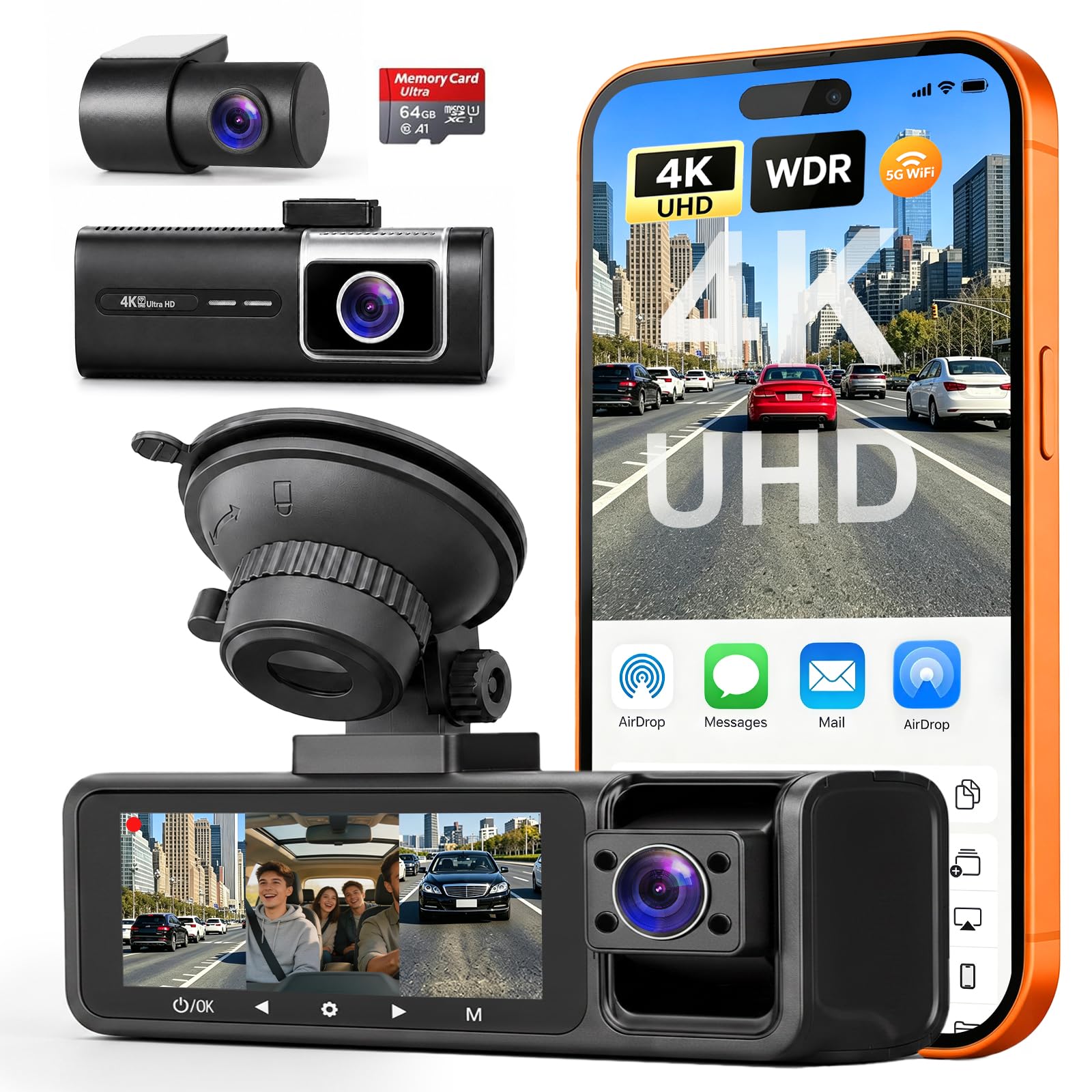
4. Huntermax J12 3 Channel 5G WiFi Dash Cam
Loop recording split into three clean time slots — you pick the chunk size, the camera keeps the newest.
Here is a nice twist on plain loop recording: the J12 lets you set the clip length and splits its loop into three time slots, so the overwrite behaves the way you prefer. The hardware matches that control — 4K front, 1080P interior, and 1080P rear run at 170, 150, and 120 degrees respectively, eliminating blind spots. A 64GB card, suction mount, cable clips, and trim tool all ship in the box.
Owners say the resolution and build beat the price, with footage clear enough to read the plate on the car ahead. The 60 FPS frame rate on the front helps smooth the picture during quick motion. When the G-sensor fires on a collision, the clip locks into a protected folder; one owner found their post-accident clip already auto-moved into that folder.
The recurring friction is the mount — the suction cup can crack, especially after heat exposure, so treat it gently. There is also a CarPlay conflict: if your phone needs WiFi for CarPlay, you cannot stream dash cam video at the same time and have to disable one. Both are annoyances, not showstoppers.
What the numbers give you: 4K + 1080P + 1080P across a 170/150/120-degree spread, plus a 64GB card so loop recording begins immediately.
Where it bites: the suction mount is the weak link and can crack with age and heat.
A smart grab for: anyone who wants triple-channel coverage and a card in the box on a mid-range budget.
Consider the alternative if: your phone depends on WiFi CarPlay during drives.
5. 70mai T800E 3 Channel 4K Dash Cam
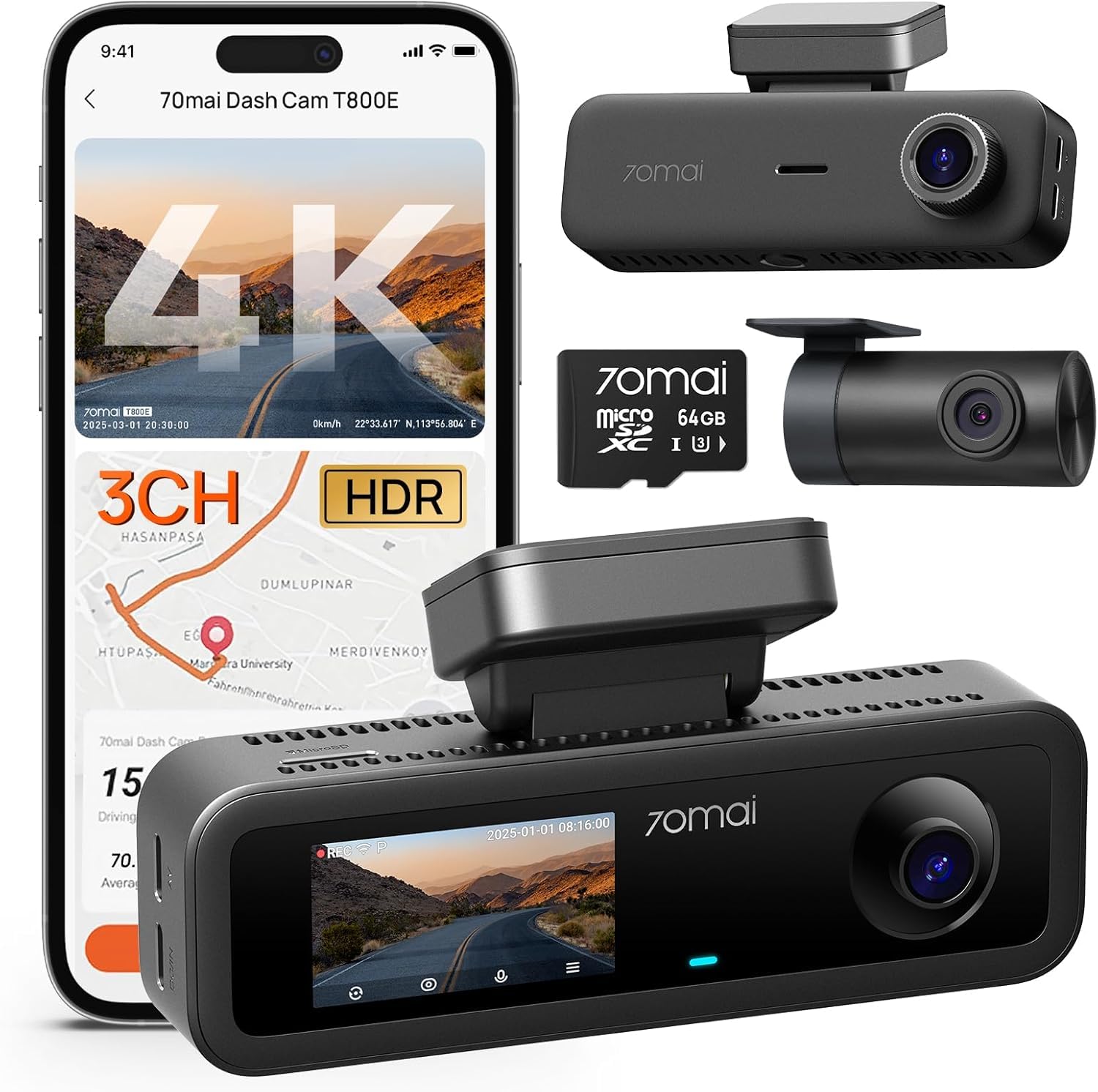
Built to keep looping from 14°F to 140°F, the temperature range that kills weaker cameras.
A hot windshield is the most common cause of dash cams that stop recording. The T800E answers that with a supercapacitor rated for extreme temperatures from 14°F to 140°F, so the heat that fails a lithium camera does not shut it down. It records 4K front plus 1080P interior and 1080P rear, and a 64GB card comes in the box, with support up to 512GB for long histories.
Getting clips off the camera is quicker too: Wi-Fi 6 (the newer, faster wireless standard) moves files to your phone at up to 10 MB/s, which the maker says beats the older Wi-Fi 4 standard — so a full card copies over in less time. Voice control fires off recording, photo, and lock commands hands-free, so you keep both hands on the wheel. The interior cam has switchable infrared (IR, a light the lens can see in the dark), so you turn it on for dark cabin footage or off when it is unwanted. The 4K front (3840-pixel-wide video) is the strong point — sharp enough to read plates, day or night.
A couple of limits to know: 4G connectivity is not supported, and the 24-hour parking mode wants a hardwire kit that is sold separately. Some owners find the app awkward. But as a heat-tolerant, three-channel setup with a card included, this is a credible premium pick.
Why drivers choose it: supercapacitor power plus a 14°F to 140°F range, which keeps recording when heat is the threat.
The one to plan for: the hardwire kit for 24/7 parking is separate, and 4G is off the table.
Made for: rideshare drivers and anyone parking in brutal summer heat.
Not the pick if: you want built-in 4G connectivity.
6. FAIMEE 4K Dash Cam Front and Rear with Night Vision
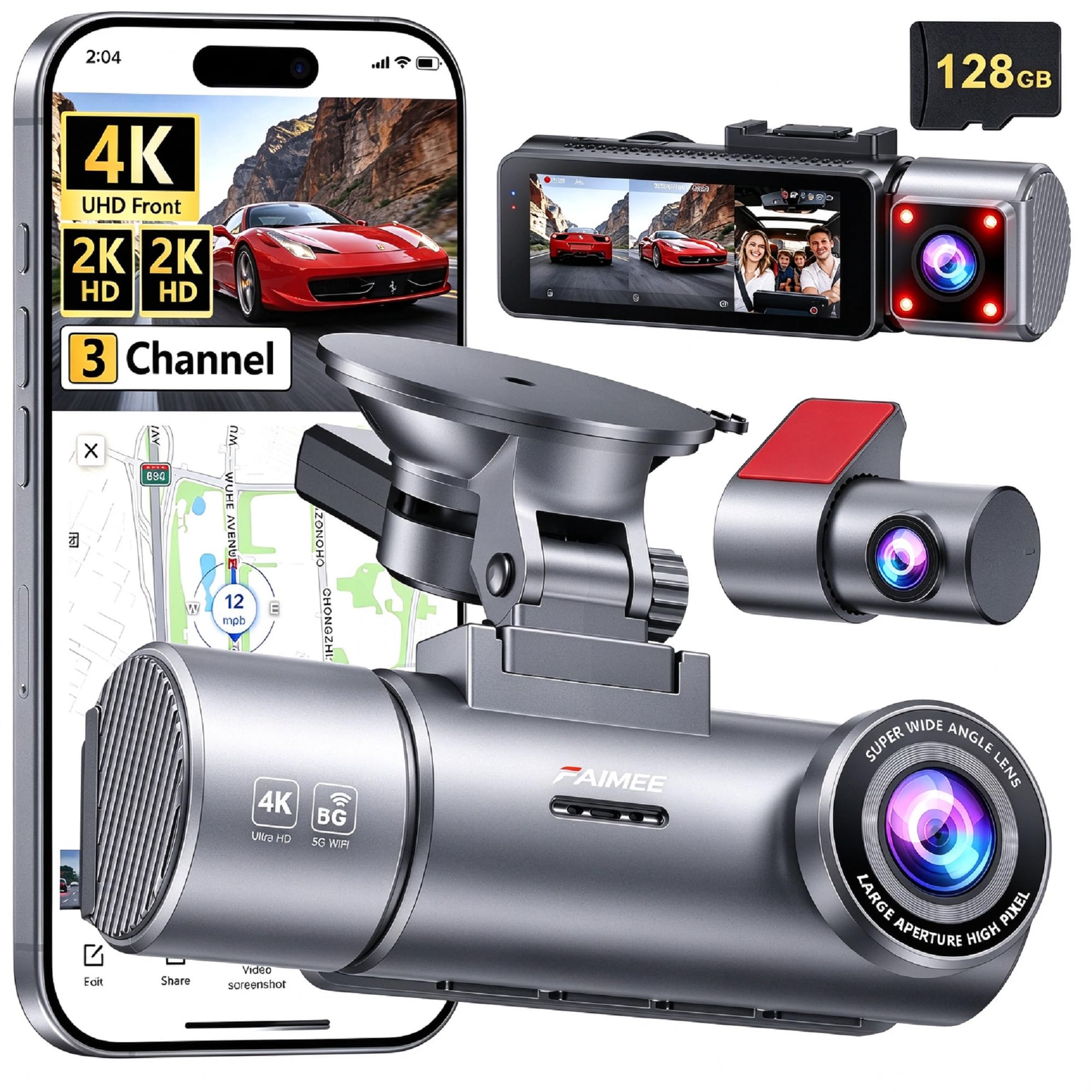
The premium step up in this family: 128GB in the box and 170 degrees across six lanes.
This is the bigger-card version of the FAIMEE formula. Where the F6 uses a 64GB card, this one ships a 128GB high-endurance card and still expands to 256GB — so your loop has twice the runway before the oldest clip rolls off. Front footage is 4K UHD (3840×2160P) and the rear records 2K (2304x1296P), with a 170-degree lens reaching across up to six lanes.
Enhanced WDR (Wide Dynamic Range — a system that balances bright and dark areas) with night vision keeps the picture readable when headlights and shadows compete at dusk. The 3-inch IPS screen is bigger than the galphi’s 2-inch display — 50% more viewable area at 3 inches versus 2 — and the compact body tucks behind the rearview mirror without blocking your line of sight. Loop recording overwrites the oldest file automatically, and the G-sensor locks footage on a sudden collision. Owners praise the true 4K clarity and fast setup, some under 20 minutes with cords hidden.
Two honest notes. Instructions and device menus are not the clearest, so expect a little trial and error on settings. And a few have had the mount break after a knock, so treat the stick-on mount with care.
What makes the upgrade worth it: 128GB in the box, a 3-inch IPS screen, true 4K front, and 170 degrees that catches six lanes.
What to expect: friendly hardware but thinner documentation.
Pick this for: bigger storage and a larger screen without giving up front-and-rear detail.
Hold off if: you want a suction mount that moves between cars easily.
7. REDTIGER F17 Elite 4K 3 Channel Dash Cam
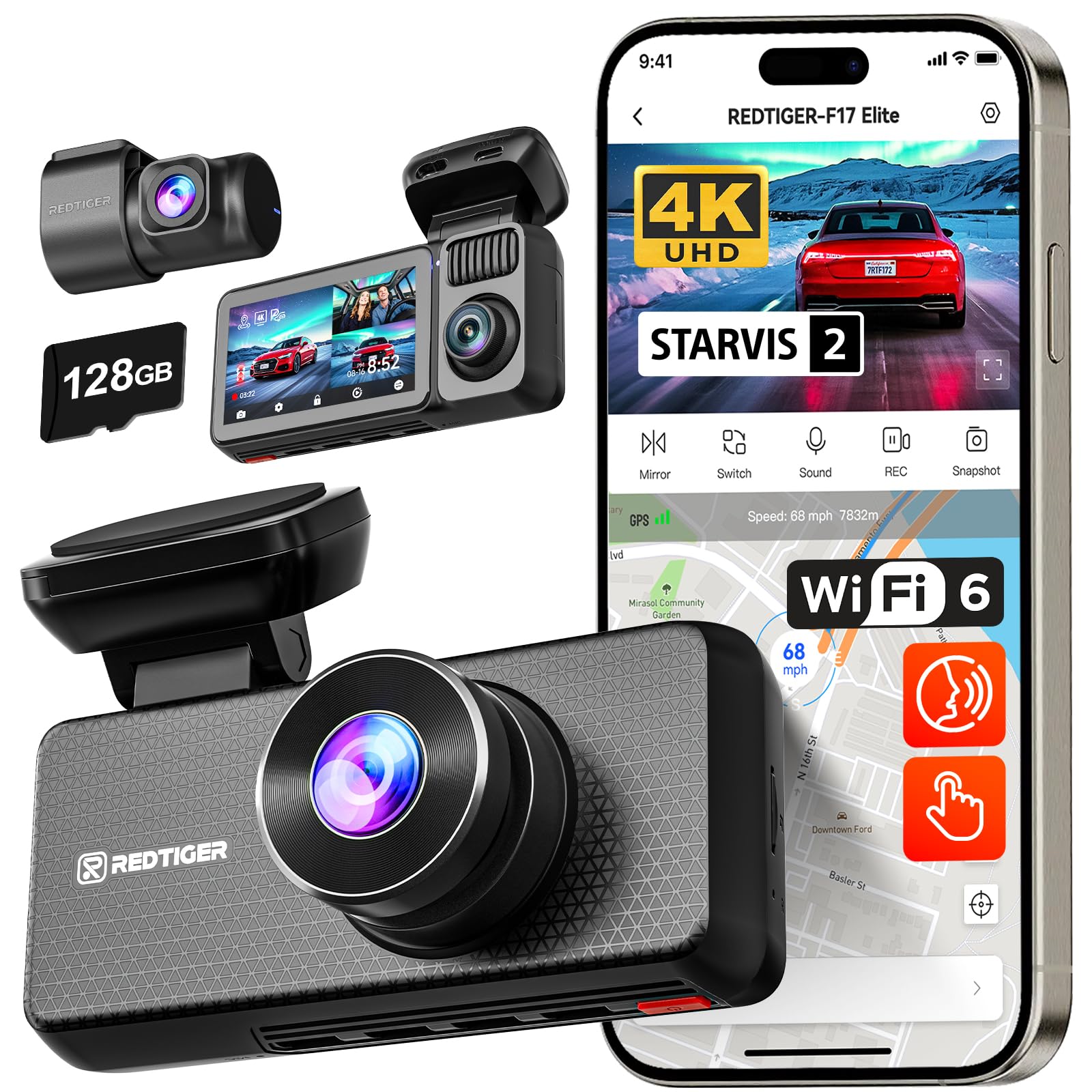
Three channels, two STARVIS 2 sensors, and night footage that keeps its color instead of going grey.
For drivers who want the clearest triple-channel evidence, the F17 Elite pairs an 8MP IMX678 front sensor with a 4MP IMX675 rear sensor. Front footage is a real 4K, the rear records 2.5K, and the cabin shoots 1080P — all three views sharp day and night. A pre-installed 128GB card is ready from the start, loop recording overwrites the oldest clip automatically, and support stretches to 512GB for longer histories.
Color night vision is what separates this from the pack: instead of the usual black-and-white infrared, both the front and cabin cameras keep true color in low light, so plates, faces, and surroundings stay identifiable. HDR (High Dynamic Range) cuts glare and balances bright areas. A supercapacitor keeps power stable in extreme temperatures, and the 5.8GHz Wi-Fi 6 connection moves files at up to 30MB/s — the fastest download speed in this group.
Honest caveats matter at this tier. Heat reliability is mixed: some owners mention shutdowns in a closed car in summer, while others report none. There is no suction cup — the mount is adhesive and hard to swap between cars — and rear cable routing can take a handy owner around 45 minutes. Plan for the heat angle if your car bakes in sun.
The standout spec: dual STARVIS 2 sensors with full-color night vision across front and cabin, plus 30MB/s Wi-Fi 6 downloads.
The honest catch: heat reliability is the one thing to verify for your climate.
Choose it when: color night footage across three views is worth paying for.
Look around if: your car sits in extreme summer heat with little shade.
Know the Specs
Loop Recording and Emergency Lock
Loop recording is the rolling overwrite that deletes the oldest clip to make room for the newest, so the card never fills. A G-sensor throws a safety net over that loop by locking the clip that contains an impact, keeping it out of the overwrite path. Get the sensitivity right or locked files pile up, so look for cameras that let you tune the trigger level or add a manual lock button.
Supercapacitor vs Lithium Battery
A supercapacitor stores power without the battery chemistry that reacts badly to heat, which is exactly why so many dash cams overheat and stop. A lithium battery can deliver steady power but ages faster in a hot windshield. For a camera that records all day in the sun, a supercapacitor tends to be the more durable choice.
Card Capacity and Card Class
The maximum microSD size decides how many days of footage you keep before the loop erases the beginning. Some cameras here cap at 128GB, several at 256GB, and a few at 512GB or more. Card class also matters: Class 10 or U3 speeds keep up with three simultaneous channels and the constant rewriting that loop recording puts the card through.
Field of View and Night Vision
Field of view is the angle of coverage the lens captures — a wider figure reaches further toward the lanes on either side. A 170-degree lens typically catches up to six lanes, whereas 150 degrees is more compact. Night vision is a separate system: aperture, sensor size, and HDR all pull light differently, so a wide lens paired with a bright sensor stays usable after dark.
Common Questions
How does dash cam loop recording overwrite old clips?
Can loop recording erase footage I need after an accident?
What card size should I buy for a three-channel dash cam?
Does loop recording need a special microSD card?
Is a supercapacitor better than a lithium battery in a dash cam?
Will parking mode kill my car battery?
What happens to my footage when the G-sensor locks too easily?
Do I need a hardwire kit for 24-hour recording?
Why is native 4K better than upscaled 4K for plate reading?
The Bottom Line
For most drivers, the dash cam loop recording winner is the ROVE R2-4K Dual. It pairs a supercapacitor (a heat-tolerant power part that replaces a battery) with microSD support up to 1 TB — twice the ceiling of the FAIMEE 4K WDR — so your loop history runs longer than any rival here. If native 4K front detail and a six-lane 170-degree sweep are what you want, the FAIMEE F6 is the value to grab. And for a cabin view plus a camera that keeps looping in brutal heat, the 70mai T800E is the one to reach for.
How we choose
We do not accept paid placement. Every pick is matched to a real buyer and a real use-case; we do not hands-on test units.
Sources
Specifications: manufacturer listings and product documentation. Review insights: verified customer reviews, as of October 2026. Pricing: not shown on this page (it changes often); check the current price via the retailer link.
As an Amazon Associate, Aappliancez earns from qualifying purchases. This does not affect which products we feature.