Disclosure: Some links in this post are affiliate links. As an Amazon Associate I earn from qualifying purchases, at no extra cost to you. Learn more
Specs are compiled from manufacturer listings and verified buyer reviews and can change over time — please confirm the key details on the product page before buying.
Your iPhone’s built-in audio jack — or the tiny adapter Apple gives you — runs out of headroom the moment you plug in real headphones. A dedicated DAC (a digital-to-analog converter, the chip that turns your music files into actual sound) fixes that by giving your wired headphones the power and clarity they were built for. The short answer: the iFi Hip-dac2 is the pick most people should make, because it delivers 400 mW of power, both 3.5mm and 4.4mm outputs, and 6–8 hours of battery in a pocket-sized body. Below are seven picks, each matched to a specific set of headphones and iPhones.
This guide is built by comparing the manufacturers’ published specifications and the patterns across verified customer reviews, so you get each pick’s real strengths and trade-offs instead of marketing spin.
Some run off USB-C, some need Lightning adapters, and some carry their own battery. The trick is matching the chip, the power output, and the connection to the headphones you actually own, and this guide to the dac for iphone walks you through every one of those trade-offs.
Top Picks


How To Choose The Best DAC for iPhone
Three things decide whether you hear a real upgrade: the converter chip inside, how much power it pushes into your specific headphones, and whether it connects cleanly to your iPhone without an adapter chain that adds noise. Get those three right and the upgrade is audible on the first track.
Check the connector before anything else
An iPhone with a Lightning port needs either a DAC with a Lightning cable in the box or an MFi-certified Lightning-to-USB-C adapter. MFi means Apple has certified the accessory, which is the difference between plug-and-play and a “device not supported” popup. Newer USB-C iPhones connect directly. If you own both kinds of iPhone, look for a DAC that ships with an OTG cable — the Hip-dac2 and Hip-dac 3 both include one, which saves you buying an adapter separately.
Match the power output to your headphones
Power output is measured in milliwatts (mW), and it decides whether demanding headphones sound full or thin. Sensitive in-ear monitors need very little; planars and high-impedance over-ears need a lot. A dongle rated at 245 mW handles most everyday headphones. If you own something like a 300-ohm Sennheiser, you want the higher-output picks with a balanced 4.4mm jack, because the balanced output typically delivers more clean power than the 3.5mm side.
Decide between bus-powered and battery-powered
A bus-powered dongle draws all its current from your iPhone’s battery, so it is tiny and light but can drain your phone faster. A battery-powered unit like the Hip-dac2 has its own 6–8 hour cell, which keeps your phone alive but adds bulk. Pick the dongle for the gym and the battery unit for long flights. Gym-goers and travelers usually prefer the dongle; desk listeners and long-haul flyers usually prefer the battery unit.
Side-by-Side Comparison
| Model | Best For | Power Output | Outputs | Weight | Amazon |
|---|---|---|---|---|---|
| iFi Hip-dac2★ Best Overall | All-around pick | 400 mW max | 3.5mm / 4.4mm balanced | 135 g | Amazon |
| FiiO KA11Best Dongle Value | Plug-and-play dongle | 245 mW at 16Ω / 200 mW at 32Ω | 3.5mm | 8.5 g | Amazon |
| EYTSE HA03 | Balanced on a budget | — | 3.5mm / 4.4mm balanced | 18 g | Amazon |
| Fosi Audio DS2 | iPhone 15 and up | 170 mW @32Ω per channel | 3.5mm / 4.4mm balanced | 1.92 oz | Amazon |
| Surfans X10 | Screen-and-filter tweakers | 522 mW balanced | 3.5mm / 4.4mm balanced | — | Amazon |
| Questyle M15i | MFi-certified iPhone use | — | 3.5mm / 4.4mm balanced | — | Amazon |
| iFi Hip-dac 3 | Desktop-grade power | — | 3.5mm / 4.4mm balanced | 0.2 kg | Amazon |
Detailed Reviews
1. iFi Hip-dac2
Our pick — 4.0+★ from 1,000+ verified ratings; the strongest balance of quality and price.
A pocket amp that drives real over-ear headphones from your iPhone without breaking a sweat.
The number that matters here is 400 mW of max power output from the on-board amplifier — enough to drive over-ear headphones that sound thin and strained from a bare iPhone jack. You get both a 3.5mm unbalanced output for everyday earphones and a 4.4mm balanced output for higher-end headphones, plus full MQA decoding so a Tidal Master file plays back at its intended resolution. It runs on its own 6–8 hour battery, which means it is not starving your iPhone all afternoon.
Sound is what wins people over: owners consistently describe detailed output and clean power, and the amp drives a Sennheiser HD 660S2 (a hard-to-drive open-back headphone) that a small dongle would struggle with. On a plane, a 7 a.m. charge is still running past the flight’s midpoint — buyers report: “Battery lasts 6+ hrs (flight tested).” The XBass button reshapes the low end for electronic and pop without muddying the mids, and PowerMatch adjusts gain (the input level) for power-hungry headphones. An LED changes colour to show the source resolution (how detailed the incoming file is), so you can confirm your Tidal stream is actually playing hi-res.
The catch is size and heft. It weighs 135 g — that is 15.9 times the weight of the 8.5 g FiiO KA11 in this list, so it lives in a jacket pocket rather than dangling from your phone. Owners also run into inconsistency trying to charge and play at the same time over Android and iOS, and the protruding volume knob is the one part that can snag on a bag. Neither issue stops the sound; they just mean you plan your listening session a little.
Where It Wins
- 400 mW max output drives demanding over-ear headphones cleanly
- 3.5mm and 4.4mm balanced outputs cover both IEMs and full-size cans
- Full MQA decoder plus an upgraded GMT Clock for hi-res Tidal files
- 6–8 hour battery keeps the load off your iPhone
- Ships with an OTG cable so Lightning iPhones connect without an extra adapter
Where It Asks More
- 135 g is a jacket-pocket device, not a dongle
- Charging while playing is inconsistent across iOS and Android
- The protruding volume knob is exposed and can snag
The verdict: If you own proper over-ear headphones and want one box that handles them everywhere, this is the one — 4.0+ stars across 1,100+ ratings backs it up.
Where it stumbles: If you want something you can forget in a jeans pocket, the weight will bother you.
2. FiiO KA11 USB C to 3.5mm Audio Adapter
The featherweight dongle that delivers 245 mW from something barely bigger than a matchbook.
At 8.5 g and 44×9.7×10.5mm, this is the dongle to pick when you want better sound without a bag. It packs a CS43131 DAC chip and hits 245 mW at 16Ω and 200 mW at 32Ω, which is enough to wake up most everyday headphones and IEMs. The stated distortion figure is under 0.0006% THD+N, and the SNR sits at 125dB — in plain terms, a very quiet background so the detail sits forward.
It earns its place by raising the sound floor on a USB-C iPhone (the newer Apple connector). Owners mention a clear improvement over the phone jack on headphones like the KZ PRX and Hifiman Edition XS, and describe the dongle as analytical and detail-forward. One owner ran it through a splitter from an iPhone 15 Pro and a Pixel and got consistent, excellent sound across Tidal, Spotify and Apple Music — and after well over a hundred hours of use, no unusual battery drain. A separate filter setting (#4) softens the treble a touch for long listening sessions.
The honest trade-off is the cable. It is fixed to the body, so when it starts to fail you cannot swap it out — that is the one recurring gripe in the review pages. It also gets slightly warm after roughly 15 minutes of play, which is normal but noticeable. If you need game-console support, note that switching to UAC1.0 mode through the FiiO Control app works for some devices and not others.
Best reason to grab it: 245 mW of output and a CS43131 chip in a body that disappears in a coin pocket.
Before you commit: The cable is soldered in. If you are rough on cords, this dongle has a limited lifespan and cannot be repaired by swapping the lead.
Suits you if: You stream on a USB-C iPhone and want an audible step up from the stock adapter for a low outlay.
Pass if: Your headphones are high-impedance planars — the power is strong but it is not a desktop amp.
3. EYTSE HA03 Portable Headphone Amplifier
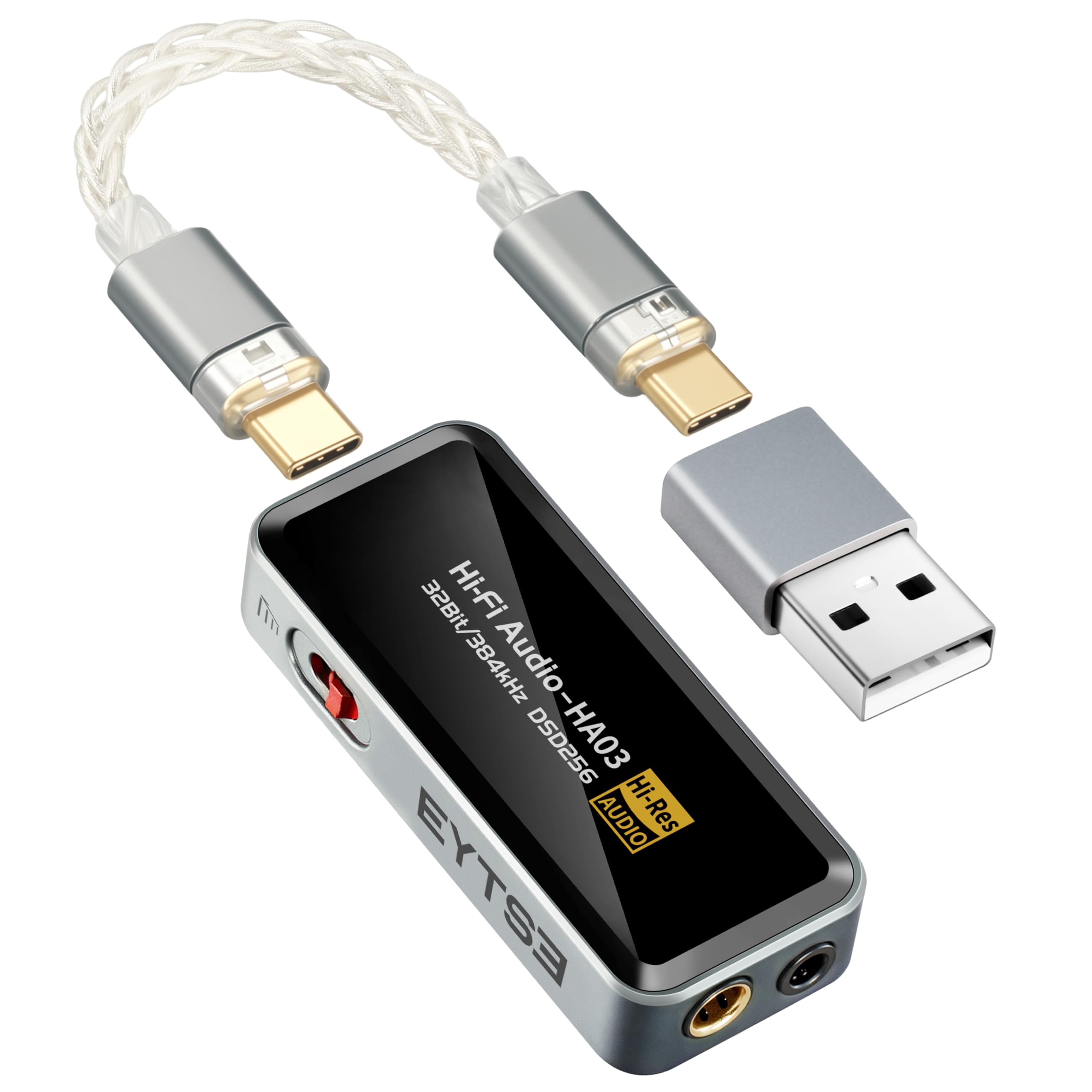
Two flagship decoder chips and a real balanced jack for a fraction of what that usually costs.
Dual CS43131 decoder chips are the headline — the same silicon you find in mid-tier hi-fi gear that costs considerably more. The circuit is tuned for a black background with under 0.0005% THD+N, which is the spec that matters when you listen to sensitive in-ear monitors late at night and do not want to hear hiss between tracks. A physical gain switch lets you drop to low gain for delicate IEMs or jump to high gain for planar magnetic earphones, a smart little design choice that prevents over-driving.
The body is aerospace aluminum with 2.5D glass, and it weighs 18 g, so it dissipates heat well and stays cool over long sessions. The braided USB-C cable is more flexible than the stiff leads most dongles ship with. There are physical play/pause and volume buttons on the unit itself, which means you can change tracks without pulling your phone out of a pocket. On-unit playback buttons mean you can skip tracks without pulling your phone out.
The thing to know before buying is iPhone compatibility. One buyer specifically reports that it would not work with an iPhone 14+ even using the included cable, though it performed beautifully with an iPad. Since that is the exact device class this guide is about, check your iPhone model against the listing before you commit, and plan on an iPad or computer as a fallback if you have one.
What earns the praise: The build. The aluminum-and-glass shell and braided cable feel like a much pricier product, and the physical buttons are a genuine convenience.
The catch worth knowing: Compatibility is the mixed variable — a specific iPhone 14+ owner could not get it working, so the listing deserves a careful read before you order.
Pick this when: You already listen on an iPad Pro or a laptop and want a balanced-jack dongle that feels durable and comes with a physical gain switch.
Think twice if: A Lightning-era iPhone is your only source device — compatibility is the one place this unit is uncertain.
4. Fosi Audio DS2 USB C to AUX Headphone Amp DAC Dongle

The dongle built for the USB-C iPhone — dual chips, balanced output, and real volume buttons.
If you own an iPhone 15 or newer, this is the balance in the whole list. It carries two CS43131 DAC chips (Cirrus Logic converter chips, one per channel), supports DSD256 and PCM 32bit/384kHz (high-resolution file formats), and delivers up to 170 mW at 32Ω per channel — enough to run high- or low-impedance headphones (how much electrical resistance they present) through either the 3.5mm single-ended jack or the 4.4mm balanced port. The stated 1μV noise floor and 130dB SNR (signal-to-noise ratio, the gap between music and background hiss) mean the background is genuinely quiet, so quiet passages stay clean. The 60-step independent volume buttons plus a volume memory function mean you do not have to touch your phone to change level.
Owners say musical instruments and singers come through clearer with more precision, and several compare it favourably to a lot of desktop DACs. On the balanced side things get serious — reviewers using a 300-ohm Sennheiser HD 660S2 report deep bass and detail through the 4.4mm port, while the 3.5mm output sounds distinctly thinner by comparison. It also has enough flexibility to work with a PS5 Pro or a laptop as an external sound card, which makes it far more versatile than a plain phone dongle.
The one honest caveat is battery draw. A gym user running it daily for two hours on an iPhone 16 Pro watched the phone fall from 100% to 84% over that session, which adds up if you are away from a charger all day. The included USB-C cable also feels cheap next to the solid metal body. Neither problem is fatal, but the battery hit is real for heavy listeners.
Reasons to Buy
- Dual CS43131 chips give a clean, analytical presentation
- 4.4mm balanced output genuinely drives 300-ohm headphones
- Independent 60-step volume buttons with volume memory
- Works as an external sound card for Mac and PC
- Solid CNC-machined metal body
Reasons to Pause
- Noticeable phone battery drain during long sessions
- The stock USB-C cable feels inexpensive next to the metal body
- Best performance is on the balanced jack, so a 4.4mm cable adds cost
Best fit for: An iPhone 15, 15 Pro, or Pro Max owner who wants balanced output and physical volume control without carrying a battery amp.
Caveat to accept: It leans on your phone’s battery, so plan your charging around long listening sessions.
5. Surfans X10 Portable Headphone Amplifier
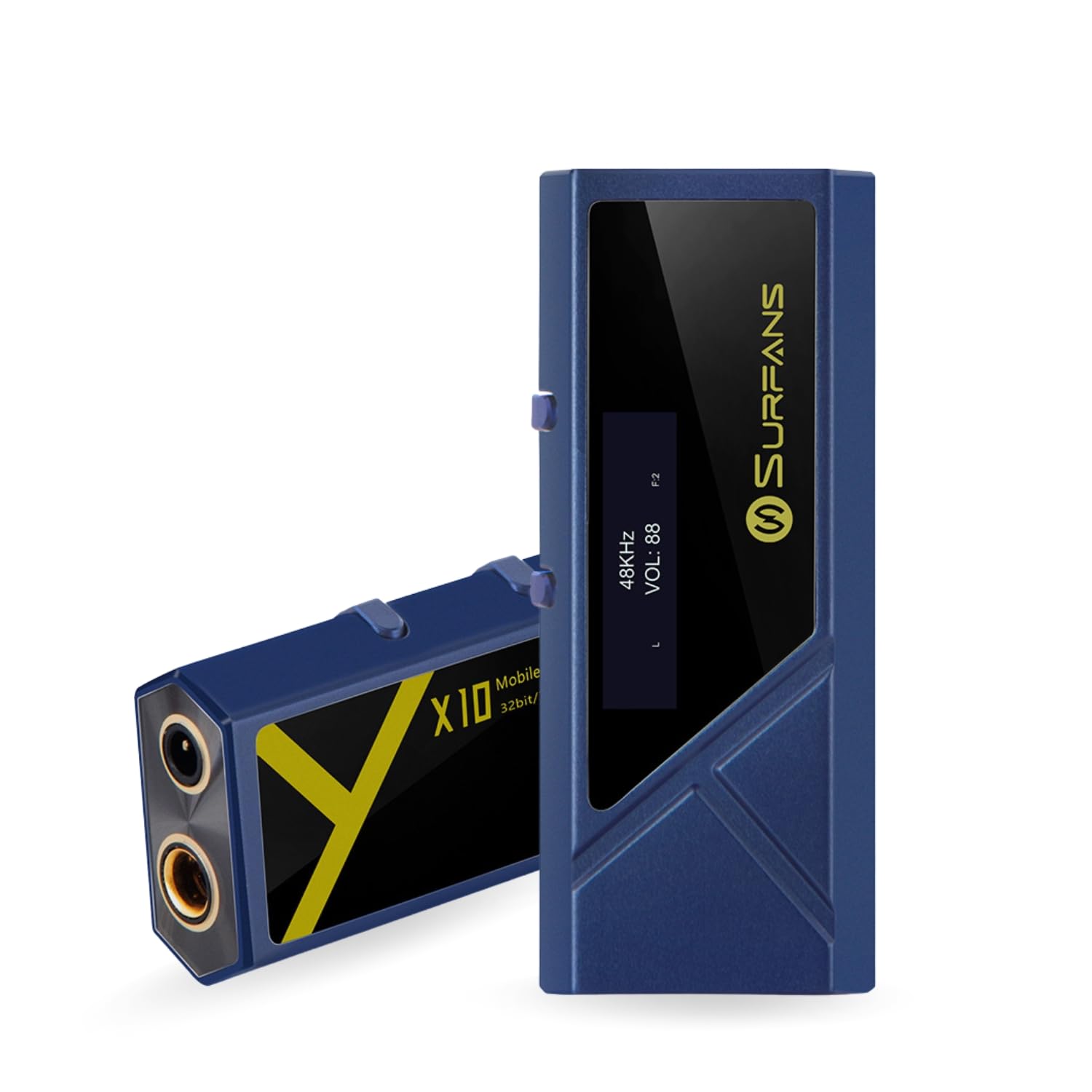
The tiny DAC with a screen, a filter menu, and 522 mW of balanced output.
This is the pick for the listener who wants to see what the chip is doing. The 0.87″ OLED screen shows volume, gain, bitrate, and the active filter, so you always know what quality stream your iPhone is feeding it. Underneath sits an ES9028Q2M DAC paired with an ES9603Q amplifier, stated at under 0.0006% THD+N, with 522 mW available from the 4.4mm balanced output — the highest raw number on this list.
That power shows up in real use. Customers note clean, controlled driving of a Sennheiser HD600 through the balanced jack with excellent channel separation, and smooth handling of a FiiO FT1 at 4.4mm with no distortion. There is also a gain switch, three digital filters (fast and slow roll-off plus minimum phase), and it remembers your settings after unplugging. Bass extension is a highlight — as buyers put it, “The bass extension on this is very nice.” It supports files from 16bit/44.1kHz up to 32bit/384kHz and happens to be plug-and-play on Windows 11 without any driver.
Be ready for a couple of small gripes. The body feels slick to grip, which matters for a device this small. The included audio cable is short and low quality, so budget for a better one. One buyer could not get the advertised power and suspected a defective unit — a real possibility on any launch, and covered by the usual return route. The bigger caveat is sound signature: the soundstage is described as narrow with slightly forward treble, which will not suit everyone.
Standout spec: 522 mW from the balanced output is more drive than almost any phone-sized amp needs, and the OLED readout makes it feel like a piece of audio gear rather than a cable.
Right for you if: You like visible settings, a filter choice, and strong balanced power for IEMs and the occasional over-ear.
Look elsewhere if: You want a rich, wide soundstage — this one is praised for detail and extension more than openness.
6. Questyle M15i Portable USB C DAC Amp

MFi-certified for a reason: it hands an iPhone high-res decoding without drama.
The M15i is built around an ESS ES9281AC DAC and supports PCM up to 768kHz/32-bit plus native DSD512 playback — the most decoding headroom here. It carries Questyle’s patented Current Mode Amplification, the design the brand is known for, and outputs through both a 4.4mm balanced and a 3.5mm single-ended jack. A manual gain control lets you dial the level to suit sensitive IEMs or full-size headphones.
The certification is the real justification for the premium placement. Official MFi certification means the M15i is certified by Apple for stable iPhone and iPad connections, which is the difference between a clean plugin and the “device not supported” error that plagues uncertified dongles. Owners say it brings bass and treble to life, and several describe clean, detailed sound with underlying warmth across all frequencies. One fan of orchestral works says the difference is immediately obvious when switching from a stock dongle.
Two things to weigh carefully. The balanced output is much better than the single-ended, so get a 4.4mm cable if you go this route. And while the sound draws consistent praise, the M15i has drawn criticisms around reliability and price. Buyers have reported intermittent static in the first seconds after plugging in, and one unit needed replacing within the first week. Treat it as a premium product with a real service path — just know that its failure record is not perfect. For Lightning iPhones you will also need the separately sold Questyle LTC02 adapter.
What stands out: Native DSD512 and PCM 768kHz support from a phone-sized body, with proper Apple certification so the connection stays solid.
Worth knowing before you commit: It leans hard on the balanced jack; the 3.5mm side is fine but clearly behind. Prices and reliability expectations sit at the top of this category.
Buy this if: You want MFi-certified compatibility with the newest iPhone, plus the most decoding headroom in the group.
Second thoughts if: You want a single 3.5mm solution, or you would rather not budget for the extra Lightning adapter on older iPhones.
7. iFi Hip-dac 3 Stealth Edition

The same core amp as the Hip-dac2, now with separate data and charging ports.
Here is the upgrade that matters most on long trips: two USB-C ports. One is for audio data, the other for charging, so you can top up the internal battery while your iPhone still feeds music in. The rest of the package stays strong — a true native DAC for bit-perfect playback, 32-bit/384kHz PCM and DSD256 support, full MQA decoding, and both a fully balanced 4.4mm and an S-Balanced 3.5mm headphone output. PowerMatch and iEMatch let you tune gain for hungry headphones or super-sensitive in-ear monitors, and XBass reshapes the low end.
The matte black Stealth Edition also revises the internal power supply components for quieter operation, and the aluminum enclosure feels sturdy in hand. It ships with both a USB-A to USB-C and a USB-C to USB-C cable, plus the OTG setup that makes Lightning iPhones practical. Listeners using an iPod Touch report it as a massive sound-quality leap, and the volume dial is one of the recurring highlights. Owners also appreciate that it dramatically improved an external speaker, not just headphones.
No DAC is perfect, and this one has two quirks. Some owners find that simultaneous charging and playing behaves inconsistently on Android and iOS. Others have hit a Windows-specific volume quirk where the DAC ignores the PC slider and needs per-app volume reduction to tame it. For iPhone use the second one simply does not apply. The trade-off you should expect is carrying a small battery amp rather than a dongle — it is a bag device, not a pocket device.
The Case For It
- Separate USB-C data and charging ports let you play and top up at once
- 32-bit/384kHz PCM, DSD256 and full MQA decoding
- PowerMatch, iEMatch, and XBass give you control over both power and sound
- Revised internal power components for quieter operation
- Ships with both USB-A and USB-C cables
The Case Against
- Charging while playing can be inconsistent on some phones
- Windows users report volume-control quirks with PC sources
- It is a carry-in-a-bag device, not a dongle
Choose it if: You want a single piece of gear that handles headphones, MQA streaming, desktop use, and long trips with the option to charge while playing.
Heads up: If your source is a Windows laptop, expect to fiddle with per-app volume — the DAC tends to output at full level.
Know the Specs
Power Output (mW)
This is how much current the amp can push into your headphones, measured in milliwatts. Low-impedance IEMs need very little, so a dongle rated around 200–245 mW is plenty. High-impedance over-ear headphones need more, and the difference between the 3.5mm and 4.4mm balanced side can be significant — a 522 mW balanced output will control a demanding pair far better than a basic dongle. If you mostly use IEMs, do not pay a premium for power you will not use.
Balanced vs Single-Ended
A 3.5mm single-ended jack is the standard headphone connection everyone knows. A 4.4mm balanced output splits the signal so each channel has its own ground, which often produces cleaner channel separation and more available power. You need a balanced cable to use it, though — the plug on a standard headphone cable is single-ended. If you have no balanced cable, the 4.4mm jack sits unused, and you are effectively paying for a feature you cannot reach.
DAC Chip and Decoding Format
The DAC chip turns your digital music into analog sound. Common names here are the CS43131 (a Cirrus Logic chip used in several picks) and the ES9028Q2M and ES9281AC (both ESS chips). Filenames and streaming tiers use PCM and DSD; PCM 32bit/384kHz is the ceiling on several options, while the ES-based units go further. Higher numbers matter only if your service actually streams at those rates — Tidal MQA needs a decoder, which the Hip-dac series includes natively.
Bus-Powered vs Battery
A bus-powered dongle (one that draws its power straight from the iPhone) stays tiny and light but can drain the phone’s battery faster. A battery-powered amp like the Hip-dac2 has its own 6–8 hour cell, so the phone’s battery takes far less strain. Choose bus-powered to travel light, battery-powered to listen long. If you are already near your phone’s battery limit, a bus-powered dongle will make the day shorter.
Common Questions
Do I need an adapter to connect a USB-C DAC to an older Lightning iPhone?
Will a DAC make my iPhone louder with the headphones I already have?
What is the difference between 3.5mm and 4.4mm balanced on a DAC?
Do these DACs drain my iPhone battery?
Can I charge my phone while a DAC is connected?
Does a DAC work with apps like Tidal and Apple Music?
Is a higher sample rate always better for phone listening?
How long does a portable DAC usually last?
Will these DACs power high-impedance over-ear headphones like a 300-ohm Sennheiser?
Do I need a separate headphone cable for the 4.4mm balanced output?
The Bottom Line
For most people, the dac for iphone winner is the iFi Hip-dac2 because it delivers 400 mW of real power, both headphone jack types, and a battery that keeps your phone alive. If you own an iPhone 15 or later and want a tiny pocket solution, grab the Fosi Audio DS2. And for the most flexible travel option that lets you play and charge at once, the iFi Hip-dac 3 is the one to reach for. The top pick’s 4.0+ star rating across 1,100+ owners is the strongest track record on this list.
How we choose
We do not accept paid placement. Every pick is matched to a real buyer and a real use-case; we do not hands-on test units.
Sources
Specifications: manufacturer listings and product documentation. Review insights: verified customer reviews, as of October 2026. Pricing: not shown on this page (it changes often); check the current price via the retailer link.
As an Amazon Associate, Aappliancez earns from qualifying purchases. This does not affect which products we feature.