Disclosure: Some links in this post are affiliate links. As an Amazon Associate I earn from qualifying purchases, at no extra cost to you. Learn more
Specs are compiled from manufacturer listings and verified buyer reviews and can change over time — please confirm the key details on the product page before buying.
You ride with a prescription for distance, then can’t read your bike computer, your phone, or a route cue without stopping. The fix is a pair of sunglasses that put a small magnifying section low in the lens, so you look up for the road and drop your gaze for the text. This guide covers seven picks sorted by what actually matters on a bike: how strong the reader power is, whether the lens cuts glare, and whether the frame stays put on a rough descent.
This guide is built by comparing the manufacturers’ published specifications and the patterns across verified customer reviews, so you get each pick’s real strengths and trade-offs instead of marketing spin.
A wrap frame that stays put and a magnifier placed low enough to keep your horizon clear matter more than any badge on the temple. Here is what separates a usable pair from one that lives in the glovebox with these cycling sunglasses with readers.
Top Picks

How To Choose The Best Cycling Sunglasses With Readers
The single biggest mistake is buying on reading power alone. A +2.00 magnifier in a frame that slides down your nose is useless at speed, and a frame with perfect grip and a magnifier placed too high forces you to tilt your head down to see the road ahead. You need both to line up.
Match the reader power to the screen, not your book
Reader strength is printed as +1.50, +2.00, or +2.50, and it sets how close the focal point sits. On a bike you mostly read a computer at arm’s length or a phone held out, so a stronger power can feel too close for that distance. If you already wear readers for a book at arm’s length, that same strength is a reasonable starting point.
Where the magnifier sits decides everything
The reader section is a small patch fused low into the lens. If it is placed well, you glance down to read and your distance view through the top stays clear and undistorted. If it sits too high or is too large, you lose road vision and end up tilting your head — the one complaint that shows up again and again across bifocal sunglasses.
Wrap shape, lens material and grip pads
A wrap-shaped frame curves around the side of your face to cut wind and side glare that a flat lens lets in. Lens material matters too: polycarbonate resists impact and scratches, while TAC lenses are lighter and hard-coated. Grip pads on the nose and temples are what keep the frame from creeping down on a bumpy descent — and on a bike, they matter as much as the reader itself.
Side-by-Side Comparison
| Model | Best For | Reader Powers | Lens | Frame | Amazon |
|---|---|---|---|---|---|
| Fishoholic Polarized Bi-Focal★ Best Overall | All-day wear on the bike and the water | 1.5x, 2.0x, 2.5x | Polycarbonate, polarized | Half frame, FlexTuff composite | Amazon |
| KastKing Tugaloo Semi-RimlessBest for Bright Sun | Biking in bright sun and on water | x1.5, x2.0, x2.5 | 1.8 mm polarized PC, oleophobic | Full frame, Grilamid | Amazon |
| proSPORT Polarized Bifocal Reader | Reading a phone GPS on the move | +1.50, +2.00, +2.50 and higher | 1.2 mm polycarbonate, TAC polarized | 180-degree wrap | Amazon |
| KastKing Ellijay Wrap Reader | Mixed riding and outdoor work | 1.5, 2.0, 2.5 | 2.0 mm polarized PC, oleophobic | Full frame, Grilamid | Amazon |
| proSPORT Karma UV400 Bifocal | Cycling, golf and driving in one pair | +1.50, +2.00, +2.50 | TAC polarized, UV400 | Minimal coverage, plastic | Amazon |
| Tifosi Rail XC Rimless Shield | Fast riding with no reader built in | None (shield lens) | Shatterproof polycarbonate | Rimless, Grilamid TR-90 | Amazon |
| SMITH Guide’s Choice Bifocal | Fly fishing and long days outside | Built-in readers | — | — | Amazon |
Detailed Reviews
1. Fishoholic Polarized Bi-Focal Fishing Sunglasses
Our pick — 4.5+★ from 1,000+ verified ratings; the strongest balance of quality and price.
The pair that keeps a low-glare lens in place all day without the magnifier crowding your view of the road.
Start with the build: the lens is 2 ml polycarbonate with a 2.2 ml bifocal fused into it, so the magnifier is part of the lens rather than sitting on top of it. Polycarbonate is the impact-resistant plastic used for safety eyewear, which matters if grit or a stray branch reaches your face at speed. Three reader strengths — 1.5x, 2.0x and 2.5x — mean you can pick the one that matches your screens instead of settling.
What keeps these on during a ride is the shape. The frame is half-frame FlexTuff composite, and the wide sides are cut to knock down glare coming in from the edge rather than from straight ahead. That side glare is the light that leaks past a flat sunglass and washes out a bike computer. The arm length reaches 13.5 centimeters, so it hooks behind the ear instead of resting on top of it, and the whole thing is stated as lightweight for all-day wear.
Owners describe them as snug and stable, and the fit is the part people keep coming back to. There is a real caveat: the bifocal area is small, and it works for glancing down at a computer or a knot but can feel cramped if you want to read a map spread across a handlebar bag. The flip side is that a small magnifier leaves more of your distance view untouched, which is exactly what you want at speed. At 4.5+ stars across 1,000+ owners, it has the largest review base of any pick here.
What riders gain
- Three reader strengths (1.5x, 2.0x, 2.5x) let you match the power to your screens.
- Wide side coverage cuts glare coming in from the edge of your vision.
- Half-frame FlexTuff build is stated lightweight for all-day wear.
- Free hard case and lens cleaning pouch included.
What to weigh
- The bifocal patch is small, so a full map or a wide screen takes some hunting.
- Owners with a larger head find the fit very snug.
Reach for this if: you want a stable, low-glare pair with a reader you can glance into without losing the road ahead.
Think twice if: you have a broad head and dislike a snug frame — size up your expectations rather than the glasses.
2. KastKing Tugaloo Semi-Rimless Bifocal Polarized Sunglasses
A semi-rimless shield built to shrug off salt, sweat and sunscreen without smearing your view.
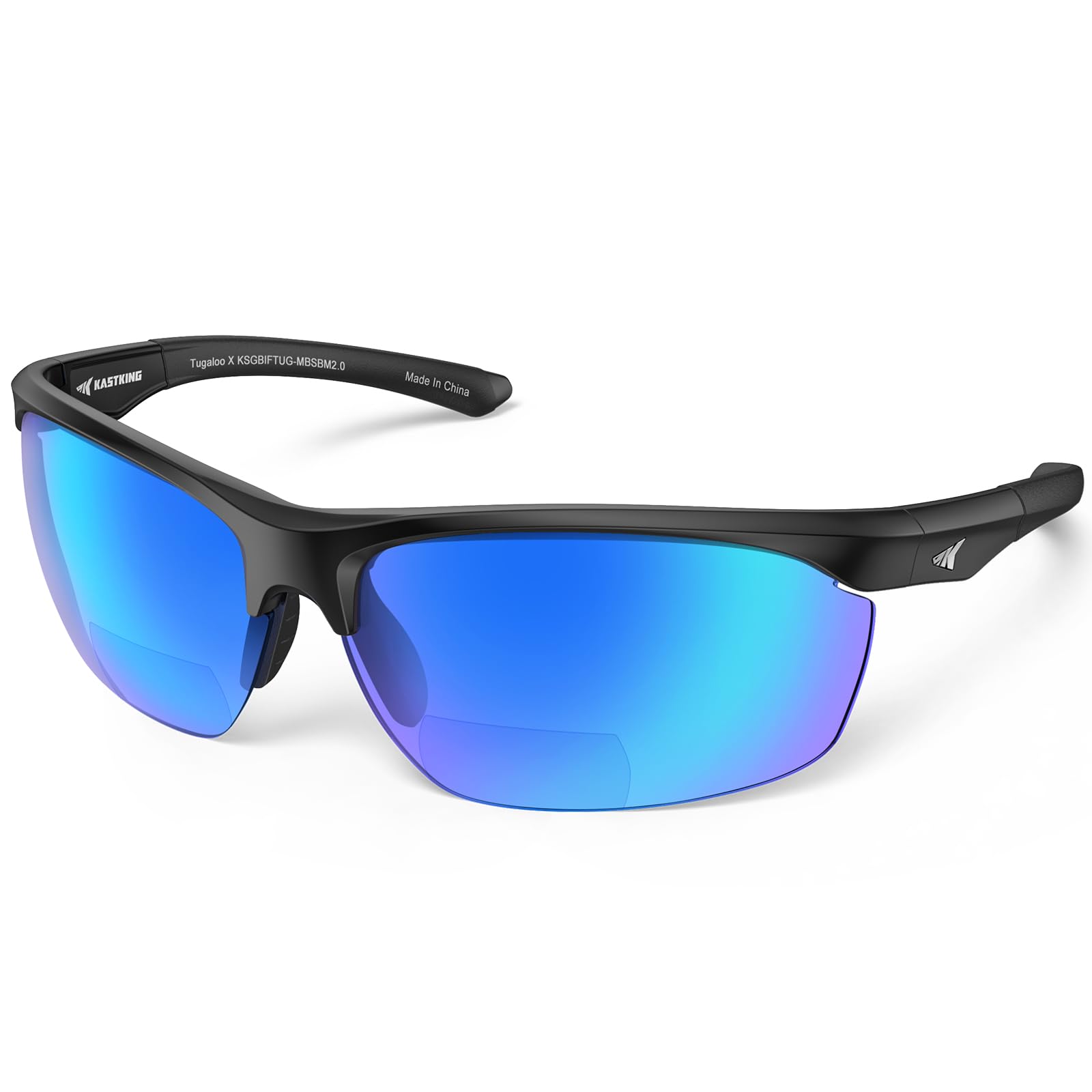
The detail that earns this one its place is the oleophobic coating on the lens. Oleophobic means it repels oil, so fingerprints, sunscreen and sweat bead up and wipe off with a cloth instead of smearing across your line of sight mid-ride. That matters more on a bike than on a boat, because your hands are busy and you only get one quick wipe. The bifocal is flush with the outer lens surface, so there is no ledge to catch in your eye line.
The frame is Grilamid, a nylon-type plastic that stays flexible and resists heat and UV — the same family of material KastKing uses across its sport frames. Non-slip temple pads press against your head, which is the part that keeps the glasses from creeping down when you hit rough tarmac. Reader powers are x1.5, x2.0 and x2.5, and the lenses block 100% of UVA and UVB rays.
One owner reports: “A month in and still going strong.” The one recurring niggle is fogging — the semi-rimless shape fogs a little quicker when you stop at a light than a fully open shield might. On the move it clears, so it is a stop-light inconvenience rather than a riding one. It also runs slightly behind the Ellijay on ratings and sits close to it in price, so if pure fit stability is your priority, read that one next.
The lens technology: An oleophobic, polarized 1.8 mm PC lens with flush magnifiers is the standout — screen and sweat wipe clean, glare off wet road cut down.
Where it asks patience: Expect some fogging when you come to a standstill at a junction.
Suits: the rider who sweats, sunscreens up, and needs a lens that wipes clean in one pass.
Less ideal: if you stop-start constantly in cold, damp weather, expect to clear fog at every light.
3. proSPORT Polarized Bifocal Reading Sunglasses Men Women
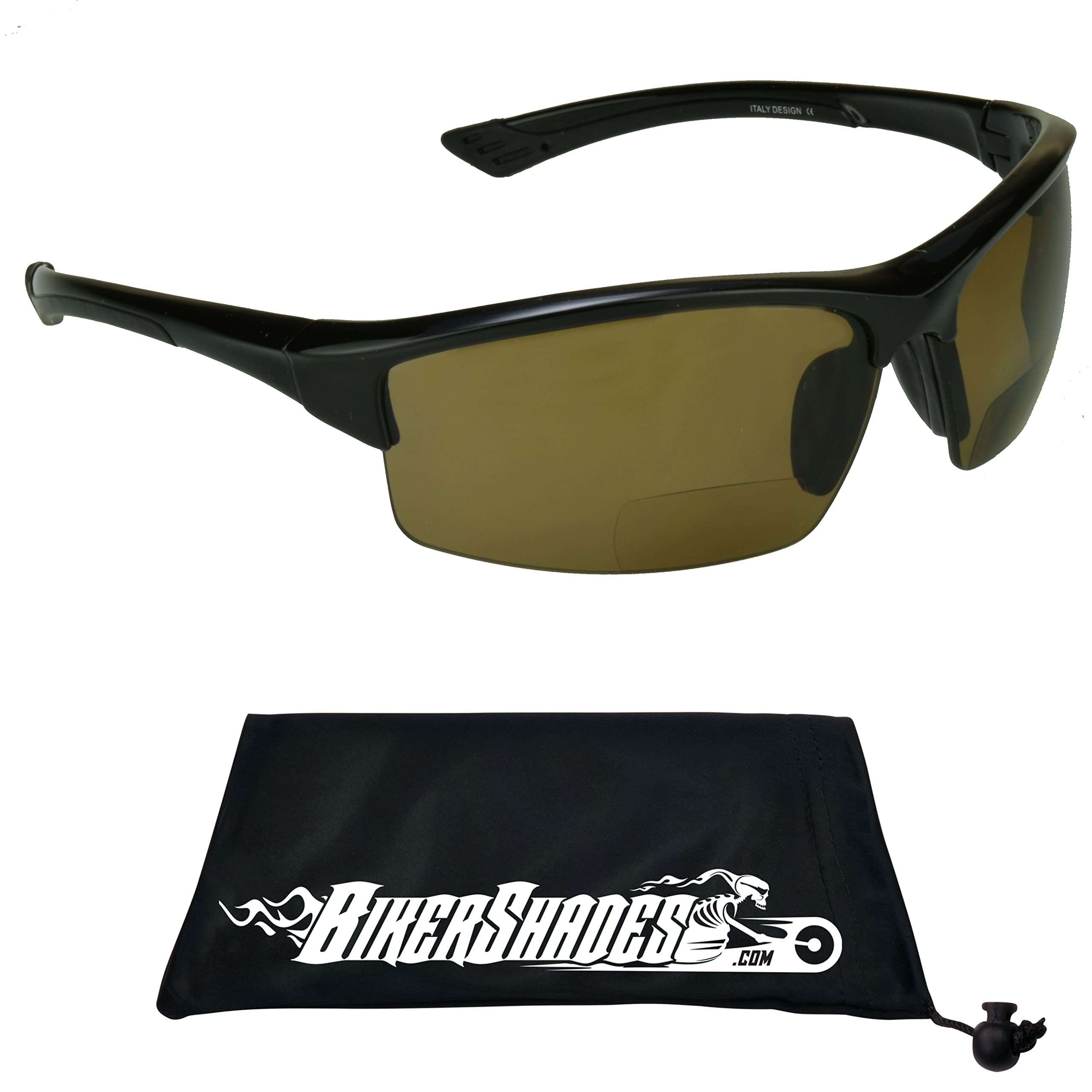
Built around a 180-degree wrap that shuts out light from the edges on a windy, sun-blasted ride.
The 180-degree wrap is the reason to look here. That is a frame that curves all the way around the side of your face, which stops light bouncing off the inside of the lens and into your eye — the sneaky glare a flat sunglass never blocks. Combined with TAC polarized lenses that cut glare off wet road, it makes a screen readable in conditions where a normal pair turns into a mirror. The bifocal line is described as near invisible, smooth across the front of the lens so you do not see a seam.
Grip is handled by GripRite rubber nose pieces and earpieces that are injection molded into the frame rather than slid on, so they will not walk loose. The lenses are 1.2 mm polycarbonate, which is impact resistant and shatter proof by design. Reader powers start at +1.50 and climb through +2.00 and +2.50, with higher powers available. It weighs 2 ounces, light enough to forget on the bridge of your nose.
The honest trade-off is that this is the older, smaller name in the group, with fewer owners behind it than the Fishoholic. It also rates 4.0+ stars, below the top two picks, so it is a fit-specific choice rather than the default. Where it shines is anyone who rides with a phone mounted and needs to read a route without reaching for a second pair. A second pair was ordered by one happy owner as a spare — the kind of loyalty that speaks to a job done right.
Glare, blocked at the edges: The 180-degree wrap and TAC polarized lens work together so side light cannot wash out a phone mounted at arm’s length.
The realistic catch: Bigger reader strengths can demand a slight head tilt when you want the on-bike screen sharp.
Go here if: you ride with a phone on the bars and want the reader power that matches it.
Keep looking if: you want the most track record behind your purchase — other picks here have more owners.
4. KastKing Ellijay Bifocal Polarized Sunglasses, Wrap Reader
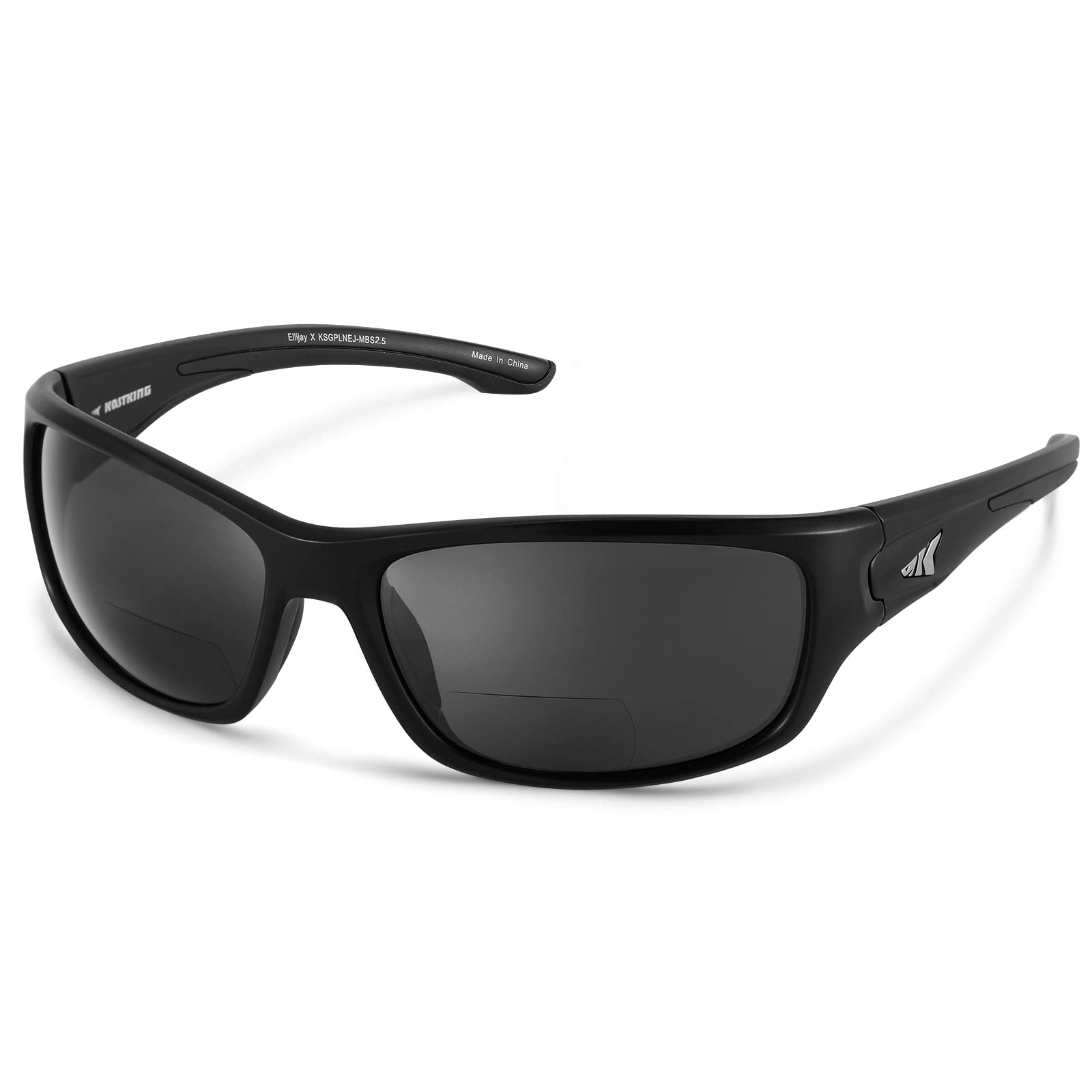
The do-everything wrap reader that scores just as strongly on a bike as it does on a work site.
Two details set this apart from its Tugaloo sibling. First, the lens is 2.0 mm rather than 1.8 mm, and the integrated magnifiers sit flush with the outer surface so there is no bump in your line of sight. Second, the tacky nose and temple pads are what keep a wrap frame planted — those are the contact points that stop the frame from sliding down when you go over a rough patch. Reader powers run 1.5, 2.0 and 2.5, and the lenses block 100% of UVA and UVB.
The Grilamid frame is the same flexible, heat-and-UV-resistant plastic used across the KastKing range, and the rectangular wrap shape keeps wind off your eyes. Owners lean on the clarity point again and again — the magnifier boosts close vision without wrecking the view down the road. It also holds 4.0+ stars across 500+ owners, the strongest review record among the wrap readers here. That is more owner feedback than any other bifocal on this list.
The catch is fit over the nose. The non-adjustable nose piece runs wide for some faces, and a slim face may sit a touch low until you add sticky nose pads. Beyond that, the polarization reads as good rather than top-tier, so if you ride into low sun and need the absolute darkest contrast, a dedicated sport shield may beat it. For everything from a commute to a long weekend ride, though, this is the one that just works. One buyer, post-cataract surgery, reports: “the bifocal works awesome and no one can tell these are bifocals.”
Where it wins on the bike
- 2.0 mm polarized PC lens with flush magnifiers — no bump in the eye line.
- Tacky nose and temple pads hold a wrap frame steady over rough ground.
- Oleophobic coating sheds sweat, oil and sunscreen.
- Hard case plus cleaning pouch included.
Where it gives ground
- Non-adjustable nose piece runs wide for slim faces.
- Polarization is solid but not the darkest in this lineup.
Best for: the rider who wants one wrap reader for the bike, the trail and the job site.
Skip if: your face is narrow and you need a nose piece you can actually adjust.
5. proSPORT Karma UV400 Bifocal Polarized Sunglasses
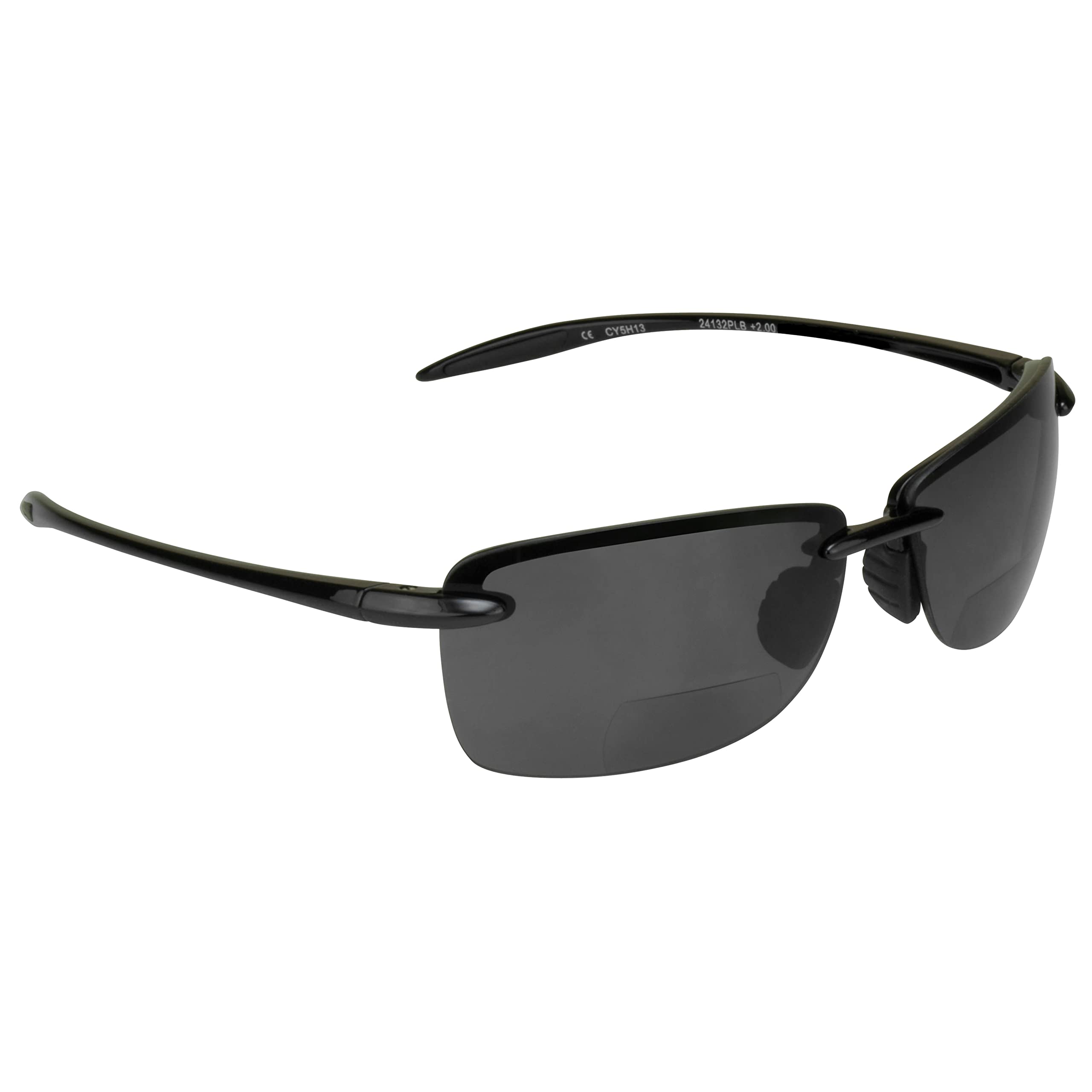
A hard-coated TAC lens that handles cycling, golf and driving without swapping pairs between them.
TAC stands for Tri Acetate Cellulose, a lens material chosen for clarity and low weight, and these are cut from it with a hard coat on top to resist scratches. The UV400 rating means the lens blocks UV light up to 400 nanometers — the full UVA and UVB band — which is the number to look for on any outdoor pair. Reader powers run +1.50, +2.00 and +2.50, so the magnification is adjustable to your eyes.
The frame coverage is listed as minimal, which is the honest weak spot for pure cycling. Minimal coverage means less wrap around the side of your eye, so at speed you feel more wind and side light than you would behind a full shield. Where this one stands taller is as an all-rounder: the maker promotes it for fishing, driving, golf, tennis, pickleball and cycling in the same breath, and that breadth suits a rider who also walks nine holes at the weekend.
Owners praise the clarity, and the point that lands is the price-to-performance ratio — it earns a better reputation for quality than for sheer value, with some finding it a touch dear for what it is. Its 4.5+ stars come from a smaller owner pool than the Ellijay’s, so treat that score as promising rather than proven at scale. One rider got three pairs deep and kept coming back, which is a decent sign. If you want one hard-wearing pair for the bike and the golf bag, this fits that job well.
The spec that sells it: A TAC polarized lens rated UV400, hard coated for scratch resistance — full UVA and UVB block in a light lens.
The thing to accept: Minimal frame coverage leaves more wind and side glare than a full wrap shield.
Pick this if: you want one polarized reader that covers cycling, golf and driving in the same weekend.
Look elsewhere if: you ride fast in open wind and need the side coverage of a full shield.
6. Tifosi Rail XC Rimless Shield Glasses

A 31-gram rimless shield for riders who want maximum airflow and no reader in the way.
Let us be straight: this pair has no built-in reader. It earns its place here for the rider who already wears contacts or has distance correction and wants a proper performance shield. At 31 grams it is the lightest thing on this list by a wide margin, and the rimless design opens up airflow so the lens does not fog on a climb. The lens-cut is 6.9 mm shallower than its predecessor, shaped for smaller face profiles, with 52.6 mm by 131 mm of coverage shielding you from sun, wind and road grit.
The frame is Grilamid TR-90, a tough nylon that resists chemical and UV damage while staying light. The ear pads and nose pads are hydrophilic — that means they grip harder the more you sweat — so the shield stays put as you heat up. The lens itself is shatterproof polycarbonate with a scratch-resistant coating, and it takes interchangeable lenses if you want to swap tint for conditions.
Owners rate the lens quality above everything. The honest caution is the photochromic version: it lightens and darkens, but it does not darken inside a car, and some find the shift from clear to dark less dramatic than a fixed tint. If you ride in consistent bright sun, choose a fixed tint over the photochromic. Used on a first century ride with changeable shade, they hold up — One buyer sums up the value: “Amazing value! My favorite running shades by a mile.”
Why fast riders like it: 31 grams, a rimless shield and hydrophilic pads that grip the wetter you get — a genuine performance frame.
The honest limit: No reader built in, and the photochromic lens changes tint slowly and not at all behind a windscreen.
Right for: the rider with distance vision sorted who wants a featherweight shield and extra airflow.
Not for: anyone who needs the reader in the lens — that is a different pick on this page.
7. SMITH Guide’s Choice Bifocal Fishing Sunglasses
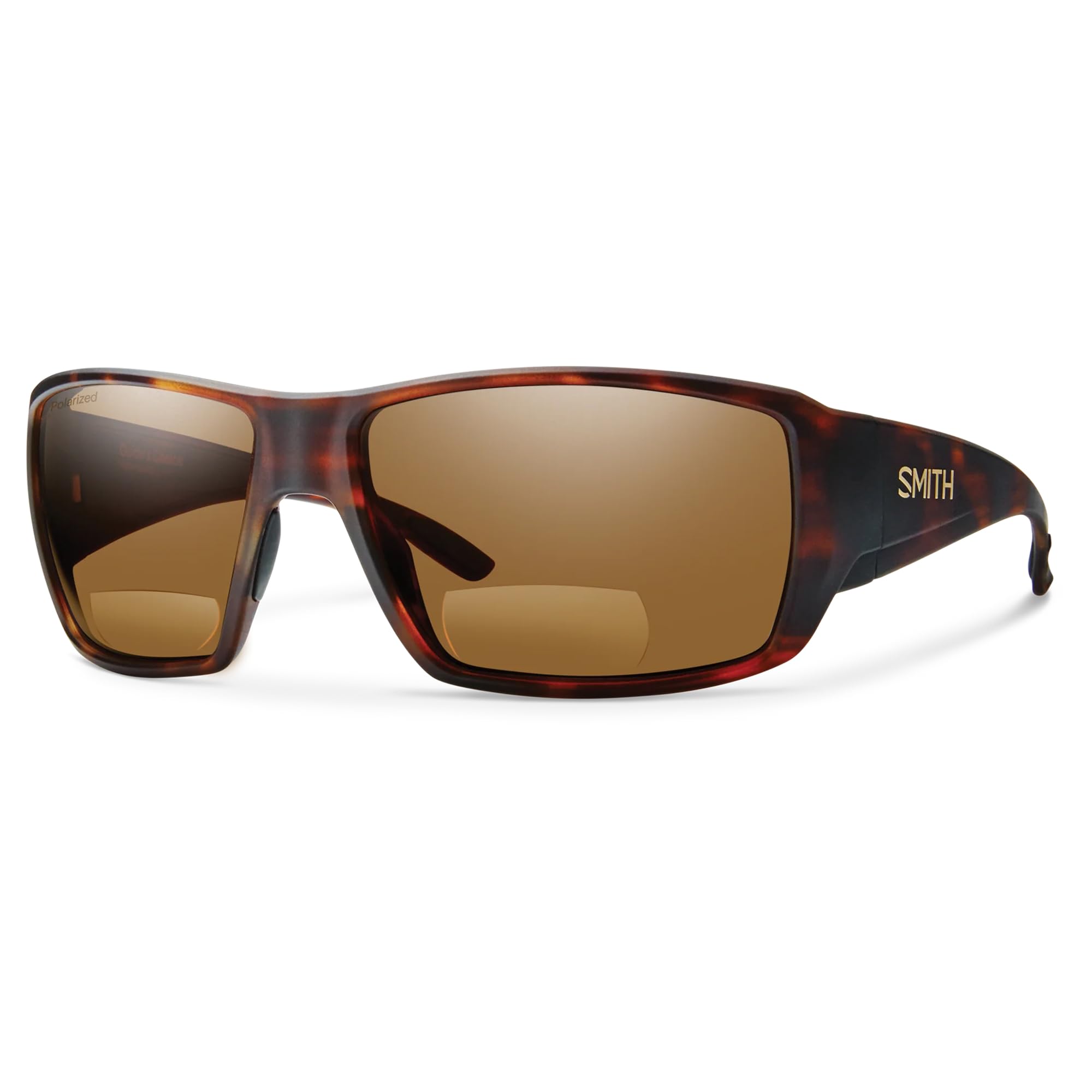
The premium pick, with a snug fit and a neck lanyard that holsters the glasses without bulk.
This is the top of the ladder here, and the case for it is simple: a snug, comfortable fit and built-in readers that work for close work like tying a knot or reading a screen. The pair ships with a neck lanyard that holsters the glasses on your neck without a bulky feel, which is the feature that keeps them on you when you are off the bike at a rest stop. Lenses and amplification both get praised by owners, and the fit is described as snug and comfortable.
Two things a buyer should know before committing. First, the sizing runs small — the frame is too tight for a broad head, and the maker does not hide that. If you have a larger face, check the dimensions before you buy. Second, the bifocal patch is generous, which is great for close work but a couple of owners found it large enough that they had to tilt their head down to see distance, and one returned a pair for that reason. It is a fit-and-placement question, not a defect.
Value holds up against premium prescription options: owners call it a very good alternative to brand-name glasses that cost many times more. The plastic lenses will scratch if you are careless, so use the pouch. Between this and the Fishoholic, the Fishoholic wins on sheer number of owners and a higher rating, while this premium pair wins on the lanyard, build pedigree and fit for smaller faces. If you ride, fish and want one serious pair, this is the investment.
Why it earns the premium tag
- Built-in readers praised for close work on the move.
- Snug, comfortable fit for smaller faces.
- Neck lanyard holsters the glasses without bulk.
- Hold up well against far pricier brand-name alternatives.
Where the fit matters
- Runs small — too tight on a broad head.
- Generous bifocal patch can require a head tilt for distance vision.
- Plastic lenses need careful handling to avoid scratches.
This is the one if: you have a smaller face, want a lanyard and treat your glasses as long-term kit.
Give it a pass if: you have a wide head or need a small, unobtrusive bifocal patch.
Know the Specs
Reader power (+1.50, +2.00, +2.50)
The number after the plus is the magnification, and it sets how close the sharp focus point sits. A +1.50 is the mildest and suits reading a screen held out at arm’s length; a +2.50 pulls the focus closer, which can feel too tight for a bike computer. Pick the strength that matches what you read most on the bike — usually a computer or a phone, not a book.
Polarized versus tinted
A polarized lens has a filter that cancels glare bouncing off flat, shiny surfaces — wet road, car glass, water. A plain tinted lens only darkens the whole scene. For cycling, polarization is what makes a screen readable in bright light and what cuts the wash off a wet descent. Look for the word polarized on the lens or in the description.
Polycarbonate versus TAC
Polycarbonate is the impact-resistant plastic used in safety eyewear — it resists shattering and scratches. TAC (Tri Acetate Cellulose) is lighter and chosen for optical clarity, often hard-coated for scratch resistance. Neither is wrong; polycarbonate leans toward protection, TAC toward clarity and low weight.
Wrap and coverage
A wrap frame curves around the side of your face to shut out wind and side glare. Coverage is listed as full, half, minimal or rimless depending on the model. More coverage means less wind in your eye at speed; less coverage means more airflow and a lighter feel. Match it to how fast and how long you ride.
Common Questions
Can I wear cycling sunglasses with readers over my contacts?
What reader power should I pick for a bike computer?
Are these strong enough for driving as well as cycling?
Will a wrap frame fit under a helmet strap?
How do I keep the bifocal area clean on a ride?
Is polycarbonate better than TAC for cycling?
Do these lenses block UVA and UVB rays?
What is the difference between a semi-rimless and a full shield?
Can I replace the lenses in a sport shield like the Tifosi?
The Bottom Line
The winner for most riders is the Fishoholic Polarized Bi-Focal, because it balances a stable half-frame fit with a low-glare lens and three reader strengths you can match to your eyes. If you want a wrap reader that wipes clean of sweat and sunscreen, grab the KastKing Ellijay. And for a performance shield with no reader and maximum airflow, the Tifosi Rail XC is the one to reach for. One honest nudge: the Fishoholic carries the strongest owner track record in this group, which is worth weighing when you are deciding between the top two.
How we choose
We do not accept paid placement. Every pick is matched to a real buyer and a real use-case; we do not hands-on test units.
Sources
Specifications: manufacturer listings and product documentation. Review insights: verified customer reviews, as of October 2026. Pricing: not shown on this page (it changes often); check the current price via the retailer link.
As an Amazon Associate, Aappliancez earns from qualifying purchases. This does not affect which products we feature.